 by Tom Gurney
Tom Gurney BSc (Hons) is an art history expert with over 20 years experience
Published on June 19, 2020 / Updated on November 29, 2026
Email: tomgurney1@gmail.com / Phone: +44 7429 011000
Profile Portrait (Possibly a Self-Portrait): Introduction
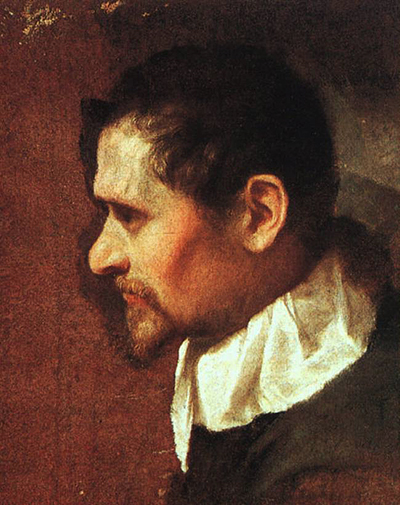
A man in a white ruff turns to the left, his gaze travelling beyond the edge of the canvas. Light catches his forehead, cheek and ear, while the line of his nose and beard stands out against a russet ground. This oil painting in the Uffizi, usually dated about 1590–91, has long been known as Annibale Carracci’s Self-Portrait in Profile. Italy’s national catalogue credits Carracci as the painter and leaves the sitter’s identity open. The canvas is Uffizi inventory 1890, no. 1797. [1] [2] [3]
At a Glance
- ArtistAnnibale Carracci
- DateAbout 1590–91
- MediumOil on canvas
Contents
- A face turned away
- Two paintings and one name
- The studio and the alternatives to the profile
- A portrait carried into print
- Annotated details
A face turned away
The collar is the first bright shape to register from across a room. Its creases make a series of short, angular passages between the warm flesh and the dark costume. Follow the light upward and the face resolves into softer transitions. The cheek reddens near the ear, a narrow shadow sits under the brow and the hair dissolves towards the right into the ground. Along the other side of the head, the forehead, nose, lips and small pointed beard read as a single contour. The turn gives the sitter a distinctive silhouette while the paint within it makes the skin and cloth feel different to the eye. [2]
A ruff can be a conspicuous part of a portrait. Here the cloth scarcely competes with the man’s face. Its broken folds lead back to the jaw, and the shoulder at the bottom right stays close in tone to the background. The pose gives full weight to the visible eye, yet keeps the focus of the man’s attention outside the picture. In Parma’s painted self-portrait, by comparison, the artist’s eyes engage the viewer from beneath the brim of a hat. The profile gives a clearer line of the bridge of the nose, while the Parma picture makes the width of the face and the directness of the gaze easier to judge. [2] [4]
Annotated Details from Profile Portrait (Possibly a Self-Portrait)
The numbered points identify visible features discussed in this article. Return from each detail to the numbered overview. Annibale Carracci, profile portrait traditionally identified as a self-portrait. Gallerie degli Uffizi, Florence, inv. 1890 no. 1797. Image source. Public domain.
.jpg)
Details from PROFILE PORTRAIT (POSSIBLY A SELF-PORTRAIT)
Compare the cropped details with the source images above. Notice how their colours, shapes and positions contribute to the larger compositions.
Forehead, nose and beard
The turned head has a continuous silhouette against the reddish ground. The eyebrow and bridge of the nose sharpen that boundary, while the lower edge of the beard fades into shadow.
 Detail 01 forehead-nose-and-beard.jpg)
The pale collar
Off-white folds catch the light below the head. The neckline descends diagonally into the dark garment, concentrating the light along the face and collar.
 Detail 02 the-pale-collar.jpg)
Two paintings and one name
Cardinal Leopoldo de’ Medici began the collection of artists’ self-portraits that became part of the Uffizi. He wanted likenesses that the artists had made with their own hands. To find them he relied on agents with contacts in Bologna and Rome. In 1670 Annibale Ranuzzi reported that he could find no portraits of the Carracci, whether by the family or by other painters. A portrait thought at first to represent Annibale had already turned out to be a possible self-portrait by his brother Agostino. An agent could come back with a Carracci portrait and still have to establish which member of the family painted it and which one it showed. [2] [5]
Gail Feigenbaum links the profile tentatively to entry 260 in Leopoldo’s 1675 inventory. She also connects it with a letter of that year in which Filippo Baldinucci supported Annibale’s authorship. The Italian catalogue records that by 1686 the profile was in the gallery joined to another supposed self-portrait of Annibale. By 1784 it was recorded on its own again. The formerly paired painting is Uffizi no. 1803, a larger canvas mounted on panel, which Donald Posner called the Romantic Self-Portrait. The national catalogue now places that work in the Venetian school and leaves the man unnamed. Baldinucci’s suggestion of a connection with Antonio Vassilacchi, known as l’Aliense, belongs to that larger portrait. [1] [2] [6]
Posner accepted the profile as both by and of Annibale. The national catalogue records that Evelina Borea accepted his hand while doubting the identification as a self-portrait. Feigenbaum describes Borea’s reservations as extending to both attribution and sitter. Feigenbaum herself finds it difficult to reconcile the profile with the man in the easel portrait even if Annibale painted both. The different positions leave room for a portrait by Annibale of someone else. They also explain why identifying the canvas by inventory number is easier than deciding whose face it preserves. [1] [2]
The studio and the alternatives to the profile
The small Self-Portrait with a Hat in the Galleria Nazionale di Parma bears the date 17 April 1593. The sitter’s broad face, rounded jaw and wide nose give Feigenbaum and the Royal Collection Trust a basis for comparing his features with those in other works. The Parma painting has a much firmer claim to represent Annibale. The Royal Collection also finds a resemblance in its attributed chalk drawing of a young man, whose tilted head and directly searching eyes give another view of those features. A caption that describes the Uffizi profile as an image of the young Annibale would place more weight on apparent age than either the likenesses or the early records can carry. [2] [4] [7]
The State Hermitage Museum’s Self-Portrait on an Easel, an oil on wood dated 1603–04, offers a different view of the artist and his trade. A palette hangs from the right of an easel and the small painted likeness stands on its ledge. A bright patch at upper left reads at first like a window. The dim interior around it makes the edge of the little portrait and the painted tools especially important. Ulrich Pfisterer reads the obscure figure at the opening as possibly the painter who has stepped away from his easel. In this view the artist himself may recede into the studio while the face he painted remains easy to see. [2] [8] [9]
The Hermitage’s catalogue records that the panel came from the Crozat collection in 1772. The panel preserves traces of a larger underlying face that had been painted over. In the Windsor preparatory sheet, Carracci sketched both a single portrait and a view into a studio. In the finished painting the face is one object among others in a room. The nearly concealed head shows that the artist had begun at a scale that would have made the sitter dominate the whole panel. The Uffizi’s separate easel picture, no. 1774, repeats the finished composition and lacks the underlying face visible in the Hermitage version. Posner regarded the Uffizi picture as a copy. Borea defended its attribution to Annibale, and Daniele Benati supported her case. The visible revisions make the Hermitage panel the stronger record of the invention. [2] [8] [10] [11]
Another way of staging a painter’s likeness appears in Brera’s Self-Portrait with Other Figures. The man in front holds a palette and brush while three other heads crowd into the background. Brera reads the gathering as a glimpse in a mirror and offers tentative identifications for members of the Carracci family. Feigenbaum questions the resemblance to the Hermitage sitter, and the attribution to Annibale has itself been questioned. The Brera picture shows how readily a turned head, a working gesture and the figures around the painter can make a proposed identification feel persuasive before the evidence for each face has been settled. [2] [12]
A portrait carried into print
Albertus Clouwet’s 1672 engraving for Giovanni Pietro Bellori’s Lives puts a near-frontal likeness of Annibale inside an oval, with foliage, a palette, brushes and a name underneath. The image could travel far beyond the room in which Bellori kept his own painted likeness of the artist. Donatella Livia Sparti found the same portrait type in copies in Rouen and at Badminton, and in the small oval in the Uffizi that Leopoldo acquired in 1673. Sparti traced the print to Bellori’s lost painting, which a visitor described as painted on a palette. The French collection record identifies the Rouen version as an attributed self-portrait, and its copper support belongs to that version. The network of objects helps recover the likely appearance of Bellori’s painting. It leaves room for disagreement over which painted versions Annibale himself made. Sparti also traces the image into Carlo Cesare Malvasia’s 1678 biography and Joachim von Sandrart’s 1675 academy book. In Sandrart’s plate, Carracci’s face appears in a group of five named artists, where the likeness helps place him in a history of Italian painting. [2] [13] [14] [15] [16]
Carracci’s small pen-and-brown-ink Self-Portrait at the Getty also sets him within an oval, but the shoulders pitch forward and his hair and heavy lids are picked out in quick strokes. His hands and a narrow drawing implement run across the bottom of the oval. Above his head, little skeletal forms and curls take the place of Clouwet’s ordered wreath. Feigenbaum reads the border as a parody of formal portrait engravings and interprets the image as a mock funerary effigy. The Getty’s online account dates the sheet to the early 1580s, while its published drawings catalogue favours the middle of that decade. Feigenbaum argues for about 1600–05, pointing to the confident hatching and its kinship with drawings from the Farnese years. The dated Parma portrait and the disputed Getty sheet show how differently a date written on a painting and a date inferred from handling can inform the comparison. [4] [17] [18] [19]
Clouwet’s print gives the painter’s name, the instruments of his profession and a face that later makers could repeat. The Uffizi profile gives a man’s face, a collar and a turn of the head. Knowing how the two images came to carry the same name makes the little canvas worth looking at again. The contour of the man’s nose is one of the most definite things in the painting. The question of whose nose it is remains open. [1] [2] [13] [14]
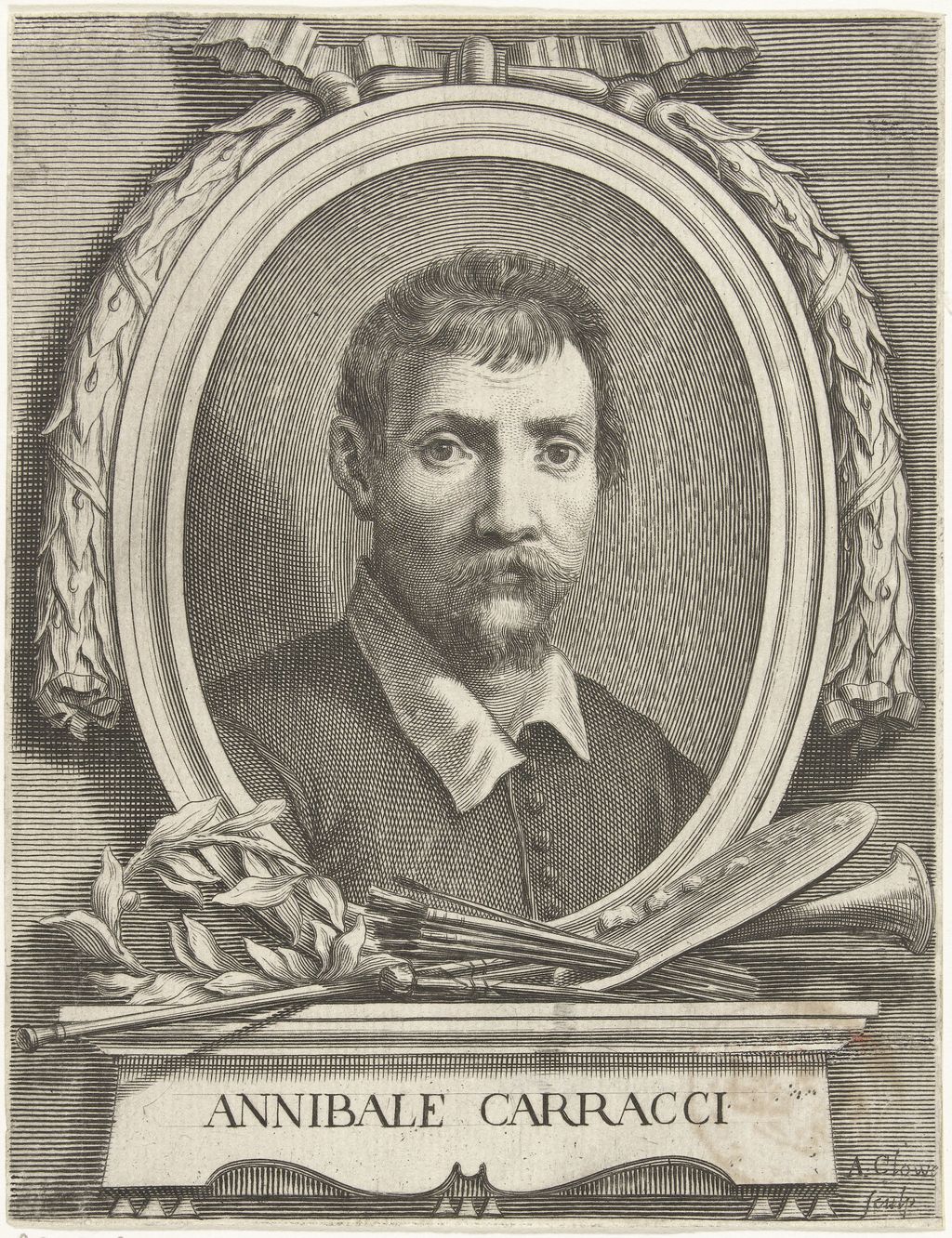
Albertus Clouwet, Portrait of Annibale Carracci, 1672. Engraved illustration for Giovanni Pietro Bellori’s Lives. Rijksmuseum, RP-P-BI-5906. Image source. Public domain.
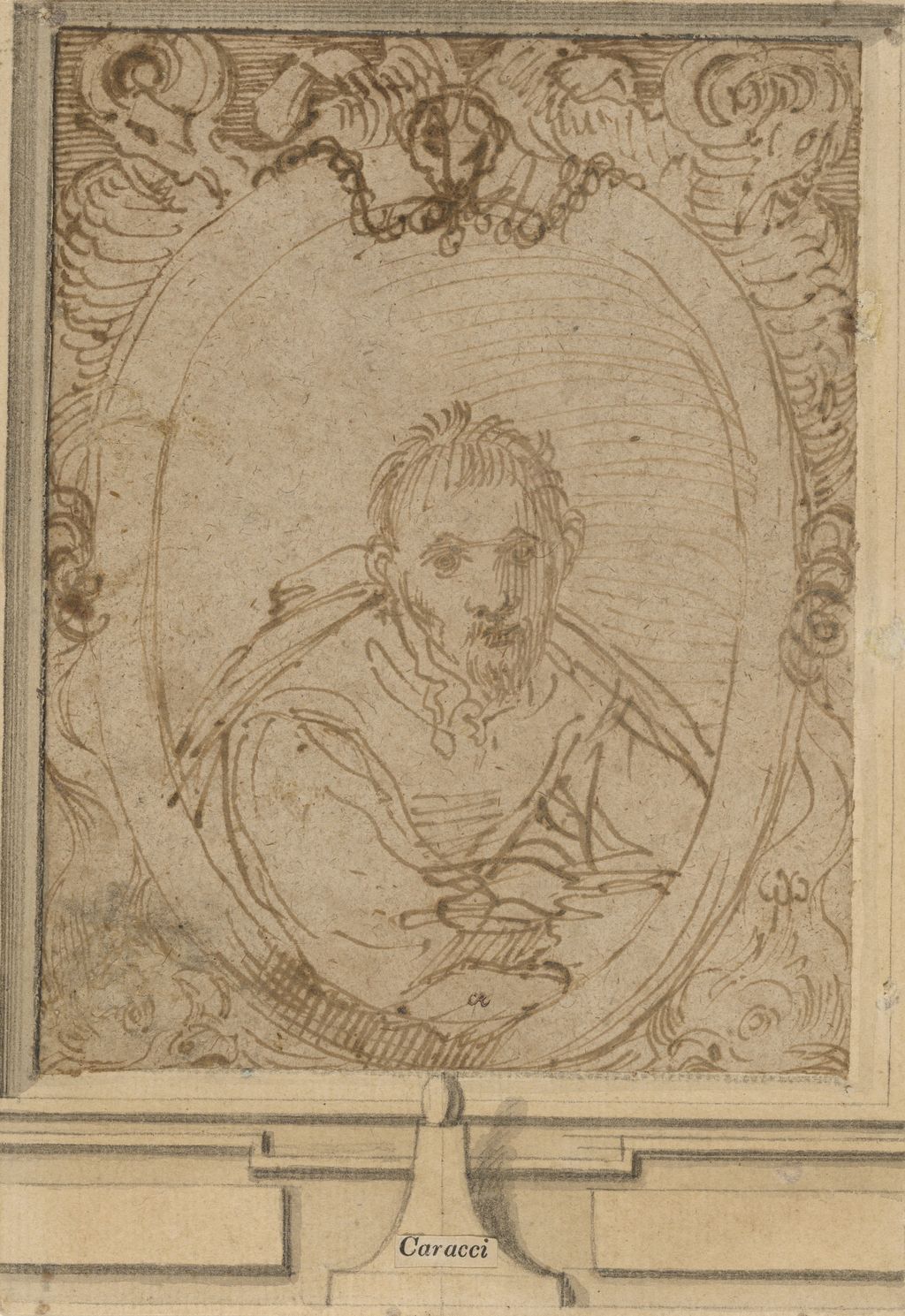
Annibale Carracci, Self-Portrait, pen and brown ink. The J. Paul Getty Museum, 96.GA.323. Image source. CC0 / Public domain.
Artworks directory
Paintings, frescoes, drawings and prints, with separate entries for documented versions and collaborative projects.
Discussion
Look again at the images and ideas explored in Profile Portrait (Possibly a Self-Portrait). These editorial prompts invite your observations.
Reader Insights
What does the profile format let you see that a frontal portrait might conceal?
Which visual or documentary evidence would help identify the person represented?
Join the Conversation
Share a detail, comparison or question about Profile Portrait (Possibly a Self-Portrait) below.
References
- Catalogo generale dei Beni Culturali, possible self-portrait in profile, Uffizi inv. 1797 View source.
- Gail Feigenbaum, An Evanescent Corpus of Self-Portraits by Annibale Carracci in the Uffizi, Imagines 4, pp. 76–97, especially fig. 5 and pp. 84–85 View source.
- Fondazione Federico Zeri, Autoritratto di Annibale Carracci, Uffizi inv. 1797 View source.
- Catalogo generale dei Beni Culturali, Autoritratto, 1593, Galleria Nazionale di Parma View source.
- Gallerie degli Uffizi, Il cardinal Leopoldo de’ Medici and the origins of the collection View source.
- Catalogo generale dei Beni Culturali, Ritratto d’uomo, Uffizi inv. 1803 View source.
- Royal Collection Trust, A Presumed Self-Portrait, RCIN 902254 View source.
- State Hermitage Museum, Автопортрет на мольберте, ГЭ-148 View source.
- Ulrich Pfisterer, Annibale Carracci. Selbstbildnis auf der Staffelei, um 1604, pp. 70–71 View source.
- Catalogo generale dei Beni Culturali, easel portrait, Uffizi inv. 1774 View source.
- State Hermitage Museum, Italian paintings catalogue, entry 87, Автопортрет на мольберте View source.
- Pinacoteca di Brera, Self-Portrait with Other Figures View source.
- Rijksmuseum, Albertus Clouwet, Portret van Annibale Carracci, RP-P-BI-5906 View source.
- Donatella Livia Sparti, Giovan Pietro Bellori and Annibale Carracci’s Self-Portraits, Mitteilungen des Kunsthistorischen Institutes in Florenz 45, pp. 60–101 View source.
- Institut national d’histoire de l’art, Autoportrait attributed to Annibale Carracci, Musée des Beaux-Arts de Rouen View source.
- Joachim von Sandrart, Teutsche Academie, 1675, book II.2, volume index for plate S View source.
- J. Paul Getty Museum, Self-Portrait, 96.GA.323, museum record reproduced by Google Arts & Culture View source.
- J. Paul Getty Museum, European Drawings 4, catalogue entry for 96.GA.323 View source.
- Gail Feigenbaum, A Likeness in the Tomb, Getty Research Journal 2, pp. 19–38 View source.