 by Tom Gurney
Tom Gurney BSc (Hons) is an art history expert with over 20 years experience
Published on June 19, 2020 / Updated on November 29, 2026
Email: tomgurney1@gmail.com / Phone: +44 7429 011000
Venus with a Satyr and Cupids: Introduction
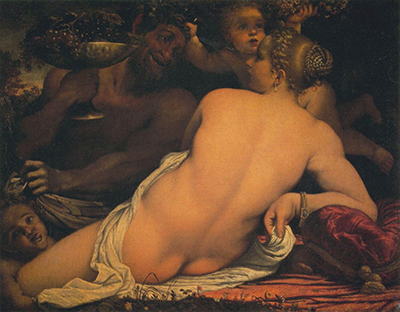
Annibale Carracci's Venus with a Satyr and Cupids turns a reclining figure into the centre of a struggle over a sheet. Venus props herself on a red cushion and looks over her shoulder. At the left, a satyr holds a bowl of grapes aloft while gathering the cloth in his other hand. One child takes hold of his horn, and another looks out from beneath the fabric. Annibale painted the scene in oil on canvas around 1587–1590. The painting measures 112 by 142 centimetres and belongs to the Uffizi in Florence, where its inventory number is 1890, no. 1452. [1] [2]
At a Glance
- ArtistAnnibale Carracci
- DateAbout 1587–90
- MediumOil on canvas
Contents
- Venus turns her back
- What the title can tell us
- From Correggio and Titian to Carracci's own print
- The Medici purchase and the painted cover
- What the restorer saw from the wall
- How copies travelled
- Annotated details
Venus turns her back
The light falls on the largest uninterrupted surface in the painting, the curve of Venus's back. Her shoulders rise toward the right of the canvas while her hip and thigh run down toward the lower left. That diagonal carries the eye to the lower child's face, its open mouth and protruding tongue almost level with the mattress. The folds of the white cloth continue the diagonal in broken, angular strokes. They catch the light in short ridges where the satyr bunches the sheet at the left and again where Venus pinches a corner near her wrist. Between the two hands, there is enough slack for the fabric to twist. The cloth makes it possible to follow what each figure is doing without seeing Venus's expression clearly. [1] [2]
The satyr's bowl is held so high that the grapes almost touch the top edge. Its rim and stem pick up the light against his face and chest, and the leaves, bunches of fruit and glimpse of sky take up a surprisingly small share of the composition. Most of our attention stays in the close space around the bed. The other child, much higher than the one at Venus's feet, meets the satyr's horn with one hand and raises a cluster of flowers with the other. The child’s arm cuts across the space between the satyr and Venus, crowding their faces together. Below, her bracelet and the fringe of the cushion show how closely Annibale has placed different textures together. The bracelet gleams in a narrow line, the cushion catches the light in broad folds, and the back is modelled in gradual shifts from warm light into shadow. [1] [2]
Annotated Details from Venus with a Satyr and Cupids
The numbered points identify visible features discussed in this article. Return from each detail to the numbered overview. Annibale Carracci, Venus with a Satyr and Cupids. Gallerie degli Uffizi, Florence. Photograph by Yair Haklai. Image source. CC BY-SA 4.0. Numbers added to a separate overview. Details cropped from the original photograph. Image derivatives use CC BY-SA 4.0.
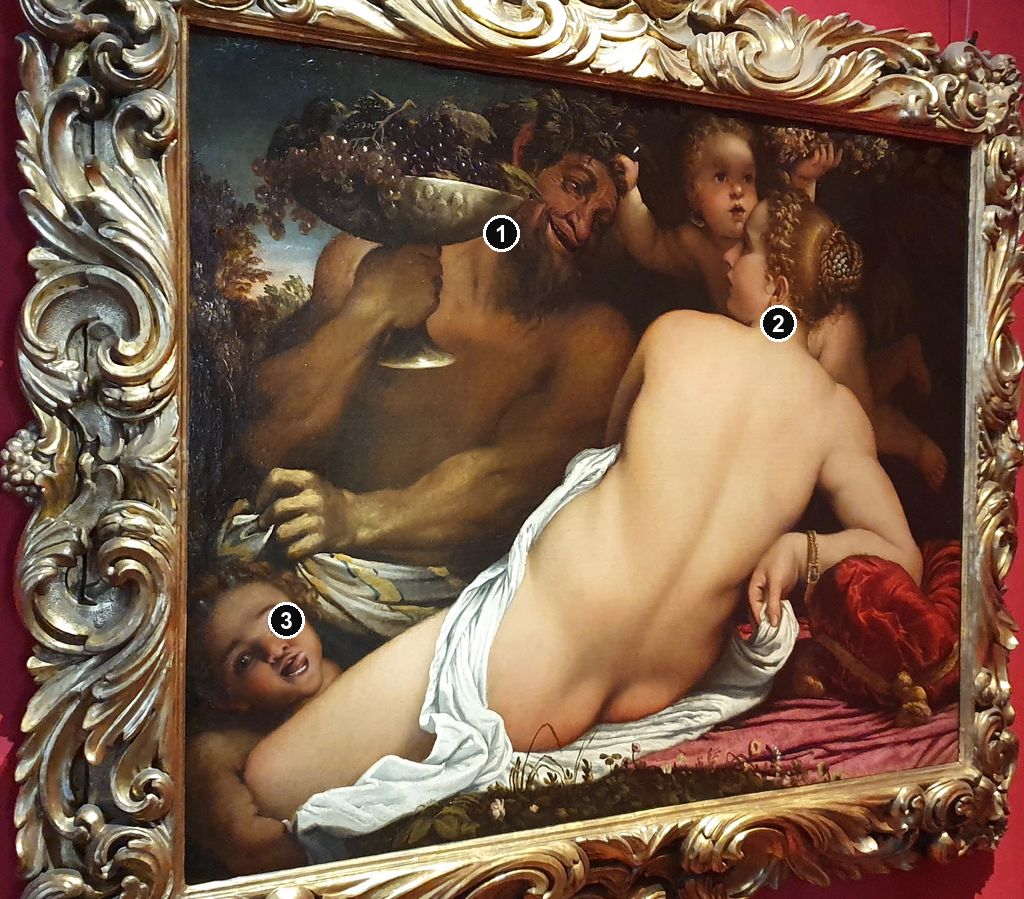
Details from VENUS WITH A SATYR AND CUPIDS
Compare the cropped details with the source images above. Notice how their colours, shapes and positions contribute to the larger compositions.
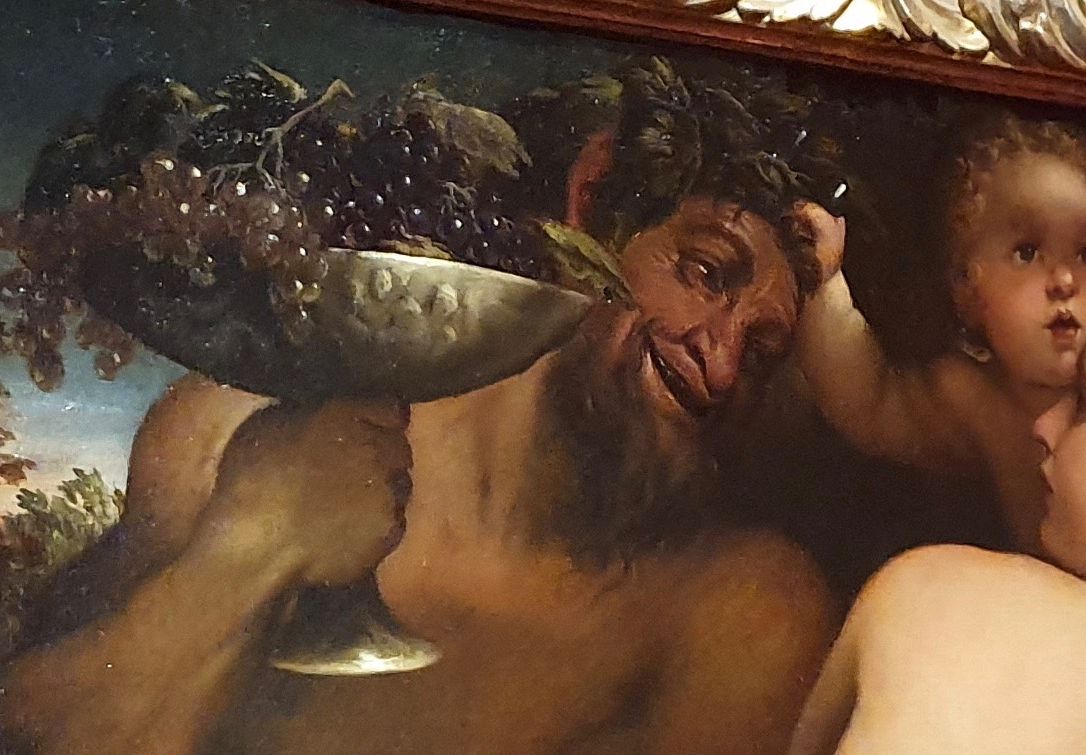
The satyr and the grapes
The shallow bowl he raises is heaped with fruit. Its rim catches the light above his shoulder while his head inclines towards Venus.
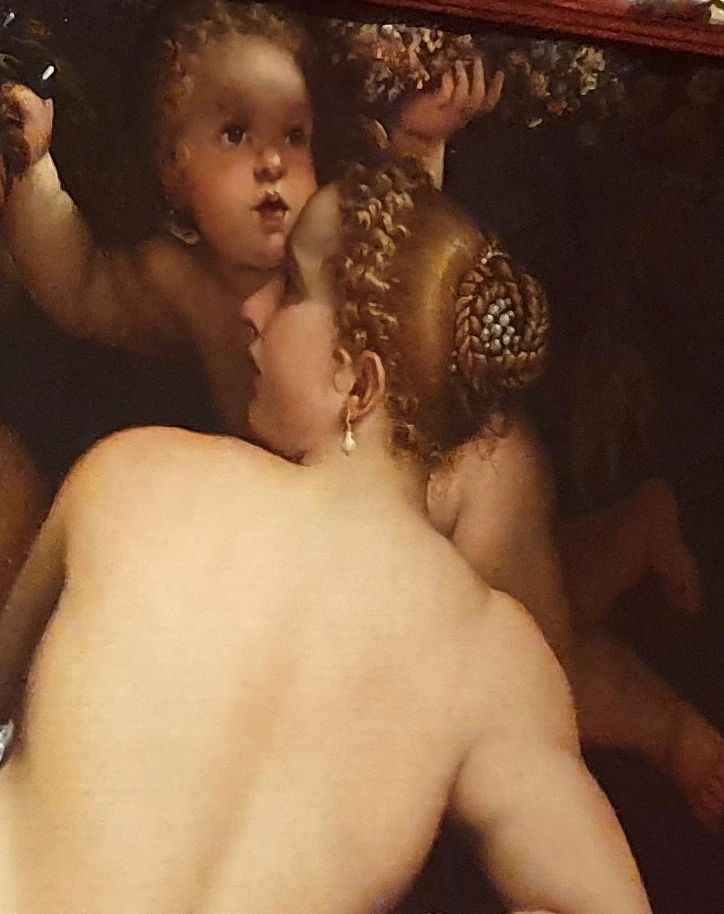
Venus turns back
The exposed back carries a long curve away from the satyr. Only a little of Venus’s face appears as she turns to the left.
A face at the lower edge
A small smiling figure peers out from shadow below the satyr. The gaze meets the viewer at the lower edge of the group.
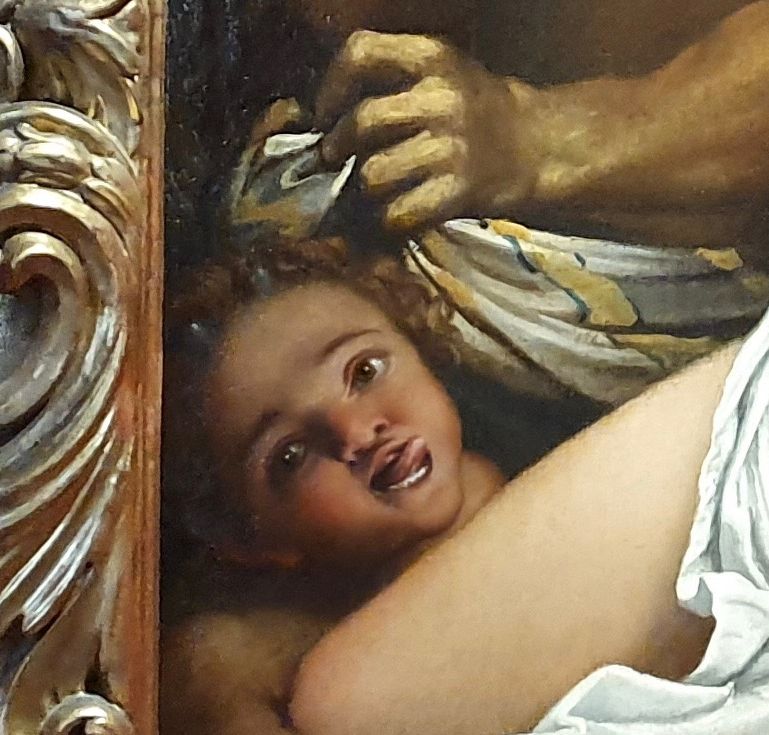
What the title can tell us
The Uffizi catalogue calls the painting Venere, satiro e putti. Its nickname, La Baccante, suggests a follower of Bacchus, an association encouraged by the grapes and the satyr. The nicknames and catalogue titles tell us how viewers identified the scene at different times. The receipt for the Medici acquisition describes a Venus seen from behind, and the 1769 Uffizi inventory again names Venus, specifying the satyr's fruit bowl and the child's hand on his horn. The broad date in the Uffizi's conservation publication accommodates narrower estimates. The Italian national catalogue puts the canvas around 1587–1588, while the Fondazione Zeri gives 1589–1590. [1] [2] [3] [4]
Art historian Barry Wind proposed that Venus and the upper child are trying to keep her covered. On this reading, the pearl jewellery and flowers help to identify a chaste or celestial Venus, and the two groups enact a contest between chastity and sensual appetite. The Fondazione Carisbo records that interpretation in its catalogue entry for a nineteenth-century print after the painting. Both the cloth held by Venus and the horn held by the upper child give it some purchase in the picture. The brighter and darker passages also keep the viewer's eye moving between the goddess and the satyr, drawing attention to the very exposure over which the figures appear to struggle. [2] [5]
From Correggio and Titian to Carracci's own print
Correggio's Venus, Satyr and the Sleeping Cupid, painted around 1524–1527 and now in the Louvre, offers an earlier treatment of the satyr pulling back a covering. In Correggio's tall canvas the woman lies asleep with the front of her body visible, the satyr bends over from behind, and a sleeping Cupid lies at her feet. Annibale spreads the encounter across a wider canvas and gives the goddess a raised shoulder and an active hand. The Louvre once called Correggio's painting Jupiter and Antiope. The earlier title is a reminder of how readily the same arrangement of sleeping woman, satyr and child could suggest different stories. [1] [6]
The Uffizi's catalogue traces the turned back to a nymph at the right of Titian's Diana and Callisto, now jointly owned by the National Galleries of Scotland and the National Gallery in London. Titian places his figure among the attendants in a story about the public exposure of Callisto's pregnancy. Annibale gives the turned body almost the entire foreground. The catalogue suggests that he could have known the pose through a workshop copy. It also preserves the later biographer Carlo Cesare Malvasia's story that Annibale's cousin Ludovico supplied the model for the back. The anecdote and the proposed visual source speak to different questions about how the painter developed the figure. The catalogue also records a preparatory drawing in the Uffizi's collection, no. 766. [2] [7]
A second sheet in the Uffizi shows how freely a pose could move between pictures, studies from life and antiquities. Raimondo Sassi compares Venus's back with a nude study on the reverse of a drawing, Uffizi 12380 F, which he associates with the Carracci Academy. The study's condition makes a firm attribution difficult. Sassi finds a closer parallel for its overall pose in the ancient relief known as the Bed of Polyclitus. The similarity of the backs is evidence of a shared interest in the pose, while the differences in the turn of the body leave the relationship between the study and the painting open. [8]
In a separate print dated 1592, Annibale returned to a satyr drawing back cloth beside a reclining woman. Her pose and the arrangement of the figures differ from those of the Uffizi canvas, and fine lines articulate the mattress and the opening onto the landscape. At the Metropolitan Museum, the catalogue notes that Adam von Bartsch identified the print as Jupiter and Antiope and that print scholar Babette Bohn preferred Venus and a Satyr. The Met also compares an Agostino Carracci drawing in the Albertina, leaving open which work came first. Multiple copies of the print survive, separate from the painted copies that circulated the Florence composition. [9] [10]
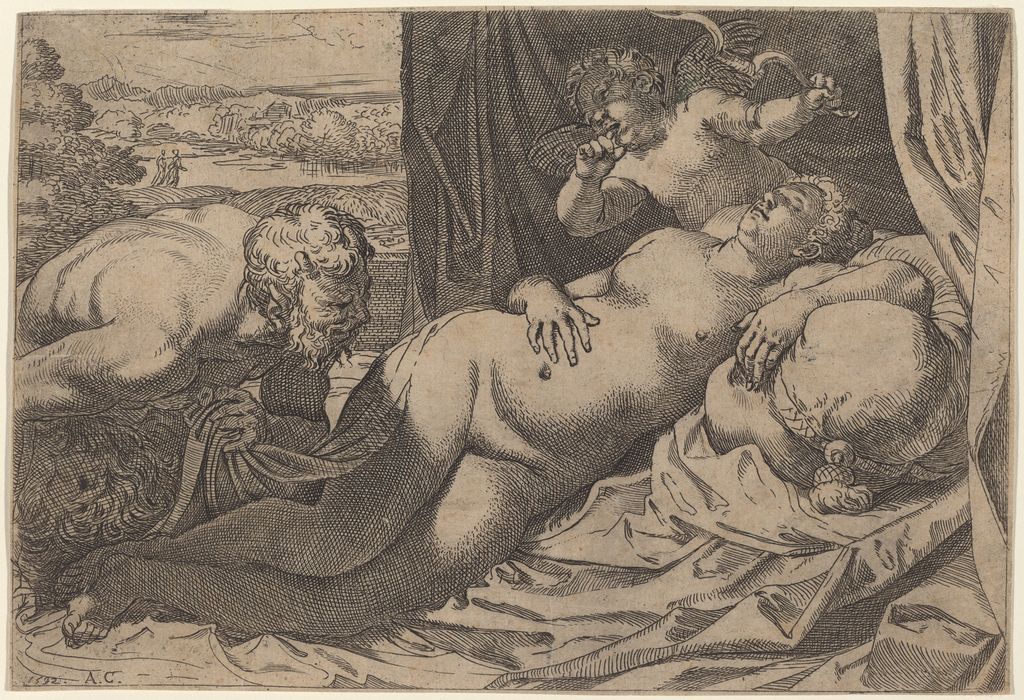
Annibale Carracci, Venus and a Satyr, 1592. National Gallery of Art, 2008.104.11. Image source. CC0 / Public domain.
The Medici purchase and the painted cover
A 1620 receipt in the correspondence of Medici secretary Andrea Cioli records a payment of 200 ducatoni for the canvas and names Camillo Bolognetti and Michelangelo Spiga in the transaction. That places it with the Bolognetti before the Medici acquisition. The original commission remains uncertain. Writing in 1678, Malvasia reported the sale and described the picture among the celebrated works in the grand-ducal collection. [2] [5]
The 1769 inventory describes two paintings that shared a frame. A mechanism allowed a second canvas by Carlo Sacconi to be raised or lowered over Annibale's picture. Sacconi's scene showed Asclepius seated on a tomb talking to a standing philosopher, with skulls on the ground. The arrangement kept Carracci's painting in the collection and gave its custodians a way to decide when to show it. In his 1781 Italian diary, the Russian traveller Nikolai Lvov wrote about a Carracci bacchanal that the diary's editor identifies as this painting. Lvov singled out its lifelike colours and the feeling in the faces. His account describes an encounter with the picture while the cover was still part of its documented history. The museum catalogue dates the cover’s permanent removal to 1812. Its subsequent whereabouts are unknown. [2] [4] [11]
In The Tribuna of the Uffizi, produced for Queen Charlotte between 1772 and 1777, Johan Zoffany included Annibale's painting high at the left. Even at that scale, the wide expanse of Venus's back makes it recognisable. Annibale's painting sits among the works that bring the room's visitors together to look and compare. The Royal Collection points out that Zoffany adapted the perspective and brought in works from other parts of the grand-ducal collection. His view shows the prominence he gave the Carracci, while later museum records document its actual placement in the Tribuna. [1] [12]
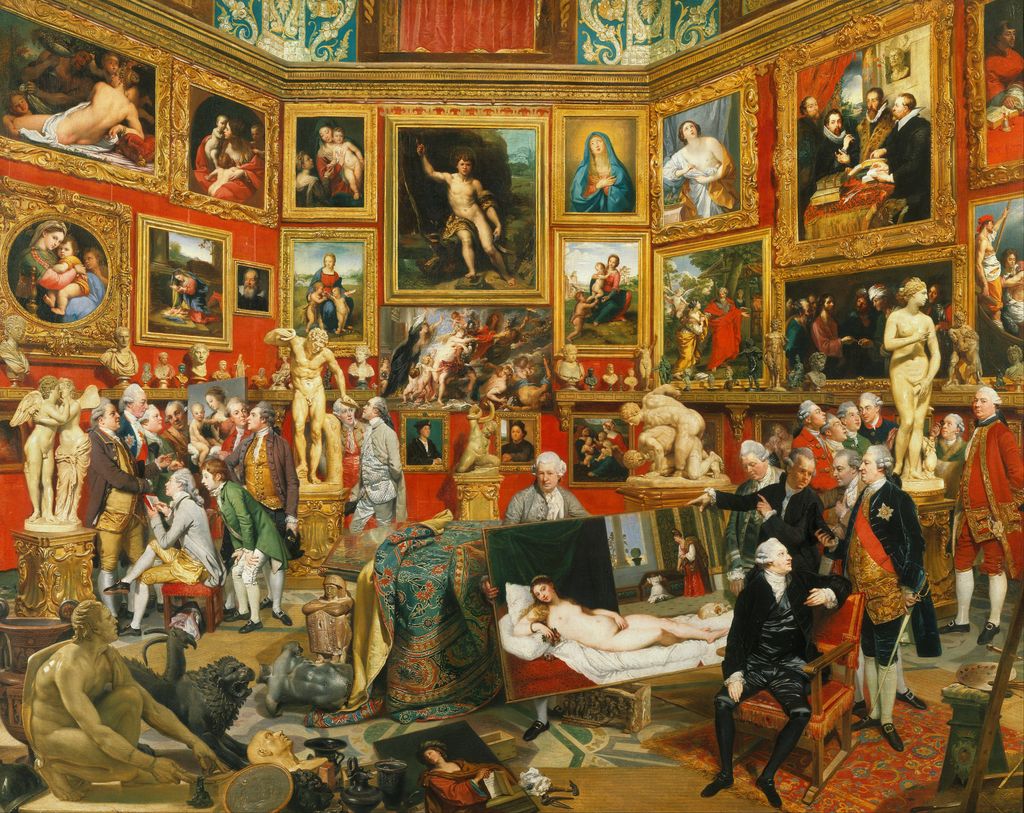
Johan Zoffany, The Tribuna of the Uffizi. Royal Collection, RCIN 406983. Image source. Public domain.
What the restorer saw from the wall
When Alessandro Mazzanti surveyed the picture in January 1887, he could only examine it from a distance. The gallery put it on a list of 32 works needing urgent attention and named its location as the Tribuna. Maria Vittoria Thau's study of the Florentine gallery archives explains that staff commonly made a preliminary inspection of high-hung pictures in place. After the Carracci canvas was taken down, Mazzanti could see the painted surface and the reverse more clearly. On 13 June 1888 he reported that the painting needed a new lining and that the paint had to be secured. Lining adds a supporting canvas to the back of the original. Consolidation addresses loose or lifting paint, which can flake away even if the canvas itself still looks intact. Thau follows the paperwork through the period of work and payment in 1889–1890. The sequence explains why an inspection from the floor could lead to a much more substantial proposal once the painting was within reach. [1]
How copies travelled
The composition circulated in more than one form. The Italian catalogue records an early painted version in Norfolk, Virginia, with an inscription naming Annibale and giving the year 1588. The inscription is on that version. Its existence helps explain the dating of the Florence painting but leaves the precise year open. The catalogue treats the Norfolk picture as a copy, while the Fondazione Carisbo records the possibility that it is Annibale's own replica. The Fondazione Zeri lists the Florence painting and its copies together in its photographic archive. [2] [3] [5]
Italy's catalogue also identifies a copy at Montecitorio, from the Naples collection, and cautiously connects it with a painting of the same subject in a 1653 Farnese inventory. A line engraving by Giovanni Paolo Lasinio reproduced the Naples version in Real Museo Borbonico. The Fondazione Carisbo notes that Saverio Pistolesi's print closely resembles Lasinio's, with slight changes in the background, and suggests that it may have been made from the earlier print. Reproductions could therefore carry Annibale's composition through several stages, from the Uffizi design to a painted copy and from one engraving to another. [2] [5]
The historical Prado inventory identifies a separate copy, P000071, as a satyr offering Venus a cup of wine. Carracci's Venus and Adonis at the Prado is a different painting, centred on the lovers in Ovid's story. The Musée Condé's Sleeping Venus is a later Farnese commission, dated 1602 by Chantilly. There the goddess sleeps while many putti play around her. The quickest way to recognise the Uffizi composition is by the combination of the turned back, the satyr's raised dish and the two children at different heights. Those details survived even in the miniature version that Zoffany painted on the Tribuna wall. [12] [13] [14] [15]
Artworks directory
Paintings, frescoes, drawings and prints, with separate entries for documented versions and collaborative projects.
Discussion
Look again at the images and ideas explored in Venus with a Satyr and Cupids. These editorial prompts invite your observations.
Reader Insights
Where does the satyr’s gesture direct your eye?
Which details distinguish this scene from Carracci’s Sleeping Venus at Chantilly?
Join the Conversation
Share a detail, comparison or question about Venus with a Satyr and Cupids below.
References
- Maria Vittoria Thau, Alessandro Mazzanti, restauratore di “somma diligenza e rara perizia”, Gallerie degli Uffizi, Imagines 3, pp. 191–194 and 216–217 View source.
- Italian General Catalogue of Cultural Heritage and Gallerie degli Uffizi, Venere, satiro e putti, 0900289171 View source.
- Fondazione Federico Zeri, Annibale Carracci, Venere, satiro e putti View source.
- Fondazione Memofonte, 1769 Uffizi inventory, entry 1183 View source.
- Fondazione Carisbo, Saverio Pistolesi, Venere e satiro con due amorini, inv. 4800 View source.
- Musée du Louvre, Correggio, Vénus, Satyre et l’Amour endormi, INV 42 View source.
- National Gallery, Titian, Diana and Callisto, NG6616 View source.
- Raimondo Sassi, Four new drawings by Pietro Faccini, Gallerie degli Uffizi, Imagines 9, p. 127 n. 62 View source.
- National Gallery of Art, Annibale Carracci, Venus and a Satyr, 2008.104.11 View source.
- Metropolitan Museum of Art, Annibale Carracci, Wilton album, folio 45b, Venus, Cupid and a Satyr View source.
- Nikolai Lvov, Italian Diary, fol. 51 and its editorial note, pp. 72 and 112 View source.
- Royal Collection Trust, Johan Joseph Zoffany, The Tribuna of the Uffizi, RCIN 406983 View source.
- Poder, patrimonio y cultura en España, Venus y un sátiro, Prado P000071 and the 1834 inventory View source.
- Museo Nacional del Prado, gallery talk on Venus and Adonis View source.
- Château de Chantilly, Vénus endormie avec des amours View source.