 by Tom Gurney
Tom Gurney BSc (Hons) is an art history expert with over 20 years experience
Published on June 19, 2020 / Updated on November 29, 2026
Email: tomgurney1@gmail.com / Phone: +44 7429 011000
The Burial of Christ: Introduction
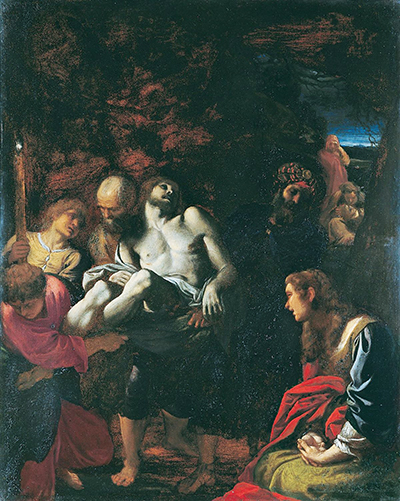
In Annibale Carracci’s The Burial of Christ, we are already inside the tomb when the mourners arrive. A torch catches Christ’s chest and knees as his companions carry him into the cave. Beyond them, a narrow strip of blue sky draws the eye past the women at the entrance. The Metropolitan Museum of Art dates this small oil on copper to 1595. It measures 43.8 by 34.9 centimetres and is accessioned as 1998.188. Commissioned in Bologna as a gift for someone in Rome, it stayed with the patron after he arranged for Guido Reni to make a copy to send in its place. [1]
At a Glance
- ArtistAnnibale Carracci
- DateAbout 1595
- MediumOil on copper
Contents
- Inside the rock-cut tomb
- Torchlight and the distant sky
- Sampieri’s commission and Guido Reni’s copy
- How the original was recognised
- Badalocchio’s versions and a drawing in Paris
- Other Passion scenes by Carracci
- Annotated details
Inside the rock-cut tomb
Mark describes Joseph of Arimathea asking Pilate for the body on the evening before the Sabbath. Joseph wraps Jesus in linen and lays him in a tomb cut into rock while Mary Magdalene and Mary the mother of Joses watch where he is laid. John brings Nicodemus into the account with a mixture of myrrh and aloes and locates the unused tomb in a garden near the place of crucifixion. Carracci builds the scene around the stone chamber, the linen and the witnesses that the texts describe in a few lines. Carracci gives that sequence physical detail through the torch, the uneven ground and the arrangement of the bearers. [1] [2] [3]
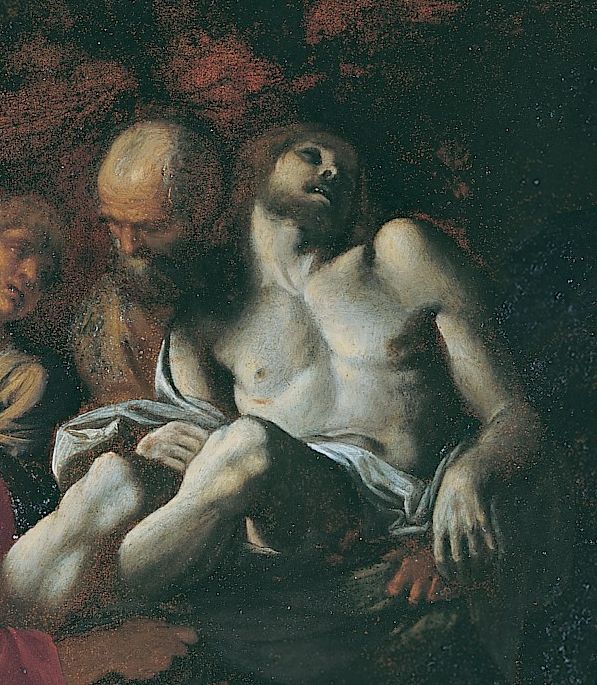
Christ’s head falls back into shadow while the nearer shoulder and upper arm catch the light. Lower down, his bent knees project towards us and his near hand hangs with the fingers apart. This is a body viewed from close by and at an angle, with distances compressed by foreshortening. The figure slumps sideways despite the effort to support him. At the left edge, the bearer in pink bends low, his arms directed under the legs. The man beside Christ’s head inclines his own head as he bears the upper body. Their exertion registers through small changes of posture, including the tilt of a shoulder and the bend of an elbow. [1]
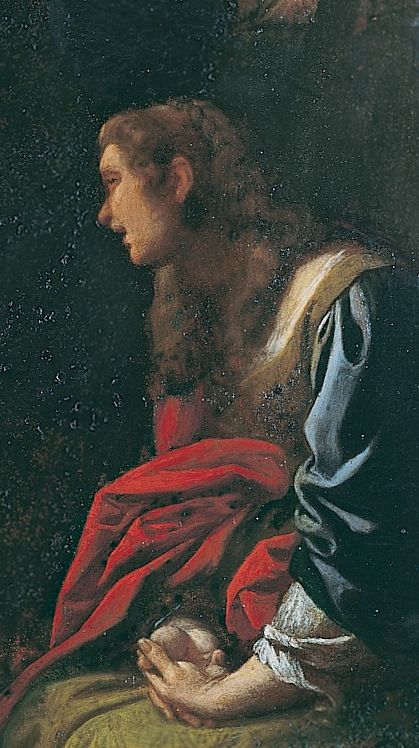
The linen changes shape where it takes Christ’s weight. It bunches over the lap, creases between the hands and falls into shadow against the darker clothes. The light picks out the contrast between the bearers’ tight grip and Christ’s slack fingers. His upper body is still exposed here, giving Carracci a way to show the effort of wrapping and carrying him as part of an unfinished act. At lower right, the mourner generally read as Mary Magdalene kneels with her hands together. Her lowered head follows the fall of Christ’s arm, while the folds of red across her lap draw the eye down towards the place where he will be laid. [1] [4]
Annotated Details from The Burial of Christ
The numbered points identify visible features discussed in this article. Return from each detail to the numbered overview. Annibale Carracci, The Burial of Christ. The Metropolitan Museum of Art, 1998.188. Image source. CC0 / Public domain.
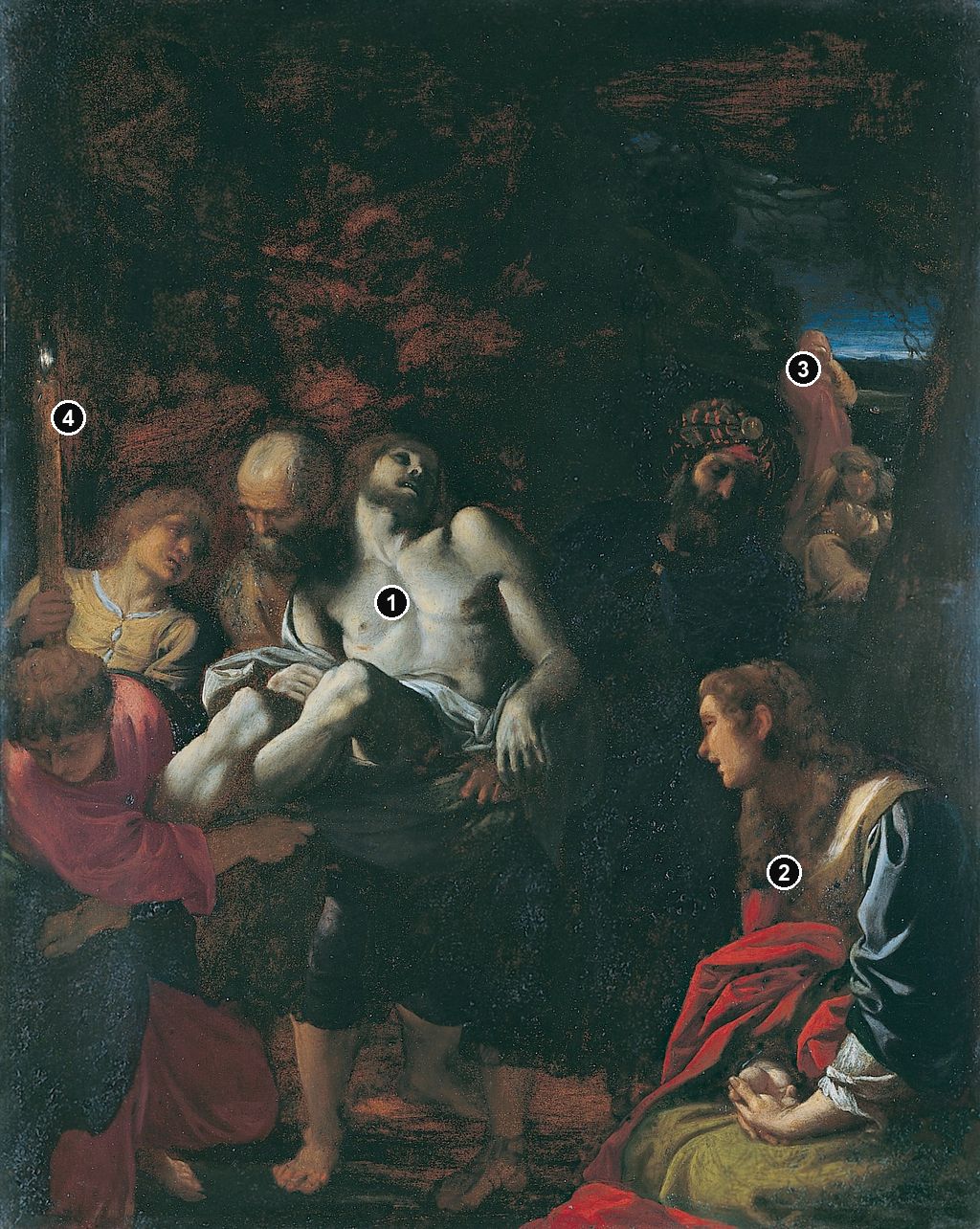
Details from THE BURIAL OF CHRIST
Compare the cropped details with the source images above. Notice how their colours, shapes and positions contribute to the larger compositions.
Christ's shoulder and the linen
Pale skin and pale cloth meet in the foreground. Light picks out the body while the bearers remain darker, making their supporting gestures easier to separate.
The foreground mourner
The kneeling mourner at the right turns her head towards the dead Christ. Her profile and red fabric are legible at the edge of the group.
A patch of daylight
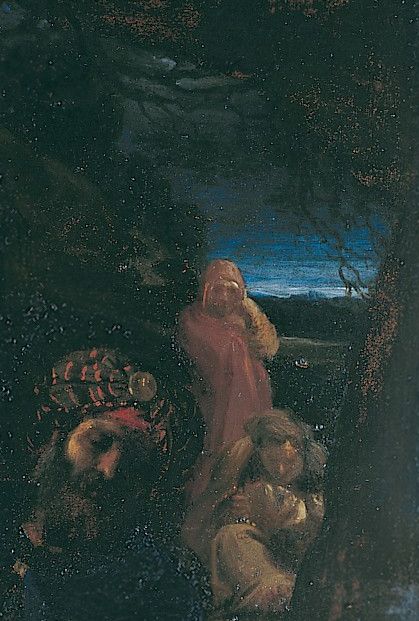
The distant blue opening is small beside the dark cavern. It distinguishes the dim interior from the world outside and carries attention into depth.
The torch at the left edge
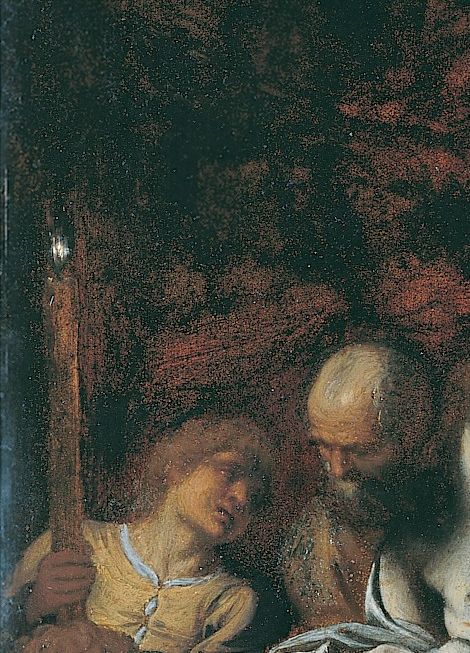
A slender torch rises beside the left edge. A little warm light reaches the rough cave wall and the faces of the men immediately inside it.
Torchlight and the distant sky
The flame is a tiny patch of brightness at the left edge. Its reach is easier to see in the reddish marks on the rock overhead and in the changing colours of the flesh. The torchbearer’s lit sleeve, Christ’s pale torso and the stiff ridge of linen stand out against a cave that occupies much of the upper half of the picture. At right, a glint on the patterned head covering and the lit edge of a cheek are almost all we see of one man. Figures close to each other can be hard to distinguish until the eye has spent time in that darkness. [1]
The opening on the right gives the women farther back a much cooler light. One upright figure stands against the sky, while lower figures overlap the cave’s edge. Their smaller scale tells us how far the procession has already come. The Met allows two readings of the light on the horizon. Evening fits Mark’s account of the hurried burial, while the look of first light can anticipate the Resurrection. The women still have the burial before them. The thin band of light can suggest what lies ahead without moving them into the later scene at the empty tomb. [1] [2] [5]
At less than 44 centimetres high, the picture invites a close look. The dark space above the bearers is broad enough to establish the chamber, while at the bottom the cropped figures and the steep angle of Christ’s legs make the space feel crowded near the viewer. Keith Christiansen saw in this relationship between the moving bodies and the viewer an anticipation of Baroque painting. [1] [6]
Livia Stoenescu connects the illuminated figure to the older Man of Sorrows tradition, in which Christ’s body was made the focus of contemplation. In the Burial, the stillness of the body gives the moving figures something to arrange themselves around. Christ is slumped almost as if asleep. His body retains a sense of mass and strength where the light falls on it, even as the bearers struggle with the dead weight. That combination makes it possible to dwell on the figure after the action of the burial has become clear. [7]
Sampieri’s commission and Guido Reni’s copy
Astorre di Vincenzo Sampieri, a canon of San Pietro, Bologna’s cathedral, commissioned the copper for an important person in Rome. As Carlo Cesare Malvasia told the story in 1678, Sampieri was so pleased with the result that he decided to keep it, and the young Guido Reni supplied the substitute. The size suits a gift intended to travel and a devotional picture to be examined at close quarters. The commission establishes a destination in Rome and a first owner in Bologna. It gives us little evidence about the room in which Sampieri actually used or displayed the painting. [1] [6] [8]
Malvasia left the Roman recipient unnamed. In a modern proposal, Massimo Pirondini identified him as Cardinal Odoardo Farnese and suggested that a Farnese inventory entry from 1708 might describe Reni’s copy, even though the inventory named Annibale. The entry describes a copper with the torchbearer, the grieving Magdalene and figures farther away. Pirondini also proposed that another copper, acquired on the art market in 2024, could be the Reni. He noted a gap in its provenance and based the comparison of the Met painting on photography. The inventory and second copper raise a possibility about the gift’s destination, while the recipient and the whereabouts of Reni’s copy remain uncertain. [4]
How the original was recognised
The original stayed with the Sampieri family until 1811, when Eugène de Beauharnais, then Viceroy of Italy, acquired it with other works from their collection. It passed into the Leuchtenberg collection, where the gallery curator J. N. Muxel engraved it. The print appeared in 1835 and again in Johann David Passavant’s 1852 catalogue. Gustav Friedrich Waagen described the painting in 1864. When the copper disappeared from scholarly view after a sale in the early twentieth century, Muxel’s print preserved a record of how the figures fitted together. [8]
The number of surviving versions was itself a clue. The Met’s acquisition entry mentions at least ten copies and variants in addition to the recorded commission for Reni. In 1967 James Byam Shaw assembled an early list of repetitions while cataloguing a version at Christ Church, Oxford. [6] [8]
Studying Sisto Badalocchio’s partly surviving altarpiece for Reggio Emilia, Carel van Tuyll traced the underlying design back to the Sampieri commission using inventories and early biographies. The small copper resurfaced at auction in New York in 1998 under Badalocchio’s name. Christiansen connected it to Annibale’s commission through that research, the correspondence with Muxel’s engraving and the fact that its support was copper. The work entered the Met that year, and Christiansen published the rediscovery in 1999. [4] [6] [8]
The metal support matters because the same composition circulated in several materials. A canvas can preserve the bearers’ postures, the kneeling figure and the cave opening. Copper is one additional clue when an early description specifies the support, although its presence alone cannot identify the painter. The National Gallery’s technical study of another Annibale copper, the Montalto Madonna, shows how examination of the priming and paint can help establish the artist’s working process. For the Burial, the published case considered here rests on the support, the historical record and visual comparison. Christiansen’s account of cleaning concerns the Dulwich variant. [1] [8] [9]
Badalocchio’s versions and a drawing in Paris
Sisto Badalocchio’s Christ Carried to the Tomb at Dulwich Picture Gallery, dated about 1607, retains the downward sweep of the bearers and the watching women seen through the mouth of the tomb. It is an oil on canvas, just a little larger than the Met copper. Compare Christ’s hanging arm and the man in the patterned head covering to see where Badalocchio adjusted the model. Drapery covers more of the arm in the Dulwich painting, and the man turns his gaze forwards. Between these changes and the close repetition of the main figures, the Dulwich version shows what a follower could keep and what he could alter without losing the original conception. Whether Badalocchio worked from Annibale’s copper or had access to a copy such as Reni’s is uncertain. [4] [10]
The Christ Carried to the Tomb in London’s National Gallery is another small copper. The gallery dates it after 1609 and gives it to Badalocchio, with a former attribution to Ludovico Carracci. Badalocchio also took up the subject on the scale of an altarpiece for the Oratorio della Morte in Reggio Emilia in 1618. Only fragments of that large canvas survive in Modena. The Galleria Nazionale in Parma holds a related canvas, whose lower-right Magdalene closely resembles the figure in Dulwich. The Parma catalogue also links that figure to a chalk drawing in the British Museum. The drawing helps establish how Badalocchio worked out his own version. [11] [12]
A different connection survives in the Louvre’s Le Christ porté au tombeau (INV 7687, recto), drawn in brown ink over black chalk. Catherine Loisel described a visual echo of the Met painting and previously associated the sheet with Ludovico’s workshop. The Louvre now catalogues it under Francesco Brizio. Its relationship to the Burial shows how the treatment of the subject travelled through Bolognese drawing as well as painting. The catalogue gives the drawing an artistic relationship to Annibale’s design and assigns it to a different hand. [13]
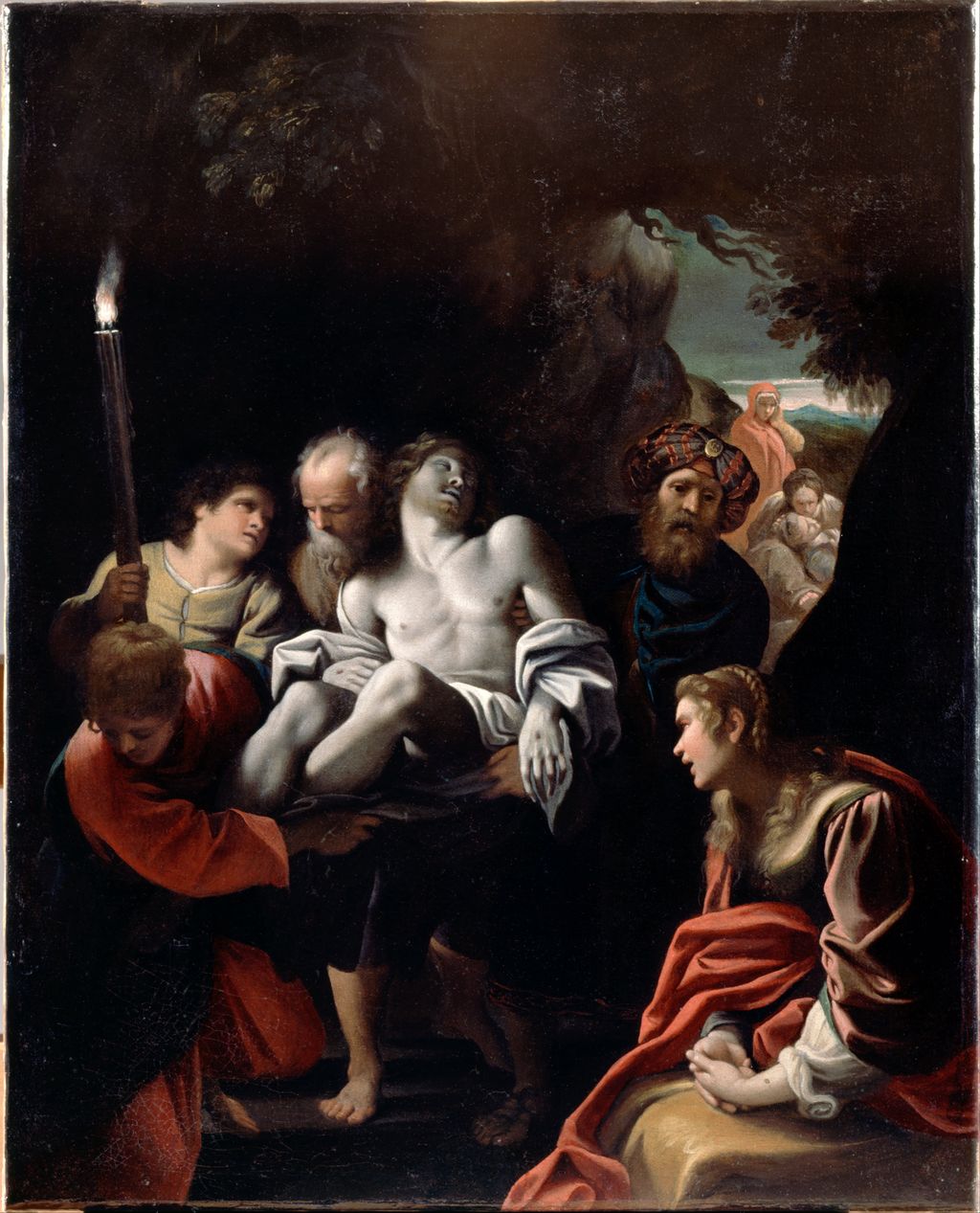
Sisto Badalocchio, Christ Carried to the Tomb. Dulwich Picture Gallery, DPG265. Image source. Public domain.
Other Passion scenes by Carracci
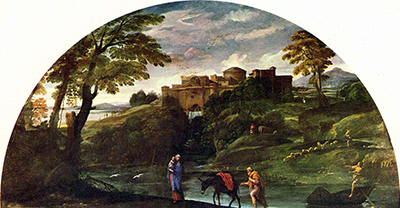
A shared subject can disguise differences between pictures. In the Doria Pamphilj Landscape with the Entombment of Christ, the mourners belong to a broad landscape designed for a lunette, a painting with a curved top. The narrow Met copper brings us inside the burial chamber and gives the figures nearly the whole width of the picture. These are two designs for the entombment, with different framing, viewing distances and settings. [1] [14]
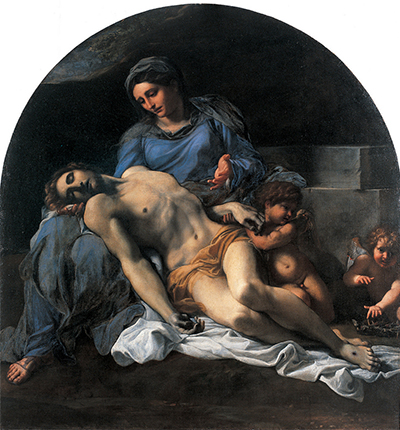
Carracci also imagined other moments of the Passion story. In the Stuttgart Dead Christ with the Instruments of the Passion, the recumbent body and the objects associated with the Crucifixion occupy the scene. In the Capodimonte Pietà, grief gathers around the Virgin and the son she holds. There is another lamentation in London, The Dead Christ Mourned, also known as The Three Maries, where the surrounding women respond to the bodies of Christ and his fainting mother. In the Hermitage Holy Women at Christ’s Tomb, an angel directs the women towards the empty grave. The women glimpsed at the entrance in the Met copper belong to the earlier moment, while the bearers still have Christ’s body in their hands. [5] [15] [16] [17]
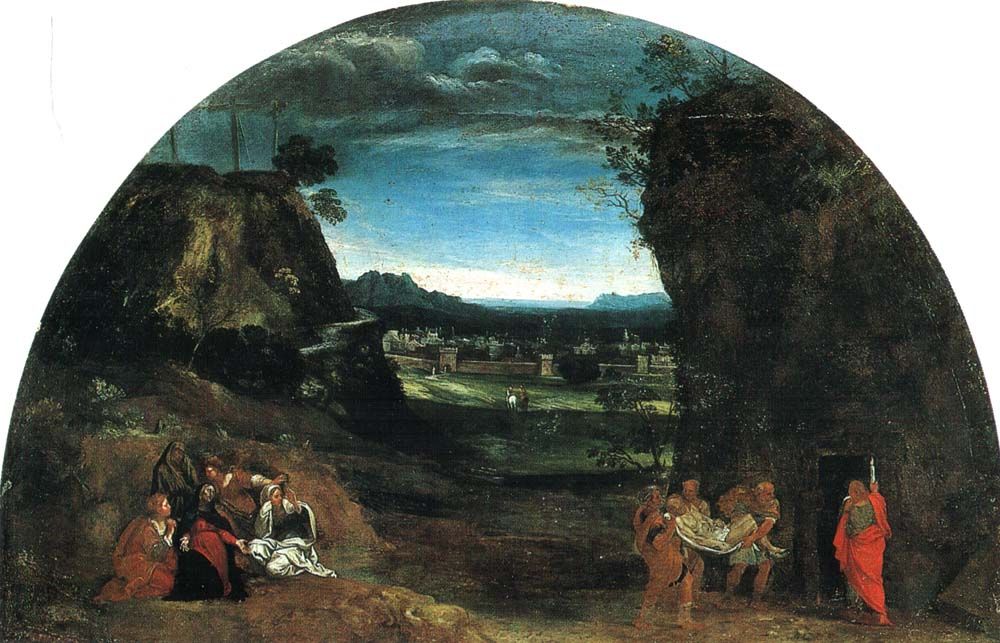
Landscape with the Entombment of Christ from the Aldobrandini lunette cycle. Galleria Doria Pamphilj, Rome. Image source. Public domain.
Artworks directory
Paintings, frescoes, drawings and prints, with separate entries for documented versions and collaborative projects.
Discussion
Look again at the images and ideas explored in The Burial of Christ. These editorial prompts invite your observations.
Reader Insights
Where does pale cloth meet bare skin in the torchlight?
What does the distant opening add to the action inside the cavern?
Join the Conversation
Share a detail, comparison or question about The Burial of Christ below.
References
- Metropolitan Museum of Art, Annibale Carracci, The Burial of Christ, accession 1998.188 View source.
- United States Conference of Catholic Bishops, Mark 15:42–47 View source.
- United States Conference of Catholic Bishops, John 19:38–42 View source.
- Massimo Pirondini, Annibale Carracci e Guido Reni: due “Deposizioni di Cristo” per l’abate Sampieri View source.
- State Hermitage Museum, Italian Painting catalogue, no. 85, The Holy Women at Christ’s Tomb View source.
- Keith Christiansen, The Burial of Christ, Recent Acquisitions: A Selection, 1998–1999, p. 30 View source.
- Livia Stoenescu, Retooling Medievalism for Early Modern Painting in Annibale Carracci’s Pietà with Saints in Parma View source.
- Keith Christiansen, Annibale Carracci’s 'Burial of Christ' Rediscovered, The Burlington Magazine, July 1999, pp. 414–418 View source.
- Larry Keith, Annibale Carracci’s 'Montalto Madonna', National Gallery Technical Bulletin View source.
- Dulwich Picture Gallery, Sisto Badalocchio, Christ Carried to the Tomb, DPG265 View source.
- National Gallery, Sisto Badalocchio, Christ carried to the Tomb, NG86 View source.
- Complesso Monumentale della Pilotta, Sisto Badalocchio, Trasporto di Cristo al sepolcro, GN 833 View source.
- Musée du Louvre, Francesco Brizio, Le Christ porté au tombeau, INV 7687 recto View source.
- Fondazione Federico Zeri, Paesaggio con Deposizione di Cristo nel sepolcro, Doria Pamphilj View source.
- Staatsgalerie Stuttgart, Annibale Carracci, Leichnam Christi mit den Leidenswerkzeugen View source.
- Museo e Real Bosco di Capodimonte, La Pietà di Gricci and Annibale Carracci’s Pietà View source.
- National Gallery, Annibale Carracci, The Dead Christ Mourned ('The Three Maries'), NG2923 View source.