 by Tom Gurney
Tom Gurney BSc (Hons) is an art history expert with over 20 years experience
Published on June 19, 2020 / Updated on November 29, 2026
Email: tomgurney1@gmail.com / Phone: +44 7429 011000
Prints by and after Annibale Carracci: Introduction
In Annibale Carracci's Holy Family with Saint John the Baptist, Joseph reads while Mary steadies two children as they embrace on a basket. At the lower right of this small print, the artist made room for his name, the year 1590 and two abbreviations that claim both the design and the making of the image. The name Carracci appears on many other prints in a different capacity. It may identify a painter whose work an engraver translated onto a plate long after his death. Sometimes it identifies his brother Agostino, who developed a printmaking career of his own. [1] [2]
The most rewarding way to tell these prints apart is to look at what the marks do before turning to the lettering. In the Holy Family, lines suggest the softness of cheeks, the weight of a book and a view through to the distance. In Christ Crowned with Thorns, they crowd around a seated figure until the bare paper on his face seems as bright as a light falling from outside the frame. Each sheet rewards the close attention that the scale of a fresco rarely allows. [1] [3]
At a Glance
- ArtistAnnibale Carracci
- Date1590
- MediumEtching and engraving
Contents
Selected prints
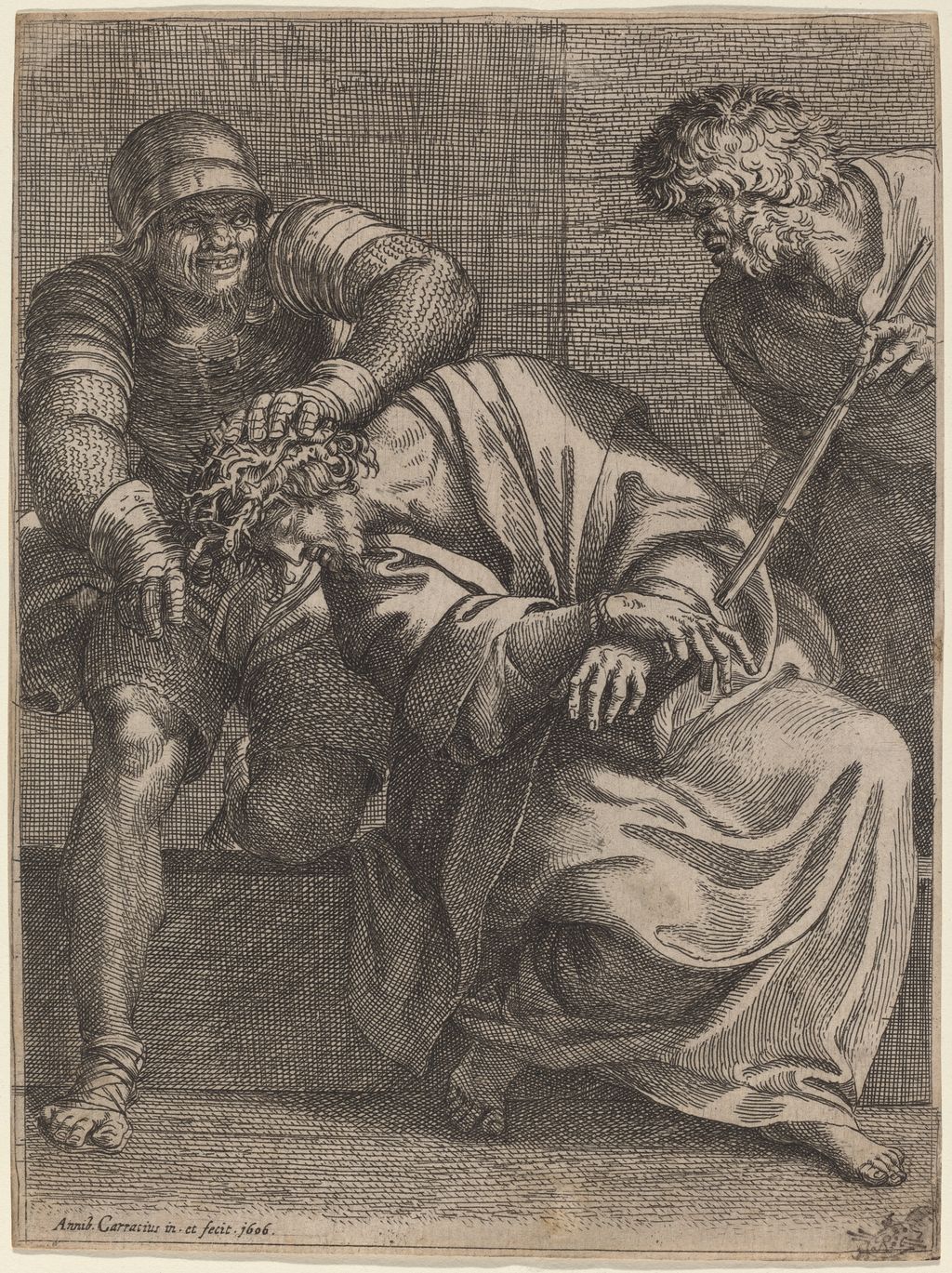
Christ Crowned with Thorns
Annibale Carracci, Christ Crowned with Thorns, 1606. Etching. National Gallery of Art, Washington, 2008.104.14. Image source. CC0 / Public domain.
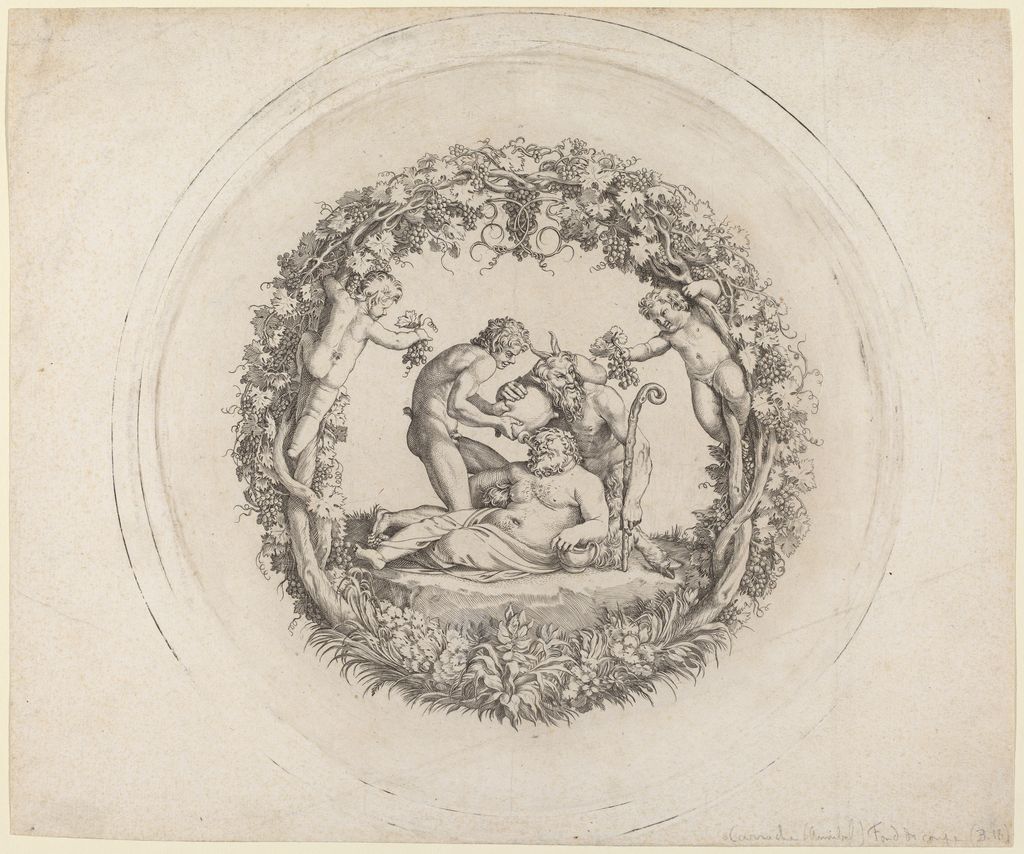
The Drunken Silenus
The Drunken Silenus, paper impression catalogued under Annibale Carracci. National Gallery of Art, Washington, 1964.8.447. Image source. CC0 / Public domain.
Prints made by Annibale
Etching, engraving and the life of a plate
A burin cuts a furrow straight into metal. An etching needle draws through a protective coating so a mordant can bite into the exposed lines. Drypoint scratches the metal directly and raises a rough edge that can carry ink along with the line, giving a dark stroke a soft fringe. All three techniques belong to intaglio. The printer wipes the surface of the plate, leaving ink in and around the worked areas, then presses damp paper against it. The paper takes up the design in reverse and often retains a faint indentation, the plate mark, where the metal edge pressed into it. An engraver and an etcher can use the same plate or even be the same person. In the museum records for Annibale, the combination of techniques is often as important as either one by itself. [4] [5] [6]
An impression is one sheet printed from a plate. A state describes the plate at a particular stage, before or after a documented change to the image or lettering. The number of known states tells us about the plate's revisions, while differences in paper, trimming, inking and wear can distinguish sheets printed from the same state. Someone making a faithful copy might cut a second plate and give it an entirely different history of revisions. An accession number identifies the particular museum object, while a catalogue number may identify the design or a recognised version of it. [1] [6] [7]
Annibale was making prints as a young man. His Saint Francis of Assisi is a signed engraving from 1585. Five years later, he combined etching and engraving for the Holy Family. By 1606 he could make a scene as complicated in feeling as Christ Crowned with Thorns entirely in etching. These dated objects establish that working directly on plates occupied him at intervals across his career. They also show the risk of describing all his works on paper as engravings. [1] [3] [8]
A household scene in the Holy Family
Look first at Joseph's open book. The page catches light and his head bends towards it, withdrawing his attention from the livelier group beside him. Mary supports the boys as they lean into each other on a basket draped with cloth. Its rim and the folds of the cloth give their bodies a place to settle. Their reaching arms make the embrace look as though it could come undone at any moment. Around the figures, the dark curtain helps the pale forms stand out. Farther back, the open view gives the space some air. The plate in the Washington record measures about 16.5 by 22 centimetres. Annibale gives those few inches the apparent room of an interior and a landscape. [1] [9]
Detroit holds another impression of the signed 1590 composition, and the Museum of Fine Arts in Budapest catalogues its sheet simply as The Holy Family. Both Budapest and Washington identify their respective sheets as first states, but they count the sequence differently. Washington follows Diane DeGrazia Bohlin's three states. Budapest follows Babette Bohn's four and also gives Adam Bartsch's earlier count of two. The dates and inscription agree. The difference concerns what each catalogue recognises as a distinct stage of the plate. The nearly identical title of Annibale's small painted Holy Family in London's National Gallery leads to another composition altogether. The London picture, known as the Montalto Madonna, is a vertical oil on copper. Find Joseph's glasses to see how a familiar figure with a book appears in a new arrangement. [1] [10] [11] [12] [13]
Fondazione Carisbo's catalogue describes what changed after the first state. A Roman publisher, Matteo Giudici, added his address. That wording was replaced by a Sandrart address. The fourth state described by the catalogue has that address removed and the plate reworked in parts of the background and faces. Carisbo also lists a reversed engraving associated with Dominicus Custos that places the figures on a tiled floor and adds a Latin verse. These are two ways a design travels. One leaves successive publishers' traces on a shared plate. The other recuts the image and supplies a new setting and text. [9] [14]
Susanna in the garden
For a larger use of the same two techniques, look at Annibale's Susanna and the Elders. A stone fountain enters from the front of the image and a trellis cuts across it. The two elders lean over that barrier to approach Susanna as she tries to cover herself. The built-up darkness in the near part of the garden makes the lit figure and the distant opening seem exposed. The Irbit Museum of Fine Arts calls attention to the position Annibale gives us, as if we too were looking in from a concealed place. Washington holds distinct sheets catalogued as the first and second states. Their plate dimensions are close, while the paper extends farther around the second sheet. Read both sets of measurements to understand which part of the object each figure describes. [15] [16] [17]
The dead Christ at Caprarola and the crowning with thorns
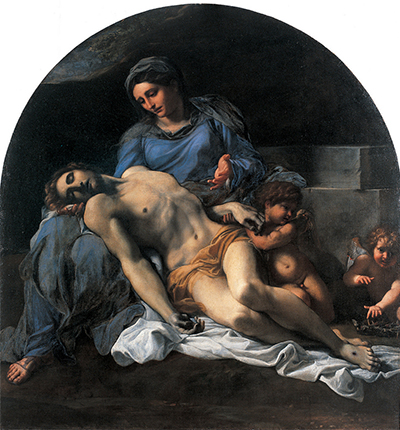
In Annibale's 1597 Pietà, the two bodies at the centre tell the story at a glance. Christ lies across the ground with his head and upper body supported by the Virgin. She collapses in turn into the arms of a mourner. The white of Christ's body and the cloth beneath him sets the direction of the eye across the little sheet. The three crosses rising behind the group establish where the mourners are, but the dense, broken marks in the sky make the space feel close. The Metropolitan Museum of Art relates the design to Correggio's Deposition in Parma and to Annibale's own related painting on copper in Vienna. Compare the print with his separately composed Pietà at Capodimonte to see how differently he could arrange grief around the body. [6] [18]
Washington's impression 1947.7.13 is the second of seven states in Bohlin's catalogue. Ferrara's sheet is recorded as the fourth. The place name Caprarola, reported from the second state onward, anchors the print in Annibale's Farnese years. His reason for being at the villa remains less certain. The Real Academia de Bellas Artes de San Fernando preserves a sheet that also names the publisher Nicolaes van Aelst. Compare those records with the Accademia Carrara catalogue for a faithful engraving of the scene in the same orientation by an anonymous maker. Bohn traces three states of that copy, beginning before any letters and ending with the De Rossi address and the date 1649. A line-for-line resemblance in the centre of the image can conceal a different plate history, which becomes visible in the margins. [6] [7] [19] [20] [21]
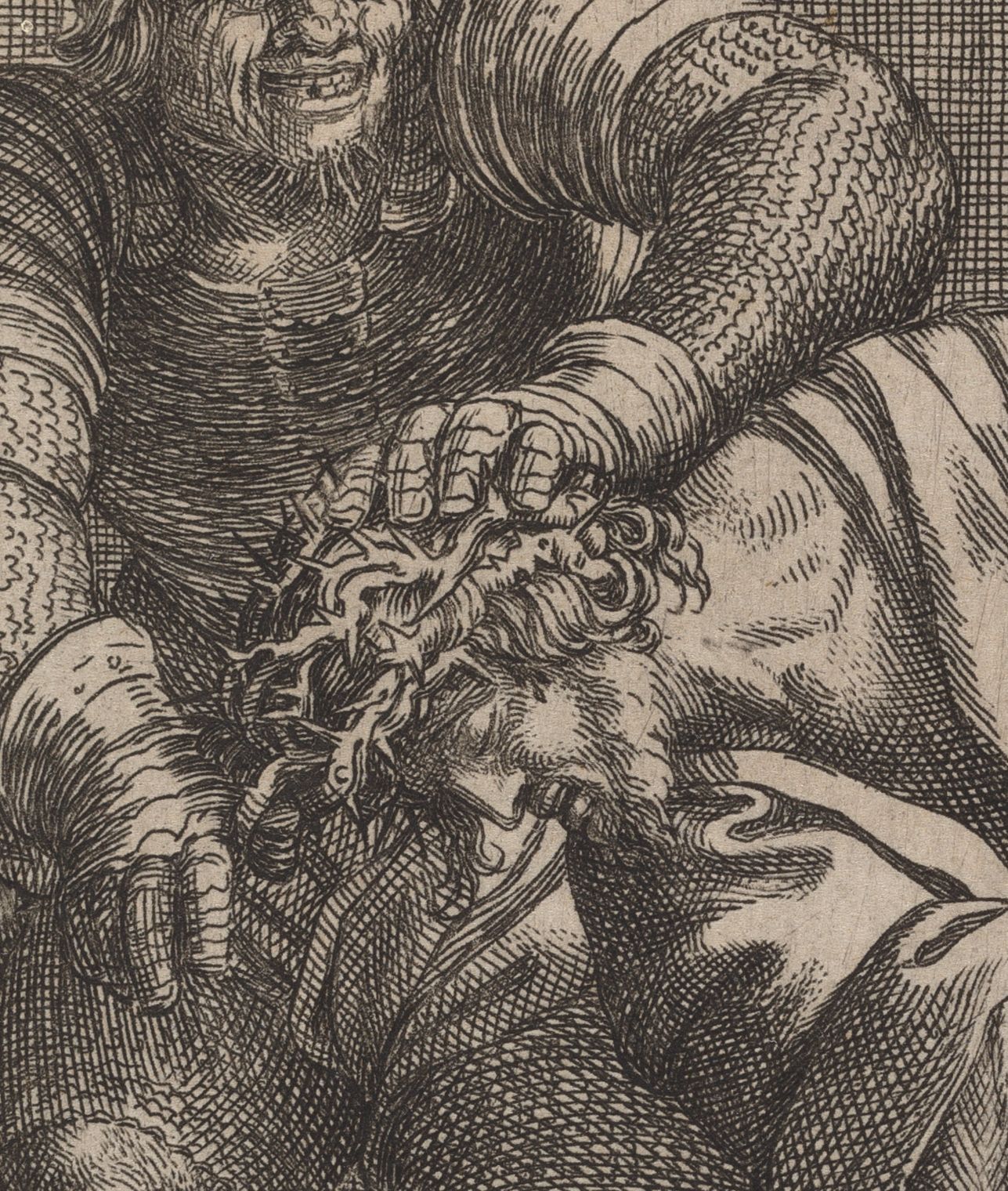
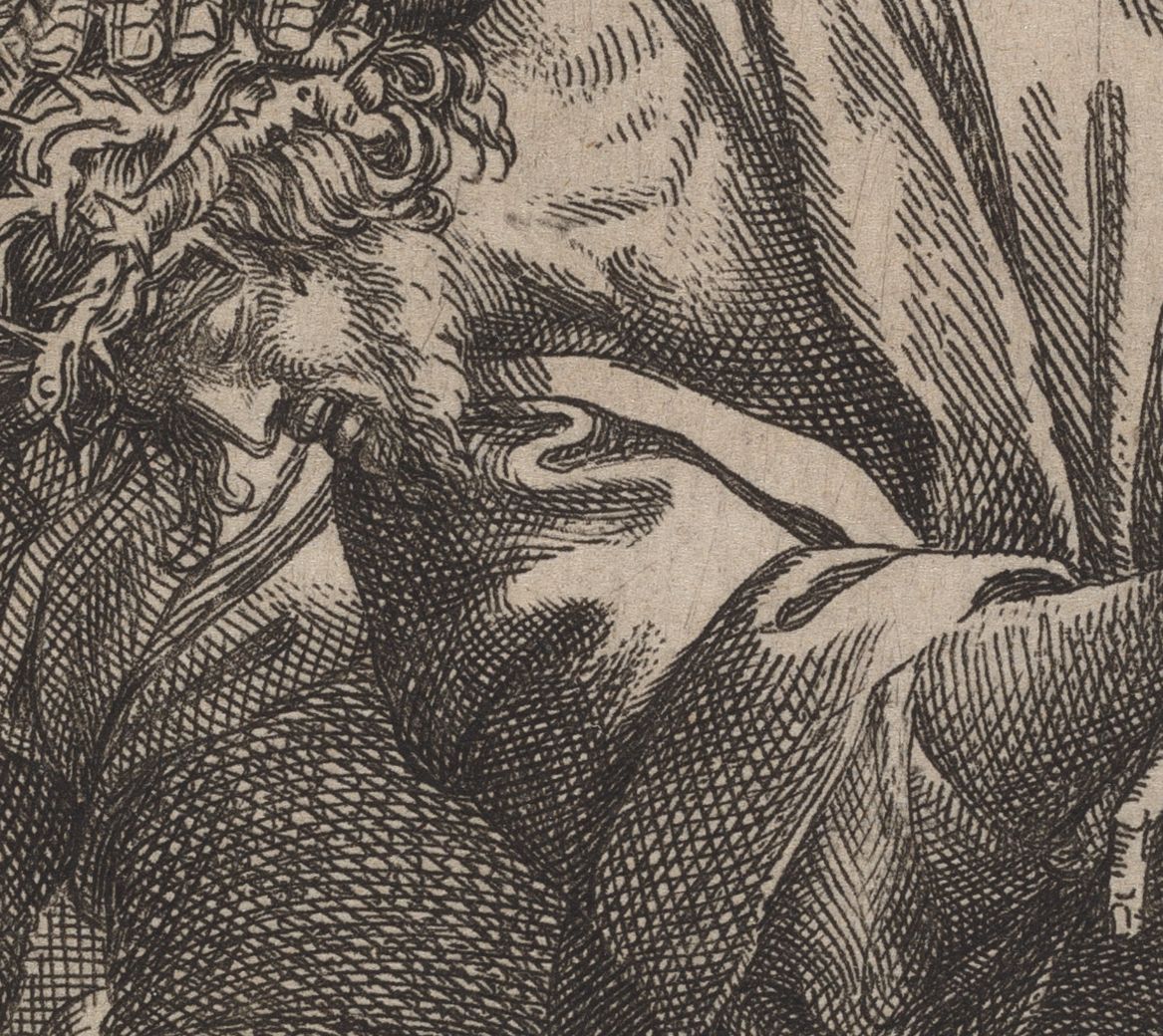
The 1606 Christ Crowned with Thorns brings the event much closer. A soldier bends in from the left of the seated Christ, while another thrusts a reed across from the right. The men make a tight enclosure around Christ's lowered head. Uneven shadows in their faces and clothes make his stillness more conspicuous. The print revisits the subject of Annibale's Bologna painting and gives it a different arrangement. Chatsworth holds a preparatory drawing with incisions for transferring the design. The Met documents the print's circulation through numerous copies, and its catalogue of Valentin de Boulogne identifies the soldier's gesture as a model for Valentin's early painted version. Here a painter made his own print and the printed invention fed back into painting. [3] [22] [23]
The Drunken Silenus and the Farnese silver
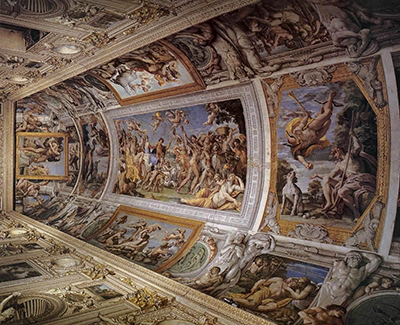
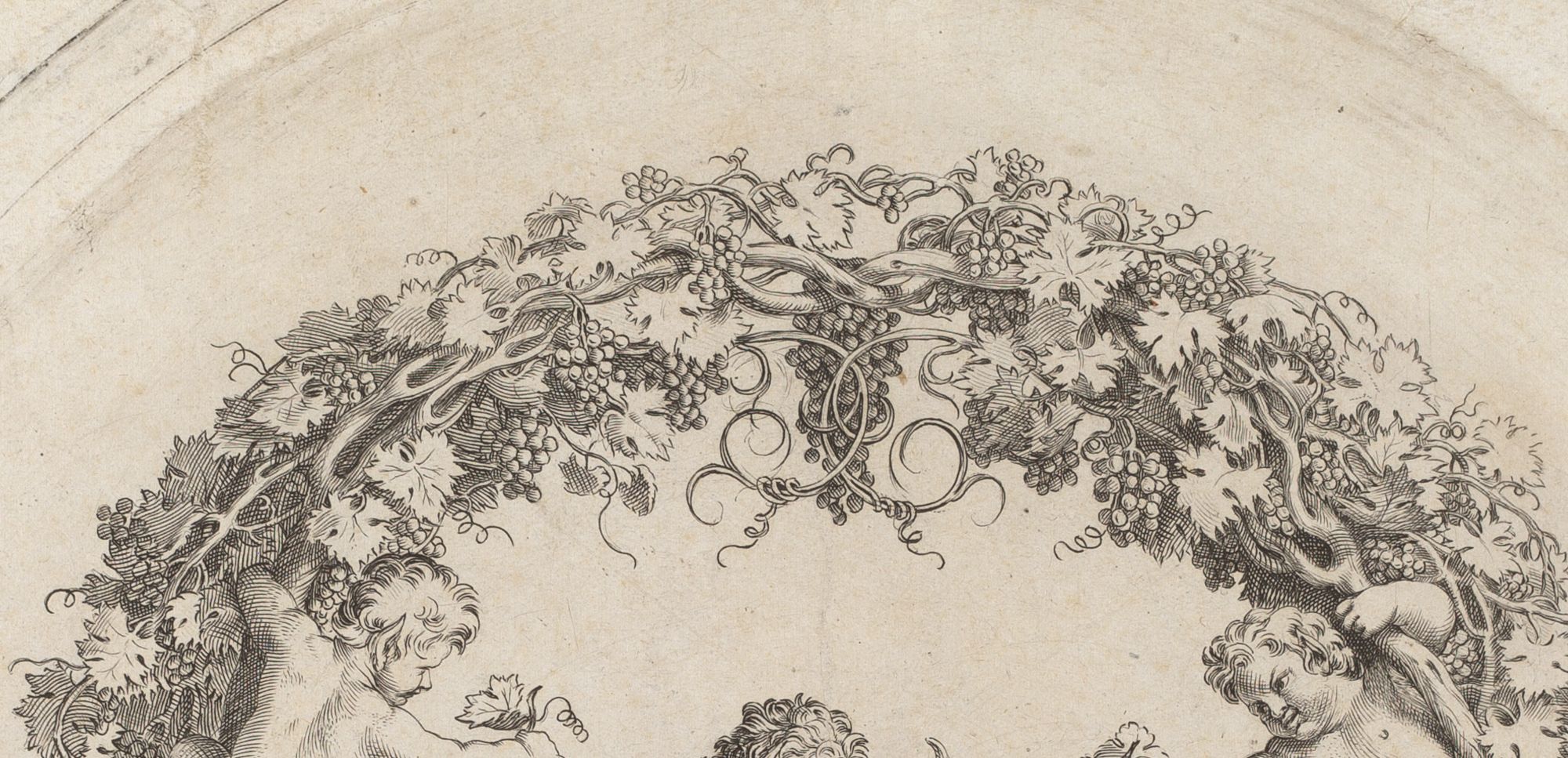
The Drunken Silenus belongs to the making of a silver vessel for Cardinal Odoardo Farnese around the turn of the seventeenth century. Look at the perimeter before the figures. Vines curve around the group and putti move along them, reaching in with grapes. In the centre a satyr and a youth give the sprawling Silenus more wine. The composition uses the round shape of the proposed vessel to bring the action back to its centre. The setting differs from the procession in the Triumph of Bacchus and Ariadne, where Silenus has to be carried along with the crowd. [24] [25]
The surviving drawings show Annibale adapting the design to that shape. The British Museum sheet puts the figures in a landscape inside a wreath, and the study in Chicago brings the group closer together. The finished drawing at the Met is signed and has compass marks and indentations around the design. A substantial part of the arrangement was ready to be transferred to metal. The engraved silver in Naples is a separate object whose precise relationship to the finished vessel is disputed. Otto Kurz identified the plaque in 1955 with the decorated part of the celebrated tazza and argued that impressions were pulled from it early on. Kate Ganz questioned the identification on the quality of the metalwork and the printed lines. The Met now describes the Naples plaque as probably a copy of the original vessel's decoration. [24] [25]
The National Gallery of Art keeps a laid-paper impression under Annibale's name, accession 1964.8.447. Its catalogue follows Bohlin in identifying a single state for that print. Budapest's engraving no. 9395 is from a separate plate by Luca Ciamberlano after Annibale. It reverses the composition and is recorded as the first of two states. Put the images side by side and the exchange of left and right becomes easy to follow through the satyr, the wineskin and the figures in the border. Annibale's design carried from a working sheet to silver and on to paper. Ciamberlano's reversal shows how one more transfer could change the direction of every gesture. [26] [27]
Annotated Details from Prints by and after Annibale Carracci
The numbered points identify visible features discussed in this article. Return from each detail to the numbered overview. Each caption identifies the work shown.
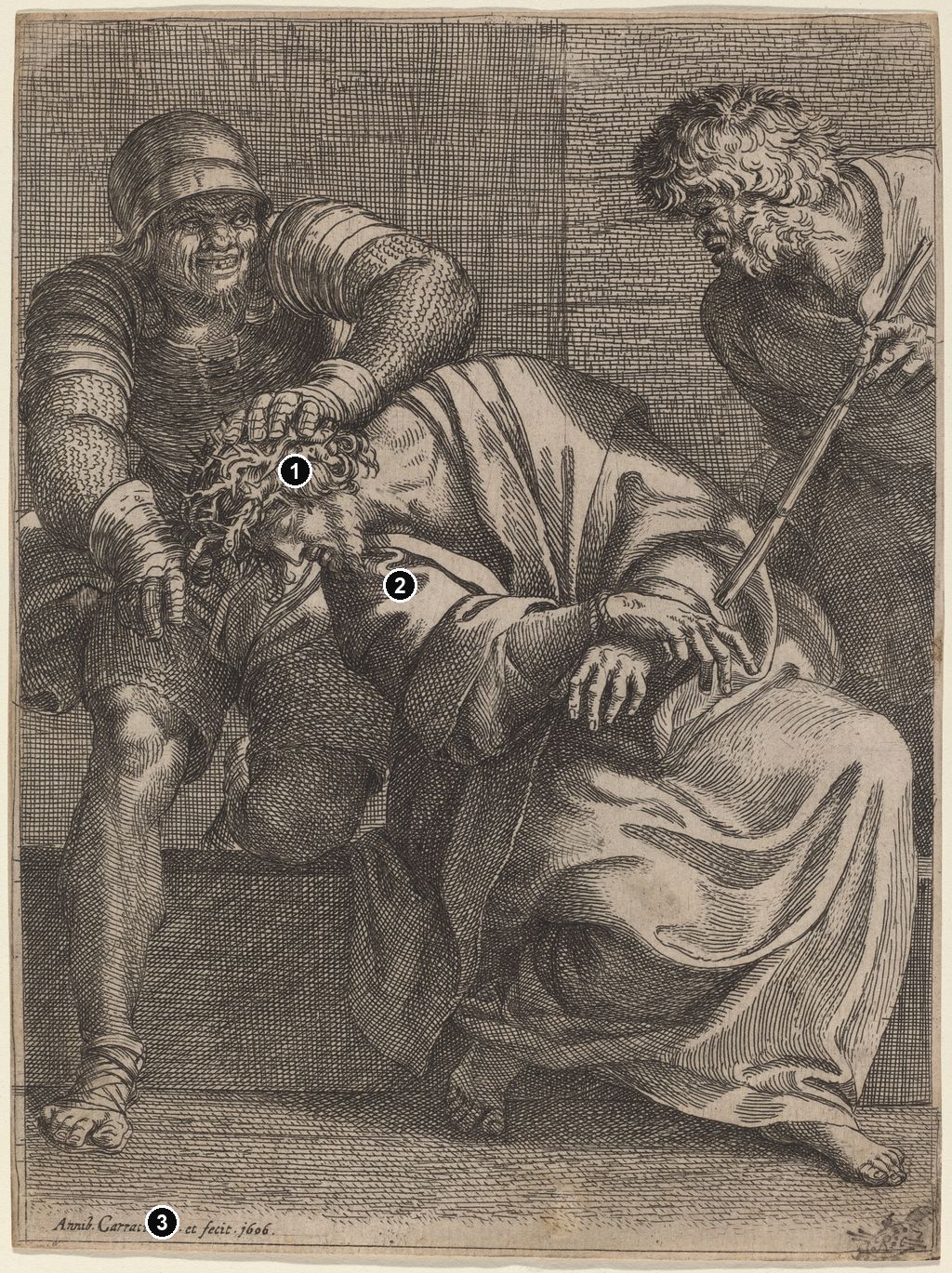
Christ Crowned with Thorns
Annibale Carracci, Christ Crowned with Thorns, 1606. Etching. National Gallery of Art, Washington, 2008.104.14. Image source. CC0 / Public domain.
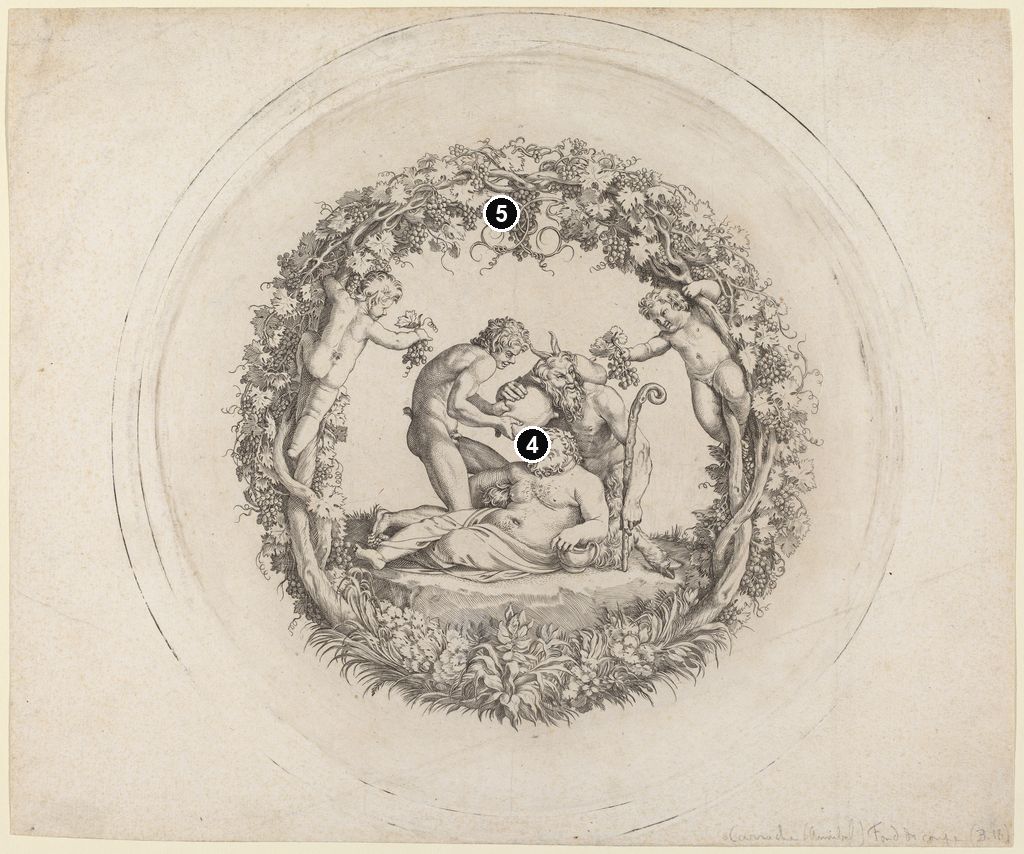
The Drunken Silenus
The Drunken Silenus, paper impression catalogued under Annibale Carracci. National Gallery of Art, Washington, 1964.8.447. Image source. CC0 / Public domain.
Details from PRINTS BY AND AFTER ANNIBALE CARRACCI
Compare the cropped details with the source images above. Notice how their colours, shapes and positions contribute to the larger compositions.
Christ Crowned with Thorns
Hands at the crown
Short dark strokes gather around the hands and the crown. Line density separates the hand in the centre from the darker sleeve behind it.
A downward tilt
Light crosses Christ’s lowered face where there are fewer printed lines. Closer hatching in the surrounding forms makes the cheek and forehead stand out.
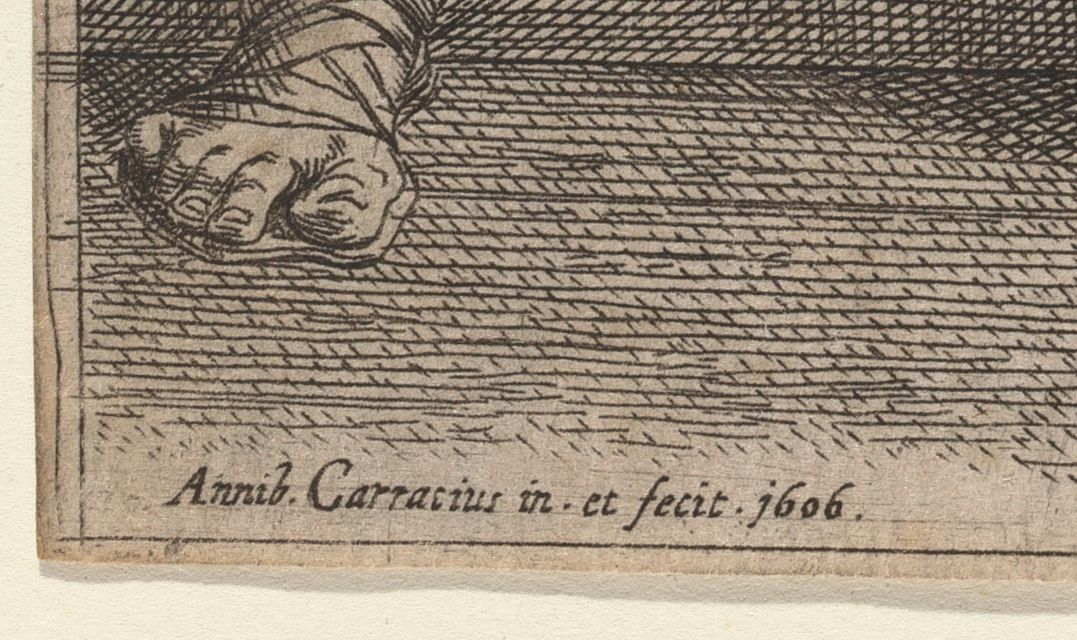
The printed date
The small inscription along the foot of the image includes the date 1606. It belongs to the print and can be read against the lightly marked ground.
The Drunken Silenus
Figures inside the garland
Silenus leans into the figure at his left. Small overlapping gestures are tightly grouped inside the open part of the garland.
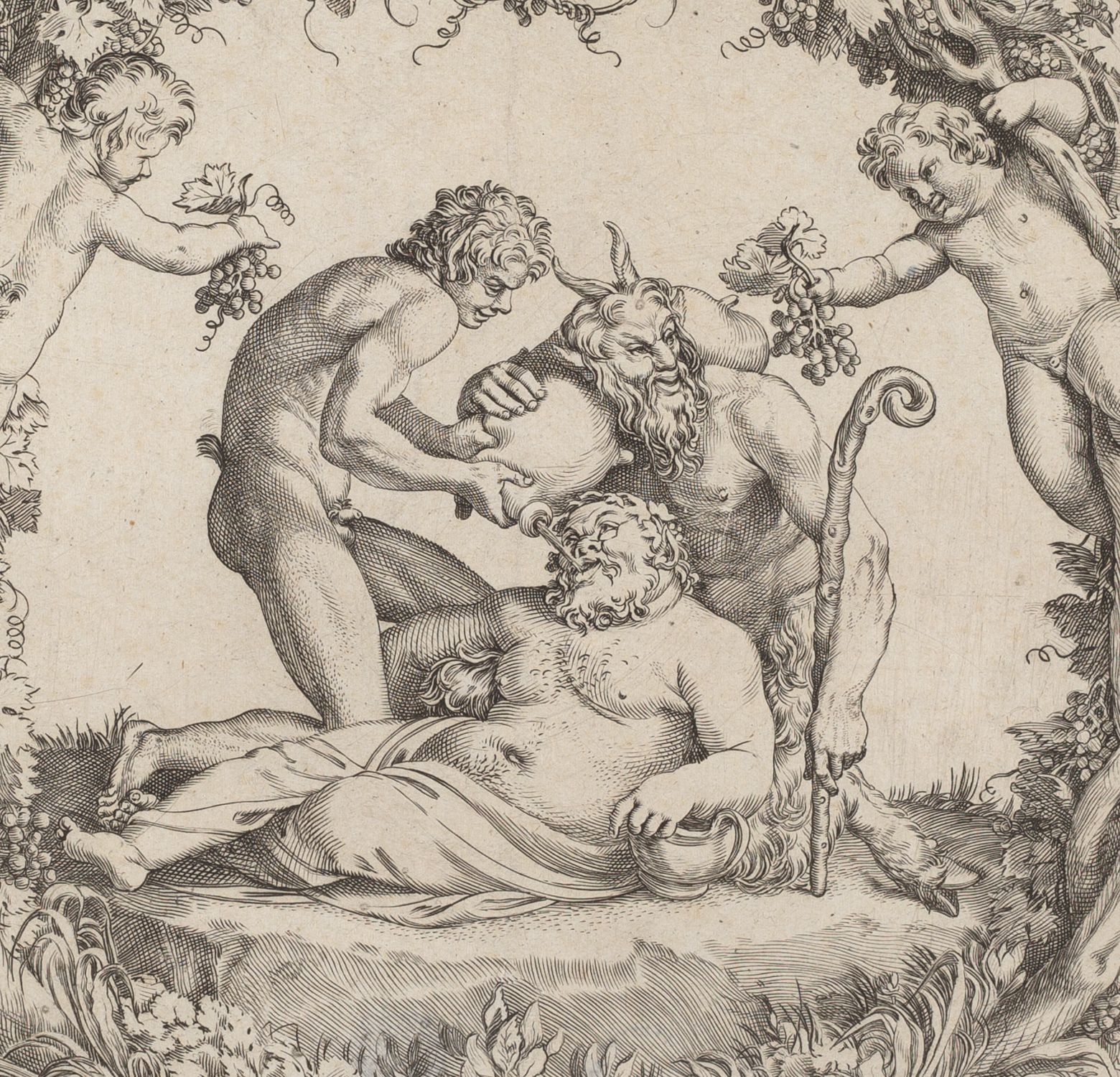
The interwoven border
Leaves, fruit and curved stems form a separate ring around the figures. The regular outer arcs show how the design was organised for a round surface.
Prints after Annibale and prints by Agostino
What the lettering credits
Agostino Carracci's large Crucifixion of 1589 reproduces Tintoretto's painting in the Scuola Grande di San Rocco in Venice. It took three plates to carry the crowd, the three crosses and the activity on the ground. The Rijksmuseum's centre sheet includes the cross of Christ, the mourners and the men looking on from their mounts. Across the assembled sheets, shifts from open hatching to dense engraved shadows give distant figures and nearby bodies their places within the scene. The Dutch catalogue names Agostino as engraver, Tintoretto as painter and Donato Rasciotti as publisher. Those jobs can come together in one maker, as Annibale's design and execution did in the Holy Family, or be distributed among several people. The division of labour is part of the history of the image. [1] [2] [28] [29]
Sometimes the name on a print is the start of the inquiry. In The Madonna and Child with an Apple, Washington identifies Annibale as the artist and Pietro Stefanoni as the publisher. Yet the plate includes a form of Agostino's name and Bartsch placed the print under Agostino. The gallery gives its trimmed sheet as the second state under Bohlin's Annibale entry. Beside a firmly documented Agostino engraving such as the Crucifixion, this small mother and child shows why catalogue attributions are worth reading alongside inscriptions, even when the letters themselves appear quite clear. [2] [30]
From paintings and drawings to new audiences
A painter's work could circulate while the panel or canvas stayed put. In Washington's Saint Roch Distributing Alms, dated 1610, the catalogue names Guido Reni and Francesco Brizio and identifies Annibale as the originating painter. Read the etching on laid paper alongside the altarpiece in Dresden. The print gives the eye a different way of finding the saint amid the crowd. Movement and changes of light across a large painted surface become denser or more open arrangements of ink. [31]
The Farnese Gallery and the smaller Camerino reached readers through different Roman publications. The Italian national catalogue traces the plate of Pan and Cupid to Carlo Cesio's Gallery series, issued in 1657 by François Collignon, the year Giovanni Pietro Bellori published his account of the scenes. The Museo Leone sheet belongs to Venanzio Monaldini's 1753 edition and still bears the name of another publisher, Arnoldo van Westerhout. Cesio's plates gave readers successive views of the principal figures and stories. A great deal of the ornament that binds those figures together overhead gives way to the single rectangular image and the order of a set. [32]
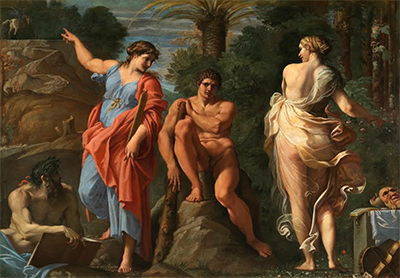
Pietro Aquila's Choice of Hercules belongs to his separate Camerino series. It translates the composition that originally occupied the central position on the smaller room's ceiling. On the National Gallery of Victoria sheet, the lettering under the image acknowledges the painted work by Carracci, the drawing and cutting of the plate by Aquila, and the Roman publication by Giovanni Giacomo de Rossi. Melbourne records both etching and engraving and identifies its sheet as the second of two states. The Aquila plate makes the myth available at reading distance, where the figures of Virtue and Pleasure and the paths they offer can be followed without looking up. [33] [34]
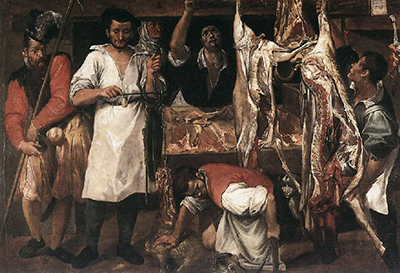
Drawings of everyday work gained a printed audience too. The Beccamorto, a man in the burial trade, is plate 43 of a book of Bologna occupations based on drawings credited to Annibale. The Bibliothèque nationale de France names Simon II Guillain as the maker of the print and locates the volume in Rome in 1646. Kassel calls Annibale the inventor and Guillain the engraver. This is a different route from the painter's attention to working life in The Butcher's Shop. The print gives an individual trade a figure and a caption, then sets it beside dozens of others in a sequence a reader can browse. [35] [36]
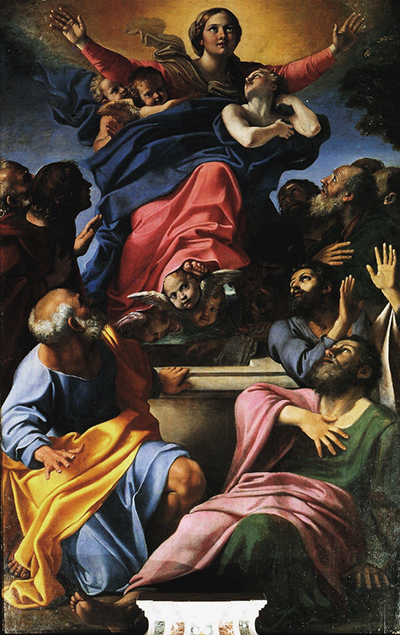
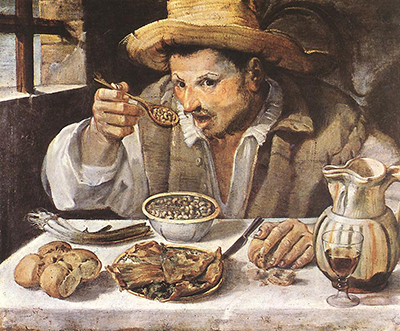
That history explains why the word print can lead to such different objects. A reader looking for an art reproduction today may want an image of The Bean Eater, The Butcher's Shop or the Assumption of the Virgin. For a historic impression, start with a museum's accession number and read across the maker, medium, inscription and state fields. There you can follow the picture from the person who drew it to the person who worked the plate, and from the plate to the particular piece of paper in front of you. [1] [32] [33]
Artworks directory
Paintings, frescoes, drawings and prints, with separate entries for documented versions and collaborative projects.
Discussion
Look again at the images and ideas explored in Prints by and after Annibale Carracci. These editorial prompts invite your observations.
Reader Insights
Which area of a print makes the difference between the etched and engraved marks easiest to see?
How might knowing the printmaker and the designer change an impression’s interpretation?
Join the Conversation
Share a detail, comparison or question about Prints by and after Annibale Carracci below.
References
- National Gallery of Art, The Holy Family with Saint John the Baptist, 1984.82.1. View source.
- Rijksmuseum, Kruisiging van Christus (middendeel), RP-P-OB-35.702. View source.
- National Gallery of Art, Christ Crowned with Thorns, 2008.104.14. View source.
- National Museum of Western Art, Tokyo, 西洋版画を視る―エッチング, exhibition on the etched line and its technique. View source.
- The Metropolitan Museum of Art, Engraving, materials and techniques. View source.
- National Gallery of Art, Pietà (the “Christ of Caprarola”), 1947.7.13. View source.
- Lombardia Beni Culturali / Accademia Carrara, Cristo di Caprarola, anonymous engraving after Annibale, citing Bohn's catalogue. View source.
- National Gallery of Art, Saint Francis of Assisi, dated engraving. View source.
- The Trout Gallery, From Artist to Audience: Italian Drawings and Prints from the 15th Through 18th Centuries, essay 8, analysis of the 1590 Holy Family. View source.
- Detroit Institute of Arts, The Holy Family with Saint John the Baptist. View source.
- Museum of Fine Arts, Budapest, The Holy Family, record 6099, with Bartsch, Bohn and Bohlin state references. View source.
- National Gallery, London, The Holy Family with the Infant Saint John the Baptist, NG6597. View source.
- National Gallery, London, Larry Keith, Annibale Carracci's ‘Montalto Madonna’, National Gallery Technical Bulletin 29, technical examination and illustrated comparison. View source.
- Fondazione Carisbo, Sacra Famiglia con San Giovanni Battista, 4598, first state, changes to the plate and copies. View source.
- Irbit Museum of Fine Arts, Сусанна и старцы, Г-1732, Russian exhibition record on technique and point of view. View source.
- National Gallery of Art, Susanna and the Elders, 1976.48.1, first state. View source.
- National Gallery of Art, Susanna and the Elders, 1972.66.22, second state. View source.
- The Metropolitan Museum of Art, Wilton album, folio 43a: The Christ of Caprarola (The Pietà), with Correggio and Vienna comparisons. View source.
- Regione Emilia-Romagna / Musei Ferrara, Pietà, Palazzo Bonacossi no. 1118. View source.
- Fondazione Carisbo, Pietà o Il Cristo di Caprarola, inv. 4718, historical notes on the second state and the place name. View source.
- Real Academia de Bellas Artes de San Fernando, Piedad (Cristo de Caprarola), C-38-016b. View source.
- The Metropolitan Museum of Art, Wilton album, folio 44a: Christ Crowned with Thorns, with Chatsworth preparatory drawing and reception. View source.
- The Metropolitan Museum of Art, Valentin de Boulogne: Beyond Caravaggio, cat. 7 and fig. 52. View source.
- The Metropolitan Museum of Art, The Drunken Silenus: Design for the “Tazza Farnese”, finished drawing. View source.
- Art Institute of Chicago, Maineri to Miró: The Regenstein Collection since 1975, pp. 20–23 and notes on the drawings and the Naples plaque. View source.
- National Gallery of Art, The Drunken Silenus (“The Tazza Farnese”), 1964.8.447. View source.
- Museum of Fine Arts, Budapest, The Drunken Silenus (The Tazza Farnese), Luca Ciamberlano after Annibale Carracci, no. 9395. View source.
- Allen Memorial Art Museum, Oberlin College, Agostino Carracci, The Crucifixion, notes on the multi-plate composition and the Venetian original. View source.
- Wellcome Collection, The Crucifixion of Christ (‘The Great Crucifixion’), 24605i, Agostino Carracci after Tintoretto. View source.
- National Gallery of Art, The Madonna and Child with an Apple, 2008.104.10. View source.
- National Gallery of Art, Saint Roch Distributing Alms, 2018.113.4, etching associated with Guido Reni and Francesco Brizio after Annibale. View source.
- Ministero della Cultura, Pan e Cupido, Italian general catalogue and technical description, 0100214979-4. View source.
- National Gallery of Victoria, The choice of Hercules, Pietro Aquila after Annibale Carracci, work 34343. View source.
- Museo e Real Bosco di Capodimonte, Angela Caròla-Perrotti, Ercole al bivio, Q 365, account of Camerino placement. View source.
- Bibliothèque nationale de France, Beccamorto, plate attributed to Simon II Guillain after Annibale Carracci, Roman series of 1646. View source.
- Hessen Kassel Heritage, Beccamorto, series plate 43, German collection record. View source.