 by Tom Gurney
Tom Gurney BSc (Hons) is an art history expert with over 20 years experience
Published on June 19, 2020 / Updated on November 29, 2026
Email: tomgurney1@gmail.com / Phone: +44 7429 011000
Christ and the Samaritan Woman: Introduction
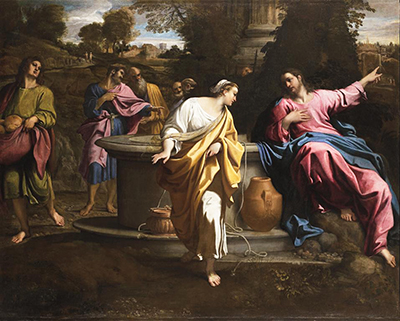
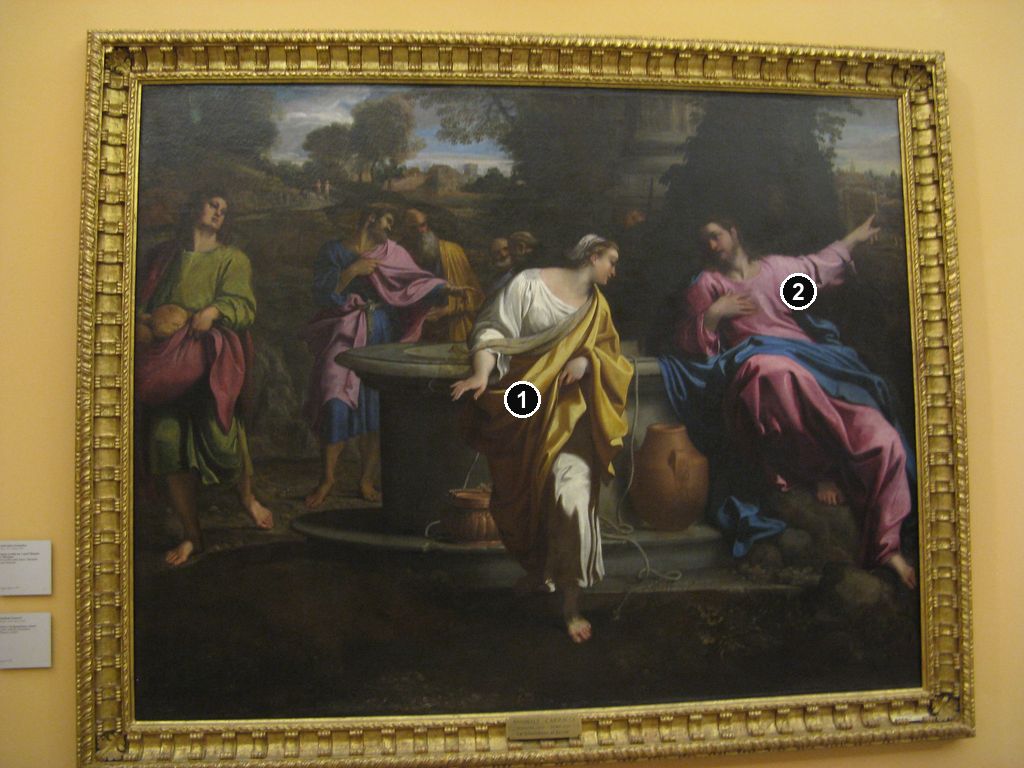
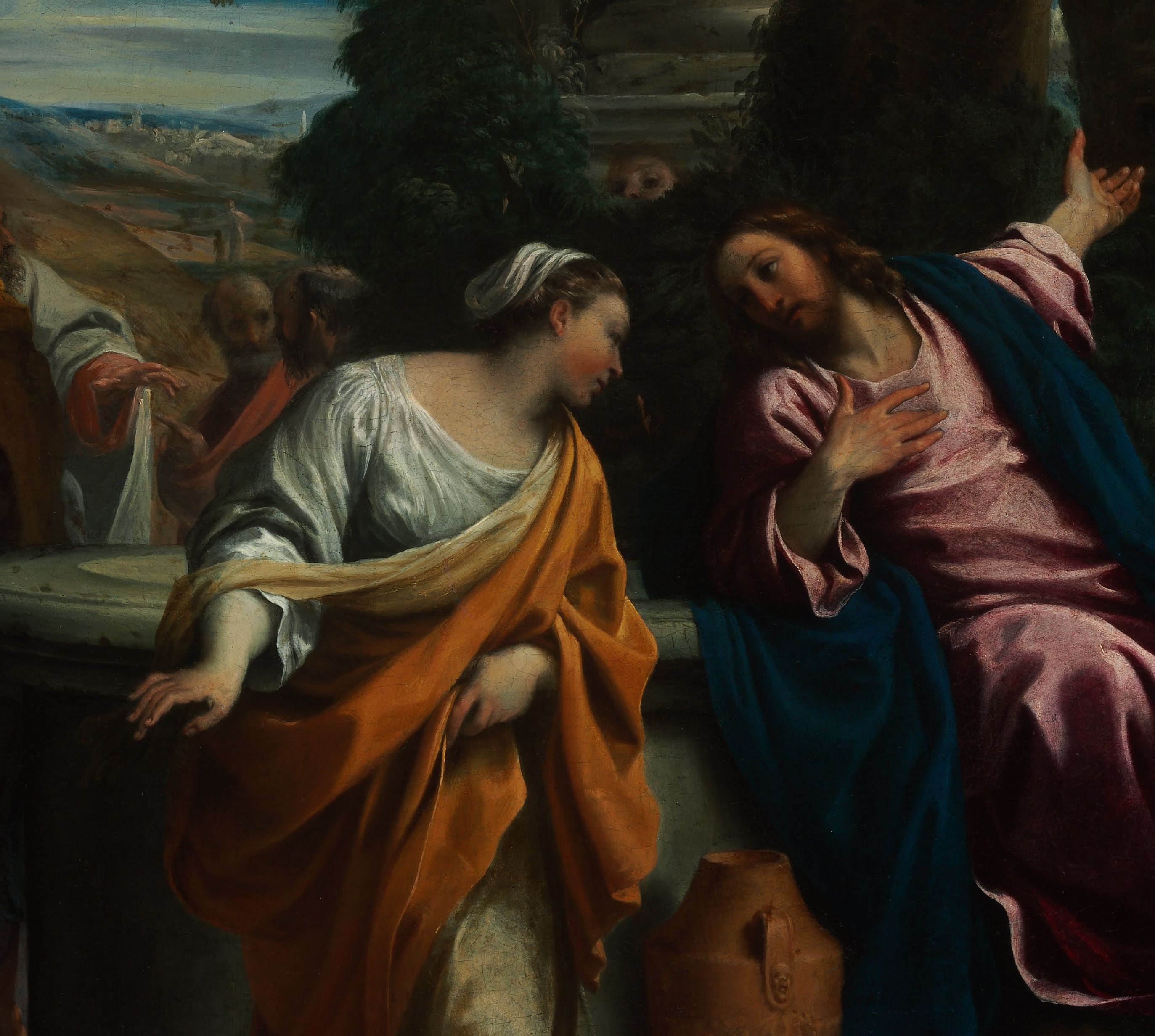
The Samaritan woman has one hand on the well and one foot on the ground below it. Her body is already turning away, but her face is still turned towards Christ. He touches his chest with one hand and points into the distance with the other. Annibale Carracci gives the two figures enough space for us to follow each movement, then holds them together with a glance. Behind the well, the returning disciples try to make sense of a conversation they have only just come upon. [1] [2]
This is the large horizontal painting made for Palazzo Sampieri in Bologna, now in the Pinacoteca di Brera in Milan. The oil on canvas measures 170 × 225 cm and is recorded as inventory 104. Brera’s English catalogue dates it to 1594–95, while its Italian entry gives 1593–94. It was made to hang above a doorway as one of three Gospel scenes, each painted by a different member of the Carracci family. Annibale returned to the encounter at the well in other works, including the smaller, upright picture in Budapest. [1] [2] [3] [4]
At a Glance
- ArtistAnnibale Carracci
- Date1594–95
- MediumOil on canvas
- Brera versionPinacoteca di Brera, 104. 1594–95, 170 × 225 cm. Part of the Sampieri series.
- Budapest versionMuseum of Fine Arts, 3823. About 1596–97, 76.5 × 63.5 cm.
Contents
- A conversation at Jacob’s well
- The well, the light and the figures behind it
- Three paintings for Palazzo Sampieri
- The composition in print and in other paintings
- Annotated details
A conversation at Jacob’s well
In the Gospel of John, Jesus stops at Jacob’s well near Sychar while his disciples go into town to buy food. When a Samaritan woman comes to draw water, his request for a drink takes her by surprise. She asks why a Jew would ask a Samaritan for water. The conversation turns to the promise of living water, then to where and how people should worship. The woman brings up the difference between Samaritan worship on a mountain and Jewish worship in Jerusalem. She then raises the subject of the promised Messiah, and Jesus identifies himself to her. The disciples return and are surprised to find him speaking with a woman. She leaves her water jar and goes to tell the townspeople about the man she has met. [5]
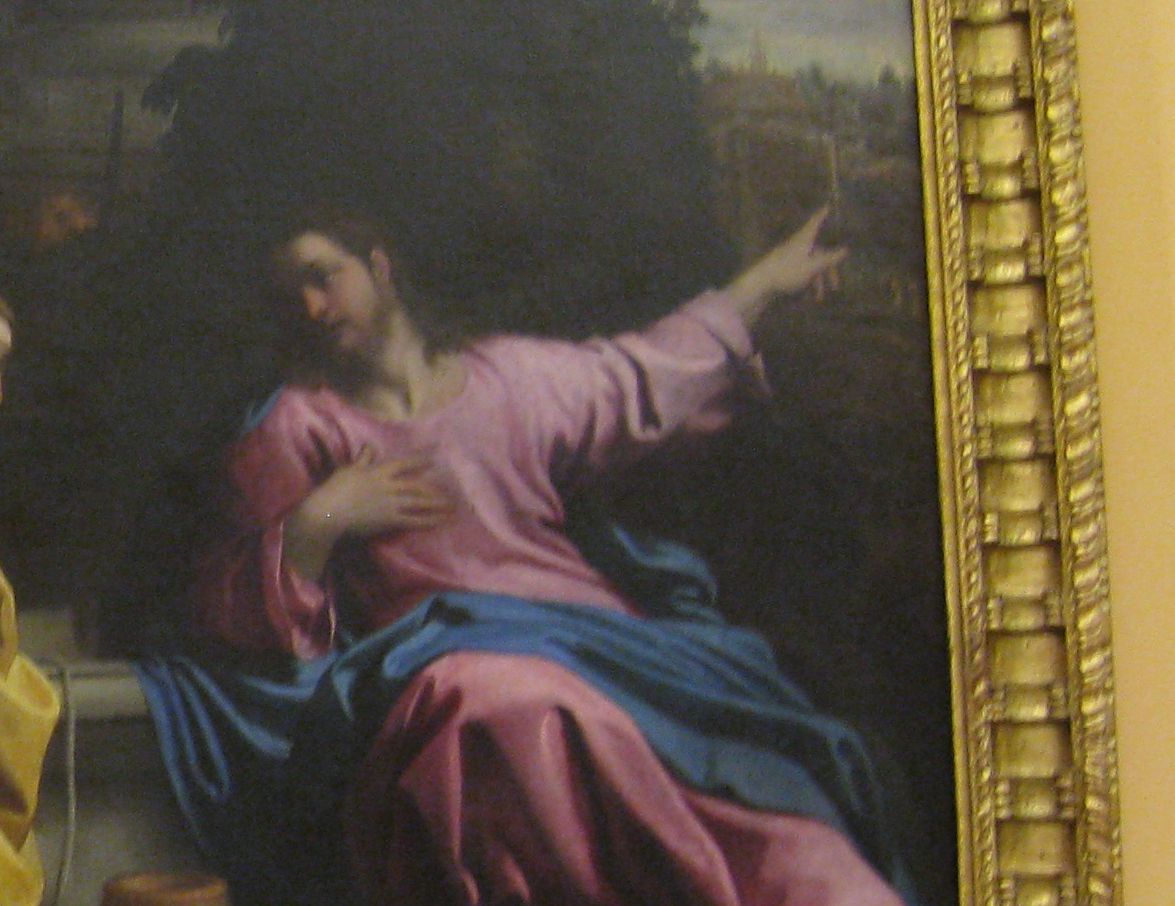
Carracci lets us see several turns in the story at once. The jar is still by the well. The disciples already have their provisions, visible as loaves gathered in the cloak of the young man at the far left. The woman herself appears on the verge of leaving. The hand at Christ’s chest fits the moment of self-disclosure, while the outstretched hand leads the eye towards a distant settlement on the right. The Gospel describes her decision to tell the town through her own words and actions. In paint, the near step down from the well makes that decision visible before she has even left the scene. [2] [5]
The well, the light and the figures behind it
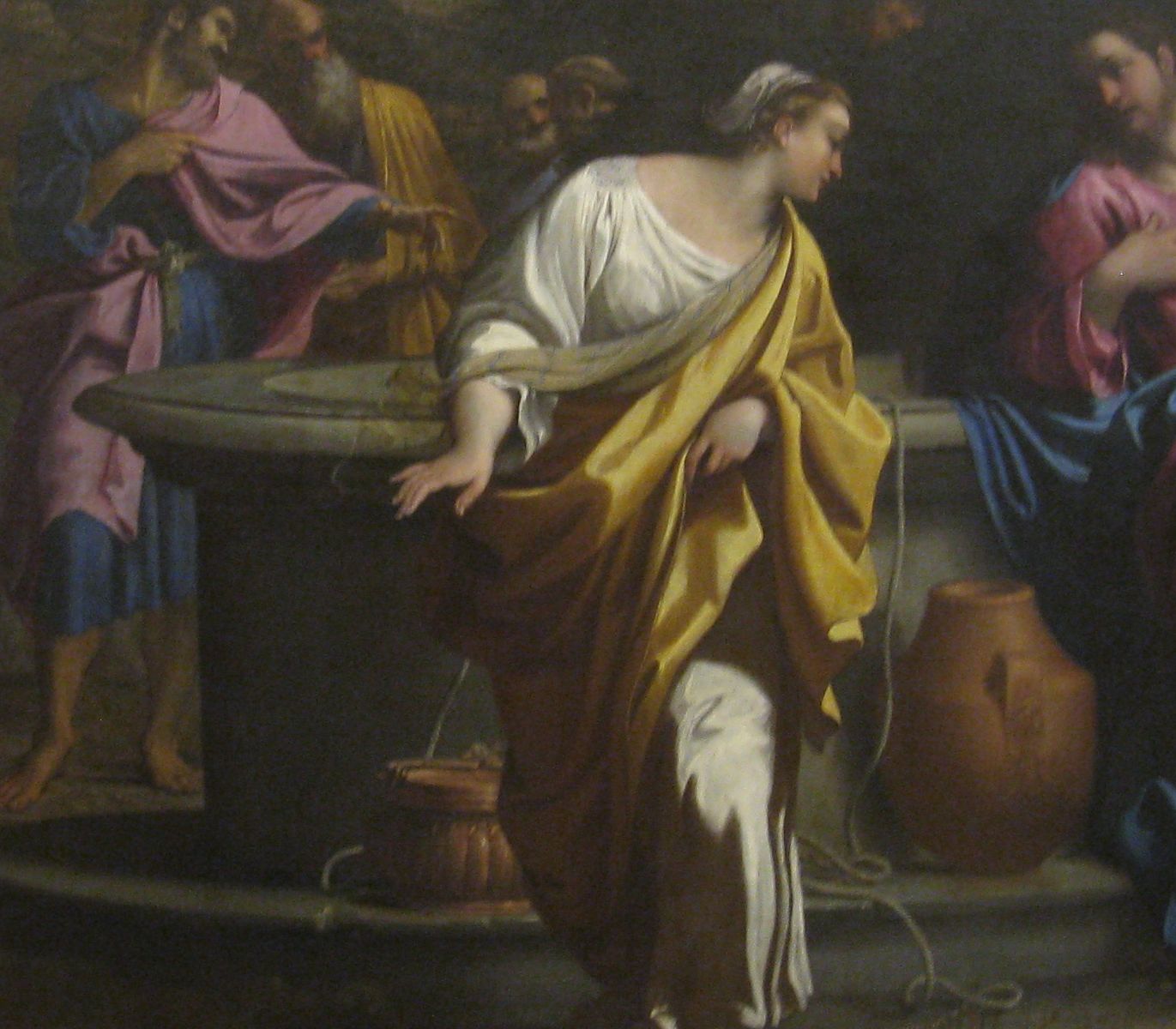
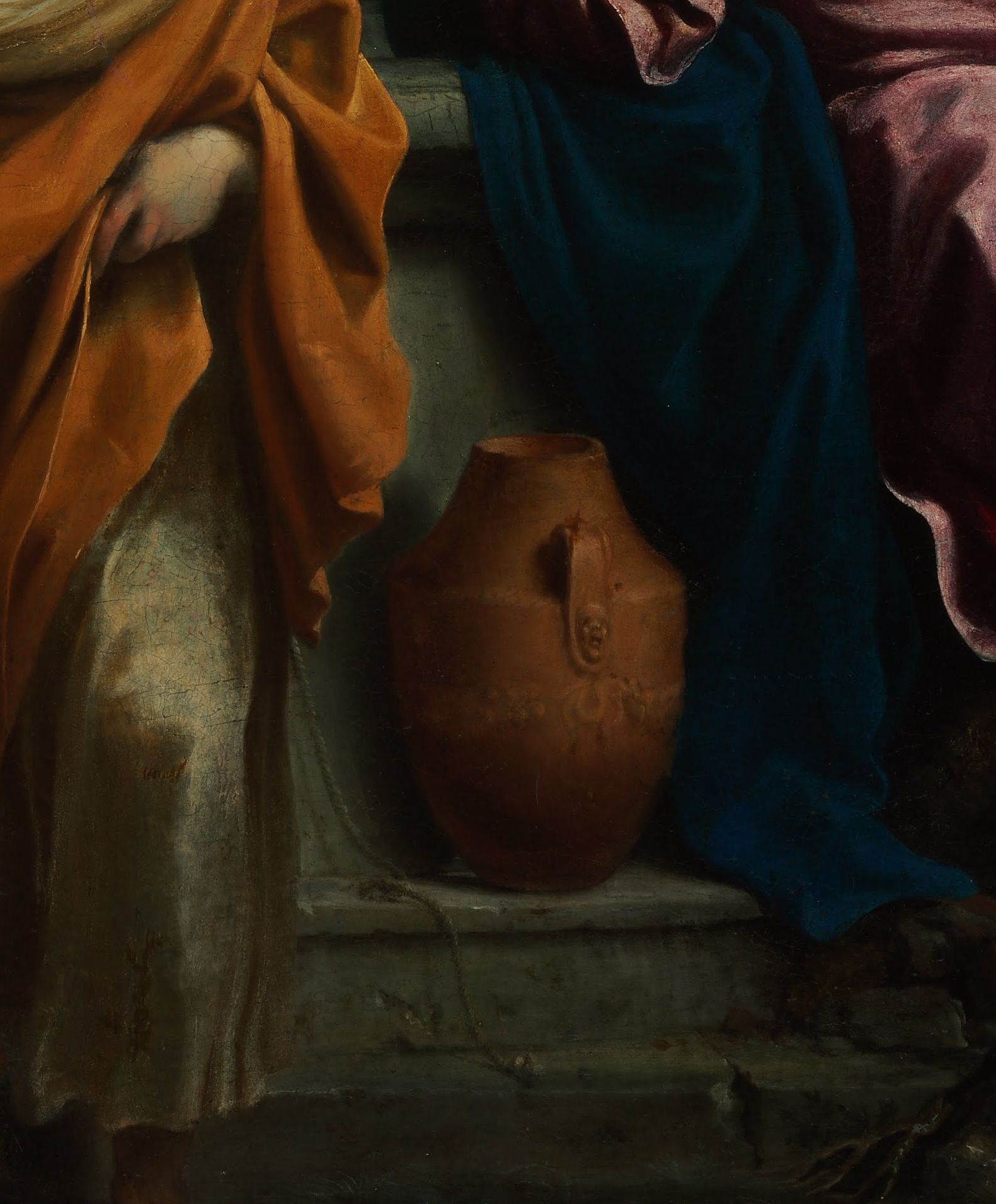
The well occupies much of the middle of the canvas. Its broad stone rim runs out from behind the woman to the left, where it partly screens the disciples. Below, a length of rope lies across the step near the smaller bucket, and the earthenware jar stands between the two main figures. Several kinds of surface meet in this small area. The stone has a broad, worn edge, the rounded jar catches the light on its shoulder, and the rope looks as though it could slide off the step. These objects make the first part of the conversation, about the ordinary work of drawing water, present throughout the scene. [1] [2] [5]
The woman’s pale sleeve and the gold of her mantle catch the light against the stone. Christ’s rose-coloured tunic and blue drapery spread across the rocks, where his knees and bare feet sit at different heights. The two are almost of a scale, though he is seated and she is stepping down. The dark foliage behind their faces makes their exchange of glances clear across the width of the canvas. A fragment of fluted column rises above them. Beyond it lie glimpses of cloud, buildings and distant ground. The landscape gives the woman somewhere to go. Sandrina Bandera, then director of Brera, compared the soft colour of the landscape to Giorgione’s and drew attention to the way Carracci stages his trees at successive depths. The column, foliage and opening to the sky let the eye measure the distance beyond the well. [1] [2] [6]
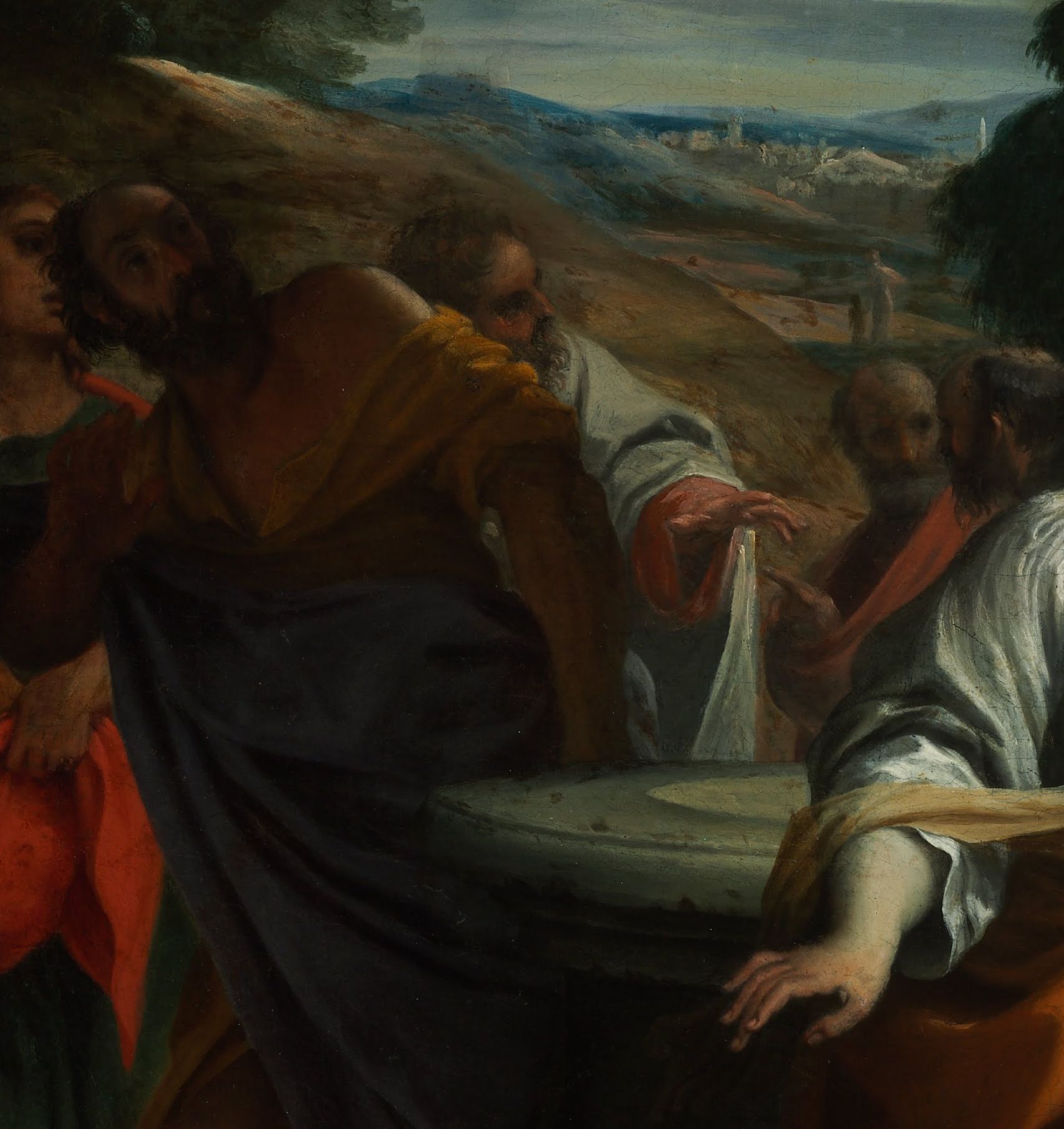
Carracci gives the young disciple with the bread a clear silhouette at the left edge. The older men behind him are more tightly grouped. One gestures towards the encounter, and farther back a pair of heads appears above the well. Their smaller gestures make a quiet counterpoint to Christ’s long reach. The figures span the change from the foreground, where we can follow the turn of a wrist and the weight on a foot, to the middle distance, where two faces and a tilt of the head suffice to suggest a second conversation. [1] [2]
Three paintings for Palazzo Sampieri
Abbot Astorre Sampieri commissioned the three painters to decorate rooms in his family’s palace on Strada Maggiore. Annibale’s brother Agostino painted Christ and the Woman Taken in Adultery, and their cousin Ludovico painted Christ and the Canaanite Woman. All three works are now in Brera’s collection. The shared horizontal format suited their place over the doors. Each canvas gave Christ a different interlocutor and a different kind of encounter. The Canaanite mother presses him to help her daughter. Agostino sets the woman accused of adultery amid men who have brought her for judgement. Annibale gives the woman at the well room to step forward out of the group and carry the news away. [2] [7] [8]
The canvases belonged to rooms that also contained frescoes of the deeds of Hercules. The frescoes still survive on vaults and fireplaces in three ground-floor rooms. In Marinella Pigozzi’s reconstruction, the well scene shared a room with the ceiling painting of Virtue guiding Hercules. The pairing sets a Gospel conversation that changes the course of a life beside a hero being shown the way through his trials. That is one connection a visitor could have made as their eye moved from wall to vault. The task of designing a body for a ceiling or a fireplace produced a different kind of drawing from that of planning an overdoor. Annibale’s Crawling Male Figure at the Metropolitan Museum, drawn in dark chalk or charcoal with traces of white, studies Cacus for a palace fresco. The low, straining figure gives a sense of the physical action the visitor could encounter elsewhere in the same decoration. The woman’s turn at the well is a subtler movement, made legible by the bright fold of cloth and the line of the step. [9] [10] [11]
Antonio Vannugli identifies a sheet in the British Museum as a preparatory composition by Agostino. Cristina Galassi notes that it was formerly given to Ludovico. Annibale made substantial changes in turning the design into paint. The sheet is evidence that one Carracci could work out a design for a canvas another would execute. Another link between the painters is visible in Parma. At the Pinacoteca Stuard, Annibale’s own Christ and the Canaanite Woman shows the mother’s plea in an upright format. Ludovico’s Sampieri canvas had to tell the same story across the width of a doorway. [12] [13] [14]
The Brera canvas stayed with the Sampieri collection until 1811. Francesco Sampieri sold paintings from the family collection in financial difficulty, and the interior ministry of the Kingdom of Italy assigned a group of them to Brera. During restoration in 2011, the gilt frame was identified as the original Sampieri frame. Brera’s Ede Palmieri reported that infrared examination revealed changes made during painting, especially in the figure of Christ. The presence of underdrawing on the canvas remained an open question. The design on paper and the changes on the canvas preserve different stages of the work. Analysis revealed azurite and blue from lapis lazuli used alongside one another in Christ’s mantle. The same two pigments were also used in the sky. For a picture designed to be seen from below, Carracci went to considerable trouble over variations within a single colour. [2] [4] [15]
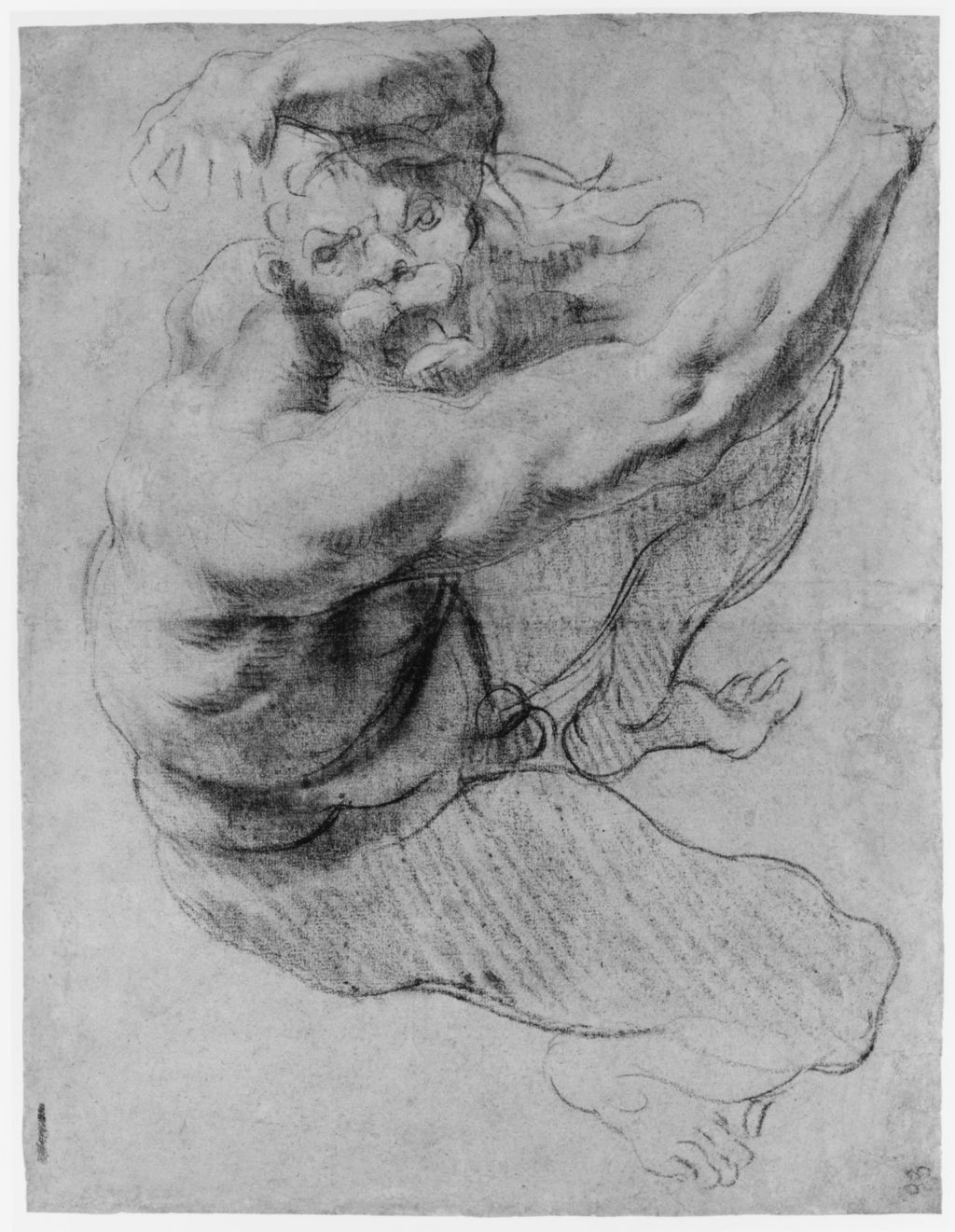
Annibale Carracci, Crawling Male Figure (Study for Cacus). The Metropolitan Museum of Art, 1972.118.244. Image source. CC0 / Public domain.
The composition in print and in other paintings
A large etching after the Sampieri composition retains the open space at the left, the returning group and Christ’s reach across the right. The National Gallery of Art dates the etching to 1595 and lists its publication in 1610. It tentatively credits the etching to Francesco Brizio and names Pietro Stefanoni as publisher. The Rijksmuseum records an impression dated 1610 with Annibale named on it and the older attribution to Guido Reni rejected. The two catalogues agree on the source of the composition. The hand that worked the plate is harder to establish. [16] [17]
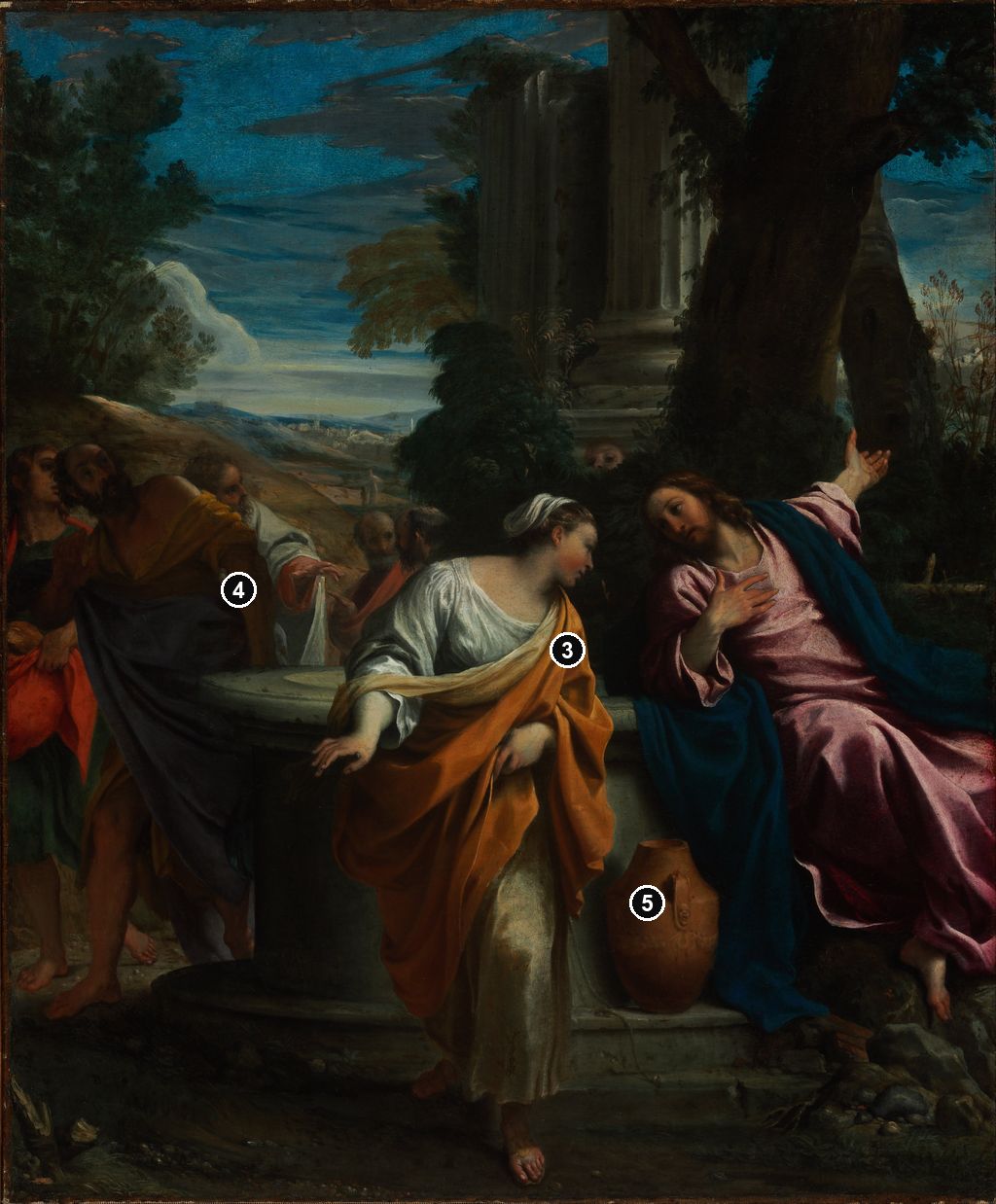
The canvas in Budapest, inventory 3823, measures 76.5 × 63.5 cm, and the Museum of Fine Arts dates it to about 1596–97. Annibale retains the woman’s turn but brings the well and figures into a much tighter space. The upright frame gives the tree and the ruins above the encounter more room, while the disciples gather near the left edge. The small canvas has its own history of print reproduction. In 1649 Carlo Maratta made an etching whose inscription locates the picture in the Degli Oddi household in Perugia. In 1669 Jan de Bisschop made another version, with the design reversed and a dedication to Jan Six. Vannugli uses those inscriptions alongside Bellori’s account of the picture’s sale to Holland to trace its journey. Galassi has argued for an earlier date for the small canvas, so the priority of the Milan painting follows the holding museums’ dating. [3] [12] [13] [18]
In Vienna, Annibale’s version of about 1604–05 opens the scene up into a much wider landscape. For a study published by the High Museum of Art, Kimberly Schrimsher compared Christ’s teaching gesture in that painting with Guercino’s preparatory drawing for the High’s own treatment of the subject. An inventory drawn up by Guercino’s heirs in 1719 records a print after an Annibale Samaritan Woman. The resemblance makes a case for Guercino having looked to a print of the Vienna version. The inventory’s brief description gives the subject but leaves the precise model open. [19] [20]
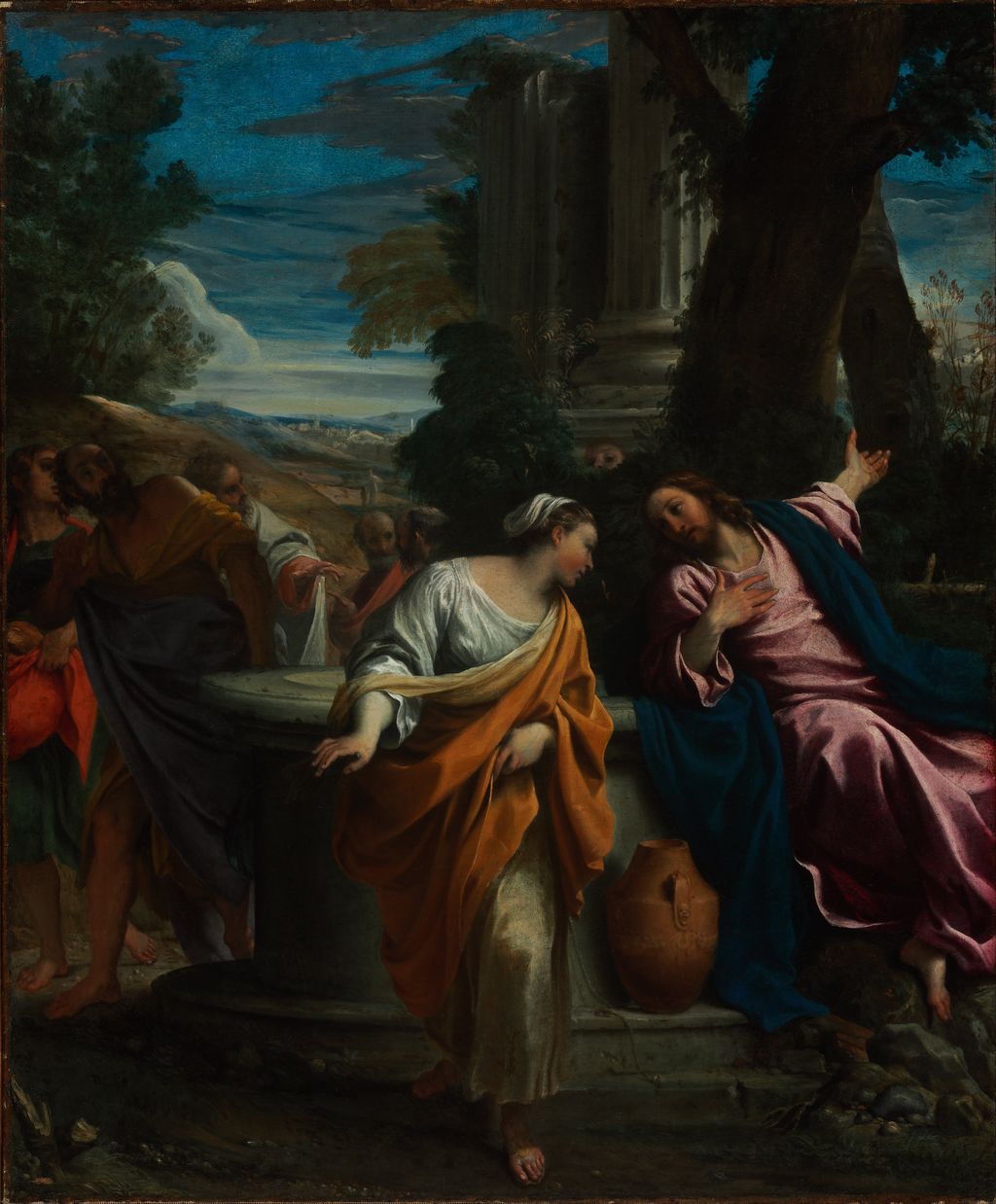
Annibale Carracci, Christ and the Samaritan Woman, Budapest version. Museum of Fine Arts, Budapest, 3823. Image source. Public domain.
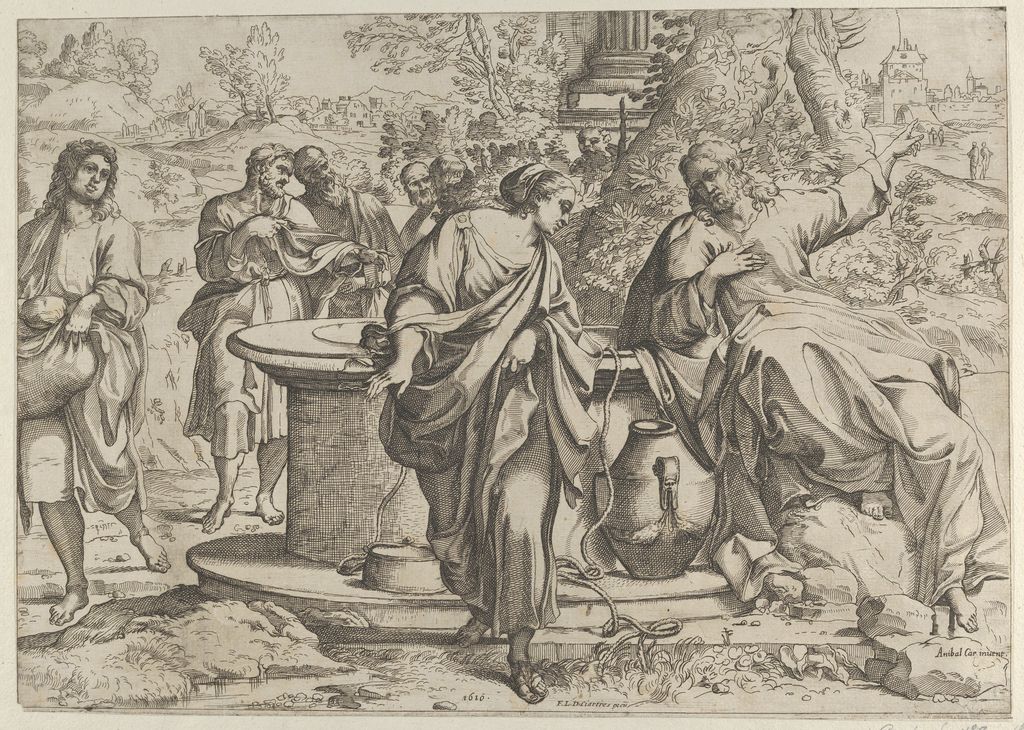
Anonymous print after Francesco Brizio and Annibale Carracci, The Samaritan Woman at the Well. The Metropolitan Museum of Art, 53.600.2203. Image source. CC0 / Public domain.
Annotated Details from Christ and the Samaritan Woman
The numbered points identify visible features discussed in this article. Return from each detail to the numbered overview. Each caption identifies the work shown.
Christ and the Samaritan Woman in Milan
Annibale Carracci, Christ and the Samaritan Woman, Sampieri version. Pinacoteca di Brera, Milan, 104. Photograph by Yair Haklai. Image source. CC BY-SA 4.0. Numbers added to a separate overview. Details cropped from the original photograph. Image derivatives use CC BY-SA 4.0.
Christ and the Samaritan Woman in Budapest
Annibale Carracci, Christ and the Samaritan Woman, Budapest version. Museum of Fine Arts, Budapest, 3823. Image source. Public domain.
Details from CHRIST AND THE SAMARITAN WOMAN
Compare the cropped details with the source images above. Notice how their colours, shapes and positions contribute to the larger compositions.
Christ and the Samaritan Woman in Milan
The well in the wider canvas
The broad rim stretches horizontally in front of the other figures. The composition allows more room to see both the approaches to the well and the gestures across it.
Christ’s gesture at the far right
Christ lifts one arm towards the right edge. The length of the reach helps connect the group to the surrounding landscape.
Christ and the Samaritan Woman in Budapest
The meeting at the well
The woman’s body inclines while Christ’s hand rises beside her. Their opposing movements put the exchange at the centre of the narrow canvas.
The arriving figures
Several figures return along the far side of the well. The dark foreground gestures give way to small, cooler patches around their path.
The vessel below the figures
The large clay vessel sits in half-shadow, near the lower edge of Christ’s robe. It closes the gap between the two figures at the bottom.
Artworks directory
Paintings, frescoes, drawings and prints, with separate entries for documented versions and collaborative projects.
Discussion
Look again at the images and ideas explored in Christ and the Samaritan Woman. These editorial prompts invite your observations.
Reader Insights
Which difference between the Budapest and Brera paintings alters the exchange most strongly?
What part does the well play in organising the conversation?
Join the Conversation
Share a detail, comparison or question about Christ and the Samaritan Woman below.
References
- Pinacoteca di Brera, Christ and the Samaritan Woman, inventory 104 View source.
- Pinacoteca di Brera, DescriVedendo Brera, entry 05 View source.
- Museum of Fine Arts, Budapest, Christ and the Samaritan Woman, inventory 3823 View source.
- Pinacoteca di Brera, Cristo e la Samaritana al pozzo, Italian collection entry View source.
- Gospel of John, chapter 4, United States Conference of Catholic Bishops View source.
- Sandrina Bandera, interview on the restored Samaritan Woman, Vatican Radio, 3 July 2011 View source.
- Pinacoteca di Brera, Ludovico Carracci, Cristo e la Cananea, inventory 96 View source.
- Catalogo Generale dei Beni Culturali, Agostino Carracci, Cristo e l’adultera View source.
- Marinella Pigozzi, La collezione Sampieri, dalla dispersione alla negazione, all’auspicabile valorizzazione View source.
- Metropolitan Museum of Art, Annibale Carracci, Crawling Male Figure (Study for Cacus), 1972.118.244 View source.
- Biblioteca Salaborsa, Casa Sampieri, Bologna’s historic buildings register View source.
- Antonio Vannugli, Il committente del ‘Cristo e la Samaritana’ di Annibale Carracci, Bollettino d’arte 10, pp. 75–96 View source.
- Cristina Galassi, Tra Scannelli, Bellori e Scaramuccia: Cristo e la Samaritana di Annibale Carracci e alcuni dipinti dell’autore delle Finezze de’ pennelli italiani (1674), pp. 203–212 View source.
- Comune di Parma, Annibale Carracci’s Cristo e la Cananea at the Pinacoteca Stuard View source.
- Ede Palmieri’s account of the Brera conservation and analysis, in the June 2011 project announcement View source.
- National Gallery of Art, Christ and the Samaritan Woman, etching after Annibale Carracci View source.
- Rijksmuseum, Christus en de Samaritaanse vrouw, etching RP-P-OB-37.014 View source.
- Rijksmuseum, Carlo Maratta, Christus en de Samaritaanse vrouw bij de put, RP-P-OB-39.090 View source.
- Kunsthistorisches Museum, Christus und die Samariterin am Brunnen, Gemäldegalerie 267 View source.
- Kimberly Schrimsher, Guercino: Christ and the Samaritan Woman, High Museum of Art, figs. 11–13 View source.