 by Tom Gurney
Tom Gurney BSc (Hons) is an art history expert with over 20 years experience
Published on June 19, 2020 / Updated on November 29, 2026
Email: tomgurney1@gmail.com / Phone: +44 7429 011000
Assumption of the Virgin: Introduction
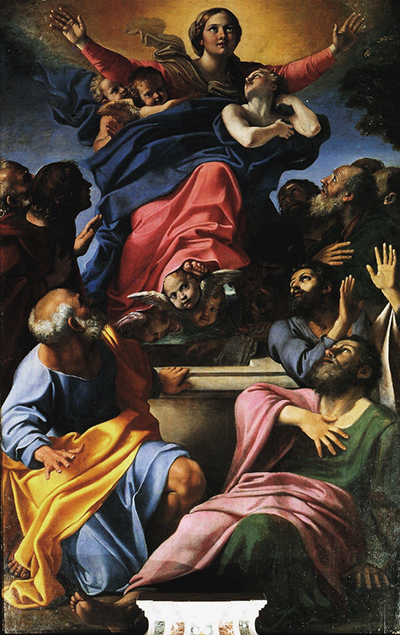
Annibale Carracci painted the Assumption of the Virgin around 1600–01 for the Cerasi Chapel in Santa Maria del Popolo, Rome. Mary rises into a field of gold, arms spread wide, while the apostles crane their necks around her empty tomb. The picture still hangs above the altar for which Carracci made it. From the entrance it faces the viewer directly, with Caravaggio’s paintings of Peter and Paul on the walls to either side. The arrangement gives Mary’s upward movement a destination beyond the top of the picture. In the vault above her, Christ crowns her. [1] [2]
At a Glance
- ArtistAnnibale Carracci
- DateAbout 1600–01
- MediumOil on panel according to Zeri
Contents
- A Roman altarpiece for Tiberio Cerasi
- Around the empty tomb
- Caravaggio on the side walls
- From the altar to the vault
- Other Assumptions by Carracci
- The picture in print and in the chapel
- Annotated details
A Roman altarpiece for Tiberio Cerasi
The chapel takes its name from Tiberio Cerasi, treasurer general to Pope Clement VIII. Cerasi acquired a chapel beside the basilica’s high altar and entrusted its remodelling to Carlo Maderno. Caravaggio’s contract of September 1600 specifies two large paintings on cypress panels for the side walls. The documentation for Carracci’s part is less precise. The Louvre’s catalogue relates the decoration to Cardinal Odoardo Farnese acting for Cerasi. Cerasi died in May 1601 with work on the chapel still in progress. The usual date of about 1600–01 for Carracci’s altarpiece describes when it was painted. The side paintings were installed in 1605. [1] [3] [4] [5]
Fondazione Federico Zeri catalogues the work as oil on panel, 245 by 155 centimetres. The Assumption is tall enough for its figures to have an almost bodily presence from the threshold. The gilded frame encloses a compact gathering with very little space at the edges. A dark tree at the upper right and patches of open sky suggest the setting, but the figures occupy nearly the entire surface. The scale is especially apparent at the bottom, where the foremost apostles crowd the area immediately above the altar. From below, their knees and draperies are the first things that seem to enter the viewer’s space. [1] [6]
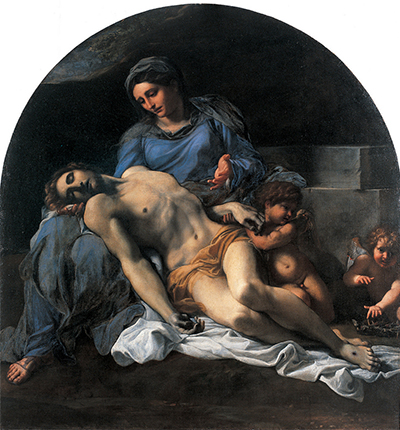
Carracci made the Pietà now in Naples at about the same time, probably for Odoardo Farnese’s private devotion. Its gathering of three figures has the intimacy of a picture made to be seen at close range. At the Cerasi altar, Carracci needed the attitudes of a whole group to register from across the chapel. [7]
Annotated Details from Assumption of the Virgin
The numbered points identify visible features discussed in this article. Return from each detail to the numbered overview. Annibale Carracci, Assumption of the Virgin, Cerasi Chapel, Santa Maria del Popolo, Rome. Photograph by José Luiz Bernardes Ribeiro. Image source. CC BY-SA 4.0. Numbers added to a separate overview. Details cropped from the original photograph. Image derivatives use CC BY-SA 4.0.
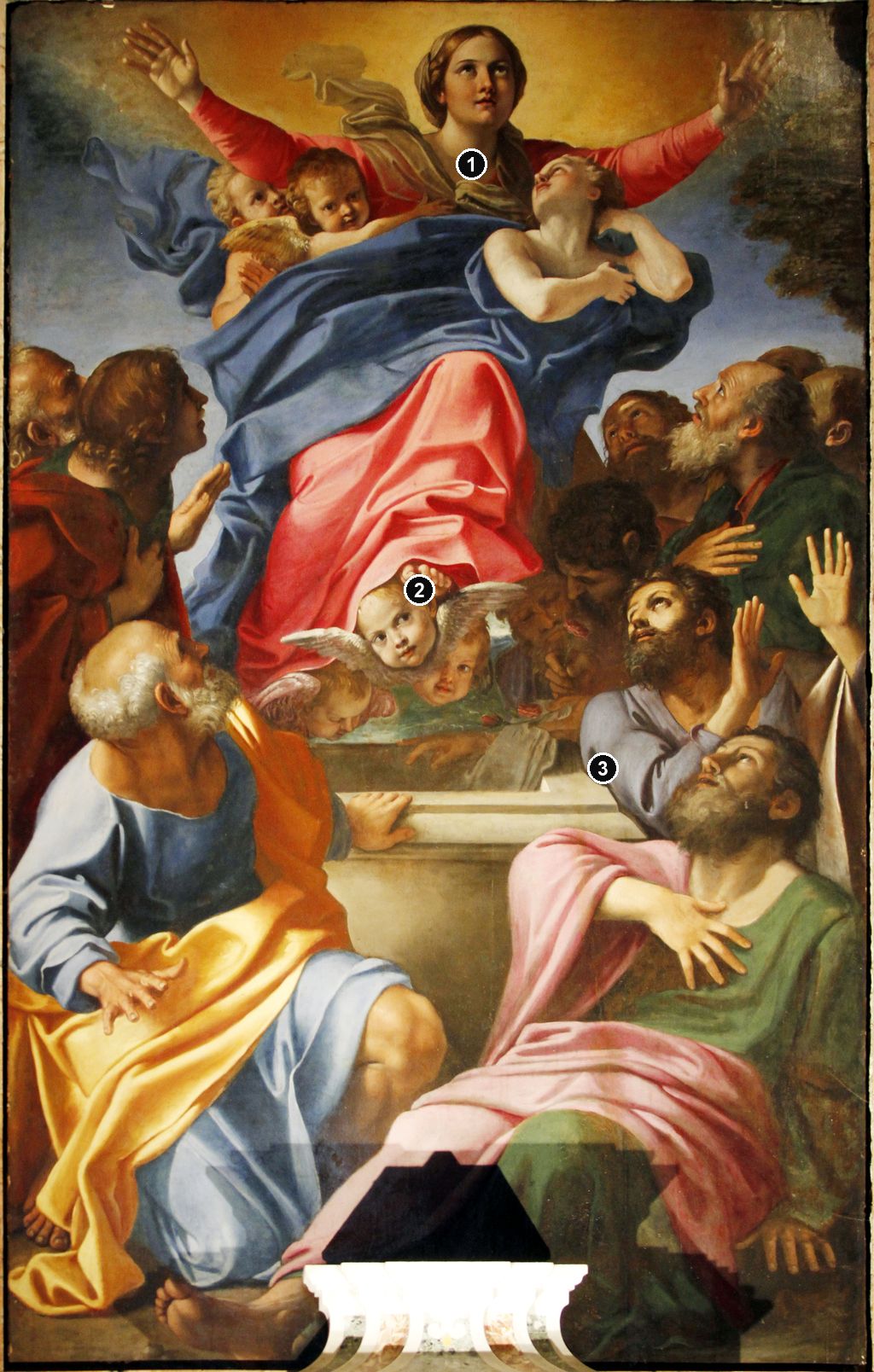
Details from ASSUMPTION OF THE VIRGIN
Compare the cropped details with the source images above. Notice how their colours, shapes and positions contribute to the larger compositions.
Mary’s open arms
Mary extends both arms into the upper corners. Light picks out her face above the blue mantle and the red dress.
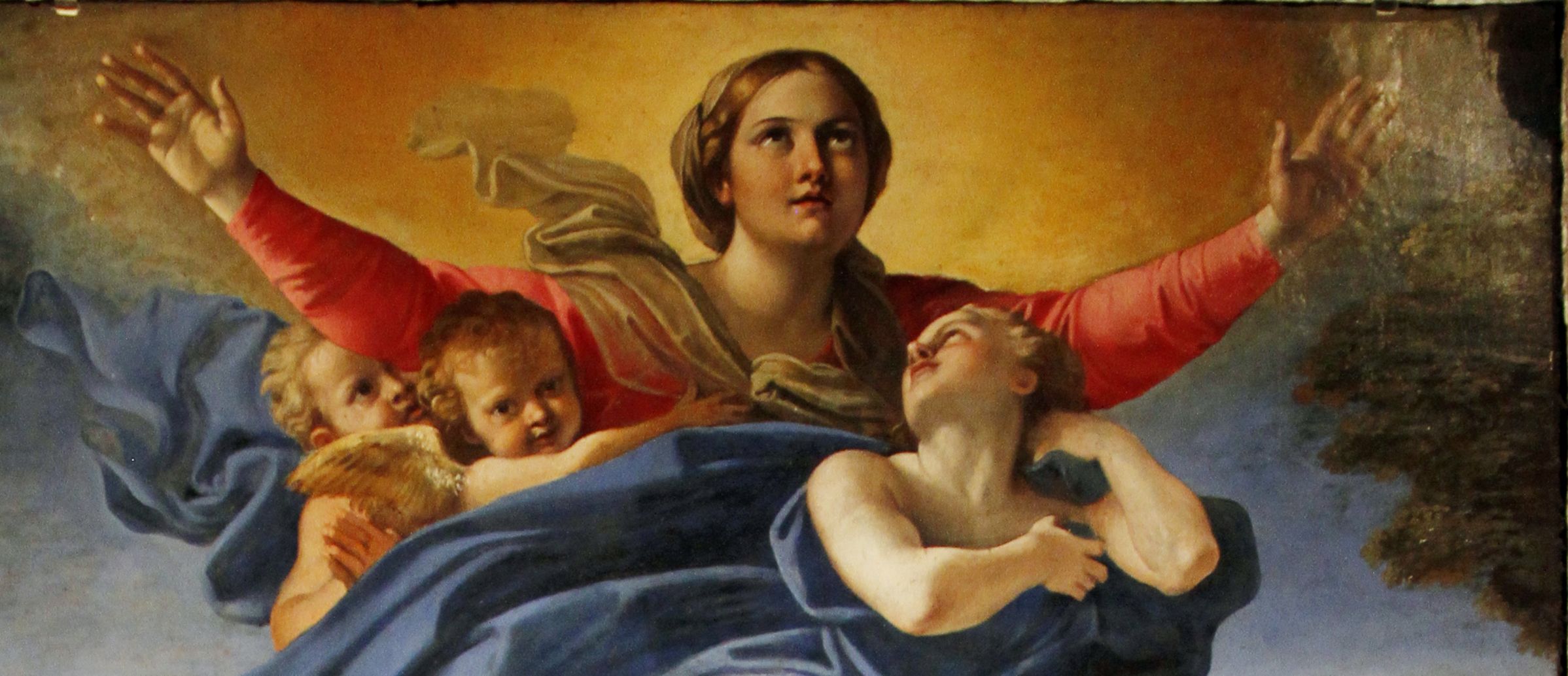
The angels in the middle
Angelic faces punctuate the interval between the rising figure and the witnesses. The visible folds move from blue into red across that tier.
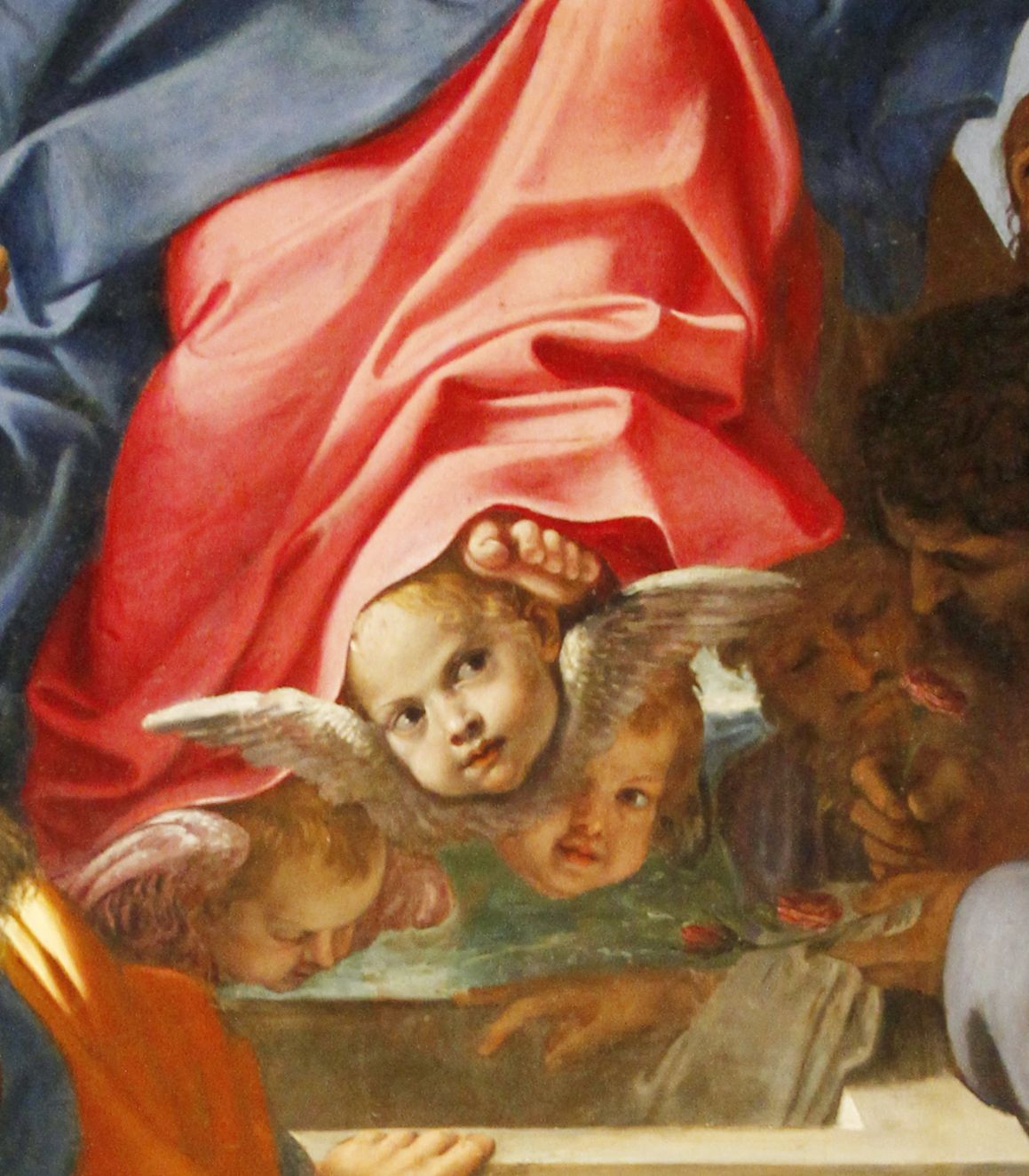
Hands around the tomb
A witness extends a hand across the edge of the tomb. At the right, lifted hands and heads lead the eye toward the upper group.
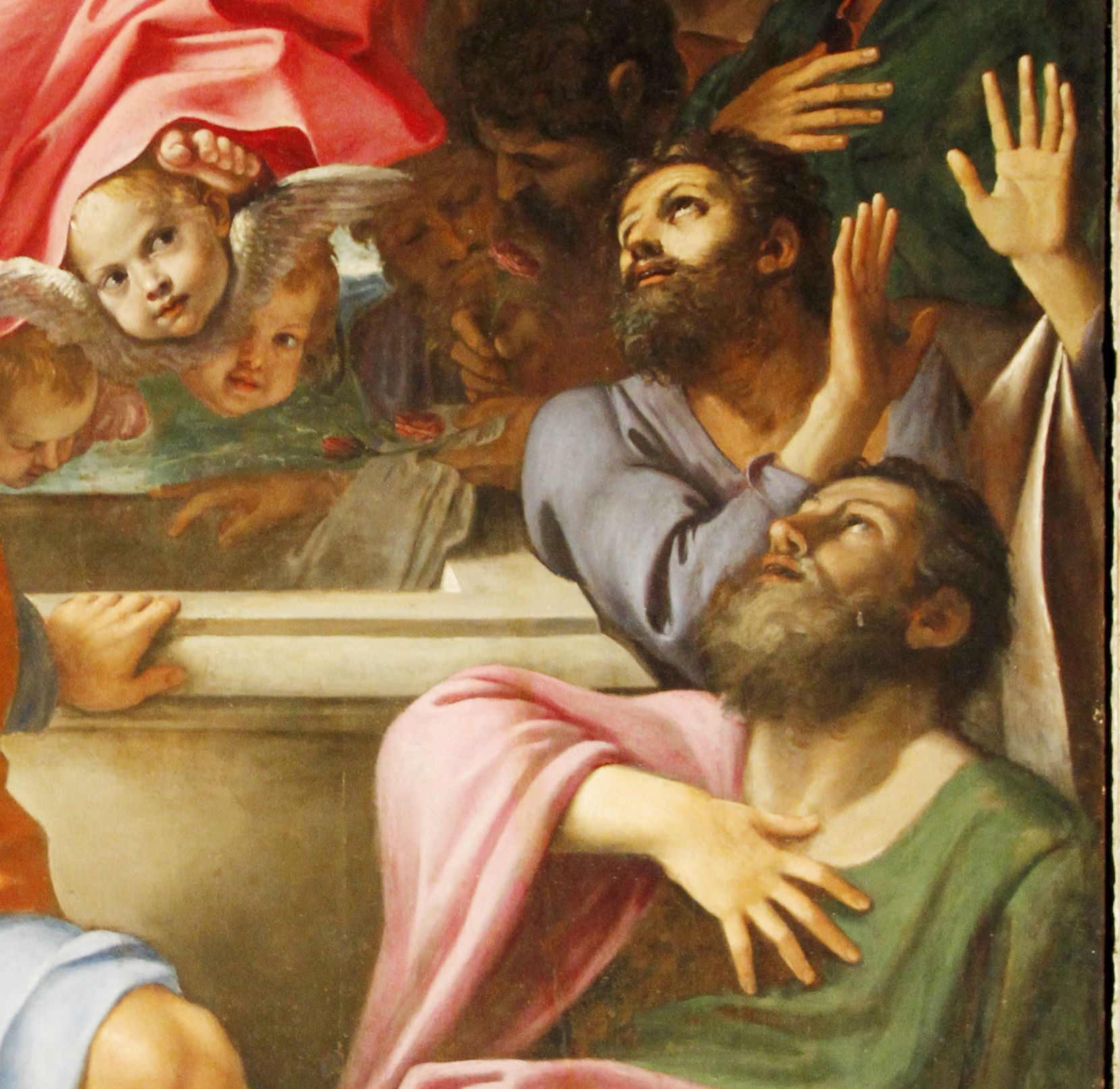
Around the empty tomb
The stone lip of the tomb is the strongest horizontal line in the picture. A bearded man in blue and yellow grips it with one hand as he turns his head sharply upwards. One knee projects into the foreground and the fabric bunches over the other. Across from him, the man in pink and green turns and presses a hand against his chest. Look past these two figures and the responses multiply. One apostle peers into the tomb, others stretch up their hands, and several faces are almost hidden by the people in front of them. The men share a discovery that they come to from different positions. Carracci gives the viewer their experience in stages, from the tangible evidence of the empty stone tomb to what they see above it. [1]
Mary’s body is already well clear of the tomb, though the nearest angels come down almost to its rim. Carracci brings her forward with the bright red fold over her knee and sets that red against a deep blue mantle that cuts sideways across her body. The weight of the folded cloth makes the body beneath it convincing even as the supporting cloud and angels lift her into the light. One angel turns a pale shoulder towards the viewer, bending up towards Mary’s face. Others are visible chiefly as heads and wings. Mary, high above the twisting figures, is nearly frontal. Her outspread arms open up the space that the crowd below has compressed. [1]
The Louvre holds a study of a raised right hand that its catalogue connects to one of the Cerasi apostles. Carracci drew it in black chalk highlighted with white on blue paper, about the time he was making the altarpiece. The blue paper supplies a middle tone between the chalk shadows and the surfaces picked out in white. Isolating a hand gave him room to study the bends of the fingers and the shape of the palm from an angle. In the painting, where a hand may have to register between two heads or against a dark background, the outline alone can carry much of the gesture. [8]
Caravaggio on the side walls
Facing the altar, the viewer has Caravaggio’s Crucifixion of Saint Peter on the left and Conversion of Saint Paul on the right. From the entrance, Carracci’s painting can be seen face on while the lateral paintings are sharply angled. Turning to the left brings the rising diagonal of Peter’s cross into view. On the right, Saul lies foreshortened under the broad flank of a horse. In both paintings, a few large bodies and distinct shapes remain legible when seen from the side. In Carracci’s altarpiece the corresponding long movement is vertical. The position of the paintings asks the viewer to change direction repeatedly, first turning across the chapel and then looking up. [2] [3]
The two painters give light different jobs. Caravaggio lights the men lifting the cross just enough to reveal the effort of hauling, pushing and bracing. In the Conversion, the light falls on Saul and the horse, giving visible form to a moment whose divine cause is outside the frame. Carracci puts the brightest area behind Mary and carries luminous colour down into the apostles’ robes. His picture also has shadows dark enough to swallow much of a face and figures as close to the surface as Caravaggio’s labourers. The difference is easiest to see in what each light draws attention to, whether that is the weight of a body, an overturned man reaching up or a figure rising through the centre of a crowd. [1] [2] [3]
The paintings on the side walls are on canvas, though Caravaggio’s original agreement specified cypress. An earlier Conversion on wood survives in the Odescalchi collection. In it, Christ appears above Saul with an angel, and more figures crowd the action. The Italian Ministry of Culture brought the two versions of the Conversion together in Santa Maria del Popolo in 2006, making their differences unusually easy to see. The first Crucifixion is untraced. Why the two originals were replaced remains disputed, so the affinities between the three pictures now in the chapel give firmer ground for interpretation than guesswork about their personal relationship. [3]
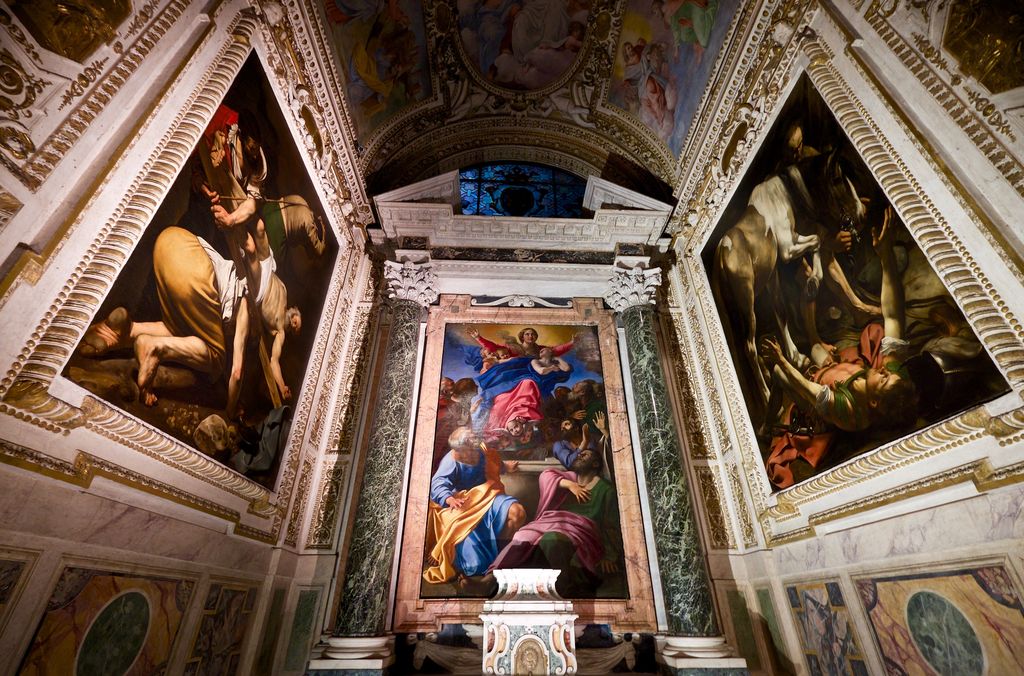
Annibale Carracci’s Assumption above the altar, with Caravaggio’s Crucifixion of Saint Peter at left and Conversion on the Way to Damascus at right. Cerasi Chapel, Rome. Photograph by Frederick Fenyvessy. Image source. CC BY 2.0. Proportionally resized for web display.
From the altar to the vault
Above Carracci’s Assumption, the gilded divisions of the vault outline an oval Coronation of the Virgin and scenes concerning Peter and Paul. Mary’s arrival in heaven can thus be read across two surfaces. The altarpiece follows her from the tomb and the oval supplies the next event. The apostolic stories also continue overhead. Peter appears in the Domine, quo vadis? episode, in which he encounters Christ on the road out of Rome. The Albertina holds two of Carracci’s pen sketches for that compartment, with a city gate behind the figures. The National Gallery in London identifies Carracci’s design for the chapel episode as the basis of a fresco executed by his pupil Innocenzo Tacconi. Carracci’s small painting of the meeting on the Appian Way in London is a separate work. [2] [5] [9] [10]
The Coronation itself shows how drawings and conservation can change the way a decorative commission is understood. The Louvre holds a chalk study by Carracci for the figure of Christ in the oval. Its catalogue notes that the restoration discussed by Annamaria Mignosi Tantillo in 2001 made it possible to assess the quality of the finished fresco and return that compartment to Annibale himself. The evidence for Tacconi’s role in the vault belongs to specific passages of the decoration. Livia Stoenescu has read the chapel as a continuous narrative in which vault and altar extend the stories on the walls. One can follow those relationships by looking from picture to picture. How much the two painters planned together in advance remains uncertain. [2] [5] [10]
Other Assumptions by Carracci
The picture in the Museo del Prado is an earlier and substantially smaller Assumption, about 130 by 97 centimetres and generally dated around 1590. Its columns and distant landscape open up a deeper setting for the tomb. Mary rises diagonally at the upper right, her head turned towards the light across the architecture. The figure sprawled in front of the tomb has room to stretch his legs across the lower edge. In the Roman altarpiece, broadly comparable poses have to fit into a much narrower field. The tomb recedes behind bodies, and Mary claims the centre from one side of the frame to the other. [1] [11] [12]
The Assumption in the Pinacoteca Nazionale di Bologna was made in 1592 for the Bonasoni Chapel in San Francesco. The date appears on the sarcophagus. The museum reads its open space and the landscape beneath the clouds in relation to Venetian painting, particularly Tintoretto. Drawings in the Louvre clarify how Carracci explored the subject at this point. One sheet studies the group of apostles at the bottom of the Bonasoni altarpiece. Another sheet, attributed by the Louvre to the Carracci school, may be an early study by Annibale for the Bologna painting. Catalogue author Catherine Loisel points out that the angel on the left and the outline of the figure at the top are closer to the smaller Prado version. The resemblances show how difficult it can be to assign a drawing of this subject to one of the finished paintings. [13] [14] [15]
The large Assumption in Dresden belongs to an earlier commission again. That 1587 canvas was made for San Prospero in Reggio Emilia. It originally stood at the high altar, in the same church that later received Carracci’s Madonna of Saint Matthew. Its height of roughly 3.8 metres and the original high-altar location make it a different kind of architectural undertaking from the altarpiece at the end of the narrow Roman chapel. The scale of the Dresden canvas also puts the Cerasi painting into perspective. What makes the Roman figures seem unusually close is partly their size, but also the compression of their setting and the short distance from the chapel entrance to the altar. [2] [16]
The title also belongs to a later wall painting made for the Herrera Chapel at San Giacomo degli Spagnoli in Rome. That project used two surfaces to tell the story. The Assumption occupied the upper area above the entrance and the apostles around the tomb appeared in a separate fresco just below it. The two detached frescoes are now in Barcelona. In the Cerasi altarpiece, Mary and the apostles occupy the same painted space. The scene that extends beyond that painting is her Coronation. [17]
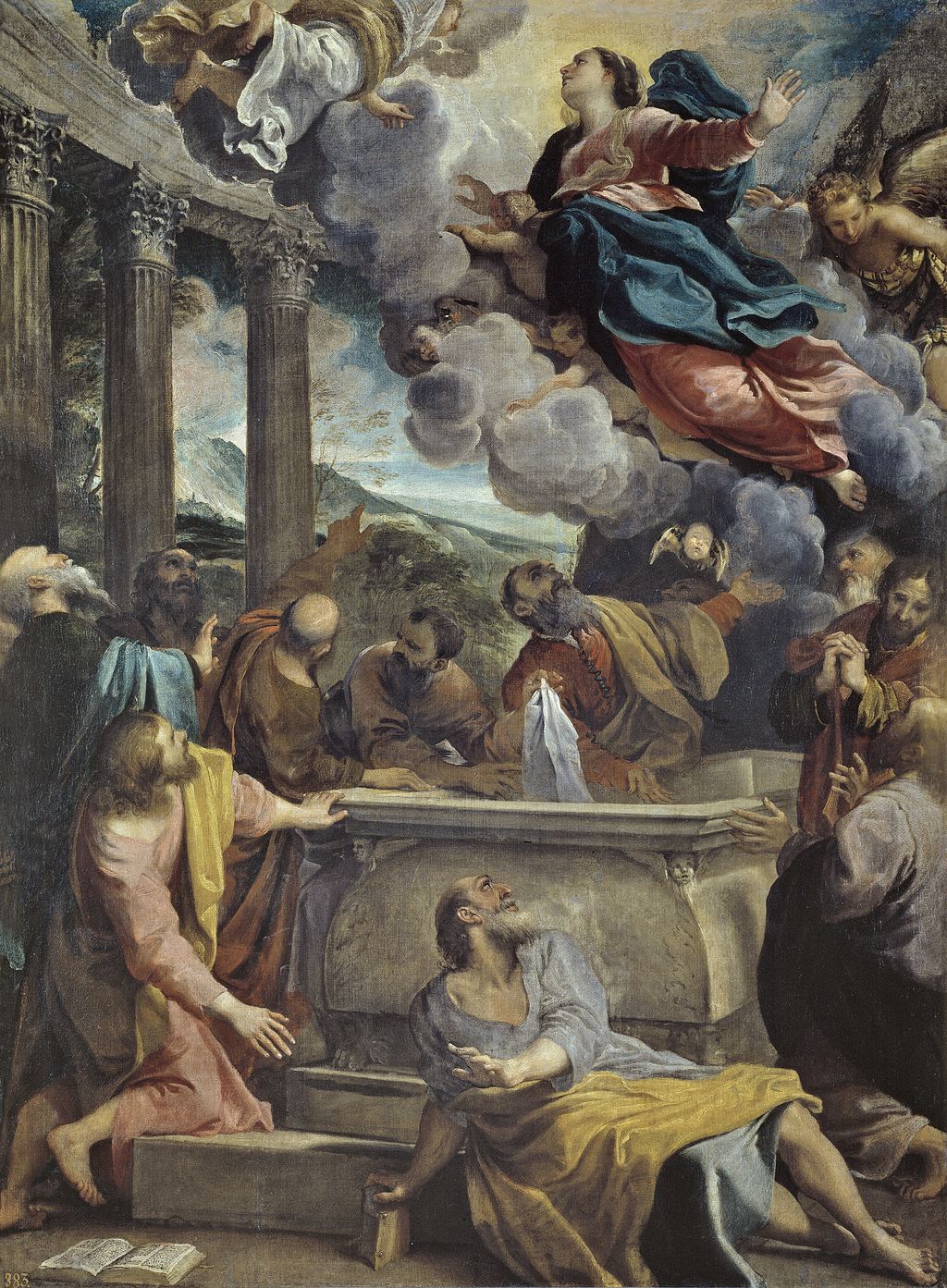
Annibale Carracci, Assumption of the Virgin. Museo Nacional del Prado, P000075. Image source. Public domain.
The picture in print and in the chapel
The Roman altar remained the focus of the chapel, but the composition circulated on paper. The Rijksmuseum preserves an etching and engraving after it by the French printmaker Guillaume Chasteau, dated there between 1645 and 1683. The printed sheet made Carracci’s arrangement available to someone who had never been inside Santa Maria del Popolo. It also stripped away the immediate surroundings that gave the picture its scale, from the altar mouldings to the lateral paintings and the curved vault. [18]
The object in Rome has its own history of repair. The archive-based study of restorations supervised by Vincenzo Camuccini records Giuseppe Candida working on the three chapel paintings in the campaign of 1819–20 and a further restoration of Carracci’s altarpiece in 1861. Giacomini cites the 2001 conservation study’s observations of wear in the dark passages and retouching that extended beyond areas of loss. That evidence shows how difficult it is to assign every mark in the painted surface to one intervention. The chapel still preserves something the separate print or photograph cannot reproduce on its own. The emptiness in the foreground, the flight above it and the scene in the vault unfold as the eye travels up the actual wall. [2] [19]
Artworks directory
Paintings, frescoes, drawings and prints, with separate entries for documented versions and collaborative projects.
Discussion
Look again at the images and ideas explored in Assumption of the Virgin. These editorial prompts invite your observations.
Reader Insights
Which apostle’s gesture first directs your eye upwards?
How does the altarpiece’s position between the side walls of the chapel shape the encounter?
Join the Conversation
Share a detail, comparison or question about Assumption of the Virgin below.
References
- Basilica di Santa Maria del Popolo, Assunzione di Maria (Annibale Carracci) View source.
- Livia Stoenescu, The Visual Narratives of El Greco, Annibale Carracci, and Rubens, section 3.3.2 and figures 70–82 View source.
- Ministero della Cultura, comparison of the two versions of Caravaggio’s Conversion of Saint Paul View source.
- John T. Spike, Caravaggio catalogue, Cerasi documents and entries 24.1–2 View source.
- Musée du Louvre, Le Christ du Couronnement de la Vierge View source.
- Fondazione Federico Zeri, Cerasi Assumption, object 57279 View source.
- Museo e Real Bosco di Capodimonte, the Pietà of Gricci and Annibale Carracci View source.
- Musée du Louvre, Main droite levée, INV 12013 verso View source.
- Albertina, Zwei Skizzen zur Darstellung Domine Quo Vadis mit Stadttor im Hintergrund View source.
- National Gallery, Christ appearing to Saint Peter on the Appian Way, NG9 View source.
- Museo Nacional del Prado, La Asunción de la Virgen, P000075 View source.
- Fundación Universitaria Española, Asunción de la Virgen, catalogue record View source.
- Pinacoteca Nazionale di Bologna, Assunzione della Vergine, inv. 455 View source.
- Musée du Louvre, Apôtres près du tombeau de la Vierge View source.
- Musée du Louvre, L’Assomption de la Vierge, INV 7948 recto View source.
- Aix-Marseille Université, Utpictura18 catalogue, Dresden Assumption, Gal.-Nr. 303 View source.
- Museu Nacional d’Art de Catalunya, Carracci and the Herrera Chapel, exhibition dossier View source.
- Rijksmuseum, Guillaume Chasteau after Annibale Carracci, Hemelvaart van Maria, RP-P-OB-42.636 View source.
- Federica Giacomini, Vincenzo Camuccini e il restauro dei dipinti a Roma nella prima metà dell’Ottocento, pp. 184–85 and 267 View source.