 by Tom Gurney
Tom Gurney BSc (Hons) is an art history expert with over 20 years experience
Published on June 19, 2020 / Updated on November 29, 2026
Email: tomgurney1@gmail.com / Phone: +44 7429 011000
The Dead Christ with the Instruments of His Passion: Introduction
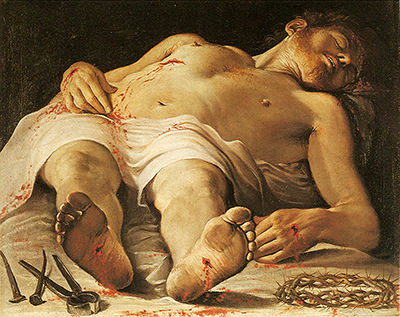
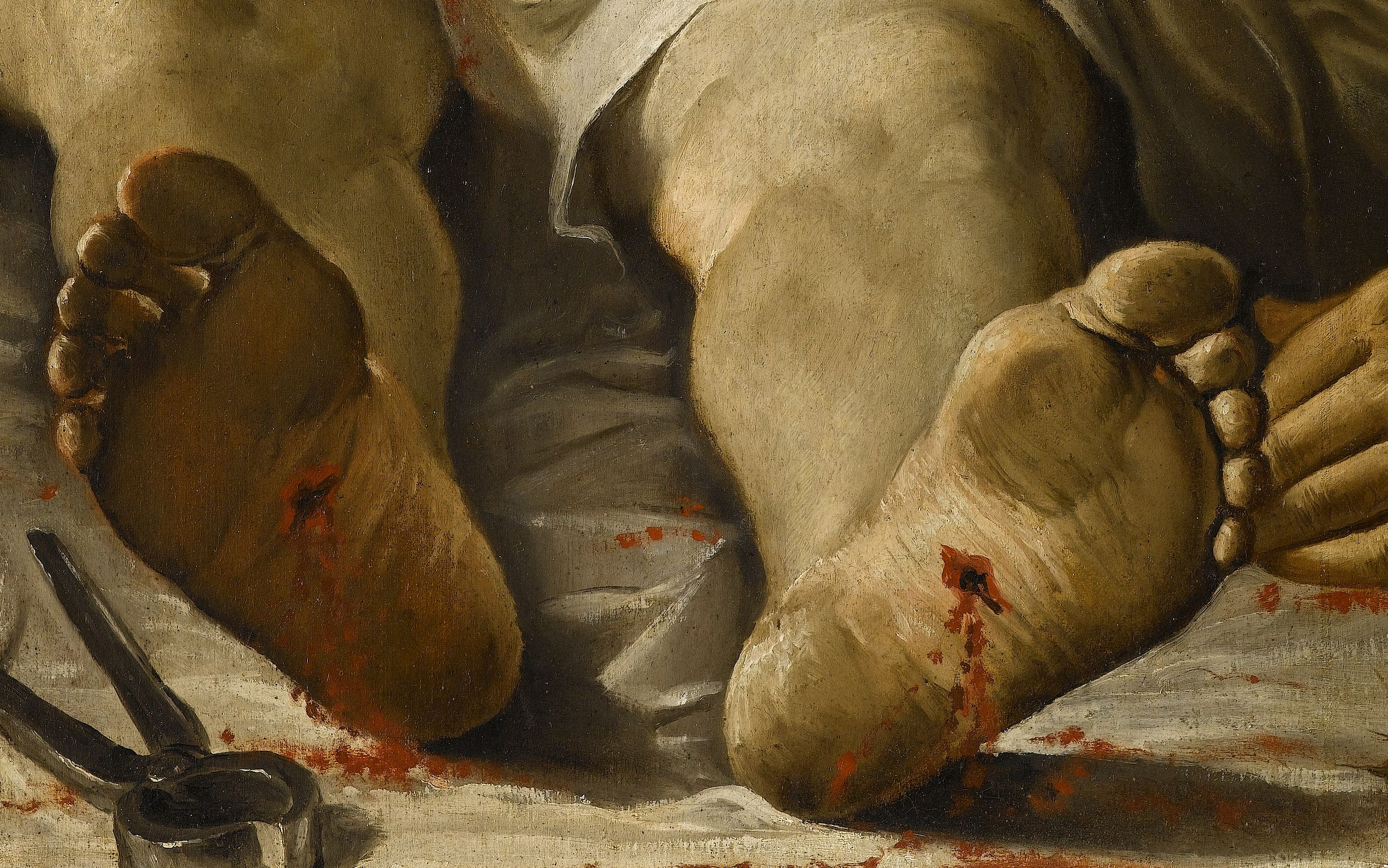
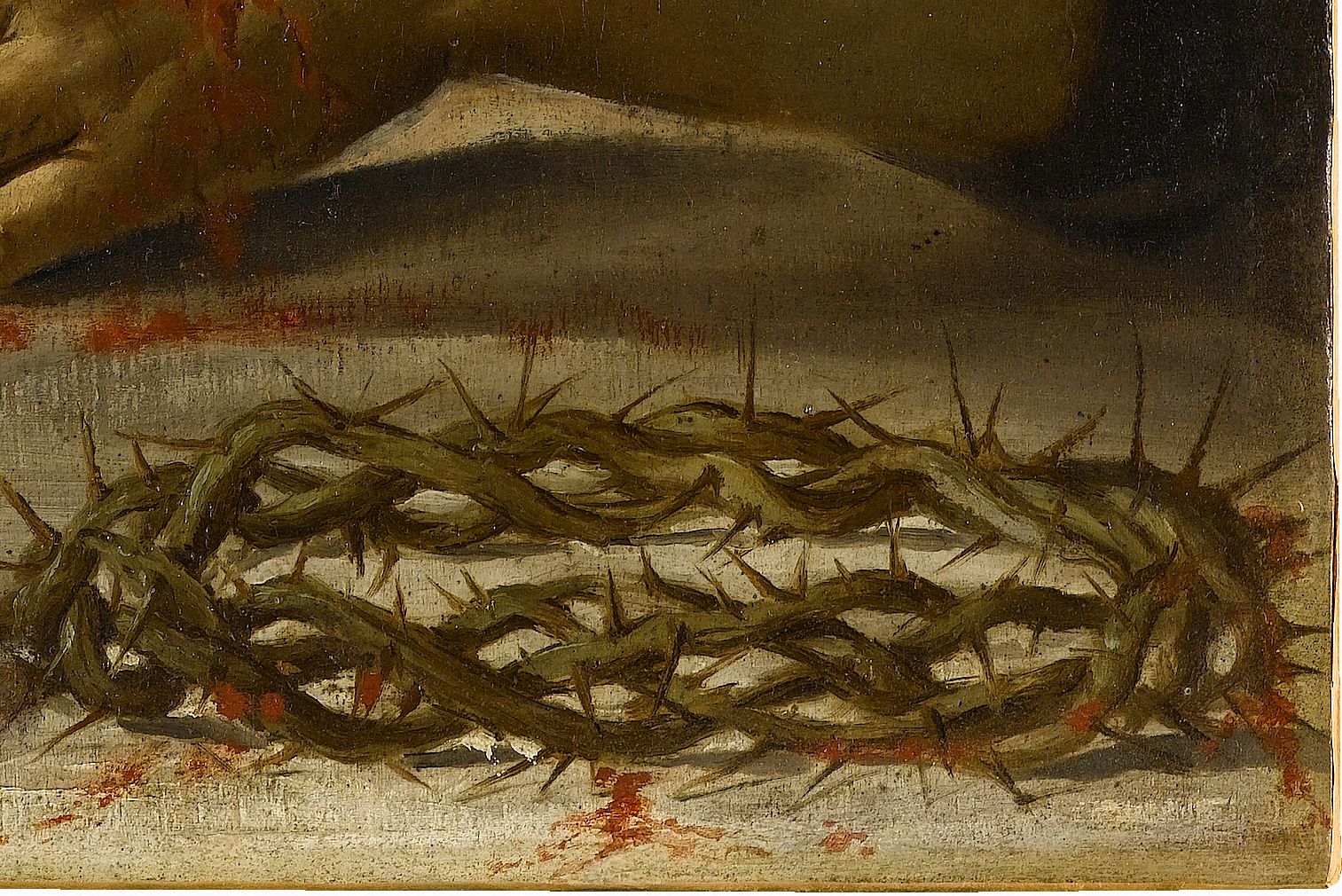
The first things we see in Annibale Carracci’s painting of the dead Christ are the wounded soles of his feet. The rest of his body falls away diagonally into the darkness, his face turned towards the upper right. At either end of the foreground lie objects that explain the wounds. A pair of pincers and two nails lie on the left, and the crown of thorns lies on the right. The tools sit so near the lower edge that we seem to have come upon the body just after someone had taken it down from the cross. [1] [2]
Sometimes called Corpse of Christ, this oil on canvas belongs to the Staatsgalerie Stuttgart, where it is inventory number 2785. It dates from the early 1580s, when Annibale was in his twenties. The German collection title, Der Leichnam Christi mit den Leidenswerkzeugen, draws attention to the instruments as well as to the body. Both help explain how a painting with a single figure can convey an event that took place outside the picture. [1] [2] [3]
At a Glance
- ArtistAnnibale Carracci
- DateAbout 1582
- MediumOil on canvas
Contents
- The body seen from the feet
- The crown, nails and pincers
- What Carracci changes in Mantegna’s composition
- A young Carracci and his later Passion paintings
- Annotated details
The body seen from the feet
Try following the nearer leg from the sole up to the knee. The foot stands upright at the end of a leg that seems to take up surprisingly little space. The other knee rises into the light while its foot turns outward. There is barely room on the canvas between the soles, knees and hips. We still read the legs at their full length because they extend towards us. This is foreshortening, the apparent compression of a form seen along its length. Carracci makes the effect easy to follow by changing the angle of each foot and giving the knees separate patches of light. [2]
The body lies slightly askew. The head has slipped to one side and the face is partly in shadow. One hand rests loosely against cloth at the waist. The other lies near the edge of the painting, its slack fingers beside the nearer foot. Read the picture from that hand towards the shoulder and a second route through the body appears, one that fans out to the right of the receding legs. The result is a figure that occupies most of a canvas less than a metre across. The darkness above and beside the body gives us almost no indication of how far the surrounding space extends. [1] [2]
The white cloth helps to explain both the figure’s position and its weight. It bunches across the hips, then tumbles into folds between the knees. Farther forward it lies flat under the foot and near the tools. Some of its folds hold the strongest lights in the picture, while others catch the same brown shadows as the flesh. The folds lead across the body at an angle to the route from the feet to the head. This makes the cloth something we can follow with our eyes as it rises over one surface and drops into the next. [2]
Brera’s exhibition notes draw attention to the short strokes and abrupt changes of tone that give the body its physical presence. Look at the transition from the lit ribs to the shadow under the arm, or at the broken red marks beside the wound in the side. The pale chest, the soles and the face each receive light differently. The exhibition also suggested that the figure looks as though it was studied from an actual model. The twisted pose and uneven weight make that suggestion understandable. The identity of any model remains unknown. [2]
The crown, nails and pincers
The Arma Christi, or instruments of the Passion, are objects associated with Christ’s suffering and death. They can appear as an array of symbols in their own right. A late medieval hanging in the Metropolitan Museum of Art, for example, places them around crosses. Carracci chooses a few objects and sets them down on the same surface as the body. The crown recalls Christ’s mockery, the nails his attachment to the cross and the pincers the work of taking him down. Only a little space separates the iron from the wounds. [2] [4]
The crown is easy to pass over when the painting is small. Its twisted stems overlap and its thorns catch the light, casting a web of dark lines against the cloth and the pale surface below. The dark iron on the other side has a different rhythm. The long nails and the open jaws of the pincers are picked out by small highlights, giving them the hardness of objects that have just been put down. Between the two groups are the traces they help bring into focus, including the red on the near hand and the blood at the heel that reaches the cloth. [2]
There is no attendant to lift the body or direct our gaze. Carracci gives the foreground over to the things a witness might notice in the aftermath. Both Stuttgart and Brera relate this emphasis on the injured body to contemplation of Christ’s sacrifice and the Eucharist. That reading starts with the view Carracci has given us. The body is low, near and exposed. The tools bear witness to what has already happened. [1] [2]
What Carracci changes in Mantegna’s composition
Andrea Mantegna’s Dead Christ in the Tomb with Three Mourners, in the Pinacoteca di Brera, puts the spectator at the foot of a receding body too. In Mantegna the straight edges of the stone on which Christ lies make the depth legible, and a small group of mourners leans into the picture at the left. The folds of the cloth have sharp edges, and the feet sit closer together. Carracci turns the figure further across the canvas, makes the soles more prominent and gives much of the lower margin to the instruments. The turn of the torso gives the chest room to spread out in the light. Outside it, the darkness takes over the space that Mantegna gives to the mourners. [2] [5]
The resemblance is part of a wider history. By Carracci’s time the foreshortened dead Christ was a familiar motif in northern Italian devotional art. Brera’s exhibition dossier traces how the motif changed hands. In a painting by Lelio Orsi, for example, Charity and Justice attend the body. Brera suggests Carracci may have known Mantegna’s design through prints or from seeing a painting. The early whereabouts of Mantegna’s canvas are still debated, so the visual kinship leaves the question of how Annibale encountered the design open. [2] [5]
In 2016 curator Keith Christiansen brought the Stuttgart painting and the Mantegna together at Brera for their first display side by side. A third canvas, Orazio Borgianni’s Lamentation over the Dead Christ, came from the Galleria Spada in Rome. Painted around 1615, it brings mourners back around the body and gives their gestures much of the emotional weight. The three works let visitors compare how painters kept the unsettling perspective while changing who stood beside the dead Christ and what the spectator could see. [6]
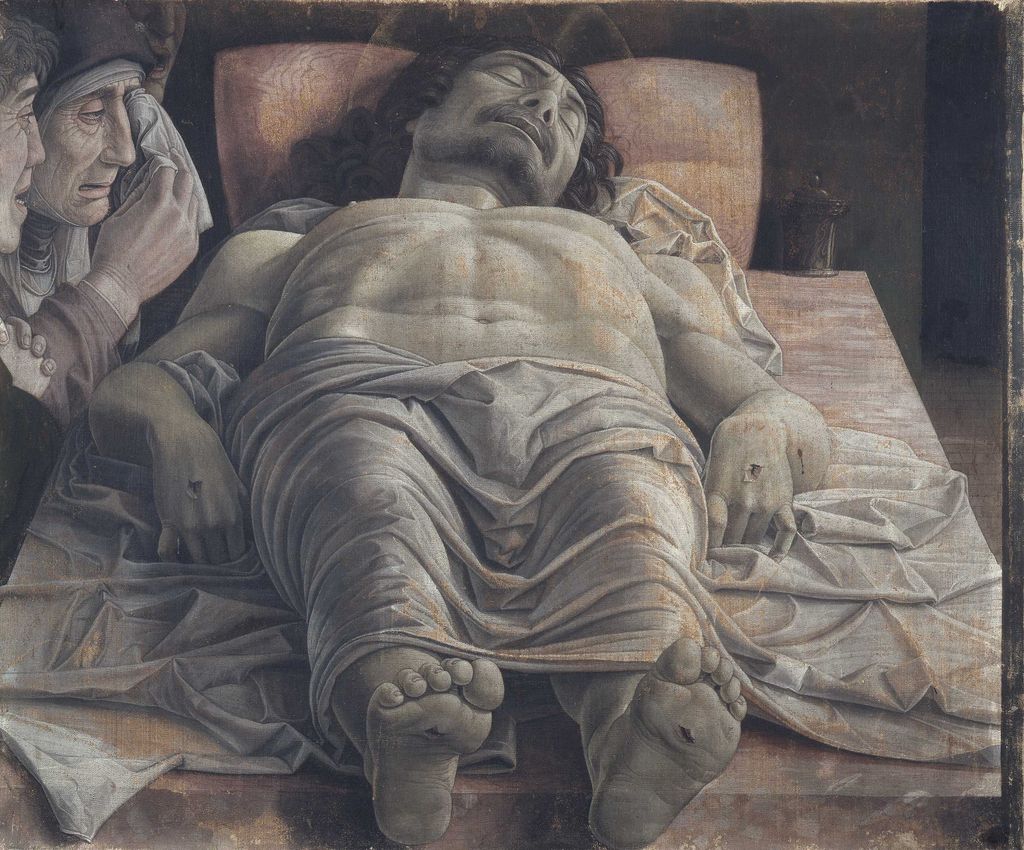
Andrea Mantegna, The Dead Christ and Three Mourners. Pinacoteca di Brera, Milan, 352. Image source. Public domain.
Annotated Details from The Dead Christ with the Instruments of His Passion
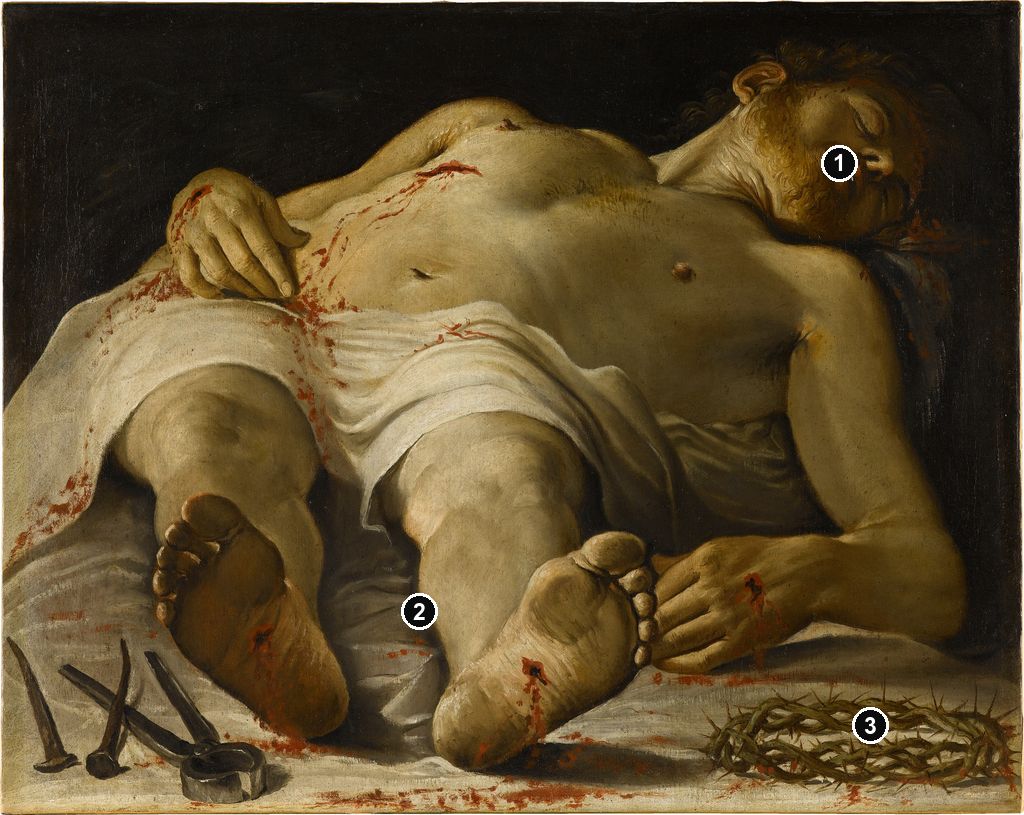
The numbered points identify visible features discussed in this article. Return from each detail to the numbered overview. Annibale Carracci, The Dead Christ with the Instruments of His Passion. Staatsgalerie Stuttgart, inv. 2785. Photograph supplied by the museum. Image source. Public domain.
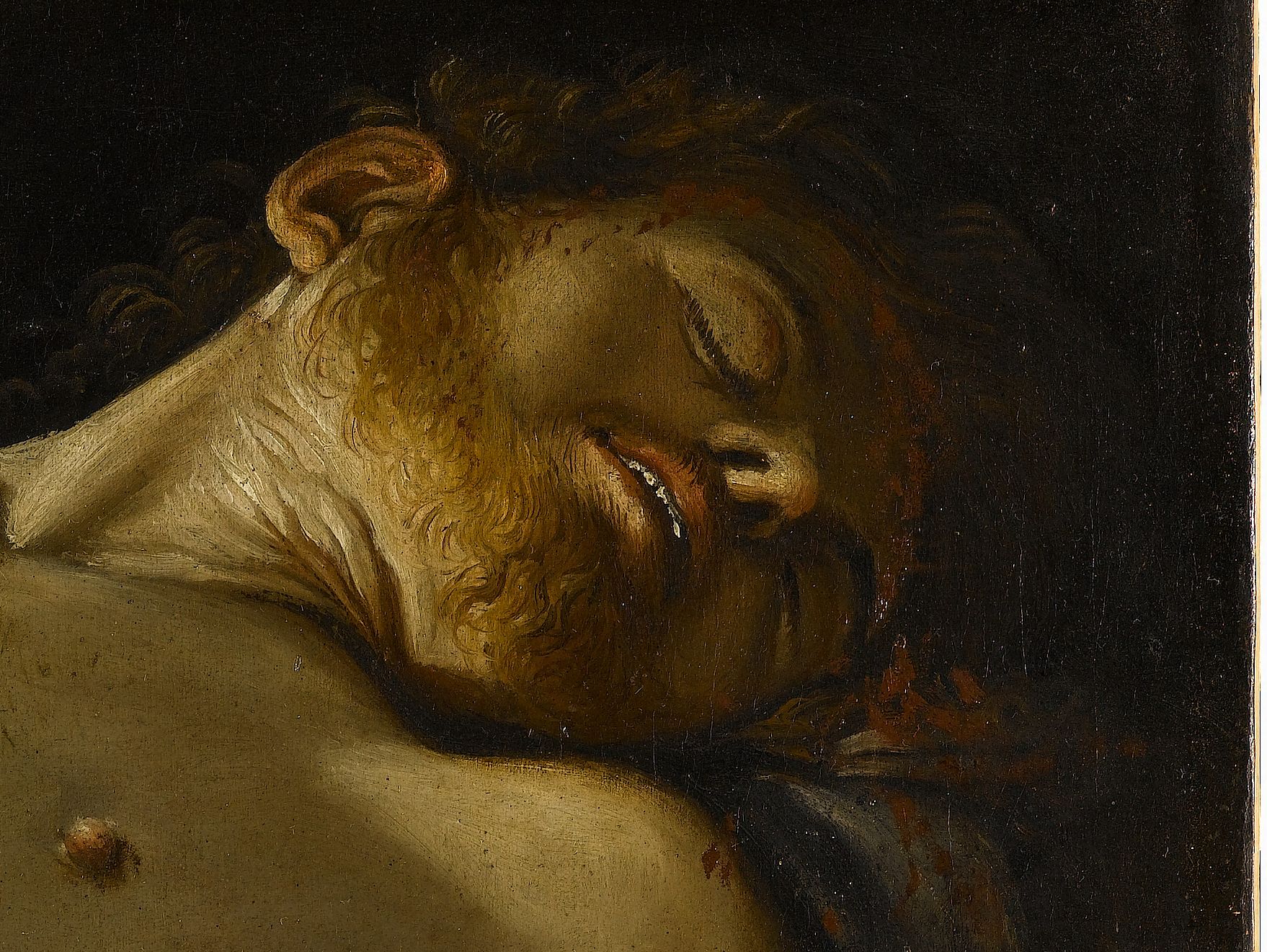
Details from THE DEAD CHRIST WITH THE INSTRUMENTS OF HIS PASSION
Compare the cropped details with the source images above. Notice how their colours, shapes and positions contribute to the larger compositions.
The head at the far end
The head nearly merges into the background. Its small scale relative to the nearby feet shows how abruptly the body recedes.
The feet at the front
The soles interrupt the folds along the lower edge. The body is seen along its length, and its nearest forms occupy a large part of the canvas.
The crown of thorns
The tangled crown lies close to the edge beside the right hand. Its angular lines are sharp against the pale ground.
A young Carracci and his later Passion paintings
Stuttgart dates the painting to about 1582 and records its size as 70.7 × 88.8 cm. The Zeri photo archive dates it to 1582–83 and gives slightly smaller dimensions, 69 × 85 cm. Brera used the Stuttgart dimensions and dated the picture to 1583–85 on its exhibition label. These are variations in the cataloguing of a single early picture. [1] [2] [3] [6] Gail Feigenbaum notes that Carracci’s early chronology depends heavily on two landmarks, the Crucifixion dated 1583 and the Baptism completed by 1585. The Stuttgart canvas falls within the period of those early religious commissions. Its date is approximate. [7]
Brera’s dossier records a mention in Cardinal Flavio Chigi’s collection in Rome in 1692, over a century after the painting was made. Zeri’s archive preserves a photograph by Carlo Carboni that identifies the painting with Palazzo Chigi, alongside a photograph from the Staatsgalerie. Stuttgart records a 1965 Rome auction catalogue in its bibliography and confirms that the museum acquired the picture with lottery funds in 1967. Its original setting and the reason it was made remain uncertain. [1] [2] [3]
Carracci went on to paint other moments around Christ’s death. In The Burial of Christ of 1595, the small oil on copper now at the Metropolitan Museum of Art, people are still carrying the body and are about to lower it into the tomb. A torch lights their work. In the National Gallery’s The Dead Christ Mourned (The Three Maries), dated around 1604, the grieving women form a circuit of hands, faces and glances around Christ. The Virgin’s drooping body echoes his. Those pictures give the people who remain with Christ something to do. In Stuttgart, where the instruments and the body are left together in silence, the spectator has time to reckon with what those objects were used for. [8] [9]
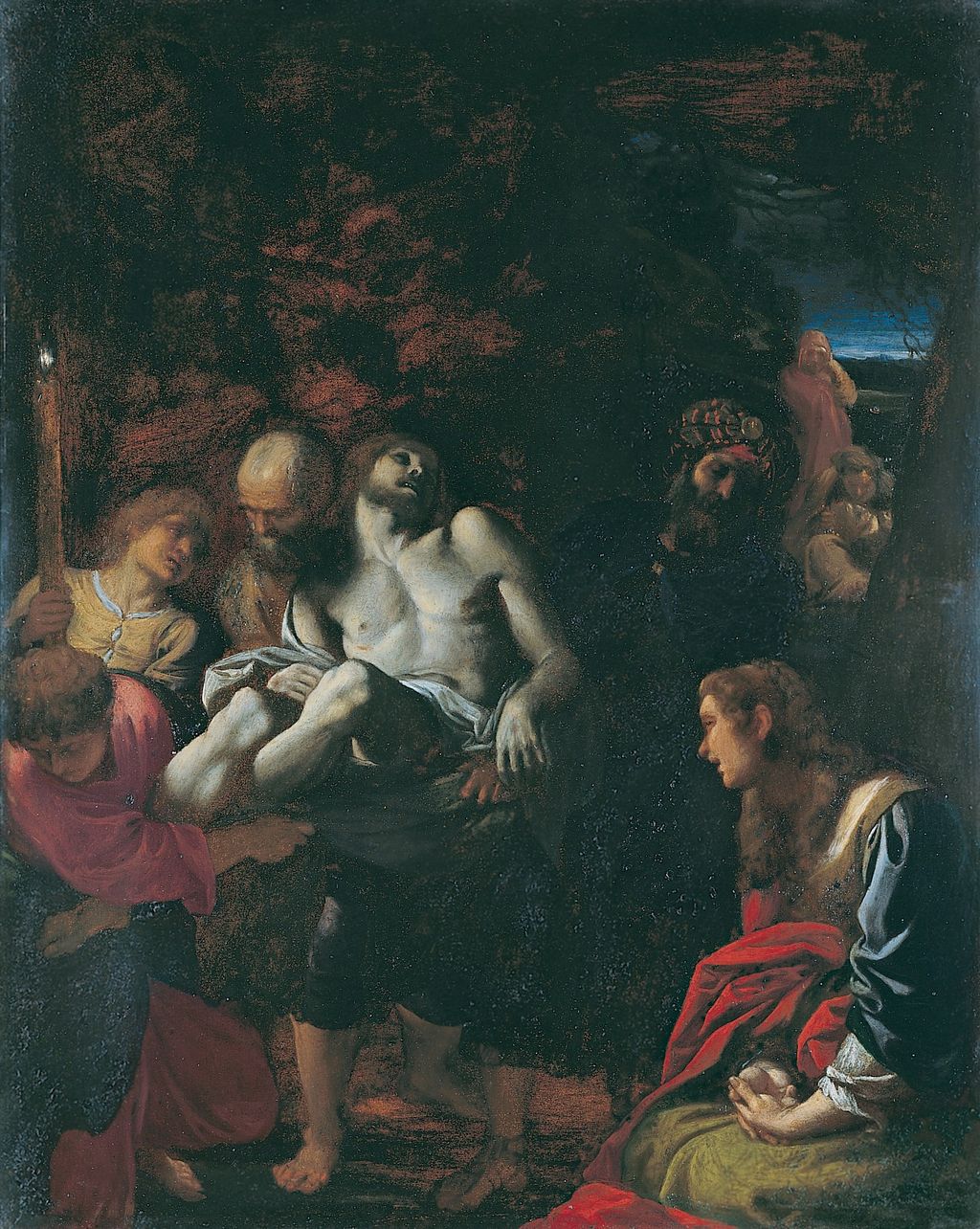
Annibale Carracci, The Burial of Christ. The Metropolitan Museum of Art, 1998.188. Image source. CC0 / Public domain.
Artworks directory
Paintings, frescoes, drawings and prints, with separate entries for documented versions and collaborative projects.
Discussion
Look again at the images and ideas explored in The Dead Christ with the Instruments of His Passion. These editorial prompts invite your observations.
Reader Insights
Where is foreshortening strongest in the body?
How do the objects of the Passion shape the way you read the physical study?
Join the Conversation
Share a detail, comparison or question about The Dead Christ with the Instruments of His Passion below.
References
- Staatsgalerie Stuttgart, Der Leichnam Christi mit den Leidenswerkzeugen, inventory 2785 View source.
- Pinacoteca di Brera, Secondo dialogo. Attorno a Mantegna, 2016 exhibition dossier, especially the Carracci entry View source.
- Fondazione Federico Zeri, Annibale Carracci, Cristo morto, work record 57316 View source.
- Metropolitan Museum of Art, Arma Christi, collection record 468389 View source.
- Pinacoteca di Brera, Andrea Mantegna, Cristo morto nel sepolcro e tre dolenti, inventory 352 View source.
- Pinacoteca di Brera, Andrea Mantegna: New Perspectives, 2016 exhibition View source.
- Gail Feigenbaum, Vulgarity and the Masterly Manner: Annibale Carracci Cites His Sources, p. 152 View source.
- Metropolitan Museum of Art, Annibale Carracci, The Burial of Christ, 1998.188 View source.
- National Gallery, Annibale Carracci, The Dead Christ Mourned (The Three Maries), NG2923 View source.