 by Tom Gurney
Tom Gurney BSc (Hons) is an art history expert with over 20 years experience
Published on June 19, 2020 / Updated on November 29, 2026
Email: tomgurney1@gmail.com / Phone: +44 7429 011000
The Dead Christ Mourned (The Three Maries): Introduction
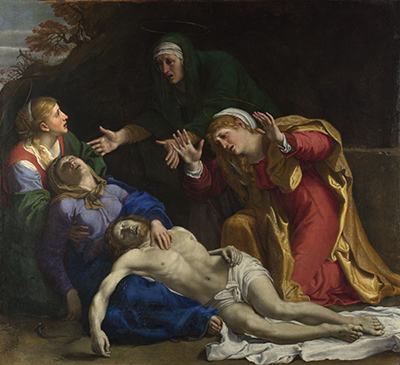
Annibale Carracci’s The Dead Christ Mourned, also known as The Three Maries, depicts the moments after Christ has been taken down from the Cross. His mother, the Virgin Mary, has fainted, and a young woman takes her weight while Mary Magdalene throws up her hands. Carracci lets us see what each woman does with her grief around the still body. The National Gallery in London dates the oil on canvas to about 1604. It measures 92.8 × 103.2 cm and is catalogued as NG2923. [1]
At a Glance
- ArtistAnnibale Carracci
- DateAbout 1604
- MediumOil on canvas
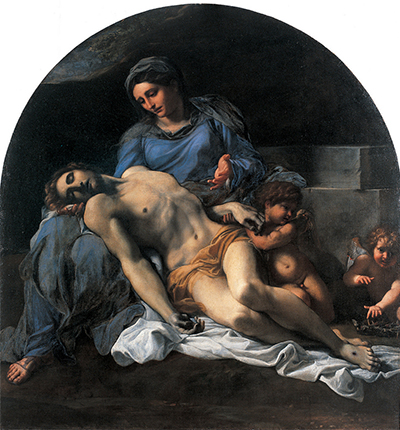
- London paintingNational Gallery, NG2923. The Three Maries gather around Christ.
- Naples comparisonCapodimonte, Q 363. Mary holds Christ, with two angels at the right.
Contents
- How Carracci paints the weight of grief
- Who are the Three Maries?
- Correggio, preparatory drawings and the red drapery
- The London painting and Carracci’s other Passion scenes
- From an uncertain Roman commission to the National Gallery
- How the composition travelled
- Annotated details
How Carracci paints the weight of grief
The white shroud spreads beneath Christ’s legs at the lower right. His chest turns towards us and his head rests against his mother, with his right arm hanging down across her blue mantle. The arm’s descent continues the line of Mary’s own limp right arm. Her other hand lies across his shoulder. The hand still touches her son even though she has lost the strength to hold him. Carracci gives the two faces much the same pallor and tips both heads back. The resemblance lets us see the effect of the death on Mary before a single expression registers in the other women’s faces. [1]
The young woman at the left cushions Mary’s body and looks up towards the older figure in green. The older woman comes forward from the shadow, one open hand extending towards the pair. From the other side, the kneeling Magdalene brings her two hands up around her face. Her head leans towards Christ even as her hands pull away from him. The bent wrist and spreading fingers change the pace of the picture after the slow diagonal of Christ’s body. The gold folds over her shoulder and knee mark the extent of her movement before we notice that her eyes are fixed on him. [1]
Light makes these separate acts readable. It picks up Christ’s torso and the linen in the foreground, crosses the Virgin’s face and catches the hair and sleeve of the woman holding her. Her upward glance takes us into the darker part of the painting, where the older woman’s face and extended hand emerge. The red at the right brings our gaze back down through the Magdalene towards the body. The tomb occupies much of the upper canvas. By holding its interior in shadow, Carracci leaves room around the raised hands to see each finger’s outline and makes the pale bodies seem nearer. [1]
Who are the Three Maries?
There are four women in the London painting. The Virgin and Mary Magdalene have the clearest identities. The Magdalene’s loose fair hair and red clothing help identify her, while Christ’s position across the fainting woman’s lap identifies his mother. The National Gallery proposes that the younger mourner could be Mary Salome and the older one Mary Cleophas. The National Trust’s catalogue of the Stourhead copy offers another possibility for the older woman, Saint Anne, the Virgin’s mother. The two proposals give the older woman different places in the story, as a witness to the Crucifixion or as a mother reaching for her daughter. [1] [2]
The title recalls the tradition of the holy women who came to Christ’s tomb. The Gospel accounts vary in the women they name and describe the burial and the later visit to the tomb. The gathering around Christ in Carracci’s picture belongs to the tradition of the Lamentation, an imagined interval in which the mourners have time to remain beside him. A crown of thorns and a nail low at the left recall the Crucifixion, while the stone opening behind the women anticipates his burial. The picture holds those events in view at the moment when the women are with the body. [1] [3]
Correggio, preparatory drawings and the red drapery
The swooning Virgin has an important precedent in Correggio’s Lamentation over the Dead Christ, painted around 1524 for the Del Bono Chapel in Parma. Correggio brings the body close to the picture’s lower edge and shows the mourners supporting Mary as she collapses. The National Gallery identifies the Parma painting as a source Carracci could have studied on his visit in the 1580s. In his London painting, Carracci uses the collapse to connect mother and son across the foreground, then gives the women behind and beside them more space for their gestures to register. [1] [4]
A sheet in the Louvre, INV 7492 verso, shows how far the composition could change during drawing. The museum catalogues the sheet as attributed to Annibale and describes the sketch in red chalk, pen and brown ink as an early design for the London picture. Catherine Loisel observes that Carracci reversed the arrangement in the painting and tempered its resemblance to Correggio. He kept the side lighting and the idea of wrapping the women’s group around Christ. The Louvre also points to another compositional study in the Pushkin Museum in Moscow, published by Marina Maiskaya. [5]
The Rijksmuseum houses a black-chalk Study for a Dead Christ, RP-T-1953-233(R), dated 1599–1604. On this sheet the body is the subject, with the mourners absent. Set beside the London painting, it gives the eye time to follow the angle of the chest and the fall of the limbs before the finished painting’s colour, drapery and gestures compete for attention. The Rijksmuseum catalogues the sheet under Annibale, but its provenance records an earlier attribution to Domenichino. Richard Spear proposed that the young Domenichino made it after the painted figure. A drawing copied from the canvas would show how a pupil studied the finished pose. A study by Carracci might instead record the work of finding it. [5] [6] [7]
The possible relationships matter for the date as well as the authorship of the drawing. Silvia Ginzburg places The Three Maries in 1603, at the beginning of Carracci’s late sequence of Pietàs. She compares Christ’s tilted head and extended legs with the dead Adonis in a Farnese Garden Loggia fresco by Domenichino, which she dates to 1603 and reads as a borrowing from Carracci’s figure. She also connects the closeness to the Del Bono Lamentation with Carracci’s return to Parma in 1602. The National Gallery keeps the wider date of about 1604. [1] [7]
Larry Keith includes the London picture alongside Domine Quo Vadis in a discussion of the more austere classicism of Carracci’s later Roman work. The grouping here helps explain what he means. The strongest expressions can remain distinct because each figure has a place in a compact arrangement. The picture draws on Correggio’s handling of bodily contact while giving the people and gestures a clear order. [8]
A separate National Gallery investigation gives us evidence from the canvas itself. Marika Spring’s survey of powdered glass in European painting lists particles measuring 5–15 micrometres in a sample from the Magdalene’s red drapery. The sample contained an organic red lake pigment and the glass was identified as leached soda-ash glass. The result applies to the sampled red paint. The garment that catches our eye across the composition also preserves evidence of a material that would be too small to pick out even when standing close to the picture. [9]
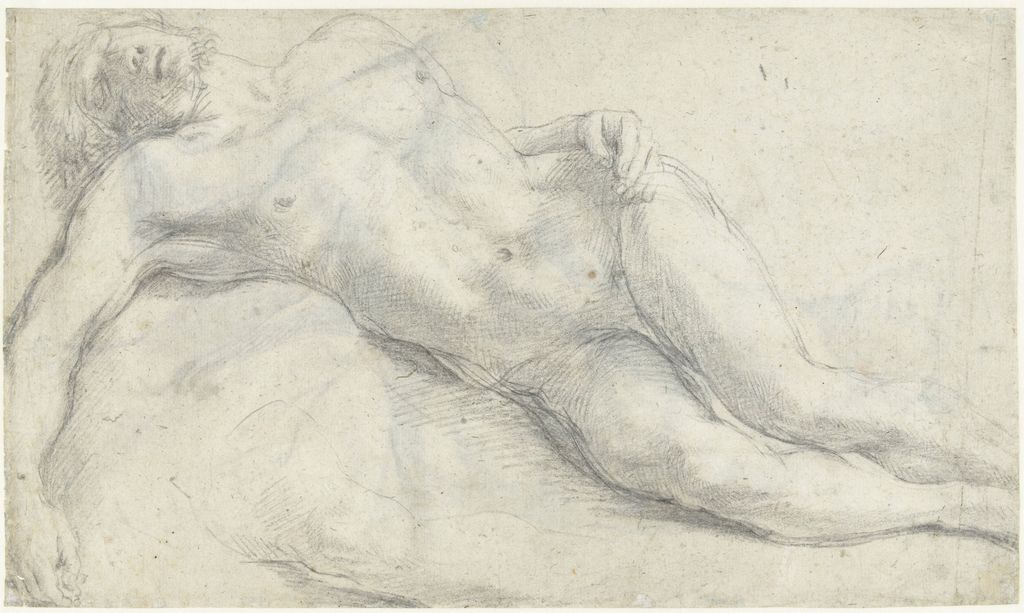
Study for a Dead Christ, catalogued by the Rijksmuseum under Annibale Carracci. Black chalk. RP-T-1953-233(R). Image source. Public domain.
The London painting and Carracci’s other Passion scenes
The Capodimonte Pietà, Q 363, belongs to the Farnese collection and is dated 1599–1600 by the Naples museum. Its arched canvas concentrates attention on Christ, Mary and two angels. Mary can still hold her son, and her free hand opens towards us. In London another woman has to hold Mary herself. The group of women allows Carracci to show the practical act of keeping someone upright alongside the more visible anguish of the Magdalene. The Louvre’s tall Pietà with Saint Francis and Saint Mary Magdalene, INV 198, makes another kind of gathering around the body. It takes its scale and cast from a different setting, the Mattei Chapel altar in Rome. [1] [10] [11] [12]
The Met’s Burial of Christ is a small oil on copper, dated 1595. Its bearers are moving Christ’s body, the action that the London mourners have yet to undertake. The Hermitage’s Holy Women at Christ’s Tomb takes place later still. An angel addresses the women at the tomb and Christ’s absence drives the scene. In Stuttgart’s Corpse of Christ with the Instruments of the Passion the body is seen on its own with the objects associated with the Crucifixion. These are useful distinctions when searching by title: the red-clad Magdalene, swooning Virgin, older woman and young supporter identify the London scene even when it is called simply Pietà or Lamentation. [1] [13] [14] [15]
From an uncertain Roman commission to the National Gallery
The first patron and setting of The Three Maries remain uncertain. Fernando López Chaurri revisits Silvia Ginzburg’s suggestion of a commission from Cardinal Pietro Aldobrandini. An inventory from 1603 records a small fresco on a roof tile by Carracci of the dead Christ with four Marys. The subject is suggestive, but the inventory describes a different object. The proposal that the London canvas hung in the Aldobrandini family chapel in the Palazzo del Corso is harder to establish. López Chaurri notes the absence of a description or payment record for that chapel’s altar picture and the presence of a related burial scene among its lunettes. He raises private devotion as a possibility given the canvas’s scale and subject. [3] [7]
The earliest record López Chaurri identifies is a description of the Marquis de Seignelay’s collection in Paris, written in 1684. How the marquis obtained the painting remains unclear. It passed into the collection of the Duke of Orléans in 1712 and can be identified in his 1724 inventory and the published catalogue of 1727. When the Italian paintings from that collection reached England in the late 1790s, the Earl of Carlisle selected the Carracci for Castle Howard. The work was valued at 4,000 guineas in the 1798–99 sale. That was the valuation, and López Chaurri cautions that Carlisle, a member of the group that bought the collection, probably paid less. [1] [3]
The picture subsequently appeared at the British Institution in 1851 and at Manchester’s Art Treasures exhibition in 1857. George Scharf’s Manchester sketchbook includes a study of the painting, made on 14 September while the exhibition was still running. Rosalind, Countess of Carlisle, presented the canvas to the National Gallery in 1913. Two later exhibitions frame changing ways of looking at it, Bologna’s study of the seventeenth-century classical ideal in 1962 and the Caravaggio and Bernini exhibition in Vienna and Amsterdam in 2019–20. [1] [3] [16]
How the composition travelled
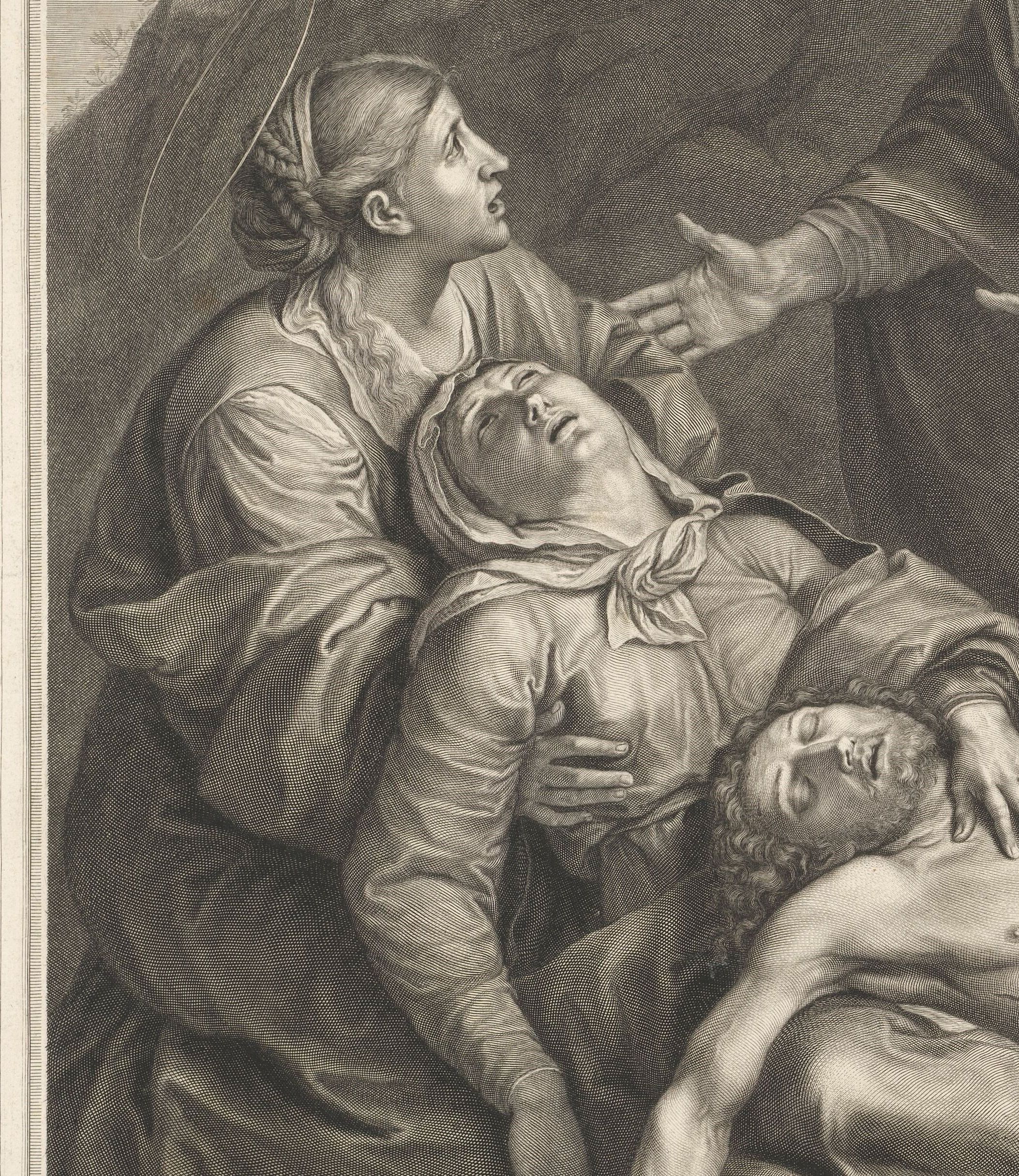
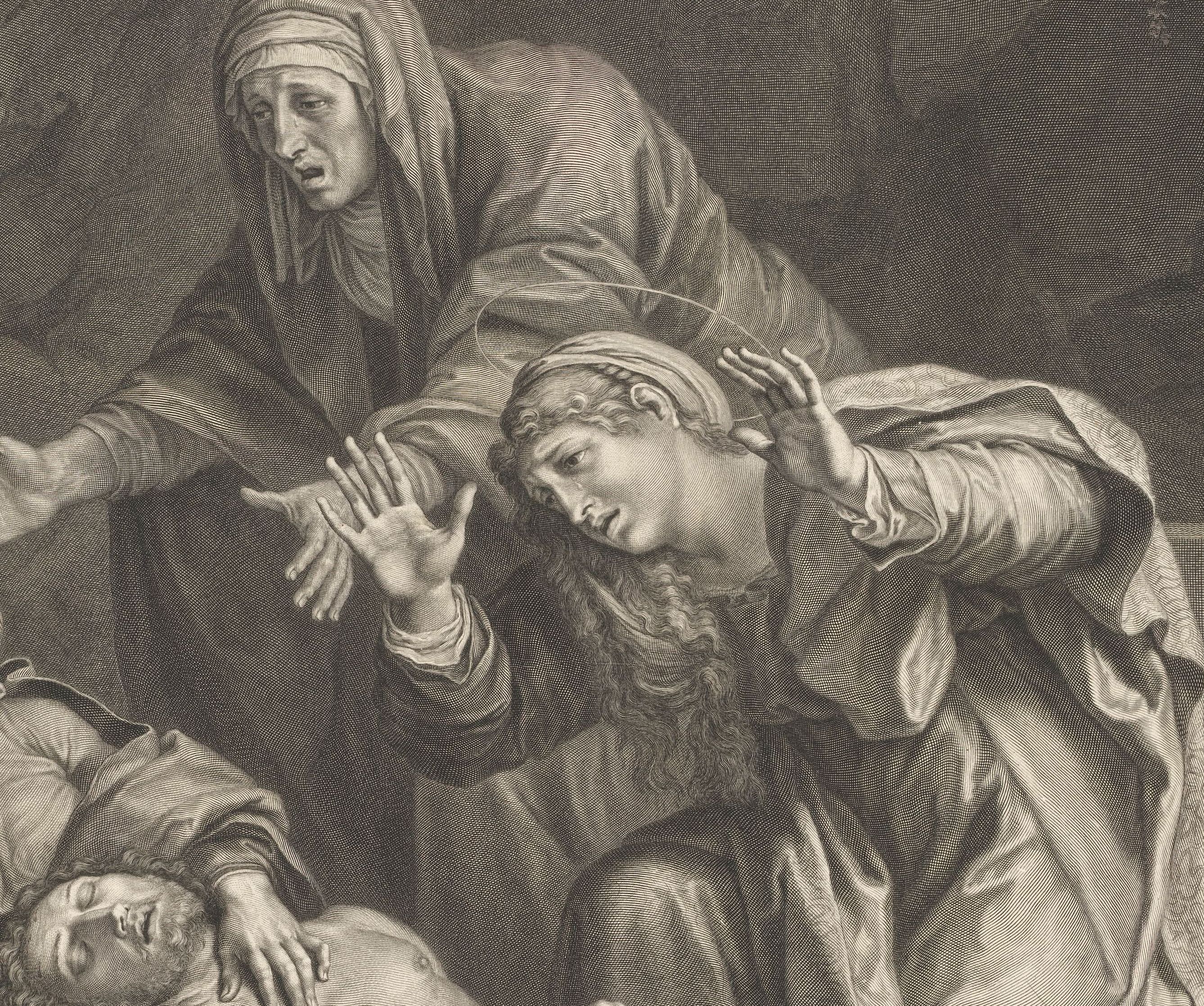
Jean-Louis Roullet engraved the London composition in the late seventeenth century. The print shows how a design so dependent on blue, red and gold could also work through line and tone. The pale body and the hands are still easy to locate against the engraved shadow. López Chaurri points out that in the impression he reproduces, Roullet moved the crown and nail in from the corner and increased the number of nails from one to three. The engraving is close enough to identify Carracci’s painting and different enough to show the engraver making choices about how clearly the instruments of the Crucifixion would read in the print. [3] [17]
Painted copies also took the composition outside the rooms its owners could open to visitors. The National Trust dates its Stourhead copy to about 1798–99, around the time the original arrived in England. [3] [2]
Another copy came to light in 2011 during building work at the hermitage of Nuestra Señora de Cabo in Villafrechós, near Valladolid. It had lost part of its right edge. The regional conservation centre stabilised it and later lined the weakened canvas and secured the paint. In 2018 the copy returned to Villafrechós for display in the parish church of San Cristóbal. [3]
The Spanish copy has the same gathering of figures but stands 121 cm high. The extra height mostly extends the dark rock above the mourners. The conservators identified hemp in the support and pigments including azurite and smalt, evidence for the materials of this copy. The difference in proportions led López Chaurri to suggest it might have been fitted to a particular setting. He investigates a possible route from Italy through the House of Osuna, whose members held office in Italy and patronised the Poor Clares in Villafrechós. The original destination of the copy remains uncertain. [3]
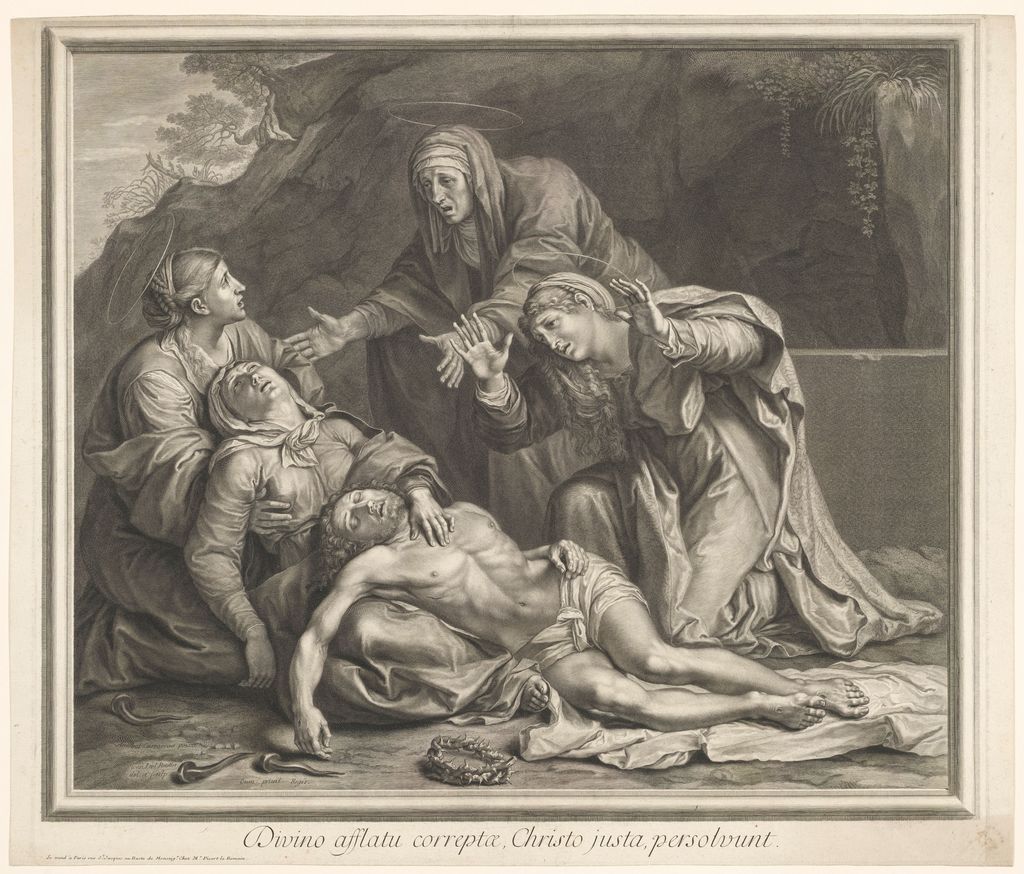
Jean Louis Roullet after Annibale Carracci, The Lamentation. Engraving. Rijksmuseum, RP-P-OB-73.007. Image source. CC0 / Public domain.
Annotated Details from The Dead Christ Mourned (The Three Maries)
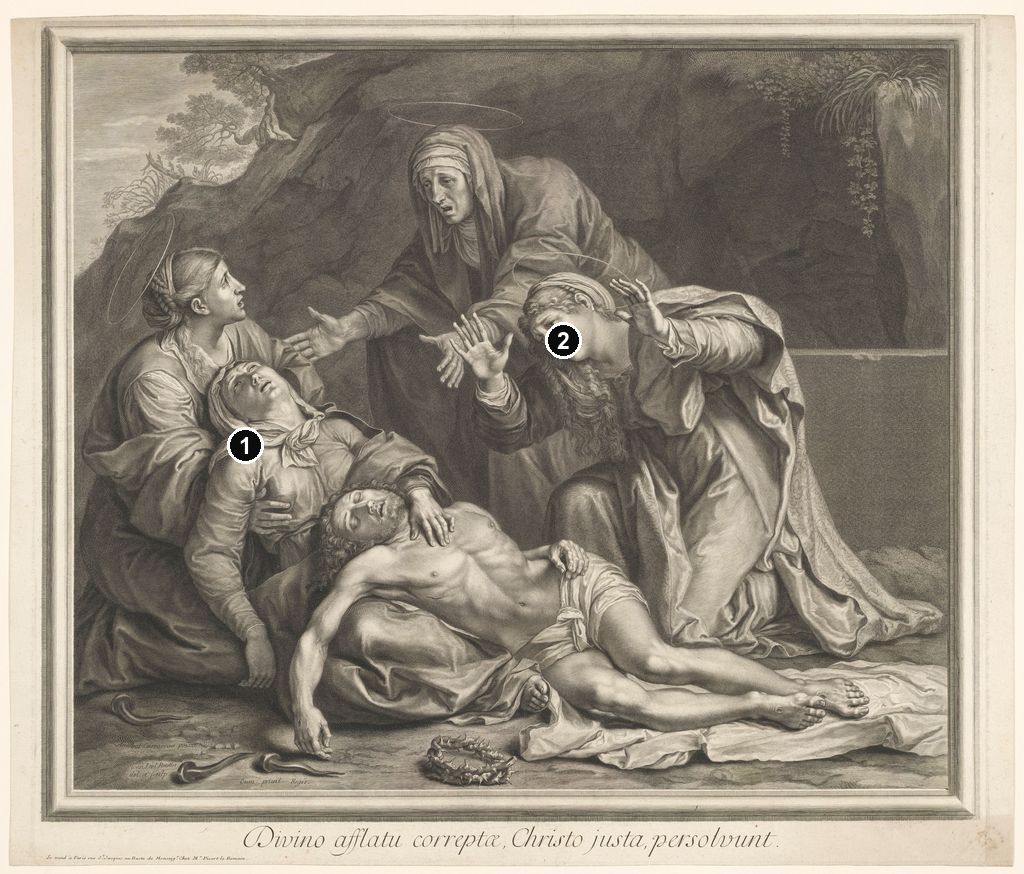
The numbered points identify visible features discussed in this article. Return from each detail to the numbered overview. Jean Louis Roullet after Annibale Carracci, The Lamentation. Engraving. Rijksmuseum, RP-P-OB-73.007. Image source. CC0 / Public domain.
Details from THE DEAD CHRIST MOURNED (THE THREE MARIES)
Compare the cropped details with the source images above. Notice how their colours, shapes and positions contribute to the larger compositions.
The supported Virgin in the print
Roullet places Mary’s backward tilt on the left side of his plate. The contours around her face and the supporting arms make the movement legible across the engraving.
The gestures in the print
The hands above Christ’s body punctuate darker banks of hatching. Comparing their positions with the painting shows the reversal of the composition.
Artworks directory
Paintings, frescoes, drawings and prints, with separate entries for documented versions and collaborative projects.
Discussion
Look again at the images and ideas explored in The Dead Christ Mourned (The Three Maries). These editorial prompts invite your observations.
Reader Insights
How do the mourners’ hands guide the eye around the group?
Which difference from the Capodimonte treatment changes the way grief is expressed?
Join the Conversation
Share a detail, comparison or question about The Dead Christ Mourned (The Three Maries) below.
References
- National Gallery, The Dead Christ Mourned (The Three Maries), NG2923 View source.
- National Trust, Pietà (The Three Maries), after Annibale Carracci, Stourhead 732147 View source.
- Fernando López Chaurri, Lamentación sobre Cristo muerto, BSAA arte 90, pp. 109–140 View source.
- Complesso Monumentale della Pilotta, Correggio’s Lamentation over the Dead Christ View source.
- Louvre, La Déploration du Christ mort, INV 7492 verso, with catalogue commentary by Catherine Loisel View source.
- Rijksmuseum, Studie voor een dode Christus, RP-T-1953-233(R) View source.
- Silvia Ginzburg, Per la cronologia di Annibale Carracci (1602–1604), pp. 161–164 and notes 51–54, 60 and 62 View source.
- Larry Keith, Annibale Carracci’s Montalto Madonna, National Gallery Technical Bulletin 29, p. 46 and plate 4 View source.
- Marika Spring, Colourless Powdered Glass as an Additive in Fifteenth- and Sixteenth-Century European Paintings, National Gallery Technical Bulletin 33, table 1, p. 22 View source.
- Museo e Real Bosco di Capodimonte, Annibale Carracci’s Pietà in the exhibition La Pietà di Gricci View source.
- Museo e Real Bosco di Capodimonte, illustrated loan register, Pietà Q 363 View source.
- Louvre, Pietà avec saint François et sainte Marie-Madeleine, INV 198 View source.
- Metropolitan Museum of Art, The Burial of Christ, 1998.188 View source.
- State Hermitage Museum, Western European Art, The Holy Women at Christ’s Tomb View source.
- Fondazione Federico Zeri, Cristo morto, Staatsgalerie Stuttgart 2785 View source.
- National Portrait Gallery, George Scharf’s Sketchbook 47, Manchester, 1857 View source.
- Rijksmuseum, Jean-Louis Roullet, Bewening, RP-P-OB-73.007 View source.