 by Tom Gurney
Tom Gurney BSc (Hons) is an art history expert with over 20 years experience
Published on June 19, 2020 / Updated on November 29, 2026
Email: tomgurney1@gmail.com / Phone: +44 7429 011000
Sleeping Venus: Introduction
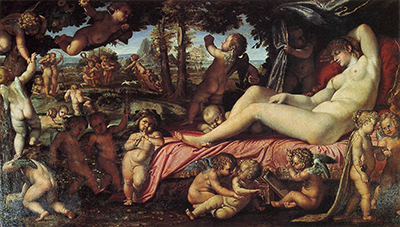
In Annibale Carracci’s Sleeping Venus, the goddess sleeps through a small commotion. Winged children clamber through the trees, play music and gather around her bed. One handles the curtain above her while others play beneath the folds of the coverlet. Known at the Musée Condé as Vénus endormie avec des amours, the oil on canvas measures 190 by 328 centimetres and was made in Rome around 1602–03 for Cardinal Odoardo Farnese. It is now in the Gallery of Painting at Chantilly, where it bears the inventory number PE 63. The museum credits Annibale with directing the composition and allows for participation by his workshop. [1] [2] [3]
At a Glance
- ArtistAnnibale Carracci
- DateAbout 1602–03
- MediumOil on canvas
Contents
- A sleeping goddess and a garden full of children
- The cupids of Philostratus and Titian
- The ancient pose and Carracci’s different Venuses
- What the drawings tell us
- From the Farnese rooms to Chantilly
- What Agucchi saw
- Annotated details
A sleeping goddess and a garden full of children
Venus lies across the right half of the canvas, her head on a dark red cushion, one arm bent above her head and the other resting across her body. Her legs extend into the picture’s middle. The pink coverlet doubles that movement before falling over the edge of the bed in creases. Above her, heavy fabric and dark foliage form a canopy. On the left, daylight opens through the trees and the activities of the cupids grow smaller across the clearing. The same glance that takes in Venus’s body can follow the folds of her bed down into the foreground or travel between the trunks into the distance. [1] [4]
The painters give the children enough room for recognisable games. Beneath the bed a group bunches together around a small object. An airborne figure near the upper left stretches almost horizontally, echoing the sweep of the adult body below. Other children turn and gesture as if the scene had caught them midway through a tune or a game. The museum’s subject index records dancing, music, grooming, bathing, disguise and a mock marriage. Some figures wear wings openly, while others blend in with the children around them. A tall canvas could have stacked these incidents above one another. Here they unfold across the width, in and out of each other’s company. [1] [4]
Venus’s stillness makes the activity legible. Her upright elbow and lifted knee give the body shape even where it rests heavily on the bed. Shade softens the head at the upper end of that long silhouette while the chest, abdomen and thigh catch the light. In its study of the painting’s lighting, Chantilly distinguishes the distant brightness that enters through the trees from a source outside the frame that illuminates Venus. The light across her body and the light glimpsed through the grove give the nearby bed and the distant clearing their separate depth. Beside the curtain, a child’s raised hands register an action as small as adjusting a piece of cloth. Across the grove, more emphatic gestures can be read at a distance. The contrast between those gestures and the goddess’s closed eyes gives the painting its comic tenderness. The whole place belongs to Venus and she can sleep through the games it inspires. [1] [4] [5]
Annotated Details from Sleeping Venus
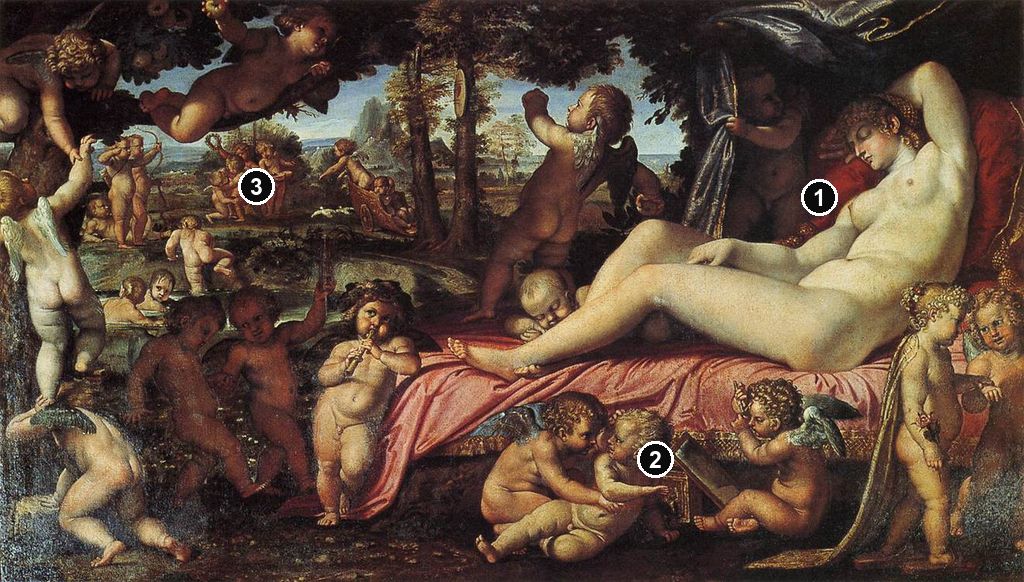
The numbered points identify visible features discussed in this article. Return from each detail to the numbered overview. Annibale Carracci, Sleeping Venus. Musée Condé, Chantilly, PE 63. Image source. Public domain.
Details from SLEEPING VENUS
Compare the cropped details with the source images above. Notice how their colours, shapes and positions contribute to the larger compositions.
Venus asleep
Venus reclines with one arm above her head. The light on her skin and the darker draperies give her pose weight within the busy foreground.
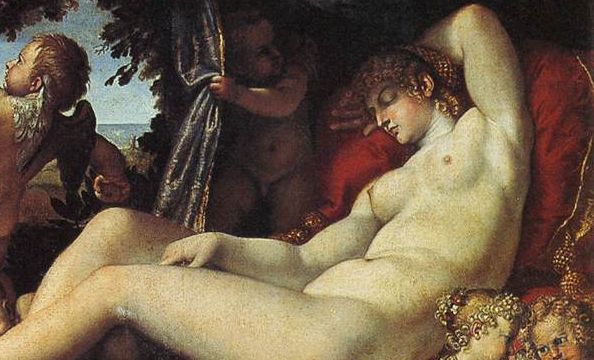
The company at her feet
Several cupids gather beneath the bed. The distribution of faces, wings and instruments fills the space below the long line of Venus’s legs.
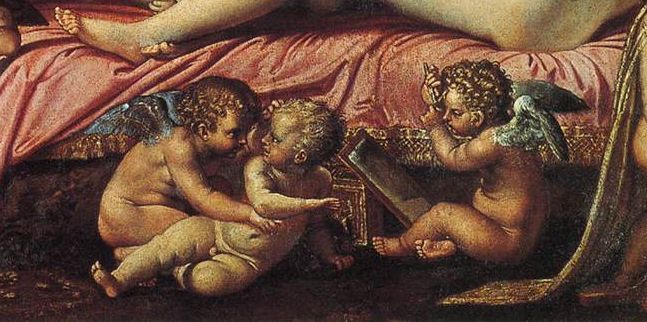
Landscape beyond the cupids
Smaller figures occupy the open country between the trees. Their scale separates the background activities from the large cupids at either side of the bed.
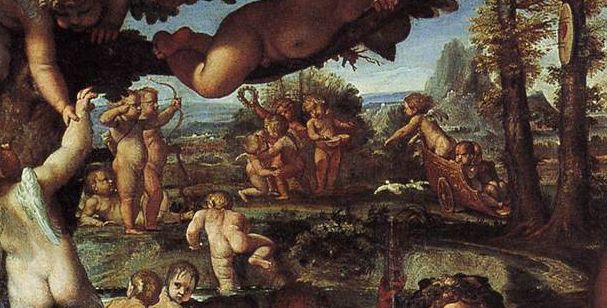
The cupids of Philostratus and Titian
The ancient writer Philostratus the Elder describes an orchard full of cupids in the sixth chapter of the first book of his Imagines. They climb among the branches, handle fruit, wrestle and practise archery. Some of their games already imitate courtship. A pair throws an apple back and forth, each kissing the fruit before it is returned. Philostratus also describes a shrine to Aphrodite. The scene gives love the shape of several small actions, some tender and some competitive, carried on at once. Chantilly cites the Imagines in the version published by Blaise de Vigenère. [1] [6]
Titian had turned the same garden into The Worship of Venus for Alfonso I d’Este’s private rooms in Ferrara. That painting and its companion The Bacchanal of the Andrians are now in the Prado. By 1598 the Aldobrandini had brought the Venetian mythologies to Rome, where painters could look closely at Titian’s treatment of the antique subjects. The Condé catalogue singles out such shared motifs as a cupid tossing an apple and two little Loves wrestling beneath a crown of leaves. In Titian’s Worship, the goddess is represented by a statue standing above the activity. Carracci brings her down to the level of the playing children and makes the weight of her sleeping body the centre of the painting. [1] [7] [8]
Geraldine Dunphy Wind proposed another ancient source, Claudian’s wedding poem for Palladius and Celerina. At the beginning of the poem, Venus seeks coolness and sleep in a vine-covered cave, where foliage shades the goddess on a bed of grass and flowers. Around her are the Loves. The poem goes on to have Venus awaken and summon Hymen. In the painting the moment of sleep expands to accommodate the many games. The screen of leaves and the curtain create enough shade for Venus to rest in a grove otherwise alive with movement. The wedding poem helps make sense of the mock ceremony among the children. The occasion for which the canvas was made is a separate question. [4] [9] [10]
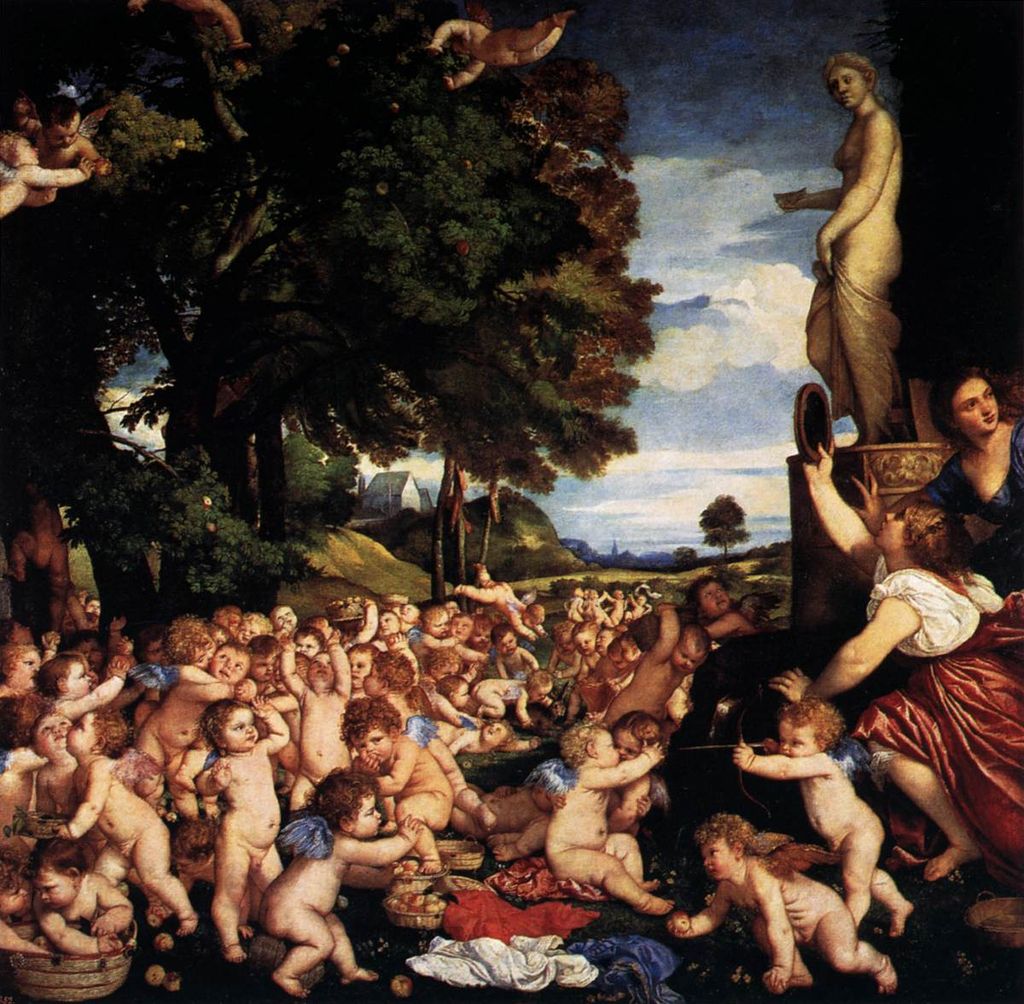
Titian, The Worship of Venus. Museo Nacional del Prado, P00419. Image source. Public domain.
The ancient pose and Carracci’s different Venuses
The Städel Museum relates the reclining figure in its drawing for the composition to the Vatican’s Sleeping Ariadne. Pope Julius II acquired that ancient marble in 1512 for the Vatican courtyard, where it was adapted to a fountain. In the sculpture, the lifted arms make a shelter around the head and allow the torso to turn as the sleeper settles into her support. The Chantilly Venus adapts that sculptural arrangement to paint. One arm frames the head, the other comes to rest low on the body, and warm cloth and falling shade replace the marble’s carved drapery. An antique model helped Carracci give a sleeping figure a distinct silhouette on a scale large enough to command a room. [1] [11] [12]
Carracci had already worked with a different Renaissance formula for Venus and her attendants. In the Uffizi’s Venus with a Satyr and Cupids, dated by Italy’s national catalogue to about 1587–88, the reclining woman turns her back towards the viewer and a satyr intrudes. The deep shadow around the satyr and the small number of figures concentrate attention on the moment of discovery. Correggio’s earlier canvas at the Louvre, Venus, Satyr and Sleeping Cupid, long called Jupiter and Antiope, offers a related example of a satyr bending towards a reclining sleeper. At Chantilly the equivalent space around the pillows is occupied by fabric and attendants. The garden disperses the drama through acts of play rather than gathering it around an intruder. [1] [13] [14]
What the drawings tell us
The Städel’s Venus Resting, about 1602, is a study attributed to Annibale Carracci. Ink and brushwork lie over black chalk, with white chalk lifting highlights from a sheet originally blue. The paper supplies the middle tone. A broad shadow beneath the lifted arm can be established in ink and the curve of the body brought forward with just enough white to catch the light. Two detail studies accompany the full reclining figure. The drawing preserves a moment of thinking about pose and light even though the museum qualifies the name of the draughtsman. The Städel associates the Frankfurt sheet with a Windsor composition study, Royal Library 2127, showing a group of playing Loves. The two studies indicate how the pose and the activity around it could be considered at different scales. [11]
At the Louvre, Un amour, INV 7303.TER, moves still closer to a single figure. In a few lines of brown ink, the draughtsman explores the pose of one of the foreground cupids. Catherine Loisel judged the sketch probably original while keeping the attribution to Annibale qualified. The putto’s pose helps link the sheet to the painting more specifically than the general resemblance of a sleeping figure. [15]
The Louvre also keeps two drawings with near-identical titles. Its catalogue identifies INV 7571 as a seventeenth-century Italian copy in brown ink and wash after the painted composition. INV 7572 is separately catalogued as an anonymous copy after Annibale and compared with the Chantilly canvas. The drawings help trace the composition’s circulation. Two sketches in an album associated with Giovanni Benedetto Castiglione also reprise elements of the scene, according to the Louvre catalogue. Using those sheets as evidence of what later artists wanted to record gives them a different value from a figure study such as the Städel’s. [16] [17]
The Condé suggests that Domenichino or Francesco Albani could have assisted while Annibale was working on other Farnese commissions. Other proposals have included Innocenzo Tacconi. Stefano Pierguidi, discussing those suggestions, places the composition at the ambitious end of the Farnese pictures and judges that the related ceiling canvases probably involved more workshop labour. Attributing particular cupids or passages of landscape to individual painters remains difficult. The eyewitness account, the study sheets and the later copies establish different kinds of evidence and leave the contribution of individual hands open. [1] [11] [16] [18]
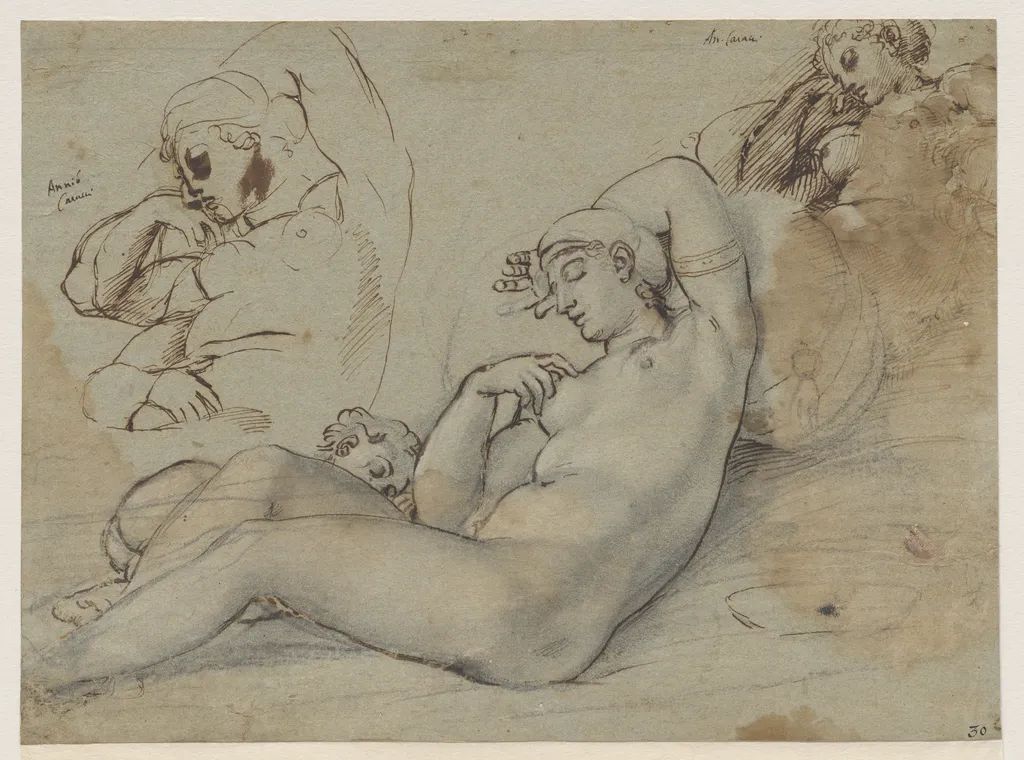
Attributed to Annibale Carracci, Venus Resting. Städel Museum, Frankfurt am Main, 4060 Z. Image source. Public domain.
From the Farnese rooms to Chantilly
The Palazzetto Farnese stood behind the main palace, across the Via Giulia and close to the Tiber. According to the Condé, Odoardo Farnese built it in 1602–03 to house part of his antiquities collection. A bridge over the street connected the two buildings. The museum traces seven works at Chantilly to the first three decorated rooms, whose imagery was associated with night, dawn and day. Night Carrying Sleep and Death, Dawn Scattering Flowers and Holding a Torch, and four individual cupids are also on view in the Gallery of Painting. In Night Carrying Sleep and Death, the winged personification carries two sleeping infants, one under each arm. The Condé reconstructs it as a ceiling painting surrounded by the four individual cupids. The related decoration gives sleep an allegorical role, while Venus’s painted garden makes it the condition that allows a household of Loves to amuse itself. The Condé leaves open the possibility that the canvas was first intended for the main palace and only later hung in the smaller building. The arrangement has been reconstructed differently over time. François-Anatole Gruyer’s early Chantilly catalogue placed the four smaller cupids at the corners of a ceiling centred on the Venus. The museum’s current account associates the four with Night Carrying Sleep and Death, in keeping with the different functions it proposes for the surviving paintings. [1] [3] [19] [20] [21]
A September 1662 inventory records the dispatch of Farnese pictures from Rome to Parma. The Condé traces the decorative ensemble to the collection of Ranuccio II Farnese there. The Venus was among the works sent south to Naples in 1735 under the Bourbon ruler Charles. The Condé traces the painting through the Neapolitan royal family to Prince Leopold of Salerno and records it with the Duc d’Aumale in 1854. Aumale donated it in 1886 while retaining the use of the collection during his lifetime. The national inventory gives 1897 as the year of physical entry. The installation in Chantilly brings several of the surviving pictures back together, with the great horizontal Venus and the separate figures now arranged for a gallery visitor. [1] [3] [4] [20]
What Agucchi saw
Giovanni Battista Agucchi saw the work in progress in Annibale’s studio, generally dated to the autumn of 1602. He wrote an extended description, an example of ekphrasis, in which words lead a reader through a work of art. His letters of April 1603 refer back to the description. Carlo Cesare Malvasia published it in 1678 in his Felsina pittrice, more than seventy years after the studio encounter. That difference in dates matters. Agucchi gives evidence of how a contemporary looked at the picture, while Malvasia’s publication shows how the account continued to shape the work’s reputation. Bellori had already singled out the painting in his 1672 life of Annibale. Gruyer admired the execution but took a colder view of Venus herself, seeing grandeur in her scale more readily than in the idea. [18] [19] [22] [23]
Agucchi was particularly attentive to effects that require a living spectator’s imagination. He imagined wanting to touch the painting and hesitating for fear of waking the goddess. He likened the inadequacy of his written description to seeing a picture through a coarse veil. In the painting itself the drawn curtain makes part of Venus less accessible to the eye, even as her figure dominates the scene. That approach suits a picture in which several incidents take place at once. A reader has to receive the details in sequence, just as a viewer has to move from the goddess’s shaded head to the child at her curtain, then on to the players under the trees. Painting and description offer different ways to spend time in the garden. The details that delayed Agucchi long enough for him to write about them still reward looking at the canvas from one side to the other. [22] [23]
Artworks directory
Paintings, frescoes, drawings and prints, with separate entries for documented versions and collaborative projects.
Discussion
Look again at the images and ideas explored in Sleeping Venus. These editorial prompts invite your observations.
Reader Insights
Which putto most clearly changes the rhythm around the sleeping figure?
Where does the Chantilly composition differ most from the Uffizi subject with the satyr?
Join the Conversation
Share a detail, comparison or question about Sleeping Venus below.
References
- Musée Condé, Vénus endormie avec des amours, PE 63 View source.
- Château de Chantilly, Sleeping Venus by Annibale Carracci View source.
- Château de Chantilly, press dossier, Gallery of Painting and the Farnese ensemble View source.
- French Ministry of Culture, Joconde inventory notice for PE 63 View source.
- Château de Chantilly, Lumières sur Chantilly, the two sources of light in Sleeping Venus, pp. 6–7 View source.
- Philostratus the Elder, Imagines, I.6, translated by Arthur Fairbanks View source.
- Museo Nacional del Prado, Memoria 2021, the paintings from Alfonso d’Este’s rooms View source.
- Metropolitan Museum of Art, Poets, Lovers, and Heroes in Italian Mythological Prints View source.
- Geraldine Dunphy Wind, Annibale Carracci’s Sleeping Venus and Claudian View source.
- Claudian, Epithalamium of Palladius and Celerina, translated by Maurice Platnauer View source.
- Städel Museum, Venus Resting, 4060 Z View source.
- Vatican Museums, Sleeping Ariadne View source.
- Italian Ministry of Culture, Venere, satiro e putti, Uffizi View source.
- Musée du Louvre, Correggio, Vénus, Satyre et l’Amour endormi, INV 42 View source.
- Musée du Louvre, Un amour, INV 7303.TER View source.
- Musée du Louvre, copy after Carracci, INV 7571 View source.
- Musée du Louvre, copy after Carracci, INV 7572 View source.
- Stefano Pierguidi, Annibale Carracci e i suoi a Roma, 1601–1609, pp. 135–37 View source.
- François-Anatole Gruyer, Chantilly, Musée Condé, Notice des peintures, entries 63–69 View source.
- Arnold A. Witte, The Artful Hermitage, the Palazzetto Farnese and its inventories View source.
- Musée Condé, La Nuit portant le Sommeil et la Mort, PE 68 View source.
- Raphael Rosenberg, Von der Ekphrasis zur wissenschaftlichen Bildbeschreibung, pp. 304–06 View source.
- Thijs Weststeijn, The Sublime and the Beholder’s Share, Agucchi discussion View source.