 by Tom Gurney
Tom Gurney BSc (Hons) is an art history expert with over 20 years experience
Published on June 19, 2020 / Updated on November 29, 2026
Email: tomgurney1@gmail.com / Phone: +44 7429 011000
Holy Women at Christ’s Tomb: Introduction
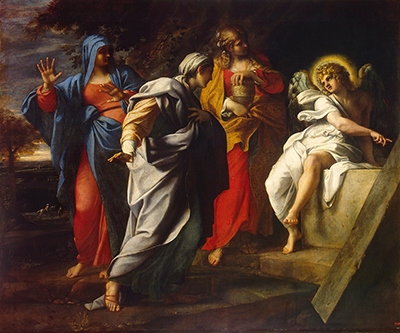
In Annibale Carracci’s Holy Women at Christ’s Tomb, a winged angel turns towards three visitors and points towards the open grave. One woman throws up her palm. Another leans forward with her hand low, as if feeling her way towards the stone. They have come to attend to a body and find the tomb open. Carracci paints that change of purpose in the distance between the women and the angel’s outstretched finger. The oil on canvas measures 121 × 145.5 cm and is in the State Hermitage Museum, Saint Petersburg, inventory ГЭ 92. The museum’s English catalogue dates it to 1597–98. The Russian catalogue also records arguments for a date closer to 1600. [1] [2]
At a Glance
- ArtistAnnibale Carracci
- DateLate 16th century
- MediumOil on canvas
Contents
- How the angel directs the eye
- What the women find in the Gospels
- Drawings, the date and the Maratti cartoon
- From Pasqualini to the Hermitage
- The painting in print and in other collections
- Annotated details
How the angel directs the eye
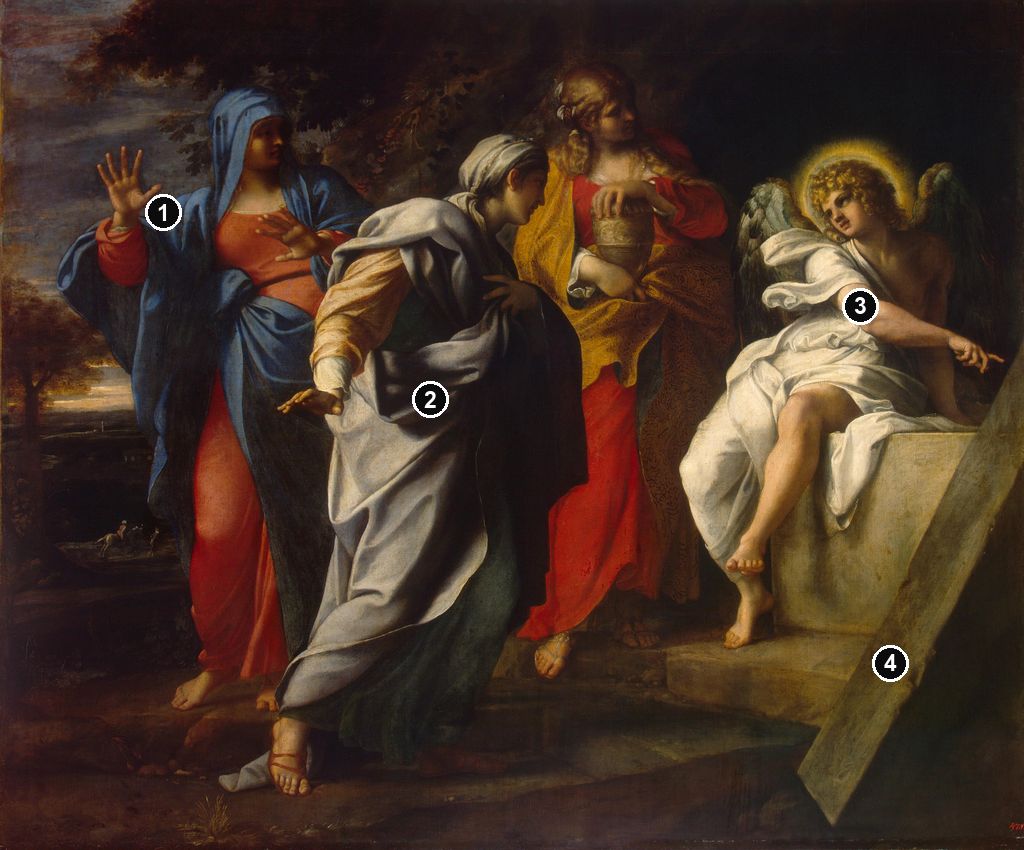
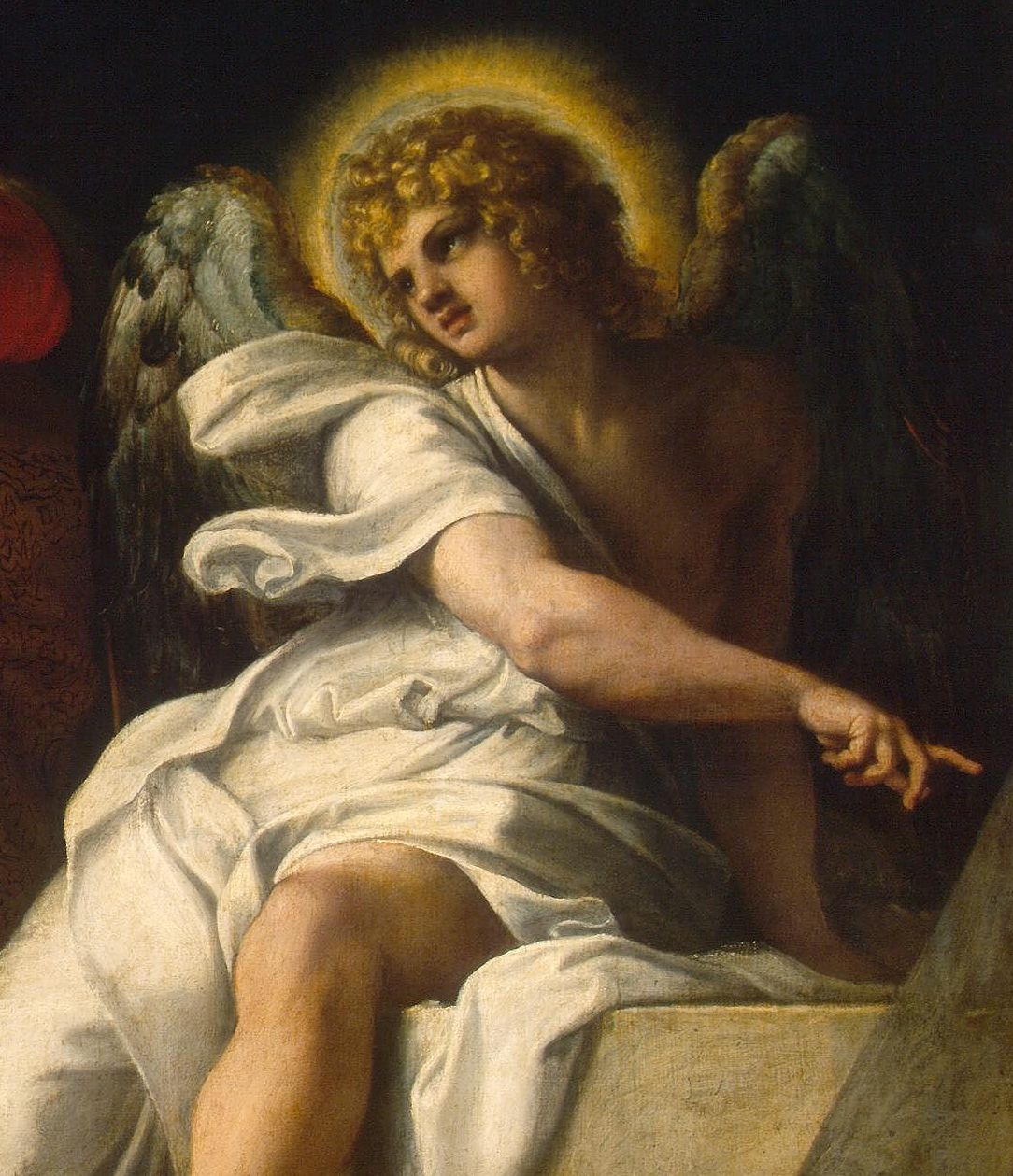
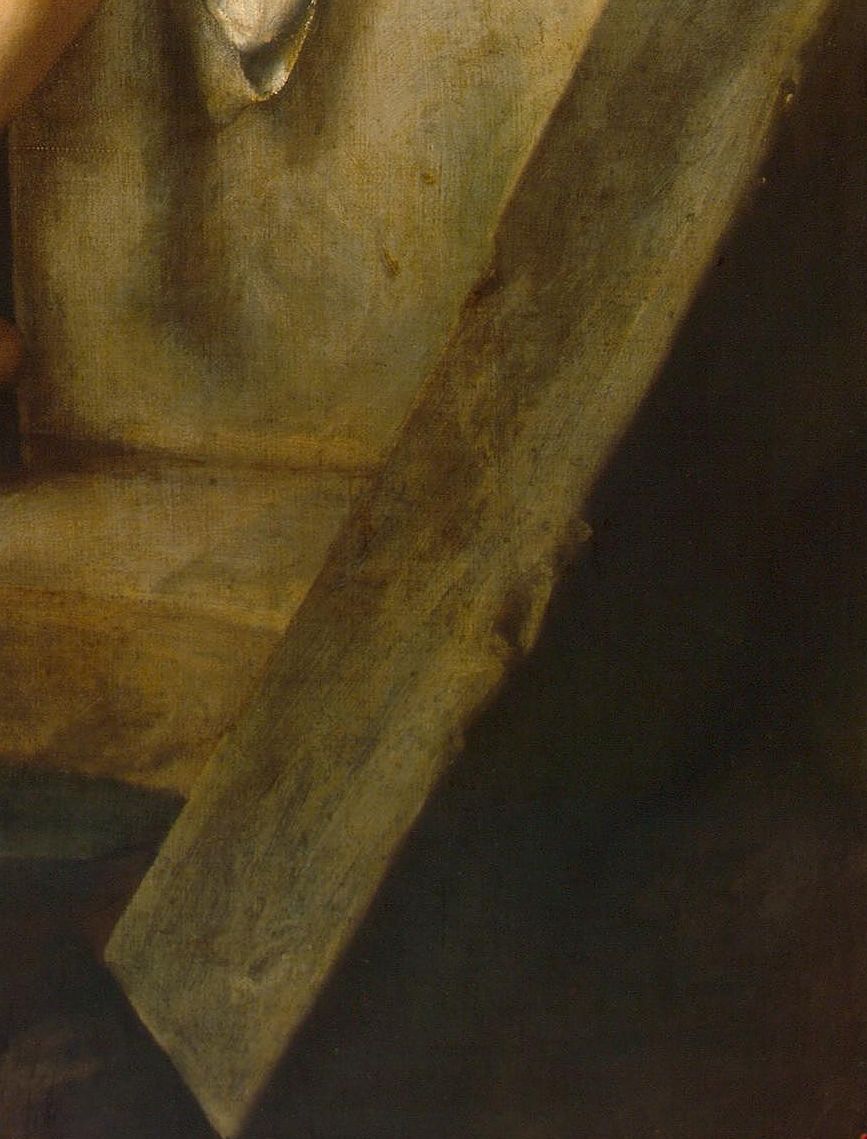
The angel sits on the rim at the right, with one bare foot planted on the step and the other suspended above it. One shoulder is wrapped in white fabric, while the other leads into the bare arm that crosses the foreground. Follow that arm to the fingertip and the eye arrives at the dark opening between the angel’s seat and the massive displaced slab. Carracci tips the slab steeply into the near corner. Its broad face and pale edge make the grave feel like something with weight and depth, even where shadow obscures its interior. The angel’s face meanwhile turns back towards the women. Gesture and gaze pull in opposite directions, holding the visit and the grave together in a single action. [1]
The three visitors approach from the left, with different responses discernible before the eye makes out their expressions. The woman farthest left opens one hand, fingers widely spaced, and brings the other to her chest. Her red dress catches the light between broad folds of deep blue. The woman in front of her bends at the waist and extends a hand low beside her, palm down. With the other hand she catches the folds of her mantle at her chest, as if to keep the cloth in place while she leans. Her sandalled foot advances to the lower edge of the composition. The visitor behind them stands nearly upright in yellow and red, gathering a covered vessel close to her body. One hand holds it from below while the other rests across the lid. Its round shoulder catches the light against the patterned fabric around it. The painter gives the group a common destination but allows each woman to arrive at a different speed. [1]
The space behind them deepens through two kinds of darkness. At the right, the angel’s wings and the recess near the tomb merge into shadow. At the left, a break beneath the trees gives onto a distant band of light. The low gleam in the landscape makes sense of the early hour. Below it, a few tiny figures are just visible along a path. Their scale sets the visitors close to the picture plane and gives their large, deliberate gestures more force. Near the grave the white cloak, forearm and lit stone carry the eye at much closer range. The pale drapery of the bending woman picks up some of that brightness and lets the eye cross back from the angel to the visitors. The strongest lights therefore belong to actions the viewer can follow at once, while small features, including the contours of several faces, emerge more slowly. [1]
Annotated Details from Holy Women at Christ’s Tomb
The numbered points identify visible features discussed in this article. Return from each detail to the numbered overview. Annibale Carracci, Holy Women at Christ’s Tomb. State Hermitage Museum, ГЭ-92. Image source. Public domain.
Details from HOLY WOMEN AT CHRIST’S TOMB
Compare the cropped details with the source images above. Notice how their colours, shapes and positions contribute to the larger compositions.
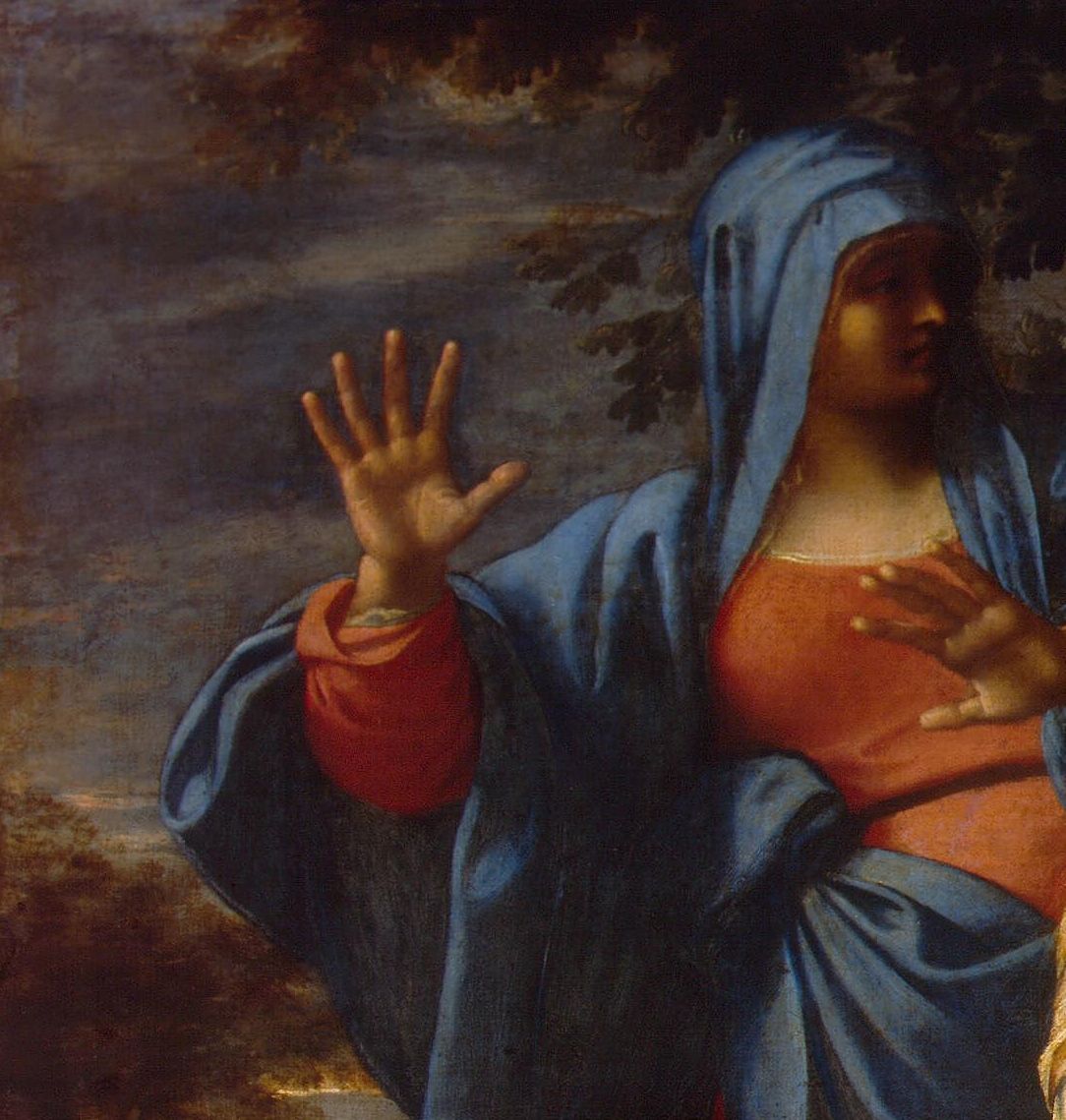
A raised palm
A woman in blue spreads the fingers of her raised hand. The gesture registers her response before the viewer has followed the angel’s pointing arm.
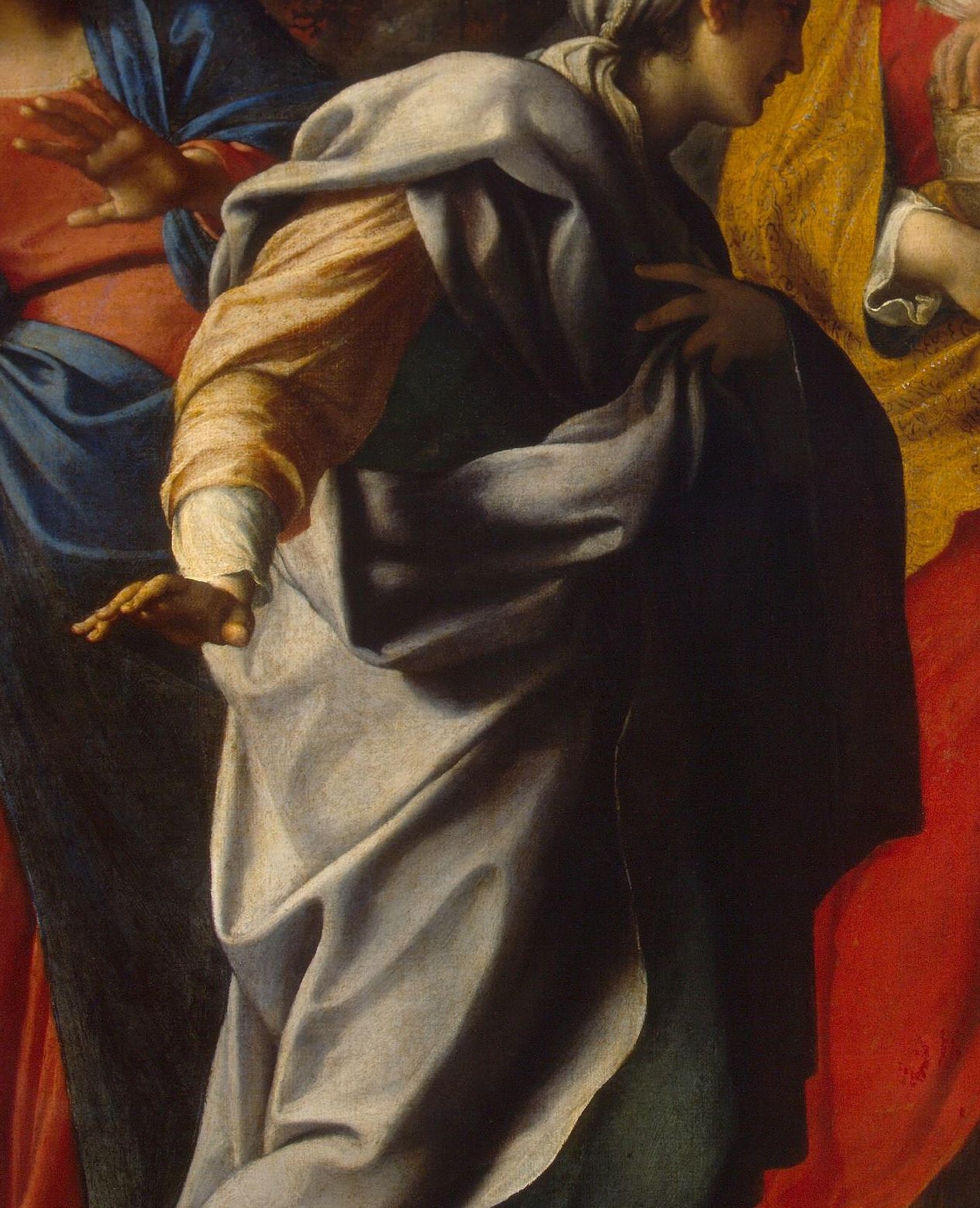
The bending figure
The foremost figure bends across the dark middle of the picture. The twisting grey drapery turns the eye towards the opening at the right.
The angel's hand
The angel extends a hand beyond the seated body towards the stone. Pale clothing and bare skin make that movement conspicuous against the shadow.
The angled stone
A large stone edge tilts diagonally across the foreground. Its angle gives the burial site greater depth and directs attention below the angel.
What the women find in the Gospels
The empty tomb is reported in all four Gospels, with different accounts of the visitors and the encounter. In Matthew 28, Mary Magdalene and the other Mary go to see the tomb as day is breaking. An angel descends, rolls back the stone and sits on it. The angel invites the two women to see where Jesus lay and sends them to tell the disciples. Matthew gives particular prominence to the person who moves the stone and interprets the empty place. Carracci likewise gives his seated messenger a prominent position and the decisive gesture, although he paints three visitors. [3]
Mark 16 names Mary Magdalene, Mary the mother of James and Salome, who bring spices to anoint the body. They find the stone already rolled away and see a young man in a white robe seated on the right after they enter. That account offers a close parallel for the painting’s group of three and the vessel one of them carries. Luke 24 also has women carry spices. There they encounter two men in dazzling garments, and the list of women includes Joanna and others as well as Mary Magdalene and Mary the mother of James. In John 20, Mary Magdalene arrives while it is still dark and sees the stone removed. She later looks into the tomb and sees two angels where Jesus’s body had lain, one at the head and one at the feet. [4] [5] [6]
The Russian catalogue title describes the visitors as the holy myrrh-bearers. The phrase emphasizes the burial rite they expected to perform. Carracci’s vessel makes that intention visible at the moment it is interrupted. The term Three Marys has long been used for the subject, but even Mark’s list of three gives one of them the name Salome. Mary Magdalene is present in all four texts. The vessel makes the woman in yellow and red a plausible Magdalene in the painting, given the saint’s association with ointment, but the composition supplies no inscriptions that would settle every figure’s identity. The Gospel differences help explain the choices Carracci had available when he brought three women, one angel and a displaced slab into the same scene. [2] [3] [4] [5] [6] [7]
Drawings, the date and the Maratti cartoon
Two Louvre drawings let us compare isolated gestures with their part in the finished group. One is a woman’s head in profile turned to the right (INV 9099, recto). The other is an open right hand (INV 9104.B, recto). Both are worked in black chalk with white chalk on blue paper, and both were formerly attributed to Domenichino. Catherine Loisel catalogued them in connection with the Hermitage picture. The Hermitage associates the profile with the middle woman and the hand study with the woman at the left. In the finished picture, that lifted palm gets its force from being held high against dark foliage. The two studies show attention to the small parts of the design that would later have to register inside a crowded group. [2] [8] [9]
The dating argument turns in part on another drawing, in the Royal Library in Turin. Denis Mahon connected the loose sketch of two women on the back of a sheet to the two figures at the left of the Hermitage canvas. The front carries an early design for a figure supporting an architectural feature in the Farnese Gallery. If the women on the reverse are Annibale’s own working sketch, the shared sheet gives the painting a tangible link with the gallery campaign and helps explain Mahon’s 1597–98 dating. Donald Posner assigned the sketch of the women to a pupil and dated the canvas to about 1600, a dating also adopted by Carel van Tuyll in the 2006–07 Bologna and Rome exhibition. A 1958 Hermitage catalogue had put it around 1605. The disagreement concerns a drawing and the painting’s place within Carracci’s Roman years. The Hermitage catalogues both name Annibale as the painter. [1] [2]
A further clue is documentary. An inventory of the painter Carlo Maratti’s collection from 1712 mentions a cartoon by Annibale showing two Marys going to the tomb. A cartoon in this context is a large drawing worked up for use in making a painting. The Hermitage suggests that the entry could describe part of the cartoon for its canvas. The subject fits, and the reference to two women is compatible with a fragment, but the inventory description gives little basis for tracing its exact relationship to the surviving painting. It is evidence of a possible stage in the process, alongside the more securely identified studies of a face and a hand. [1] [2] [8] [9]
From Pasqualini to the Hermitage
Writing in 1678, the Bolognese biographer Carlo Cesare Malvasia reported that Carracci made the picture for Lelio Pasqualini, a Bolognese antiquarian and canon of Santa Maria Maggiore. He traced it from Pasqualini to Giovanni Battista Agucchi, the papal diplomat and writer on painting, and then to Cardinal Ascanio Filomarino, archbishop of Naples. By Malvasia’s account it had come into the collection of Filomarino’s nephew, the Duke della Torre. This history puts a painting usually discussed alongside the Roman Farnese campaign in a different setting of ownership, from an antiquarian’s collection to a Neapolitan palace. The link to Pasqualini rests on Malvasia’s later account. [1] [2] [7] [10]
For the picture’s departure from Naples the Russian catalogue cites the painter Wilhelm Tischbein’s account of the sacking of the della Torre household during the French takeover. Tischbein lists the Carracci among the works taken. By the early nineteenth century the canvas is recorded in the collection of Lucien Bonaparte. It subsequently belonged to W. G. Coesvelt in London, from whose collection the Hermitage acquired it in 1836. The acquisition date anchors the last documented transfer in a chain that also depends on retrospective evidence, particularly for the circumstances in which the painting left Naples. [1] [2]
The painting in print and in other collections
Jean Louis Roullet’s reproductive print offers an earlier record of the composition’s circulation. The Italian national catalogue ties it to the painting in the della Torre palace in Naples and dates the plate to after 1673 and before 1683. Roullet worked from a drawing by Jérôme Trudon for the publisher Jacques Raillard. A Rijksmuseum impression names all three and preserves the scene in reverse. The tomb and angel move to the left and the visitors to the right. Darker and lighter areas of hatching do the work of the canvas’s whites, blues and yellows. The print also had a life beyond Raillard. Rome’s Istituto Centrale per la Grafica catalogues an impression with Raillard’s address and a third state carrying the name of the Augsburg publisher Johann Daniel Herz. The same arrangement of figures could reach viewers in new editions well beyond the palace where the original hung. [7] [11] [12] [13]
The Russian catalogue records several further forms of circulation. It notes a reduced version possibly by Giovanni Antonio Solari and a repetition by Antonio Carracci that gives the landscape more room. Fondazione Federico Zeri documents the altered Saint Louis version as a school copy, with earlier tentative attributions recorded in its photographic archive. The Hermitage also catalogues a separate painting of the subject by Francesco Albani, inventory ГЭ 4795. Its much smaller figures sit within a more expansive painted landscape, changing the distance from which the visitor witnesses the encounter. Carracci’s possible influence on Albani concerns the subject and its treatment. The Albani painting has its own collection history and entered the Hermitage in 1923. [2] [14]
The Hermitage catalogue also records where the original travelled as a loan. In 1993–94 it was no. 19 in the exhibition of Italian Renaissance and Baroque paintings that went from the Tobu Museum of Art in Tokyo to the Mie Prefectural Art Museum and then to the Museum of Modern Art, Ibaraki. It appeared as no. VIII.6 in the Carracci exhibition in Bologna and Rome in 2006–07 and as no. 78 in the 2011–12 Hermitage exhibition in Madrid. The artist exhibition gave it a place alongside Carracci’s other work, the context in which van Tuyll considered its date. [2] [15]
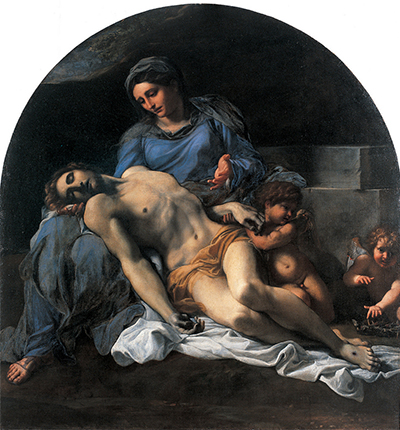
The name Three Maries can also lead to Carracci’s The Dead Christ Mourned, NG2923 in the National Gallery, London. That canvas dates to about 1604 and shows Christ’s body supported by the Virgin Mary, with Mary Magdalene kneeling to the right. Both paintings give each woman a distinct gesture, but the gestures in London gather around a body the eye can see. In Saint Petersburg they have to direct attention to an absence. The lifted hand, the angled slab and the angel’s steady finger all help the viewer make the same discovery as the visitors. [1] [16]
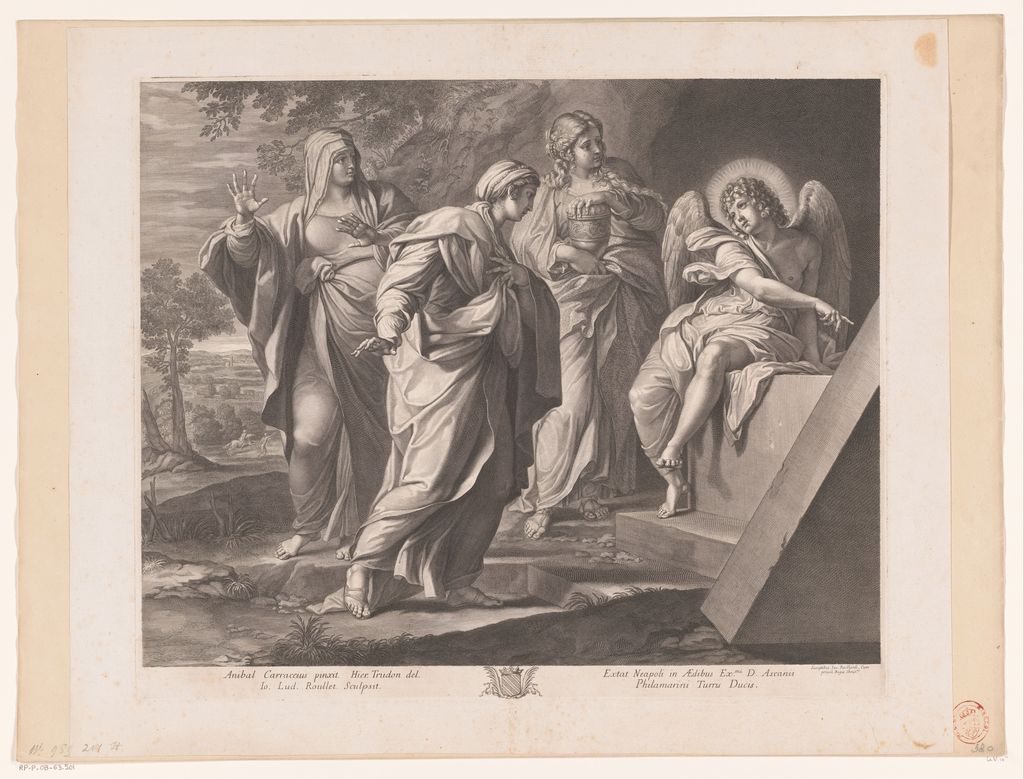
Jean Louis Roullet after Hieronymus Trudon and Annibale Carracci, The Holy Women at the Tomb. Published by Jacques Raillard. Rijksmuseum, RP-P-OB-63.501. Image source. Public domain.
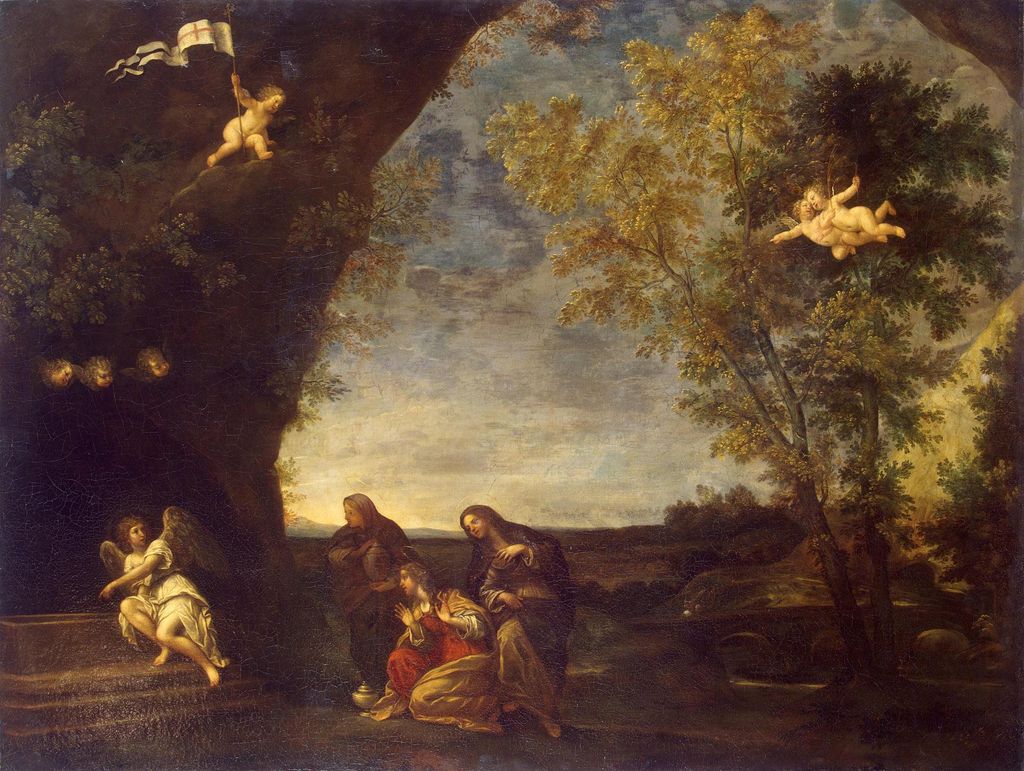
Francesco Albani, Holy Women at Christ’s Tomb. A separate painting of the same episode. State Hermitage Museum, ГЭ-4795. Image source. Public domain.
Artworks directory
Paintings, frescoes, drawings and prints, with separate entries for documented versions and collaborative projects.
Discussion
Look again at the images and ideas explored in Holy Women at Christ’s Tomb. These editorial prompts invite your observations.
Reader Insights
Which figure’s gesture makes the empty tomb legible before you examine it directly?
How do the different reactions among the women help tell a story that the angel already understands?
Join the Conversation
Share a detail, comparison or question about Holy Women at Christ’s Tomb below.
References
- State Hermitage Museum, Western European Art: Paintings 13th to 18th Century, no. 29, pp. 46–47. View source.
- S. N. Vsevolozhskaya, Italian Painting of the Seventeenth Century, State Hermitage Museum (2013), no. 85, ГЭ 92, and no. 4, ГЭ 4795. View source.
- Matthew 28:1–10, New American Bible. View source.
- Mark 16:1–8, New American Bible. View source.
- Luke 24:1–12, New American Bible. View source.
- John 20:1–18, New American Bible. View source.
- Italian national cultural heritage catalogue, Roullet after Carracci, Angelo annuncia la resurrezione alle pie donne, 0800437652. View source.
- Musée du Louvre, Tête de femme de profil, tournée vers la droite, INV 9099, recto, citing Catherine Loisel, 2004, p. 257, no. 550. View source.
- Musée du Louvre, Main droite ouverte, INV 9104.B, recto, citing Catherine Loisel, 2004, p. 257, no. 551. View source.
- Dizionario Biografico degli Italiani, Agucchi, Giovanni Battista. View source.
- Rijksmuseum, Jean Louis Roullet, Drie Maria’s bij het graf, RP-P-OB-63.501, Le Blanc 10-II. View source.
- Istituto Centrale per la Grafica, Roullet, Le tre Marie al sepolcro di Cristo, second state, S-FC52530. View source.
- Istituto Centrale per la Grafica, Roullet, Le tre Marie al sepolcro di Cristo, third state, S-FC52529. View source.
- Fondazione Federico Zeri, Pie donne al sepolcro, school of Annibale Carracci, no. 56123. View source.
- CiNii Books, Italian Renaissance and Baroque Painting: State Hermitage Museum Exhibition (1993), catalogue and Japan itinerary. View source.
- National Gallery, London, The Dead Christ Mourned (‘The Three Maries’), NG2923. View source.