 by Tom Gurney
Tom Gurney BSc (Hons) is an art history expert with over 20 years experience
Published on June 19, 2020 / Updated on November 29, 2026
Email: tomgurney1@gmail.com / Phone: +44 7429 011000
The Bean Eater: Introduction
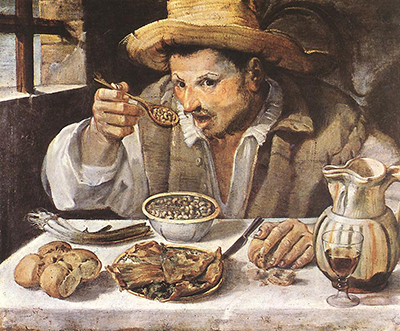
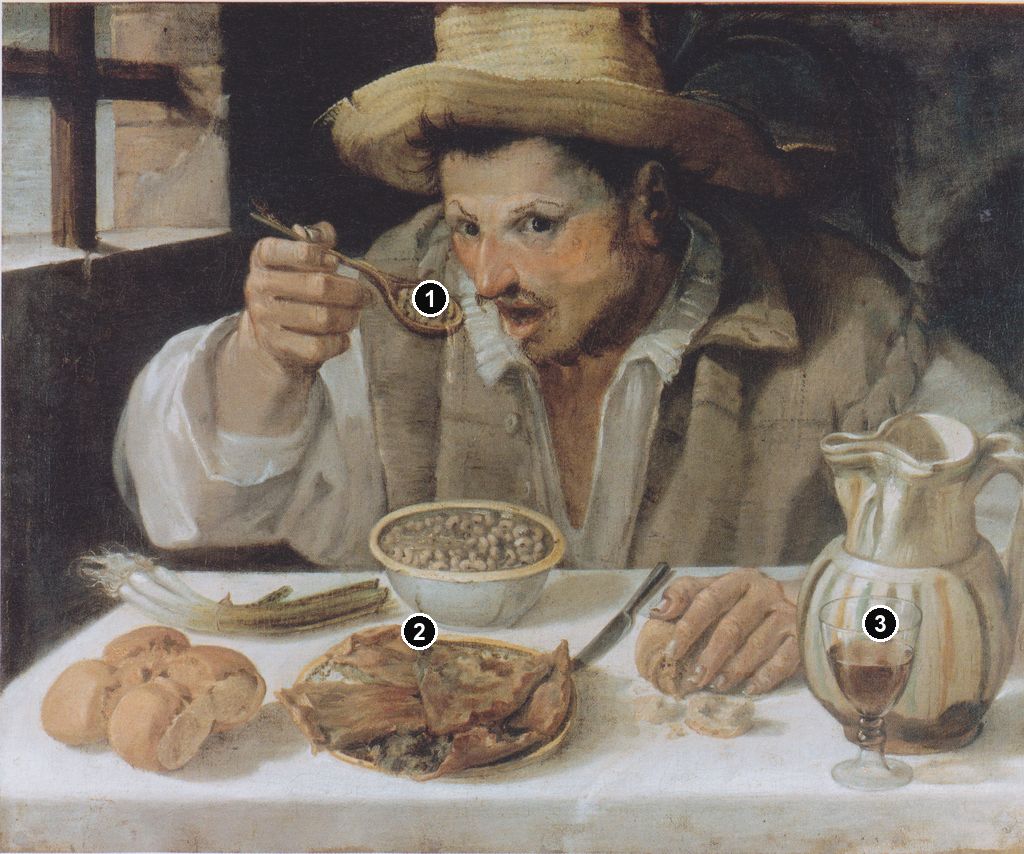
A spoonful of beans has almost reached the man's mouth when he looks up. His lips are parted and his right hand is still in the air. His other hand holds a piece of bread against the tablecloth. A little broth spills from the spoon. In The Bean Eater, Annibale Carracci makes an everyday meal feel as though it has been interrupted by someone just across the table. Our view of the scene places us close enough to be that person. [1] [2]
The small oil on canvas, also known as Il Mangiafagioli, belongs to the Galleria Colonna in Rome, where the gallery checklist lists it as no. 59 in the Sala dell’Apoteosi di Martino V. The canvas measures about 57 × 68 cm. Scholars place it in Annibale's early career and have proposed dates from around 1580–81 to around 1584–85. The subject looks simple enough to describe in a few words. How Carracci understood the man he was painting, and how he expected viewers to respond to him, are harder questions. [1] [2]
At a Glance
- ArtistAnnibale Carracci
- DateLate 16th century
- MediumOil on canvas
Contents
- A meal interrupted
- Beans, bread and crockery
- How Carracci makes the moment feel immediate
- A countryman, a comic type or a portrait?
- Other ways to paint ordinary life
- From the Pallavicini collection to Palazzo Colonna
- Annotated details
A meal interrupted
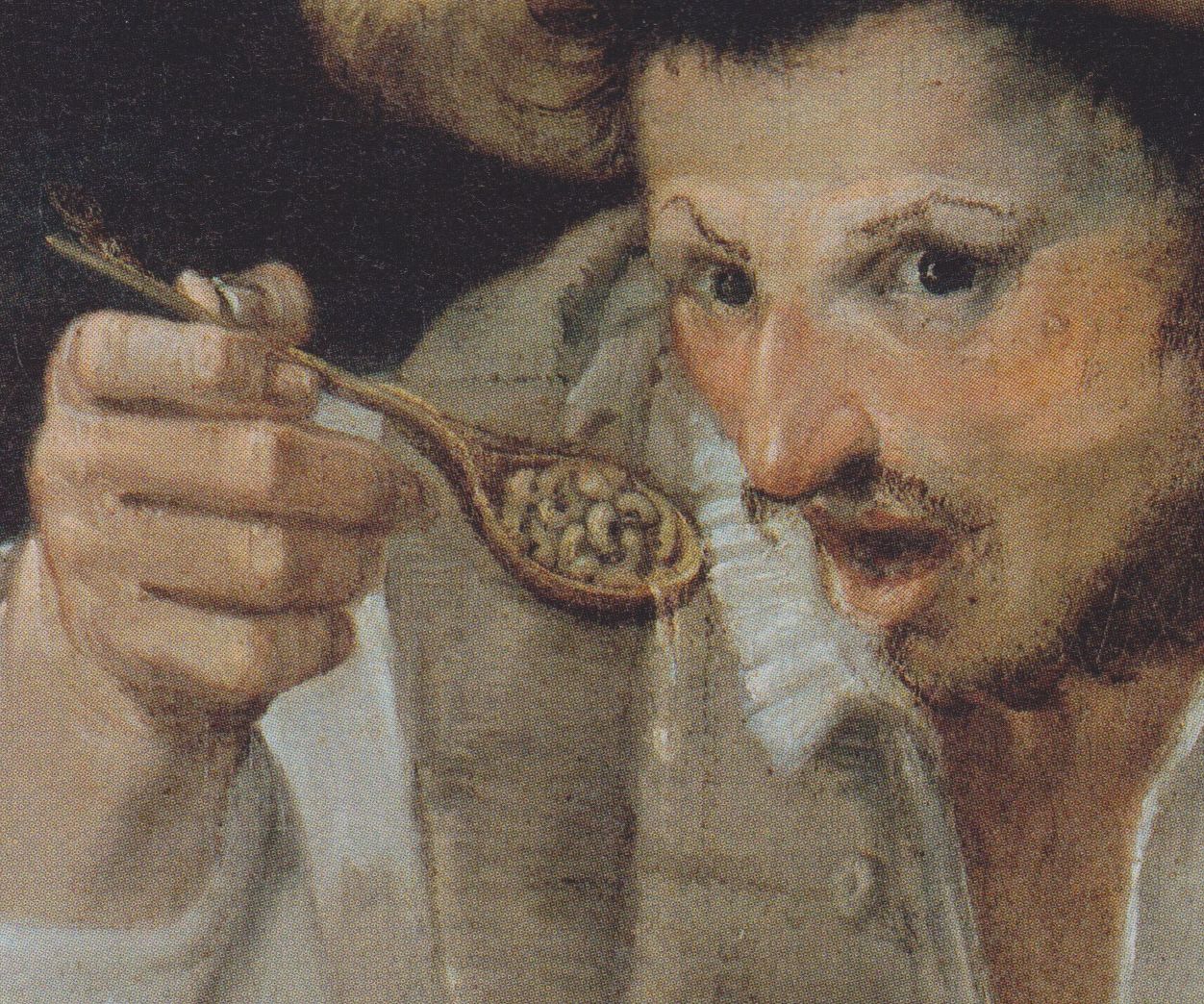
The man's gaze moves out of the picture while the spoon keeps its course towards his mouth. Carracci has left a narrow gap between the spoon and the lips, just enough space to see the way the spoon tilts and the liquid falls. The raised forearm gives the gesture weight. The hand on the bread rests low and wide, with its fingertips pressing against the torn crust. One hand is poised to move and the other seems scarcely to have moved at all. The interruption happens in the time it takes to shift a glance. [1] [2]
Carracci brings the man up close. The crown of the hat meets the top of the image and the pitcher's handle reaches the right edge. The front of the table forms a broad, bright band along the bottom. We look down enough to see the beans in their bowl and the food on the plate, yet we are close to the level of the man's face. Those two views work together. The first gives us a place at the table and the second makes us feel that the person already sitting there has noticed our presence. The picture leaves that encounter open. The glance might register surprise, caution or the brief attention someone pays to an unexpected sound. [1]
The opening at the upper left is the only part of the room that offers a view beyond the table. Its bars give the dark background a sharp corner and help direct attention back towards the face. The broad brim shades the brow while light catches the bridge of the nose, the cheek and the thin edge of the shirt collar. Behind the head, the room falls into shadow. Annibale gives us enough architecture to place the figure indoors and keeps the viewer's attention on what happens beside the bowl. [1] [2]
Annotated Details from The Bean Eater
The numbered points identify visible features discussed in this article. Return from each detail to the numbered overview. Annibale Carracci, The Bean Eater. Galleria Colonna, Rome. Image source. Public domain.
Details from THE BEAN EATER
Compare the cropped details with the source images above. Notice how their colours, shapes and positions contribute to the larger compositions.
The raised spoon
The spoon carries beans towards a half-open mouth. Its movement stops at the same moment as the eater looks up.
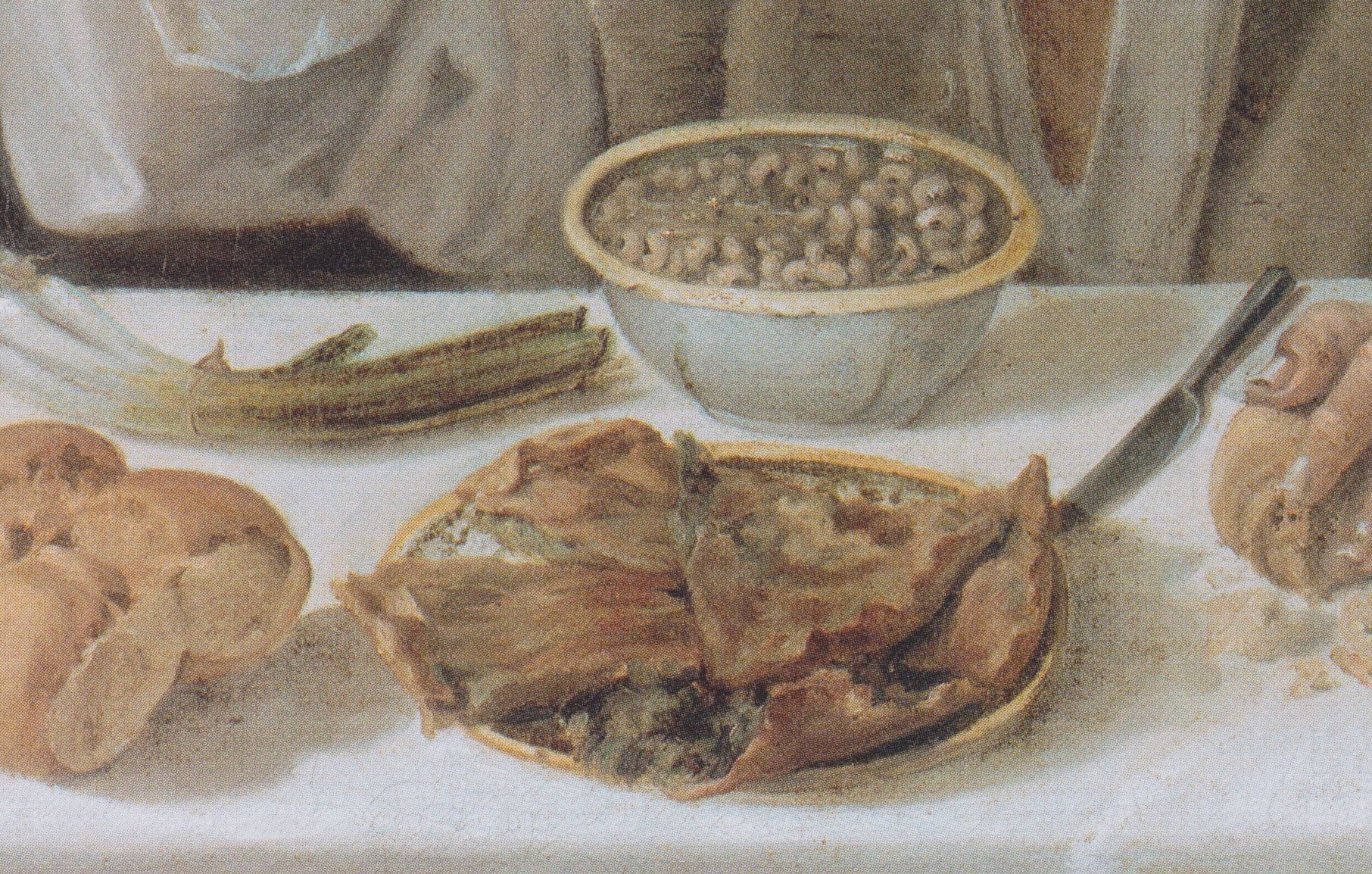
The bowl and bread
The light tablecloth separates the pale bowl and the round bread from the dark interior. Loose touches around the meal keep the surfaces distinct.
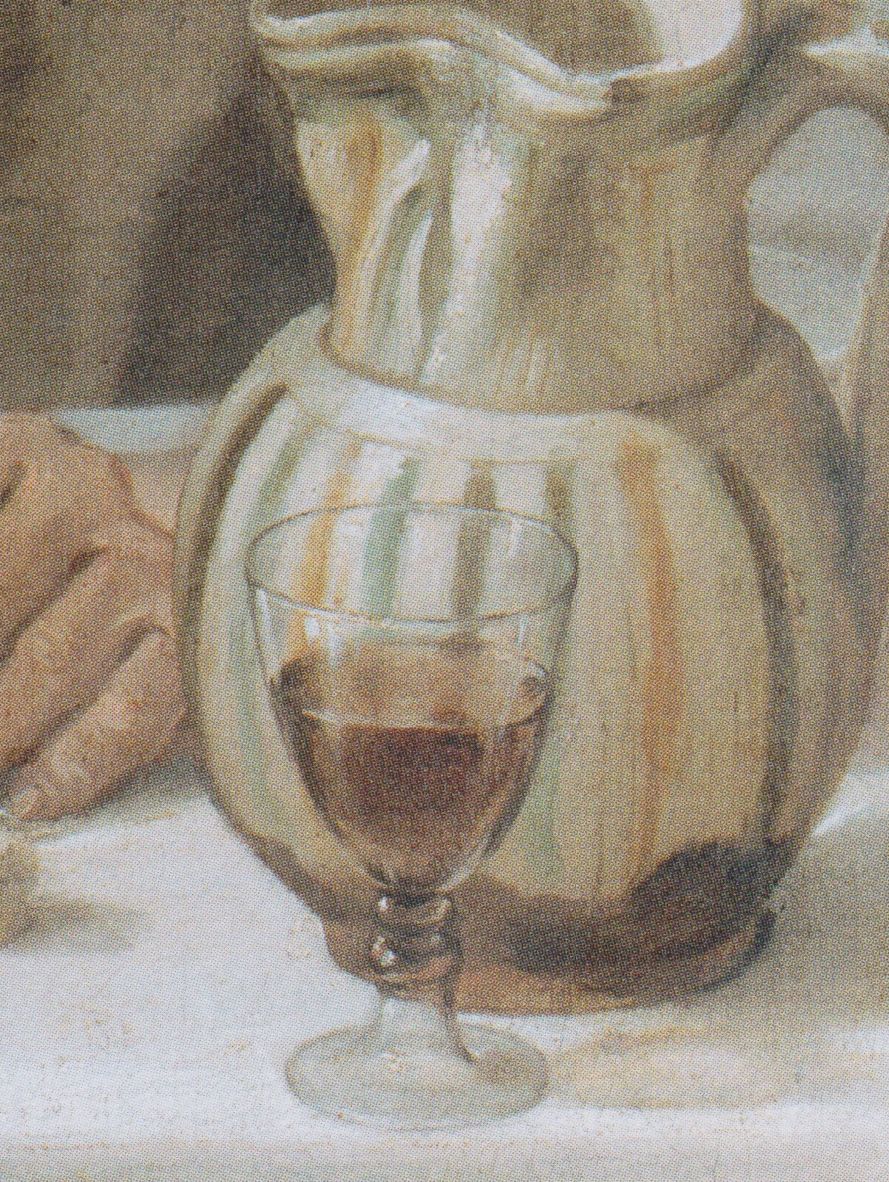
The jug and glass
The striped jug has a broad ceramic surface. In front of it, a thin stem and small reflections distinguish the much lighter structure of the drinking glass.
Beans, bread and crockery
The bowl occupies the space beneath the raised spoon. Across the front of the table, Carracci sets torn bread, a bunch of onions with pale roots and long green stalks, and a shallow dish of browned food with a darker filling. Pigozzi identifies the dish as erbazzone, a savoury greens pie. Its dark filling is visible where the crust has broken. A knife lies diagonally between the dish and the hand on the bread. On the right, a stemmed glass holding what looks like wine overlaps a striped earthenware pitcher. The folds and marks in the cloth, the crumbs at the fingers and the faint shadow of the glass keep this from looking like a table waiting to be used. Someone has already broken bread and begun to eat. [1] [2] [3]
The arrangement also gives each material room to catch the light in its own way. The crock's lip is described by a pale, wavy stroke that folds into shadow on its inner wall. Softer stripes follow the curve of the vessel below it. The glass is largely made of what we can see through it, interrupted by the thin line of the rim and the dark weight of the drink. The bread does something different. Highlights break across the cut and torn surfaces, leaving duller tones on the rounded crust. Across the bottom of the painting a few pale strokes have to describe a shiny glazed surface, transparent glass and a piece of cloth, sometimes within a finger's breadth of each other. [1] [2]
Beans and onions carried a social meaning in late sixteenth-century northern Italy. Sheila McTighe relates scenes like this to contemporary arguments about which foods suited people of different ranks. The link between beans and rural life also turns up in comic writing. In the Bolognese writer Giulio Cesare Croce's story of Bertoldo, the peasant ends up at court and is fed food he cannot stomach. He longs for beans cooked with onions. The comparison helps explain what cultivated viewers might have recognised in a bowl of beans. It gives the painting a period context while leaving the actual recipe, the man's livelihood and the occasion of the meal open. [2] [3] [4]
How Carracci makes the moment feel immediate
The weave of the straw hat reads in runs of ochre and pale brown. A few fine strokes lift from the brim like loose fibres. Below it the brush changes pace again. Light dabs pick out eyes and skin, while the open mouth sits among darker, less clearly bounded marks. Look across to the raised sleeve and the shifts between white and grey are wider. Broad folds of cloth need fewer edges than the fingers holding the spoon. The most fleeting parts of the scene, from the glance to the liquid slipping away, are also the details the painter makes easiest to locate. [1] [2]
The tabletop has an order of its own. The knife points up between the two hands. The onions carry the eye from the bread towards the bowl, and the pitcher draws it back down into the foreground. The two large patches of light in the lower half, the shirt sleeve and the tablecloth, are separated by a deep shadow that makes the elbow stand out. Carracci makes a seemingly accidental look possible through deliberate choices about where each shape ends, which objects overlap and how much of the dark room to show. The apparent spontaneity belongs to the encounter he paints. The individual brushstrokes alone can tell us little about the time it took him to arrange that encounter. [1] [2]
An eating figure in an Annibale drawing at the Uffizi offers another way to see the problems he was exploring. In Boy Eating, the head is tilted back and viewed from below, while the objects on the table are seen a little from above. Diane De Grazia points to this change of viewpoint as one of several ways the young Carracci tested what a nearby observer could see. Sybille Ebert-Schifferer stresses how much the sheet differs from the Colonna painting despite the shared subject. It is evidence for Annibale's sustained interest in the mechanics of a meal and the observer's position. Its relationship to the making of this canvas remains uncertain. [2] [5]
A countryman, a comic type or a portrait?
The Colonna Gallery describes the man as a peasant, and the Fondazione Federico Zeri catalogue indexes the picture under Contadino che mangia, meaning a countryman eating. A seventeenth-century description uses the word villano, a term that could carry a social judgement as well as describe a rural person. The hat, open collar and food establish a recognisable type for an early viewer. The features remain individual enough to prompt a different question. Was the painter drawing on someone's likeness, perhaps someone the first viewers could recognise? [1] [2] [3] [6]
The long nose, parted mouth and sideways glance have encouraged comparisons with the exaggerated faces of popular comedy. Ebert-Schifferer considers the resemblance to the masks of commedia dell’arte and to the Carracci practice of ritratti carichi, portraits that heighten a person's distinguishing traits. She entertains the possibility of a portrait of Croce playing a role. Marinella Pigozzi brings Carracci and Croce together through their interest in ordinary gestures and popular life, while concluding that the comparison cannot identify the sitter. Croce's writing shows how a stock countryman could have wit, appetite and a forceful character. It gives a way into the picture without supplying the name of the man at the table. [2] [3]
De Grazia reads Carracci's approach as attentive to people going about daily activities, with less emphasis on moralising than in some related pictures. The viewer's closeness makes that reading persuasive. The man catches us looking, and his reaction claims a share of the scene that might otherwise belong to the food or to someone's joke about his manners. A comic note can coexist with that alertness. What remains uncertain is how the painting balanced those effects for its first owner. [2] [4] [5]
Other ways to paint ordinary life
Vincenzo Campi's Ricotta Eaters in Lyon puts several people close to the table, facing out with wide mouths and conspicuous grins. The single eater in Carracci's picture gives his attention to something outside the frame for just a moment. The two works use direct looks to very different effect. Campi makes a gathering out of them, while Carracci uses one set of eyes to make the viewer aware of where they are standing. Campi's Fishmongers in Milan gives eating a smaller place in a larger market scene. A couple eats in the middle of work, and a child's distress adds another incident. Carracci makes the whole picture turn on the sort of gesture that Campi can assign to a corner. [1] [2] [7] [8]
Bartolomeo Passerotti's lute-playing countryman offers a closer set of props. As Ebert-Schifferer points out, there too are bread, a spread cloth and a similar pitcher. A dog helps itself to the bread while the musician is occupied. Carracci dispenses with a second action of that kind. The everyday things on his table are enough to establish the setting for a look, without building a story around what happens to the food. Similar crockery shows the painters working with a familiar repertoire of objects. Common objects alone are a slim basis for making one canvas a direct model for the other. [2] [3]
The comparison stretches beyond Bologna and Cremona. Netherlandish painters such as Joachim Beuckelaer had already made kitchens, markets and abundant provisions major pictorial subjects. In Beuckelaer's The Four Elements: Earth, baskets of fruit and vegetables come right up to the front of the painting, while the Holy Family appears at a distance. The foreground food can look like the whole story until the eye finds the background. The Colonna picture fills its small space with the eater and his immediate surroundings. The wider European taste for pictures of food and work helps explain the subject's possibilities, even where a specific model for Annibale is difficult to establish. [2] [5] [9]
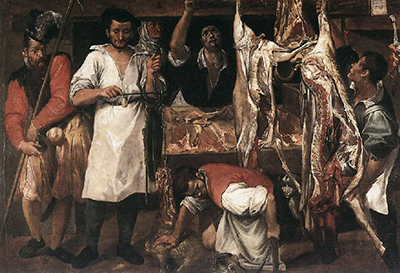
Among Annibale's own paintings, the Butcher's Shop at Christ Church, Oxford, invites comparison through its nearly life-size figures and the range of actions in one place. Men handle cuts, prepare meat and weigh it at the counter. In Bologna in 1956, visitors could see the Oxford painting alongside The Bean Eater and judge what Carracci could do with a shop full of people and with a single man at a bowl. The Kimbell Art Museum owns a separate, much smaller Butcher's Shop. Its sober tradesmen, earth colours and shadows offer another example of Carracci finding a suitable scale and manner for a scene of work. In Cleveland's Boy Drinking, a young figure tips a glass to his mouth. Light passing through the glass and carafe matters as much to the action there as the tilt of the spoon does in Rome. [10] [11] [12] [13]
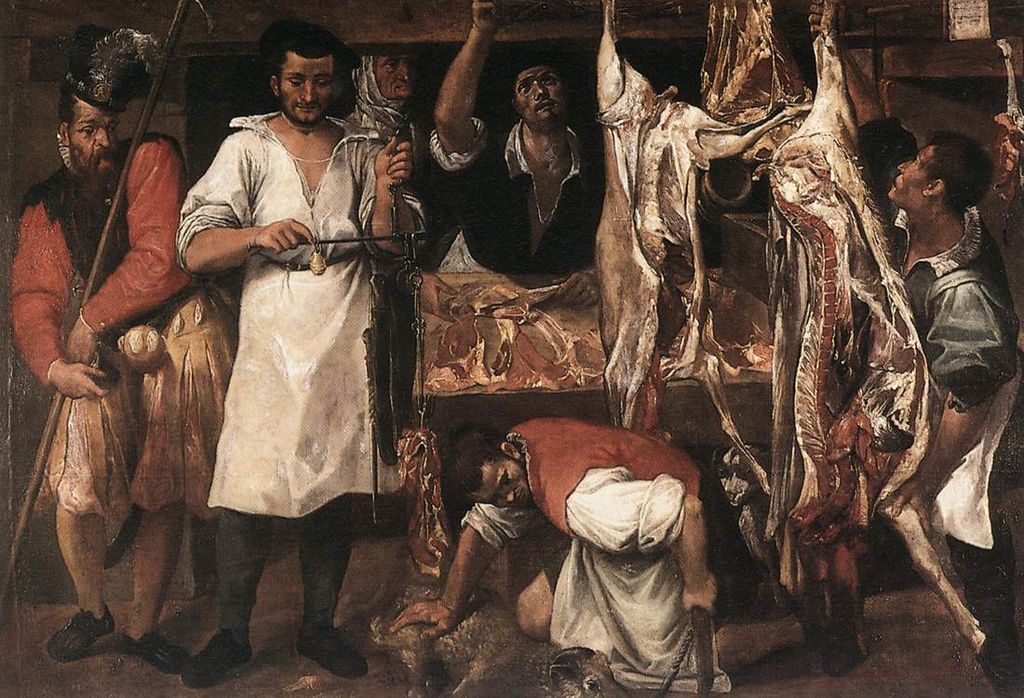
Annibale Carracci, The Butcher’s Shop. Christ Church Picture Gallery, Oxford, JBS 181. Image source. Public domain.
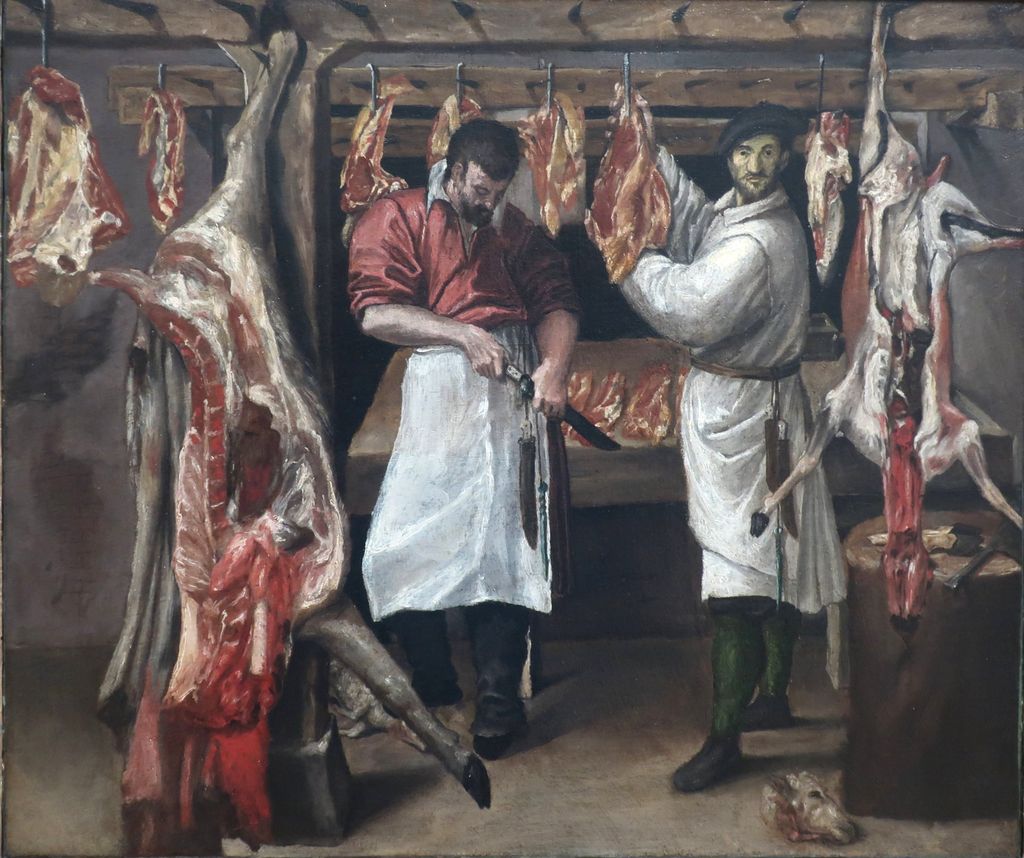
Annibale Carracci, The Butcher’s Shop. Kimbell Art Museum, AP 1980.08. Image source. Public domain.
From the Pallavicini collection to Palazzo Colonna
The earliest secure written trace so far identified is a Pallavicini inventory from 1678. It describes a countryman eating beans and names Annibale Carracci. A Colonna record cited by Pigozzi places the work in the Roman palace by 1783 and praises its convincing rendering of ordinary life. Those descriptions show that collectors recognised both the rural subject and the effect of lifelikeness. They come generations after the picture was made, which leaves its original commission and the circumstances of the meal unrecorded. [2] [3]
The attribution still came under debate. Roberto Longhi assigned the painting to Bartolomeo Passerotti in 1928. Godefridus Johannes Hoogewerff had proposed Pietro Paolo Bonzi. Adele Milozzi's study of the correspondence for Bologna's 1956 Carracci exhibition shows how strongly the organisers wanted to borrow the Colonna painting. The princess withheld authorisation for restoration, yet the organisers pursued the loan. The first edition of the exhibition catalogue listed the work as restored. Milozzi found no permission for treatment in the surviving correspondence, and the notice disappeared from the third edition. The documented turning point was the painting's inclusion next to the Oxford Butcher's Shop, where visitors could see that Annibale's handling could change with a subject. The organisers sold 1,545 postcards of the work during the exhibition. That gives a measure of the appeal of this particular picture at the moment when its place in Annibale's career was being reassessed. [10]
Today it hangs in the room named for Benedetto Luti's ceiling painting of the apotheosis of Pope Martin V. The exhibition room makes for a striking change of scale. There is a pope above and, among the paintings on the walls, a man with a spoonful of dinner. The small canvas rewards the time it takes to notice where the spoon stops and where the man's eyes go. The two movements carry the whole encounter. [1]
Artworks directory
Paintings, frescoes, drawings and prints, with separate entries for documented versions and collaborative projects.
Discussion
Look again at the images and ideas explored in The Bean Eater. These editorial prompts invite your observations.
Reader Insights
What do the position of the spoon and the man’s eyes tell you about timing?
How do the small meal and the Oxford butcher shop give everyday actions different kinds of attention?
Join the Conversation
Share a detail, comparison or question about The Bean Eater below.
References
- Galleria Colonna, gallery description and image of The Bean Eater and paintings checklist, no. 59. View source 1. View source 2.
- Sybille Ebert-Schifferer, “Annibale Carraccis Bohnenesser – Revolution als Nebenprodukt”, in Novità. Neuheitskonzepte in den Bildkünsten um 1600 (2011), pp. 111–131. View source.
- Marinella Pigozzi, “Annibale Carracci, Giulio Cesare Croce e Agostino Carracci”, in Le arti e il cibo (2014), especially pp. 232–240. View source.
- Sheila McTighe, “Foods and the Body in Italian Genre Paintings, about 1580: Campi, Passarotti, Carracci”, The Art Bulletin 86, no. 2 (2004), pp. 301–323. View source.
- Diane De Grazia, The Drawings of Annibale Carracci, National Gallery of Art (1999), pp. 17–18 and fig. 2. View source.
- Fondazione Federico Zeri, Contadino che mangia, object record 57607. View source.
- Musée des Beaux-Arts de Lyon, Vincenzo Campi, Les Mangeurs de ricotta and programme for the painting. View source 1. View source 2.
- Pinacoteca di Brera, Vincenzo Campi, Pescivendoli, collection record 403. View source.
- National Gallery, London, Joachim Beuckelaer, The Four Elements: Earth, NG6585. View source.
- Adele Milozzi, “L’impronta di Longhi, l’emergere di Mahon nella mostra dei Carracci”, in Ideale classico, especially pp. 84–86 and notes 34–36. View source.
- Christ Church Picture Gallery, Oxford, collection entry for The Butcher's Shop. View source.
- Kimbell Art Museum, The Butcher's Shop, AP 1980.08. View source.
- Cleveland Museum of Art, Boy Drinking, 1994.4. View source.