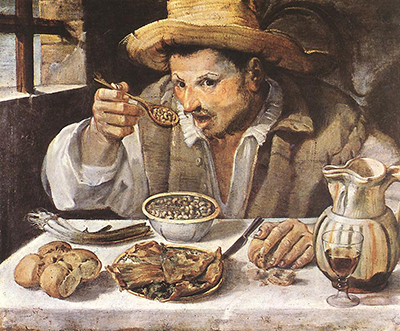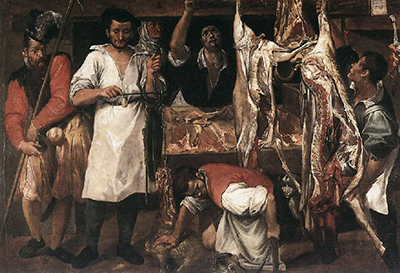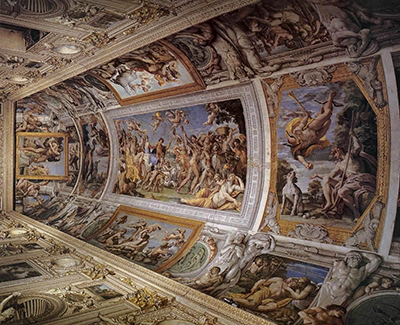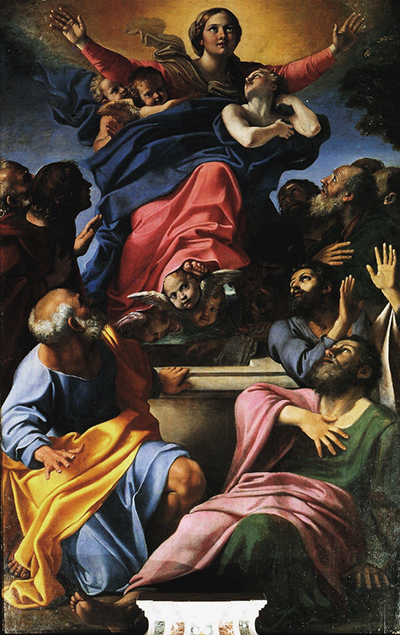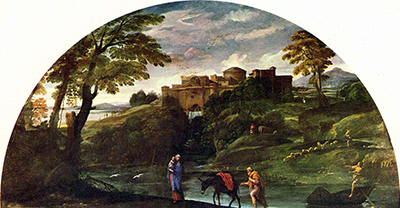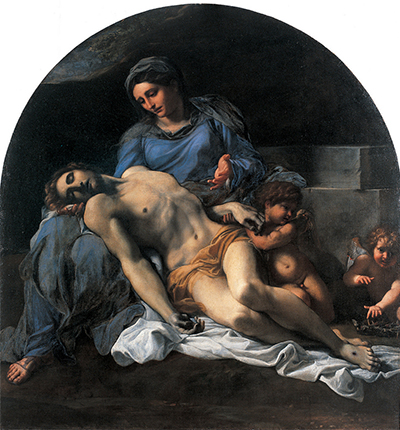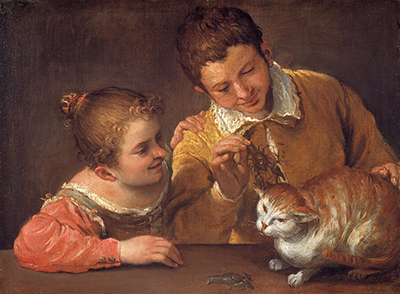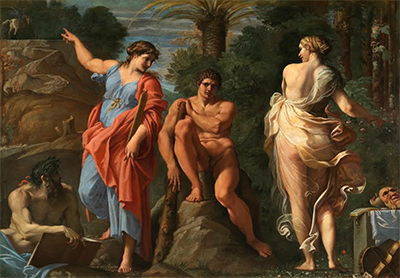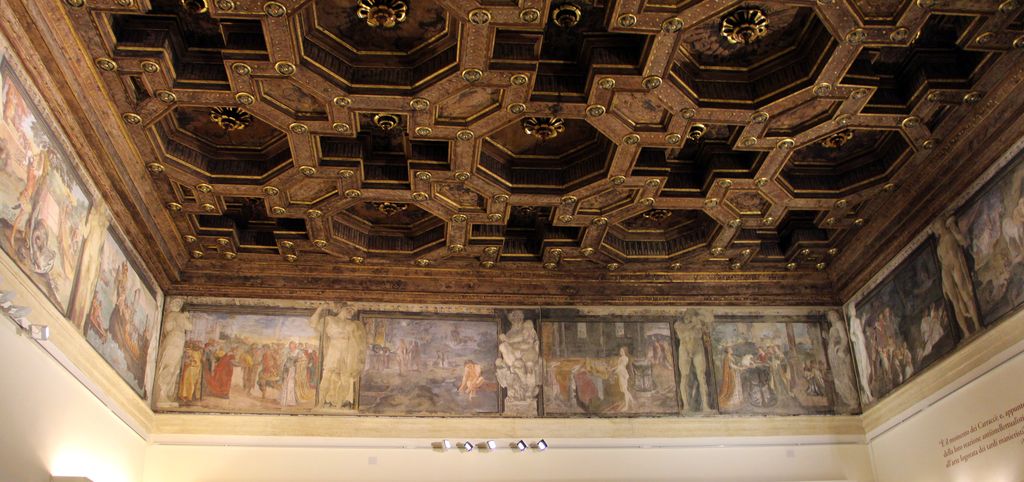
Annibale, Agostino and Ludovico Carracci, Jason and Medea frieze, Palazzo Fava, Bologna. Sailko. Image source. CC BY 3.0. Proportionally resized for web display.
 by Tom Gurney
Tom Gurney BSc (Hons) is an art history expert with over 20 years experience
Email: tomgurney1@gmail.com / Phone: +44 7429 011000
The Carracci Academy: Introduction
In the early 1580s, three painters in Bologna made drawing from life central to the training they offered younger artists. Annibale and Agostino Carracci were brothers, and Ludovico, the eldest of the three, was their cousin. Their private school and working studio became known as the Accademia degli Incamminati. A student could learn to draw an unfamiliar pose, study how Correggio made a body turn in light, and see a design developed for an actual commission. The painters' frescoes at Palazzo Fava, Palazzo Magnani and Palazzo Sampieri show how those habits of close observation, revision and discussion served three very different rooms. [1] [2] [3]
At a Glance
- ArtistAnnibale Carracci and collaborators
- Date1584
- MediumFresco
Contents
- When the academy began
- Drawing from life and learning from pictures
- Palazzo Fava and the story of Jason
- Palazzo Magnani and the founding of Rome
- Palazzo Sampieri and three encounters
- Ludovico in Bologna and the pupils in Rome
When the academy began
Around 1582 is a reasonable date for the beginning of the Carracci Academy. The Pinacoteca Nazionale di Bologna places it broadly in the 1580s, while the art historian Lorenzo Pericolo argues for 1582 in his study of its beginnings. Madrid’s Museo Nacional Thyssen-Bornemisza dates the founding to 1585 in its account of Ludovico. [4] In the accounts that give two names, the first was Accademia dei Desiderosi, referring to the participants' desire to learn. The later Incamminati suggests people who have set out on a path. Brera also records an early name, Accademia del Naturale, which identifies the practice for which the school became famous. The evidence supports an early-1580s beginning and a period of development under several names. The exact date when Incamminati came into use remains uncertain, even though about 1590 is often given for the change. [1] [5] [6] [7]
An academy could mean several things in late sixteenth-century Italy. Florence already had its Accademia del Disegno, and painters gathered to draw from the model and from casts in Bologna before the Carracci school began. Clare Robertson identifies the gatherings around the Bolognese painter Bernardino Baldi as a local precedent. In its early years, the Carracci academy combined instruction with a business taking commissions. Its founders could set a problem for a pupil and continue working out an answer among themselves. Pericolo sees discussion in front of an actual drawing, print or painting as especially important to the school's character. The three painters could disagree over a contour or the fall of light and test a solution on the work in front of them. [2] [5]
Several kinds of evidence help reconstruct what went on. A near-contemporary source is the oration Lucio Faberio gave at Agostino's funeral observances in Bologna in January 1603. Faberio addressed people who had known the painter, including members of the academy, but was also giving a eulogy. Carlo Cesare Malvasia's Felsina pittrice appeared in 1678 and preserves Bolognese testimony at a greater remove. Drawings supply a different record, particularly when they retain several attempts at a figure or can be compared with a finished work. A surviving sheet can show what a draughtsman changed even when the conversation that led him to change it has been lost. [2] [8] [3]
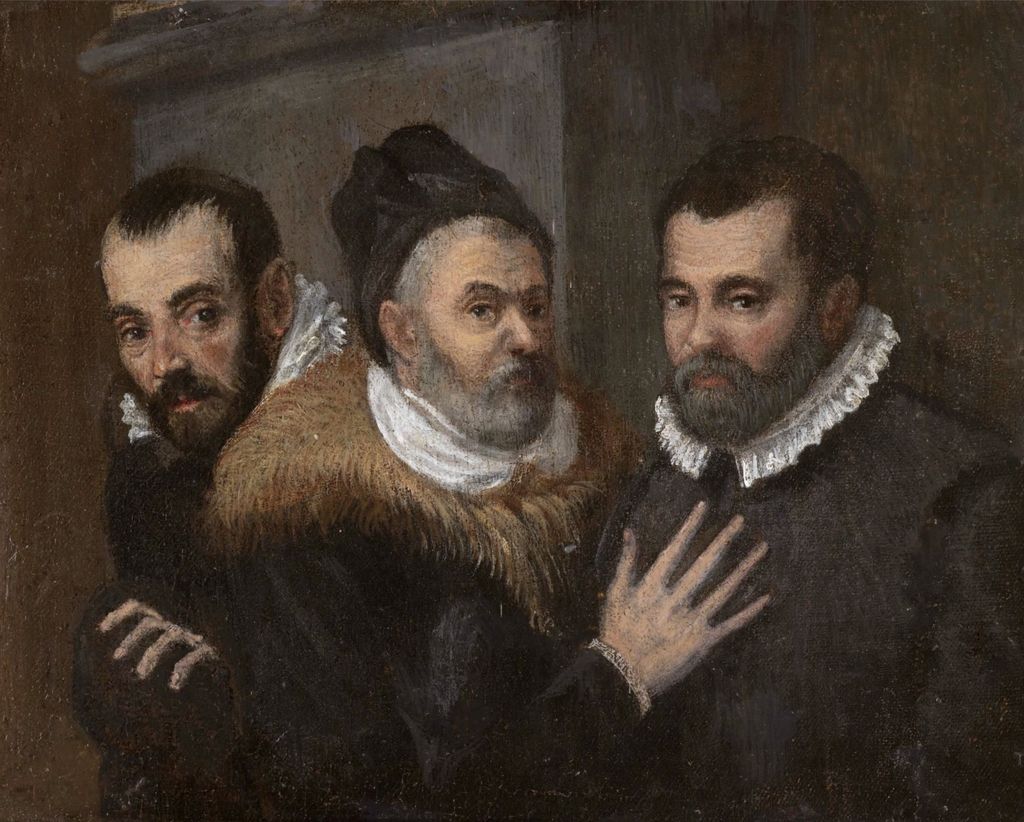
Bolognese School, portrait group traditionally identified as Annibale, Ludovico and Agostino Carracci. Image source. Public domain.
Drawing from life and learning from pictures
One of the rare images of a drawing session is in the Nationalmuseum in Stockholm. Its catalogue calls it An Academy, probably the Accademia degli Incamminati Bologna and credits the Carracci school. It was formerly attributed to Agostino. In brown ink and wash over chalk, the draughtsman treats the nude model with particular attention to form, while the students are more quickly characterised by how they sit and work. The museum suggests a pupil may have drawn it. A single model offered several people a view. Each position in the room presented a different problem of foreshortening or silhouette. [9] [2]
A drawing reproduced in a Japanese and English exhibition booklet from the National Museum of Western Art in Tokyo, Standing Young Man, gives a closer view of that practice. Red chalk sets down a young man whom the catalogue suggests may have been an apprentice asked to pose. The attribution to Annibale comes with a warning about the difficulty of separating the family members' drawings in the 1580s and early 1590s. That caution matters for the history of the academy. A drawing can reveal the studio's interest in the way a particular person stands even when an individual hand is difficult to identify. Faberio and Malvasia also supplied testimony about investigating anatomy. Robertson points out that Malvasia describes both male and female models, although surviving nude studies drawn from a female model are comparatively rare. [10] [2]
Study from life reached beyond the posed figure. Robertson discusses the Carracci's habit of drawing ordinary activity and making excursions into the country around Bologna. A figure at work or a landscape seen out of doors required a different kind of attention from an arranged pose, since the light, the people and sometimes the viewpoint would change. Study of earlier art took place alongside these exercises. Bologna's Pinacoteca names Correggio, Titian and Veronese among the painters who mattered to the three Carracci. An earlier picture could show how to arrange a group or make the course of a gesture clear. Returning to the model gave a painter a chance to see whether that solution would hold for a different body or a different angle. [2] [1]
Agostino brought the experience of translating paintings into prints to this exchange. The Rijksmuseum holds the central sheet of his 1589 engraving after Tintoretto's vast Crucifixion in the Scuola Grande di San Rocco. Broad areas of light and darkness had to be rebuilt in lines on a copper plate. The work also made a composition tied to a particular Venetian wall available on paper. A sheet like this gave painters a way to discuss the arrangement of Tintoretto’s groups in front of an image they could handle and scrutinise. Agostino put sustained preparation into his own large altarpiece for the Certosa in Bologna, The Last Communion of Saint Jerome. The Pinacoteca records a long sequence of studies for that commission and points to the variety of expressions among the people crowding around the dying saint. Ludovico’s Preaching of Saint John the Baptist stood opposite it in the Certosa church. In that altarpiece, now also in the Pinacoteca, the expressions of a large group register the force of the preacher’s words. This pairing gives a sense of how the two painters used Venetian colour and lighting to organise the emotions of a crowd under the different demands of each commission. [11] [12] [13]
Palazzo Fava and the story of Jason
Genus Bononiae dates Filippo Fava's commission for the main floor of his palace to 1584. The Jason and Medea frieze in the great hall is associated with 1583–84 in the scholarship, and the palace dates the eighteen scenes in that room to 1584. The decoration unfolded in more than one room and campaign. An early cycle tells the story of Europa. The Aeneas rooms also preserve work by Ludovico, Francesco Albani, Bartolomeo Cesi and other painters. These distinctions matter because the name of the palace can stand for the best-known joint frieze or for a much larger body of work involving several hands over time. [14] [15] [16] [7]
The Jason story made the painters solve a problem of continuity. Viewers had to recognise characters from one scene to the next as their eyes travelled round the upper walls. In the ninth scene, Jason greets King Aeëtes. Hercules is identifiable by his club and the skin of the Nemean lion, and Orpheus brings a stringed instrument. The figures at this public meeting make a useful comparison with the scene of Medea's nocturnal rites, where moonlight and her isolation at the stream carry much of the action. A single frieze could accommodate both kinds of incident because the rhythm of the painted divisions linked episodes of very different scale and mood. At the edges of the scenes, fictive sculpture helps the eye register where one event ends and another begins. [3] [15] [17]
The Staatliche Graphische Sammlung in Munich holds a double-sided study for the meeting with Aeëtes, attributed to Annibale by Daniele Benati in the National Gallery of Art's 1999 catalogue. An early design on the reverse arranges the scene in depth and includes one of the fictive statues that flanks it. On the other side, the figures are more clearly resolved, and two sets of squaring lines survive in black and red chalk. The squares let the figures be enlarged in proportion onto a full-sized drawing, or cartoon. No cartoon is known to survive for the project, but lines incised in the fresco preserve evidence of its use. A related sheet in Ottawa studies Orpheus and, on the reverse, the Argonaut who points behind Jason. Orpheus has a lyre in the Munich design and a violin in the fresco. Here the sequence of sketches, separate figures and marks in plaster makes the connection between looking, revising and painting unusually concrete. The Munich sheet's earlier attribution to Ludovico also explains why an attribution of one drawing should be kept distinct from credit for the room as a whole. [3] [18]
Palazzo Magnani and the founding of Rome
Around 1590 the family had a second opportunity to devise a great hall frieze, this time for Lorenzo Magnani. Fourteen scenes tell the story of Romulus and Remus, from the wolf suckling the abandoned infants to the appearance of the deified Romulus. Plutarch's Life of Romulus supplied much of the story. The choice of episodes gives it a distinct emphasis. The painters pass over Romulus killing his brother and instead mark the city's foundation with the plough cutting its boundary. Magnani owed his senatorial appointment to papal authority, and the Biblioteca Nazionale Centrale di Firenze's account of the engraved frieze connects the choice of Roman history to that political relationship. Samuel Vitali's study sets the work in the context of the newly built family palace and the patron's public position in Bologna. [19] [20] [21] [22]
The room explains choices that are harder to see in isolated photographs. Each narrative resembles a picture mounted within a larger framework, with painted sculpture and architecture setting off one episode from the next. The real windows interrupt the circuit, and the painted divisions take account of them. Domenico Maria Bonaveri's series of fourteen engravings, first issued as individual prints in 1704, shows the framing and the interruptions as well as the stories. A room view and the old prints help recover something of the experience of looking around the hall, including the movement between the brightly coloured narrative panels and the simulated sculpture that separates them. [21] [22]
Malvasia recounts that the Carracci answered questions about individual responsibility by saying the work belonged to them all. The story records a family reputation that their patrons could recognise. It gives little help in dividing inventions, preparatory studies and execution between the three. Vitali finds a number of scenes stylistically distinct enough to propose individual hands, with Ludovico's often the clearest. He also identifies cases where a design or a related drawing by one family member may have contributed to a scene painted by another. These proposals make sense of both the similarities and the shifts in the frieze. The shared design of the hall, down to the repeated intervals between scenes, allowed individual passages to vary without breaking the sequence. [16] [21]
There is independent evidence that patrons negotiated with the family as a group. In late 1593, the Bolognese historian Pompeo Vizzani reported bargaining with the Carracci over the price of a Transfiguration for San Pietro Martire. Ludovico ultimately painted the altarpiece. Likewise, Annibale's 1595 letter about Saint Roch Distributing Alms offers to seek the help of his brother and cousin if his patrons insist on delivery before he leaves Bologna. The letter records one of the options he put to them. It shows how directly the men could call on one another while each remained responsible to a patron for a particular work. [16]
Palazzo Sampieri and three encounters
The last documented Bolognese palace project of all three family members was for Abbot Astorre Sampieri around 1593–94. The rooms called for a different arrangement from those at Fava and Magnani. Gabriele Fiorini's stucco settings unite frescoes distributed over the ceilings and fireplaces of three ground-floor rooms. Hercules is the main figure in the programme, which also includes episodes involving Ceres and Proserpine. Faberio's 1603 oration names Agostino's Hercules Helping Atlas Support the World. The state catalogue attributes Hercules Guided by Virtue on the ceiling of the second room to Annibale. Virtue leads the hero upward, with both figures foreshortened for the view from below. The setting makes a comparison with Annibale's later Choice of Hercules for Odoardo Farnese possible, although that painting concerns the choice between Virtue and Pleasure and was made on canvas for a different ceiling. Graziani suggests that the relatively low vaults at Sampieri may have helped prompt the change from a continuous frieze to discrete ceiling scenes. [8] [23] [24]
A drawing in the Metropolitan Museum takes the connection with life study down to a single figure. Annibale’s Crawling Male Figure, dated 1593, is a large dark-chalk or charcoal study for Cacus in the fresco above the second room’s fireplace. Before the figure took its place within the stucco frame, the painter had to understand how to make that lowered body seem to carry its own weight. In 1761, Fragonard copied the Cacus group and the defeated giant Enceladus from the adjacent room onto one sheet. The copy drops the shaped surrounds, leaving the figures free of the space for which they were made. The attributions written on Fragonard’s sheet have since been reversed. The Met now identifies Cacus with Annibale’s fireplace scene and Enceladus with Agostino’s. [25] [26]
The three large horizontal canvases made for the palace are now in the Pinacoteca di Brera. Annibale painted Christ and the Samaritan Woman, Agostino Christ and the Woman Taken in Adultery, and Ludovico Christ and the Canaanite Woman. The paintings were intended for positions above doorways. The similar formats and encounters between Christ and a woman make them a series. The different stories called for different kinds of address: conversation across a well, a confrontation involving accusers, and a mother's appeal on behalf of her daughter. Brera notes an unusual closeness in Ludovico's painting to the increasingly classical manner of his cousins and associates it with the need for unity across the set. Its catalogue dates his canvas to 1594–95. The dated range generally given for the frescoes should therefore be distinguished from the dates assigned to individual canvases. [6] [27] [8]
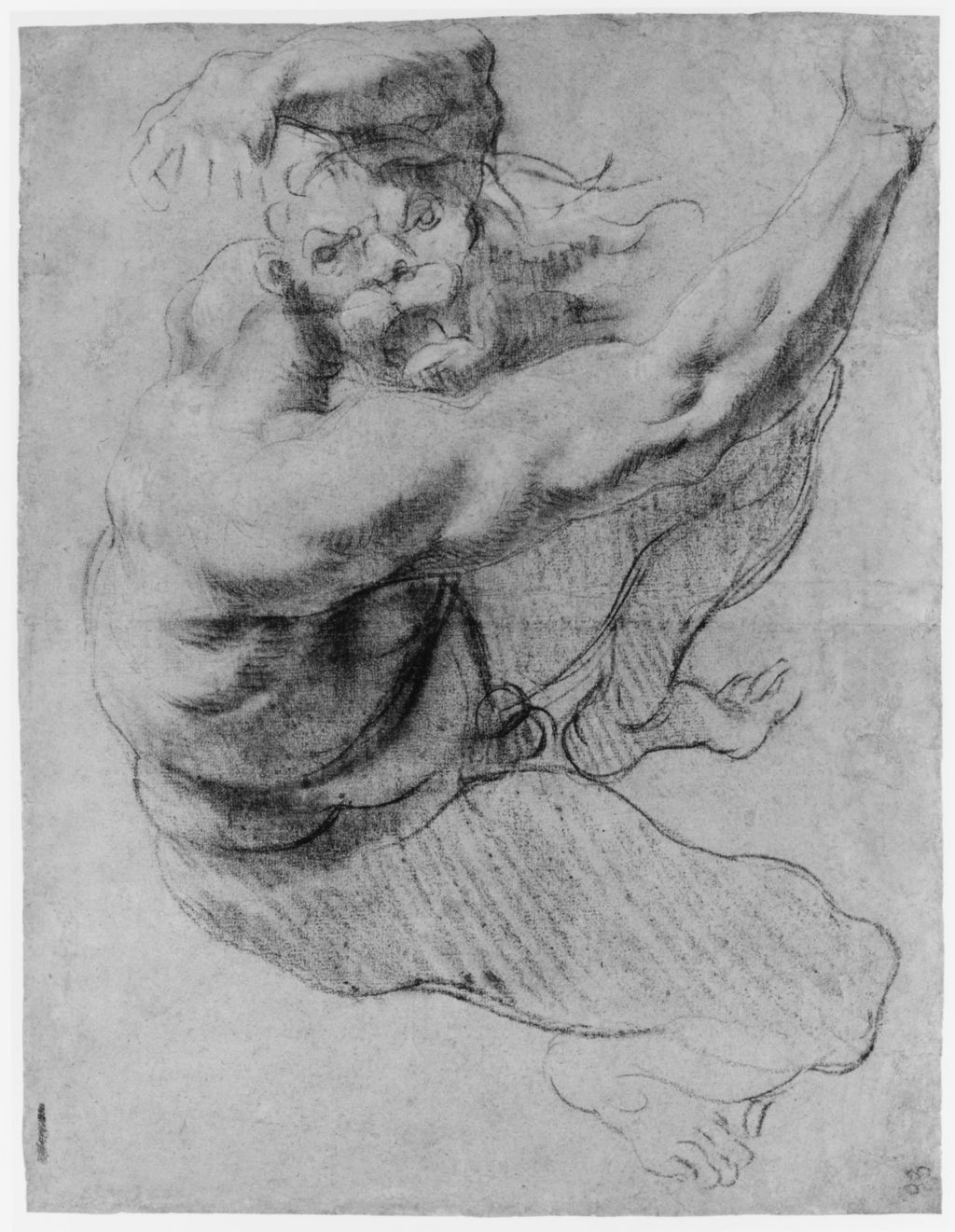
Annibale Carracci, Crawling Male Figure (Study for Cacus). The Metropolitan Museum of Art, 1972.118.244. Image source. CC0 / Public domain.
Ludovico in Bologna and the pupils in Rome
Annibale settled in Rome in 1595. Agostino subsequently joined him on the Farnese Gallery, while Ludovico remained the academy's leading presence in Bologna. Under Ludovico the school took a more formal direction. Robertson traces his efforts in 1602 to bring it into association with the Bolognese painters' company and the Roman Accademia di San Luca. His later correspondence with Cardinal Federico Borromeo about the rules of the academy belongs to this phase. An institutional history built on those later rules would miss how much the earlier school had depended on the practice of three painters sharing work and testing ideas together. [1] [2] [28]
The Städel groups Guido Reni, Francesco Albani and Domenichino among the school’s pupils. [29] Some carried that experience to Rome. Francesco Albani trained under Denis Calvaert and then joined the Incamminati around the mid-1590s, according to the Louvre's chronology. His presence among the hands at Palazzo Fava and his later work in Rome illustrate the reach of the network. Domenichino trained under Ludovico in Bologna and joined Annibale in Rome by about 1602. A small, documented early painting of his, The Vision of Saint Jerome, offers a particularly close comparison. The National Gallery relates the scene to Annibale's Christ Appearing to Saint Anthony Abbot, and notes that the lion with its head resting on its paws also appears in an engraving by Agostino. Decades later, Domenichino could adapt a boatman and a whole arrangement of river and settlement from Annibale's Flight into Egypt to his own Landscape with a Fortified Town. His debt to the family can be traced from the pose of a lion to the structure of an entire landscape. [30] [15] [31] [32] [33]
Ludovico's influence in Emilia also travelled through paintings that younger artists could study outside the academy. In Cento, for example, the local collection preserves his Holy Family with Saint Francis and Donors, known as the Carraccina, which helped form Guercino's taste for plausible settings and expressive gestures. The picture arrived in Cento in the year of Guercino's birth. That is a different channel of influence from Albani working alongside other painters in a palace or Domenichino following a teacher to Rome. The Russian catalogue of the Hermitage's Italian paintings makes a similar distinction in describing its collection of the founders, pupils and followers of the Bolognese school. When Bologna mounted its Annibale retrospective in 2006, the organisers included views of all three Bolognese palaces alongside the individual paintings and drawings. Those interiors still offer the clearest way to see what the family learned together and what each painter could do within a shared commission. [34] [35] [36]
Artworks directory
Paintings, frescoes, drawings and prints, with separate entries for documented versions and collaborative projects.
Discussion
Look again at the images and ideas explored in The Carracci Academy. These editorial prompts invite your observations.
Reader Insights
How does a figure studied from life contribute to an invented scene?
What evidence would let you distinguish an individual hand within a jointly credited fresco cycle?
Join the Conversation
Share a detail, comparison or question about The Carracci Academy below.
References
- Pinacoteca Nazionale di Bologna, Sala 23: I Carracci. View source.
- Clare Robertson, “Federico Zuccari’s Accademia del Disegno and the Carracci Accademia degli Incamminati: Drawing in Theory and Practice”, Römisches Jahrbuch der Bibliotheca Hertziana, vol. 39, especially pp. 191–192 and 202–203. View source.
- Daniele Benati and colleagues, The Drawings of Annibale Carracci, National Gallery of Art, 1999. Illustrated catalogue PDF, cat. 5, pp. 58–59. View source 1. View source 2.
- Museo Nacional Thyssen-Bornemisza, Ludovico Carracci, Spanish biography and founding chronology. View source.
- Lorenzo Pericolo, “1582: The Beginnings of the Carracci Academy between Bologna and Florence”, especially pp. 135–136 and note 2. View source.
- Pinacoteca di Brera, DescriVedendo, Annibale Carracci’s Christ and the Samaritan Woman at the Well, item 05. View source.
- La Storia di Bologna, Annibale Carracci and Ludovico Carracci. View source 1. View source 2.
- Valeria Castelli and Irene Graziani, “Ercole, Cerere e Proserpina nel ciclo decorativo di palazzo Sampieri-Talon a Bologna”, Figure, University of Bologna, no. 2, 2014, pp. 33–46 and photographs of the rooms and frescoes. View source.
- Nationalmuseum, An Academy, probably the Accademia degli Incamminati Bologna, NMH 906/1863. View source.
- National Museum of Western Art, bilingual exhibition booklet, no. 18, Standing Young Man. View source.
- Rijksmuseum, Agostino Carracci, Kruisiging van Christus (middendeel), 1589. View source.
- Pinacoteca Nazionale di Bologna, Agostino Carracci, Ultima Comunione di San Girolamo, inv. 461. View source.
- Pinacoteca Nazionale di Bologna, Ludovico Carracci, Predica del Battista, inv. 458. View source.
- Genus Bononiae, Palazzo Fava, palace and commission history. View source.
- Genus Bononiae, Gli affreschi dei Carracci, illustrated guide to the Jason and Aeneas cycles. View source.
- Samuel Vitali, “Between Family Brand and Personal Ambition: Strategies and Limits of Collaboration in the Carracci Workshop”, 2012, pp. 139–158. View source.
- Soprintendenza Archivistica e Bibliografica dell’Emilia-Romagna, Scrigni di memorie, Palazzo Fava documentary history and photograph of a fresco in its architectural surround. Great Hall frieze in situ. View source 1. View source 2.
- Peter M. Lukehart, “The Evidence of Drawing”, in Nino Nanobashvili and Tobias Teutenberg, eds., Drawing Education: Worldwide!, Heidelberg University Publishing, 2019, pp. 57–59 and figs. 8–9. View source.
- Fondazione del Monte di Bologna e Ravenna, Palazzo Magnani, collection and fresco overview. View source.
- Samuel Vitali, “Der Palazzo Magnani in Bologna als Zeugnis und Instrument sozialen Aufstiegs im Kirchenstaat”, in Modell Rom? Der Kirchenstaat und Italien in der Frühen Neuzeit, 2003, pp. 101–117, including the Sala Grande room photograph, fig. 11. View source.
- Samuel Vitali, “Il fregio dei Carracci”, in Sergio Bettini, ed., Palazzo Magnani in Bologna, Milan, 2009, pp. 90–135. View source.
- Biblioteca Nazionale Centrale di Firenze, catalogue entry for Domenico Maria Bonaveri’s engravings, RARI 22.B._55, p. 123. View source.
- Comune di Bologna, Casa Sampieri, Bologna Online. View source.
- Ministero della Cultura, Ercole guidato dalla Virtù, catalogue no. 0800017461. View source.
- Metropolitan Museum of Art, Annibale Carracci, Crawling Male Figure (Study for Cacus), 1972.118.244. View source.
- Metropolitan Museum of Art, Jean Honoré Fragonard, Hercules and Cacus, after Annibale Carracci, and the Destruction of Enceladus, after Agostino Carracci, 60.53. Exhibition catalogue, cat. 10, p. 94. View source 1. View source 2.
- Pinacoteca di Brera, Ludovico Carracci, Cristo e la Cananea, inv. 96. View source.
- Musée du Louvre, Dessins des Carrache. La fabrique de la galerie Farnèse, exhibition 2025–26. View source.
- Städel Museum, Annibale Carracci, German collection biography. View source.
- Musée du Louvre, Département des Arts graphiques, Francesco Albani. View source.
- National Gallery, London, Domenichino. View source.
- National Gallery, London, Domenichino, The Vision of Saint Jerome, NG85. View source.
- National Gallery, London, Domenichino, Landscape with a Fortified Town, NG6629. View source.
- Civica Pinacoteca il Guercino, Ludovico Carracci, The Holy Family with Saint Francis and Donors. View source.
- State Hermitage Museum, introduction to the catalogue of Italian painting, Russian text. View source.
- Comune di Bologna, Mostra di Annibale Carracci, 2006–07 exhibition history and record of the catalogue edited by Daniele Benati and Eugenio Riccòmini. View source.