 by Tom Gurney
Tom Gurney BSc (Hons) is an art history expert with over 20 years experience
Published on June 19, 2020 / Updated on November 29, 2026
Email: tomgurney1@gmail.com / Phone: +44 7429 011000
Pietà: Introduction
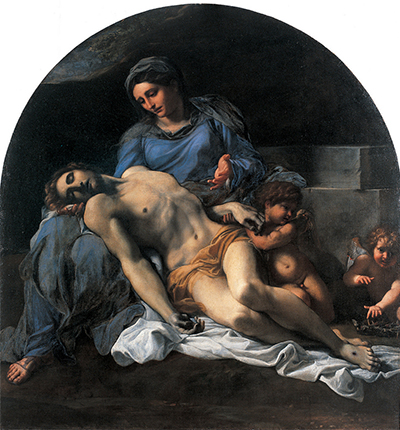
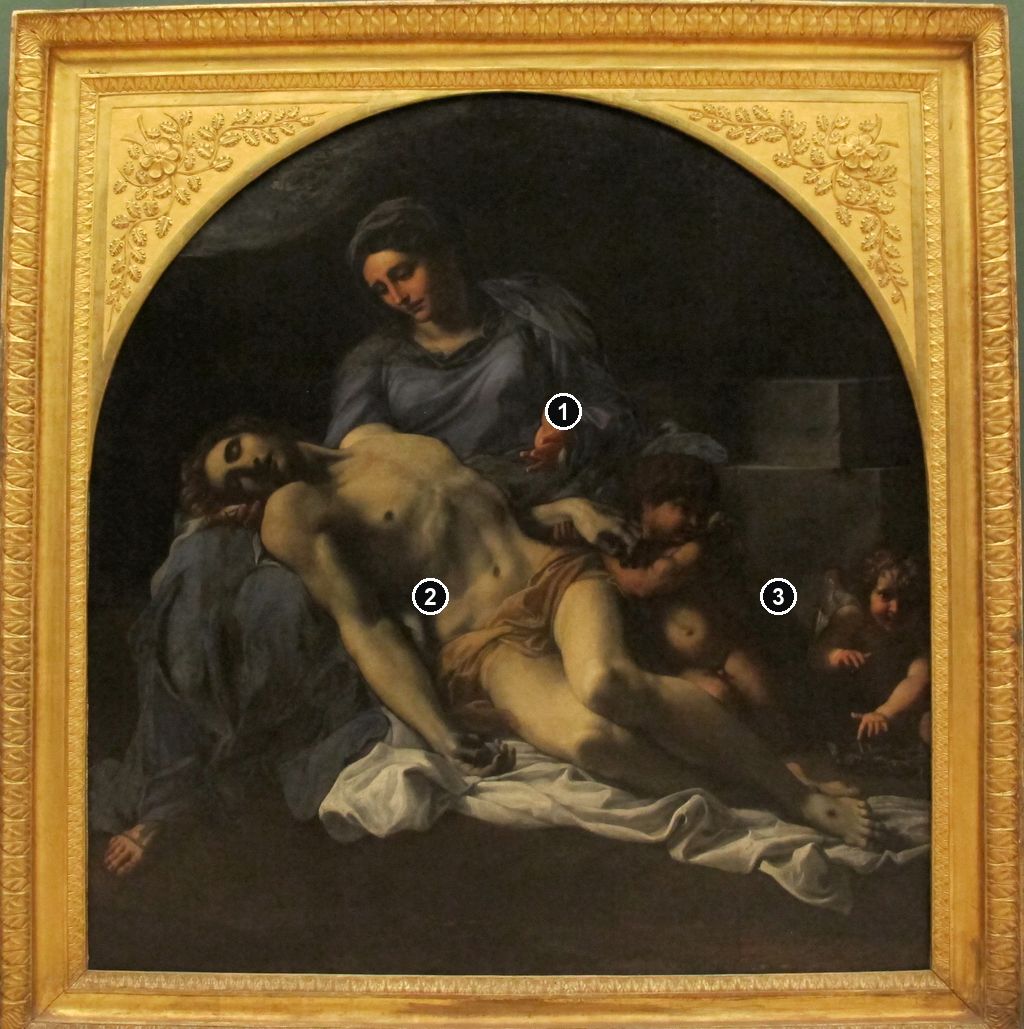
In Annibale Carracci’s Pietà at Capodimonte in Naples, the Virgin supports Christ’s head on her lap while his body slopes down towards the edge of the picture. Two small angels keep watch beside them. The painting is an oil on canvas made for Cardinal Odoardo Farnese and dated 1599–1600 by the museum. Carracci gives the group the weight and stability of sculpture, then uses light to pick out the small gestures that make this an intimate scene of mourning. [1]
At a Glance
- ArtistAnnibale Carracci
- DateAbout 1599–1600
- MediumOil on canvas
- Naples PietàCapodimonte, Q 363. The Farnese canvas with Mary, Christ and two angels.
- London comparisonNational Gallery, NG2923. The Dead Christ Mourned, also called The Three Maries.
Contents
- Christ’s weight and Mary’s gesture
- Michelangelo’s marble and Correggio’s painting
- Drawing the hand and arranging the group
- The Farnese commission and the date
- Other Pietàs by Annibale and his followers
- How the Naples design travelled
- Annotated details
Christ’s weight and Mary’s gesture
Mary sits low and bends her head to look at her son. Her blue mantle spreads along the ground and rises behind his shoulders, forming the broad base of a triangle that narrows towards her head. Christ fits neither entirely on her lap nor entirely on the ground. His shoulder slopes away from her, his knees turn towards us and his feet extend almost to the right edge. The shroud runs under him in bright folds. It lies partly over the front of the dark rock, which makes the body feel close to the viewer. Above the figures, the canvas has a rounded top. The large area of darkness beneath the arch leaves the Virgin’s head exposed and gives her stoop space to register. [2] [3]
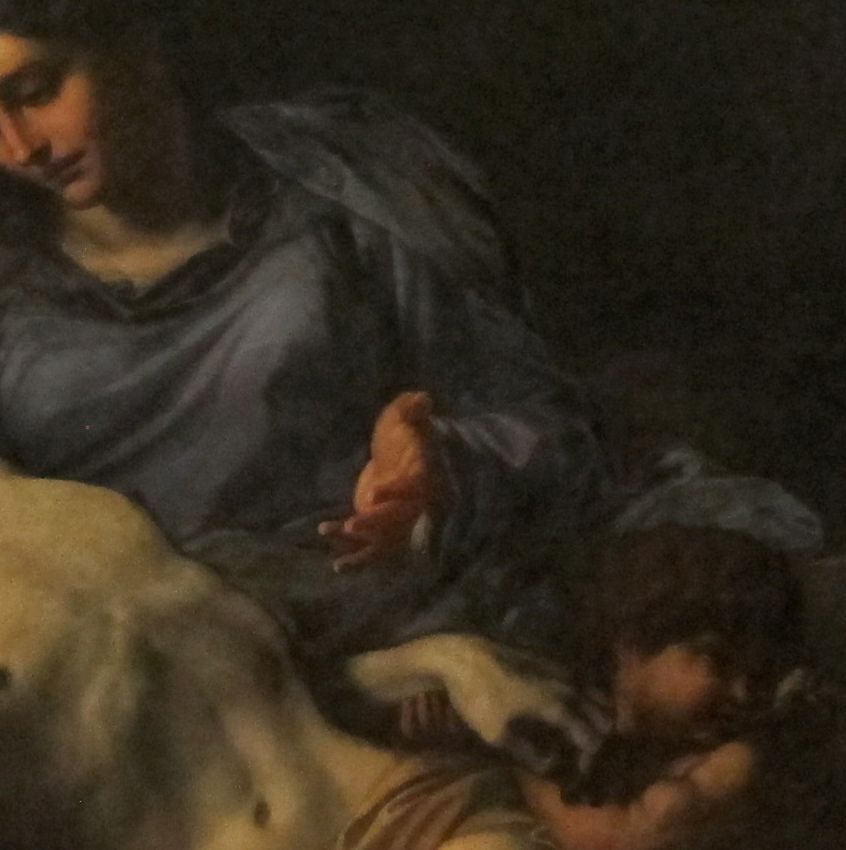
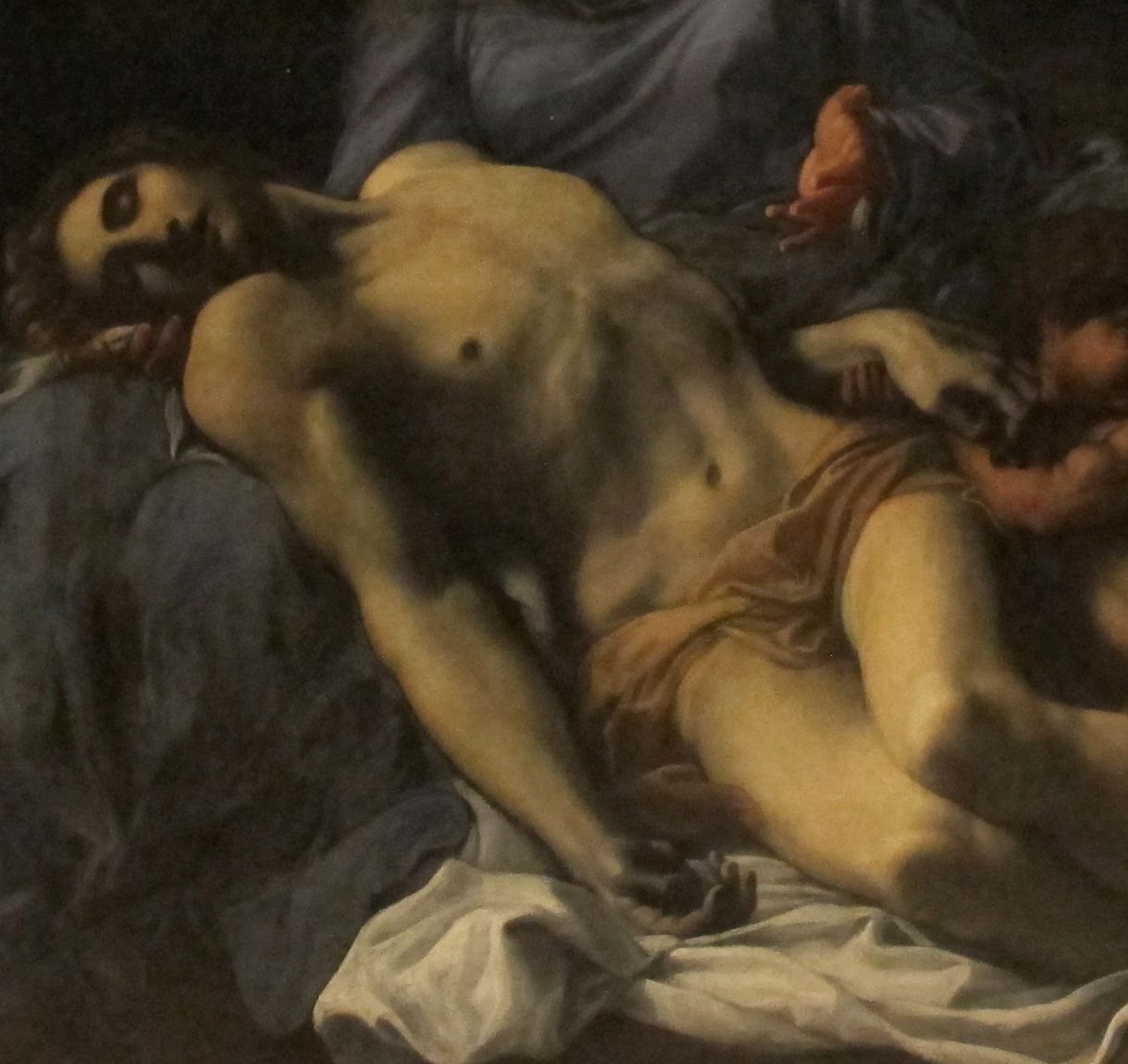
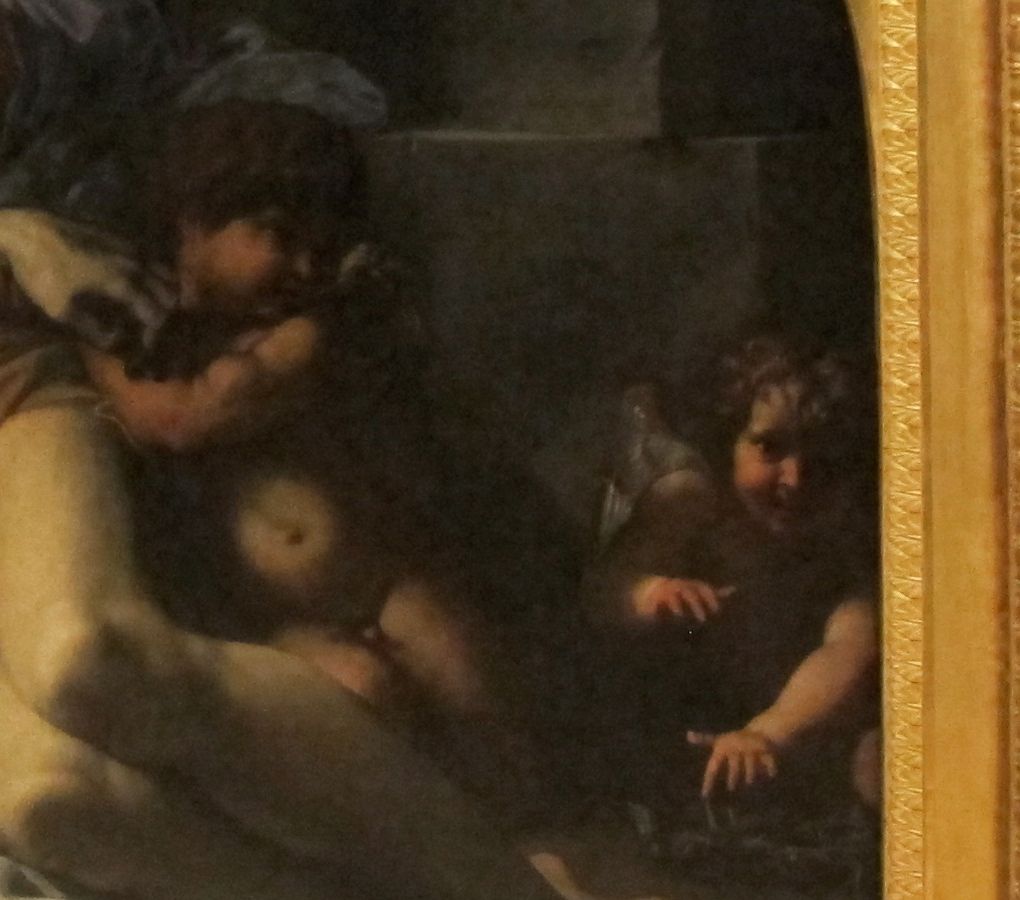
Follow the hands to see how Carracci directs attention. Mary’s left hand opens just above Christ’s forearm. The angel beside her takes up Christ’s left hand and bends close to it. Christ’s right hand, which falls across the white linen in the foreground, is partly curled. The cloth catches enough light to show the fingers against it. Farther right, the second angel reaches down towards the crown of thorns. These gestures separate the tasks of the figures. Mary bears the weight of her son’s head and the nearer angel tends his hand, while the other angel looks down towards a reminder of what killed him. [2] [3]
The painting takes its subject from a tradition of imagining the time between the Crucifixion and the burial. The Gospels relate those events in different ways. The scene of Mary mourning over the body in her lap belongs to devotional imagery. The Italian word pietà here conveys pity or compassion. The angels attend to Christ’s wounded hand and the crown of thorns. His chest and limbs, by contrast, show little of the violence he has suffered. The concentrated signs of injury leave space for the tender handling of the body, which the rock, linen and masonry suggest is about to be buried. [2] [4]
Annotated Details from Pietà
The numbered points identify visible features discussed in this article. Return from each detail to the numbered overview. Annibale Carracci, Pietà. Museo e Real Bosco di Capodimonte, Q 363. Photograph by Sailko. Image source. CC BY 3.0. Numbers added to a separate overview. Details cropped from the original photograph. Image derivatives use CC BY 3.0.
Details from PIETÀ
Compare the cropped details with the source images above. Notice how their colours, shapes and positions contribute to the larger compositions.
Mary’s lifted hand
Mary raises one hand beside her lowered face. The small warm shape can be picked out against the dark blue of her clothing.
The weight of Christ’s body
Christ’s arm falls from the supported torso towards the cloth. The turn at the hip and the curve in the pale linen keep the eye on the weight of his body.
The angels with Christ
The figures at the right are partly held in shadow. The smaller scale of their faces and hands draws attention to the care with which they approach the body.
Michelangelo’s marble and Correggio’s painting
Capodimonte identifies Michelangelo’s marble Pietà in Saint Peter’s as a model. Michelangelo made the group for the tomb of the French cardinal Jean de Bilhères at the end of the fifteenth century. The Virgin’s bowed head, the sweep of the body across her knees and the fan of drapery establish a triangular silhouette. The open left hand is especially close to Carracci’s. In the painting, the hand catches a warm light that makes the palm visible against the darker blue. Michelangelo gives Christ’s full length the support of Mary’s lap and mantle. Carracci brings the lower half of the body down onto the shroud and turns one knee towards the viewer. The pose preserves the shape of the marble group while making the descent of the body feel steeper. [5] [6]
A second point of comparison is Correggio’s Lamentation over the Dead Christ, painted around 1524 for the Del Bono Chapel in San Giovanni Evangelista, Parma, and now in the Galleria Nazionale there. Correggio lays Christ low across his wide canvas, with the white cloth close to the foreground and the dying movement of the body echoed in the swooning Virgin. Other mourners crowd around her. The low position of Christ and the length of the body along the foreground cloth are also important to the Naples painting. The difference lies in what the Virgin can do. In Correggio, she herself needs support. In Naples, she can still hold her son as his body slips away from her. [7] [8]
Annibale had already responded to Correggio in an altarpiece dated 1585, now at the Pilotta in Parma. The Lamentation over the Dead Christ with Saints Clare and Francis expresses grief through a falling Virgin and a larger cast of figures, with the two Franciscan saints addressing a viewer in the Capuchin church for which it was painted. Conservators discovered the date under Christ’s right hand when the Parma painting was treated for the 1956 Carracci exhibition. Its existence puts the Naples canvas within a long engagement with the subject, beginning well before Annibale worked for Odoardo in Rome. [9]
Drawing the hand and arranging the group
A drawing in the Louvre (INV 7397, recto) concentrates on a half-closed right hand on drapery. Donald Posner connected it to Christ’s right hand in the Naples painting, an identification recorded in Catherine Loisel’s catalogue. Annibale drew the hand with black chalk and added white chalk to beige paper. The middle tone of the paper lets the dark contours and highlights establish the shape of the fingers before any flesh or fabric colour is introduced. In the canvas, the corresponding hand sits where the bright linen meets deep shadow. Its position is easy to overlook because the knee and lit chest have much more presence at first glance. The sheet makes it possible to study that quieter detail on its own. [10]
Drawings with several figures are harder to assign. Loisel discusses a Louvre Lamentation (INV 7162, recto) that Diane DeGrazia connected to the 1597 Christ of Caprarola print. Loisel allows that the sheet may have helped Annibale work through the disposition of figures for the Naples canvas. Silvia Ginzburg sees a closer relationship to the London Three Maries, particularly in the fuller group, the fainting Virgin and the placement of Christ’s legs. Ginzburg instead links two Windsor drawings to the Naples picture. In one of them, RL 2169 recto, Mary kneels beside the body in profile. In the finished painting, her front faces us and she lowers her head towards Christ. The other, RL 2023, has a projecting knee that Ginzburg compares with the one in the finished painting. The associations are proposals about how Annibale worked through recurring forms. The chalk hand offers a more specific match. [10] [11] [12]
The Farnese commission and the date
Cardinal Odoardo Farnese was also the patron of Annibale’s work in the Camerino and Gallery of the Palazzo Farnese in Rome. Capodimonte considers private devotion a probable purpose for the Naples Pietà. The size of the figures gives them a monumental presence, but the restricted cast and close view suit sustained attention to a single sorrow. The precise original setting remains uncertain. The Italian catalogue entry for a copy at Civate traces the original through the Farnese palace at Caprarola and then the Palazzo del Giardino in Parma. That account of its whereabouts gives no basis for assigning the curved canvas to a particular chapel. The broader Farnese collection passed through Elisabetta Farnese to her son Carlo di Borbone, who brought it to Naples. Capodimonte records the Pietà at the Royal Palace in Naples in the eighteenth century. [1] [2] [13] [14]
The conventional dating of 1599–1600 follows Capodimonte. The Fondazione Federico Zeri gives a slightly wider range of 1598–1600. Ginzburg has argued for execution around 1604, with a possible start in 1603. Her comparison is with Caravaggio’s Deposition for the Vittrice Chapel in Santa Maria in Vallicella. She draws attention to the darkness at the back of the Naples painting, the way Christ’s knee projects into the viewer’s space and the role played by the edge of the stone. In Caravaggio, the projecting slab and the men bearing Christ give the motion of the lowering body visible force. Annibale uses comparable effects in a scene where Christ has already been set down. The later dating depends on reading the Naples painting as a response to Caravaggio. The resemblance itself leaves the direction and timing of any exchange open. [1] [3] [12] [15]
The Louvre gives the canvas dimensions as 156 × 149 cm in the dossier for the 2023 exhibition Naples à Paris. The Zeri entry records 158 × 151 cm. Capodimonte’s illustrated loan register names it as Q 363 and lists larger dimensions, including depth, alongside the photograph of the framed object. The arched outline is also visible in the register. Capodimonte reported conservation work on the frame before the loan, and later placed the frame among its examples of Bourbon-period frames treated in a wider programme. The museum’s account dates the frame to a later phase of the painting’s life in Naples. [2] [3] [16] [17] [18]
Other Pietàs by Annibale and his followers
In 1597 Annibale put the place name Caprarola on a print in which Christ lies across the foreground and his head is cradled by a figure leaning in close. The National Gallery of Art’s impression, 2008.104.12, is made with etching, engraving and drypoint on laid paper and records the fifth of seven states, or stages in the working of the plate. The Met relates the design to Correggio’s Del Bono Lamentation and to Annibale’s later oil on copper in Vienna. The print is horizontal, and the etched and engraved lines take the place of the contrasts between blue, white and flesh colour in the Naples canvas. It is an earlier treatment by Annibale himself. [19] [20]
The Kunsthistorisches Museum dates the Vienna Pietà, no. 230, to around 1603. It measures 43 × 62.5 cm. Mary has fainted, and the cool cast of her skin resembles that of Christ, while the angels’ warmer faces show that they are still alert. The horizontal layout also appears in a seventeenth-century Pietà at Dulwich Picture Gallery (DPG162). Dulwich catalogues its canvas as After Annibale Carracci and sees elements of both the 1597 print and the Naples canvas in the design. These two versions show how Annibale and later painters could recombine the same gestures across different supports and sizes. [21] [22]
The National Gallery’s The Dead Christ Mourned (The Three Maries), NG2923, is more crowded than the Naples canvas. Mary faints and is held up by another woman as the Magdalene raises both hands. A dark opening in the tomb stands behind the group. The Louvre’s Pietà with Saint Francis and Saint Mary Magdalene (INV 198) has a different arrangement again. It is 277 cm high, with the two saints enlarging the mourning group around the Virgin and Christ. The Louvre thinks it may have been begun for Odoardo around 1602 and records its completion and installation on the Mattei Chapel altar at San Francesco a Ripa around 1607. French commissioners removed it in 1797 and it remained in Paris after the restitutions of 1815. When the Louvre showed both paintings together in 2023, the Farnese canvas was there on loan from Naples. [2] [4] [23]
The Mattei design was already circulating among other artists before the likely date of installation. Loisel cites a version ascribed to Annibale’s pupil Domenichino and dated to 1603 as evidence that much of the altarpiece may have been painted by then. The Louvre also holds three drawings after the Mattei composition. Loisel catalogued all three as copies by an anonymous seventeenth-century hand. One is squared for transfer, a mark of how another artist could carry the altarpiece’s arrangement into a new work. [24]
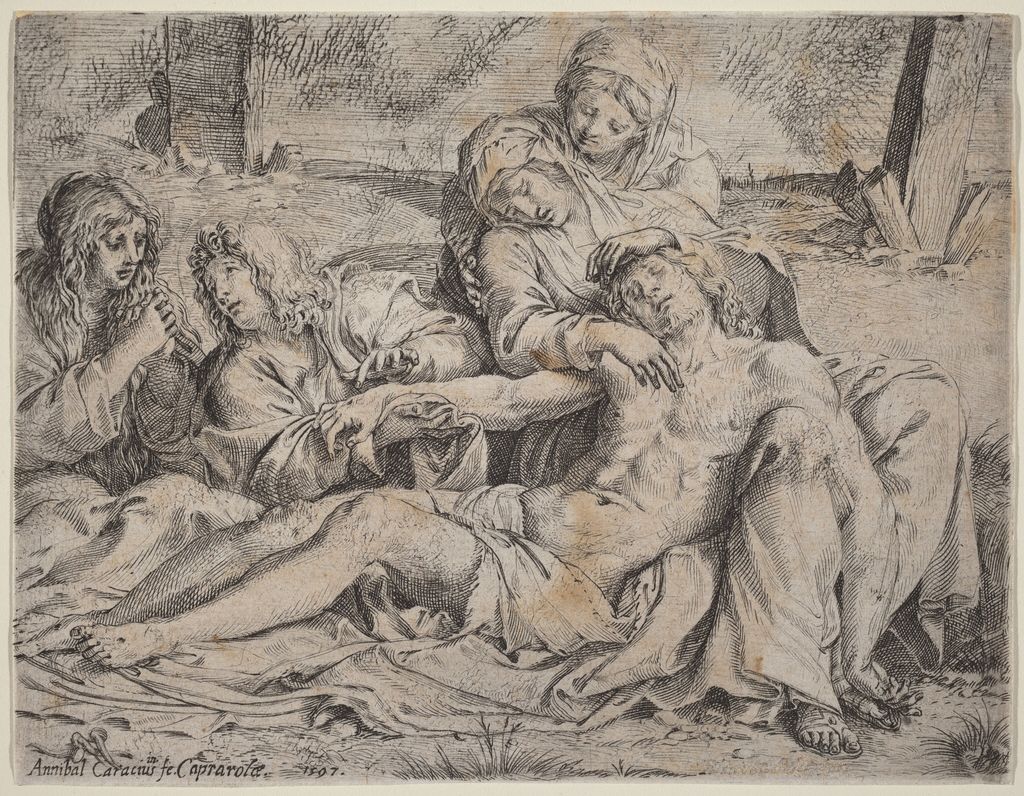
Annibale Carracci, Pietà (Christ of Caprarola), 1597. Print with a distinct composition from the Naples canvas. National Gallery of Art, 2008.104.12. Image source. CC0 / Public domain.
How the Naples design travelled
An etching by the Flemish printmaker Joost de Pape, dated about 1633–46 by the Met, gives an early example of the Capodimonte design in circulation. Its angels appear at the left, where the reversal of the composition puts them. The pose of the Virgin and the place where the pale linen catches the light would still make the source recognisable to someone who knew the painting. [25]
The Italian state catalogue records a close oil copy at Rosazza. A nineteenth-century will called it a work by Agostino Carracci, but the catalogue identifies it as a copy of Annibale’s Naples painting and notes its straight upper edge. The Louvre records a sketch by Sophie Rude after a print by Pietro del Pò, who reversed the Naples composition when he reproduced it. In Córdoba, the Museo de Bellas Artes holds a red-chalk drawing traditionally attributed to Juan de Guzmán. It reverses the painting as well. The museum proposes a print by Gilles Rousselet as the likely intermediary. The chalk sheet is ruled into squares, suggesting that the arrangement was being prepared for transfer to a larger surface. [26] [27] [28]
The design also came back into three dimensions. Capodimonte displayed the painting in 2025 alongside a terracotta Pietà modelled by Giuseppe Gricci around 1744–45 and a white porcelain group he made in 1744. The museum draws attention to the way the limbs of Christ and the shroud run together over the rocks in both sculptures, as they do in the painting. The movement of Mary’s arm differs between Gricci’s two versions. In the terracotta, she raises a hand to wipe away her tears. That change gives the sorrow a motion of its own and makes it possible to see what remains so distinctive in Annibale’s canvas. Mary’s open hand hangs in the light, with no answering gesture from her son. [1]
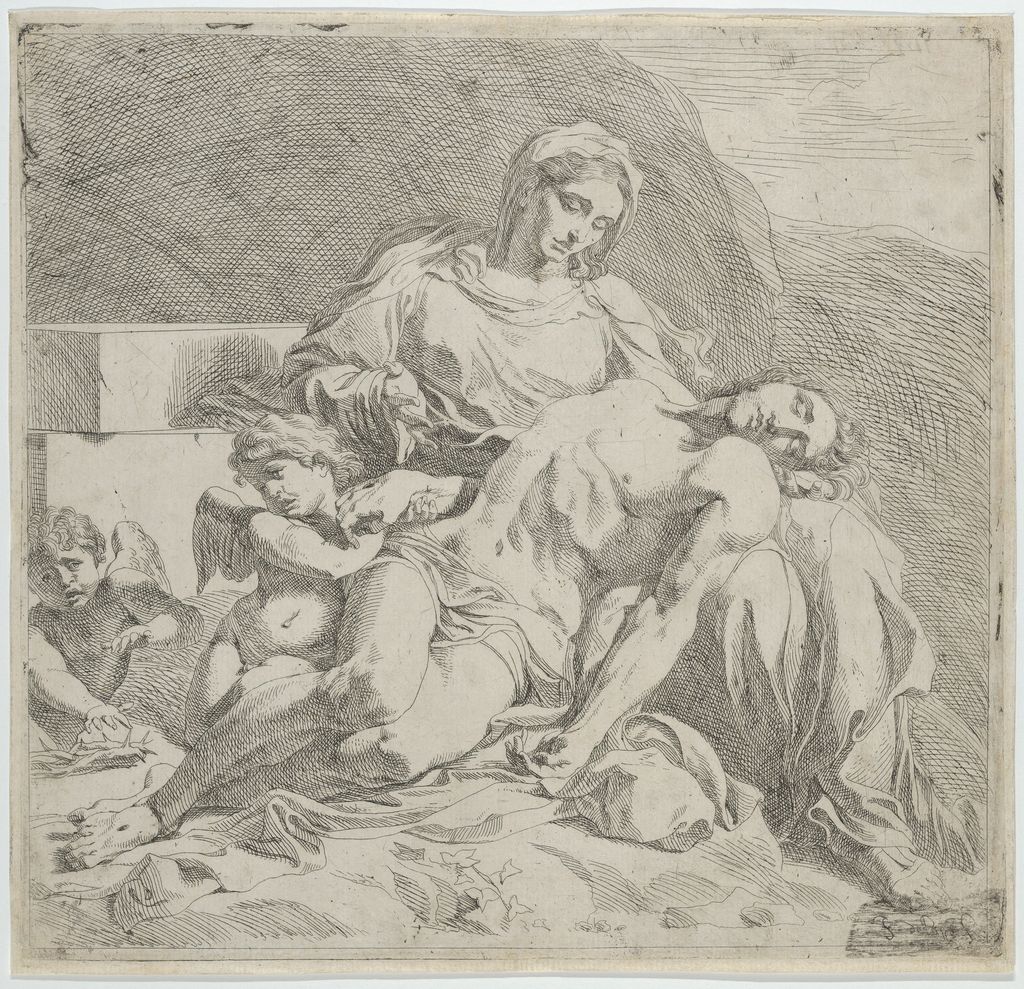
Joost de Pape after Annibale Carracci, Pietà. Reversed print after the Naples composition. The Metropolitan Museum of Art, 2014.663. Image source. CC0 / Public domain.
Artworks directory
Paintings, frescoes, drawings and prints, with separate entries for documented versions and collaborative projects.
Discussion
Look again at the images and ideas explored in Pietà. These editorial prompts invite your observations.
Reader Insights
Which angel’s movement most changes how you look at Christ?
How do the architecture and medium of Michelangelo’s Pietà affect its comparison with this painting?
Join the Conversation
Share a detail, comparison or question about Pietà below.
References
- Museo e Real Bosco di Capodimonte, La Pietà di Gricci, il modellatore del Re View source.
- Musée du Louvre, Naples à Paris exhibition dossier, Annibale Carracci and the two Pietàs View source.
- Fondazione Federico Zeri, Annibale Carracci, Pietà, Q 363 View source.
- National Gallery, London, The Dead Christ Mourned (The Three Maries), NG2923 View source.
- Museo e Real Bosco di Capodimonte, Pietà, Google Arts & Culture collection entry View source.
- Fabbrica di San Pietro, The Pietà of Saint Peter’s View source.
- Complesso Monumentale della Pilotta, Correggio, Lamentation over the Dead Christ View source.
- Princeton University Art Museum, Pietà (Christ of Caprarola), commentary on Correggio View source.
- Complesso Monumentale della Pilotta, Annibale Carracci, Lamentation over the Dead Christ with Saints Clare and Francis View source.
- Musée du Louvre, Annibale Carracci, Main droite, à moitié fermée, posée sur une draperie View source.
- Musée du Louvre, Annibale Carracci, Piéta, Déploration du Christ mort, INV 7162 View source.
- Silvia Ginzburg, Per la cronologia di Annibale Carracci (1602–1604), in Nuova luce su Annibale Carracci, 2011 View source.
- Catalogo generale dei Beni Culturali, Pietà at Civate, 0300060119 View source.
- Museo e Real Bosco di Capodimonte, Collezione Farnese View source.
- Vatican Museums, Caravaggio, Deposition View source.
- Museo e Real Bosco di Capodimonte, 2023 loans register, Pietà Q 363 View source.
- Museo e Real Bosco di Capodimonte, Alcuni capolavori Farnese in restauro, January 2023 View source.
- Museo e Real Bosco di Capodimonte, Progetto di restauro, riqualificazione, efficienza energetica e valorizzazione, 2023 View source.
- National Gallery of Art, Pieta (the Christ of Caprarola), 2008.104.12 View source.
- The Metropolitan Museum of Art, Wilton album, The Christ of Caprarola (The Pietà) View source.
- Kunsthistorisches Museum, Passione & Compassione, Annibale Carracci’s Pietà, inv. 230 View source.
- Dulwich Picture Gallery, Pietà, after Annibale Carracci, DPG162 View source.
- Musée du Louvre, Pietà avec saint François et sainte Marie-Madeleine, INV 198 View source.
- Musée du Louvre, Drawing after the Mattei altarpiece, INV 7544, with Loisel’s catalogue commentary View source.
- The Metropolitan Museum of Art, Joost de Pape after Annibale Carracci, Pietà, 2014.663 View source.
- Catalogo generale dei Beni Culturali, Pietà at Rosazza, 0100017922 View source.
- Musée du Louvre, Sophie Rude, Pietà avec un angelot, after Pietro del Pò View source.
- Museo de Bellas Artes de Córdoba, Miscelánea de dibujos, Pietà attributed to Juan de Guzmán, pp. 48–49 View source.