 by Tom Gurney
Tom Gurney BSc (Hons) is an art history expert with over 20 years experience
Published on June 19, 2020 / Updated on November 29, 2026
Email: tomgurney1@gmail.com / Phone: +44 7429 011000
Annibale Carracci Biography: Introduction
In July 1595, Annibale Carracci wrote to Giulio Fossi in Reggio Emilia about an overdue painting. The Confraternity of Saint Roch had been waiting years for its enormous canvas of the saint giving alms. Annibale was preparing to leave for Rome. He offered to return the money he had already received, finish the work in Rome, or, if the confraternity needed it before he left, enlist his brother and cousin to help. He had a cardinal’s patronage in prospect and an obligation to a confraternity whose members had commissioned him when his career was still taking shape. The letter catches him at the point when those commitments began to pull in different directions. [1]
Annibale had spent his early career painting altarpieces for Bologna and nearby cities, decorating palaces with Agostino and Ludovico Carracci, and finding subjects in the everyday life around him. In Rome he became responsible for the decoration of two rooms in Palazzo Farnese and continued to take on work for churches and private patrons. He died in 1609, at forty-eight. By then younger painters had worked alongside him in Rome and were taking on commissions of their own. His career can be followed through the arrangements that made those pictures possible, from the shared scaffolding of a Bolognese palace to the drawings that allowed assistants to carry his last chapel commission forward. [2] [3] [4]
At a Glance
- ArtistAnnibale Carracci
- Life1560–1609
- Principal placesBologna and Rome
Annibale Carracci in context
Italian Renaissance precedents
16th century [5]Carracci Academy, Bologna
From the 1580s [6]Baroque classicism
Late 16th–early 17th century [7]Ludovico Carracci
1555–1619 [8]Agostino Carracci
1557–1602 [7]Annibale Carracci
1560–1609 [5]Domenichino
1581–1641 [9]The Butcher’s Shop
Early 1580s [10]The Bean Eater
Late 16th century [11]Two Children Teasing a Cat
About 1587–88 [12]The Choice of Hercules
1595–96 [13]Assumption of the Virgin
About 1600–01 [5]Landscape with the Flight into Egypt
Early 1600s [15]Contents
- Family and first commissions in Bologna, 1560–85
- Family frescoes and the work in Reggio, 1580s–1595
- A cardinal’s household and the Farnese Gallery, 1595–early 1600s
- Churches, collectors and landscapes in Rome
- The Herrera Chapel and the final years, 1604–09
- Words and Reputation
Family and first commissions in Bologna, 1560–85
Annibale was baptised in Bologna on 3 November 1560. His father, Antonio, was a tailor. Agostino, born in 1557, was his older brother, and Ludovico, born in 1555, was their cousin. Carlo Cesare Malvasia’s seventeenth-century account placed the start of Annibale’s career in Ludovico’s workshop. Ludovico certainly mattered to his development, although the surviving evidence leaves the terms of his early training uncertain. Agostino brought the skills of an engraver to the family enterprise. He engraved works by other artists as well as working as a painter, and in 1579 he made a print after Michelangelo’s Pietà. That plate offers one way to understand how a painter in Bologna could study an invention made for Rome before he was able to work there himself. [2] [16] [17]
In the 1580s the three relatives began the teaching venture known as the Carracci Academy and later associated with the name Accademia degli Incamminati. The date often given is around 1582, within the decade given by Bologna’s Pinacoteca. Drawing from living models was central. A painter could ask someone to take a pose from a revered picture or sculpture and see how differently an actual body held its weight. Gail Feigenbaum identifies a study in which Annibale worked through the position of Michelangelo’s dead Christ with a slender living model. The resulting body in the Pietà with Saints, now in Parma, relates to Michelangelo through work done in the studio. An inherited composition became something the young painter could test with a person in front of him. [17] [6]
The young painter also had to satisfy people who would see his work across a church. His dated Crucifixion with Saints of 1583 was painted for San Nicolò di San Felice. The Baptism of Christ was installed in 1585 at Santi Gregorio e Siro. Malvasia, who described the two pictures nearly a century later, made Annibale eighteen at the time of the commissions and claimed Ludovico had passed them to him. The dated works correct the age. The account still preserves something of the competitive world in which the pictures were made. Malvasia names established Bolognese painters, including Prospero Fontana, Denys Calvaert and Bartolomeo Passarotti, in his explanation of why the family was keen to keep the commissions. Feigenbaum traces how the later story of criticism of these pictures came to form part of the Carracci’s reputation as reformers. [17]
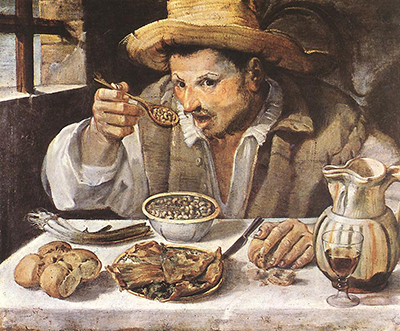
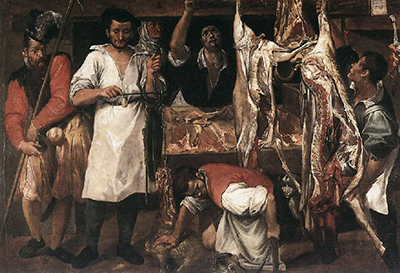
The early domestic pictures make a useful companion to the altarpieces. In The Bean Eater, a man brings a spoonful to his mouth and looks up. The way his hand stays on the bread, alongside the placement of the bowl so close to the viewer, makes a brief interruption seem worth painting. A different treatment of working life can be seen in Annibale’s large Butcher’s Shop at Christ Church, Oxford, and in the smaller, separate canvas in the Kimbell Art Museum. For the Oxford painting, Feigenbaum draws attention to the painter’s knowledge of Renaissance figure compositions even as he assigns their weight and presence to tradesmen. The altarpieces and shop pictures were made for different settings, but the painter’s interest in people doing something purposeful runs through both. [17] [18] [19]
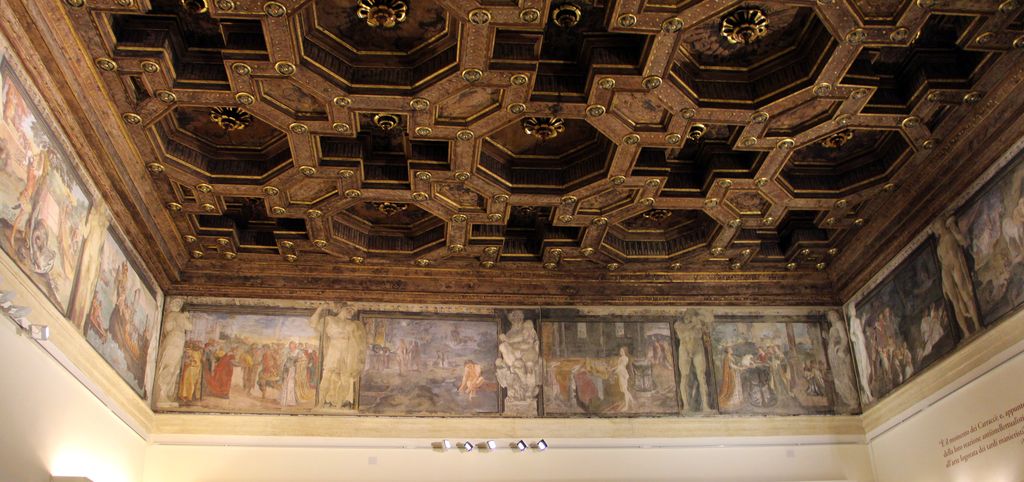
Annibale, Agostino and Ludovico Carracci, Jason and Medea frieze, Palazzo Fava, Bologna. Sailko. Image source. CC BY 3.0. Proportionally resized for web display.
Four stages of Annibale Carracci’s career
These periods group related developments; painting, travel and local work overlap across their boundaries.
Observation and early painting
Bologna was the setting for the painter’s family collaboration, work from life and early paintings of meals and trades.[5]
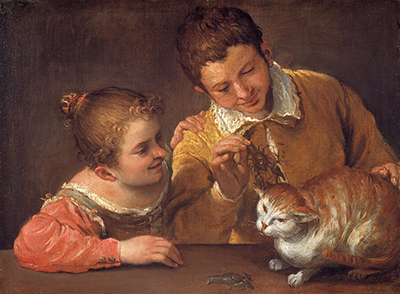
The Carracci in Emilia
The Carracci combined work from life with the study of earlier painting. The family undertook decorative commissions together as Annibale developed paintings for churches and collectors.[8]
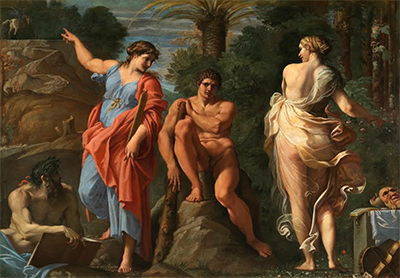
Painting for the palace
The Camerino and Gallery called for different solutions. The movable Hercules canvas and the Gallery vault bring painted myth into different architectural settings.[7]
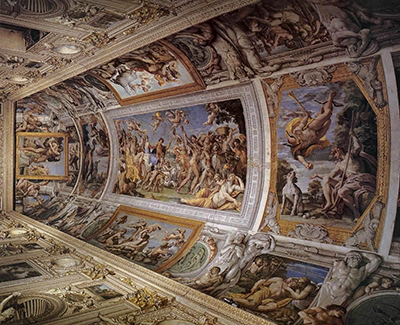
Altars, landscapes and late studies
Annibale continued to make devotional paintings and designs for Roman patrons. Illness affected the later Herrera commission, and drawings from the final years survive.[4]
Family frescoes and the work in Reggio, 1580s–1595
At Palazzo Fava in Bologna, the three painters worked on stories from classical mythology. The early cycles tell of Europa and of Jason, whose voyage for the Golden Fleece leads him to Medea. The date 1584 appears beneath the decorative figure of Jupiter in the Jason frieze, and the early frescoes are generally placed around 1583–84. A room devoted to the adventures of Aeneas followed. Working high in a room meant deciding where a story would begin, how it would carry a viewer around the walls and how much it could say in each painted compartment. The arrangement of the rooms and the surviving painting provide firmer evidence of that work than later efforts to divide each episode neatly among the three men. [17] [8]
Around 1590 the Carracci reunited at Palazzo Magnani, where Lorenzo Magnani commissioned their Stories of the Founding of Rome for the great hall. The choice honoured the city at the centre of papal power, from which the patron’s standing as a senator derived. The scenes from the lives of Romulus and Remus appear to be framed pictures, hung between painted architectural elements. More than a century later Domenico Maria Bonaveri’s prints reproduced the episodes together with their illusionistic surrounds and even registered the windows that interrupt the rhythm of the last scenes. Malvasia recalls the painters answering questions about their individual contributions by saying the work was by the Carracci and that all of them made it. The third Bolognese palace collaboration, at Palazzo Sampieri in the early 1590s, again gave the family occasion to work on mythological subjects. The years in Bologna gave Annibale extensive practice in designing paintings for rooms that had architectural demands and patrons of their own. [1] [2] [20]
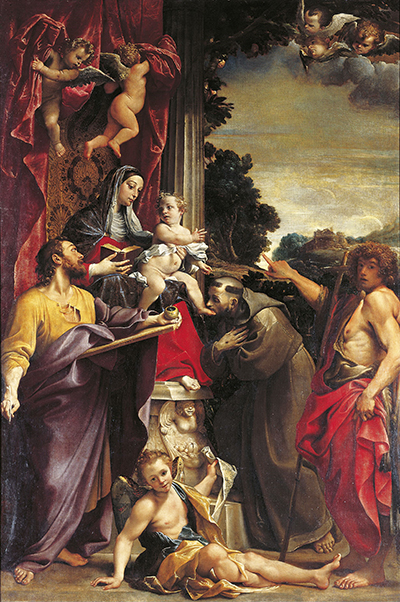
The period also took him beyond Bologna. Annibale studied Correggio’s painting in Parma and looked closely at Venetian art, particularly Veronese. Giovanni Pietro Bellori puts the Venetian study after a stay in Parma and has Annibale finding Agostino already occupied with engraving in Venice. The passage establishes how one early biographer understood the sequence. It leaves the precise itinerary uncertain. The commissions are easier to date. The 1587 Assumption painted for San Rocco in Reggio Emilia and the 1588 Madonna of Saint Matthew, now both in Dresden, make visible how quickly patrons in Reggio entrusted Annibale with demanding subjects. The second was made for the merchants’ chapel at San Prospero. Its clustered saints and the figure of the Madonna above them belong to a specific altar and community, part of a history of work for civic and church groups that continued alongside the palace frescoes. [2] [21] [5] [22]
The Reggio patrons had different commissions. The Louvre’s Virgin Appearing to Saints Luke and Catherine was painted for the notaries’ chapel in the cathedral. The same museum’s Resurrection, signed and dated 1593, gives Annibale’s own form of his name, Annibal Carratius, and provides another firm landmark before his departure. For the Confraternity of Saint Roch, the first commission for the Assumption was followed by the large Saint Roch Distributing Alms. The July 1595 letter concerns the latter. The possibility of bringing in Agostino and Ludovico was practical enough for Annibale to offer it to a patron in writing. Among the preparatory sheets for the canvas is a study of a seated woman now in the Boijmans collection in Rotterdam. She holds her hand by an empty bowl and looks up towards the saint. The drawing follows the orientation of the final painting. The Boijmans catalogue describes how examination of the underdrawing showed that Annibale had already transferred part of an earlier design to the canvas before reversing the composition. His letter shows a painter under pressure to finish. The physical evidence shows that considerable work, including a decision to change the direction of the scene, had preceded that effort. [23] As Samuel Vitali observes, the letter gives direct evidence of how the painters could envisage sharing work even on a commission contracted by one member of the family. [1] [24] [25]
A cardinal’s household and the Farnese Gallery, 1595–early 1600s
Cardinal Odoardo Farnese brought Annibale to Rome. The brothers visited Odoardo in Rome in 1594, and Annibale moved there permanently the following autumn. The earliest letters discuss a grand hall that might be decorated with the exploits of Odoardo’s father, Duke Alessandro. By August 1595 the plan for the hall had been postponed and Annibale had been assigned the Camerino, a smaller room. The change meant that the painter known for his share in the histories of ancient Rome at Palazzo Magnani began work for the Farnese on the moral choices of an individual hero. A canvas of The Choice of Hercules occupied the centre of the ceiling. The hero must choose between an arduous course offered by Virtue and the easier way offered by Pleasure. The antiquarian Fulvio Orsini has been associated with the choice of subject, which was suited to presenting the young cardinal’s virtues within his own residence. The central painting, now in Capodimonte, is an oil on canvas that could be moved. Annibale designed it to be read over a viewer’s head in the Camerino. [2] [26] [27]
The Farnese Gallery was a much larger undertaking. The long room housed ancient sculpture from the Farnese collection. Annibale’s study of sculpture in Rome, and of the work of Michelangelo and Raphael, informed the new setting he devised overhead. Mythological scenes appear in painted frames. Figures seem to sit and lean against architecture that exists only in paint, and the alternation of colour and simulated stone helps the eye move between the narratives and their surroundings. At the centre, The Triumph of Bacchus and Ariadne takes the form of a procession with music, dancing and unruly movement. The ceiling could reward a visitor who looked at individual stories and one who first took in the company of figures overhead as he entered the room. [3] [28] [29]
Agostino joined his brother in Rome two years after Annibale settled there, according to the National Gallery’s account, and was responsible for two large scenes on the vault. The finished frescoes and related large cartoons give his role substance independently of accounts of disagreements between the brothers. The cartoon for Cephalus carried off by Aurora in her Chariot, now in London, is close to the size of the passage for which it was prepared. Agostino subsequently left for Parma, where he died in 1602. Work in the Gallery continued with younger painters, among them Domenichino, who went to Rome in 1602. An account records a payment to the mason Domenico da Corte for removing scaffolding from the vault in July 1602. Farnese books still record payments to Annibale and three assistants in 1603, when the painter was also certifying stucco work and recording the cost of colours he bought for the cardinal. The ceiling, the work for the room as a whole and the painter’s service to the household each had different timetables. [3] [16] [28] [30] [27]
Designing and supervising a fresco cycle required Annibale to make decisions that others could follow. The surviving drawings include exploratory compositions, separate figure studies and large-scale preparations. The Galerie Farnèse exhibition at the Louvre in 2025–26 brought stages of that process together. A small drawing could establish how a figure entered the scene. Working at the scale of the ceiling forced the painter to settle how far a limb extended or where an edge should fall. In a workshop, that later decision had to be clear enough to survive the passage from paper to plaster. The drawings make it possible to follow the artist at work in a way that the accounts of his temperament rarely do. [28] [29] [27]
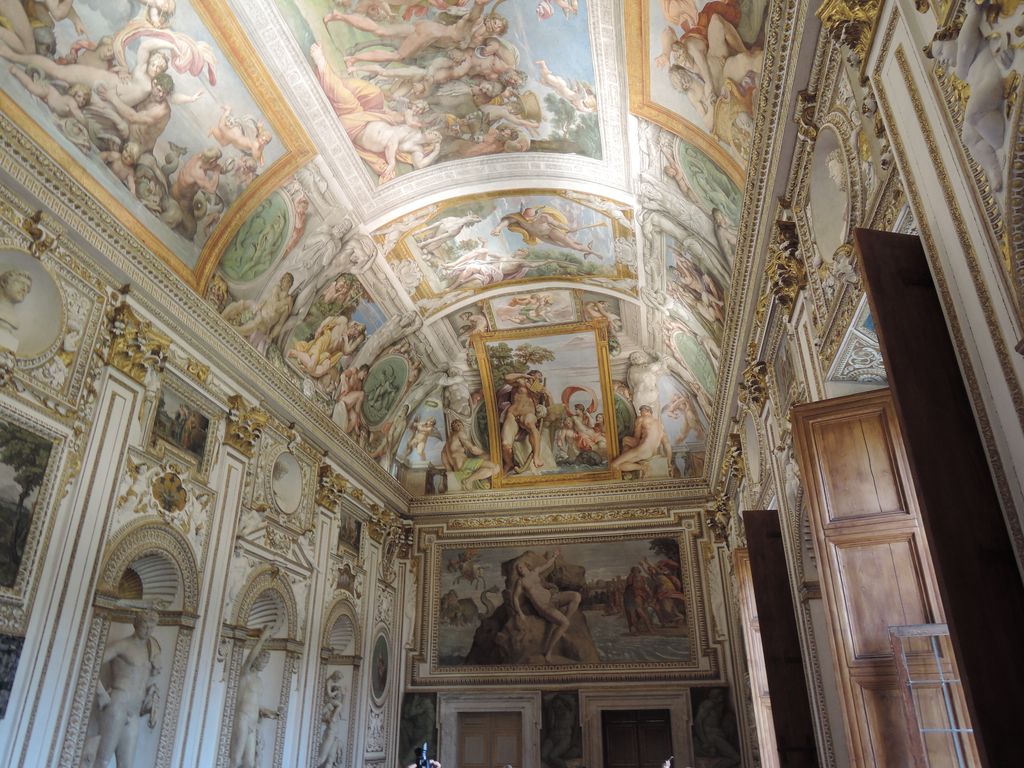
Interior of the Farnese Gallery, Palazzo Farnese, Rome. agennari. Image source. CC BY 2.0. Proportionally resized for web display.
Churches, collectors and landscapes in Rome
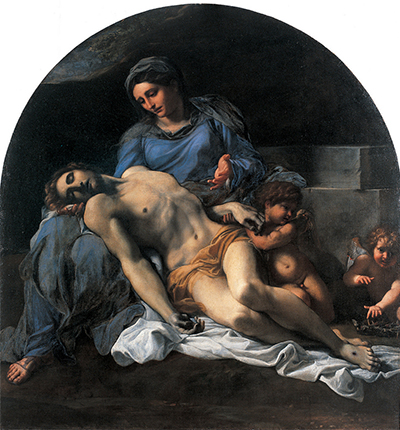
While the palace decorations occupied him, Annibale developed relationships with other patrons and painted at very different scales. The Metropolitan Museum dates its Coronation of the Virgin to shortly after his move, associates it with Cardinal Pietro Aldobrandini and records its long presence in the Aldobrandini collection. Odoardo remained important outside the frescoes. Capodimonte associates its Pietà with his private devotion. The placement of Christ’s weight across the Virgin’s lap recalls the problem that had interested the painter in Bologna, worked out here in a picture whose few main figures and dark setting ask for sustained attention to the body. The Hermitage dates Holy Women at Christ’s Tomb to 1597–98. Its catalogue follows Malvasia in placing the picture initially with the Bolognese antiquarian Pasqualini and later with Giovanni Battista Agucchi. In the autumn of 1602, Agucchi saw a Sleeping Venus nearing completion in Annibale’s studio at the Farnese palace and wrote a long description. Annibale maintained working relationships with other patrons and connoisseurs while attached to the household. For a modern reader, Agucchi’s account of seeing a picture in progress offers something rare in this career, the response of a visitor who knew both the painter and the studio. [17] [31] [32] [33] [27]
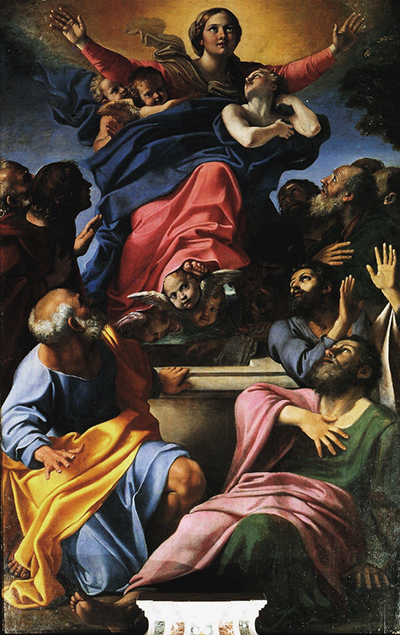
In Tiberio Cerasi’s chapel at Santa Maria del Popolo, the setting is integral to Annibale’s Assumption of the Virgin. The Virgin rises directly above the altar, and her movement can be seen even from the entrance to the narrow chapel. Caravaggio’s paintings of the conversion of Saint Paul and the crucifixion of Saint Peter occupy the sides. The two painters are often paired as innovators of the period. Here their pictures meet in an actual place, where the patron’s commission brought a Marian altarpiece and different episodes from the lives of saints into the space a visitor could see. In 1603, when Caravaggio was questioned during Giovanni Baglione’s libel case, he included Annibale among the painters he considered accomplished. Caravaggio explained that an accomplished painter could paint well and imitate natural things well. The deposition and the chapel record two different kinds of proximity between the men, one in the professional life of the city and the other in the demands of a shared site. [2] [3] [34] [35]
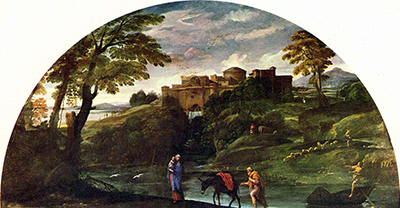
Smaller commissions demanded another sort of concentration. In the National Gallery’s Christ Appearing to Saint Peter on the Appian Way, the barefoot Christ advances into the picture as Peter gestures in surprise. The subject turns on Peter’s decision, but the clarity of the encounter depends in part on how easily the viewer can read those two bodies against the road. On a curved canvas of the Flight into Egypt for an Aldobrandini chapel, Annibale arranged a journey across the expanse of a river, with buildings, trees and the far bank given ample room. The Holy Family belongs to the scale of this terrain. He had already painted river country as a subject in its own right in the River Landscape now in Washington, where boatmen occupy an expanse of water below a mass of trees. The Aldobrandini work gave those interests an architectural setting and a role in a biblical story. [36] [37] [9]
Domenichino saw the Aldobrandini lunettes at close quarters. His later Landscape with a Fortified Town, in the National Gallery, takes up the general arrangement of the Flight into Egypt and adapts the figure of a boatman. His early version of the Flight, now in Oberlin, and a landscape of 1621–22 for the Villa Ludovisi show how long he kept returning to what he had learned. The traceable links between those paintings give a sense of what Annibale passed on. A young collaborator could remember a small figure, a route across water or the distribution of buildings in a valley and find that it still had work to do in a different picture years later. [30] [9]
The Herrera Chapel and the final years, 1604–09
One of Annibale’s last large commissions was for Juan Enríquez de Herrera, a Spanish banker whose family had a chapel in San Giacomo degli Spagnoli in Rome. Annibale took responsibility for a cycle illustrating the life and miracles of the Franciscan Saint Didacus of Alcalá, known in Spanish as San Diego. By 1605 illness prevented him from carrying the Herrera Chapel frescoes through in person as planned. Francesco Albani took over the project with the assistance of other painters. Annibale’s preparation and the work done by Albani and the other contributors belong to the same commission, and the surviving frescoes are evidence of both. The chapel itself has been lost. The dispersal of the detached frescoes between Barcelona and Madrid once made that division of labour especially hard to see across the whole cycle. The exhibitions of 2022–23 brought the detached frescoes held by the museums back together. At the Rome venue visitors could also see the chapel’s separate altarpiece, lent from Santa Maria in Monserrato degli Spagnoli. [4] [38]
The biographers’ accounts of the illness and of Annibale’s treatment by the Farnese household differ in emphasis. Bellori’s story of a small reward from the cardinal has often been told as the explanation for everything that followed. The Herrera documents establish an interruption in Annibale’s capacity to execute a major commission. The drawings show a more uneven final period. Carel van Tuyll has examined sheets from these years in the Morgan Library & Museum and traced sustained work on paper even after the large fresco projects were beyond his reach. A portrait drawing identified by its inscriptions as the Florentine painter Cigoli, is catalogued as a work of about 1604–09 in Stockholm and in the exhibition checklist of the National Museum of Western Art in Tokyo. The Stockholm catalogue also records a proposed attribution to Agostino, which would place the drawing before his death in 1602. In the Hermitage’s Self-Portrait on an Easel, generally placed around 1603–04, Annibale shows his likeness as a painting standing on an easel in a dim room. A related sketch shows him considering how the view might work. The two objects offer a glimpse of a painter thinking about what another person sees on entering a studio. [28] [39] [40] [41] [42]
In April 1606 Odoardo wrote to the Duke of Modena that Annibale had long been unable to paint for him. The same year, Annibale signed and dated two prints, Christ Crowned with Thorns and the Madonna della Scodella. The Nativity of the Virgin the Duke of Modena hoped to obtain remained undelivered. By July 1608 Annibale, his nephew Antonio and two other painters working with him had signed an agreement to work for two hours a day and each complete a small painting of a head every five weeks. The arrangement survives on the back of a drawing in Turin. It gives a particular scale to what the people around him thought he might still do, and records their part in making the attempt. [27]
Annibale died in Rome on 15 July 1609. On the day of his death, Agucchi wrote that Annibale’s nephew Antonio would arrange burial in the Pantheon, where Raphael was already buried. The funeral followed on 16 July. Decades later Bellori and the painter Carlo Maratti took a hand in commemorating Annibale and Raphael through the monuments there. There is a remarkable difference in scale between the private arrangements that had to be made at short notice in 1609 and the public argument for the standing of both painters that the monuments expressed. The fact that Antonio could obtain a burial for his uncle in the Pantheon also says something about the reputation the painter had already acquired by the time he died. [27] [43]
Words and Reputation
“We painters have to speak with our hands.” Giovanni Battista Agucchi attributed these words to Annibale in his Trattato di pittura. Agucchi knew the painter, but his account should be read as reported speech. A related formulation is traceable to Francesco Moücke’s 1754 life of Annibale. Moücke recounts how Agostino praised the ancient Laocoön group and mistook his brother’s silence for indifference. Annibale supposedly turned to the wall and drew the sculpture in charcoal from memory. In this later telling he replies, in translation, “Poets paint with words, and painters speak in this way with their works.” The anecdote uses the brothers’ different responses to the sculpture to make a point about what drawing can communicate. The eighteenth-century printing gives the familiar saying a historical source, with a publication date well after the painter’s lifetime. [17] [44]
The first audiences after Annibale’s death could learn about him through works that travelled as well as through works that stayed where he had made them. Carlo Cesi’s prints took the subjects of the Farnese Gallery beyond the palace. Bellori’s Argomento, printed with the engravings in 1657, supplied a reading of the mythological pictures in moral terms. The plates made particular figures and scenes accessible to artists and collectors who had never stood in the room. The text also helped fix the idea that this was Annibale’s achievement, even though the two brothers and their assistants had all played substantial parts in the Gallery. By the time Bellori published his Lives in 1672, the painter provided his strongest case for what sustained study of nature, ancient art and exemplary Renaissance work could accomplish. Bellori placed The Idea of the Painter, the Sculptor and the Architect, derived from his 1664 discourse at the Accademia di San Luca, before the biographies. His history of Annibale served a position he had already taken in the artistic debates of his own time. [40] [45] [46]
Malvasia published Felsina pittrice in Bologna in 1678. He spent years gathering documents and testimony and gave the family, the collaboration and the city’s artists a much larger place in the story. He could be critical of the way Annibale painted after leaving Bologna. Early copies of the book provoked enough displeasure for him to revise some comments. Bellori’s and Malvasia’s different interests are especially revealing where they tell the same part of the life. In the Bolognese account an experiment at a local altar could set change in motion. For Bellori the decisive achievement was in Rome. Reading both alongside the dated paintings and the letter to Fossi makes it possible to follow the times and places at which Annibale actually worked, even where the two writers disagree about which city deserved the credit. [1] [17] [40] [47] [48]
Later critics could find in the combination of earlier styles the very grounds on which to diminish Annibale’s achievement. The Prado’s lectures around its Herrera exhibition addressed the distance between the esteem in which the painter was held in the seventeenth century and the much harsher judgements of nineteenth-century historians. Exhibitions in Bologna and Rome in 2006–07, and earlier in Washington and London around his drawings, returned attention to how he made pictures and to the range of what he took on. The study of a model’s body, the design for a room and the figure borrowed and adapted by a pupil all belong to the same career. They make an artist whose private life remains elusive unusually tangible at work. [27] [49] [50]
Artworks directory
Paintings, frescoes, drawings and prints, with separate entries for documented versions and collaborative projects.
Discussion
Look again at the images and ideas explored in Annibale Carracci Biography. These editorial prompts invite your observations.
Reader Insights
Which work best marks the shift from Annibale’s Bolognese commissions to his Roman practice?
Where does the evidence of family or workshop collaboration change how you understand his career?
Join the Conversation
Share a detail, comparison or question about Annibale Carracci Biography below.
References
- Samuel Vitali, “Between Family Brand and Personal Ambition,” in Rachel Mader, ed., Kollektive Autorschaft in der Kunst, 2012, discussion of the letter to Giulio Fossi, group authorship and Saint Roch, figs. 2–3. View source.
- Donald Posner, Istituto della Enciclopedia Italiana, “Carracci, Annibale,” Dizionario Biografico degli Italiani, vol. 20, 1977, family, Bologna and Reggio chronology, and Roman commissions. View source.
- Keith Christiansen, The Metropolitan Museum of Art, “Annibale Carracci (1560–1609),” Heilbrunn Timeline of Art History, 2003, Bologna, Rome and the next generation. View source.
- Museu Nacional d’Art de Catalunya, Annibale Carracci. The Frescoes of the Herrera Chapel, exhibition account, project and delegation to Francesco Albani. View source.
- National Gallery, London, “Annibale Carracci (1560–1609),” artist record on training and northern Italian painting. View source.
- Pinacoteca Nazionale di Bologna, “Sala 23: I Carracci,” collection and academy history. View source.
- Musée du Louvre, The Carracci Drawings and the Farnese Gallery. View source.
- Genus Bononiae, “Palazzo Fava,” building and Carracci fresco cycles. View source.
- National Gallery, London, Landscape with a Fortified Town, NG6629, Domenichino’s use of the Flight into Egypt and the Aldobrandini chapel. View source.
- Christ Church Picture Gallery, The Butcher’s Shop. View source.
- Galleria Colonna, The Bean Eater. View source.
- The Metropolitan Museum of Art, Two Children Teasing a Cat. View source.
- Catalogo generale dei Beni Culturali, Ercole al bivio. View source.
- Fondazione Federico Zeri, Pietà. View source.
- Galleria Doria Pamphilj, Annibale Carracci. View source.
- Istituto della Enciclopedia Italiana, “Carracci, Agostino,” Dizionario Biografico degli Italiani, vol. 20, 1977, engraving and later Roman and Parma work. View source.
- Gail Feigenbaum, “Vulgarity and the Masterly Manner: Annibale Carracci Cites His Sources,” Mitteilungen des Kunsthistorischen Institutes in Florenz 63, no. 1, 2021, pp. 146–159, especially pp. 148–149 on Fava and the altarpieces, pp. 157–159 on the butcher shop and life study, and n. 35 on Agucchi. View source.
- Galleria Colonna, Elenco dei Dipinti, entry 59, Il Mangiafagioli. View source.
- Kimbell Art Museum, The Butcher’s Shop, c. 1580, object AP 1980.08. Christ Church Picture Gallery, The Butcher’s Shop. Kimbell collection. Christ Church collection. View source 1. View source 2.
- Biblioteca Nazionale Centrale di Firenze, “Una serie di incisioni ‘rinfrescate’ in una rara edizione di dedica,” sec. III.1, p. 123, BNCF RARI 22.B._55, on Magnani’s patronage and Bonaveri’s engravings. View source.
- Giovanni Pietro Bellori, Le vite de’ pittori, scultori et architetti moderni, Rome, 1672, pp. 23–24, the study of Parma and Venice. View source.
- Fondazione Federico Zeri, Madonna di san Matteo, photographic catalogue, record 112196, date and Dresden holding. View source.
- Museum Boijmans Van Beuningen, Study of a Woman Sitting on the Ground, I 447 (PK), Surya Stemerding’s entry on the seated figure, technical examination and the Dresden Saint Roch. View source.
- Musée du Louvre, La Vierge apparaît à saint Luc et à sainte Catherine, collection record, Reggio commission. View source.
- Musée du Louvre, La Résurrection du Christ, collection record, signature and date. View source.
- Museo e Real Bosco di Capodimonte, Ercole al bivio, Q 365, overview of the canvas, its Camerino placement and Fulvio Orsini. View source.
- Stacey Sell, “Annibale Carracci: Chronology and Documents,” in The Drawings of Annibale Carracci, National Gallery of Art, 1999, pp. 34–39, with Diane De Grazia, “The Inventive Genius of Annibale Carracci,” pp. 14–23. View source.
- National Gallery, London, Cephalus carried off by Aurora in her Chariot, NG147, full catalogue and accompanying history of the Farnese commission. View source.
- Victor Hundsbuckler, Musée du Louvre, Dessins des Carrache. La fabrique de la galerie Farnèse, 2025–26 exhibition and drawing campaign. View source.
- Keith Christiansen, The Metropolitan Museum of Art, “Domenichino (Domenico Zampieri) (1581–1641),” Heilbrunn Timeline of Art History, 2008, arrival in Rome and work at Palazzo Farnese. View source.
- The Metropolitan Museum of Art, The Coronation of the Virgin, 1971.155, Japanese collection record, date, patron and collection history. View source.
- Museo e Real Bosco di Capodimonte, “La Pietà di Gricci, il modellatore del Re,” exhibition account discussing Annibale’s Pietà and its probable commission. View source.
- State Hermitage Museum, Russian collection catalogue, entry for inv. ГЭ-92, Святые жены-мироносицы у гроба воскресшего Христа, and English catalogue entry 29 on Pasqualini and Agucchi. Russian collection catalogue. English catalogue. View source 1. View source 2.
- Archivio di Stato di Roma, “Il processo del 1603,” Caravaggio’s deposition of 13 September 1603, passage on the valent’huomini. View source.
- Roma Capitale, “Basilica di Santa Maria del Popolo,” Cerasi Chapel and its three principal paintings. View source.
- National Gallery, London, Christ Appearing to Saint Peter on the Appian Way, NG9, composition and subject. View source.
- National Gallery of Art, River Landscape, 1952.5.58, collection record and catalogue entry. View source.
- Museu Nacional d’Art de Catalunya, Annibale Carracci. The Herrera Chapel Frescoes, exhibition booklet, chapel reconstruction, dispersion and works reunited. Exhibition booklet. Palazzo Barberini, Rome exhibition, 2022–23, reunion and altarpiece loan. Exhibition record. View source 1. View source 2.
- Carel van Tuyll van Serooskerken, “Annibale Carracci at the Morgan: Drawings from the Artist’s Final Period,” annual Thaw Lecture, 11 June 2019. Watch the Morgan Library & Museum lecture. Rijksmuseum publication record. View source 1. View source 2.
- Giovanni Pietro Bellori, Le vite de’ pittori, scultori et architetti moderni, Rome, 1672, introductory discourse and life of Annibale. View source.
- Nationalmuseum, Stockholm, Portrait of the Artist Ludovico Cardi, called Cigoli, NMH 944/1863, inscriptions and discussion. National Museum of Western Art, Tokyo, bilingual exhibition checklist, no. 20, dating. Stockholm collection. Tokyo checklist. View source 1. View source 2.
- Gail Feigenbaum, “An Evanescent Corpus of Self-Portraits by Annibale Carracci in the Uffizi,” Imagines 4, 2020, Hermitage panel, fig. 2, related drawing, fig. 11, and early inventories. View source.
- Gianpasquale Greco, “Le sepolture di Raffaello e Annibale Carracci al Pantheon,” Il capitale culturale 19, 2019, Agucchi’s letter of 15 July 1609 and the later commemoration. View source.
- Francesco Moücke, Serie di ritratti degli eccellenti pittori, vol. 2, Florence, 1754, p. 78, the Laocoön anecdote. English rendering in the text. View source.
- Fondazione Carisbo, Andromeda e Perseo, Carlo Cesi engraving and catalogue description of the 1657 Argomento and its publication. View source.
- Sara Ventra, L’Accademia di San Luca nella Roma del secondo Seicento, Florence, 2020, pp. 96–97, Bellori’s promotion of Carracci in 1657 and use of his earlier discourse in the Lives. View source.
- Carlo Cesare Malvasia, Felsina pittrice, vol. 1, Bologna, 1678, the lives of the Carracci. View source.
- Gallerie degli Uffizi, Felsina pittrice. Vite de pittori bolognesi, research and revision of the first edition. View source.
- Leticia de Frutos, “Annibale Carracci en Roma,” Museo Nacional del Prado, 11 June 2022, lecture introduction on the artist’s changing critical reputation. Watch the lecture. View source.
- Biblioteca Salaborsa, Comune di Bologna, “Mostra di Annibale Carracci,” account of the 2006–07 exhibition and accompanying scholarship. View source.