


 by Tom Gurney
Tom Gurney BSc (Hons) is an art history expert with over 20 years experience
Published on June 19, 2020 / Updated on November 29, 2026
Email: tomgurney1@gmail.com / Phone: +44 7429 011000
Annibale Carracci Paintings: Introduction
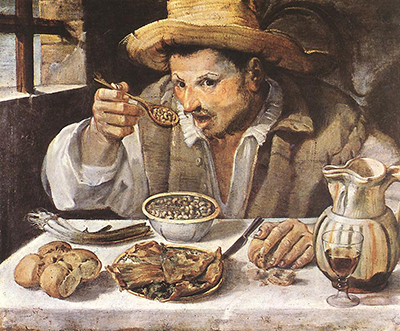
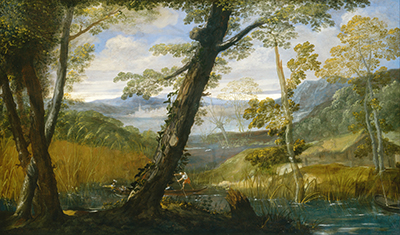
Start with the spoon in The Bean Eater and the boatman's pole in River Landscape. The spoon stops halfway to the man's mouth. The pole angles down into a river that bends gradually into the distance. Annibale Carracci gives each small gesture a different reach. One brings a meal so close that we seem to have interrupted it. The other gives us a way into a much larger space. Follow those two habits of looking, at close quarters and at a distance, through his altarpieces, mythologies and painted rooms. [1] [2]
The form of the work changes what you can see. A picture on copper can bring the gleam of a pair of glasses into focus. An altarpiece several metres high needs gestures that carry across a chapel. In the Farnese Gallery, even the marble and bronze we think we see are painted, and the pictures change their relation to one another as we move along the room. The same subject may turn up on another support, at another scale or under a pupil's name. Collection names and inventory numbers are the surest way to find the version you want. [3] [4] [5]
At a Glance
- ArtistAnnibale Carracci
- Life1560–1609
- Principal placesBologna and Rome
Contents
- Meals, work and faces
- Paintings for churches and chapels
- Small paintings and scenes of devotion
- The Passion and the empty tomb
- From riverbanks to the Aldobrandini landscapes
- Venus and the choice of a subject
- Paintings made for a room
- Looking across the collections
Meals, work and faces
In The Bean Eater, in Rome's Galleria Colonna, the man's attention suddenly shifts out of the picture. His open mouth and the tilt of his spoon catch an instant that would be gone by the next breath. The bread has a much broader form than the pale beans. The upright pitcher gives the table a shape beyond the loose scattering of food. These objects have the same directness as the face and hand, which is part of the painting's power. We can recognise the predicament of someone interrupted mid-mouthful without being able to name him or say how much money he earned. The painting gives unusually close attention to a meal that a grander subject would have left in the background. [1]
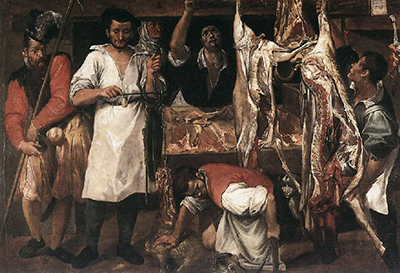
The Butcher's Shop in Christ Church Picture Gallery, Oxford, gives a workday subject the size of a public commission. At 190 × 272 cm, the picture is wide enough for the workers to be seen together as a group and large enough for each to have room for his particular task. One stands weighing meat. Another crouches low to handle a sheep. Repeated reds and whites move between the clothes, the counter and the meat. The counter runs most of the way across the picture, but the man at work below it and the hanging carcasses above it draw the eye up and down. The impression of business going on all around us depends on that distribution of work through the space. [6]
The Kimbell Art Museum in Fort Worth holds a separate Butcher's Shop. At about 60 × 71 cm it asks for a closer look. The cuts of meat marked by strong lights sit much nearer the two principal workers in the smaller picture. There is room for the men to work, but much less room for us to imagine standing beside them. Place the two shops beside The Bean Eater. All three accept ordinary things as worthy of sustained attention. Each arranges them for a different encounter, from a meal seen across the table to a shop commanding a whole wall. [1] [6] [7]
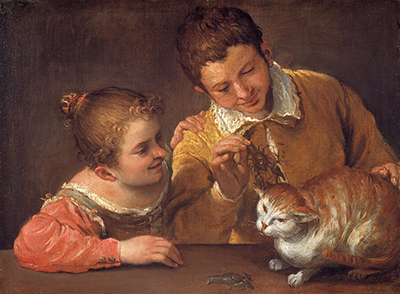
The tight grouping of Two Children Teasing a Cat at the Metropolitan Museum of Art makes the children's amusement and the cat's response hard to separate. One child applies the crayfish and the other leans in to watch. Give the painting time and the smiles grow less reassuring. The Met suggests a proverbial subject, a possible reason for the cruelty under the play. The same museum holds A Domestic Scene, a drawing it catalogues as Annibale's while recording disagreement over the attribution. There, two children and a cat look towards a woman warming a garment at the hearth. Looking across the two makes it easier to see how much the oil painting gains from bringing the faces and the animal into a tight cluster near the front. [8] [9]
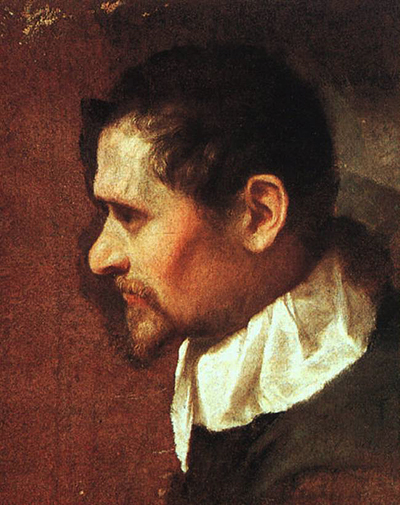
A face in profile can seem as easy to recognise as one turning to look at us. The Uffizi painting traditionally called Self-Portrait in Profile makes that recognition a question. Art historian Gail Feigenbaum traces the profile to a probable entry in Cardinal Leopoldo de' Medici's 1675 inventory. Filippo Baldinucci defended Annibale's authorship that year. The name of the painter and the name of the person in profile are separate questions. Feigenbaum notes how little that face resembles the one on the easel. Set the profile alongside the Hermitage's separately catalogued Self-Portrait on an Easel. The latter puts a frontal face inside a painted picture propped in a dark room. The easel and the space around it are as important in constructing this image of a painter as the head itself. The Hermitage catalogue describes a larger head design still visible under the brown paint and compares both arrangements with a drawing at Windsor. The act of conceiving a likeness, changing it and putting it on display has become part of the easel picture's subject. [10] [11]
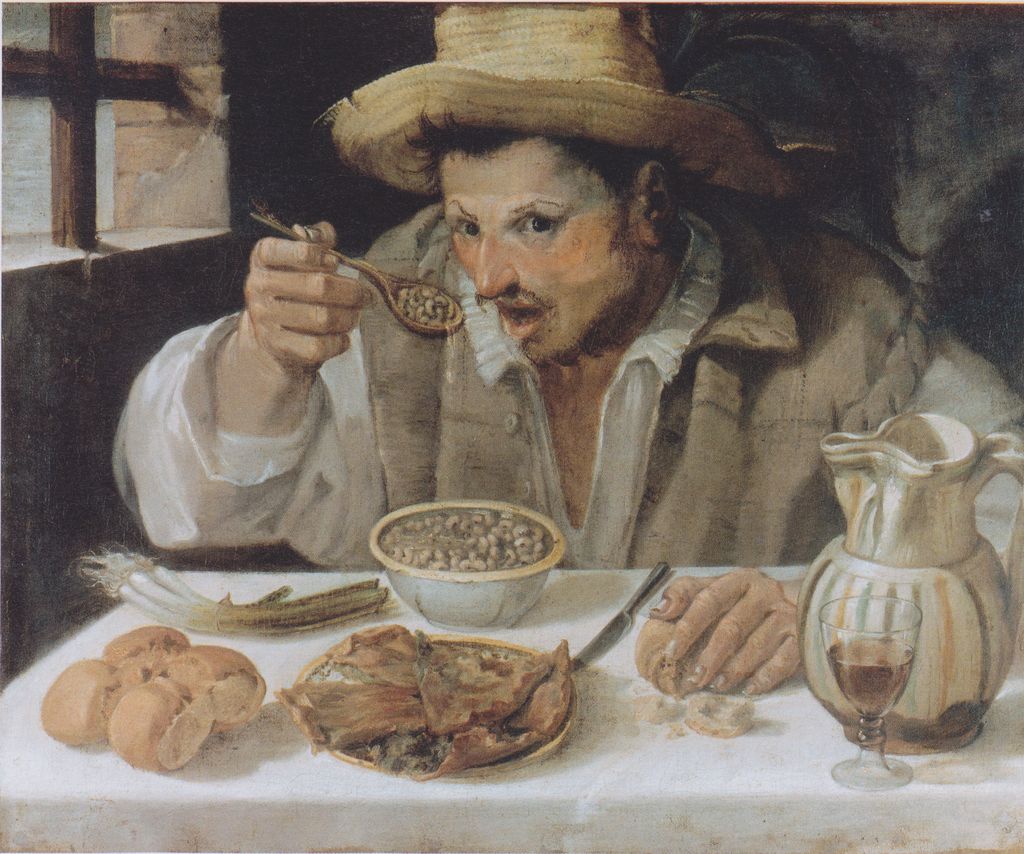
Annibale Carracci, The Bean Eater. Galleria Colonna, Rome. Image source. Public domain.
Paintings for churches and chapels
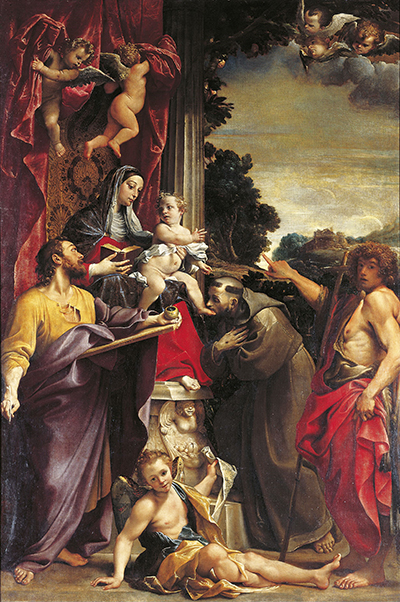
The Madonna Enthroned with Saint Matthew in Dresden is a canvas nearly four metres high. The Madonna and Child sit high enough for the saints' gestures to lead clearly towards them. The curtain behind the throne picks up the warm colour of the figures below, helping join the upper and lower halves of the painting even at a distance. Look closer at Matthew and the angel. The angel bends towards Matthew, closing the gap between a heavenly visitor and a man at work. The altarpiece was made in 1588 for San Prospero in Reggio Emilia. Its rich colour and gathered curtain show what Carracci had learned from Venetian painting. In the small reproduction the colour blocks can be the first thing we see. At the scale of the original, each block has body enough to become robe, curtain or sleeve. [4] [12] [13]
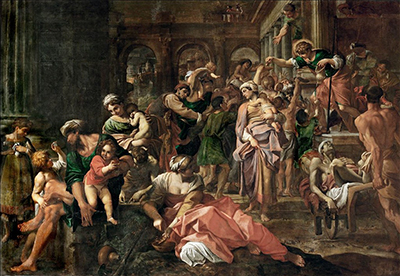
Saint Roch Distributing Alms, also in Dresden, rewards looking across as well as up. People wait, watch and step forward, so that the gift of alms is registered through several actions and points of view. The composition was made for the Bolognese confraternity of San Rocco and completed in 1595. A chalk study in Rotterdam shows a seated woman at a stage when the position of a bent arm or the weight on a skirt could still change. The Boijmans catalogue compares the drawings, underdrawing and prints after the preparatory design. Carracci replaced a landscape background with architecture and reversed the composition as he brought it into its final form. Find the woman from the Rotterdam study at the centre of the foreground, gesturing to her empty bowl. Carracci carried the folds of her dress into the painted figure and kept the turned head that directs our attention up to the saint. A crowded scene that appears to have been caught in full flow was the result of decisions worked out well before the final surface. [14]
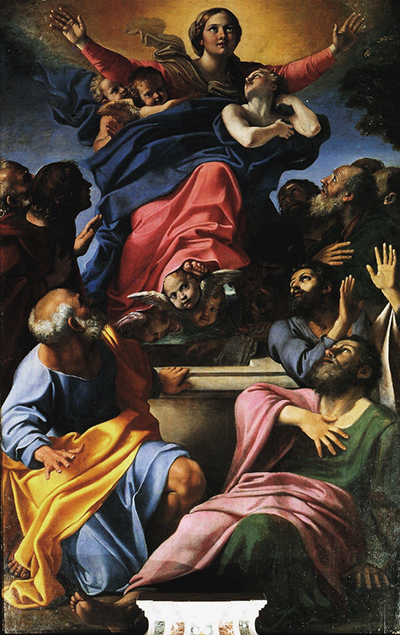
The Assumption of the Virgin in the Cerasi Chapel occupies the altar between two Caravaggios in Santa Maria del Popolo, Rome. Seen from the entrance, where the side walls are harder to take in, the upward pull of the Virgin and the angels establishes the focus. The clustered apostles and open tomb hold the scene down at the bottom. Move further into the chapel and Caravaggio's Conversion of Saint Paul and Crucifixion of Saint Peter come into view at either side, with large bodies unusually close to the picture surface. In Bologna the Pinacoteca shows another Assumption by Annibale and one by Agostino. The title alone leaves the site, format and painter open. [15] [16] [17]
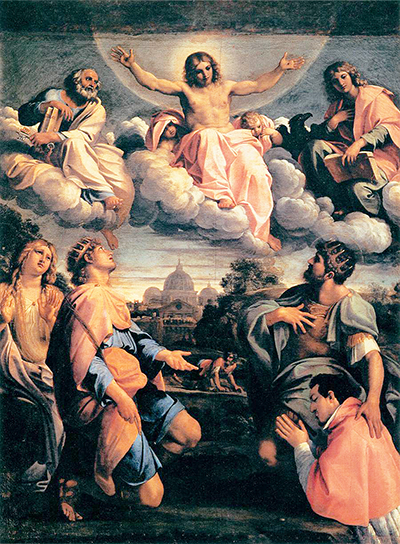
Christ in Glory offers another way to organise a height difference. In the Palatine Gallery painting, a register of saints and the donor Odoardo Farnese below looks towards Christ above. One of the saints is Edward the Confessor, whose name connects him to Odoardo. The full Uffizi title names the donor and all five saints. That makes a better identification than a short label such as Christ in Glory, which describes the kind of scene and can apply to other artists' works as well. Compare the fixed point of attention in this painting with the unrest of the figures at the tomb in the Cerasi Assumption. Both put worshippers near the earthly register, but the nature of the encounter changes what the figures have to do. [18] [15]
Small paintings and scenes of devotion
Three pictures in London's National Gallery give a sense of Carracci's range at a scale that allows small objects to matter. In Christ Appearing to Saint Anthony Abbot, a panel of copper less than 50 centimetres high holds a confusion of creatures around the fallen saint. The appearance of Christ gives the crowd of limbs and fantastic bodies a direction. In Christ Appearing to Saint Peter on the Appian Way, an oil on wood, Peter recoils and Christ continues on his way with a cross. The work is also called Domine, Quo Vadis?, a reference to Peter's question about where Christ is going. Christ strides towards us and points out into our space as Peter throws up both hands. X-rays show that Carracci first placed Peter closer to Christ, standing more upright. The new position makes his body itself express his surprise. A drawing for the treatment by Carracci's pupil Innocenzo Tacconi in the Cerasi Chapel shows Peter kneeling. The wooden panel in London was recorded separately in Cardinal Pietro Aldobrandini's inventory in 1603. [19] [20]
Another copper, The Holy Family with the Infant Saint John the Baptist, is known as the Montalto Madonna. Joseph has set aside his reading glasses, John tugs at Mary's cloak, and she balances the child on her knee. There are enough details to suggest a family just managing to sit still. They also give the composition a centre. Joseph's book and John's grasp turn our attention back towards the Virgin and Child. Carracci's study of Correggio helps explain the soft modelling and the close-knit action. At 35 cm high, the picture sets out the main shapes simply enough to make the tiny gestures count. [3]
Such paintings also invite unusually exact comparisons between versions. The Montalto Madonna was celebrated and copied in the seventeenth century. Long thought lost, Carracci's own version was identified by comparing the history of the copper that appeared for sale in 2003 with the old descriptions and records. The National Gallery investigated its materials and used electron emission radiography to study the painted layers on a metal support. In his technical study, Larry Keith describes the pale priming and relates the handling to the picture's unusually subtle transitions between light and shade. Details that can be appreciated in an ordinary viewing, like the way a form emerges from shadow, also played a part in weighing whether this was the painter's prime version. [3] [21]
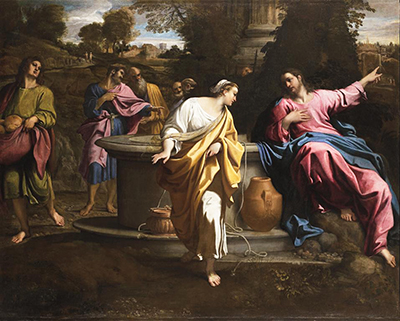
The size of a sacred narrative can be just as decisive as its setting. In the Budapest Christ and the Samaritan Woman, the well and the main figures fill much of a canvas 76.5 cm high. The separate version at the Pinacoteca di Brera is 170 × 225 cm and opens the encounter into a landscape. Abbot Astorre Sampieri commissioned it as part of a group that also included Agostino's Christ and the Woman Taken in Adultery and Ludovico's Christ and the Canaanite Woman. Carracci's scene had to have a life of its own while answering to two other encounters. In the smaller Budapest picture the viewer is brought closer to Christ and the woman, and the place they share around the well. [22] [23]
The Passion and the empty tomb
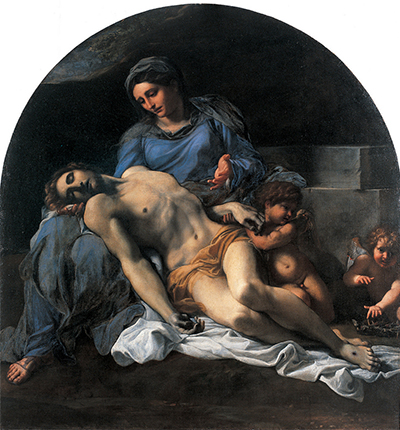
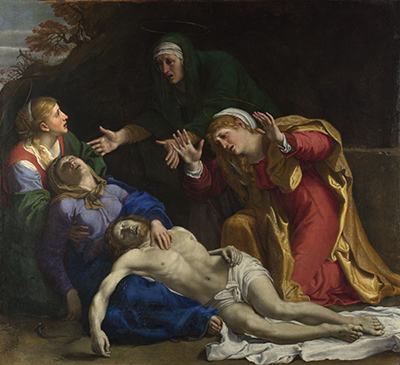
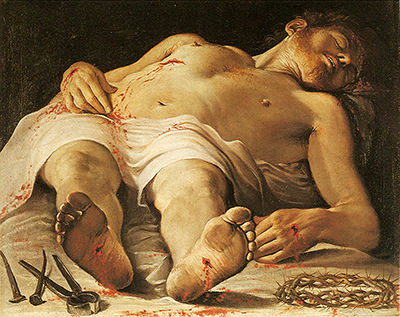
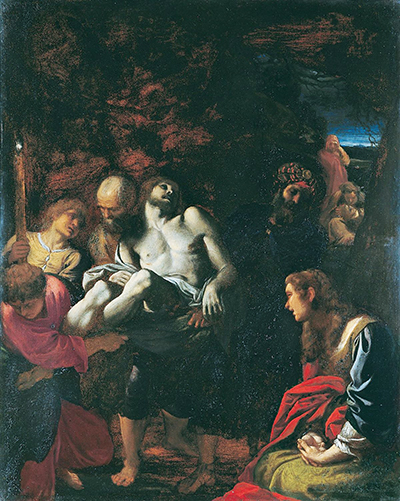
The pictures of Christ's death, burial and Resurrection are often confused because of their titles. Begin with what each painter asks the body to do. In the Stuttgart Corpse of Christ, its steep recession from the feet makes the spectator look along the length of the body. This is an early oil on canvas, recorded by Fondazione Zeri under Stuttgart inventory 2785. The Staatsgalerie dates it to about 1582 and names the instruments of the Passion in its German title. Their presence around the body gives a purpose to the narrow stretch of ground in front of it. The Capodimonte Pietà lets the head and shoulders rest against the Virgin while the body stretches diagonally into the foreground. The shaped top of that picture and the compact joining of the two bodies give the image a much different outline. London has another great lamentation, The Dead Christ Mourned, known as The Three Maries. Here the Virgin is collapsing, her pose echoing Christ's, while the other women register grief in different ways. The hand she rests on his shoulder links the two bodies even when attention shifts to the surrounding figures. [24] [25] [26] [27]
In the Metropolitan Museum of Art's Burial of Christ, Christ is being lowered. The light across the sheet and torso shows the care necessary to move a body that can give no help. The darkness of the cave also presses the action towards the people closest to him. The Bolognese canon who commissioned this painting decided to keep it and sent Guido Reni's copy in its place. A related composition on copper in London's National Gallery, Christ Carried to the Tomb, is attributed there to Sisto Badalocchio. It uses torchlight in a different arrangement of figures. A close relationship with an Annibale design is compatible with another painter working out new effects for himself. [28] [29]
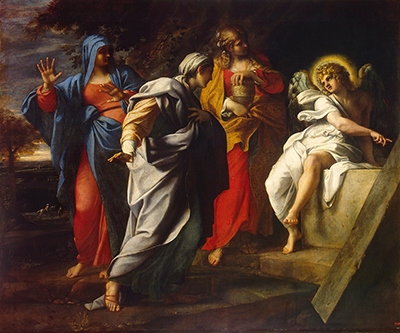
In the Hermitage Holy Women at Christ's Tomb the absence of Christ drives the action. The angel's gesture and the women's turns give a direction to their discovery. The empty tomb holds our attention long enough for us to register the difference between what the women came to do and what they have found. The Hermitage catalogue identifies the canvas as ГЭ-92 and traces its route from early Italian collections through the Coesvelt collection in London. The London Three Maries and the Hermitage Holy Women should be easy to tell apart once we ask which episode we are seeing. In one the body is laid out before the mourners. In the other its absence is the event. [27] [30]
From riverbanks to the Aldobrandini landscapes
In River Landscape, painted about 1590, the trunks nearest us make a dark pattern against water open to the sky. The boat passes behind a trunk, momentarily vanishing as we follow its movement. The alternating banks carry the eye farther back. Small changes in angle and tone keep a large canvas from seeming like a single flat stretch of water. The Washington painting was catalogued as Velázquez at nineteenth- and twentieth-century sales. Its present attribution makes the painting a distinct example of his work around 1590, before the large arched canvas for the Aldobrandini chapel. [2] [31]
A pair in Paris brings the relationship between distance and action out in a larger format. The Louvre holds The Hunt and Fishing, both oil on canvas and each about two and a half metres wide. Their long proportions let incidents at different distances share almost a continuous line of sight. Look for the activity nearest the viewer, then for people whose forms have almost merged into the country behind them. The pictures are pendants, each conceived to go with the other. They also travelled together, given by Camillo Pamphilj to Louis XIV in 1665. The National Art Center's 2015 Louvre exhibition in Japan set The Hunt among paintings of daily life, a useful reminder of how strongly these landscapes attend to things that people do. [32] [33] [34]
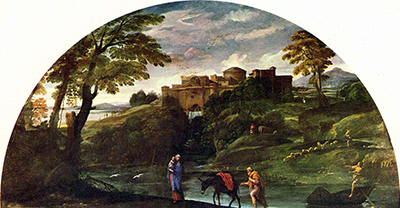
Small figures can carry a story without occupying the centre. The Pinacoteca Nazionale's Saint John the Baptist in a Landscape, dated 1594–95, sets the kneeling saint and angels off centre and lowers the distant horizon. In Landscape with the Flight into Egypt, the Holy Family passes through a view organised by water, banks, trees and distant buildings. Their route is one of several ways into the picture. Originally made for an Aldobrandini chapel, the arched canvas has its own logic as the eye moves from the grounded horizontal sweep below towards the curve of the sky. The Doria Pamphilj gallery credits this lunette to Annibale and gives separate attributions for companions, among them an Assumption by Francesco Albani. The composition also provided a specific example for the younger Domenichino. London's Landscape with a Fortified Town is a good comparison for the placement of a building high above smaller figures and passages of water. [35] [36] [37]
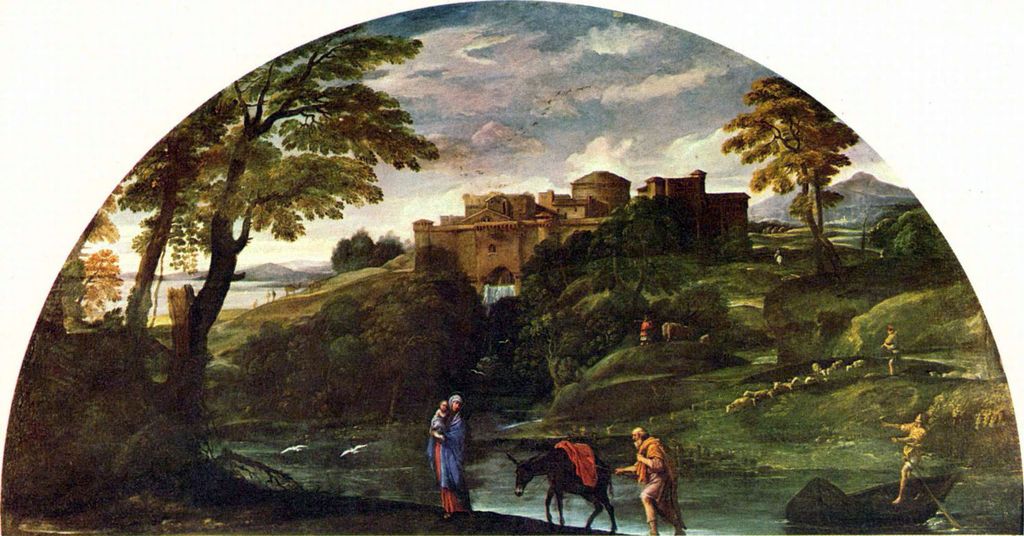
Annibale Carracci, Landscape with the Flight into Egypt. Galleria Doria Pamphilj, no. 236. Image source. Public domain.
Venus and the choice of a subject
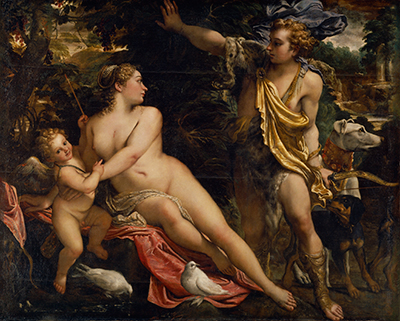
Venus, Adonis and Cupid at the Prado centres on a departure. Venus and Cupid are together on the left, while Adonis turns towards the hunt. The arrangement directs attention to the space closing and opening between the seated goddess and the upright hunter. Compare it with the Venus and Adonis Titian sent to Philip II, also in the Prado. There, Venus's back and arm communicate the force with which she clings to Adonis. Carracci allows the figures to address each other across the picture. That makes their parting depend as much on a glance as on the action of leaving. The Prado presented Carracci's canvas after restoration in 2005, giving this large early mythology its own exhibition. [38] [39] [40]
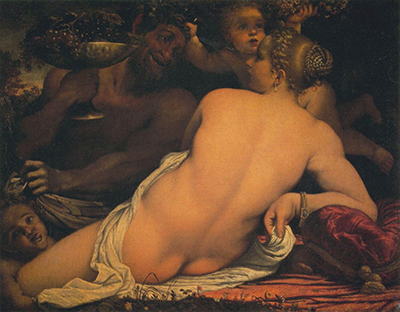
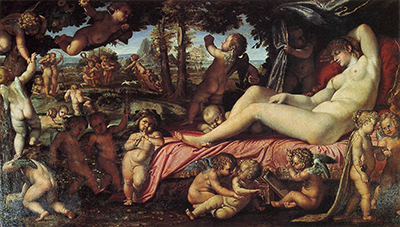
The Uffizi Venus with a Satyr and Cupids and the Musée Condé Sleeping Venus are separate canvases. The Uffizi painting gives much of the foreground to the goddess's back and lets the satyr appear above the bed. In Chantilly the sleeping figure stays still while the cupids play around her, distributing the action more widely across the picture. Look at both for the way a still body can set the pace of a whole composition, then compare that effect with the urgency of the gestures in Venus, Adonis and Cupid. Maria Vittoria Thau's account of historical conservation at the Uffizi records the Florence picture under its earlier name La Baccante. That title is useful for finding old records, and the inventory number 1890 no. 1452 connects them to the image. [41] [42]
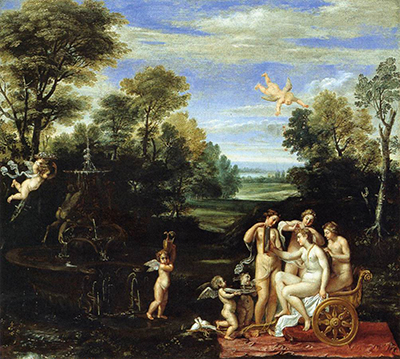
A wooded Landscape with the Toilet of Venus associated with the Bologna collection has a more complicated authorship. The RKD's reconstruction of an older collection records it under Annibale's name in the historical inventory and identifies it as Albani in Bologna. That change is worth following in its own right. The workshop shared subjects and a pictorial language, and a close resemblance tells us something about that relationship before it can tell us who did the painting. The National Gallery of Art's Venus Adorned by the Graces, catalogued under Annibale's name, offers a separate painting for comparison. [43] [44]
Paintings made for a room
In Bologna's Palazzo Fava, episodes of Jason and Medea unfold on a frieze below the ceiling. The first important joint commission of the three Carracci dates from 1584. The story advances with the viewer's glance around the room. Some episodes give us more than one moment at a time. The spaces between them mark a pause, so that a new stretch of wall can move the story on. The Carracci used a related format for the stories of Rome's foundation in Palazzo Magnani. In Parma, copying parts of a Correggio fresco on separate canvases posed a different problem. Capodimonte reunited six works by Annibale and Agostino made after Correggio's lost apse decoration for San Giovanni Evangelista. Seen together, they show how a figure seen from an angle high above the altar could be carried into a new medium and studied at eye level. [45] [46] [47]
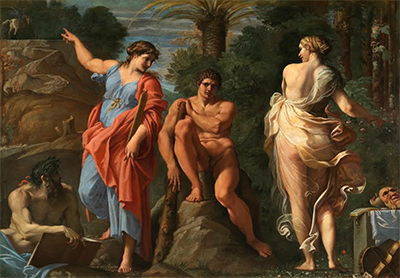
The ceilings of the Palazzo Farnese demonstrate two very different ways to paint overhead. The Choice of Hercules now hangs in Naples at Capodimonte. It is an oil on canvas, made for the centre of the vault in Odoardo Farnese's small Camerino. Hercules sits between the figures of Virtue and Pleasure, his body and gaze pulled in different directions. Seen in the museum, we can inspect the small things that mark the two paths, including the objects scattered near Pleasure and the steep way indicated by Virtue. There is also still a painting in the Camerino. Capodimonte documents the removal of the original in 1662 and its replacement with a copy, giving two distinct places to understand the picture today. [48]
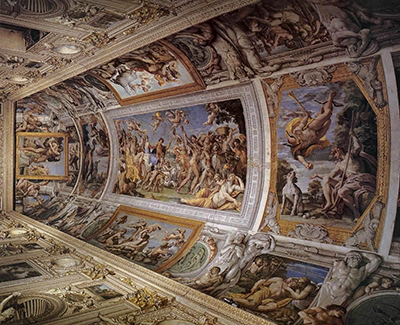
In the nearby Gallery, The Loves of the Gods grew out of the physical length and shape of the room. Part of the pleasure is to recognise pictures that only seem to hang inside frames. Figures painted to resemble marble shoulder the apparent weight of the vault. Painted bronze medallions carry further stories in the spaces between the main scenes. At the centre, the Triumph of Bacchus and Ariadne opens the vault up into a moving procession. The light and dark of separate groups give the eye a route from one part to the next when seen from the floor. The Louvre exhibited preparations by Annibale, his brother Agostino and their circle in 2025–26. In Urbino a full-scale drawing for the group with Silenus lets us follow the shift from drawing to fresco at the very size required by the ceiling. The painted ensemble depended on distinct hands working to a connected design. [5] [49] [50]
In the Herrera Chapel frescoes, the relationship of design to execution took a different form. Annibale devised the cycle about Saint Didacus for the Herrera family chapel at San Giacomo degli Spagnoli in Rome, but illness led to Francesco Albani assuming responsibility for its completion. The frescoes were later detached, so the Prado and Museu Nacional d'Art de Catalunya preserve paintings that once worked together across a vault and walls. The separate altarpiece helps show how the scenes converged on an altar. The original arrangement also explains differences of format and scale among the fragments. The Apostles around the Empty Tomb of the Virgin was painted above the entrance. The exhibition dossier credits the execution to Albani. Seen on its own in a museum, the fresco preserves the figures that once greeted visitors before they crossed into the chapel. Higher up inside, the seams in the plaster mark the portions worked in separate sessions. In four scenes from the dome, the dossier proposes that Albani painted the settings and Annibale worked on features such as heads and hands. The same workshop could divide responsibility differently from one part of a chapel to the next. [51] [52]
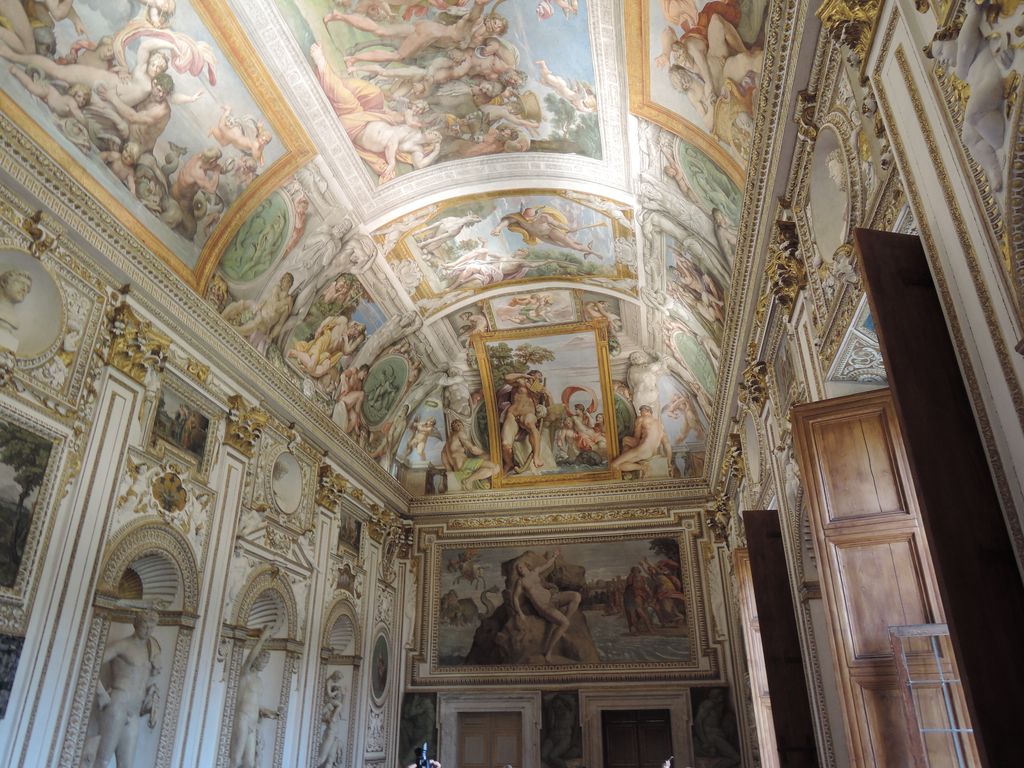
Interior of the Farnese Gallery, Palazzo Farnese, Rome. agennari. Image source. CC BY 2.0. Proportionally resized for web display.
Looking across the collections
Rome holds objects best understood where they were made to be seen, from the Cerasi altarpiece to the Farnese Gallery. Bologna's Pinacoteca shows family relationships across works in the same rooms. Dresden allows two monumental pictures to be compared through the same question of viewership. In London, the small coppers and the Appian Way panel show how different surfaces and scales could carry a sacred story. Naples preserves the Camerino canvas and the Farnese Pietà, and the Herrera fragments in Barcelona and Madrid make sense when read against their former chapel arrangement. A gallery record gives the work's home. Its exhibition history can explain why an encounter with the object happened somewhere else, as it did when Washington's River Landscape travelled to the Bologna and Rome retrospective in 2006–07. [2] [4] [5] [17] [14] [15] [26] [48] [51]
A painted original, a workshop variant and a print after the design can all help us see different things. In a full view of the Oxford Butcher's Shop, look for the way tasks are distributed across the big canvas. In a detail of the Montalto Madonna, look for a single action that keeps the group from sitting still. In the Flight into Egypt, compare the close view of the travellers with how little room they take up in the lunette. The same eye for the position of a hand or the distribution of a crowd can serve a kitchen table, an altar and an entire room. [3] [6] [36]
Browse Carracci’s paintings
 Annibale Carracci.jpg)

Studies of Carracci’s paintings
Raw Painting: The Butcher’s Shop by Annibale Carracci. C. D. Dickerson III. Kimbell Art Museum and Yale University Press, 2010.
A study of the Kimbell canvas and the early work that put everyday labour at the centre of the painting. View the publisher’s record.
Dessins des Carrache. La fabrique de la Galerie Farnèse. Victor Hundsbuckler. Musée du Louvre and Lienart, 2025. In French.
The catalogue assembles known preparatory drawings and examines how they relate to the painted decoration. View the Louvre catalogue.
Artworks directory
Paintings, frescoes, drawings and prints, with separate entries for documented versions and collaborative projects.
Discussion
Look again at the images and ideas explored in Annibale Carracci Paintings. These editorial prompts invite your observations.
Reader Insights
How does the size of the Oxford Butcher’s Shop change the way you look at its subject?
Which two paintings give the clearest example of how Carracci adapted paint handling to a particular setting?
Join the Conversation
Share a detail, comparison or question about Annibale Carracci Paintings below.
References
- Galleria Colonna, Colonna Gallery, Sala dell'Apoteosi and illustrated Il Mangiafagioli listing. View source.
- National Gallery of Art, River Landscape, accession 1952.5.58, object record, image, provenance and exhibition history. View source.
- National Gallery, London, The Holy Family with the Infant Saint John the Baptist (The Montalto Madonna), NG6597, object record and provenance. View source.
- Getty Museum and Staatliche Kunstsammlungen Dresden, Captured Emotions, Madonna Enthroned with Saint Matthew, illustrated loan record and dimensions. View source.
- Victor Hundsbuckler, Musée du Louvre, Dessins des Carrache. La fabrique de la galerie Farnèse, French exhibition introduction, 2025–26. View source.
- Christ Church Picture Gallery, Our Collections, Annibale Carracci's Oxford Butcher's Shop, illustrated entry. View source.
- Kimbell Art Museum, The Butcher's Shop, AP 1980.08, collection and technical information. View source.
- Metropolitan Museum of Art, Two Children Teasing a Cat, accession 1994.142, image and object account. View source.
- Metropolitan Museum of Art, A Domestic Scene, drawing, object record. View source.
- Gail Feigenbaum, Gallerie degli Uffizi, study of the Carracci portraits in Imagines 4, Fig. 5 and discussion of the profile, 2020. View source.
- State Hermitage Museum, Russian collection catalogue, no. 87, Автопортрет на мольберте, inv. ГЭ-148, evidence of an earlier design and related drawing. View source.
- Fondazione Federico Zeri, Madonna con Bambino in trono e santi, 1588 Dresden altarpiece, original Reggio Emilia location. View source.
- National Gallery, London, Annibale Carracci, the artist's study of Venetian painting, landscape and collection works. View source.
- Surya Stemerding, Museum Boijmans Van Beuningen, Studie van een op de grond zittende vrouw, Dutch catalogue account of the study and revisions for the Dresden Saint Roch. View source.
- Ministero della Cultura, Assunzione della Madonna, Santa Maria del Popolo, Italian national record 1200182973. View source.
- National Gallery of Art, Italian Paintings of the Seventeenth and Eighteenth Centuries, artist biography and Cerasi commission context. View source.
- Pinacoteca Nazionale di Bologna, Sala 23: I Carracci, Italian gallery guide and work links. View source.
- Gallerie degli Uffizi, Palatina holdings list, full subject and inventory Palatina (1912) 220, Cristo in gloria. View source.
- National Gallery, London, Christ Appearing to Saint Anthony Abbot during his Temptation, NG198. View source.
- National Gallery, London, Christ Appearing to Saint Peter on the Appian Way, NG9, object record and Aldobrandini provenance. View source.
- Larry Keith, Annibale Carracci's “Montalto Madonna”, National Gallery Technical Bulletin 29, 2008, pp. 46–59. View source.
- Museum of Fine Arts, Budapest, Christ and the Samaritan Woman, object page 9563, inventory 3823. View source.
- Pinacoteca di Brera, Christ and the Samaritan Woman, separate Brera painting, object record and Sampieri context. View source.
- Fondazione Federico Zeri, Cristo morto, Stuttgart inv. 2785, object, photographs and catalogue details. View source.
- Staatsgalerie Stuttgart, Von Farbe bis Emotion: Annibale Carracci, German collection presentation of Der Leichnam Christi mit den Leidenswerkzeugen. View source.
- Museo e Real Bosco di Capodimonte, illustrated loan register, Pietà Q 363, Naples à Paris loan entry. View source.
- National Gallery, London, The Dead Christ Mourned (The Three Maries), NG2923, image and iconography. View source.
- Metropolitan Museum of Art, The Burial of Christ, accession 1998.188, object, patronage, copy and technical notes. View source.
- National Gallery, London, Sisto Badalocchio, Christ Carried to the Tomb, NG86, attribution and Carracci relationship. View source.
- State Hermitage Museum, Russian collection catalogue, no. 85, Святые жены-мироносицы у гроба воскресшего Христа, inv. ГЭ-92. View source.
- National Gallery of Art, Italian Paintings of the Seventeenth and Eighteenth Centuries, River Landscape, entry and technical notes. View source.
- Musée du Louvre, La Chasse, INV 210, French collection record. View source.
- Musée du Louvre, La Pêche, INV 209, French collection record. View source.
- National Art Center, Tokyo, ルーヴル美術館展 日常を描く, Japanese introduction to the 2015 Louvre exhibition. View source.
- Pinacoteca Nazionale di Bologna, San Giovanni Battista in un paesaggio, inv. 32529, Italian collection record. View source.
- Galleria Doria Pamphilj, Paesaggio con la Fuga in Egitto, FC 236, and the illustrated register of the Aldobrandini gallery, including Assumption FC 240. View source.
- National Gallery, London, Domenichino, Landscape with a Fortified Town, NG6629, and relationship to the Aldobrandini lunette. View source.
- Museo Nacional del Prado, 2005 annual report, exhibition and restoration of Venus, Adonis y Cupido, P-2631. View source.
- Museo Nacional del Prado, Carracci and Reni Ovidian pictures, Prado gallery presentation. View source.
- National Gallery of Art, Italian Paintings of the Sixteenth Century, Titian's Venus and Adonis, with Prado version comparison. View source.
- Maria Vittoria Thau, Gallerie degli Uffizi, Imagines 3, pp. 192–195, Fig. 5, Venere, satiro e putti and conservation records. View source.
- Musée Condé, Château de Chantilly, Vénus endormie avec des amours, French collection record. View source.
- RKD – Netherlands Institute for Art History, catalogue appendix, historical Toilet of Venus entry N2 and comparison with the Bologna painting catalogued as Albani. View source.
- National Gallery of Art, Venus Adorned by the Graces, separate Washington painting, object record. View source.
- Genus Bononiae, Palazzo Fava, the 1584 commission and Jason and Medea cycle. View source.
- Comune di Bologna, Palazzo Magnani, the three Carracci and the frieze with stories of Rome's foundation. View source.
- Museo e Real Bosco di Capodimonte, new installation of works by Annibale and Agostino after Correggio's lost frescoes in Parma. View source.
- Museo e Real Bosco di Capodimonte, Angela Caròla-Perrotti, Ercole al bivio, Q 365, illustrated account of Camerino placement and replacement. View source.
- Ministero della Cultura, Trionfo di Bacco e Arianna, national catalogue record for the Urbino cartoon. View source.
- National Gallery of Art, The Drawings of Annibale Carracci, Farnese vault layout and its painted architecture, fig. 3 and accompanying text. View source.
- Museu Nacional d'Art de Catalunya, Annibale Carracci. The Frescoes of the Herrera Chapel, exhibition and fragment distribution. View source.
- Museu Nacional d'Art de Catalunya, Annibale Carracci. Los frescos de la capilla Herrera, exhibition dossier, sections 3–6 on placement and hands. View source.