 by Tom Gurney
Tom Gurney BSc (Hons) is an art history expert with over 20 years experience
Published on June 19, 2020 / Updated on November 29, 2026
Email: tomgurney1@gmail.com / Phone: +44 7429 011000
Madonna Enthroned with Saint Matthew: Introduction
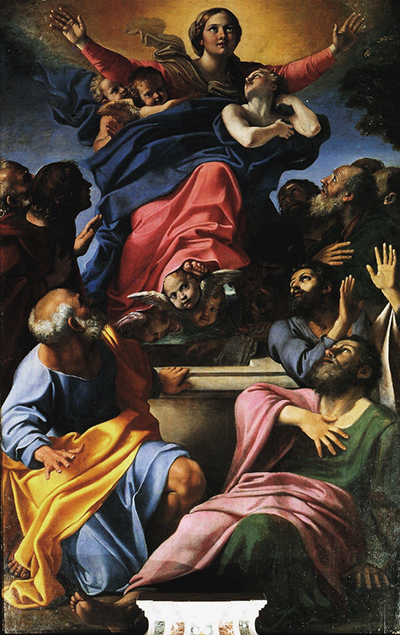
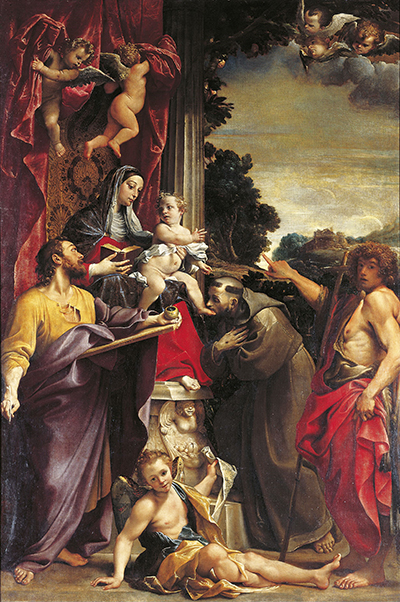
Saint Francis bends to kiss the Christ Child’s foot in Annibale Carracci’s Madonna Enthroned with Saint Matthew. The child turns towards Mary, who inclines her head to meet his gaze. It is a small exchange in a painting almost four metres high, and Carracci arranged the saints, angels and architecture to draw attention to it. He painted the altarpiece in 1588 for the cloth merchants’ chapel in San Prospero, Reggio Emilia. The original, an oil on canvas measuring 384 × 255 cm, is now in the Gemäldegalerie Alte Meister in Dresden, inventory number Gal.-Nr. 304. [1] [2]
At a Glance
- ArtistAnnibale Carracci
- Date1588
- MediumOil on canvas
Contents
- An altarpiece for the cloth merchants of Reggio Emilia
- Matthew, Francis and John the Baptist
- The signature on Matthew’s writing board
- Venetian splendour and the world outside the curtain
- Other commissions and a new setting in Dresden
- Copies of the altarpiece and its life in print
- Annotated details
An altarpiece for the cloth merchants of Reggio Emilia
The Arte dei Mercanti di Panno, the cloth merchants’ guild, had its own chapel and altar dedicated to Saint Matthew in the basilica of San Prospero. Before the eighteenth-century alterations to the church, the chapel stood at the end of the right transept. The dedication explains why Matthew gives his name to the painting, also called the Madonna di San Matteo, even though Francis is the saint who comes closest to Mary and the child. The eighteenth-century Dresden gallery publication also credited the guild with choosing the saints it wished to see represented. That account records how the commission was understood when the painting entered the royal collection. [2] [3]
This is a sacra conversazione, a type of devotional image in which saints from different periods share the presence of the Virgin and Child. Matthew and John the Baptist belong to the world of the Gospels, while Francis lived in medieval Italy. Carracci brings them onto the same patch of ground. Seen from below in a chapel, the raised throne would have drawn attention upwards, while the feet and folds of cloth at the lower edge suggested that the gathering began close to the viewer. The painting gives the saints room to respond in their own ways, through writing, pointing and physical devotion. [1] [3] [4]
Annotated Details from Madonna Enthroned with Saint Matthew
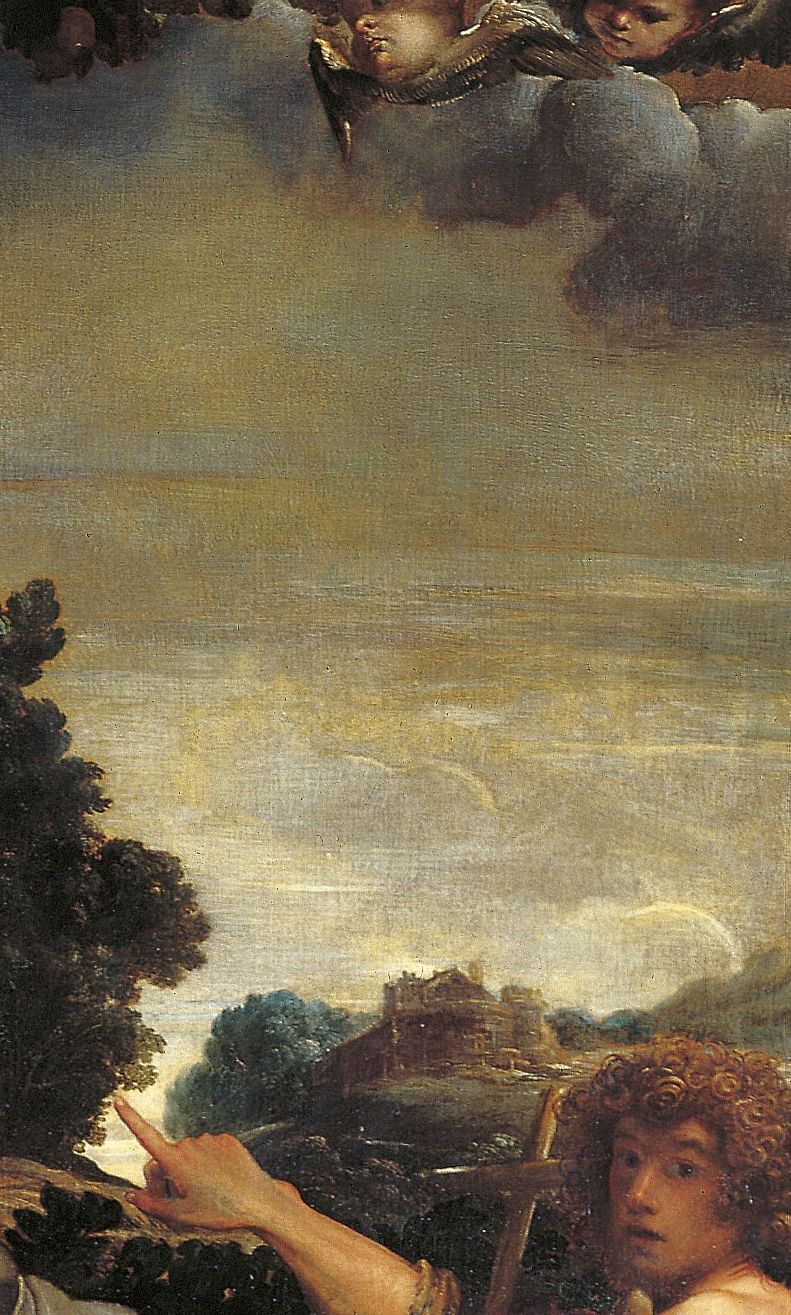
The numbered points identify visible features discussed in this article. Return from each detail to the numbered overview. Annibale Carracci, Madonna Enthroned with Saint Matthew. Gemäldegalerie Alte Meister, Dresden, Gal.-Nr. 304. Image source. Public domain.
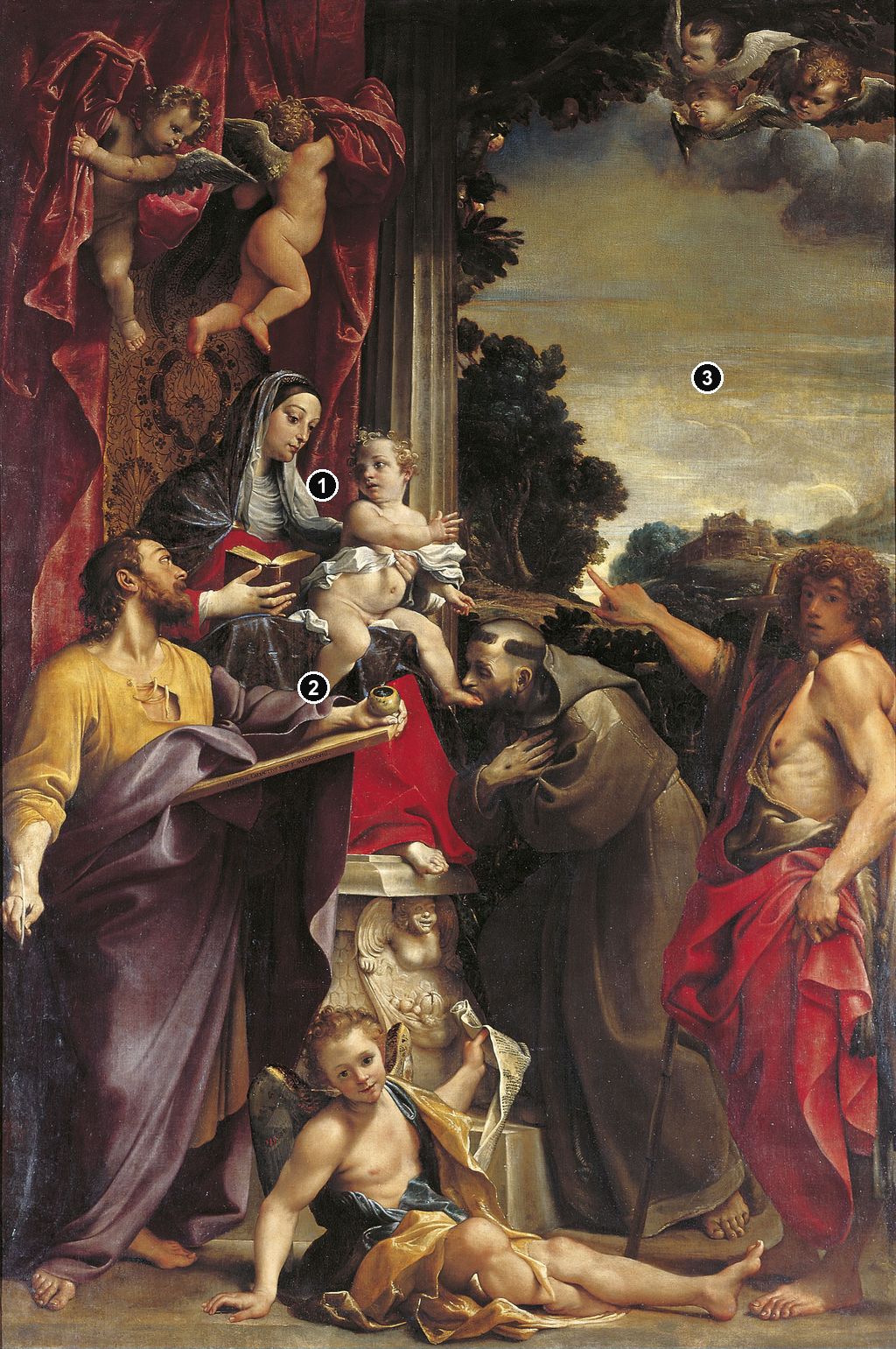
Details from MADONNA ENTHRONED WITH SAINT MATTHEW
Compare the cropped details with the source images above. Notice how their colours, shapes and positions contribute to the larger compositions.
The Madonna and child
Around the child’s pale body, the dark mantle holds the upper part of the group together. The figures below direct their attention into this narrow area.
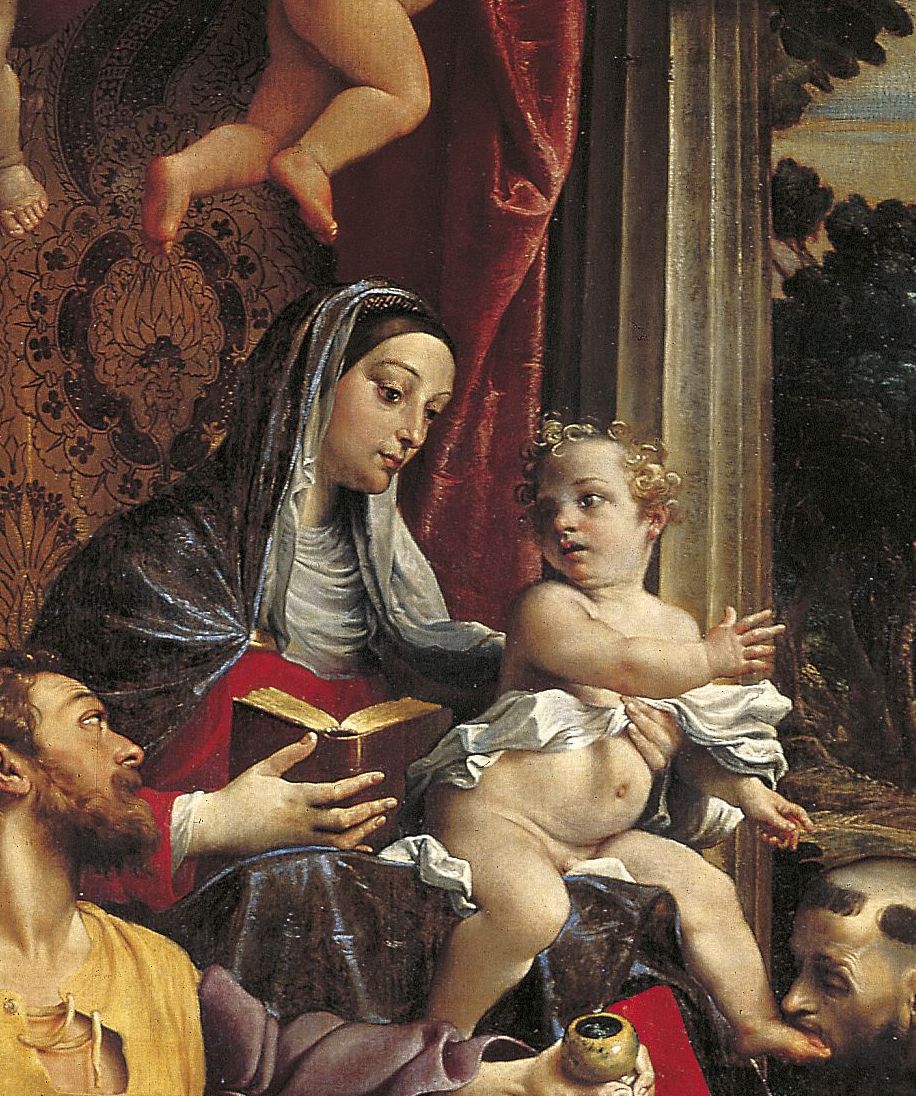
The inkpot and signed writing board
Matthew holds a small inkpot above his writing board. The board’s slender edge bears the painter’s Latin signature and the date 1588.
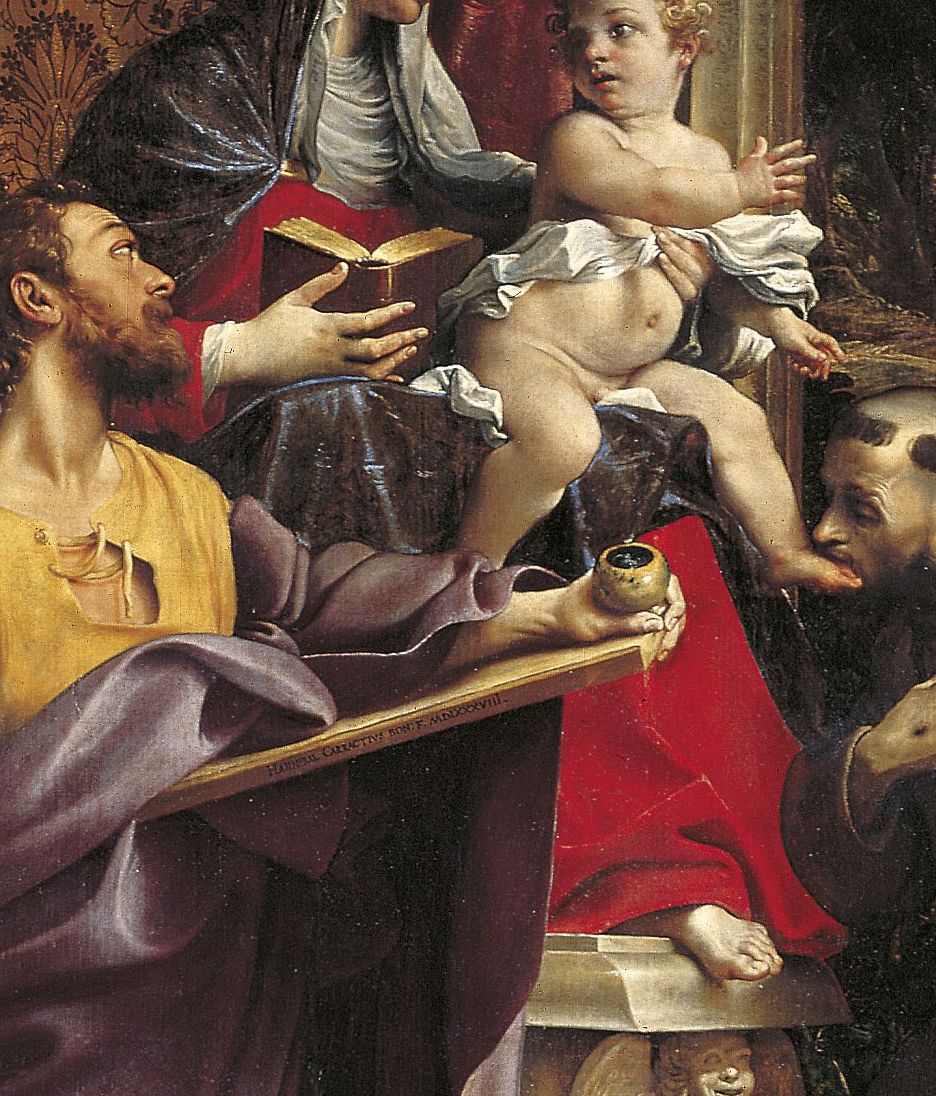
An opening to the sky
A broad opening beyond the architecture gives the right side a cooler colour. The horizon behind the figures contrasts with the richly shadowed fabric on the left.
Matthew, Francis and John the Baptist
At the left, Matthew wears a yellow garment under a purple mantle. He looks up towards Mary and the child, holding a quill low in one hand and an inkpot in the other, with a writing board across his lap. Mary holds an open book beside the child. Below him a winged youth looks out of the painting. The historical Dresden catalogue identifies this foreground figure as Matthew’s angel. The angel props himself on one arm and stretches his legs across the base of the throne, close to the viewer’s space. Above him, the painted stone support with its carved ornament has a different weight and surface from the gold fabric caught beneath his leg. [1] [5]
Francis, at the centre, crosses his hands over his chest and bows in his brown habit. His bare feet, knotted cord and the marks of the stigmata identify him even though his face is partly hidden by the turn of his head. The child’s torso twists towards Mary while his leg remains within reach of the saint. One action is deliberate and reverent, the other can be read as a child’s instinctive turn towards his mother. Carracci lets that difference register through the tilt of two heads and the direction of their eyes. [4] [6]
John the Baptist stands on the right. His bare torso catches the light, his reed cross rises behind his shoulder, and a red mantle loops across his lower body. He raises one arm across the landscape to indicate Christ while turning his head outwards. His gesture supplies a path into the picture from the right, just as Matthew’s upward glance does from the left. Follow it and the landscape quickly gives way to the small circle of faces at the throne. Carracci’s inclusion of John’s bare feet on the earth also makes the painted ground feel continuous beneath all three saints. [1] [4] [5]
The signature on Matthew’s writing board
Dresden transcribes the inscription on the edge of the writing board as HANNIBAL CARRACTIUS BON. F. MDLXXXVIII. The Latin gives Annibale’s name, identifies him as Bolognese and says that he made the work in 1588. The signature occupies the edge of a tool used by the evangelist. Its placement makes the painter’s name part of the depicted scene, tucked into a narrow surface near the child’s feet. The date also gives historians a firm point in the development of Annibale’s painting during the later 1580s. [1] [7]
A red chalk study in the British Museum, Pp,3.14, is linked to John the Baptist in the Dresden canvas in the National Gallery of Art’s drawings catalogue. In the study, the raised arm passes across the lower part of the face. In the painting, it angles down from the head before rising towards the pointing hand, leaving the face and the outward glance clear. Scholarship also identifies a study of the Christ Child in the Uffizi’s drawings collection. The child in that drawing raises one arm while an adult hand steadies him across the chest. In the painting his arms travel across his body and his head turns up towards Mary. The two studies show Carracci working out different demands of the commission. John’s gesture needs to carry across a large canvas, while the child’s turn has to register at the scale of a glance. [6] [7] [8]
Venetian splendour and the world outside the curtain
Mary sits off centre, beneath two flying angels who lift a red curtain. The cloth frames her head and exposes the patterned hanging behind the throne. A column separates those rich, clustered surfaces from the view at the right, where trees and distant buildings sit beneath an open sky. A second group of angels appears in the upper-right cloud. The curtain hangs close to the picture surface, while the hills recede behind the architecture and the cloud half conceals the angels. The lower half brings the eye back to bodies, clothes and the ground. [1] [4]
One precedent is Paolo Veronese’s Mystic Marriage of Saint Catherine of Alexandria, painted around 1570–75 for the Venetian church of Santa Caterina dei Sacchi and now in the Gallerie dell’Accademia. Veronese built a rising diagonal towards the Virgin and Child and made the occasion vivid through columns, suspended cloth and richly coloured dress. Carracci took up the sweep towards an elevated throne and the prominent drapery. He gave these devices different surroundings. Francis’s worn habit and John’s bare feet take the place of the sumptuous costume found in the Venetian scene, and a view of the countryside opens behind the group. Carracci concentrates attention on the contact between the saint and the child, as Veronese does in the ring-giving at the centre of his altarpiece. [4] [9]
Annibale’s brother Agostino had made an engraving after that same Veronese altarpiece in 1582. The impression in Madrid’s Real Academia de Bellas Artes de San Fernando reverses the composition and carries inscriptions naming Veronese, the Venetian church and Agostino. It shows how a monumental altarpiece could be studied far from the church for which it was painted. Scholars consider the 1588 Madonna important evidence for Annibale’s encounter with Venetian painting. The date fixes the moment when he used those lessons on the Reggio canvas, while the engraving shows one way the composition was already circulating. Veronese’s Pala Bonaldo, made for a chapel in the Venetian church of San Zaccaria, offers a second comparison. A curtain and lavish hanging set off the Virgin and Child, while Francis leans forward from the group of saints. Those motifs appear again in Reggio, where Francis bends close enough to kiss the child’s foot. [4] [6] [10] [11]
The foreground angel also recalls a tradition closer to Bologna. Correggio’s Madonna of Saint George brings winged children and the saints’ attributes close to the picture edge. The angel below Carracci’s throne similarly gives the eye an entry into the assembly. Bartolomeo Passarotti’s altarpiece for San Giacomo Maggiore in Bologna, painted around 1564–65, offers another point of comparison. The Baptist is set among saints around an enthroned Madonna in a columned space. Carracci gives that device of a foreground figure a different function by assigning the outward glance at the foot of the throne to Matthew’s angel. [6] [12] [13]
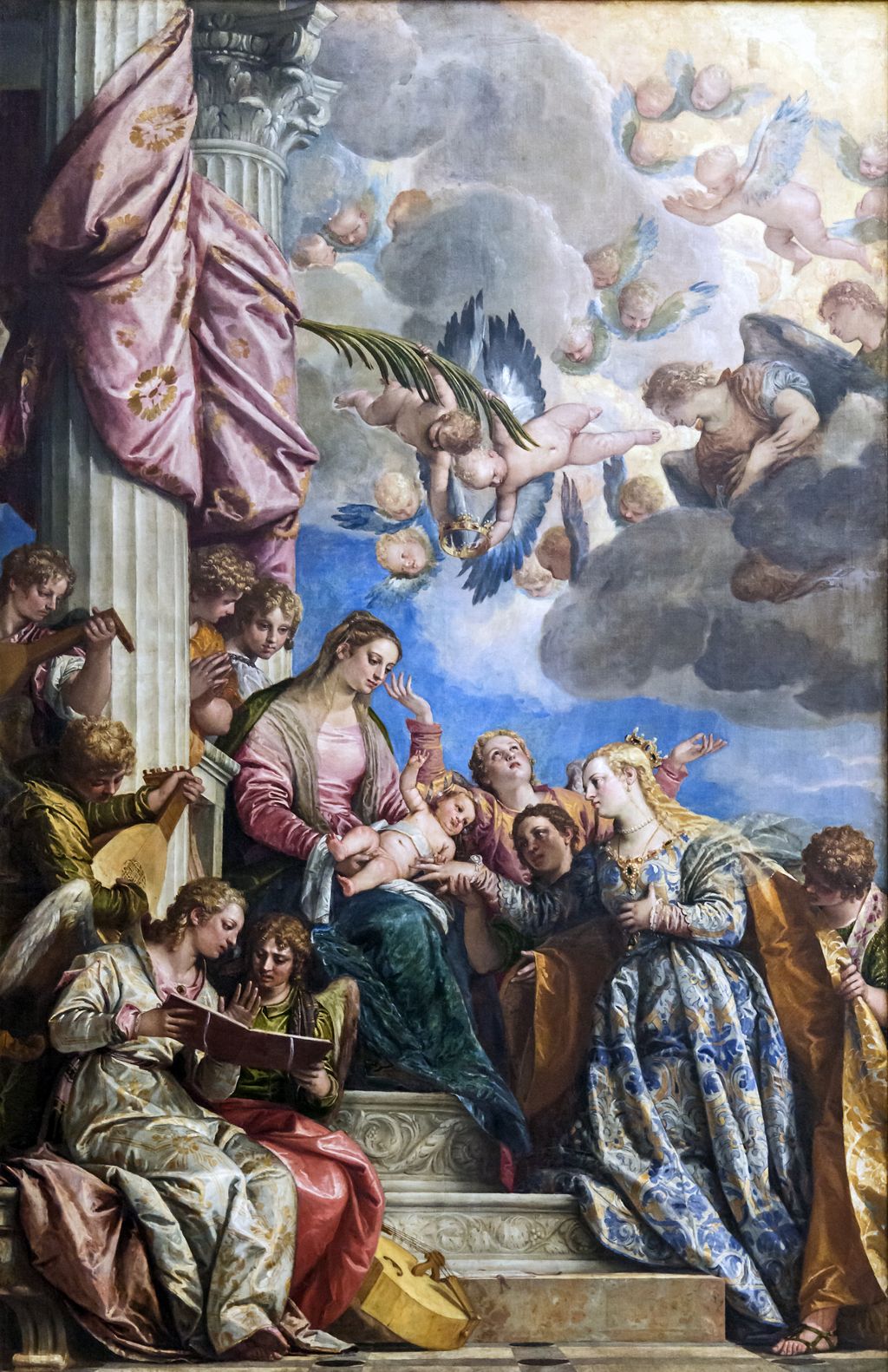
Paolo Veronese, Mystic Marriage of Saint Catherine. Gallerie dell’Accademia, Venice. Photograph by Didier Descouens. Image source. CC BY-SA 4.0. Proportionally resized for web display under the same CC BY-SA 4.0 licence.
Other commissions and a new setting in Dresden
A second signed altarpiece shows how Carracci adapted the format for another professional group in Reggio Emilia. The notaries commissioned The Virgin Appearing to Saint Luke and Saint Catherine for their chapel in the cathedral in 1589. The painting bears the date 1592 on its pedestal and is now in the Louvre. In Bologna, the Madonna of Saint Louis, usually dated around 1590–92, placed six saints beneath the Virgin’s appearance for the high altar of Santi Ludovico e Alessio. Its two titular saints occupy the foreground. That altarpiece separates the heavenly and earthly groups into distinct zones, a useful comparison with the Reggio painting’s continuous chain of gestures from the ground to the throne. These commissions show how the dedication of each altar informed the placement of its saints. [14] [15]
The Italian national heritage catalogue dates the transfer of the Saint Matthew altarpiece to the Este ducal collection in Modena to 1640. A painted copy took its place in San Prospero and stayed on the original altar until 1898. It has traditionally been assigned to the French-born Este court painter Jean Boulanger, though the documentary basis for that attribution has been questioned. For worshippers in Reggio, the copy kept the composition associated with the merchants’ chapel even after the original became a gallery painting. A century later, Francesco III d’Este sold a hundred paintings to Augustus III, elector of Saxony and king of Poland, amid financial pressure during the War of the Austrian Succession. The group arrived in Dresden in 1746 and helped establish the standing of the royal gallery. Emanuela Fiori records the price as 100,000 gold zecchini for the whole purchase. [1] [2] [4] [16]
Copies of the altarpiece and its life in print
A small version in grey oil paint on card at the Louvre shows how Carracci’s arrangement could be studied without relying on its colour. Catherine Loisel associates it with an artist close to Annibale in Bologna, and the Louvre catalogues it as a copy after the Dresden composition. The 1741 sale of Pierre Crozat’s collection described the original as a painting in the gallery of the Duke of Modena. That reference places the work in the ducal collection before its move to Dresden and shows that the composition was already known to a French collector through a copy. [17]
Giuseppe Maria Mitelli etched the composition in Bologna in 1668. The Fondazione Carisbo holds an impression, inventory F34821, from the years when Mitelli was also bringing other Emilian and Venetian paintings into circulation on paper. In 1753 the first volume of the Dresden royal gallery’s Recueil d’estampes presented a new engraving by Nicolas-Gabriel Dupuis based on a drawing by Stefano Torelli. The accompanying text recalled the cloth merchants and singled out the signature. It also judged the earlier Mitelli etching harshly and promoted the newer plate as a truer likeness. That judgement tells us something about the royal gallery’s ambitions for its publication. It wanted readers at a distance to recognise the composition and to value the painting as a work in its own collection. The next plate reproduced another of Annibale’s commissions for Reggio, Saint Roch Distributing Alms. The royal publication placed the two paintings side by side in its sequence even though they had served different patrons in Reggio. [3] [18] [19]
Dupuis’s engraving reverses the painting, placing the Baptist on the left and Matthew on the right. Fine engraved lines supply shadows and textures, but the sweep of red from the curtain above Mary to John’s mantle has to be imagined from the plate. [19] The canvas itself travelled to Los Angeles for the Getty and Dresden exhibition Captured Emotions: Baroque Painting in Bologna, 1575–1725 in 2008–09. The Getty drew attention to Carracci’s handling of the body, textures, and light and shade. The painting’s nearly four metres of height provide room for those effects, from the hanging curtain to the quiet turn of a child’s face. [1] [20]
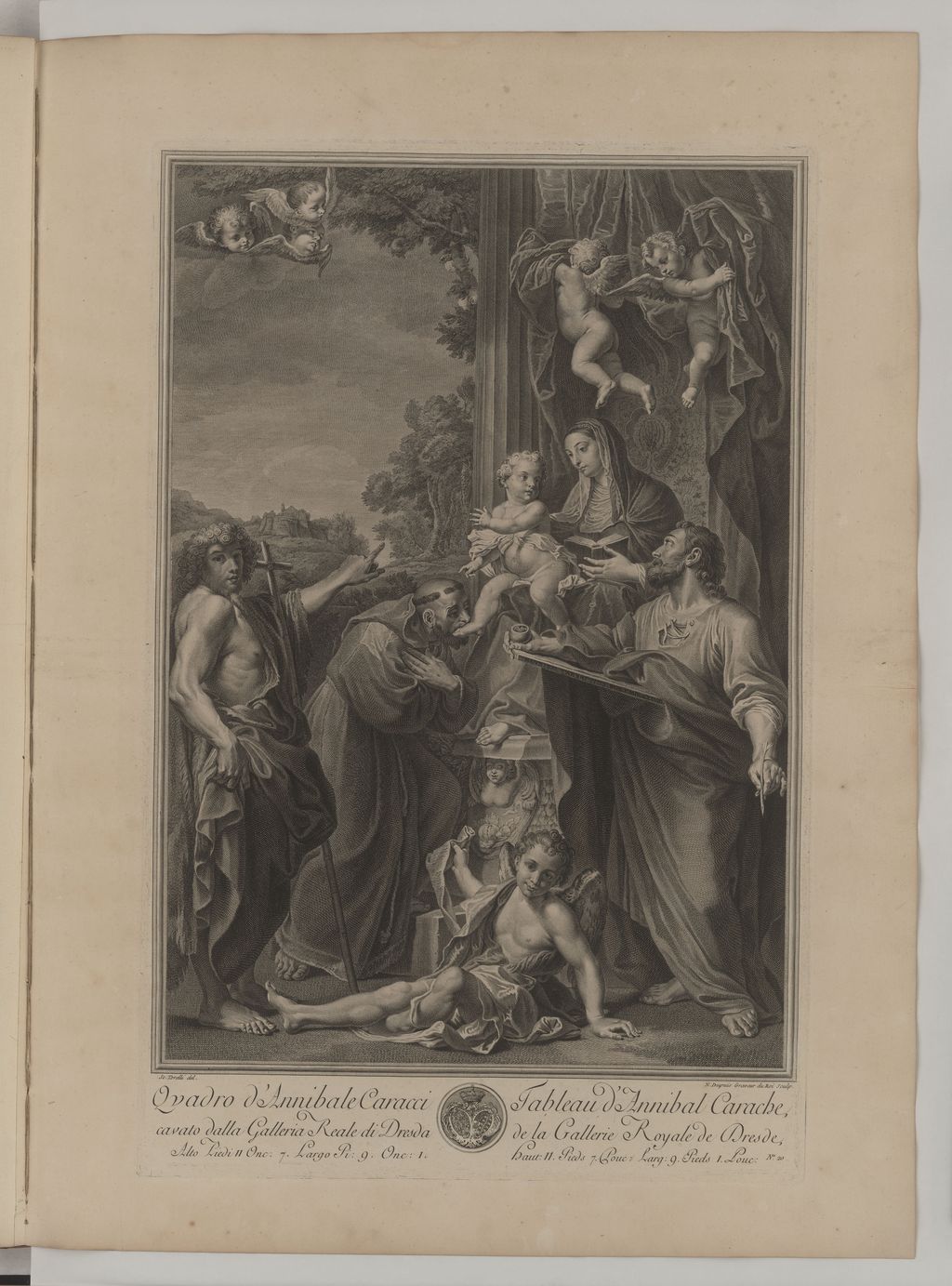
Nicolas-Gabriel Dupuis after Stefano Torelli, plate 20 from the Dresden royal gallery’s Recueil d’estampes, 1753. The print reverses the painting. Scan from SLUB Dresden. Image source. Public domain.
Artworks directory
Paintings, frescoes, drawings and prints, with separate entries for documented versions and collaborative projects.
Discussion
Look again at the images and ideas explored in Madonna Enthroned with Saint Matthew. These editorial prompts invite your observations.
Reader Insights
How do the curtain and the steps affect the way the figures are grouped?
Which detail would have been especially legible from a distance in the original chapel?
Join the Conversation
Share a detail, comparison or question about Madonna Enthroned with Saint Matthew below.
References
- Staatliche Kunstsammlungen Dresden, Thronende Madonna mit dem heiligen Matthäus, Gal.-Nr. 304 View source.
- Italian Ministry of Culture, copy of the Madonna di San Matteo and the San Prospero chapel View source.
- Carl Heinrich von Heineken, Recueil d’estampes de la Galerie Royale de Dresde, volume I, notice XX View source.
- Emanuela Fiori, Madonna in trono col Bambino e i santi Francesco, Matteo e Giovanni Battista View source.
- Catalogue of the Pictures in the Royal Gallery at Dresden, no. 304 View source.
- Iconografia francescana, San Francesco nella Madonna di san Matteo View source.
- National Gallery of Art, The Drawings of Annibale Carracci, catalogue no. 21 View source.
- British Museum, study of Saint John the Baptist, Pp,3.14 View source.
- Gallerie dell’Accademia, Veronese’s Mystic Marriage of Saint Catherine of Alexandria View source.
- Real Academia de Bellas Artes de San Fernando, Agostino Carracci’s 1582 engraving after Veronese View source.
- Gallerie dell’Accademia, Veronese’s Pala Bonaldo from San Zaccaria View source.
- Ernst von Siemens Kunststiftung, Correggio’s altarpieces in Dresden View source.
- Italian Ministry of Culture, Bartolomeo Passarotti’s altarpiece for San Giacomo Maggiore View source.
- Musée du Louvre, L’Apparition de la Vierge à saint Luc et à sainte Catherine, INV 196 View source.
- Pinacoteca Nazionale di Bologna, Madonna and Child in Glory with Six Saints, inv. 471 View source.
- Simone Sirocchi, University of Bologna doctoral thesis, p. 179 n. 81 View source.
- Musée du Louvre, La Vierge de saint Matthieu, copy after Carracci, INV 7541 View source.
- Fondazione Carisbo, Giuseppe Maria Mitelli’s etching after the altarpiece, F34821 View source.
- Saxon State and University Library, Dresden gallery engraving, volume I, plate 20 View source.
- J. Paul Getty Museum and Gemäldegalerie Alte Meister, Captured Emotions View source.