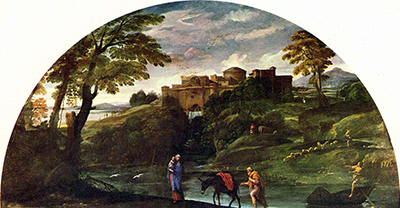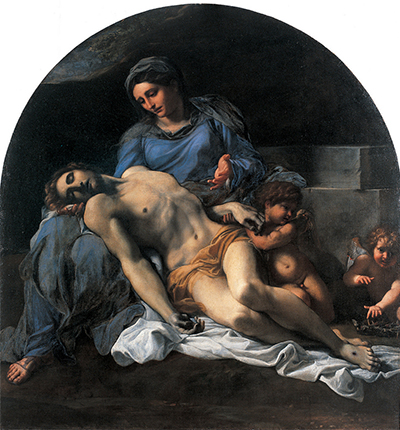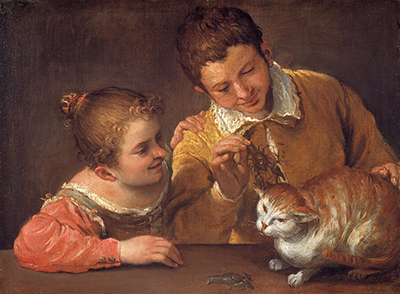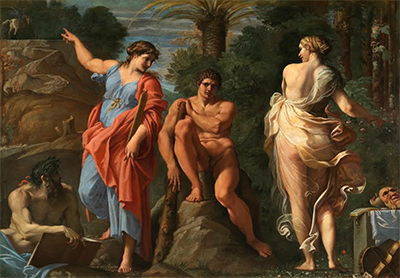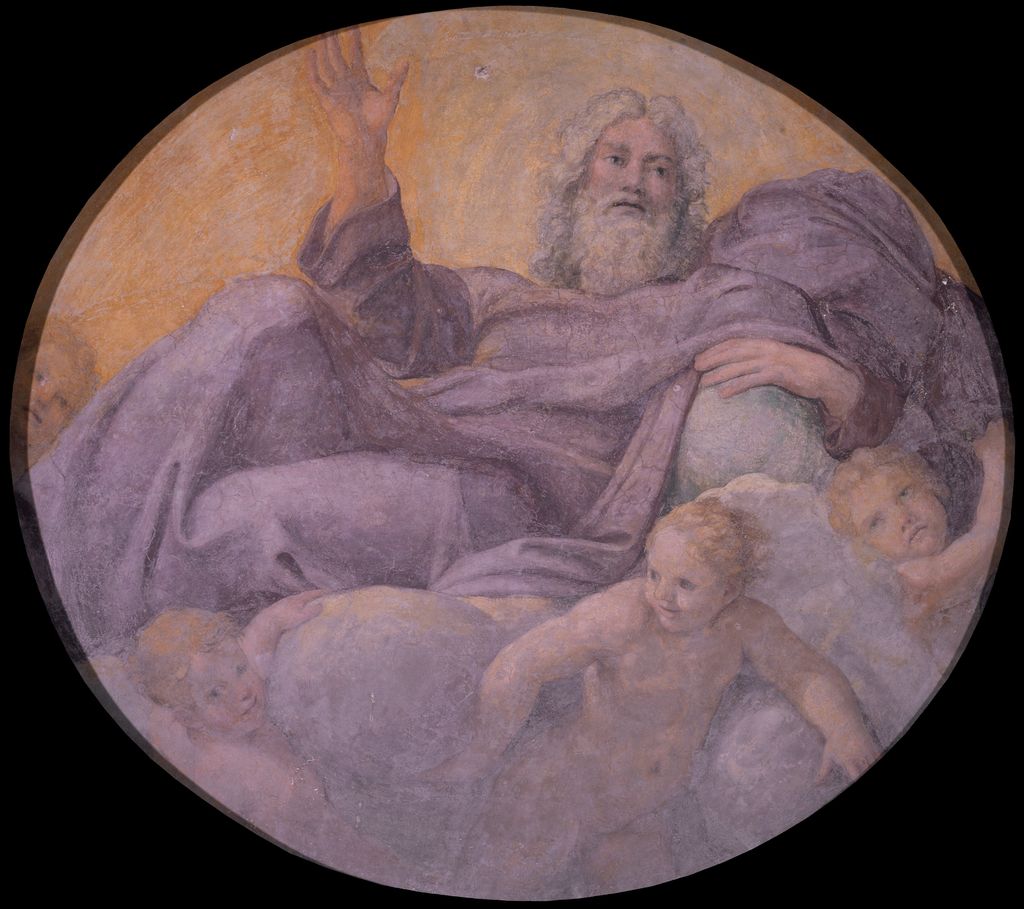
The Everlasting Father, painted by Francesco Albani for the Herrera Chapel project designed by Annibale Carracci. Museu Nacional d’Art de Catalunya, 024282-000. Image source. Public domain.
 by Tom Gurney
Tom Gurney BSc (Hons) is an art history expert with over 20 years experience
Email: tomgurney1@gmail.com / Phone: +44 7429 011000
The Herrera Chapel Frescoes: Introduction
Above the entrance to the Herrera Chapel in Rome, the apostles gathered around an empty tomb. One level higher, the Virgin rose among angels. To see both paintings together, a visitor had to look up before stepping inside. There the story changed from Mary’s Assumption to the life of a Spanish Franciscan, Saint Didacus of Alcalá, whose intercession the Herrera family credited with saving a child. Annibale Carracci planned the ensemble and began painting it. When he fell seriously ill, Francesco Albani took charge, completing the cycle with other painters from Carracci’s circle. [1]
The chapel itself has vanished. Nine frescoes are in Barcelona on long-term loan from the Reial Acadèmia Catalana de Belles Arts de Sant Jordi, and seven are at the Museo del Prado in Madrid. Three further frescoes taken off the walls in the nineteenth century remain unlocated. The oil painting from the altar is still in Rome, at Santa Maria in Monserrato degli Spagnoli. The curved and irregular outlines of the surviving frescoes help explain how these works once fitted together. [1]
At a Glance
- ArtistAnnibale Carracci and collaborators
- DateEarly 17th century
- MediumFresco subsequently transferred
Contents
- A family chapel in Rome’s Spanish church
- Looking up from the church aisle
- Miracles on the walls and the plea at the altar
- From the corner saints to the lantern
- How Carracci and Albani worked together
- Prints and the three missing frescoes
- How the frescoes reached Barcelona and Madrid
- Seeing the paintings together again
- Annotated details
A family chapel in Rome’s Spanish church
In 1602 the Castilian banker Juan Enríquez de Herrera acquired space for a family chapel in San Giacomo degli Spagnoli, the Spanish church on Piazza Navona. Herrera had prayed to Didacus, a fifteenth-century friar canonised in 1588, when his son Diego was gravely ill. The chapel fulfilled his vow of thanksgiving for the boy’s reported recovery and served as a burial chapel for Herrera and his heirs. Its location in a church associated with the Spanish monarchy gave that family act of devotion a setting of considerable public visibility. [1] [2] [3]
Gaspar van Wittel’s 1699 view of Piazza Navona shows the church at the right of the square. Inside, the chapel was the second on the left when entering from the Sapienza side. An engraving published in 1725 for the funeral of Luis I of Spain shows its entrance and part of a painted wall. It also records the stucco ornament by Stefano Fuccari and the stucco sculpture by Ambrogio Buonvicino that accompanied the paintings. Ferdinando Fuga’s designs for prints of the funeral of Philip V in 1746 supply another record of the interior and floor plan. The building views locate the chapel within the church, while the mural outlines and early prints help place individual paintings within it. [1] [3] [4]
Annotated Details from The Herrera Chapel Frescoes
The numbered points identify visible features discussed in this article. Return from each detail to the numbered overview. Each caption identifies the work shown.
The Everlasting Father from the Herrera Chapel
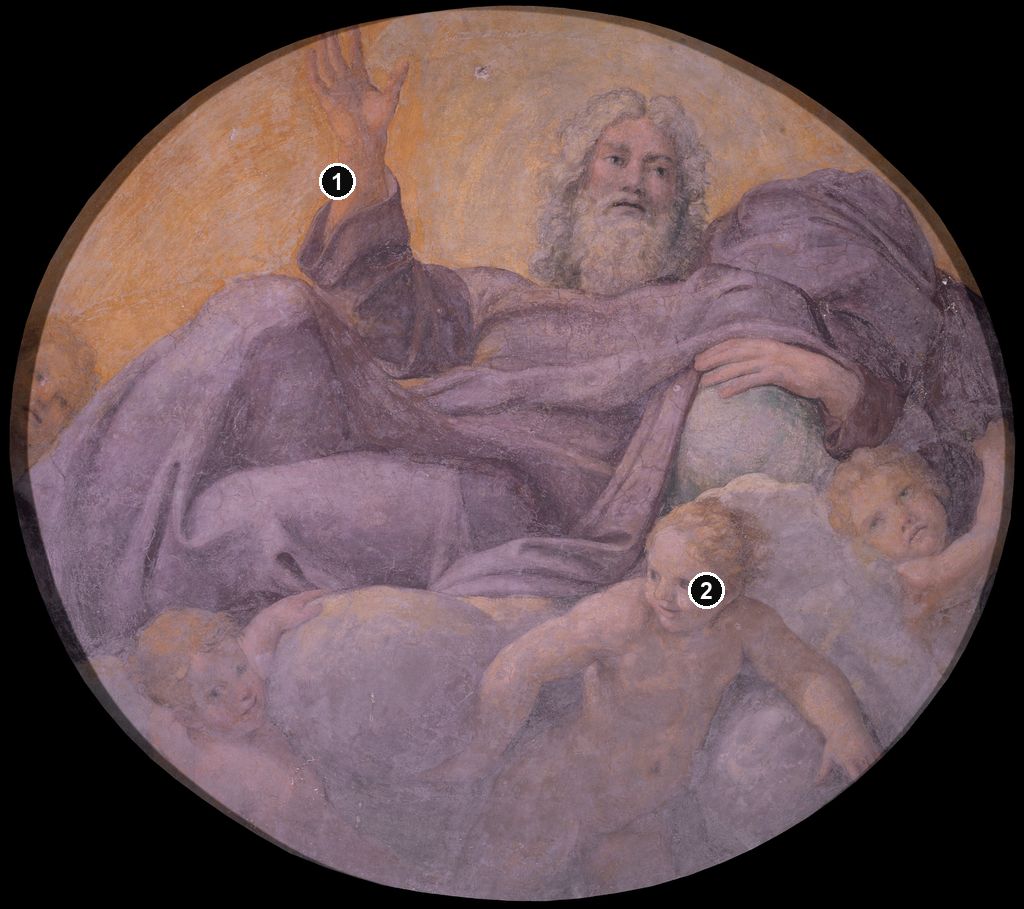
The Everlasting Father, painted by Francesco Albani for the Herrera Chapel project designed by Annibale Carracci. Museu Nacional d’Art de Catalunya, 024282-000. Image source. Public domain.
Apparition of Saint Didacus above His Sepulchre
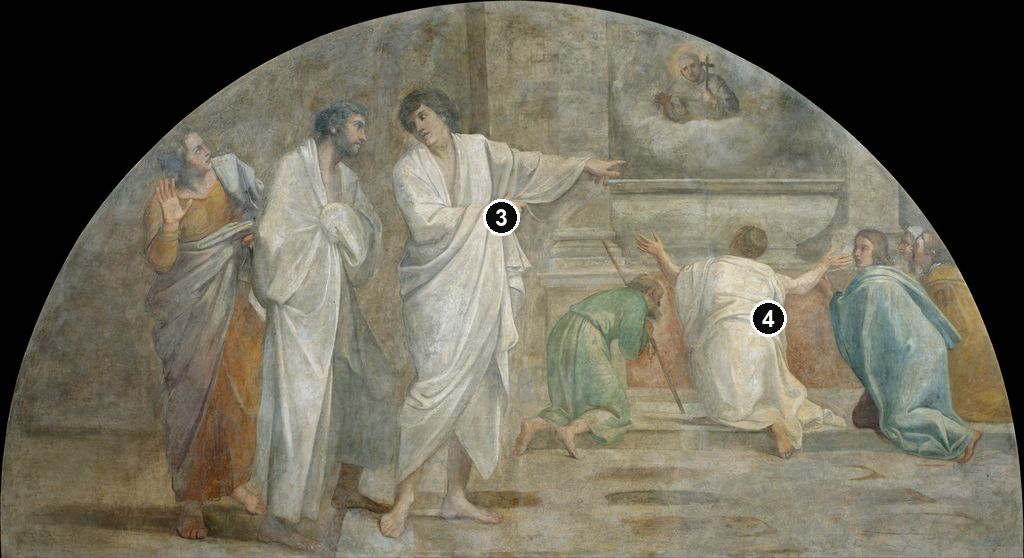
Apparition of Saint Didacus above His Sepulchre, credited to Giovanni Lanfranco in the 2022 exhibition of the Herrera Chapel cycle. Museu Nacional d’Art de Catalunya, 024285-000. Image source. Public domain.
Apostles around the Empty Sepulchre
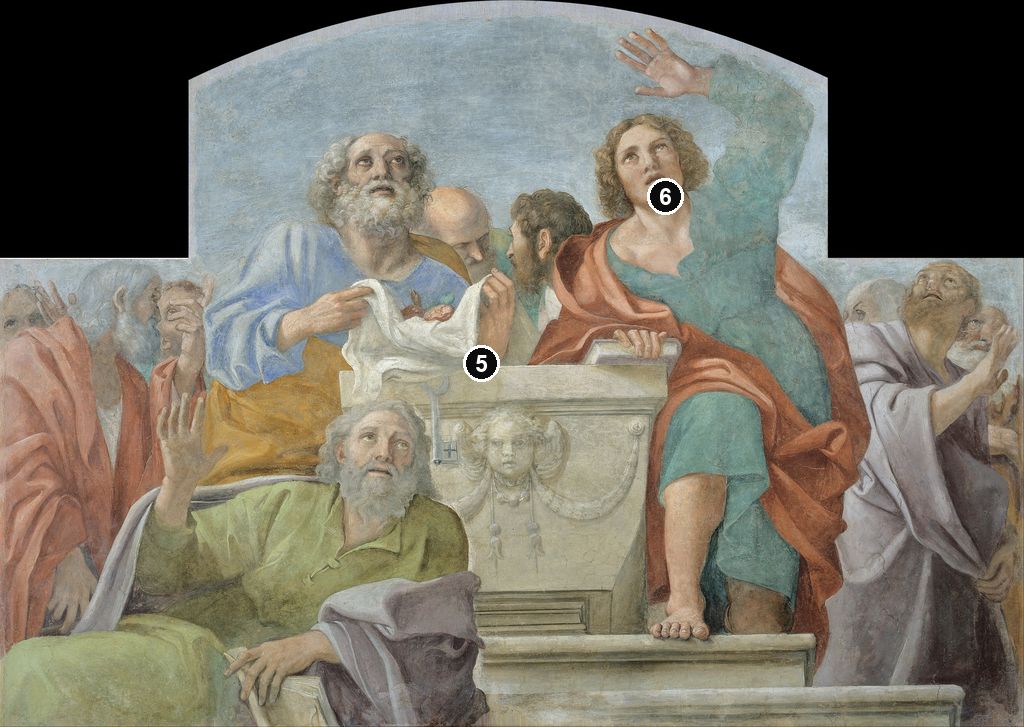
Apostles around the Empty Sepulchre, painted by Francesco Albani for the Herrera Chapel project designed by Annibale Carracci. Museu Nacional d’Art de Catalunya, 024284-000. Image source. Public domain.
Details from THE HERRERA CHAPEL FRESCOES
Compare the cropped details with the source images above. Notice how their colours, shapes and positions contribute to the larger compositions.
The Everlasting Father from the Herrera Chapel
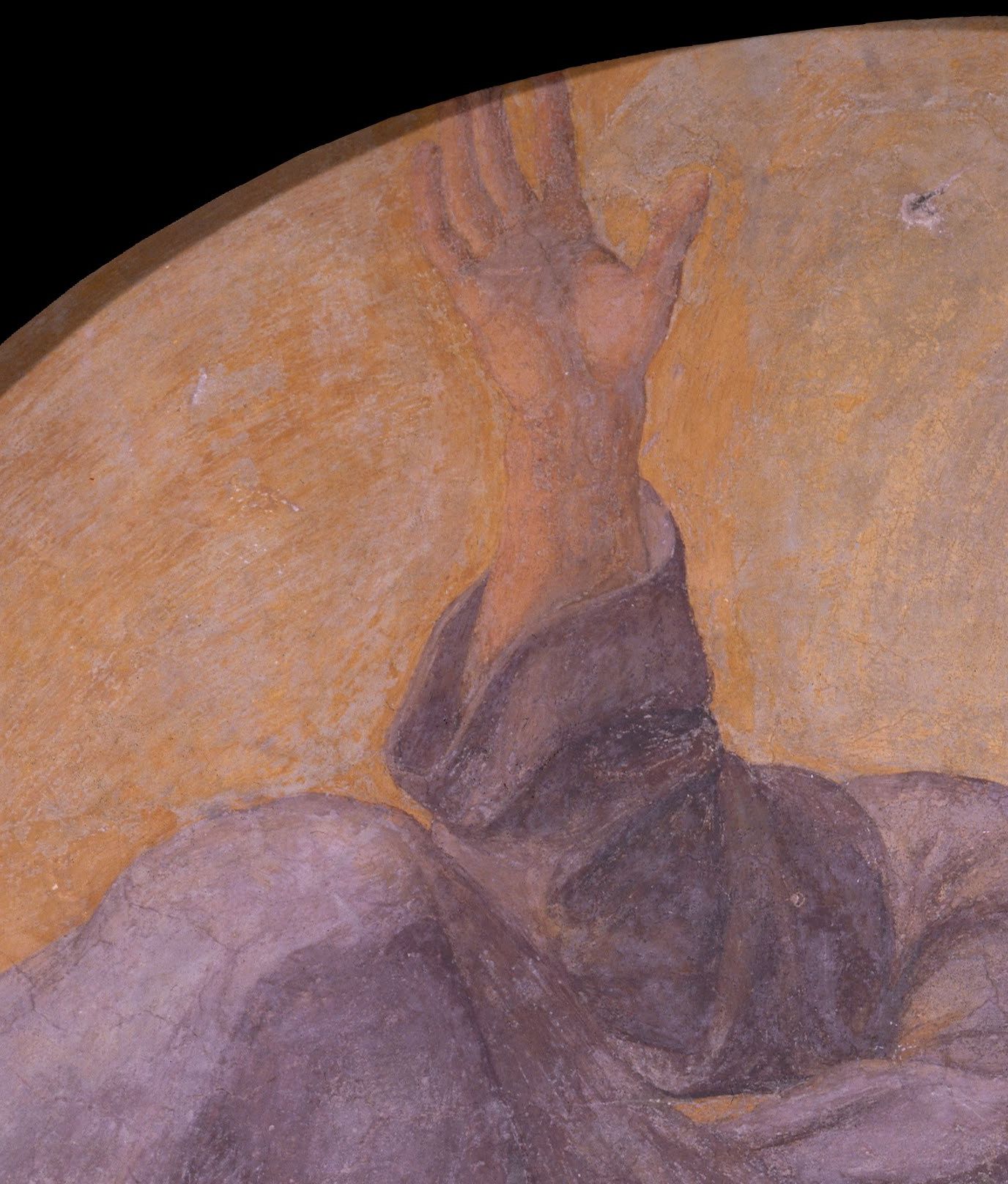
The upturned palm
The raised hand emerges above the purple drapery. The gold field around the palm keeps the gesture distinct in the upper half of the round composition.
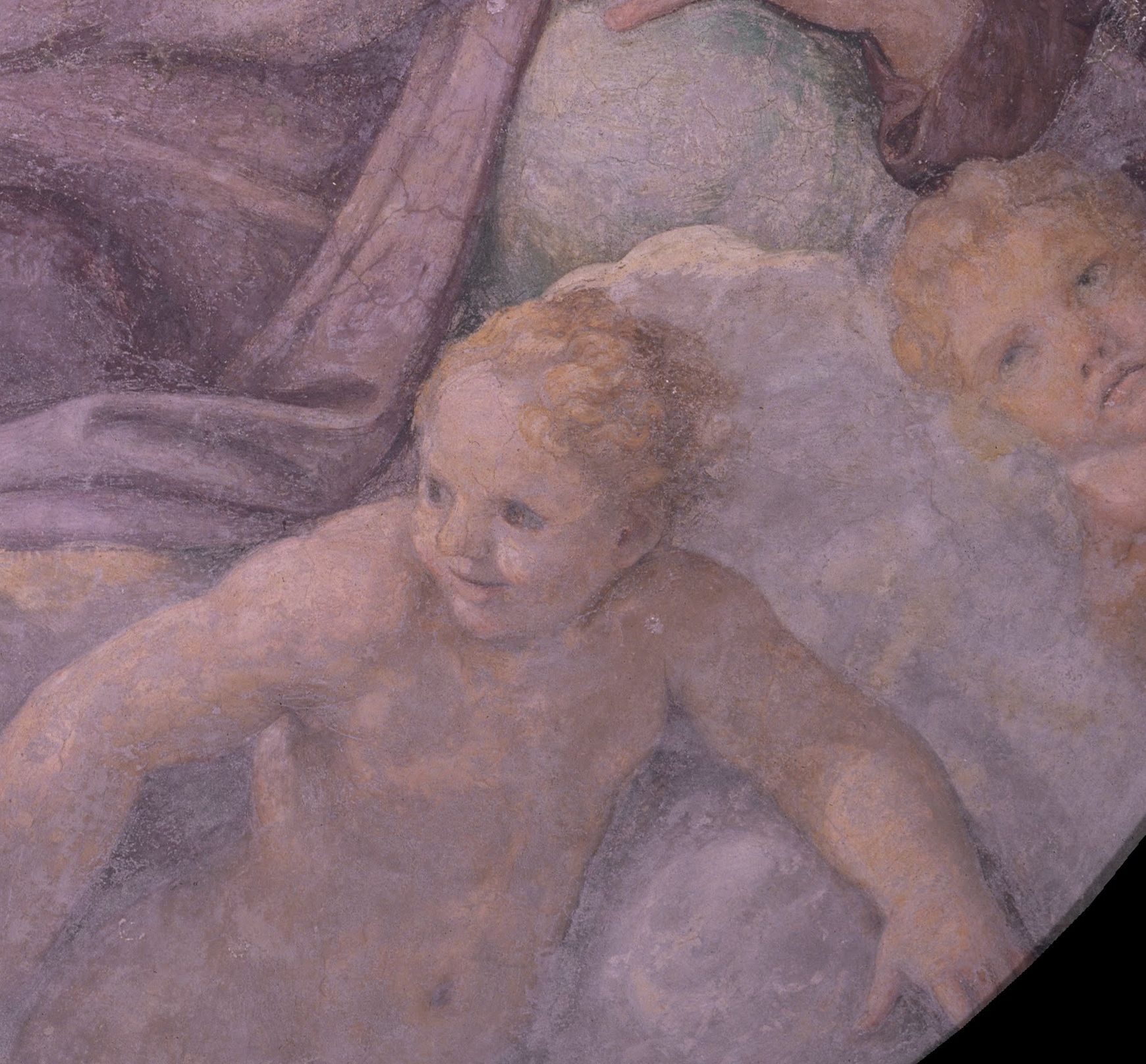
The figures below
The angled group below the Father follows the lower arc. Foreshortened limbs help make sense of an image originally seen from beneath.
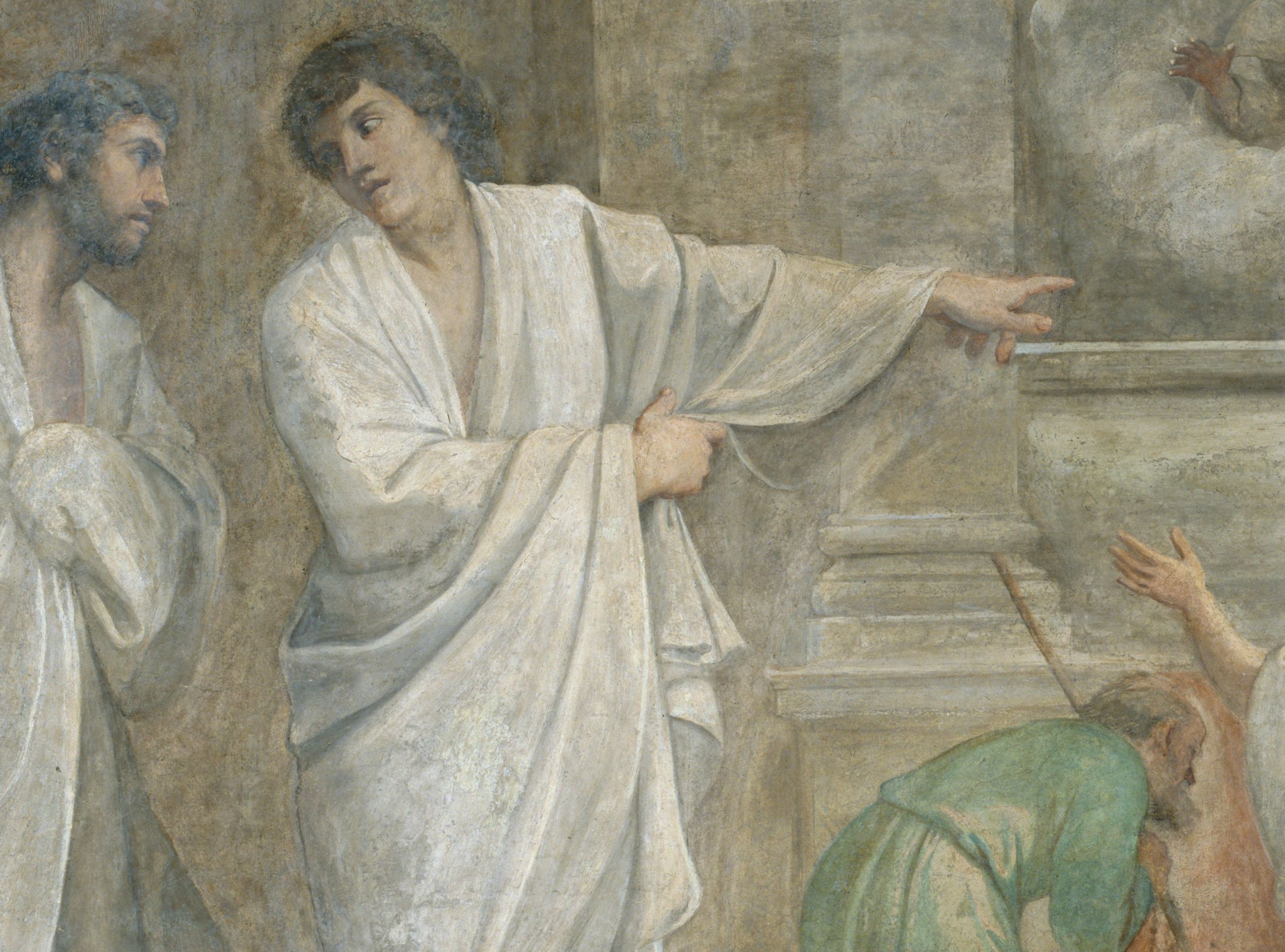
Apparition of Saint Didacus above His Sepulchre
The pointing figure at the tomb
The central figure in light drapery extends his arm towards the tomb. The gesture crosses the junction between the upright group and the devotees leaning forward.
The kneeling figures
Several people turn and kneel along the right half of the lunette. Their backs and sleeves describe a shallow space in front of the sepulchre.
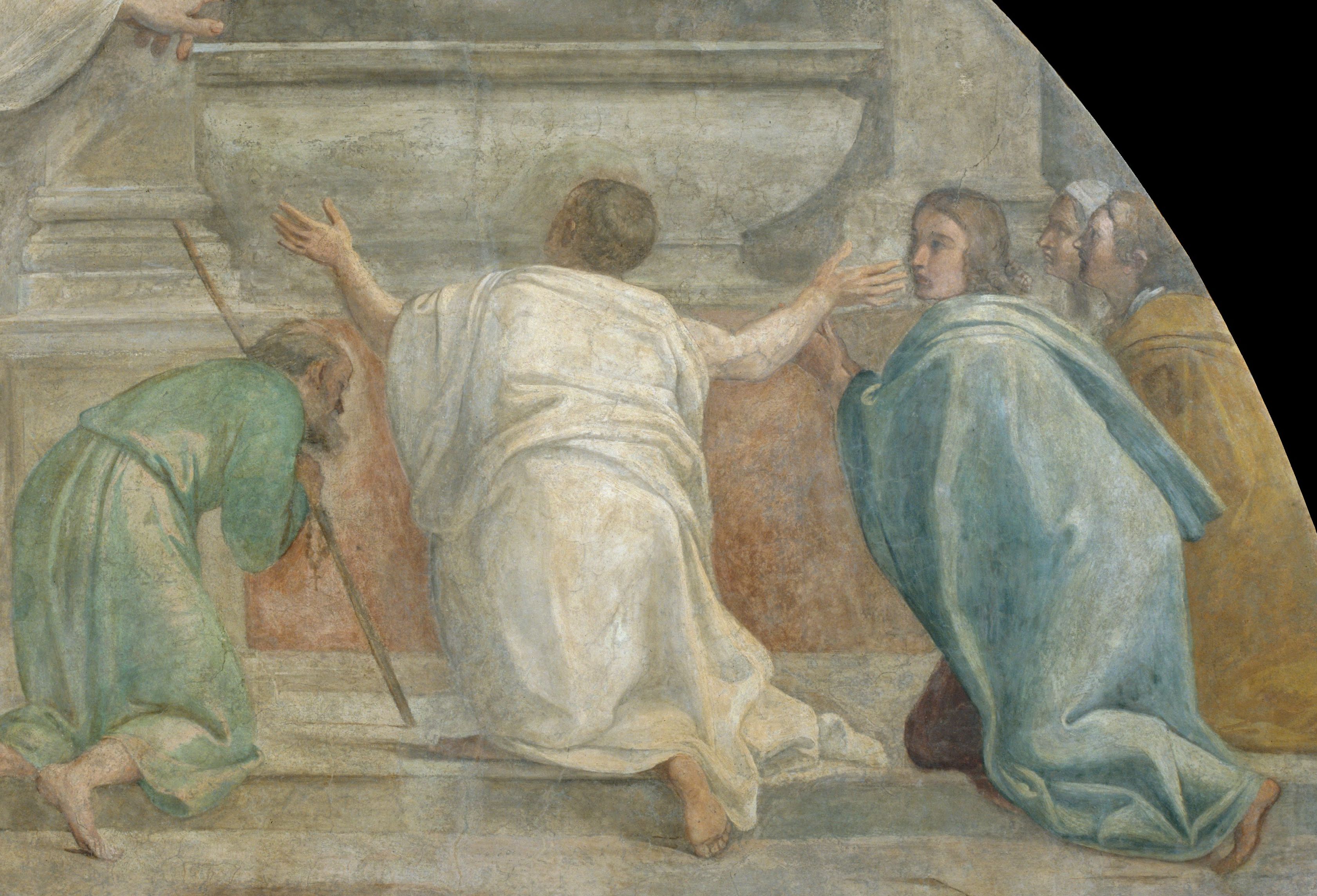
Apostles around the Empty Sepulchre
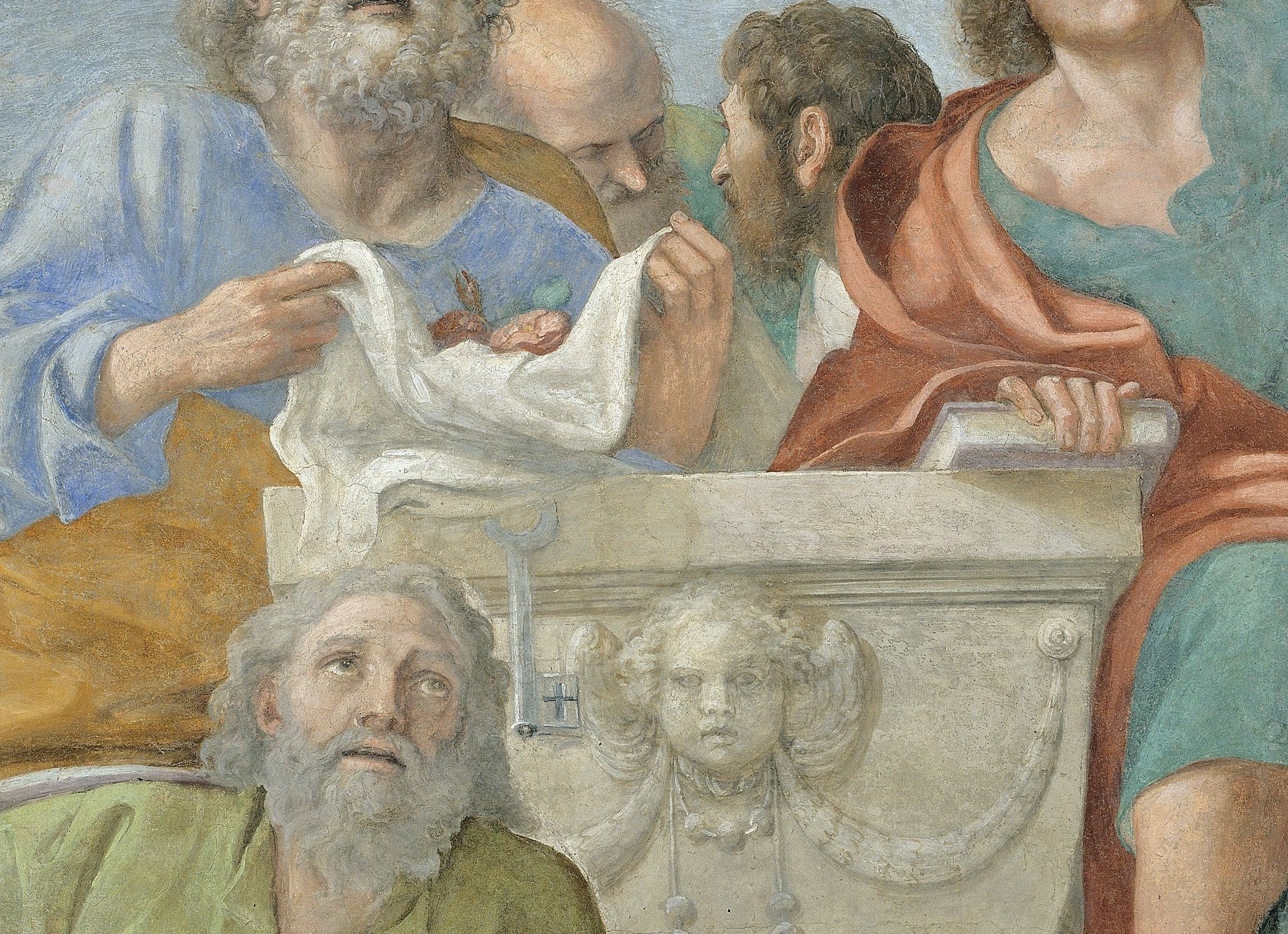
Over the empty sepulchre
Figures at the front hold a white cloth and lean over the central stone tomb. Their hands give the opening a clear position beneath the ascending gestures.
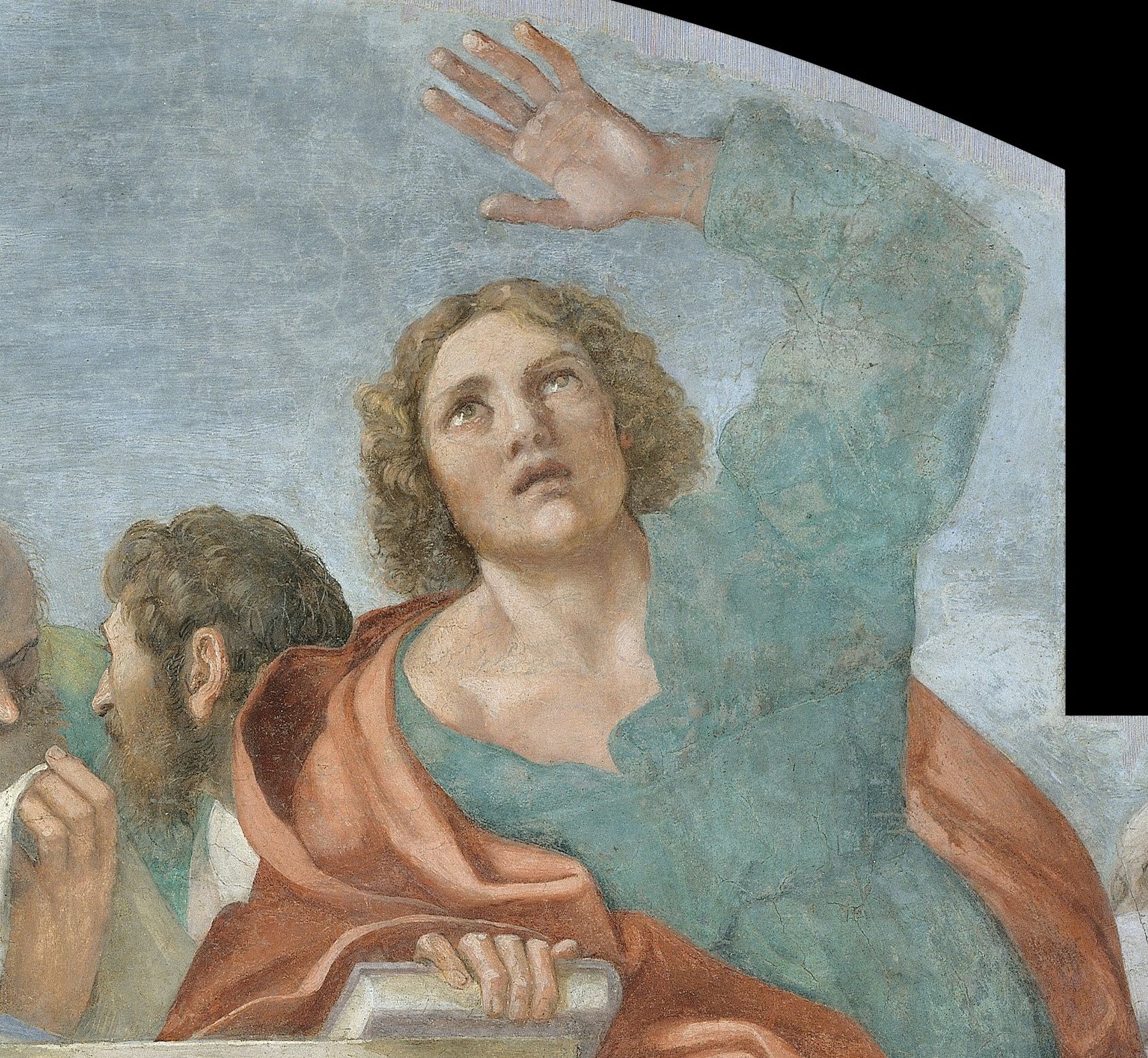
A hand in the upper arc
A raised hand reaches into the shallow curve at the top. The viewer can follow the upward direction before seeing the lower part of the scene.
Looking up from the church aisle
The upper Assumption of the Virgin occupies a rounded field a little over two metres high. The Apostles around the Empty Tomb of the Virgin below it is broader, and the archway cuts into its lower edge. The tomb stands on steps, with the apostles moving around it in response to the absence of Mary’s body. Peter holds the burial cloth, with his keys visible in the foreground. In the upper picture Mary appears among angels and clouds, high above the group that is still searching for her below. [1] [5] [6]
The two frescoes date from around 1604–05. The 2022 exhibition credited both Carracci and Albani with the Assumption. Its curators described Albani as the painter of the Apostles, although the exhibition checklist credited both men, recognising Carracci’s part in the project. The surviving studies include drawings of John the Evangelist and of two other apostles assigned to Carracci in the exhibition. The Royal Collection catalogues another sheet, of a single apostle, under Carracci’s name. The exhibition checklist placed it in his workshop. Black chalk establishes the folds of the standing figure’s robe, while white picks out the light against blue paper. A painting largely executed by Albani can preserve decisions developed at Carracci’s drawing table. [1] [7]
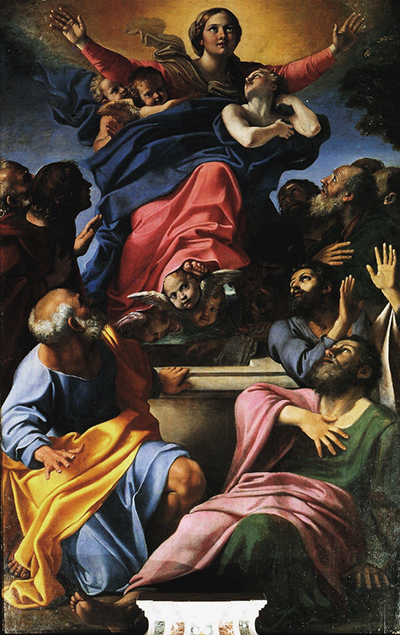
Carracci’s earlier treatment of the Assumption of the Virgin in the Cerasi Chapel at Santa Maria del Popolo brings Mary and the apostles together in one altarpiece. At the Herrera Chapel the two registers were far enough apart for viewers to take in the apostles’ discovery, then raise their eyes to see Mary. [1] [6]
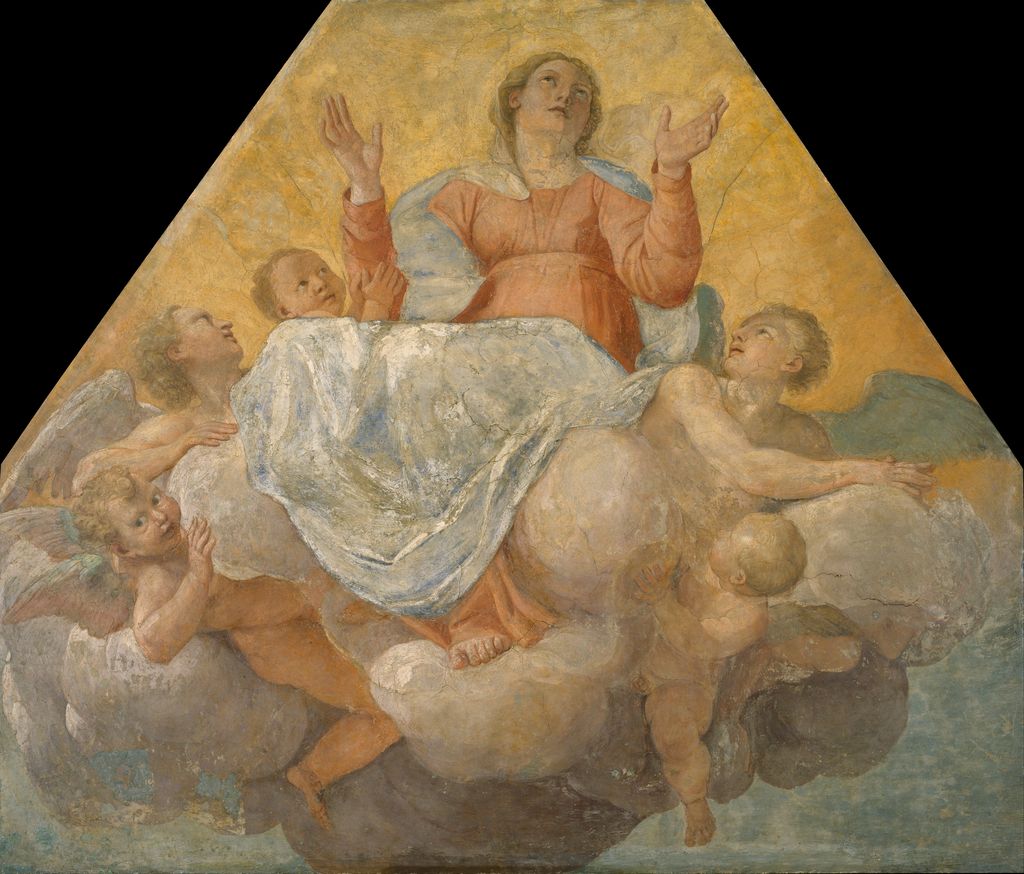
Annibale Carracci and Francesco Albani, Assumption of the Virgin from the Herrera Chapel. Museu Nacional d’Art de Catalunya, 005676-000. Image source. Public domain.
Miracles on the walls and the plea at the altar
Two scenes almost three metres high occupied the lower parts of the side walls. In Saint Didacus Healing a Blind Youth, Didacus holds a lamp in one hand and applies its oil to the boy’s eyes with the other. The boy’s upturned face gives the gesture a clear focus amid the crowd. Across the chapel, the Miracle of the Roses shows the friar displaying flowers in the folds of his habit. In the saint’s legend, the loaves he had been carrying for the poor turned into roses when he was challenged. The convent loggia and entrance place the encounter where the friar carried out his daily duties. The 2022 exhibition credited both wall paintings to Albani. An earlier account also records a claim by Domenichino that he helped paint part of the convent backdrop in the Roses. That contribution remains disputed. [1] [5] [6]
Above these larger vertical pictures were two lunette paintings, each close to 3.75 metres wide. Sisto Badalocchio is credited with Saint Didacus Preaching, above the healing of the blind youth. Early accounts say Albani retouched Badalocchio’s work after the plaster had dried. Giovanni Lanfranco is credited with the opposite lunette, Apparition of Saint Didacus at His Sepulchre, above the Miracle of the Roses. A kneeling pilgrim seen from behind gives the viewer a position from which to look towards the saint and the tomb. A black-chalk study for that figure, heightened in white on blue-grey paper, is attributed to Lanfranco. The pair of lunettes shows Didacus addressing listeners during his life and appearing to pilgrims after his death. [1] [5] [6]
At the far end, the altar painting made the family’s particular appeal explicit. In Saint Didacus of Alcalá Interceding for Diego Enríquez de Herrera, the friar kneels with the young Diego and places a hand on him as he appeals to Christ above. The portrait brings the patron’s son into the chapel’s governing image. His kneeling figure and Didacus’s raised gaze carry the scene from the ground towards Christ, seated on clouds in a field of golden light. The panel is oil on wood and usually dated about 1606. The 2022 checklist gave it to Annibale Carracci with help from members of his circle, leaving the exact division of work open. The two frescoes of Peter and Paul once stood to either side. Each is about 2.35 metres high and less than a metre wide. Their proportions suit the strips of wall flanking the altar. The same exhibition assigned each to Albani or Lanfranco. [1] [3] [6]
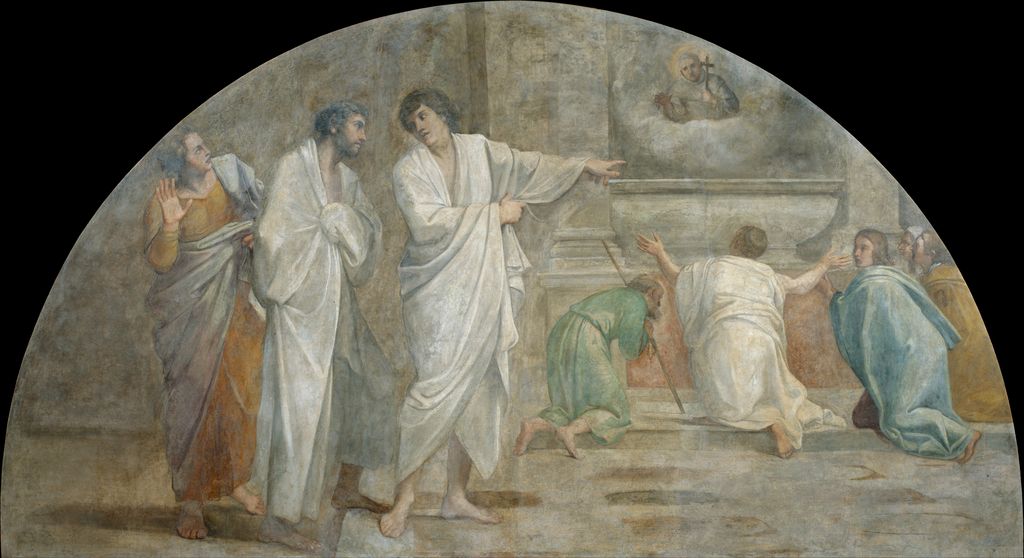
Apparition of Saint Didacus above His Sepulchre, credited to Giovanni Lanfranco in the 2022 exhibition of the Herrera Chapel cycle. Museu Nacional d’Art de Catalunya, 024285-000. Image source. Public domain.
From the corner saints to the lantern
Above the walls, four oval saints occupied the pendentives, the curved triangular surfaces that carry the dome over the corners of the room. Of the three surviving ovals, the 2022 exhibition attributed Saint Lawrence to Annibale and Saint James the Greater to Albani. The curators identified Carracci’s hand in Saint Francis, which the checklist credited jointly to Carracci and Albani. The fourth oval, Saint John the Evangelist, is missing. An Annibale study for Saint Lawrence, drawn in black chalk with white highlights, survives in the Royal Collection. [1] [6]
Four trapezoids, each about 1.25 metres high and 2.2 metres wide, occupied the vault. Their slanting sides adapted the pictures to the curved space overhead. In Saint Didacus Receives Alms, the young saint asks for help beside a poor dwelling. In The Miraculous Meal, food appears to Didacus and another friar in an open landscape. According to the legend, the two travellers find a cloth laid out with food on the ground. The other two scenes use buildings to bring the figures together. The friars gather around the kneeling Didacus as he receives his habit. The oven gives the rescue scene its focus as Didacus saves a child who has fallen asleep inside. The rescue of another child gives the overhead narrative a point of contact with the Herrera family’s own story. [1] [6]
The small dome capping the lantern held God the Father. Albani painted the scene, which the exhibition identified as probably the first fresco executed in the chapel. The figure extends his arms into the surrounding clouds. The painted surface is still concave, about two metres across and more than half a metre deep. That depth mattered when the conservators examined how the detached fresco had been mounted. At the Louvre an ink-and-wash study attributed to Albani preserves an earlier design for the whole composition. Its arrangement differs enough from the fresco for the museum to identify it as a working study. [1] [5] [8]
How Carracci and Albani worked together
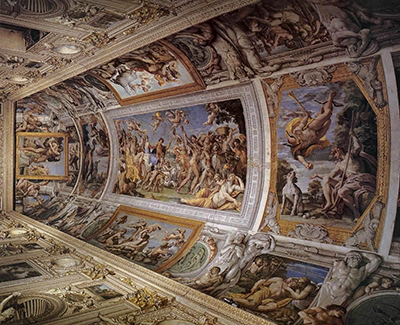
Carracci came to the commission after his work at the Farnese Palace, where The Loves of the Gods had also required him to plan paintings around the architecture. Work on the Herrera frescoes began in 1604, with Albani assisting from the start. The workshop painted inside the chapel first, turned to the entrance frescoes and then returned to the interior. The reason for that interruption is uncertain. The curators suggested that painters may have had to share the tight space with other trades. Late in 1604 or early in 1605, while the Assumption was under way, Carracci suffered a serious illness. The illness ended Carracci’s sustained work on the scaffold. Albani took over the direction of the painting, and the workshop finished around 1606. [1] [2] [3]
A fresco painter spreads only as much finish plaster as can be worked while it remains damp. The area prepared for one session is called a giornata. The joints between areas can survive as slight edges or lines in the surface. The 2022 curators counted five in the Assumption, eight in the wider Apostles and six in the Miracle of the Roses. Each trapezoid in the vault has a vertical joint dividing two working areas. The curators proposed that Albani laid in skies, landscape, vegetation and architectural details, with Carracci possibly working on principal faces and hands or making final adjustments. The seams show where the fresh plaster ended. Identifying the person who painted on either side also depends on drawings, documents and the surviving paint. The count gives the scale of the work at the wall, with further time required for planning, drawing and setting up the scaffold. [1]
Preparation could pass between the two artists even for the same patch of wall. A sheet in Stockholm for The Miraculous Meal uses brownish-grey ink and wash over black chalk. Nationalmuseum lists both Carracci and Albani in its artist fields and connects the design with the Prado fresco. The Städel’s rapid pen drawing for the robing of Didacus, attributed there to Carracci, lays out the surrounding architecture in a few marks while the friars cluster around the candidate. The Louvre gives its composition study of Saint Didacus Receives Alms to Albani, while the 2022 exhibition linked a much earlier black-chalk study by Carracci to the donor in the fresco. The workshop could use a pre-existing figure study alongside a design made for the chapel. [1] [9] [10] [11]
The chapel’s drawings preserve choices about poses, figure groups and architecture before the plaster went on. The exhibition compared Carracci’s organisation of the work to Raphael’s practice of keeping charge of the overall design while entrusting execution to trained collaborators. Some passages of paint are difficult to assign because of damage, early retouching and later restoration. [1] [3]
Prints and the three missing frescoes
In 1646 Simon Guillain etched the Vita di San Diego after the chapel paintings. Examples are held at the Albertina in Vienna. One sheet in its collection includes both the apostles at Mary’s empty tomb and Didacus healing the blind boy. The series also records the subjects of the three missing frescoes. Saint John the Evangelist occupied the missing pendentive, while Saint Jerome and Saint John the Baptist flanked the window above the altar. The etchings preserve the forms of those scenes in monochrome. The funeral books supply another piece of evidence, showing where the paintings sat in relation to the entry, walls and altar. [1] [6] [12]
How the frescoes reached Barcelona and Madrid
By 1731 the paintings already needed attention. The Italian painter Sebastiano Conca restored them, and the church continued to deteriorate. It was deconsecrated in 1818. In 1833 the removal of the paintings was entrusted to Pellegrino Succi, who worked on them between 1833 and 1835. He used a method called stacco, taking away the painted surface together with some of the original plaster. The paint face was protected with cloth while the layers were freed from the wall. The backs were then levelled and attached to a new canvas support. The Barcelona conservators identified a single hemp canvas on the works they examined. [2] [13]
The curved God the Father needed a different treatment. Conservators propose that the detached painting was placed face down in a matching mould while its back was prepared. Eight triangular pieces of canvas fit its curve, joined along the seams by strips of the same material. The piece also retains the wooden support made for it in Rome, with curved ribs and textile ties that hold the canvas in place. Some of those ties were replaced in 2019. For the flat murals in Barcelona, the wooden stretchers were replaced at a later date with rigid supports. [13]
Analysis of tiny cross-sections has made it possible to separate the original work from the layers added during the transfer. In samples from the chapel, Núria Oriols of the Museu Nacional identified pigments including lead-tin yellow and green earth. Blue smalt retained its colour in the calcium carbonate of the fresco. Behind the original paint and plaster, tests detected casein and collagen in Succi’s transfer mortar. The laboratory associated the collagen with animal glue and proposed that milk supplied the casein. The samples lacked the phosphate deposits that would have pointed to cheese, an ingredient in some later mural transfers. [14]
The sculptor Antoni Solà coordinated the rescue and subsequent transport. By 1839 the detached frescoes were in his Roman workshop, where losses had been treated. In 1850 sixteen of the nineteen detached murals went by ship from Civitavecchia to Barcelona in three crates. The nine larger works remained with the Barcelona academy, where they formally entered in 1851. The seven smaller frescoes went to Madrid by way of the Museo de la Trinidad and are now at the Prado. Eight of the Barcelona paintings entered the then Museu Municipal on long-term loan in 1906. The curved lantern fresco joined them for display at Montjuïc by 1934. The other three murals stayed in Rome at Santa Maria in Monserrato degli Spagnoli, where they have yet to be located. The altar panel survives at that church. [1] [3] [5] [13] [15]
Seeing the paintings together again
Barcelona’s restoration campaigns began in 1992. The Prado’s restoration of its seven works allowed the museums to study the two groups side by side and bring the sixteen surviving frescoes together with the Roman altar panel. The joint exhibition opened at the Prado in March 2022, travelled to the Museu Nacional d’Art de Catalunya that summer and reached Palazzo Barberini in November, where it ran into February 2023. Palazzo Barberini built a structure to the proportions of the original chapel and placed the paintings in their reconstructed sequence. In November 2025 the Prado presented a permanent installation that returned its frescoes to an elevated position in a reconstruction of the vault. [1] [3] [16] [17] [18]
Lifted into the vault, the slanting edges of the four trapezoids follow the contours of the architecture. The two lunettes turn towards each other from opposite walls, and the oval saints sit below the stories of Didacus. The chapel could be read through those changes in level. The visitor looked up to find Mary above the empty tomb and, from the boy’s portrait at the altar, followed Didacus’s gaze up to Christ. [1] [3]
Artworks directory
Paintings, frescoes, drawings and prints, with separate entries for documented versions and collaborative projects.
Discussion
Look again at the images and ideas explored in The Herrera Chapel Frescoes. These editorial prompts invite your observations.
Reader Insights
What changes when you see a detached fragment in its proposed original position?
Which fragment best helps you distinguish the programme’s design from its execution?
Join the Conversation
Share a detail, comparison or question about The Herrera Chapel Frescoes below.
References
- Museu Nacional d’Art de Catalunya, Museo Nacional del Prado and Palazzo Barberini, 2022 exhibition dossier, reconstruction and checklist View source.
- Museu Nacional d’Art de Catalunya, The Carracci Chapel View source.
- Gallerie Nazionali di Arte Antica, Herrera Chapel exhibition dossier and gallery texts View source.
- Museo Nacional Thyssen-Bornemisza, Gaspar van Wittel, Piazza Navona, Rome View source.
- Museu Nacional d’Art de Catalunya, Herrera Chapel group collection record View source.
- M. Assumpta Roig i Torrentó, study of the Herrera Chapel frescoes, Universitat de Girona View source.
- Royal Collection Trust, An Apostle, RCIN 902104 View source.
- Musée du Louvre, Albani, The Eternal Father Blessing the Universe, INV 6827 View source.
- Nationalmuseum, A Meal Miraculously Appearing to St. Diego and a Companion, NMH 952/1863 View source.
- Städel Museum, Franciscan Habit Is Put on Saint Diego, 4049 View source.
- Musée du Louvre, Albani, Saint Didacus Receives Alms, INV 8002 View source.
- Albertina, Simon Guillain’s 1646 prints after the Herrera Chapel frescoes View source.
- Museu Nacional d’Art de Catalunya, Paz Marquès on the detachment, transfer and transport to Spain View source.
- Museu Nacional d’Art de Catalunya, Núria Oriols on the microscopic analysis of the frescoes View source.
- Museu Nacional d’Art de Catalunya, Annibale Carracci topic guide and the collections’ provenance View source.
- Museu Nacional d’Art de Catalunya, 2022 exhibition overview View source.
- Gallerie Nazionali di Arte Antica, Annibale Carracci. The Herrera Chapel Frescoes View source.
- Museo Nacional del Prado, 2025 installation of the Herrera Chapel frescoes View source.