 by Tom Gurney
Tom Gurney BSc (Hons) is an art history expert with over 20 years experience
Published on June 19, 2020 / Updated on November 29, 2026
Email: tomgurney1@gmail.com / Phone: +44 7429 011000
The Loves of the Gods and the Farnese Gallery: Introduction
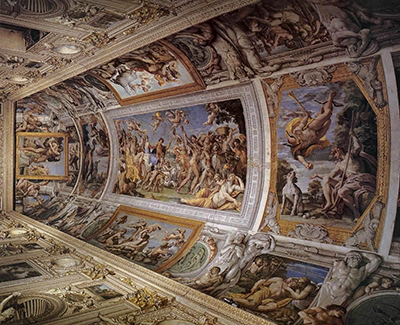
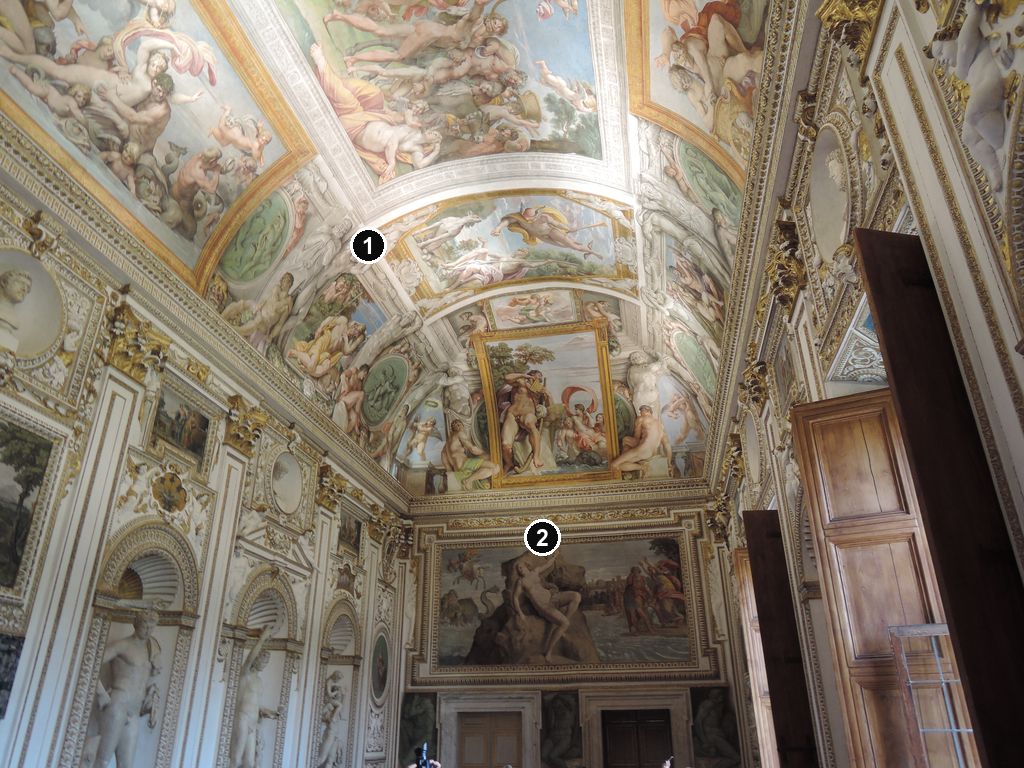
In the Farnese Gallery in Rome, the easiest place to lose your bearings is where the wall meets the ceiling. A gilded frame seems to rest on the cornice. Beside it, a seated youth appears to lean out from a stone support. Behind him is what looks like an ancient bronze relief. All three are painted. Below them, real pilasters and niches once framed some of the Farnese family’s finest ancient sculptures. Annibale Carracci built the illusion on the room’s actual architecture. On the vault, stories unfold in gilt frames and imitation bronze, watched by figures who seem to have climbed into the display. [1] [2] [3]
The title The Loves of the Gods fits the scenes of pursuit, persuasion and celebration overhead. It also leaves room for the jokes surrounding those scenes and for the ways their stories contradict one another. As you walk the length of the room, the besotted Polyphemus gives way to a furious giant, a mortal refuses the goddess of dawn, and Jupiter proves susceptible to a scheme devised by his own wife. The wedding procession in the middle gives the ceiling a ceremonial centre. Around it, the gods and their lovers repeatedly lose their footing, their dignity or their ability to choose. [1] [3]
At a Glance
- ArtistAnnibale Carracci and collaborators
- DateFrom the late 1590s
- MediumFresco with dry retouching
Contents
- The cardinal’s gallery
- How the ceiling changes as you move
- A marriage bed and a jealous giant
- Agostino’s two scenes across the room
- From the whole vault to a patch of plaster
- The walls after the vault
- The wedding and other ways of reading the room
- What restoration brought back into view
- How the gallery travelled
- Annotated details
The cardinal’s gallery
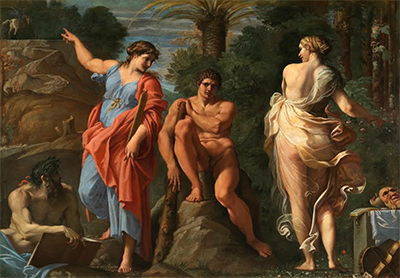
Cardinal Odoardo Farnese commissioned two very different interiors from Annibale. The Louvre places Annibale’s first visit to Rome in 1594 and the National Gallery dates his move there to the following year. His first painted room in the Palazzo Farnese was the Camerino, a small study and retreat whose heroic examples included the Choice of Hercules. Its young hero has a decision to make, and the alternatives invite sustained reading in an intimate room. The Gallery, begun in 1597, spreads its incidents across a space the viewer has to cross and turn in to see. Agostino Carracci joined his younger brother for the Gallery in 1597 and left in 1600. [1] [4]
The gallery occupies the palace’s principal floor on the garden side. Its barrel vault extends about twenty metres over a room roughly six metres wide. Antique standing figures occupied six niches along one long wall and four along the other, where there were also windows. Busts had places of their own nearer the cornice. The antique display is documented, while the room’s precise function remains open. The Capitoline Museums point to three keyboard instruments recorded there in a 1644 inventory, evidence for music in the room at that date. Their account also records a mirror on wheels, which would have let viewers follow the decoration without continually tipping their heads back. [1] [2] [3]
Completion depends on which part of the room is in question. A public notice of 2 June 1601 records a brief opening of the gallery. The Louvre dates the unveiling of the vault to that year and puts the end of work on the walls around 1609. Conservator Alessandra Acconci records the years 1598, 1599 and 1600 marked on the vault. An account published by Roberto Zapperi records payment for taking down the painters’ staging by July 1602. The stucco accounts and work certificates place a separate phase on the walls in 1603. Annibale signed certificates for the stucco specialist Giacomo da Parma between May and September that year, and a separate receipt records Annibale’s expenditure on colours. [1] [3] [5] [6]
Annotated Details from The Loves of the Gods and the Farnese Gallery
The numbered points identify visible features discussed in this article. Return from each detail to the numbered overview. Each caption identifies the work shown.
The Farnese Gallery Interior
Interior of the Farnese Gallery, Palazzo Farnese, Rome. agennari. Image source. CC BY 2.0. Numbers added to a separate overview. Details cropped from the original photograph. Image derivatives use CC BY 2.0.
Jupiter and Juno in the Farnese Gallery
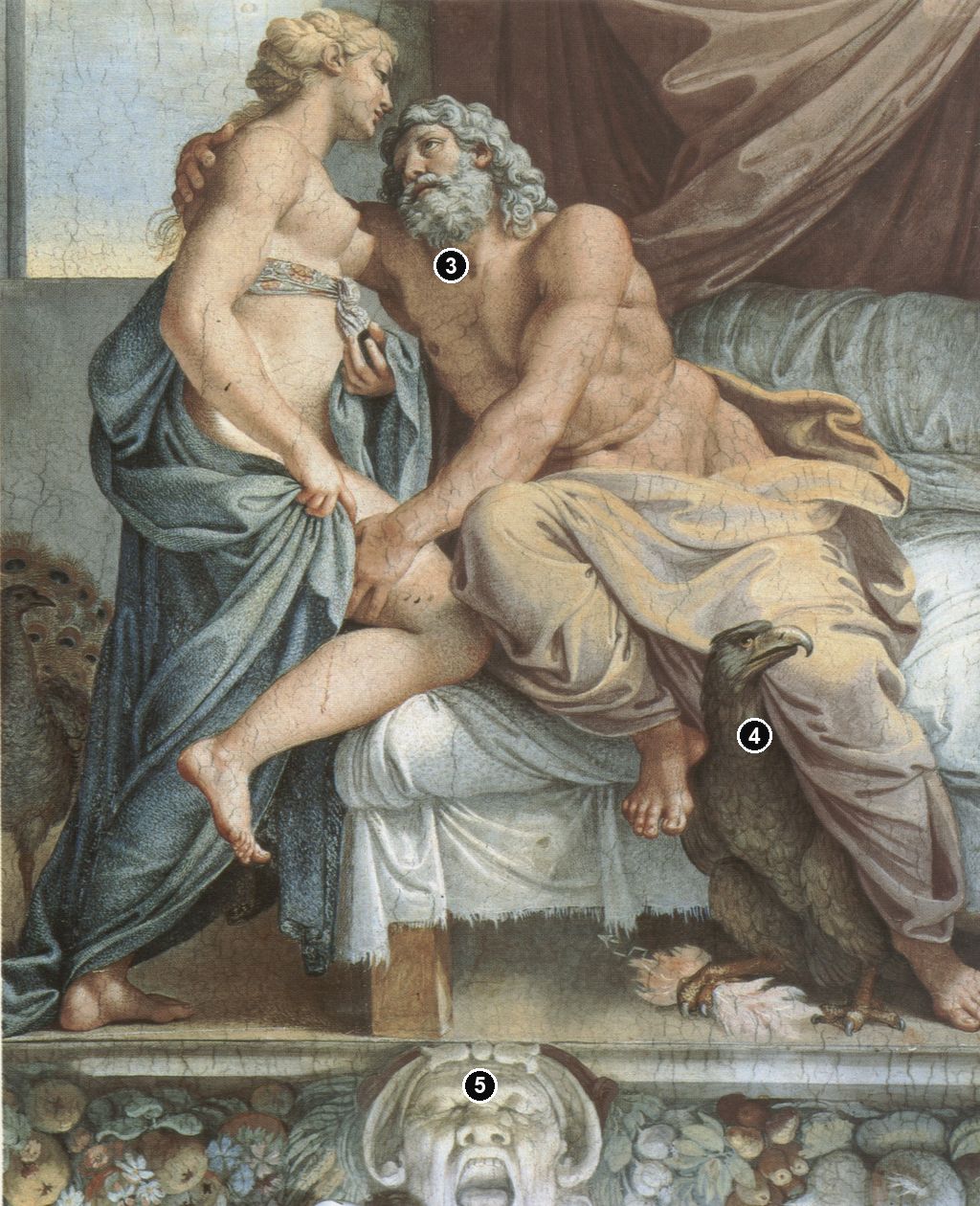
Jupiter and Juno, fresco in the Farnese Gallery, Palazzo Farnese, Rome. Image source. Public domain.
Details from THE LOVES OF THE GODS AND THE FARNESE GALLERY
Compare the cropped details with the source images above. Notice how their colours, shapes and positions contribute to the larger compositions.
The Farnese Gallery Interior
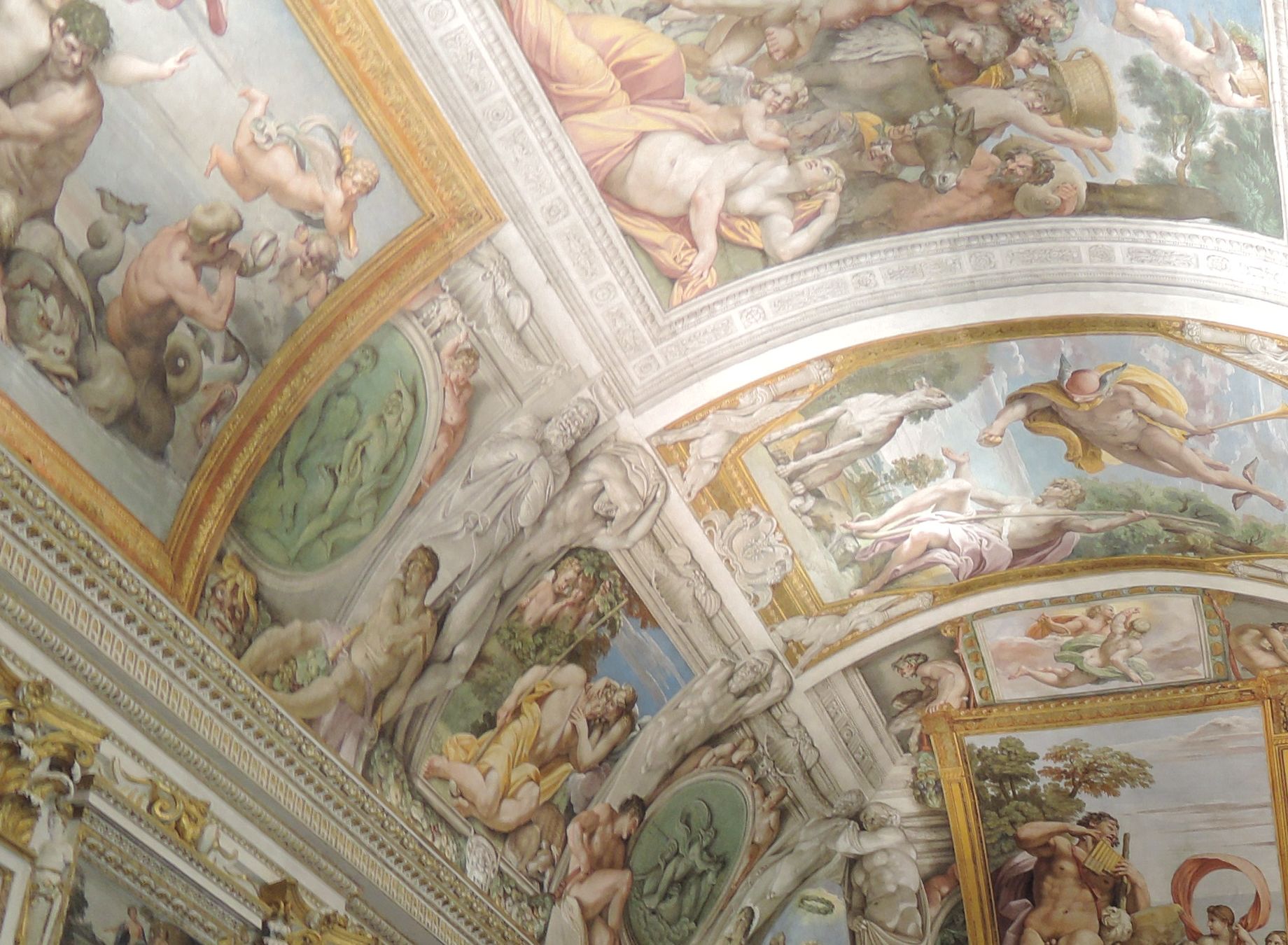
The curve where wall meets vault
The photographed corner shows fictive frames and painted figures following the spring of the vault. The upright mouldings and openings on the wall give a point of comparison for the painted architecture.
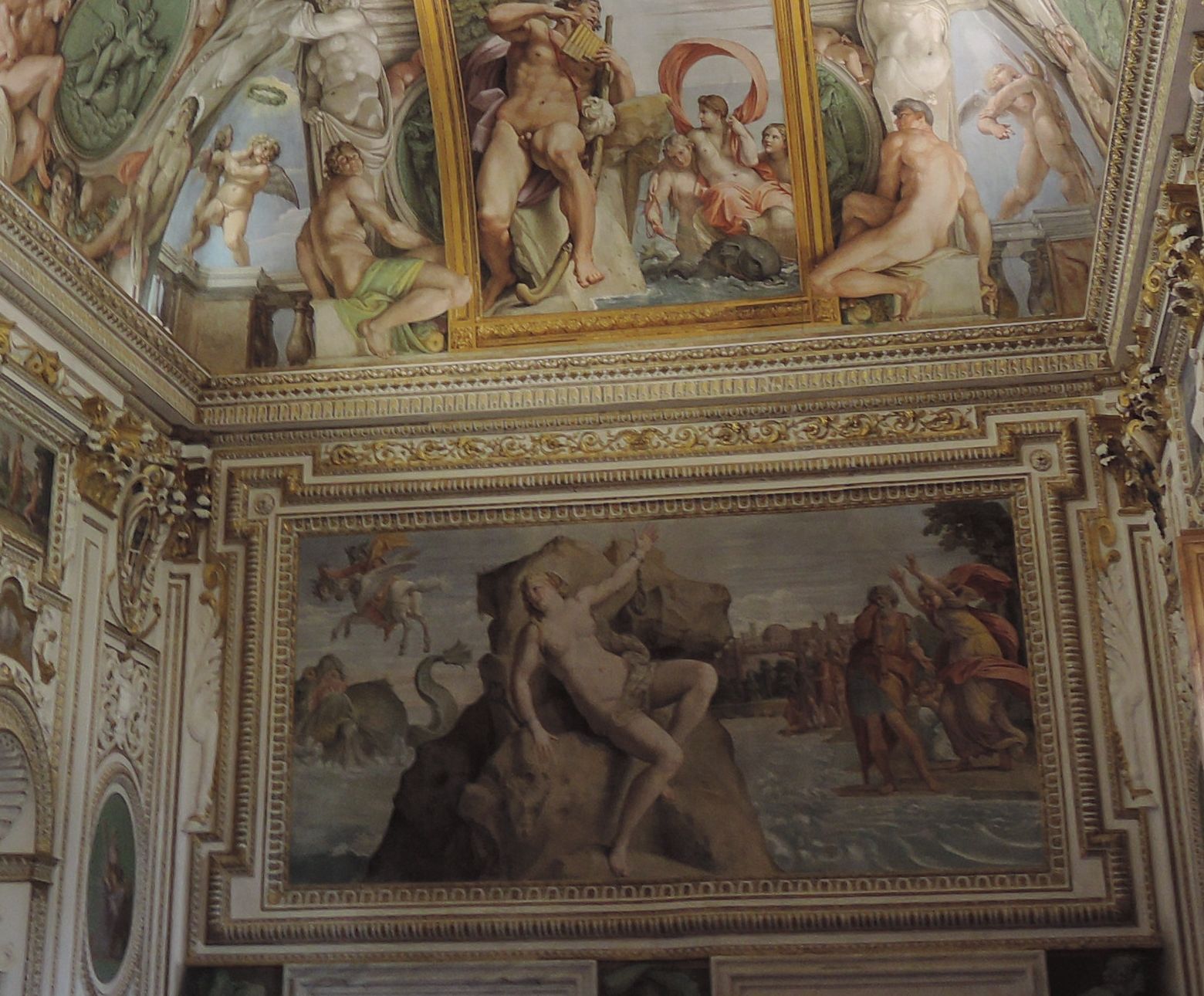
A framed scene on the end wall
One large scene reads as a framed field within the end wall. Painted framing and actual architectural boundaries compete for attention when seen from below.
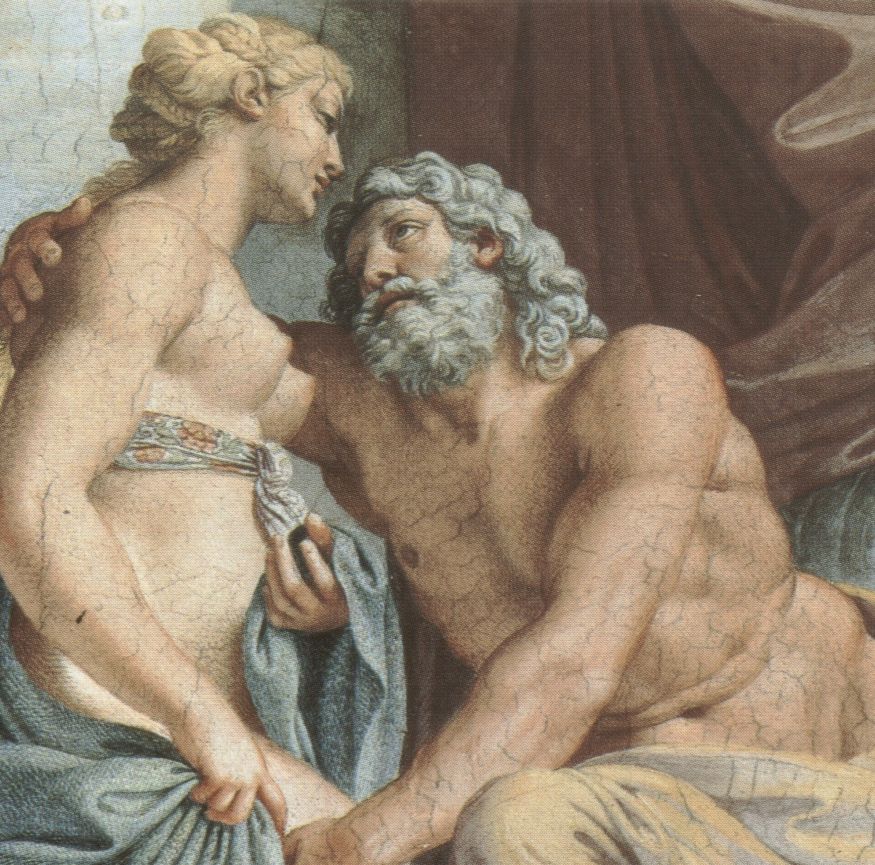
Jupiter and Juno in the Farnese Gallery
The gods turn towards each other
Juno stands while Jupiter leans forward from the bed. Their turned profiles create a compact exchange in the upper part of the field.
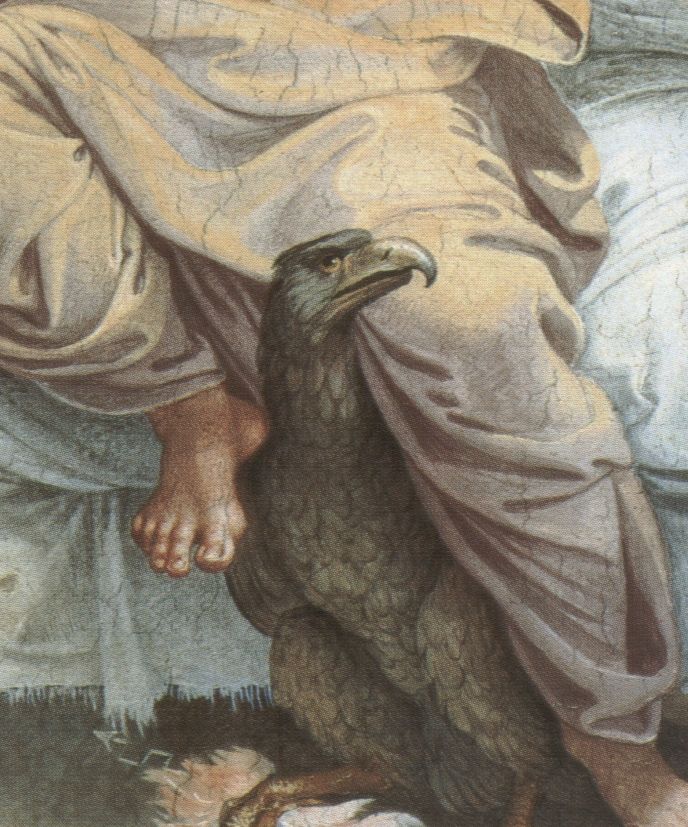
The eagle below Jupiter
The eagle’s beak and eye interrupt the folds near the edge of the bed. Its position lets the bird read as an attribute without breaking the pair’s encounter.
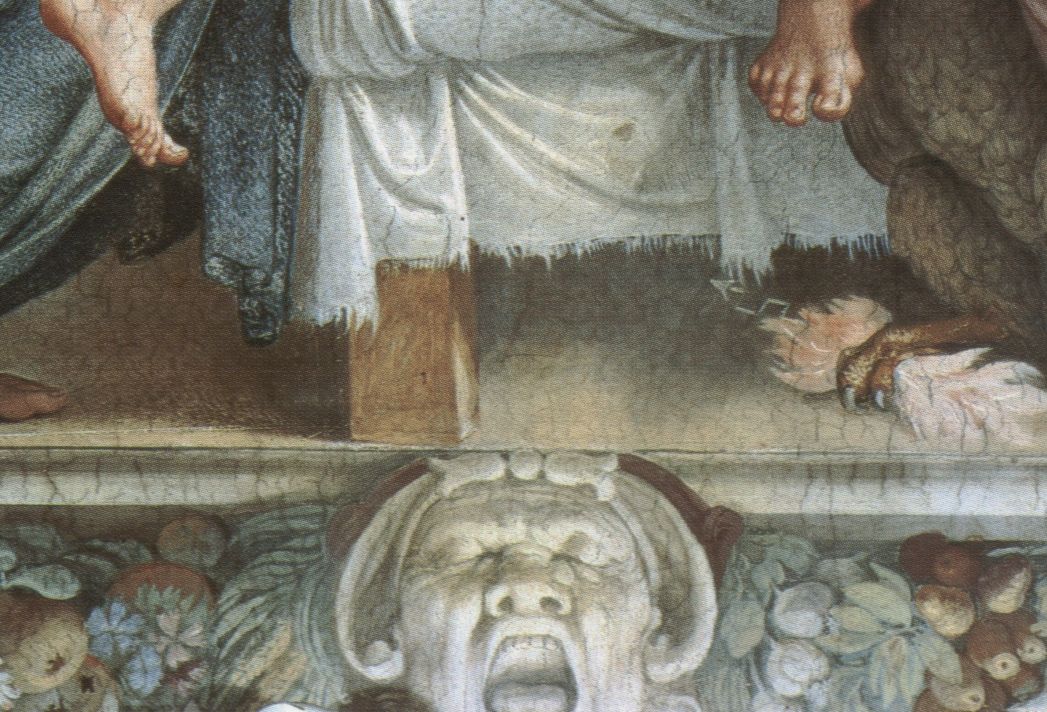
A face beneath the painted edge
A pale head appears below the horizontal border. The change in scale and colour separates the fictive decoration from the scene above.
How the ceiling changes as you move
Follow a pilaster up from the wall to the real cornice. Above it an apparent stone support takes over, with a human upper body rising from a squared shaft. These painted figures, called herms, make the upper cornice look as though it belongs to the architecture below. They are related in scale to the ancient statues once set into the walls. Moving sideways, you can follow that correspondence from one bay to the next, even while the bodies above begin to twist and look across their allotted spaces. [2] [3]
The depth changes with each kind of object. Smaller pictures sit back in the painted architecture, while the round bronze-coloured scenes project from it. The largest lateral and end pictures appear to have been lifted into position in projecting gilt frames on the actual cornice. These are quadri riportati, frescoes made to look like independent framed paintings. The sections overlap in ways a real installation might. A frame partly hides a medallion, while fruit garlands sag in front of both. At the ends, satyrs perch above the frames and look into an apparent space beyond them. The architectural illusion lets the comedy spill out of the mythological pictures and into their surroundings. [1] [3]
On the Sistine ceiling, Michelangelo had used painted architecture and seated nude youths, the ignudi, to mark intervals between pictures. The Farnese youths work within their own set of illusions. Their warm bodies sit against stone-coloured herms, and the garlands they carry pull the eye across bays. At the Villa Farnesina, Raphael and his workshop had staged a myth about desire in the Loggia of Cupid and Psyche, among festoons and alongside antique sculpture. In another room of the villa, Raphael’s Galatea and Sebastiano del Piombo’s Polyphemus show how different painters could make adjacent frescoes speak to one another. The Farnese Polyphemus stories make their connection across the longest possible distance in the room. [3] [7]
The Triumph of Bacchus and Ariadne lies high at the crown of the vault. Its broad horizontal procession fixes the centre of the long room. The two large frescoes on the vault above the midpoints of the long walls face each other across it, so from near the middle of the floor, a turn of the head takes you from the sea on one side through the land procession overhead to the goddess of dawn on the other. Charles Dempsey reads the placement as a movement through sea, land and air. The central train unrolls across a long field, while action in either side picture concentrates around an encounter. [2] [3]
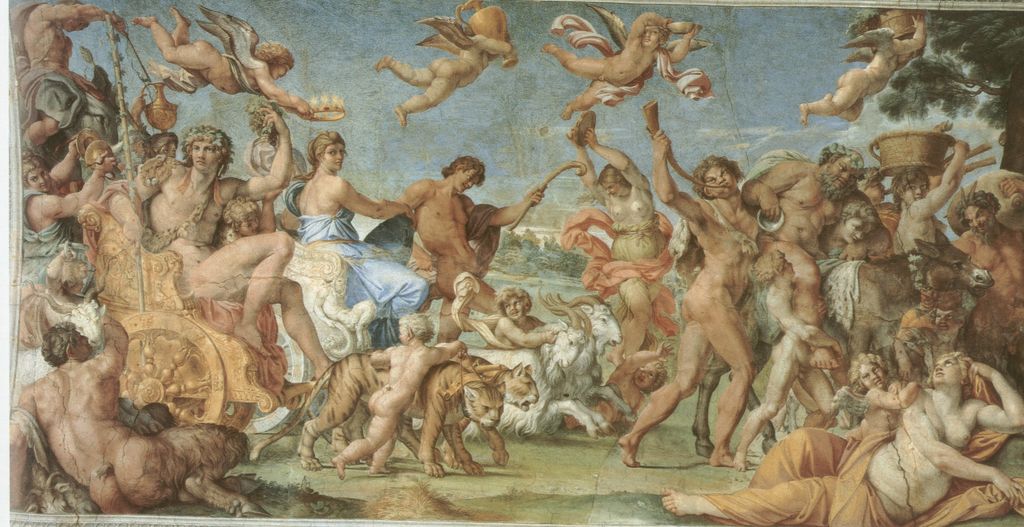
Annibale Carracci, The Triumph of Bacchus and Ariadne. Central field of the Farnese Gallery vault, Rome. Image source. Public domain.
A marriage bed and a jealous giant
In Jupiter and Juno, one of the smaller pictures on a long side of the vault, Carracci puts two large figures into a tight space. Juno leans in, and Jupiter is already giving ground. His thunderbolt has dropped below the bed near his eagle, which turns towards the viewer. The reversal is easy to read even from below. An insignia of office has become something the bird has to attend to while the ruler of the gods concentrates on his wife. The story comes from Homer’s Iliad. Juno borrows Venus’s power of seduction to distract Jupiter from the fighting at Troy. It brings a marital encounter into the cycle, with deception at the heart of it. [3]
At one end of the room, Polyphemus tries to charm Galatea with music. He dominates his rocky perch, but Galatea and her companions have room to move offshore. At the other end, scale becomes a threat. The giant turns to heave a boulder at Galatea and Acis, the small figures whose flight carries them towards the edge. You have to turn away from the first picture to see its consequences. In Ovid’s story the boulder kills Acis, who becomes a stream. Carracci stops before it lands, at the moment when the lovers still have space to run. Dempsey also draws attention to Philostratus’s description of a painting of Polyphemus in love, where an attempt at tenderness still betrays the giant’s animal nature. [3] [6]
Two later sheets in the Louvre preserve different sides of that story. Its anonymous seventeenth-century red-chalk Polyphemus and Galatea copies the end picture with the lovesick giant. Polyphemus Pursuing Acis and Galatea, a pen and wash drawing associated with Michel II Corneille, takes its subject from the violent scene opposite. The sheets reveal what other artists chose to carry away from the gallery. The distance that gives the pair its force in the palace collapses to the distance between two leaves of paper. [8] [9]
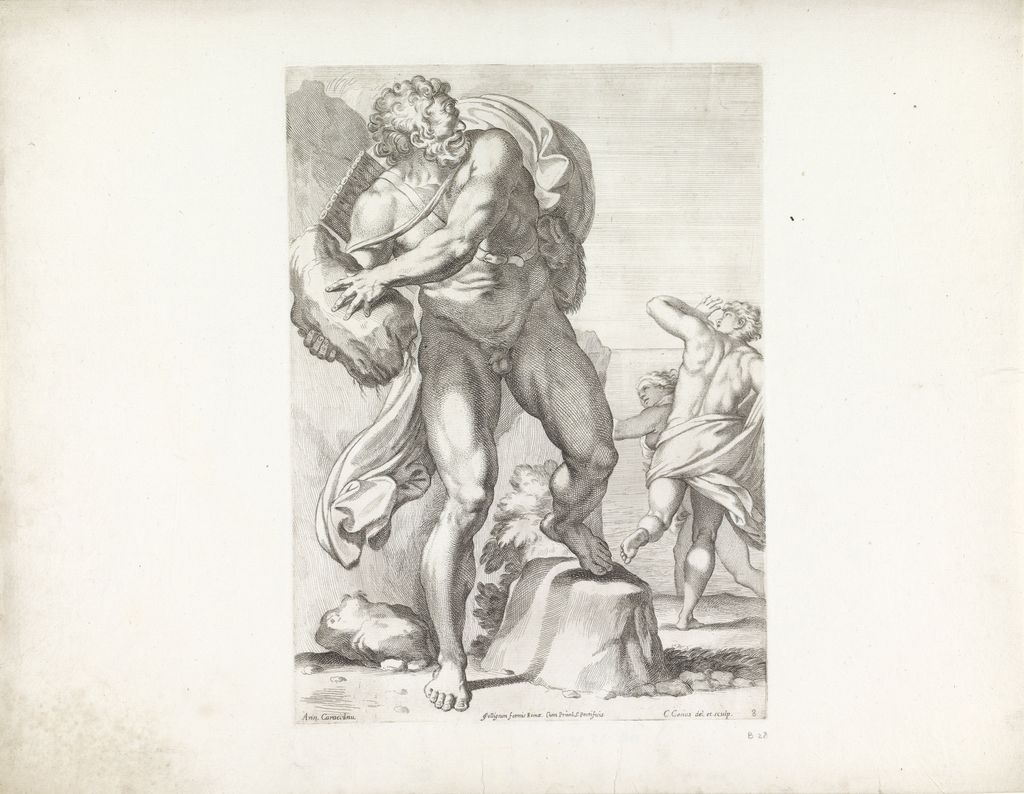
Carlo Cesio after Annibale Carracci, Polyphemus Throws a Rock at Acis, 1656. Rijksmuseum, RP-P-OB-35.901. Image source. CC0 / Public domain.
Agostino’s two scenes across the room
The National Gallery in London owns the two surviving full-size working drawings, or cartoons, for the large side pictures. Each is about two metres high and four metres across. The cartoons are charcoal drawings with white highlights on blue-grey paper. Overlapping sheets bring each to the scale of its fresco. The finished scenes remain on the plaster vault in Rome. In the Gallery’s architectural fiction, their broad frames seem propped on the cornice opposite one another. Set across from one another, they invite a comparison between two figures being carried off. [10] [11] [12]
In Cephalus Carried Off by Aurora in Her Chariot, the goddess presses the hunter towards the chariot while he pulls away. A spear and a hound in the foreground identify the mortal as a hunter. Cupid scatters petals above the figures. The old man asleep at the other end might be Tithonus, Aurora’s aged husband, or, in the National Gallery’s account, Oceanus at the place where dawn rises. The story in Ovid gives the hunter a reason for his refusal. He loves Procris. The National Gallery considers Agostino largely responsible for the drawing and the related painting, while entertaining the possibility that the dog was Annibale’s contribution to the design. [10]
The facing scene crowds marine figures around a woman borne by a sea god. A conch-blowing Triton at the right and a sea nymph at the left reach into the picture’s outer space, while Cupid aims into the central group. The woman’s arm, which once rested on the sea god’s shoulder in the cartoon, was raised in the course of drawing. A putto riding a dolphin has two positions for its head on the same sheet. The woman arches back against her companion’s arm. Her identity remains unsettled. The Getty has used Thetis Carried to the Bridal Chamber and lists Glaucus and Scylla among the alternatives. The National Gallery retains a question mark in A Woman Borne Off by a Sea God (?). The changes of pose help us see how the group was composed, while Cupid, dolphins and a Triton leave more than one story available. [11] [13] [14]
From the whole vault to a patch of plaster
Annibale had to decide how much a viewer could take in at once, long before the life-size figures were drawn. An early overall study in the Louvre, INV 8048 recto, lets you see him working on that problem. Long filed under the Carracci school, it was assigned to Annibale by Catherine Loisel. Silvia Ginzburg sees a frieze-like scheme in this early design, informed by Bolognese ceiling painting, alongside framing devices the Carracci had encountered in Rome. The finished ends, where the satyrs look into a painted recess above the frame, preserve something of the sharply foreshortened view from below that the brothers had explored in their sketches. [15] [16]
In the Royal Collection’s RCIN 902165, dated 1598, pen, wash and chalk work out parts of the decorative framework on a sheet only thirty-eight centimetres wide. The small scale makes the spacing and proportions easy to compare. On the vault the same decisions govern what you can see from one place on the floor. A single figure study could then solve a problem within one of those spaces. [17]
At the scale of a single body, Annibale’s Getty study of the Triton blowing his conch shell belongs to the marine picture associated with Agostino. In the large marine cartoon the figure opens out towards the viewer. In Annibale’s study and in the fresco, the torso turns away as the mouth meets the shell. The change brings the figure closer to the plane of the other bodies. The National Gallery’s technical study reports traces of pouncing around the revised Triton in the fresco, evidence for another full-size drawing used to transfer the altered form. Elsewhere, the workshop simplified the flying drapery. The Nereid at the left, who looks up in the cartoon, looks down in the painting. The large drawings still allowed for decisions on the scaffold. [13] [14] [12]
The two cartoons also show different ways of getting a drawing onto the vault. The Aurora cartoon was cut into sections to be transferred to manageable areas of fresh plaster. A pointed stylus carried selected contours through to the surface as shallow incisions. In the marine cartoon, punctures follow outlines. With the paper held against the plaster, chalk powder passed through the holes and left a dotted outline. This method is called pouncing. The National Gallery proposes that the large surviving drawing was pricked over a substitute sheet. The substitute could be cut into pieces and taken up to the ceiling in sections while the original stayed whole. The Aurora sections were later reassembled. Their cuts can still be compared with the joins in the ceiling plaster. [10] [11] [12]
A giornata is a patch of fresh finishing plaster prepared for a work session. Where an edge followed the contour of a figure or a surrounding fold, the join could disappear into the composition from floor level. The technical study cites a mapping of the plaster joins that counts eight working sessions for Aurora’s chariot scene and seventeen for the marine panel. The order of the overlapping patches also suggests that much of the ceiling’s centre had already been painted when Agostino executed the two scenes. Across the vault, the Istituto Centrale per il Restauro counted at least three hundred plaster applications and recorded hundreds of metal fastenings. The painters also added colour after the plaster had dried. At close range, the conservators could see how hatching, points of colour and thicker highlights gave the painted forms relief. [12] [18]
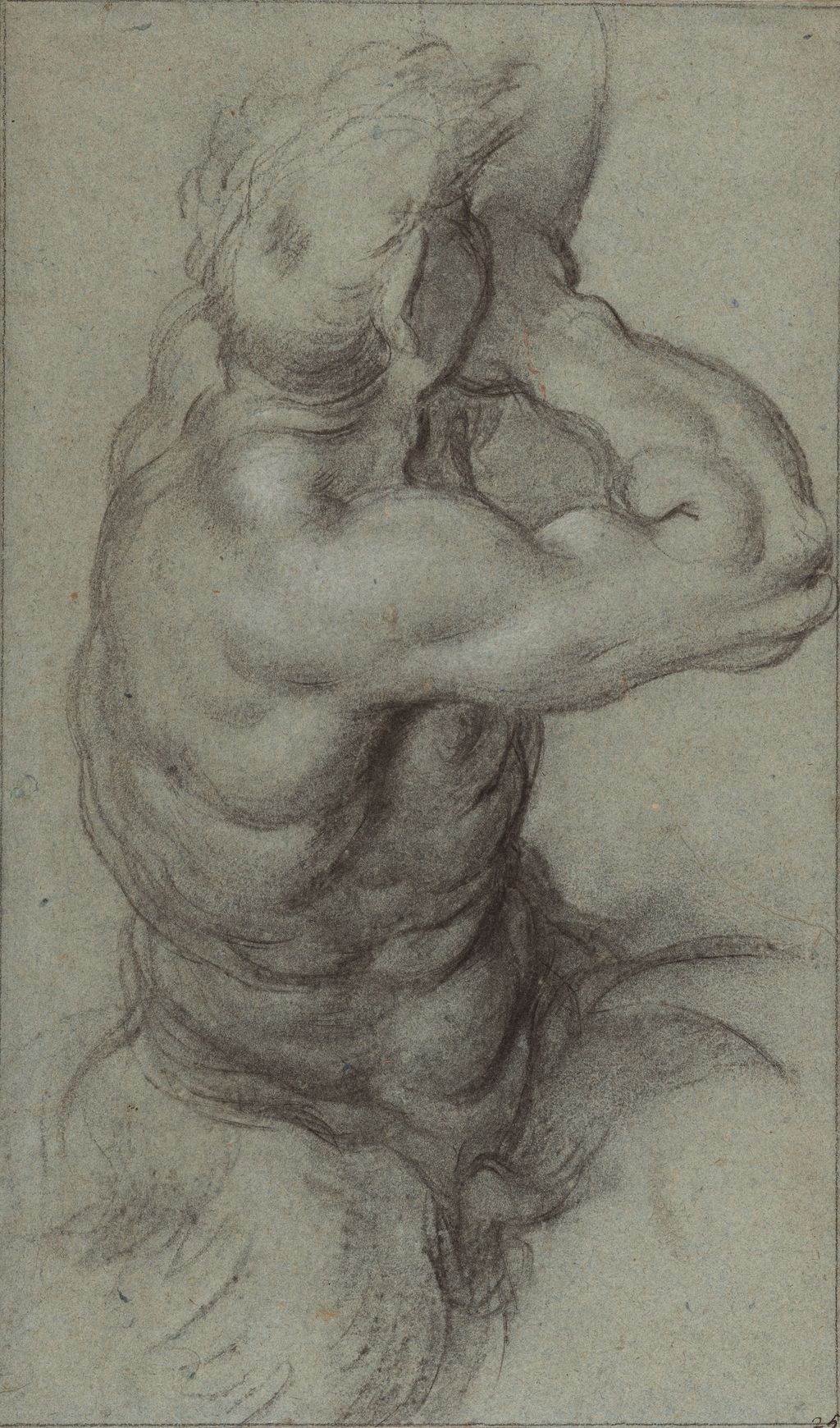
Annibale Carracci, Study of Triton Blowing a Conch Shell. Study for a figure in the Farnese Gallery. The J. Paul Getty Museum. Image source. CC0 / Public domain.
The walls after the vault
After the unveiling of the vault, plasterers and painters turned to the walls around the windows, doorways and niches. The real gilded stucco along the walls had to work with the fictive gilt and stone above it. Acconci records a payment to Giacomo da Parma for gilded stucco in June 1603. The wall pictures also involved the painters who assisted Annibale after Agostino’s departure. Erich Schleier places eight rectangular mythological scenes in this phase and describes them as frescoes executed from Annibale’s designs. The division of labour helps explain why Annibale’s name remains associated with paintings carried out by younger artists. [1] [5] [6] [19]
Schleier reports broad acceptance of Giovanni Lanfranco’s hand in Arion on the Dolphin and gives Mercury and Apollo as a possibility. The Fondazione Zeri indexes both Lanfranco and Annibale for Arion and Hercules Liberates Prometheus. Those joint entries record attribution at the level of the whole panel. Schleier’s account shows where the attribution to Lanfranco is strongest. In Arion, the dolphin carries the musician and his lyre within a small wall panel, while entire groups of sea creatures churn across one of the ceiling’s largest pictures. The proximity lets viewers compare two ways the workshop handled a human body set in motion by a creature from the sea. [19] [20] [21]
The wedding and other ways of reading the room
The marriage of Odoardo’s brother Ranuccio Farnese to Margherita Aldobrandini in 1600 makes an obvious context for a room with a mythological wedding at its centre. Acconci presents a reading in which Fulvio Orsini, the Farnese librarian and antiquarian, suggested a programme for the marriage, drawing on Ovid and Philostratus. At the palace Orsini was in a position to discuss ancient texts and works of art with Annibale. Zapperi disputes the wedding as the origin of the scheme. He argues that in September 1599, when the marriage negotiations resumed, the work was already too far advanced for a change of programme, and sees the vault as an expression of Odoardo’s taste for erotic mythology. The central wedding could resonate with the Farnese match even if the pictures owe their first conception to a different set of interests. [1] [6] [22]
Giovanni Pietro Bellori, writing in the seventeenth century, interpreted the ceiling through different kinds of love. The Capitoline Museums summarise his account in terms of sacred and profane love. At the corners, pairs of small winged figures wrestle, embrace or fight over objects, bringing agreement and rivalry into the ornament at the same time. Dempsey gives more weight to the ways the painters vary the theme, sometimes wittily, from one part of the room to another. Juno gets what she wants by a ruse, Aurora’s pursuit meets refusal, and Polyphemus turns jealous. Even the bronze-coloured medallions complicate the mood. In Hero and Leander on the window side, mutual desire brings Leander into the water where he will drown. A few bays away, a child subdues the much larger Pan. Nearby stories could turn on love with markedly different consequences. [2] [3]
What restoration brought back into view
The Gallery reopened in 2015 after an eighteen-month campaign that addressed cracks, water infiltration and the darkening of the surfaces. Conservators treated the stucco separately from the paintings and kept some old repairs as part of the painted surface’s history. Among the earlier interventions was work paid for in the 1690s, undertaken by Giovan Francesco de Rossi under Carlo Maratti after repairs to cracking by Leonardo Reti. The 2014–15 team used funori, a material made from seaweed, to treat some vulnerable blue areas. The return of modern casts to the arrangement of the antique marbles also helped restore the spacing and silhouettes the vault was designed to answer. [6] [18] [23]
Cleaning opened other views into the room’s life. In the lower zones and the recesses of the windows, conservators recorded inscriptions, figures and caricatures drawn in graphite and red chalk or scratched into the surface. The dated marks on the vault help place periods of work. Undated lines near the windows record activity at a scale easily missed from the middle of the room, but an individual mark may be difficult to tie to a painter or a particular campaign. The École française de Rome’s Carracci ConservArt project brings the conservation records together with earlier accounts so that the phases of work can be studied against one another. [6] [18] [24]
How the gallery travelled
Carlo Cesio’s etchings let the subjects circulate individually. The Rijksmuseum’s print of Polyphemus and Galatea and the Metropolitan Museum’s Jupiter Embracing Juno reduce painted figures above head height to lines a reader can follow at the distance of a book. On paper, the scene could be studied apart from its height, colour and neighbours. A reader acquainted with the ceiling through prints could therefore recognise a particular picture on entering the palace, while discovering for the first time the physical act of looking from it to another. [25] [26]
Francesco Panini chose an end-on view for his drawing of about 1775, made for the opening plate of Giovanni Volpato’s series published in 1777. The view looks south towards the end-wall scene of Perseus and Andromeda. You can follow the wall bays and the picture frames up to the crown of the vault in the same sheet. The drawing gives a sense of the room’s length and the comparatively small area occupied by any one scene. [27] [28]
An earlier enterprise carried the design from Rome to Paris at the scale of a palace interior. In 1667, Louis XIV set artists from the newly founded French Academy in Rome to work copying the frescoes at full scale. Their drawings went to Paris for a replica in the Galerie des Ambassadeurs at the Tuileries. The fire of 1871 destroyed the palace and left surviving copies on paper as evidence of the undertaking. The Louvre brought those sheets together with original preparatory studies in its 2025–26 exhibition. Beside the preparatory drawings, the copies showed two stages of the gallery’s life on paper. The original cartoons carried designs to the plaster. The Academy’s sheets took the designs from the finished frescoes so that they could be painted again. In the Roman gallery, the stories still depend on their distance from one another. From either end of the room, the story of Polyphemus continues behind you. [1]
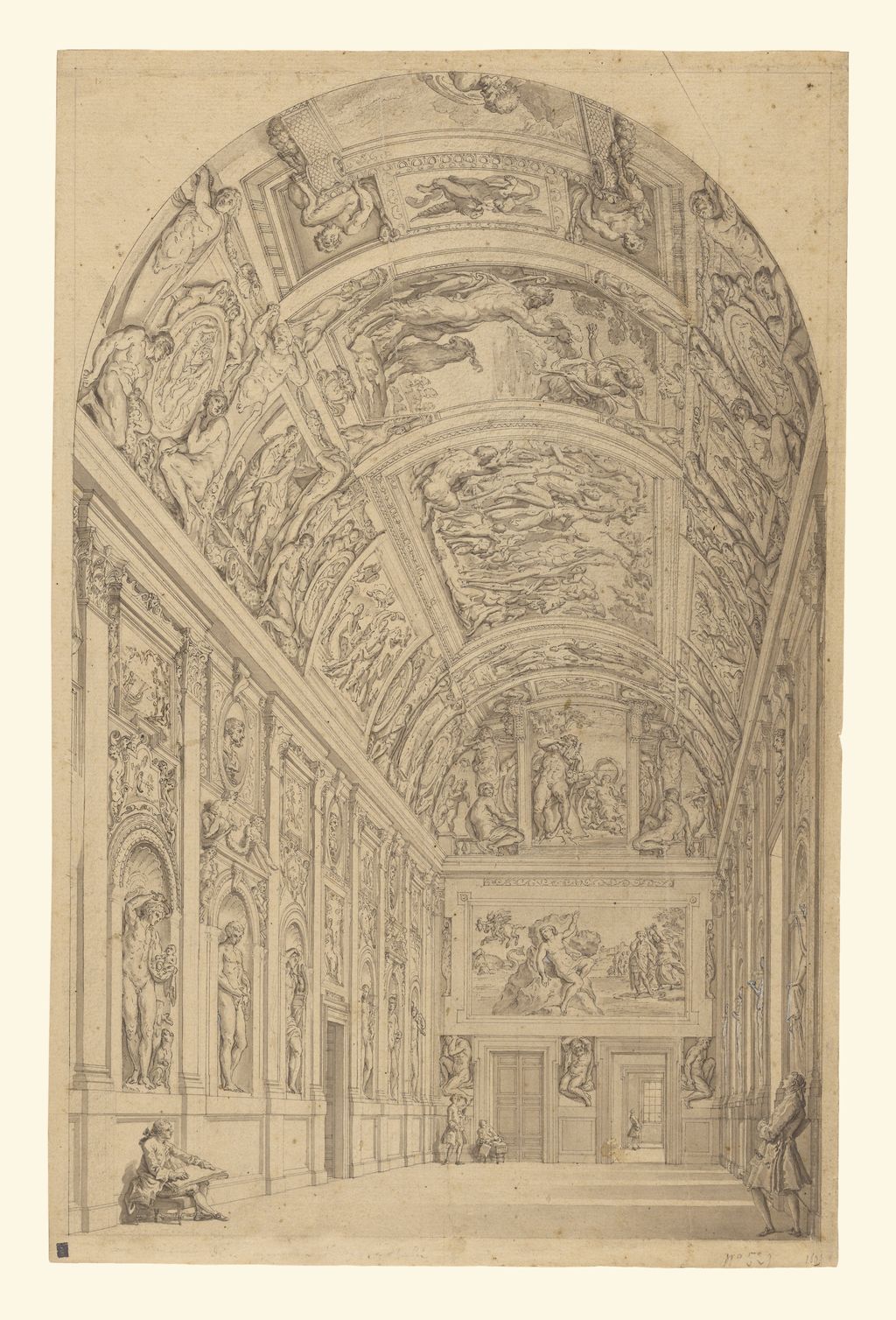
Francesco Panini, View of the Farnese Gallery, Rome, about 1775. The J. Paul Getty Museum. Image source. CC0 / Public domain.
Catalogues of the Farnese Gallery drawings
Dessins des Carrache. La fabrique de la Galerie Farnèse. Victor Hundsbuckler. Musée du Louvre and Lienart, 2025. In French.
The catalogue assembles known preparatory drawings and examines how they relate to the painted decoration. View the Louvre catalogue.
The Drawings of Annibale Carracci. Daniele Benati and contributors. National Gallery of Art, 1999.
The exhibition catalogue traces drawing across the artist’s career and records the life-size cartoon lent from Urbino. Read the NGA publication.
Artworks directory
Paintings, frescoes, drawings and prints, with separate entries for documented versions and collaborative projects.
Discussion
Look again at the images and ideas explored in The Loves of the Gods and the Farnese Gallery. These editorial prompts invite your observations.
Reader Insights
Which painted frame makes the relation between the real vault and the fictive scene clearest?
How would looking from the gallery floor change what you notice in a reproduction of the vault?
Join the Conversation
Share a detail, comparison or question about The Loves of the Gods and the Farnese Gallery below.
References
- Musée du Louvre, Dessins des Carrache. La fabrique de la Galerie Farnèse, exhibition dossier View source.
- Musei Capitolini, The Gallery, room guide View source.
- Charles Dempsey, Annibale Carracci: The Farnese Gallery, Rome View source.
- National Gallery, The Carracci Cartoons: Myths in the Making, exhibition press release View source.
- Roberto Zapperi, “Per la datazione degli affreschi della Galleria Farnese”, Mélanges de l’École française de Rome View source.
- Alessandra Acconci, “La Galleria dei Carracci attraverso i suoi restauri e la sua fortuna critica”, Accademia Nazionale dei Lincei, conference abstracts View source.
- Villa Farnesina, history of the villa and its first pictorial cycles View source.
- Musée du Louvre, Polyphème et Galatée, INV 7574 recto View source.
- Musée du Louvre, Polyphème poursuivant Acis et Galatée, INV 25457 recto View source.
- National Gallery, Agostino Carracci, Cephalus Carried Off by Aurora in Her Chariot, NG147 View source.
- National Gallery, Agostino Carracci, A Woman Borne Off by a Sea God (?), NG148 View source.
- Gabriele Finaldi, Eric Harding and June Wallis, “The Conservation of the Carracci Cartoons in the National Gallery”, National Gallery Technical Bulletin View source.
- J. Paul Getty Museum, Annibale Carracci, Study of Triton Blowing a Conch Shell View source.
- Nicholas Turner, European Drawings 4: Catalogue of the Collections, J. Paul Getty Museum View source.
- Musée du Louvre, Annibale Carracci, Projet d’ensemble pour le décor de la voûte de la Galerie Farnèse, INV 8048 recto View source.
- Vittoria Romani, “Rotture e continuità con il Cinquecento negli affreschi della galleria Farnese” View source.
- Royal Collection Trust, Annibale Carracci, Studies of a Decorative Framework for the Farnese Gallery, RCIN 902165 View source.
- Istituto Centrale per il Restauro, study day on the conservation history of the Gallery View source.
- Erich Schleier, “Giovanni Lanfranco”, Dizionario Biografico degli Italiani View source.
- Fondazione Federico Zeri, Arione con la lira sul delfino, photograph and linked work record View source.
- Fondazione Federico Zeri, Ercole libera Prometeo View source.
- Roberto Zapperi, “Annibale Carracci a Palazzo Farnese: studi recenti”, Bollettino d’Arte View source.
- Ministero della Cultura, 2015 account of the Gallery’s restoration and reopening View source.
- École française de Rome, Carracci ConservArt research programme View source.
- Rijksmuseum, Carlo Cesio, Polyphemus and Galatea View source.
- Metropolitan Museum of Art, Carlo Cesi, Jupiter Embracing Juno, plate 6 View source.
- J. Paul Getty Museum, Francesco Panini, View of the Farnese Gallery, Rome View source.
- Nicholas Turner, Lee Hendrix and Carol Plazzotta, European Drawings 3: Catalogue of the Collections, J. Paul Getty Museum View source.