 by Tom Gurney
Tom Gurney BSc (Hons) is an art history expert with over 20 years experience
Published on June 19, 2020 / Updated on November 29, 2026
Email: tomgurney1@gmail.com / Phone: +44 7429 011000
Saint Roch Distributing Alms: Introduction
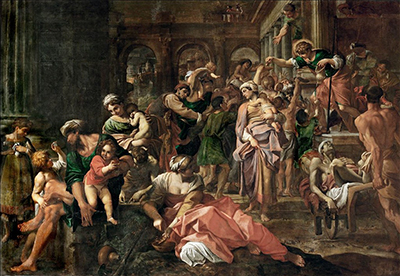
Saint Roch stands high on the right of Annibale Carracci’s painting, leaning over a crowd to give away his money. Lower down, a man pushes an invalid towards the steps in a wheelbarrow. Across the foreground, children and adults gather around coins that have already changed hands. Carracci gives the people who receive or seek help almost the entire span of the picture. Completed in 1595 for the Confraternity of San Rocco in Reggio Emilia, this oil on canvas measures about 3.31 by 4.77 metres. It is now in the Gemäldegalerie Alte Meister in Dresden, where it is catalogued as Gal.-Nr. 305. [1] [2]
At a Glance
- ArtistAnnibale Carracci
- DateLate 1580s–1595
- MediumOil on canvas
Contents
- A gift before the pilgrimage
- A commission finished on the eve of Rome
- Looking through the crowd
- Reversing the design
- Charity on a monumental scale
- The etchings and the move to Dresden
- Annotated details
A gift before the pilgrimage
The painting represents a story about the young Roch giving away his inheritance before setting off as a pilgrim. He would become known for tending people with plague and as a saint invoked against the disease. Here he is still among the possessions he is relinquishing. The lofty entrance behind him suggests the scale of the household that he inherited, and the handfuls of money give that wealth a form that can pass directly from one person to another. The man in the wheelbarrow brings illness into the scene and anticipates Roch’s later association with healing. The encounter on the steps is the earlier episode of giving. [2]
The subject took on a fuller meaning in the confraternity’s oratory. Across from Carracci’s canvas hung a painting of comparable size by Camillo Procaccini, showing Roch intervening during an outbreak of plague. Procaccini’s 1585 contract survives, and he painted his scene before Carracci finished the Alms. A photograph preserves the appearance of the large companion canvas, which was destroyed during the Second World War. In it, the angel putting away a sword makes the end of the pestilence visible. Carracci had a different problem to solve. He needed to show what a gift could do without relying on an overt miracle to mark the outcome. [2]
The commission was one among several that made Reggio important to Carracci before his move to Rome. He also painted an Assumption of the Virgin for the confraternity. His signed and dated 1588 Madonna with Saint Matthew belonged to a different Reggio commission, for the merchants’ chapel at San Prospero. Later accounts sometimes put the Alms at San Prospero as well and associated the commission with Canon Brami. The confraternity’s own place of worship was under the authority of the Benedictine abbey of San Prospero. Francesco Scannelli’s account, published in 1657 while the canvas was still in Reggio, places the Alms on a wall beside the high altar of the confraternity church. [2]
Annotated Details from Saint Roch Distributing Alms
The numbered points identify visible features discussed in this article. Return from each detail to the numbered overview. Annibale Carracci, Saint Roch Distributing Alms. Gemäldegalerie Alte Meister, Dresden, Gal.-Nr. 305. Photograph by Dguendel. Image source. CC BY 4.0. Numbers added to a separate overview. Details cropped from the original photograph. Image derivatives use CC BY 4.0.
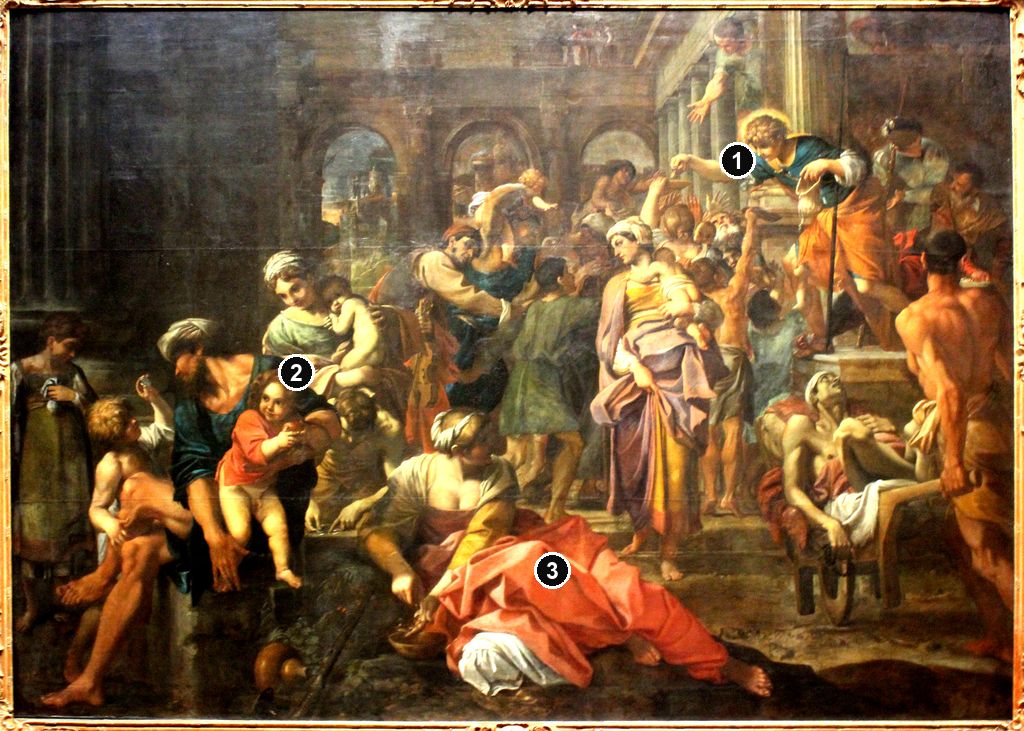
Details from SAINT ROCH DISTRIBUTING ALMS
Compare the cropped details with the source images above. Notice how their colours, shapes and positions contribute to the larger compositions.
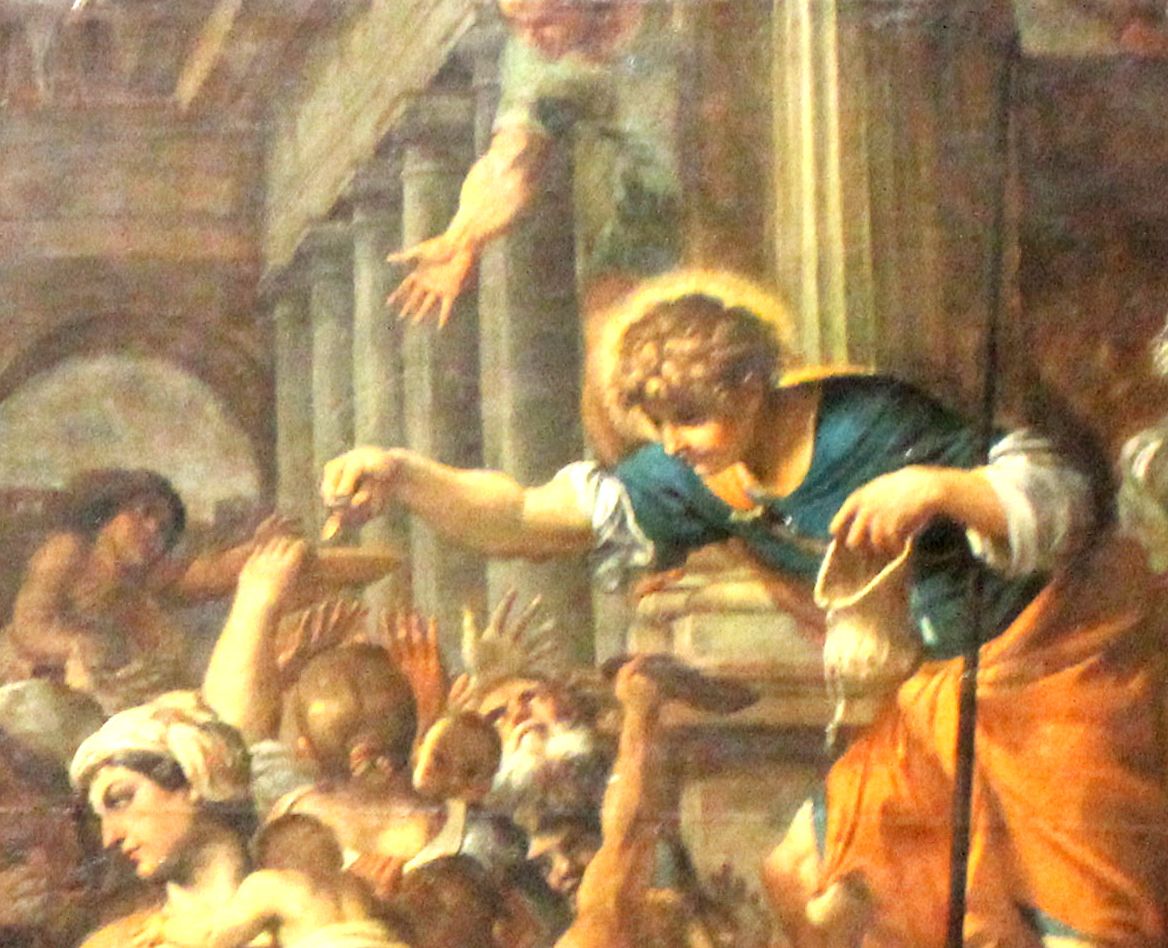
Roch’s reaching hand
The saint leans from the raised steps and extends a hand. Hands reaching up from the crowd continue the gesture in the opposite direction.
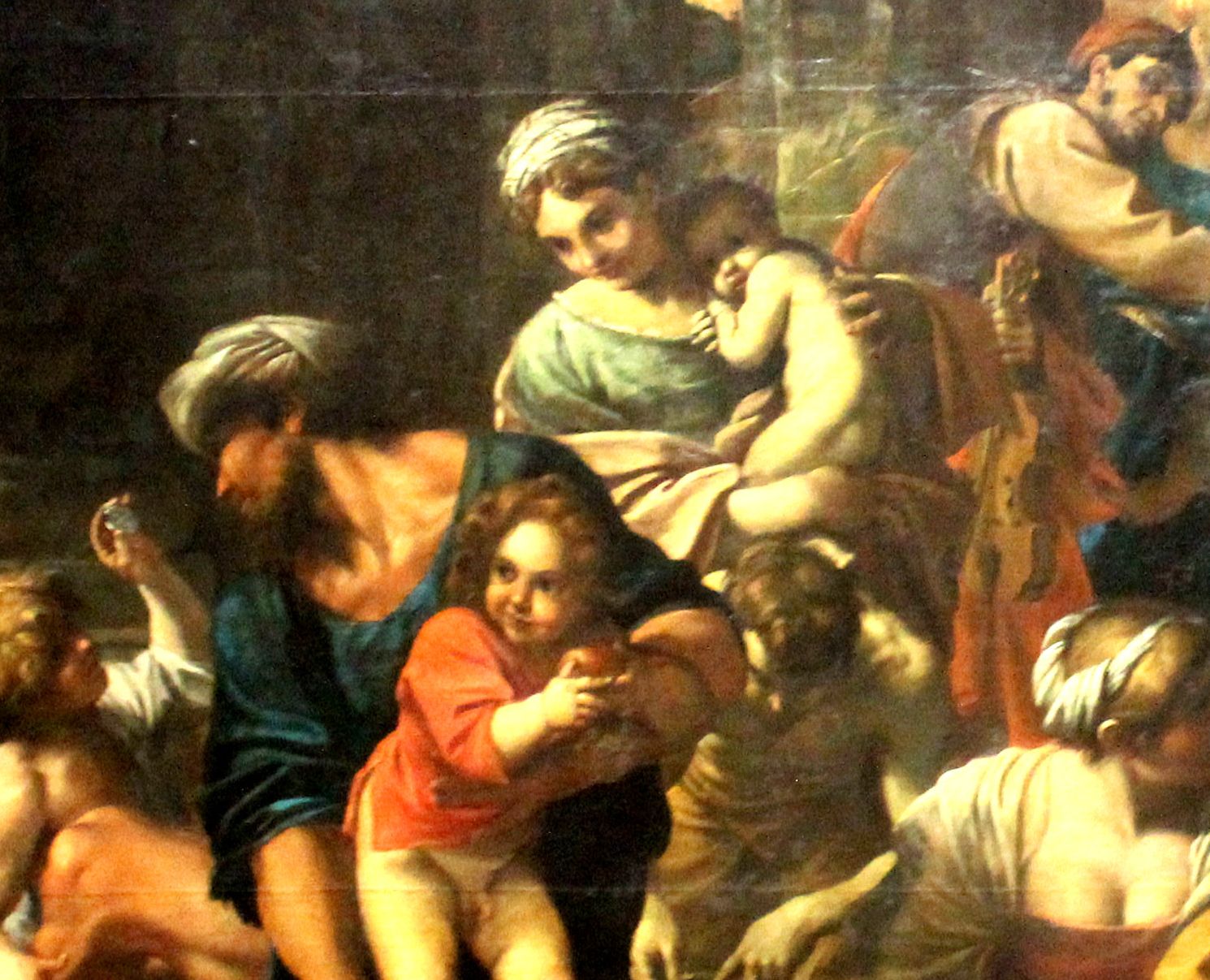
Two children in the crowd
Along the left side, two children are held at different heights. Their small figures help separate the layers of people in the foreground.
The foreground diagonal
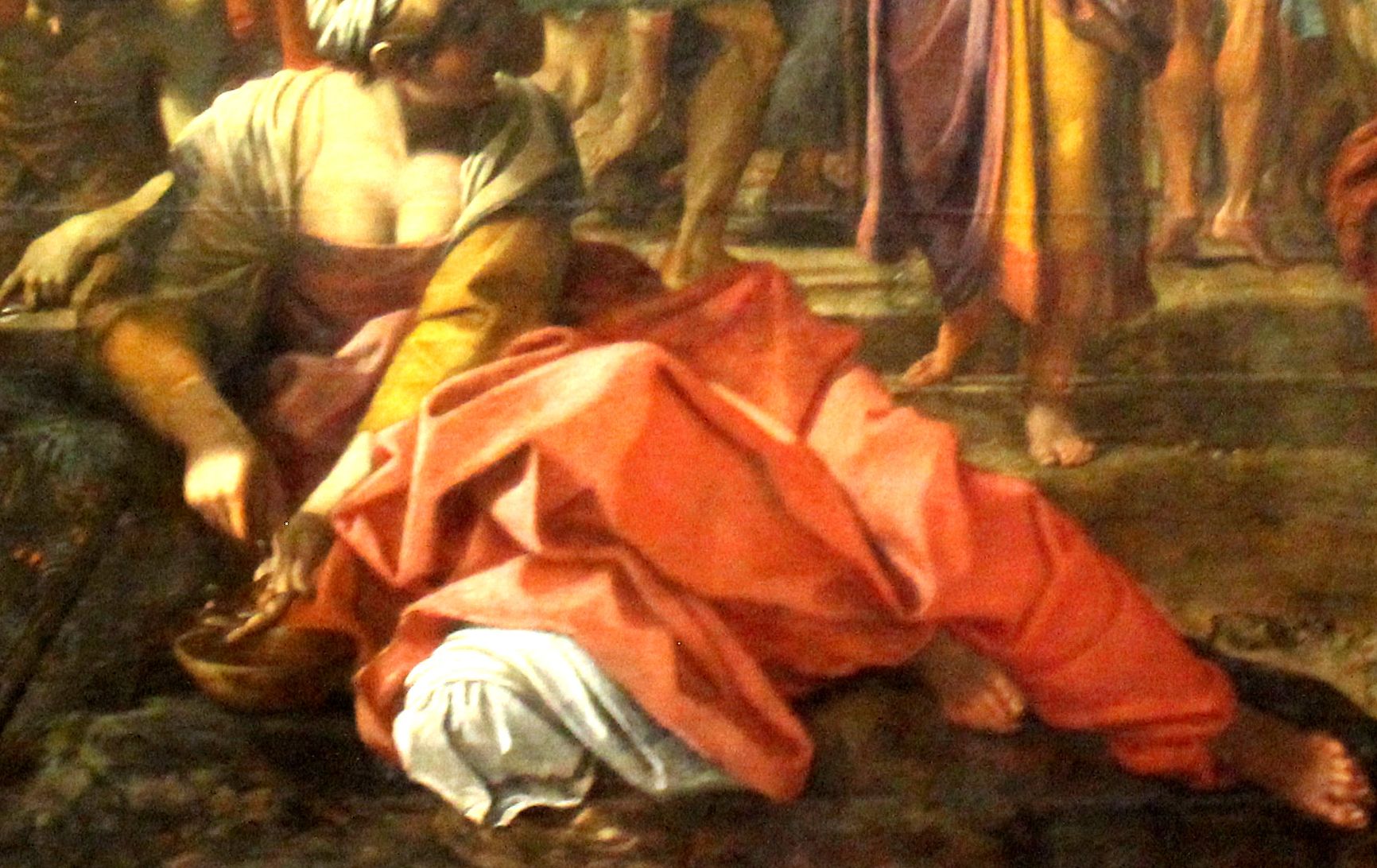
A figure low on the ground turns towards the stairs. The broad red cloth gives that turn a strong diagonal across the darker foreground.
A commission finished on the eve of Rome
In a letter to the confraternity dated 8 July 1595, Annibale said that the painting had occupied him for seven years or more and promised to finish it soon. That account is the basis for dating the commission to about 1587–88. The letter catches the work in progress, in the year of its completion and at the transition to his Farnese employment in Rome. Annibale offered to return the advance, to finish the canvas later in Rome, or to make a final push for delivery before he left, seeking help from his brother Agostino and his cousin Ludovico. Giulio Fossi, who answered for the confraternity, chose the third option and insisted on Annibale’s hand and judgment. [2] [3] [4]
Scholars differ on what Fossi’s reply meant in practice. Samuel Vitali argues that it left room for help under Annibale’s supervision. He suggests that the relatively thin layers of paint and subdued light around the wheelbarrow group make Ludovico’s involvement there plausible. Other readings give greater weight to the confraternity’s insistence on Annibale’s own hand. The attribution of the composition to Annibale is secure, while the suggestion that a relative painted particular passages remains a stylistic judgment. [3] [4]
Looking through the crowd
At upper right, Roch’s staff and halo pick him out. One hand reaches out across the stairs while the other attends to his purse. From below, hands rise at different heights. Some figures look directly at him and some watch the hands of those ahead of them. A woman carrying a child makes her way towards the front of the scene, one foot already down on a lower tread. The steps let Carracci show people converging, waiting and leaving in the same stretch of space. The arches behind them mark a more distant tier, where the crowd thins and daylight opens beyond the building. [1] [2]
In the foreground a seated woman in rose-coloured drapery turns towards the stairs, with one hand low beside a bowl. A staff and flask nearby have led art historian Ulrich Pfisterer to read her as a possible pilgrim. The white shape below her knee may be the body of a swaddled child, as Surya Stemerding suggests in her catalogue entry for Museum Boijmans Van Beuningen. The painting leaves the contents of the bundle obscure. The figure’s action is clearer. Her body stays low and close to the bowl while her head turns back towards the movement of the crowd. The bright folds of her skirt pull the eye down from the steps before her glance directs it back to them. [2] [5]
At left, the child who raises a coin shows it at the height of the seated man’s face. Their conversation takes place in a small pocket of light, with a woman and child looking on behind them. At right, the man at the wheelbarrow turns his bare back to us and grips the handles. Its shafts and wheel lead the eye in the direction of the steps, but the passenger’s body slumps across that line of movement. His pose changes how we read the labour of the man bringing him. In one group a coin is light enough for a child to hold up. In the other, someone has to carry the full weight of a person who cannot make it to the saint unaided. [1] [2]
Reversing the design
The arrangement of the figures once ran the other way. Stemerding’s catalogue entry reports the results of technical examination, which detected part of the design transferred to the canvas in the opposite orientation. Early prints and a small painted design discussed by Maria Letizia Paoletti offer further evidence of Carracci’s working process. Paoletti regarded that small painting as an autograph modello, a preliminary version for working out the composition. Stemerding describes an early landscape setting that gave way to the architecture in the completed canvas. Evidence from the underlying design makes the reversal more than a difference between copies. Carracci had already begun transferring his plan to the large support before changing its direction. [5]
The reason for the change is open to interpretation. Pfisterer reconstructs the Alms on the left wall as seen by someone facing the altar. From that position the oblique setting and the figures drawing the eye towards the left of the composition could help turn the picture towards the congregation. Procaccini’s plague scene, the adjoining altar and the approach from the side of the church give this suggestion a specific setting. The technical examination establishes the change of direction. Its connection to the original hanging remains a proposal grounded in the historical description and the reconstructed plan. [2] [5]
Carracci’s chalk study for the seated woman, now in Rotterdam, already faces in the same direction as the finished figure. In black chalk with white heightening on originally blue paper, he traces how the folds fall from the body and collect over the bent legs. The light chalk measures the breadth of a fold across the knee as economically as a line marks its edge. In the painting, differences between pink and red pick out much the same changes of plane. The volume of the drapery mattered enough to be resolved in the study, even though she is one figure among dozens. [5]
The Museum of Fine Arts in Budapest holds another kind of preparation. Its sheet of a male nude seen from behind, inventory 1810, uses dark and white chalk on blue paper to work out the shifting planes of a body in motion. It belongs to the preparations for the Alms, whose figure of the barrow bearer similarly makes posture and muscular effort visible from the back. Catherine Loisel’s exhibition catalogue entry links the drawing’s handling of light and contour to Veronese and Tintoretto. That connection helps explain how the study of a posed body could serve a painter familiar with Venetian ways of letting light travel across a figure. The Louvre preserves a related study of a man in profile in black and white chalk on a sheet that was once blue and has now yellowed. A strip of paper added to its right edge is visible in the object record. Other studies are recorded in Oxford and Montpellier, and a drawing of a seated man with a child in the Uffizi has also been linked to the picture. The separate sheets suggest how much of the larger design depended on working out the weight, direction and lighting of single bodies. [3] [6] [7]
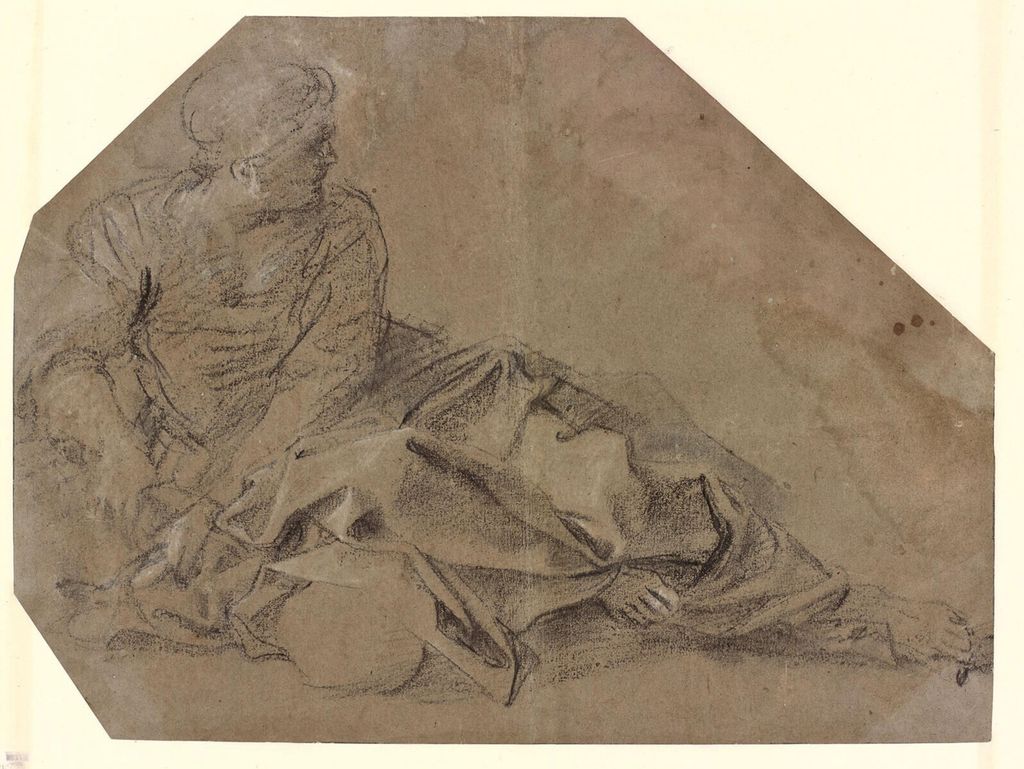
Annibale Carracci, Study of a Woman Sitting on the Ground. Museum Boijmans Van Beuningen, I 447 (PK). Image source. Public domain.
Charity on a monumental scale
The young mother, placed between the saint and the foreground, has a role beyond leading us down the stair. Her upright movement and the child held against her side recall the way Charity could be personified as a woman caring for children. Pfisterer draws a particular comparison with a figure in Baldassare Peruzzi’s Presentation of the Virgin at Santa Maria dell’Anima in Rome. Carracci’s mother still has a place in the story. She has a child to support and stairs to descend. Her resemblance to a traditional image of Charity gives that ordinary movement a further meaning. The figure next to her, absorbed in the hard work of pushing the wheelbarrow, gives another visible form to care. [2]
By spacing out these incidents in the foreground, Carracci gives the viewer time to consider how people act once the gift has left the saint’s hand. Pfisterer reads the painting in the context of late sixteenth-century Catholic discussion of the works of mercy. A patron who helped furnish a place of worship could understand that contribution as its own act of giving. For members of the confraternity, the material object on their wall and the action it represented thus bore on the same practice. A later painter could use Carracci’s arrangement to ask a different question. In Domenichino’s Saint Cecilia Distributing Alms at San Luigi dei Francesi in Rome, donors and recipients again occupy distinct parts of the scene, but quarrels break out over the clothes the recipients have just been given. [8] [9]
The etchings and the move to Dresden
Prints gave the composition a life outside the oratory. The National Gallery of Art in Washington catalogues its 1610 etching, accession 2018.113.4, under Guido Reni after Carracci, with Francesco Brizio also recorded among the associated artists. The attribution has a history. Marzia Faietti argued for Reni, while the catalogue for an impression in the Civica Raccolta delle Stampe Achille Bertarelli favours Brizio. The inscription on the Washington sheet identifies Carracci as inventor of the design and Pietro Stefanoni as publisher. The Real Academia de Bellas Artes de San Fernando in Madrid catalogues an impression with that inscription as a second state, a later stage of the plate. In it Roch and the wheelbarrow are on the left, reversing the corresponding groups in the Dresden painting. [10] [11] [12]
The Metropolitan Museum of Art catalogues its sheet, 53.600.976, as a counterproof of an etching by Brizio. A counterproof is made by taking a second impression from a freshly printed sheet, so the image is reversed again. In the Met’s example this puts Roch and the wheelbarrow at the right, as they appear in the painting. The pale lines also bring out a difference at the far left. Two additional figures are legible near the architecture where the present painting is dark. The Bertarelli catalogue suggests the printmaker may have known earlier material for the painting. Pfisterer points out that the corresponding surface of the canvas appears disturbed, which gives another reason to be cautious about using the visible difference to reconstruct the sequence. [2] [11] [13]
Another etching after the painting, dated 1614 and credited to Baldassare Aloisi Galanini, belongs to Auckland Art Gallery Toi o Tāmaki. It came to the museum as part of the Peter Tomory Collection purchased in 2004. The Dresden canvas has a separate history. In 1661 the Duke of Modena acquired it from the confraternity, together with Procaccini’s companion. Copies of the two works were made for the confraternity. The originals passed from the Este collection into the Dresden gallery in 1746. Removed from the oratory and from the work it once faced, Carracci’s painting still carries the upward angle of that first setting in the tilt of Roch’s body and the faces turned towards him from the steps. [1] [2] [14]
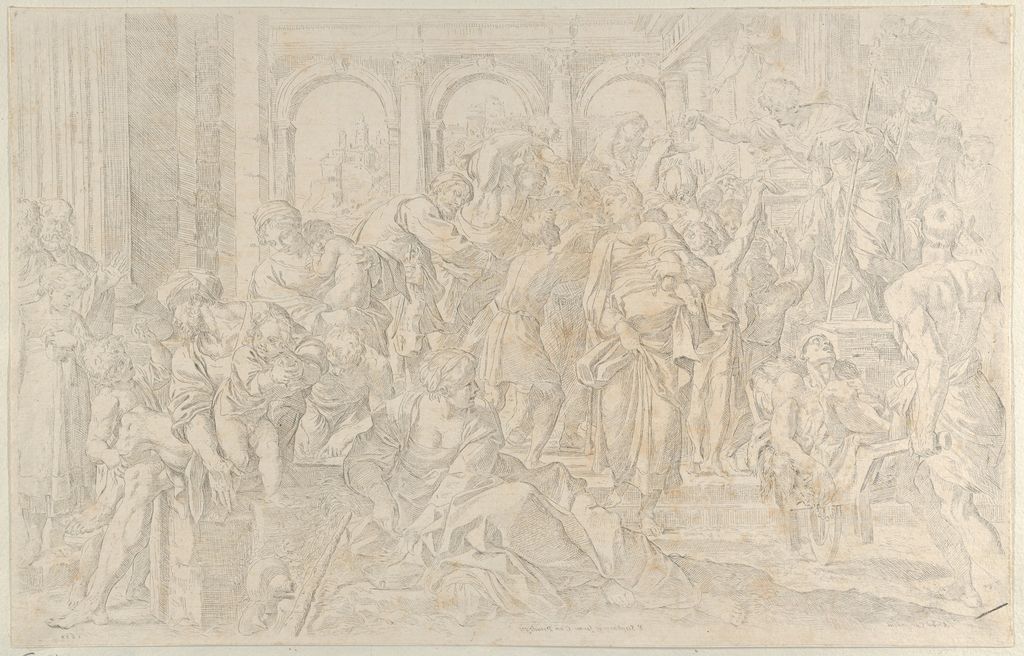
Francesco Brizio after Annibale Carracci, Saint Roch Distributing Alms. The Metropolitan Museum of Art, 53.600.976. Image source. CC0 / Public domain.
Artworks directory
Paintings, frescoes, drawings and prints, with separate entries for documented versions and collaborative projects.
Discussion
Look again at the images and ideas explored in Saint Roch Distributing Alms. These editorial prompts invite your observations.
Reader Insights
At what point does your eye move from Roch down into the crowd?
How does the large canvas express the exchange through more than one group of figures?
Join the Conversation
Share a detail, comparison or question about Saint Roch Distributing Alms below.
References
- Karl Woermann, Katalog der Königlichen Gemäldegalerie zu Dresden, no. 305 View source.
- Ulrich Pfisterer, L’Elemosina di san Rocco di Annibale Carracci e l’innovazione della historia cristiana, pp. 247–269 View source.
- National Gallery of Art, The Drawings of Annibale Carracci, cat. 26 and fig. 1 View source.
- Samuel Vitali, Between Family Brand and Personal Ambition, pp. 145–147 View source.
- Museum Boijmans Van Beuningen, Study of a Woman Sitting on the Ground and catalogue commentary View source.
- Museum of Fine Arts, Budapest, Figure Study for Saint Roch Distributing Alms, inv. 1810 View source.
- Musée du Louvre, Annibale Carracci, Figure d’homme de profil, INV 7357 recto View source.
- Ulrich Pfisterer, Visuelle Topoi um 1600 View source.
- Eva Maringer, Domenichinos Caecilienzyklus in San Luigi dei Francesi in Rom View source.
- National Gallery of Art, Saint Roch Distributing Alms, 1610 etching View source.
- Lombardia Beni Culturali, Civica Raccolta delle Stampe Achille Bertarelli, Elemosina di San Rocco View source.
- Real Academia de Bellas Artes de San Fernando, San Roque reparte sus bienes entre los pobres, C-38-021 View source.
- The Metropolitan Museum of Art, Francesco Brizio after Annibale Carracci, counterproof, 53.600.976 View source.
- Auckland Art Gallery Toi o Tāmaki, Baldassare Aloisi Galanini after Annibale Carracci, 1614 etching View source.