 by Tom Gurney
Tom Gurney BSc (Hons) is an art history expert with over 20 years experience
Published on June 19, 2020 / Updated on November 29, 2026
Email: tomgurney1@gmail.com / Phone: +44 7429 011000
Landscape with the Flight into Egypt: Introduction
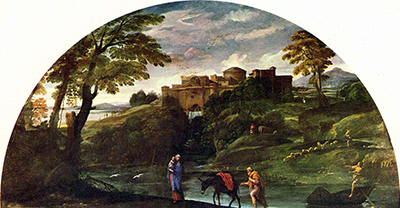
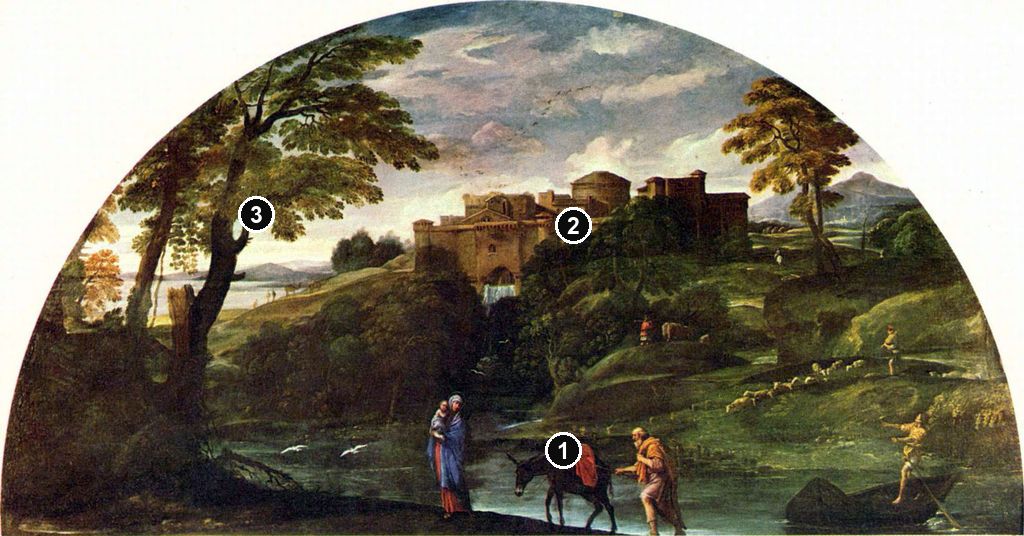
The woman in blue on the riverbank is Mary. She carries the infant Christ, and Joseph follows with a donkey. Above their heads a fortified town crowns a hill, water spills from an arch in its wall, and the crown of a tall tree spreads beneath the curve of the canvas. Annibale Carracci's Landscape with the Flight into Egypt, painted around 1603–04 for a private chapel in Rome, gives the family an entire countryside to cross. It is an oil on canvas measuring 122 × 230 cm, now in the Galleria Doria Pamphilj, inventory FC 236. The gallery attributes almost all of its execution to Annibale. [1] [2] [3]
At a Glance
- ArtistAnnibale Carracci
- DateEarly 1600s
- MediumOil on canvas
Contents
- The family on the riverbank
- How the landscape opens and closes
- The semicircle and the Aldobrandini commission
- What changed between drawing and canvas
- What Domenichino took from the Flight
- Annotated details
The family on the riverbank
In Matthew's Gospel, an angel warns Joseph in a dream that Herod intends to kill the child. Joseph leaves for Egypt with Mary and Jesus by night. The Gospel gives the reason for the flight and its destination in a few verses. Carracci pictures the family on the way, beneath an open, clouded sky. The donkey is a familiar feature of the subject in art, and the riverbank is Carracci's setting for the journey. The family has come down to the water, where their path shares the bank with people going about their ordinary business. [1] [4]
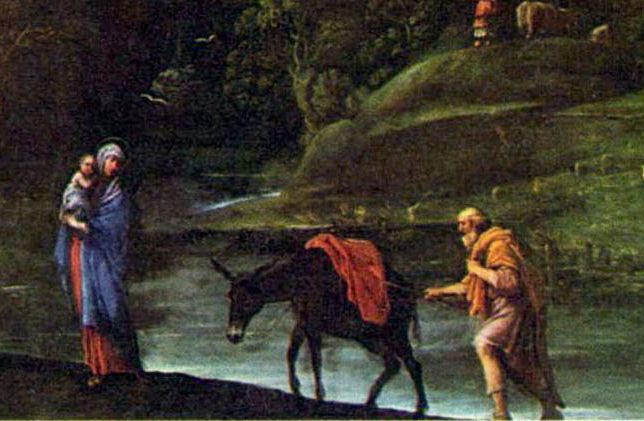
Follow the line of the figures from right to left. Joseph stoops forward with bent knees. The donkey lowers its head, and the warm red of its saddlecloth stands out against its dark body. Mary is ahead of them on slightly higher ground. Christ's head appears against her shoulder, and the fold of her blue mantle makes one long shape from shoulder to knee. The donkey's direction carries the eye towards her, while the dark hillside behind Mary helps the child's pale face stand out. They are easy to identify once the eye is down at the water. In the full view their small size gives a sense of how much ground they still have to cover. [1]
A boatman works near the right edge, and a shepherd tends a line of sheep farther up the slope. On the left, two pale birds skim the water beneath the trees. These incidents help locate the family in space. The people on the hillside are smaller than Joseph and Mary, and the boatman is large enough to register a separate action of his own. His long diagonal pole or oar stands out against the almost horizontal water. At first, the family's movement can seem to be one more activity along the shore. Once the title has identified them, their vulnerability becomes apparent in the contrast between their slow progress and the routine of the people around them. [1]
Annotated Details from Landscape with the Flight into Egypt
The numbered points identify visible features discussed in this article. Return from each detail to the numbered overview. Annibale Carracci, Landscape with the Flight into Egypt. Galleria Doria Pamphilj, no. 236. Image source. Public domain.
Details from LANDSCAPE WITH THE FLIGHT INTO EGYPT
Compare the cropped details with the source images above. Notice how their colours, shapes and positions contribute to the larger compositions.
The travellers at the water
The figures and the donkey follow the bank close to the base of the lunette. Small flashes of colour make them legible against water, trees and banks.
Buildings in the middle distance
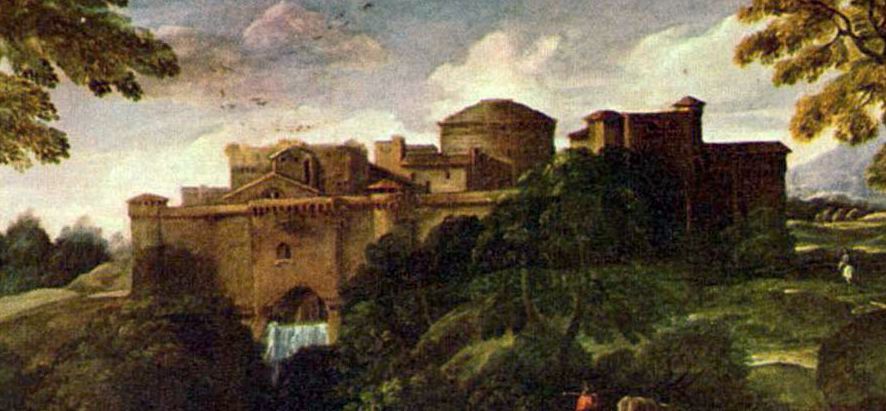
Buildings occupy a ridge behind the travellers. Their straight lines mark the middle distance between the near trees and the far horizon.
A tree against the light
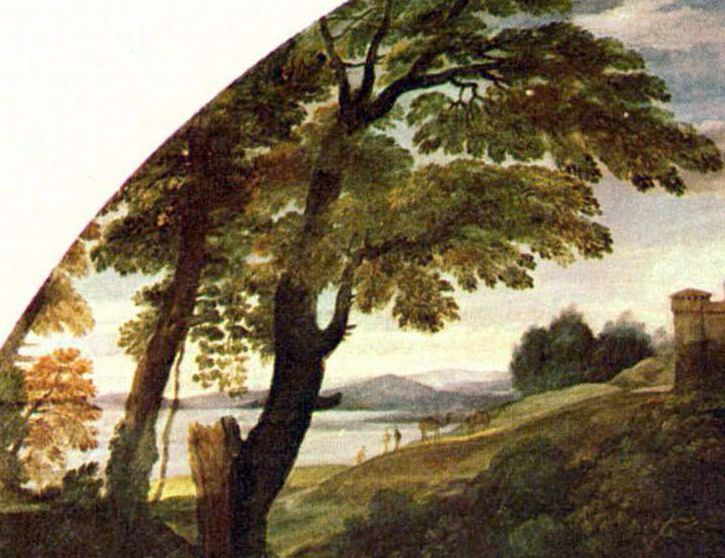
The tree on the left breaks the outline of the hills and catches the light in separate groups of leaves. It gives the distant landscape a foreground frame.
How the landscape opens and closes
The large trees on the left stand close to the viewer, their trunks dark in places where the water and opening sky are light. A broken stump brings that foreground even closer. Beyond the trunks, a strip of pale water leads to low hills. On the right, a smaller tree repeats the gesture of the left-hand canopy from farther away. Between those two sides the fortified complex interrupts the view. Its straight walls and rooflines make the surrounding slopes look softer, and the rounded building rises into the brightest portion of the sky. There is enough of the distant country on either side of the hill to suggest that the terrain continues well beyond it. [1] [2]
The water makes the change in level easy to follow. High in the centre, a short, bright fall emerges beneath the masonry. Lower down, pale streaks mark water glimpsed between dark banks. The river spreads wide and catches more sky by the figures. These stages give the eye a route from the town to the foreground. The drop under the arch leads to the shaded channel where the land folds inwards, then to the margin where the donkey and boat are visible. Greens turn from nearly black beneath the trees to lighter tones on the slopes grazed by the sheep. The red cloth and blue mantle are small enough to keep their force without competing with the whole valley. [1]
The title names Egypt as the destination. The buildings have a vocabulary familiar from Italy, including the round mass above the walls and the arched opening at their base. The art historian Giovanna Perini Folesani proposes a resemblance between parts of the fortified complex and the abbey at Grottaferrata, which had Aldobrandini connections, while treating the prominent rotunda as a separate feature. The resemblance allows for Roman associations while leaving the site of the scene open. The separate forms also do practical work within the picture. The walls run across the hill, the rotunda breaks the skyline, and the arch opens a way down to the water. [5]
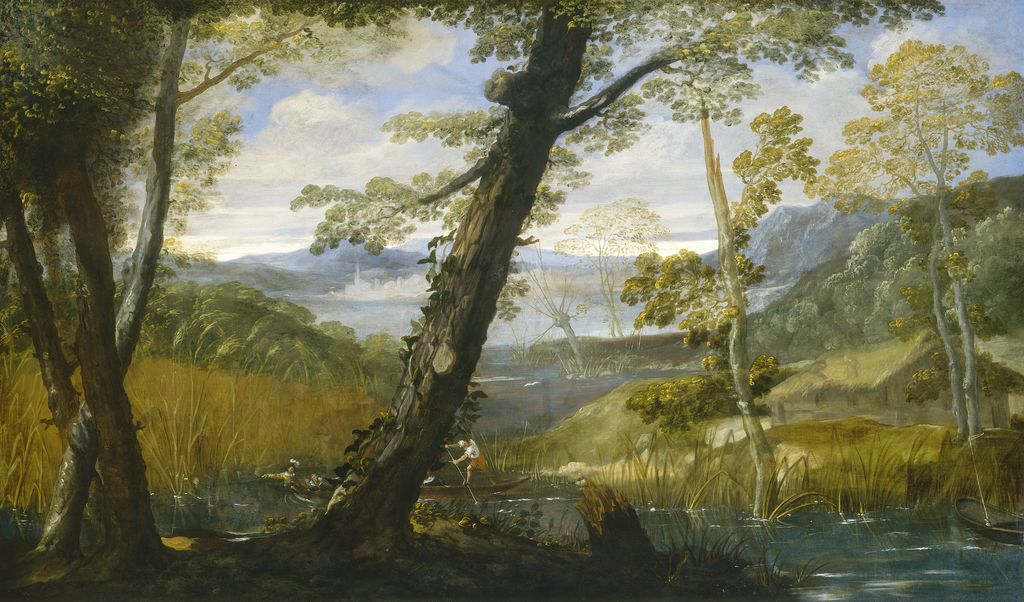
Annibale Carracci, River Landscape. National Gallery of Art, Washington, 1952.5.58. Image source. CC0 / Public domain.
The semicircle and the Aldobrandini commission
The broad, curved upper edge was designed for a specific setting. This type of picture is called a lunette because it fits a space shaped like a half-moon. Cardinal Pietro Aldobrandini, a nephew of Pope Clement VIII, bought the palace on Rome's Via del Corso in 1601 and had its existing private chapel refurbished. The six canvases were conceived as part of that architectural project. In the Flight, the straight bottom edge gives the travellers a path across the picture, the trees rise into the narrowing sides, and an expanse of sky occupies the widest vertical opening under the crown of the arch. Seen as an architectural painting, the form gives the country room to rise over the story. [1] [6]
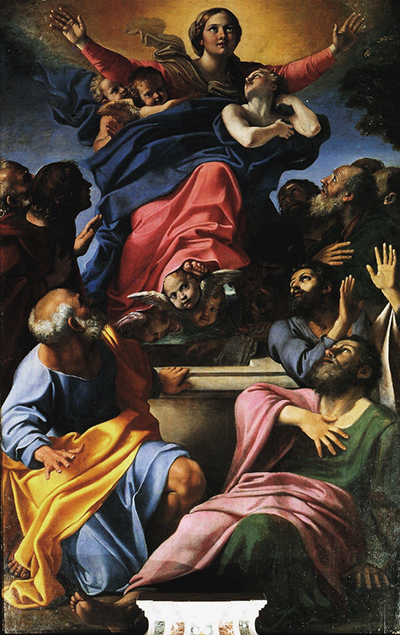
The six subjects were the Visitation, Adoration of the Shepherds, Adoration of the Magi, Flight into Egypt, Transport of Christ's Body, and Assumption of the Virgin. An inventory list from 1646 identifies three pairs, as reconstructed by the art historian Andrea G. De Marchi. The Flight was paired with the Adoration of the Magi. The Visitation went with the Shepherds, and the Assumption with the Transport. The first pair shares exactly the same recorded dimensions, 122 × 230 cm. The pairing gives particular force to Matthew's sequence. The Magi come to honour the child, and the family sets out immediately afterwards to escape Herod. [2] [4] [7]
The commission is usually placed early in the century. The Louvre dates the related landscape drawings to about 1603 and treats the exact date of the commission as uncertain. Pierguidi favours 1603–04 and notes Silvia Ginzburg's earlier estimate of 1602–03. The Doria Pamphilj gives 1604–13 for the series. The surviving payments, discussed by Catherine Puglisi and Stefano Pierguidi, name Francesco Albani and his collaborators from 1605, with a final payment in 1613. Annibale died in 1609. These dates distinguish the early design and painting of the Flight from the workshop's work on the ensemble over several years. [1] [3] [6] [8]
The gallery's painting list makes the different hands visible. It records the Assumption as Albani and the Visitation as Albani, with Antonio Carracci tentatively named. The Shepherds is assigned to Albani and assistants, possibly including Sisto Badalocchio. The Magi is listed under Albani and assistants identified as Giovanni Lanfranco and Antonio Carracci. The Transport is listed under Albani and assistants, with a question over Annibale's involvement. Scholars have long debated Annibale's share in that canvas. These attributions describe individual works within the project for which Albani was paid, and they allow for collaboration even within a single scene. [1] [2] [6] [8]
The 1646 record lists the pictures in the palace collection and describes losses at corners of the canvases and their frames. De Marchi connects those losses with the way the works were mounted and later taken out of the chapel. He also records that Giovanni delle Tele lined, cleaned and filled losses in the Flight. The records of corner repairs and work on the frames show some of the changes involved in turning a chapel decoration into a set of gallery pictures. The gallery traces the painting's passage into the Pamphilj collection to Olimpia Aldobrandini's dowry in 1647. Its current display belongs to that later history of collecting. Its shape still bears the clearest evidence of the original commission. [1] [7]
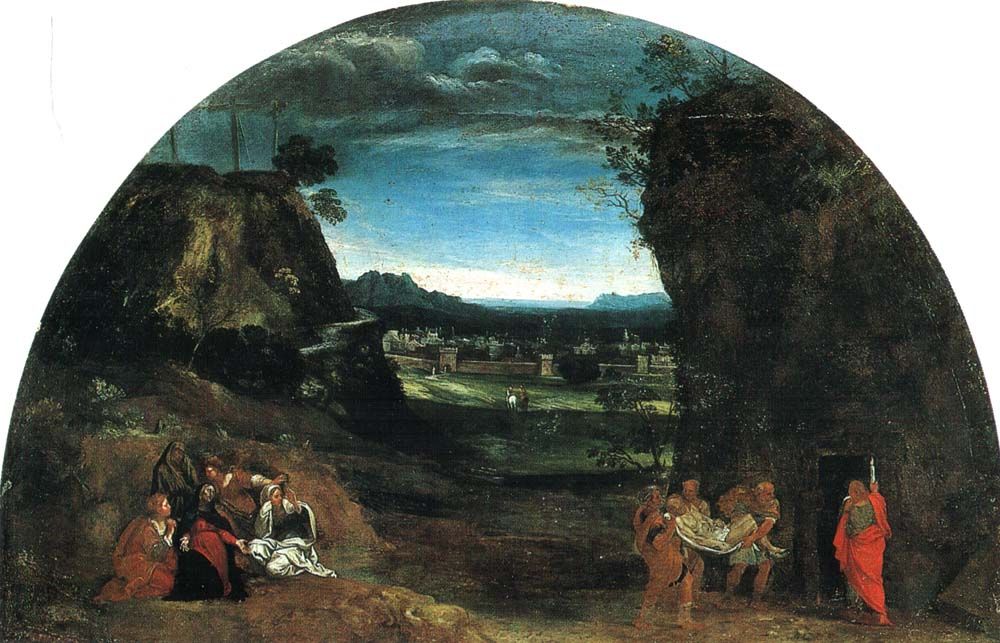
Landscape with the Entombment of Christ from the Aldobrandini lunette cycle. Galleria Doria Pamphilj, Rome. Image source. Public domain.
What changed between drawing and canvas
Three sheets in the Louvre document the making of the composition. One, Boatmen in a Landscape with a Castle in the Distance (INV 7489), is a rectangular drawing in brown pen and wash. The Louvre dates it about 1603. Another, Fortified Castle in a Landscape (INV 7873), is worked in brown ink and wash over black chalk. Its reverse bears a study of houses on a hill. The museum records that sheet under an attribution to one of the Carracci and gives Catherine Loisel's more specific attribution to Annibale. These sheets, with INV 7869, trace decisions about the placement of buildings and the scale of the figures. Loisel notes that the Virgin and Child were first tried farther down the slope before being brought back to the foreground. [3] [9]
That change matters in the finished work. Bringing Mary forward puts her at roughly the height of the waterside activity and within sight of Joseph, in front of the low ground behind her. The terrain remains large enough to absorb much of the viewer's attention. The drawings show an artist working out how far that could go while keeping the family readable. From an earlier point in Carracci's career, the River Landscape of about 1590 in Washington shows a similar interest in using small figures alongside water and trees to give a place scale and activity. The Roman painting gives that approach a sacred subject and the constraints of a shaped design. [1] [3] [10]
The Gemäldegalerie's Roman River Landscape with Castle and Bridge, which the Berlin museum dates to about 1600, gives a nearer comparison. A fortified building divides the view, and tree trunks frame openings on either side. Erich Schleier identifies the Tiber Island and the Ponte Fabricio as likely sources for the architecture in Berlin. Set beside the Flight, it shows how Carracci gave water and fortifications a central role in two very different subjects. The structure of the painted landscape could draw on familiar buildings and bridge forms even when the larger scene was imagined. [11]
This deliberate arrangement is why the Doria Pamphilj calls the Flight an ideal landscape. The cascade, grove, distant hills and buildings give a plausible impression of countryside while each is placed to control what opens up or disappears from view. Older paintings show how many different settings the subject could support. In Pieter Bruegel the Elder's Landscape with the Flight into Egypt of 1563, the little family travels through a steep, imaginary European landscape viewed from high above. Writing in the Japanese journal Juncture, Kuroda notes how Carracci's lower viewpoint and the fortifications across the middle distance shut off much of the view in comparison. The size of the holy figures alone tells little about the kind of country they inhabit. [1] [12] [13]
Caravaggio's Rest on the Flight into Egypt, also in the Doria Pamphilj, makes the difference between rest and journey especially clear. Its seated Joseph holds music for a violin-playing angel beside the sleeping Mary and child. The figures occupy most of the width. Annibale's own Rest in the Hermitage, a round canvas about 82.5 cm in diameter and dated by the museum to about 1604, is another distinct work. For the chapel, the low position and small size of the figures allow the river and the land above them to convey the duration of the flight. [1] [14] [15]
What Domenichino took from the Flight
Domenichino painted his own Landscape with Flight into Egypt around 1605–06. The Allen Memorial Art Museum painting is oil on copper, about 26 × 34 cm, and its scale invites a much closer view. The small biblical figures still share the scene with trees, water and buildings. The relationship of the two artists has also prompted a narrower attribution question. The Louvre records the proposal that Domenichino helped with the Aldobrandini Flight, and the National Gallery notes the suggestion that he painted Mary and the child. That particular contribution remains a proposal. The gallery's attribution of almost all the painting to Annibale and his connection with the related drawings provide firmer ground for discussing the design. [1] [3] [16] [17]
Domenichino's later Landscape with a Fortified Town, of about 1634–35 in the National Gallery, shows how much of the composition could survive when given a different subject. The town above the river, the arrangement of wooded and open ground, the small shepherd and flock, and the man propelling a foreground boat all recall the lunette. At the lower left of Domenichino's painting, a fisherman sorts his catch near a woman and child. There is no identifiable narrative tying these people together. The two works show how a painter could transfer the structure of a biblical landscape to a scene made up of ordinary rural activities. [1] [16]
Between the small copper at Oberlin and the late painting in London, Domenichino returned to the biblical subject on a large scale. The Louvre's Landscape with the Flight into Egypt, painted around 1620–23 for Cardinal Ludovico Ludovisi, measures 165 × 212 cm. The rectangular canvas gives the trees and the rocky height an especially prominent place. The three paintings span nearly three decades of Domenichino's work, from the small-scale treatment of the flight to a painting in which the same kind of terrain supports an everyday riverside scene. [16] [17] [18]
The Aldobrandini series also reached painters outside the Bolognese workshop. In his study of Claude Lorrain's View of Delphi, Marcel Rothlisberger traced the influence of the Flight on Claude's middle years and related the rocky setting of Delphi to the Transport lunette in particular. Looking at the series as a whole helps make sense of that distinction. A town that closes off the view, or two heights that open a distant prospect between them, could be taken up separately and made to serve different subjects. [19]
Artworks directory
Paintings, frescoes, drawings and prints, with separate entries for documented versions and collaborative projects.
Discussion
Look again at the images and ideas explored in Landscape with the Flight into Egypt. These editorial prompts invite your observations.
Reader Insights
What first lets you locate the family in the large landscape?
How does the lunette’s curved form alter the balance between land and sky?
Join the Conversation
Share a detail, comparison or question about Landscape with the Flight into Egypt below.
References
- Galleria Doria Pamphilj, Landscape with the Flight into Egypt (FC 236) View source.
- Galleria Doria Pamphilj, Aldobrandini Gallery painting inventory View source.
- Musée du Louvre, Bateliers dans un paysage, un château au loin (INV 7489), catalogue entry by Catherine Loisel View source.
- Matthew 2, New American Bible View source.
- Giovanna Perini Folesani, Landscapes, Townscapes and Maps in the Oeuvre of the Carracci, translated by Yuko Nakama, Ritsumeikan Studies in Language and Culture, vol. 30, no. 4 View source.
- Catherine Puglisi, The Aldobrandini Lunettes: From Early Baroque Chapel Decoration to Pamphilj Art Treasures, McMullen Museum of Art, 2011 View source.
- Andrea G. De Marchi, Le provenienze dei Caravaggio Doria Pamphilj e qualche novità sulle Lunette Aldobrandini, Bollettino d'Arte View source.
- Stefano Pierguidi, Annibale Carracci e i suoi a Roma, 1601–1609: bilancio di una bottega e di una scuola, Studi Romani View source.
- Musée du Louvre, Château fortifié dans un paysage (INV 7873) View source.
- National Gallery of Art, Annibale Carracci, River Landscape (1952.5.58) View source.
- Gemäldegalerie, Staatliche Museen zu Berlin, Roman River Landscape with Castle and Bridge, entry by Erich Schleier View source.
- The Courtauld, Pieter Bruegel the Elder, Landscape with the Flight into Egypt View source.
- Kuroda (黒田秀法), Juncture 04, section on Annibale Carracci and ideal landscape View source.
- Galleria Doria Pamphilj, Caravaggio, The Rest on the Flight into Egypt (FC 241) View source.
- State Hermitage Museum, Annibale Carracci, Rest on the Flight into Egypt (ГЭ-138) View source.
- National Gallery, Domenichino, Landscape with a Fortified Town (NG6629) View source.
- Metropolitan Museum of Art, Domenichino, Landscape with Flight into Egypt (Allen Memorial Art Museum 1968.51) View source.
- Musée du Louvre, Domenichino, Paysage avec la fuite en Égypte (INV 800) View source.
- Marcel Rothlisberger, Claude’s View of Delphi, Art Institute of Chicago Museum Studies 1, 1966, pp. 85–95 View source.