 by Tom Gurney
Tom Gurney BSc (Hons) is an art history expert with over 20 years experience
Published on June 19, 2020 / Updated on November 29, 2026
Email: tomgurney1@gmail.com / Phone: +44 7429 011000
The Butcher’s Shop: Introduction
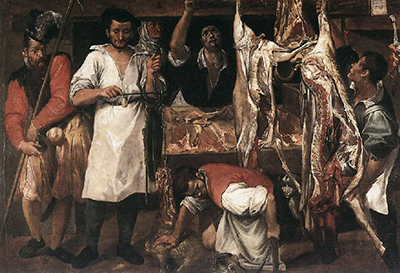
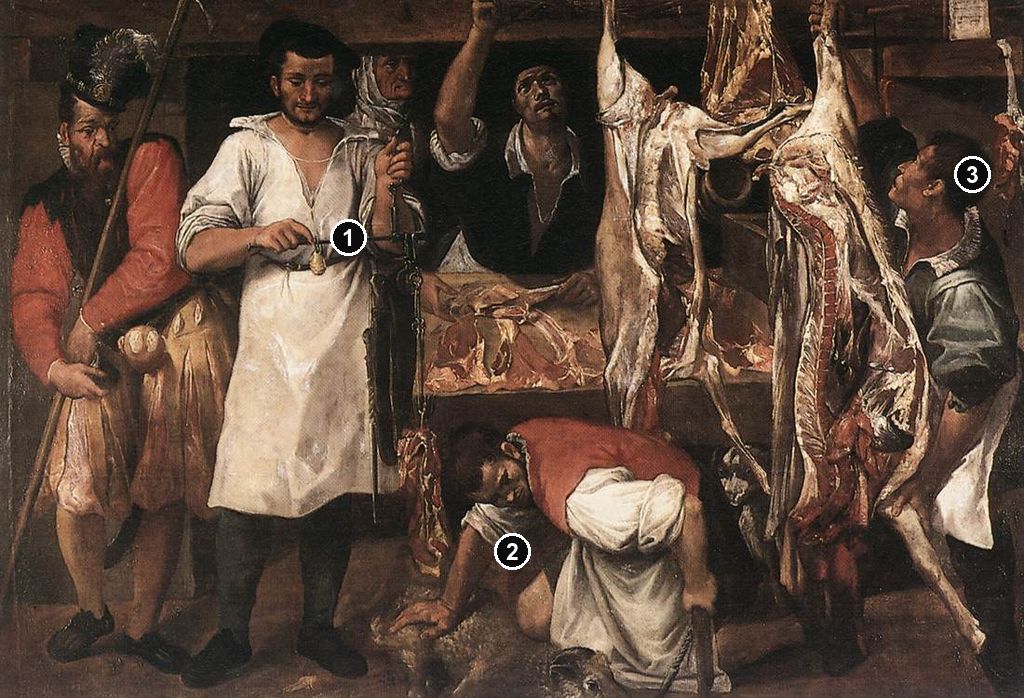
A butcher in a white apron holds a piece of meat clear of the floor and watches the beam of his scale. Beside him, a man with a feathered hat and an unwieldy polearm reaches for his money. Across the shop, another butcher raises a heavy cut towards a hook. Annibale Carracci painted these people at nearly life size in the early 1580s. The oil on canvas, now at Christ Church Picture Gallery in Oxford, measures 190 × 272 cm according to the gallery. The size gives the preparation and sale of meat a prominence unusual in Italian painting of the period. [1]
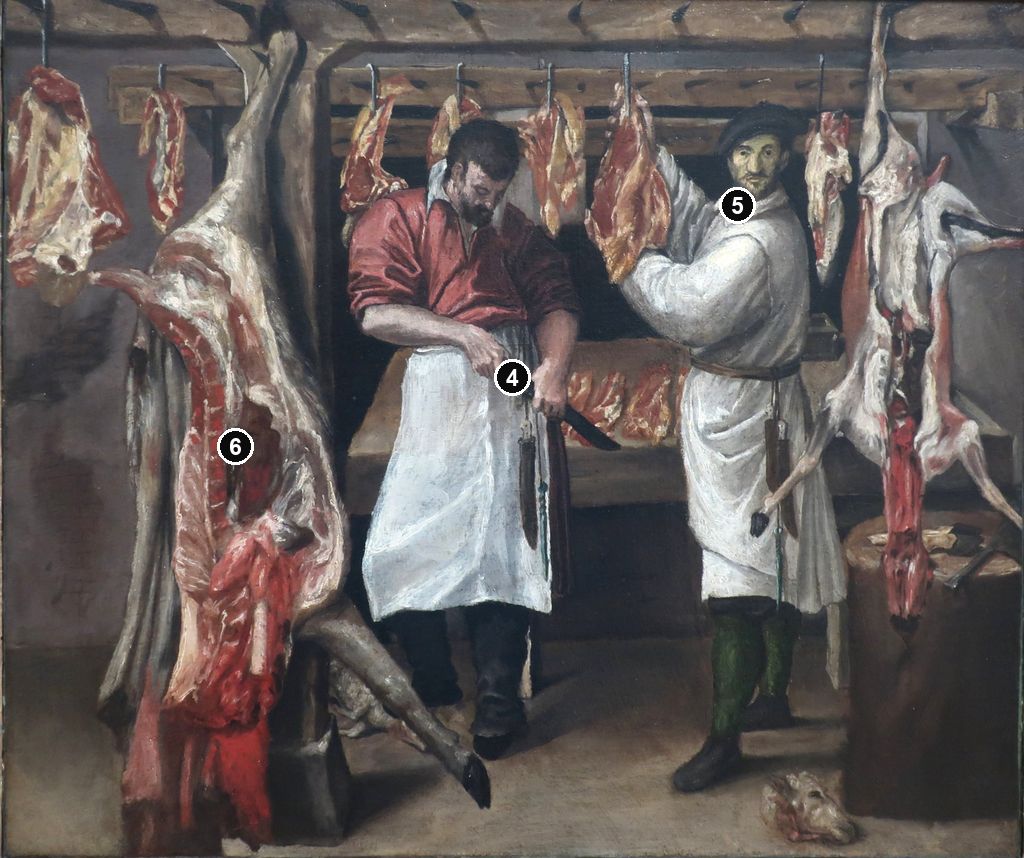
Carracci painted a second Butcher’s Shop, now in the Kimbell Art Museum in Fort Worth. The Kimbell’s oil on canvas, accession AP 1980.08, measures 59.7 × 71 cm and is also dated to the early 1580s. Its two butchers stand between rows of hanging meat in a narrow interior. In Oxford, the shop becomes a broad stage for several tasks carried out at once. In Fort Worth, the low beams and large carcasses bring the viewer close to two men absorbed in their trade. The dates are approximate, and the smaller painting’s size alone gives no grounds for making it a study for the larger one. [1] [2] [3] [4]
At a Glance
- ArtistAnnibale Carracci
- DateEarly 1580s
- MediumOil on canvas
- Oxford versionChrist Church Picture Gallery, JBS 181. Oil on canvas, 190 × 272 cm.
- Fort Worth versionKimbell Art Museum, AP 1980.08. Oil on canvas, 59.7 × 71 cm.
Contents
- The Oxford painting and the work of the shop
- The drawing that shows how Carracci planned the scene
- Michelangelo and Raphael in an ordinary shop
- The Bolognese meat trade and the question of patronage
- From Mantua to Christ Church
- The Kimbell painting in Fort Worth
- How Carracci recast the market picture
- Annotated details
The Oxford painting and the work of the shop
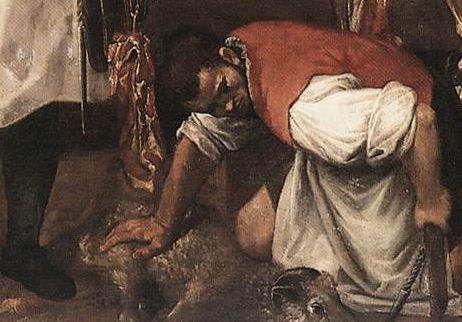
The Oxford scene gives four workers different jobs. The nearest crouches over a ram, steadying it with one hand and holding a blade low in the other. His bent back and bare legs come forward almost to the bottom edge. At the right, a worker reaches up to suspend a cut alongside meat already hanging from the beams. Behind the counter, another raises his arm towards what has been identified as a sprig of willow, the sort of flexible stem that could tie a parcel. An older woman stands nearby. Cuts are laid out on the counter between them and the viewer, while a dog peers from the shadows below. The butcher with the scale completes the sequence that the eye can trace from the animal on the floor to suspended carcasses, cuts on the table and meat weighed out for sale. [1] [4] [5]
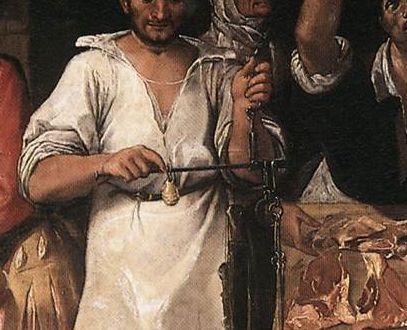
The scale is a steelyard, known in Italian as a stadera. A cut dangles below one part of the beam, and a counterweight is moved along the other until it balances. Unlike a pair of scales with two pans, the steelyard needs only a single movable weight. The butcher’s interest is concentrated in the small interval between his hands, where his fingers control the beam. His stance is steady enough to make the uneven pitch of the halberdier’s body beside him conspicuous. The knife and sharpening steel at the butcher’s waist belong to the same working day, but his attention at this moment is on measurement. [3] [5]
A separate kind of weight dominates the right of the canvas. The cuts hang unevenly, the light running over pale fat and the edges of bone before falling into dark red hollows. The worker at the edge looks up to the point where he has to fasten the meat, while the weighing butcher looks down. These opposite gazes organise the crowded space. Carracci staggers the shop’s other figures in depth, yet the counter and beams run broadly parallel to the picture’s surface. The arrangement lets the eye move from worker to worker while keeping the meat in view almost everywhere. The shop appears busy without losing its order. [1] [4]
Look too at the apron of the man with the scale. A broad area of pale cloth makes him easy to pick out from across a room. Nearer the painting, flesh, linen and wood are differentiated by the size, direction and density of the marks. The hanging meat takes the most conspicuous paint. Pink, cream and reddish brown strokes remain perceptible as strokes even as they suggest muscle, fat and the gloss of a freshly cut surface. Christ Church singles out this broad handling of the carcass. Feigenbaum connects the visible marks to a larger question about finish. A section that looks roughly worked up close can produce a precise impression of the material from the distance at which the whole scene comes into view. [1] [4]
Annotated Details from The Butcher’s Shop
The numbered points identify visible features discussed in this article. Return from each detail to the numbered overview. Each caption identifies the work shown.
The Butcher’s Shop in Oxford
Annibale Carracci, The Butcher’s Shop. Christ Church Picture Gallery, Oxford, JBS 181. Image source. Public domain.
The Butcher’s Shop in Fort Worth
Annibale Carracci, The Butcher’s Shop. Kimbell Art Museum, AP 1980.08. Image source. Public domain.
Details from THE BUTCHER’S SHOP
Compare the cropped details with the source images above. Notice how their colours, shapes and positions contribute to the larger compositions.
The Butcher’s Shop in Oxford
The steelyard
The butcher in the pale apron holds the balance beam across his body. Its hanging counterweight is visible against the fabric.
The crouching worker
The worker in the foreground folds his body over the animal, with his arm dropping into shadow. The scale of the figure helps pull the work of the shop towards the viewer.
The raised arm
A worker at right reaches above the carcass. The pale painted cuts and the dark contour of his sleeve make separate paths across this part of the canvas.
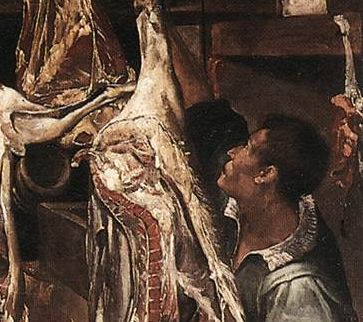
The Butcher’s Shop in Fort Worth
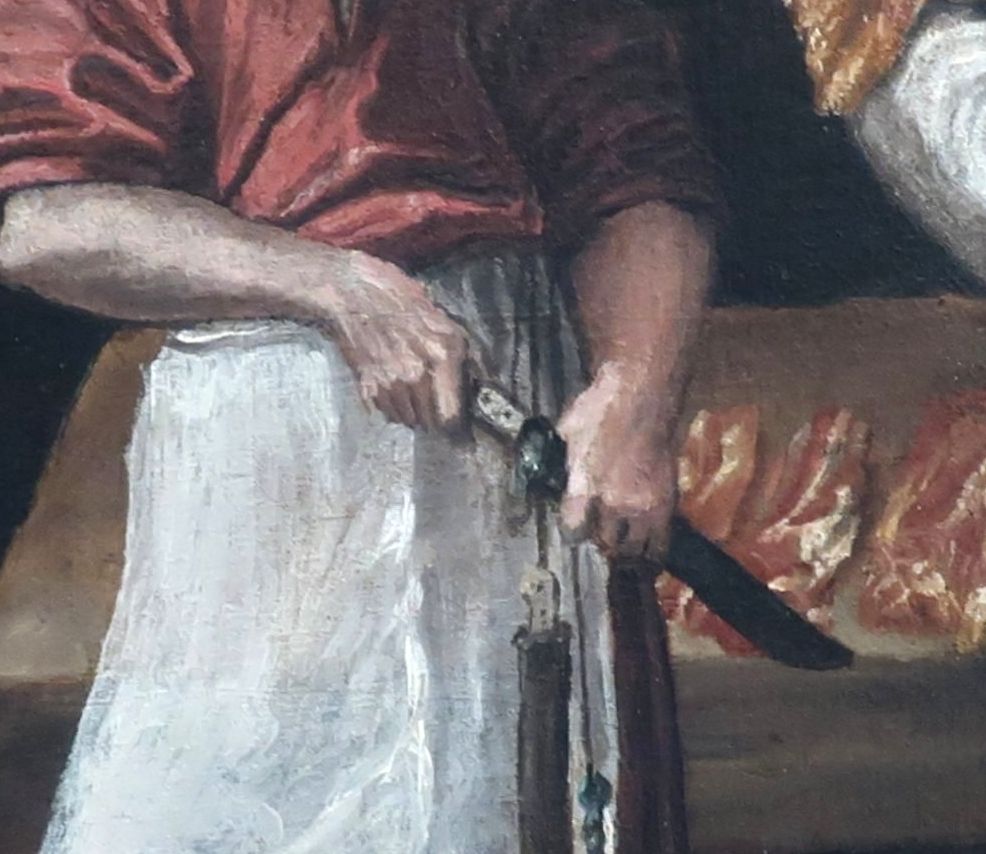
Knife and steel
The red-shirted worker brings both hands together over his pale apron. The light fabric makes the angle of his tools easier to follow.
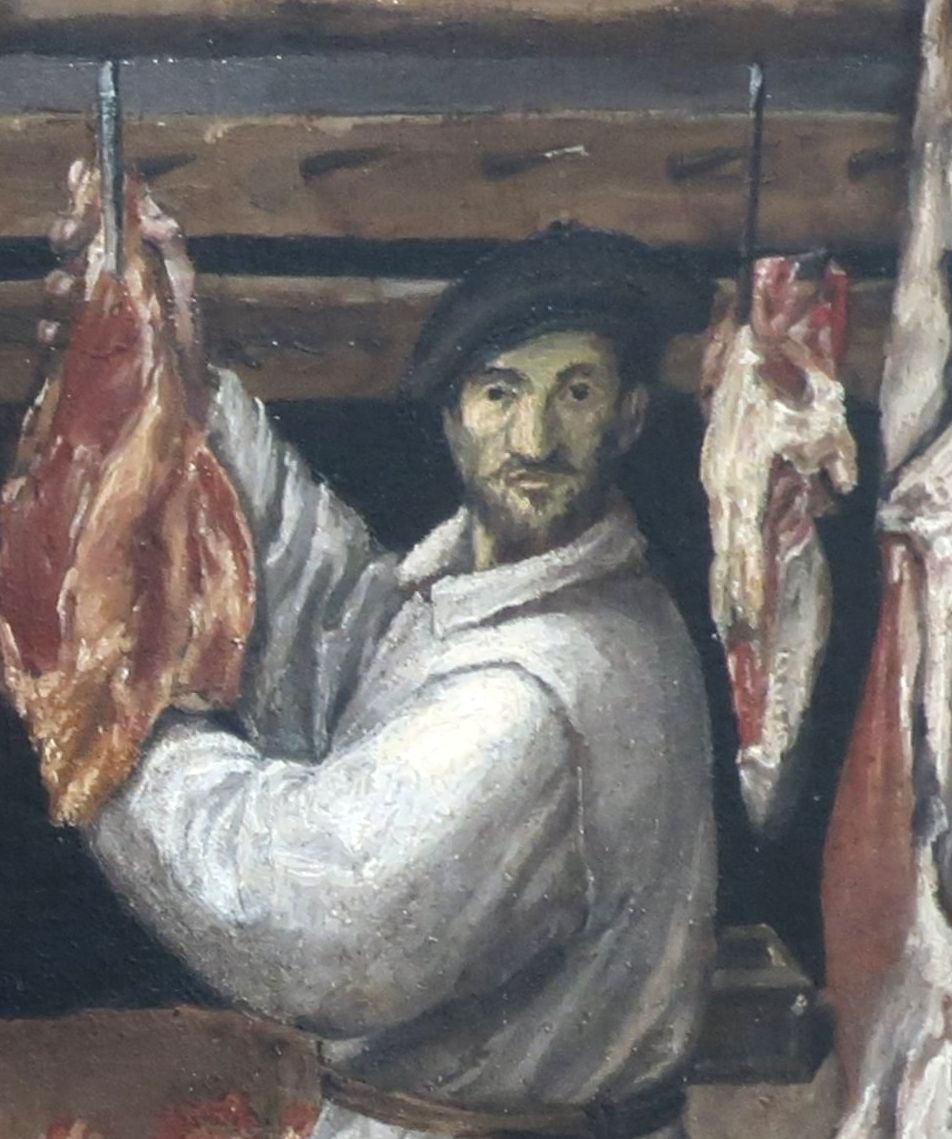
A look across the shop
The more brightly dressed worker glances out while raising a cut of meat. His lifted hand sets a different rhythm from the lowered arms of the red-shirted figure.
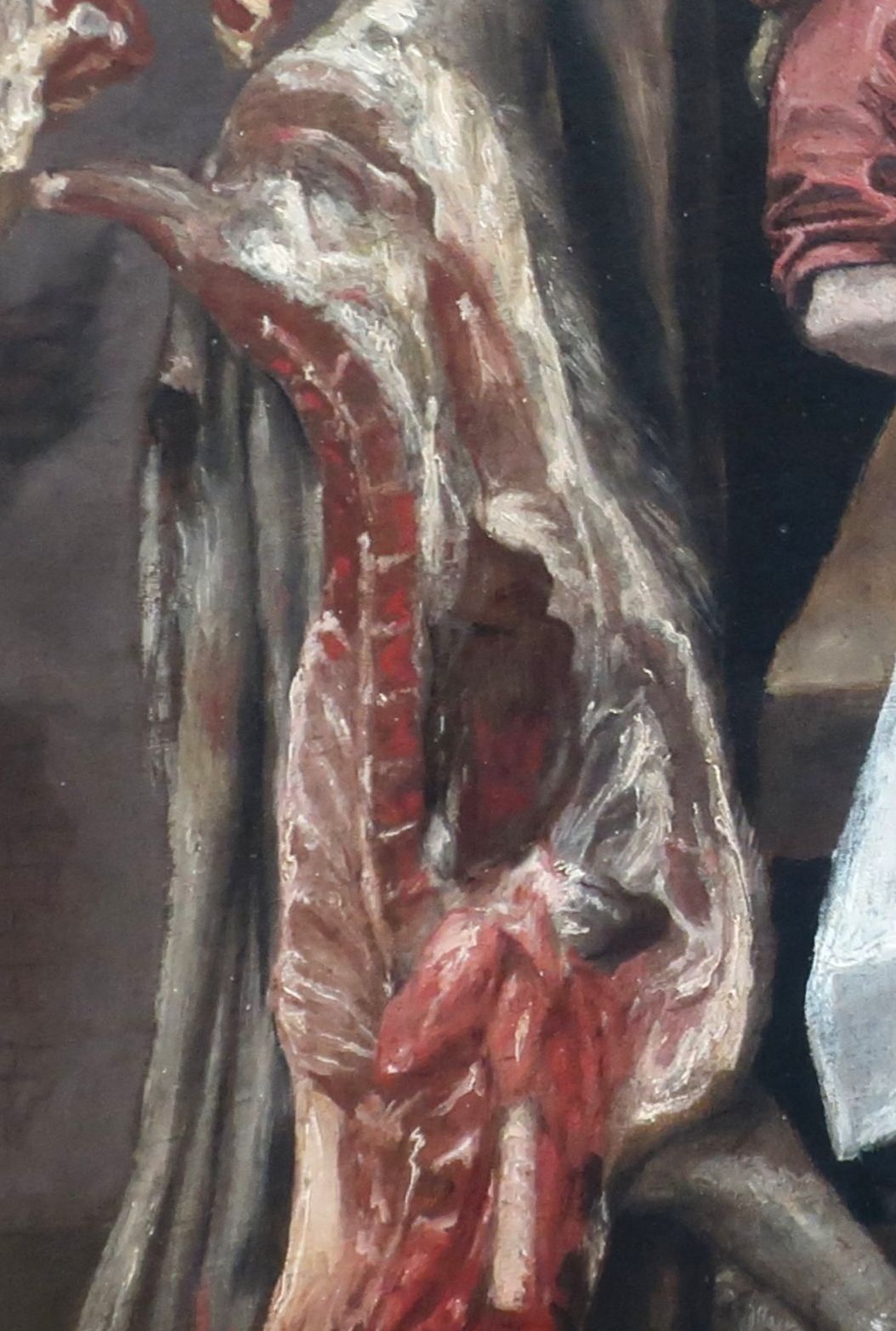
The carcass at left
Pale fat and deeper reds run down the hanging carcass. This intervening shape takes up much of the space that the much wider Oxford canvas gives to its workers.
The drawing that shows how Carracci planned the scene
A red-chalk sheet in the Royal Library at Windsor, A Man Weighing Meat (RL 2215), records preparation for the Oxford butcher. In the main study the model looks younger than the painted butcher, but the open shirt, cap, apron and dark stockings are already there. Carracci paid close attention to the scale. He gave the operation of the counterweight greater clarity than the shape and texture of the piece hanging from it. Off to the right is a separate study of an arm with the sleeve pushed back, closer to the arm in the painting. The canvas adds the belt tools and gives the face a more mature appearance. [3]
The reverse of the sheet preserves part of a compositional sketch. The right-hand worker is already engaged in hanging meat, and the crouching man at the front is visible from behind. The sheet was cropped, so the surviving fragment reveals only part of the plan. Even that fragment shows Carracci reconsidering the participants. Daniele Benati notes that the worker at the right appears older and wears a hat in the sketch. Such differences matter because a figure might combine the observed position of one model with alterations made to suit the whole painting. A convincing trade gesture and an identifiable face are two different kinds of evidence. [3]
The red chalk is economical. A few firm lines establish the width of the stance and the fall of the apron without filling the garment with decorative folds. That economy survives in the Oxford canvas alongside passages of much more forceful brushwork. In the drawing the balance is a mechanical problem to work out. On the canvas it is also a point of attention for the workers, the customer and the person looking at the picture. [3] [4]
Michelangelo and Raphael in an ordinary shop
The Oxford painting was planned with older images in mind as well as real tools and bodies. John Rupert Martin identified parallels with sacrificial scenes in the Vatican, developed in later studies by Gail Feigenbaum and Sybille Ebert-Schifferer. The butcher behind the counter recalls the figure at the sacrificial altar in a scene on Michelangelo’s Sistine Chapel ceiling traditionally called The Sacrifice of Noah. The woman close to the counter also has a counterpart in that grouping. Vasari himself gave different identifications for Michelangelo’s scene, so the strongest point of the comparison is the grouping of the figures around a raised surface. Annibale makes that surface a shop counter. [4] [6]
The kneeling figure has another proposed model in Raphael’s Sacrifice of Noah in the Vatican Logge. A surviving engraving by Marco Dente transmits the design. In it, men hold a ram near the ground in front of the altar. The bent torso, disposition of the hands and placing of the animal invite comparison with the most prominent figure at the bottom of the Oxford canvas. The circulation of the print offers a plausible route for the motif to reach Annibale. It leaves open which image he actually consulted. [4] [6] [7]
These parallels account for some of the solemnity of the shop. The raised arm and the close grouping around the counter give a commercial exchange the formality of an offering. Christ Church records two further religious readings. The scale can recall Saint Michael weighing souls at the Last Judgement, and the animal at the front can call to mind the Lamb of God. Those associations have the force of recognisable imagery. The order of tasks from slaughter to sale makes equal sense in terms of work and trade. [1] [4]
The use of the old masters can also be read as a claim about painting. At the time, an ambitious history painting usually treated scripture, mythology or an event of public consequence. Feigenbaum argues that Carracci used the forms of such art to give consequence to a subject that connoisseurs could find vulgar. She reads the resulting wit as a kind of praise in an unexpectedly elevated register. Ebert-Schifferer likewise sees a deliberate combination of poses from older painting, a study from life and thick paint reminiscent of late Titian. These arguments explain how the canvas can be so immediate at first glance and so carefully contrived on longer inspection. [4] [6]
The Bolognese meat trade and the question of patronage
Butchery in sixteenth-century Bologna was a closely regulated trade with powerful interests at stake. Paul Freathy and Ian Thomas trace the guild’s role in providing and policing the city’s meat supply. Slaughter generated waste and fears of contagion, and sellers had to maintain the confidence of customers who could seldom judge a cut’s origins or weight by inspection. The city concentrated slaughter and trading facilities, and the established market near Porta Ravegnana remained close to customers when a new facility was developed in the 1560s. In this setting, the Oxford butcher’s conspicuous weighing is about more than dexterity. An open display of the measure makes the terms of an exchange visible. [8]
A pale square high in the right corner has been read as a posted price list. A Bolognese edict of 1539 required shops and stalls to display fixed meat prices, and inspectors could check what a customer had paid and whether the meat was properly weighed. The clean apron and the almost unmarked floor similarly present the trade at its most orderly. There is an important discrepancy with local practice. Benati points out that slaughter took place away from the shop, although Carracci gives that act the most conspicuous position in the foreground. The painting brings several stages of the trade into one room and puts an unusual emphasis on the moment that connects it to sacrificial imagery. [3] [5] [8]
The new market gave two brothers, Giuseppe and Girolamo Canobbi, revenues from letting stalls. The family had a chapel at Santi Gregorio e Siro and commissioned Carracci’s Baptism of Christ, installed in 1585. Historian Mario Fanti proposed the family as possible patrons of the Oxford shop. The known altarpiece establishes a real connection between the painter and wealthy people in the meat trade. The shop’s large format and the care with which Carracci shows the work make the hypothesis plausible. The original commission, location and audience remain undocumented. A Canobbi residence, a business setting and the guild’s own premises would each have given the picture a different function. [3] [4] [8]
The halberdier and the woman complicate any simple tribute to the shop. She is easy to miss behind the table, while his bright clothes and awkward movement are immediately visible. Barry Wind saw a comic element in the customers, with a sexual double meaning in the woman’s gesture near the meat. Freathy and Thomas read the uniformed man as a possible reference to papal government and to tensions over regulation. They also compare the counter scene with Straordinario della Carne, an etching from the series known as Le Arti di Bologna. The print, issued in 1646 by Simon Guillain II after a design attributed to Annibale, shows a meat inspector dealing with a customer. The comparison makes a civic reading possible without identifying the soldier’s office or settling what the elderly woman is doing. The purse and scale also support a straightforward reading of a customer getting ready to pay. [5] [8] [9]
The painter’s family had its own connection with the occupation. Vincenzo Carracci, Annibale’s uncle and Ludovico’s father, belonged to the butchers’ guild. Martin took the connection further and proposed that the Oxford workers include Annibale, his brother Agostino and his cousin Ludovico, with their trade standing for the painters’ commitment to observation from life. Donald Posner read the scene as an observed portrayal of butchers, and Benati questions the likenesses in light of the changes visible in the Windsor drawing. Valérie Boudier returns to the analogy between artist and butcher through the precision of their tools and the ways each gives form to material. That analogy works independently of the proposed likenesses, which remain unconfirmed. [1] [3] [4] [10]
From Mantua to Christ Church
The Oxford picture enters the documentary record through the Gonzaga collection in Mantua. It was among the paintings acquired by Charles I in the negotiations of 1627–28. The Royal Collection’s catalogue places the purchase alongside a group of works by Titian and pictures by Correggio, Giulio Romano and Caravaggio. Whatever its first setting, the shop had become a work of courtly collecting early in its recorded life. It came to Christ Church through the bequest of Major-General John Guise in 1765 and is catalogued there as JBS 181. [3] [5] [11] [12]
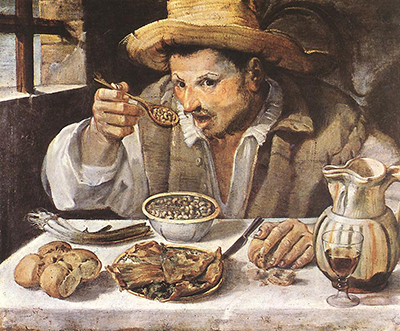
The painting was exhibited at the 1956 Carracci exhibition in Bologna alongside The Bean Eater, now in the Galleria Colonna. Seeing them together encouraged study of how Annibale matched the way he painted to his choice of subject. In The Bean Eater, one man’s glance and the pause over a meal hold attention. In the Oxford shop, separate gestures unfold across a broad canvas and several tradesmen are given the physical presence of figures in a grand narrative. The exhibition photograph in the Fondazione Zeri archive records that twentieth-century return to Bologna. [12] [13]
The Kimbell painting in Fort Worth
The Kimbell canvas puts two men between the viewer and a butcher’s bench. A man in a red shirt drops his head over the knife and steel at his waist. Beside him, a man in pale sleeves and green stockings raises a cut towards the overhead rail and turns his head out. A large carcass fills much of the left foreground, and another hangs at the right over a round block. Between them is a row of smaller cuts, spaced high across the wall. No customer interrupts this pair. The man who looks out is the closest the picture comes to acknowledging the viewer. [2]
Space is compressed by the low overhead timbers and by the positions of the carcasses, which overlap the block and the figures’ outlines. The bench recedes behind the two men. A slant of dark paint on the floor, a momentary brightness along the underside of a beam and the edges of the white aprons give this shallow space depth. At the left, the pale ridges and dark red passages of the largest carcass connect with the raw reds and creams of the smaller cuts. The whites of the aprons are cooler and flatter. Similar colours serve noticeably different surfaces. [2]
The Kimbell records that the red-shirted man to the left of the pair was painted over already completed passages. This is a revision made during the development of the Fort Worth composition. It shows that Carracci could lay in substantial parts of the shop before fixing the figure arrangement. The museum describes a limited earthy palette and calls attention to the shadows on the floor and beams. C. D. Dickerson’s study explores how the light creates an impression of painting done before the motif, even though he understands the work as studio painting. The directness is a pictorial effect as well as a way of handling oil paint. [2] [14]
The Kimbell’s published ownership history begins at Haddo House in Scotland with the family of the Marquesses of Aberdeen and Temair. After a Christie’s sale in London in 1978, the picture passed through Thomas Agnew and Son and was acquired by the Kimbell Art Foundation in 1980. That history belongs to this smaller canvas. A named early patron and an original shop location are still open questions. [2] [14]
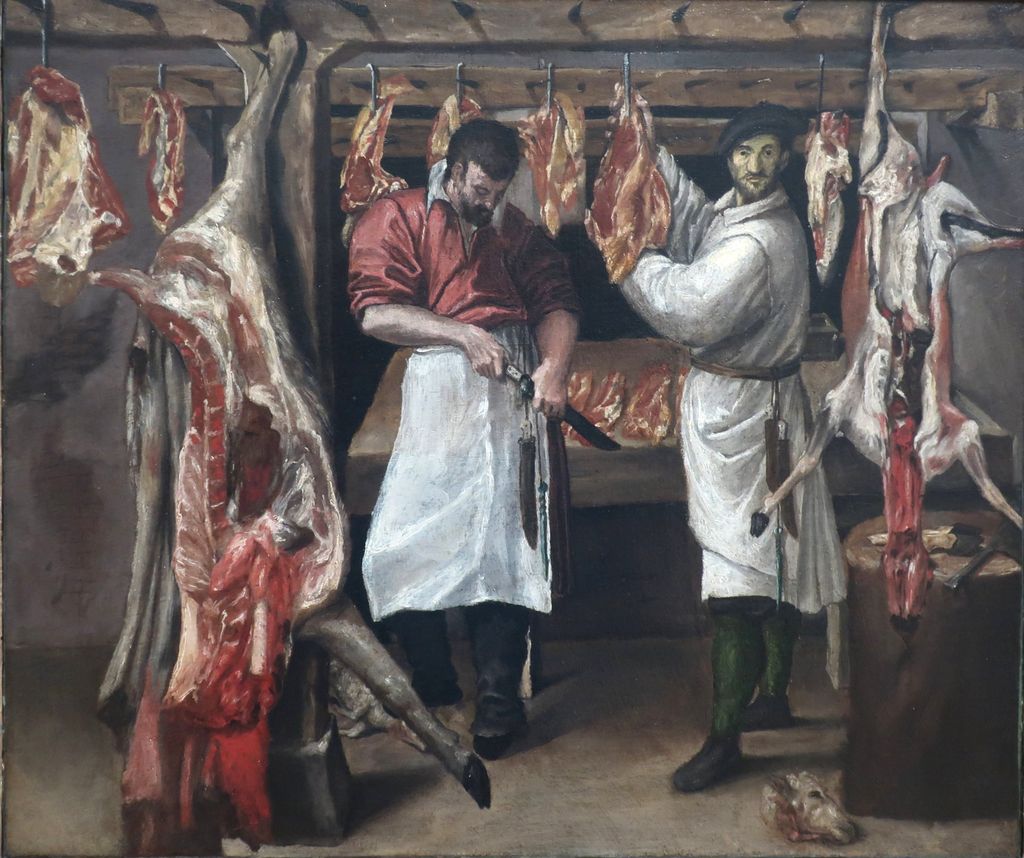
Annibale Carracci, The Butcher’s Shop. Kimbell Art Museum, AP 1980.08. Image source. Public domain.
How Carracci recast the market picture
Carracci had precedents for the shop subject. In Bartolomeo Passerotti’s Macelleria, now in Palazzo Barberini, two vendors grin behind their counter amid an abundant stock of meat. The Barberini records it as part of a group of four paintings that included a fish shop. The vendors in the butcher scene actively present their merchandise to the viewer. In Carracci’s Oxford painting the work has its own sequence, and the men look chiefly at what they are making, weighing or lifting. The Fort Worth worker who does meet the viewer’s eye still has his hands occupied. [1] [2] [15]
An earlier Northern European comparison is Pieter Aertsen’s Butcher’s Stall with the Flight into Egypt of 1551, in Uppsala University’s collection. An ox head and the stock of the stall fill the foreground, while the Holy Family giving alms occupies a much smaller opening in the distance. Carracci brings possible sacred echoes into the positions and actions of the full-size shop workers themselves. Benati notes that pictures by Aertsen and Joachim Beuckelaer were present in Northern Italian collections. Their market scenes establish a visual tradition in which Carracci could work. The Uppsala painting makes the difference between their approaches visible without requiring a claim that he saw that specific panel. [3] [4] [16]
Set the paintings beside each other and the little actions pick out Carracci’s change of emphasis. In Oxford the weighing butcher has an observer inside the painting. The halberdier’s awkward reach toward his purse draws the viewer into the transaction, with the production of that purchase spread out behind and around him. In Fort Worth the pale-sleeved worker looks outward while keeping hold of the meat. The viewer takes the place of a visitor at the stall, close enough to follow what his hands are doing.
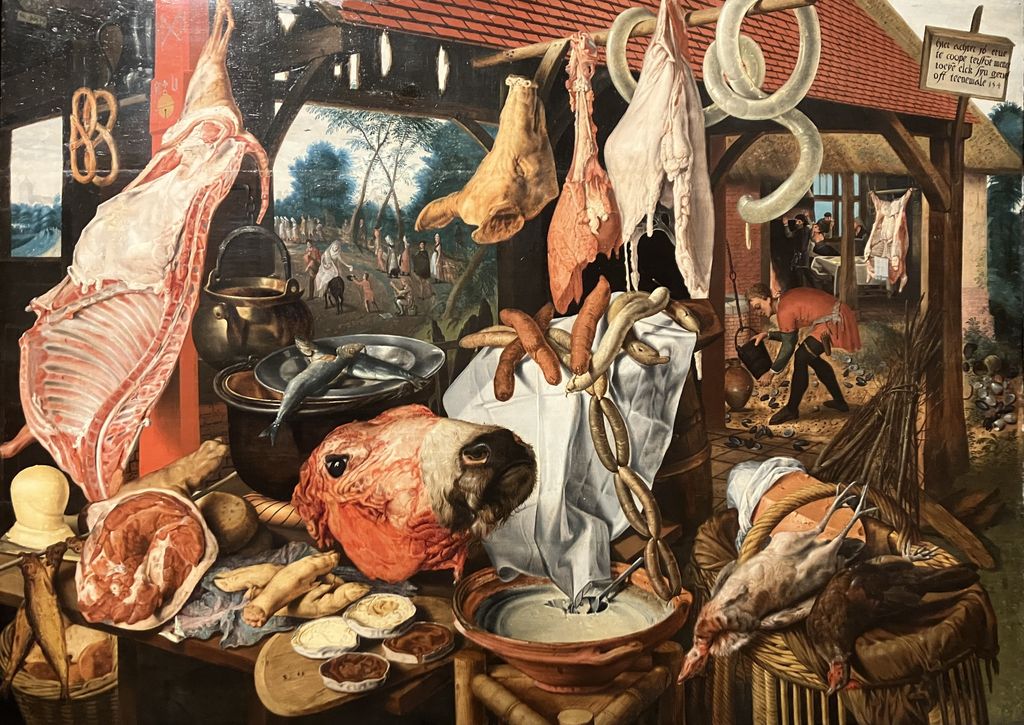
Pieter Aertsen, Butcher’s Stall, 1551. Uppsala University art collections, UU 1. Image source. CC0 / Public domain.
A study of the Kimbell painting
Raw Painting: The Butcher’s Shop by Annibale Carracci. C. D. Dickerson III. Kimbell Art Museum and Yale University Press, 2010.
A study of the Kimbell canvas and the early work that put everyday labour at the centre of the painting. View the publisher’s record.
Artworks directory
Paintings, frescoes, drawings and prints, with separate entries for documented versions and collaborative projects.
Discussion
Look again at the images and ideas explored in The Butcher’s Shop. These editorial prompts invite your observations.
Reader Insights
Which gesture shows the work of the shop most clearly?
How does the difference in scale between Oxford and the Kimbell change the relation between the tradesmen and the viewer?
Join the Conversation
Share a detail, comparison or question about The Butcher’s Shop below.
References
- Christ Church Picture Gallery, “Annibale Carracci: The Butcher’s Shop”. View source.
- Kimbell Art Museum, The Butcher’s Shop, AP 1980.08. Museum’s parallel record on Google Arts & Culture. View source 1. View source 2.
- Daniele Benati, “A Man Weighing Meat,” in The Drawings of Annibale Carracci, National Gallery of Art, 1999, no. 1, pp. 49–50. View source.
- Gail Feigenbaum, “Vulgarity and the Masterly Manner: Annibale Carracci Cites His Sources,” Mitteilungen des Kunsthistorischen Institutes in Florenz 63, no. 1, 2021, pp. 147–159. John Rupert Martin, “The Butcher’s Shop of the Carracci,” The Art Bulletin 45, no. 3, 1963, pp. 263–266. View source 1. View source 2.
- Mike McKiernan, “Annibale Carracci: The Butcher’s Shop c.1583,” Occupational Medicine 61, no. 8, 2011, pp. 529–530. Full-text copy. Barry Wind, “Annibale Carracci’s ‘Scherzo’: The Christ Church Butcher Shop,” The Art Bulletin 58, no. 1, 1976, pp. 93–96. View source 1. View source 2. View source 3.
- Sybille Ebert-Schifferer, “Zwischen Tabula rasa und Normerwartung: Kreativität in der Kunst am historischen Beispiel der Malerei,” 2008, pp. 124–126. View source.
- The Metropolitan Museum of Art, Marco Dente, Noah’s Sacrifice. View source.
- Paul Freathy and Ian Thomas, “Hegemony and Protectionism in Bologna’s Meat Trade: The Role of Visual Imagery in Reputation Management,” Enterprise & Society, 2021. University of Stirling author manuscript. View source 1. View source 2.
- Catalogo Generale dei Beni Culturali, Simon Guillain II after Annibale Carracci, Straordinario della Carne, Biblioteca Comunale, Urbania. Bibliothèque nationale de France record. View source 1. View source 2.
- Valérie Boudier, L’Art de trancher. Carrache, Crespi, Friedmann, Institut national d’histoire de l’art, 2026. View source.
- Royal Collection Trust, The Art of Italy in the Royal Collection: Renaissance and Baroque, introduction. View source.
- L’«Ideale classico» del Seicento nella storia dell’arte del Novecento, Fondazione 1563, pp. 74–75 and 85–86. View source.
- Fondazione Federico Zeri, A. Villani e Figli, exhibition photograph of La bottega del macellaio, 1956. View source.
- C. D. Dickerson III, Raw Painting: “The Butcher’s Shop” by Annibale Carracci, Kimbell Art Museum and Yale University Press, 2010. View source.
- Gallerie Nazionali di Arte Antica, Palazzo Barberini’s North Wing collection notes, “Macelleria”. View source.
- Gustavianum, Uppsala University, Pieter Aertsen, Butcher’s Stall with the Flight into Egypt, UU 1. Getty CONA record for the Uppsala painting. View source 1. View source 2.