 by Tom Gurney
Tom Gurney BSc (Hons) is an art history expert with over 20 years experience
Published on June 19, 2020 / Updated on November 29, 2026
Email: tomgurney1@gmail.com / Phone: +44 7429 011000
River Landscape: Introduction
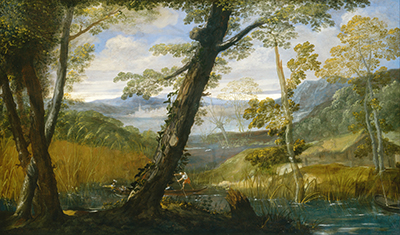
A dark tree cuts across Annibale Carracci’s River Landscape, hiding part of a boat and almost dividing the view in two. A flash of white and red on the boatman’s clothes brings the eye down to the water, while the bend of the river draws it back towards a pale town under the mountains. The painting is an oil on canvas measuring 88.3 by 148.1 centimetres. The National Gallery of Art in Washington, DC, dates it to about 1590. Its title gives unusual prominence to the setting for a painting by Carracci. The four people in the boat give the scene its human scale, and their journey is one of several things to discover in the landscape. [1]
At a Glance
- ArtistAnnibale Carracci
- DateAbout 1590
- MediumOil on canvas
Contents
- The river, the boat and the foreground trees
- How Carracci built up the painted surface
- From observed detail to a composed view
- The missing companion painting
- From a Velázquez attribution to the Kress Collection
- Carracci’s landscape and its reception
- Annotated details
The river, the boat and the foreground trees
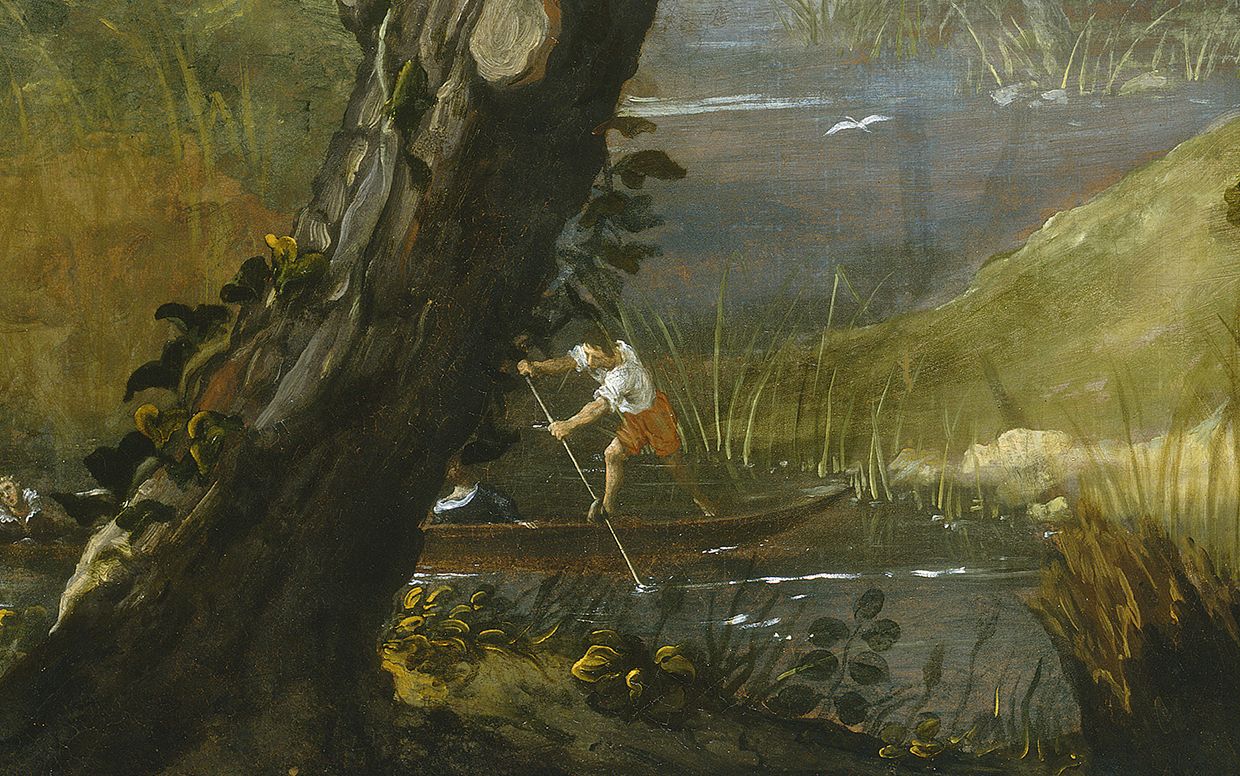
The trees nearest us are more than a border around the view. A group of trunks rises through the left side, and the thickest tree leans from low in the picture towards the upper centre. Its angled trunk seems almost close enough to touch. Look to either side of its base and you can make out passengers at the left and the standing boatman at the right. The hull runs almost horizontally behind the strongest diagonal in the composition. By interrupting the hull, Carracci gives the tree weight and makes the boat feel as though it is passing behind it, briefly visible through a break in the trees. [1]
The long pole is one of the smallest things in the picture with one of the clearest functions. The boatman bends into it, pushing against the riverbed. His stance gives a sense of shallow water and slow progress, even where the depth is hard to judge. The three seated or reclining passengers have the luxury of staying where they are. Look for the light collar and the feathered cap among them. These little touches suggest an outing without explaining where anyone came from or what they will do next. Across the water, a thatched hut and a distant cluster of pale buildings mark successive points of habitation. The Gallery’s catalogue discusses the suggestion that a reclining passenger holds a mirror, a detail that could change the tone of the excursion. The object is too indistinct to identify securely, and the catalogue reads the group as people enjoying the river. [1] [2]
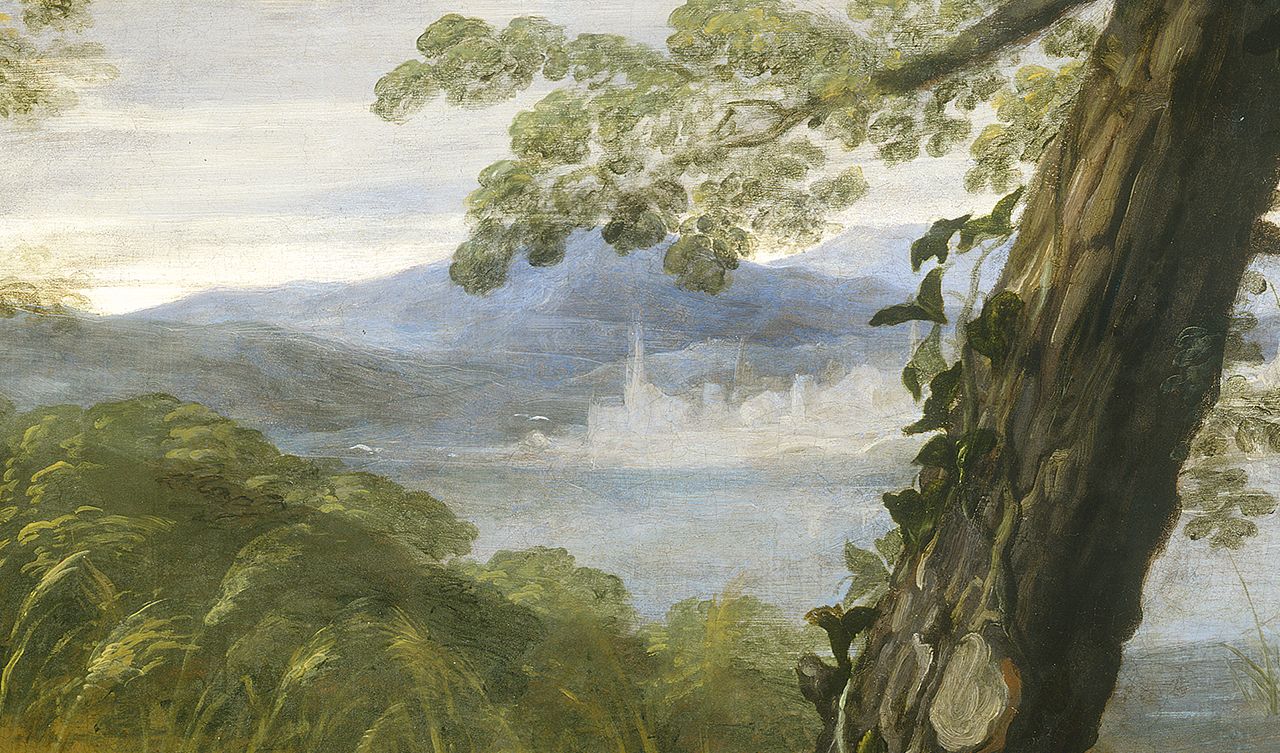
The river occupies much of the lower right corner, where its ripples are light marks against cool, dark water. A bank projects in from the right near the hut. Farther away, the opposite bank leads the eye back across the canvas, and a succession of paler stretches of land and water leads it into the centre. Those alternating projections give the painting its rhythm. The recurrence of slender trees along the banks also gives the eye a way of judging distance. In the foreground a single trunk can conceal several people. In the distance, entire buildings read as a few strokes of light paint. [1] [2]
A viewer can follow the picture in the opposite direction, too, from the hazy horizon back to the reeds and the dark bank. That movement brings out two sorts of light. The distant town sits in an area of diffuse pale blue and white. Nearer at hand, light picks out separate surfaces, such as the tops of the grasses and patches of golden foliage. The National Gallery of Art suggests early autumn as a way of reading the foliage. The suggestion fits the colour, while the contrast between the shaded foreground and the bright air beyond accounts for much of the picture’s sense of a particular moment. [1]
Annotated Details from River Landscape
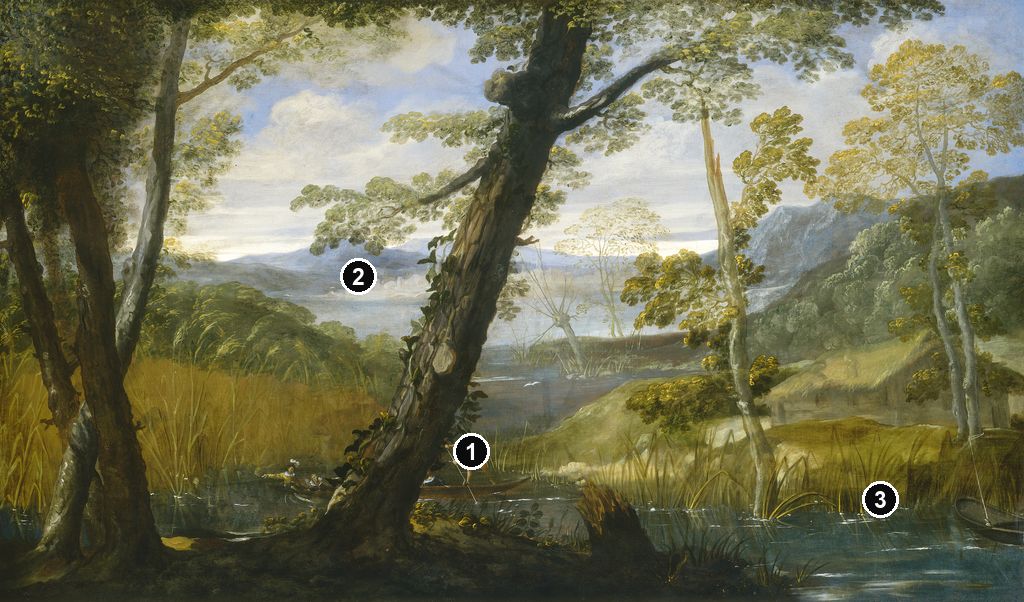
The numbered points identify visible features discussed in this article. Return from each detail to the numbered overview. Annibale Carracci, River Landscape. National Gallery of Art, Washington, 1952.5.58. Image source. CC0 / Public domain.
Details from RIVER LANDSCAPE
Compare the cropped details with the source images above. Notice how their colours, shapes and positions contribute to the larger compositions.
A small figure on the water
A pale figure is visible beside the leaning trunk. The small mark makes the near trees and the reach of water behind them feel much larger.
The distant town
The white buildings sit beyond the river, beneath the cooler hills. Their vertical accents register at a distance where most of the slopes read as broad masses.
Reeds and reflections
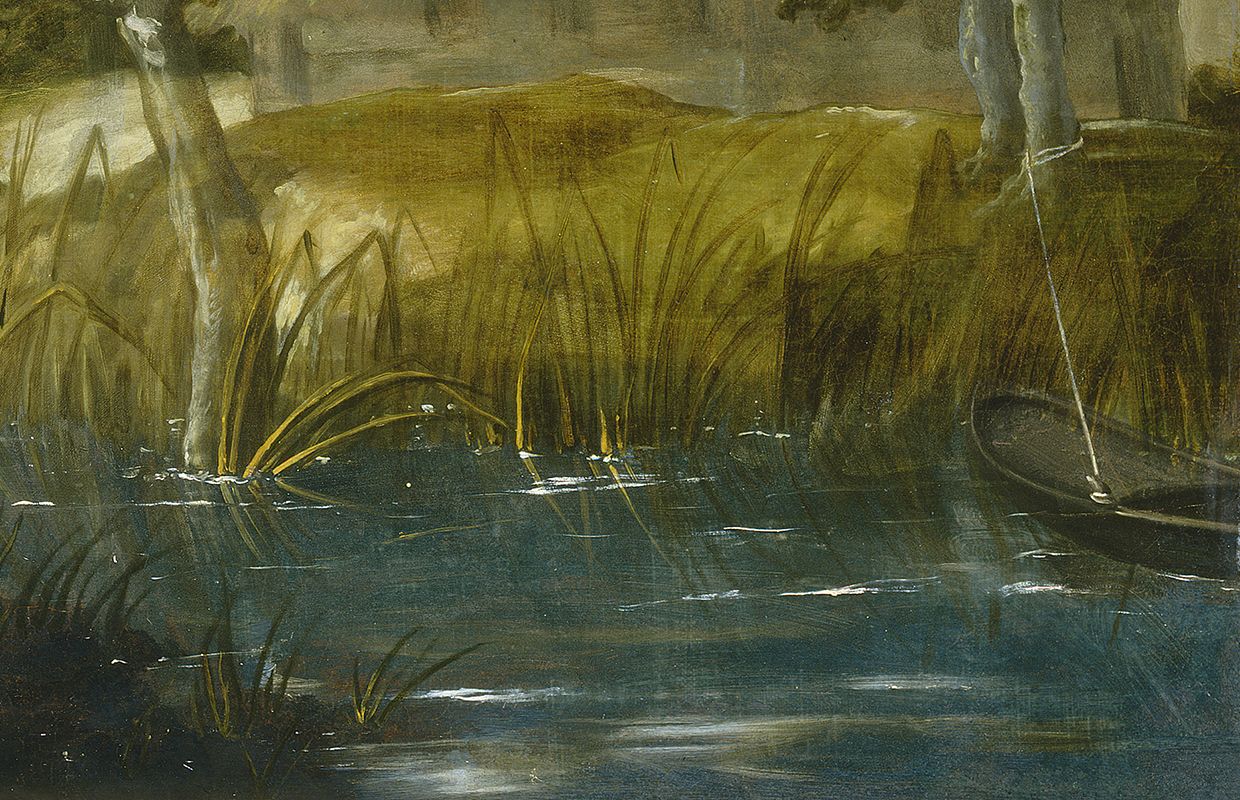
Narrow reeds stand against bands of water. Fewer sharp outlines and lighter crossing strokes distinguish reflected light from the plant stems.
How Carracci built up the painted surface
The National Gallery of Art’s technical examination describes a loosely woven canvas prepared with a single red ground. Here the ground was part of the colour scheme. Thin dark paint allows some of its warmth to remain perceptible, and lightly brushed, more opaque colours can catch over it. The reeds left of centre are a useful place to see the effect. A thin greenish-yellow layer establishes the clump before individual stalks are picked out. Up close, those marks look sketchy. At the scale of the whole picture, they make the edge of the water feel uneven and alive. [2]
The order of work helps explain how the image holds together. Carracci first blocked in the large foreground trees and the dark ground around them, then added the sky and distant land. He laid smaller trees, reeds, people and parts of the final definition of the larger shapes over those layers. The catalogue records revisions, or pentimenti, chiefly in the trees. The riverside looks casually encountered, yet those changes show Carracci adjusting the forms that govern how much of the distance we can see. The catalogue also records wear and small losses in the sky and background and around the central tree. Stephen Pichetto relined the canvas and removed discoloured varnish in 1948. In 1985–86, Teresa Longyear again removed discoloured varnish and retouched areas where wear allowed the ground to show through in distracting patches. The same red layer that helped Carracci unify his colours could break up the image where overlying paint had been lost. [2]
From observed detail to a composed view
The Gallery’s date of about 1590 places the canvas in Carracci’s Bolognese years, near the time he worked with his brother Agostino and his cousin Ludovico on a frieze for Lorenzo Magnani. The Washington catalogue compares the foliage, loosely indicated banks and light touches on the water with the landscape around Romulus and Remus in the frieze. The fresco uses the river setting for a particular moment from the story of Rome’s founding. In the Washington canvas, comparable means of suggesting light and distance are given room to carry the picture. The catalogue also sees a connection with the Louvre’s Fishing, where a figure in a boat offers a parallel to a passenger in the Washington painting. The Louvre’s much larger canvas and its pendant Hunting organise a wider range of human activities across the land and water. [2] [3] [4] [5]
In his 1603 funeral oration for Agostino, Lucio Faberio described drawing hills, fields and rivers in the countryside. The Washington catalogue uses this testimony to discuss the Carracci’s practice of outdoor sketching and its likely importance for Annibale’s studio landscapes. Surviving drawings give a sense of how he organised such observations with a pen. In River Landscape with Boats, a separate sheet in the Cleveland Museum of Art dated about 1590, a gnarled bank-side tree anchors the left side and a standing figure poles a boat close by. The sky and water are spaced out with fine horizontal pen lines, giving relatively few marks a great deal of work to do. The similarities make this an illuminating comparison. A specific source relationship for the sheet has been proposed elsewhere. The catalogue of the Sir Denis Mahon collection traces both a pollarded tree and boats in Landscape with Boating Parties, catalogued there under Domenichino, to the Cleveland drawing. A compositional study for the Washington canvas has yet to be identified. The Washington catalogue treats a pen drawing by Agostino sometimes associated with it, Woodland River with a Boat, as an independent work. For a documented example of how a drawing can relate to a canvas, the Louvre identifies its pen study INV 8063 as a first exploration for Fishing. [2] [6] [7] [8] [9]
In Amsterdam, Carracci’s Landscape with a Fortified Town in the Distance, dated about 1585–87, offers another way into the painting. The Rijksmuseum relates the sheet’s panoramic format and parallel hatching to the example of Domenico Campagnola, whose work Carracci encountered in northern Italy. At the same time, it points to observations like the resting family with sheep and the house with a smoking chimney. Details like these make a place seem inhabited, and Carracci could marshal them into a broad view he designed himself. The Washington catalogue likewise places the canvas in the context of Venetian and Flemish panoramic landscapes. Its exact site remains unidentified. Even if particular features began in sketches of a real place, the sequence of river bends, trees and openings is a pictorial arrangement. [2] [10]
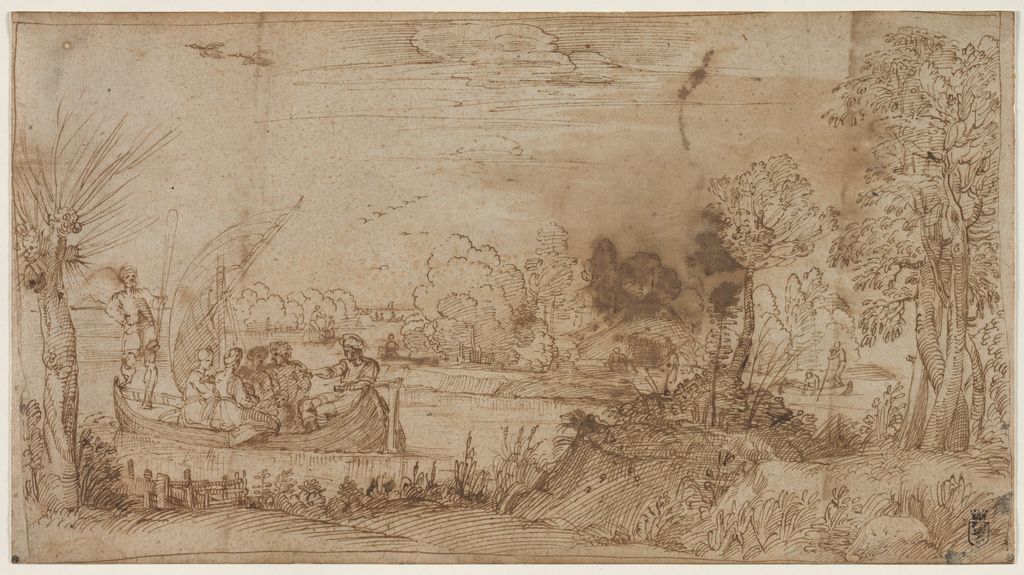
Annibale Carracci, River Landscape with Boats. Pen and brown ink. Cleveland Museum of Art, 1972.101. Image source. CC0 / Public domain.
The missing companion painting
Two prints in a volume published by the Paris dealer Jean-Baptiste-Pierre Lebrun in 1809 offer evidence that River Landscape circulated with a companion. The historian Alessandro Brogi drew attention to the pair of prints, which show the paintings in reverse. The companion shows small figures around a bridge, including travellers and a flock of sheep. Francesco Gatta and Clovis Whitfield identify the two paintings with a pair of landscapes recorded together at Lebrun’s sale in Paris in 1810, where the dealer Pierre-Joseph Lafontaine acquired them. The two canvases were offered as consecutive lots at Christie’s in London in 1811. Gatta and Whitfield note conflicting accounts of the outcome of that sale. How the paintings were separated remains unclear. [11]
Gatta and Whitfield also identify an old copy of the bridge scene in the collection of the Opera Pia dei Poveri Vergognosi in Bologna. Its canvas is smaller than the dimensions recorded for the lost painting, but it preserves enough of the design to recognise the travellers on the bridge, the seated figure in the foreground and the washerwoman behind him. The relationship between the two scenes adds a further dimension to the Washington picture. One view looks across figures travelling by water and the other arranges its figures around a crossing by land. Donald Posner had already suggested that the Washington canvas might have hung above a doorway, a possibility the Gallery’s catalogue considered in light of other Bolognese interiors. Gatta and Whitfield argue that both paintings were overdoors, pointing to the way the scenes accommodate a viewer looking up. The first patron and the original room are still unknown. The scholars also report a later date of 1599 proposed by Silvia Ginzburg, which would place the canvas in Carracci’s Roman period. Washington retains its date of about 1590, and the Fondazione Zeri dates the canvas to 1589–91. [1] [2] [11] [12]
From a Velázquez attribution to the Kress Collection
By the nineteenth century the surviving canvas belonged to John Rushout, second Baron Northwick. It was sold as a Velázquez in the 1859 sale of his collection at Thirlestane House in Cheltenham. It went through Sotheby’s in London in 1931 under the same attribution. F. Kleinberger & Co. sold a half interest to Durlacher Brothers in 1947. The Samuel H. Kress Foundation acquired the canvas in May 1948. William E. Suida published it as a work by Carracci in 1951, and the foundation gave it to the National Gallery of Art in 1952. [1] [2] [13]
The Washington catalogue bases the identification on style. The comparison with the Palazzo Magnani fresco supports it through something more specific than a resemblance between two wooded settings. Both use small touches of colour across foliage, water and figures to draw the eye through a much larger space. The catalogue places it among a small group of generally accepted independent landscapes, a group narrowed as some works were assigned to Agostino. It also compares the Washington canvas with Carracci’s Landscape with Bathing Women and Landscape with River Scene in Munich. The handling of the foliage and lightly brushed distant buildings is close, while the Munich paintings give a larger role to groups of figures. The catalogue suggests the more complicated arrangements in the Munich canvases may make them a little later. [2]
Carracci’s landscape and its reception
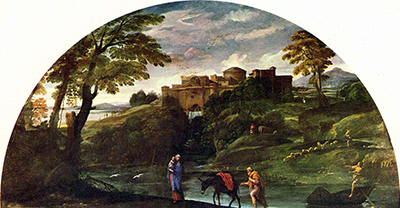
In Carracci’s later Landscape with the Flight into Egypt, made for the Aldobrandini chapel in Rome, a river and bands of land again carry the eye into the distance. The small family is identifiable by its place in a biblical story. In River Landscape, the work of poling the boat and the passengers’ shared passage provide the human incident. The difference helps explain why the Washington canvas belongs in the history of landscape as an independent subject, even though Carracci continued to give religious and mythological figures an important role in many of his landscapes. [1] [14]
The National Gallery in London identifies that later Aldobrandini lunette as the compositional precedent for Domenichino’s Landscape with a Fortified Town, probably painted about 1634–35. Its polemen and small episodes of fishing, shepherding and travel also show how the younger artist elaborated the kind of riverside incident Carracci could suggest with a few strokes. Drawings reached other artists and collectors in a different form. The Rijksmuseum holds a print of boating figures around an island, attributed to Jean-Baptiste Corneille and catalogued as after a design by Carracci, from a series reproducing drawings in the Jabach collection. Here it was the drawn designs, translated into prints, that could circulate. [14] [15]
When the Washington canvas travelled to the 2011 exhibition on seventeenth-century Roman landscape in Paris and Madrid, it appeared as catalogue number one, ahead of a story in which Carracci’s pupils and successors made the form their own. The Prado’s account of that exhibition emphasises Carracci’s role in shaping the kind of carefully ordered landscape later described as classical. The Washington canvas makes that achievement visible through an ordinary crossing. If you start at the boatman’s sleeve, follow the pole to the water and then pick up the line of the bank, you can travel from a gesture that takes a few seconds to a stretch of countryside that seems to go on for miles. [1] [16]
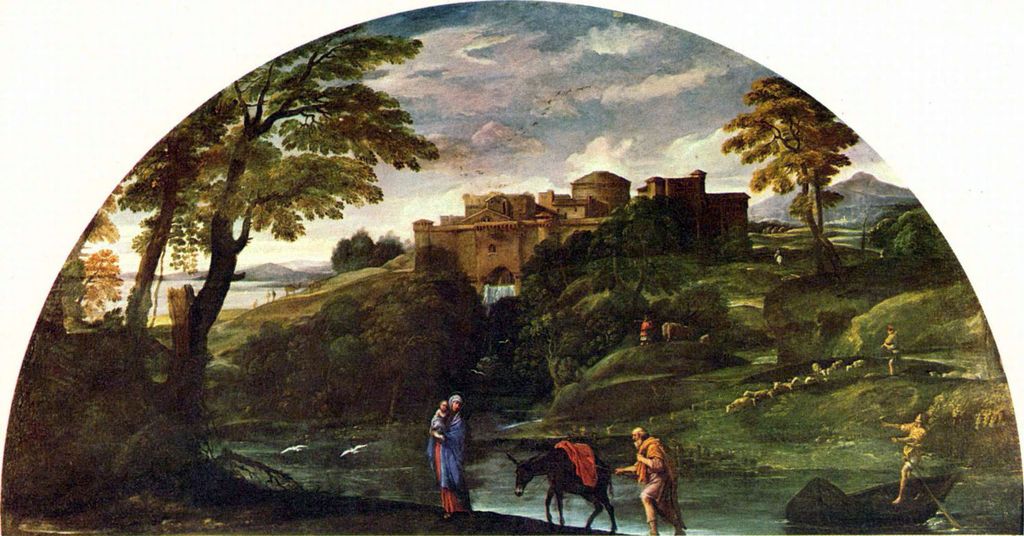
Annibale Carracci, Landscape with the Flight into Egypt. Galleria Doria Pamphilj, no. 236. Image source. Public domain.
Artworks directory
Paintings, frescoes, drawings and prints, with separate entries for documented versions and collaborative projects.
Discussion
Look again at the images and ideas explored in River Landscape. These editorial prompts invite your observations.
Reader Insights
Where does the river turn your eye from the near bank to the middle distance?
What is different about the role of the people in the Washington painting and the Aldobrandini lunette?
Join the Conversation
Share a detail, comparison or question about River Landscape below.
References
- National Gallery of Art, River Landscape, 1952.5.58 View source.
- Diane De Grazia and Eric Garberson, Italian Paintings of the Seventeenth and Eighteenth Centuries, National Gallery of Art systematic catalogue, pp. 45–49 View source.
- Musée du Louvre, La Pêche, INV 209 View source.
- Musée du Louvre, La Chasse, INV 210 View source.
- Anna Ottani Cavina, Annibale Carracci e la lupa del fregio Magnani, École française de Rome View source.
- Cleveland Museum of Art, River Landscape with Boats, 1972.101 View source.
- Discovering the Italian Baroque, Sir Denis Mahon collection exhibition catalogue, no. 19, Landscape with Boating Parties View source.
- National Gallery of Art, Agostino Carracci, Woodland River with a Boat, 1978.70.1 View source.
- Musée du Louvre, La Pêche, INV 8063 recto View source.
- Rijksmuseum, Landscape with a Fortified Town in the Distance, RP-T-2018-44(R) View source.
- Francesco Gatta and Clovis Whitfield, Novità sul ‘Paesaggio fluviale’ di Annibale Carracci a Washington e sul suo disperso pendant View source.
- Fondazione Federico Zeri, Paesaggio fluviale con figure, 57396 View source.
- Samuel H. Kress Foundation, River Landscape, K1539 View source.
- National Gallery, Landscape with a Fortified Town, NG6629 View source.
- Rijksmuseum, Rivierlandschap met kanovarende figuren rond een eiland, RP-P-OB-42.907 View source.
- Museo Nacional del Prado, Memoria de Actividades 2011, Roma. Naturaleza e Ideal View source.