Annibale Carracci.jpg)
 by Tom Gurney
Tom Gurney BSc (Hons) is an art history expert with over 20 years experience
Published on June 19, 2020 / Updated on November 29, 2026
Email: tomgurney1@gmail.com / Phone: +44 7429 011000
Jesus and Saint Peter (Domine, Quo Vadis?): Introduction
Peter has nearly made it out of Rome when he meets Christ walking the other way. In Annibale Carracci’s painting, Christ comes towards us barefoot, carrying a cross. He turns his head to meet Peter’s eye, even as his right hand points beyond the edge of the picture. Peter draws back with his hands raised. The National Gallery in London calls the painting Christ Appearing to Saint Peter on the Appian Way (Domine, Quo Vadis?). Carracci painted it in oil on a wood panel measuring 77.4 by 56.3 centimetres. The Gallery dates it to 1601–02. [1]
At a Glance
- ArtistAnnibale Carracci
- Date1601–02
- MediumOil on wood
Contents
- What Peter asks on the Appian Way
- The cross, the glance and the road
- The studies and the change under the paint
- The cardinal who collected the panel
- Copies, collectors and changing titles
- Annotated details
What Peter asks on the Appian Way
Domine, quo vadis? means “Lord, where are you going?” The question itself has a familiar echo in the Gospel of John, where Peter asks Jesus where he is going before the Passion. The encounter on the road out of Rome belongs to the apocryphal Acts of Peter. It takes place after the Resurrection, when Peter is in danger in Rome. In the apocryphal account, members of the Christian community urge him to leave. Outside the city, he sees Jesus and hears that he is going to Rome to be crucified again. Peter takes the reply to refer to what he himself must face. He returns to the city and is later crucified. At his execution, Peter asks to be placed head down and uses his inverted position to speak about the fallen world. Carracci stops the story before Peter turns back. [2] [3] [4]
The story passed into Jacobus de Voragine’s medieval Golden Legend and became attached to a place that visitors to Rome could identify. The small church of Santa Maria delle Piante, also called Domine Quo Vadis, stands at the junction of the Via Appia and Via Ardeatina, where tradition locates the meeting. By Carracci’s time the encounter also had a pictorial history. [5] [6]
The question and answer are central to Giulio Bonasone’s sixteenth-century print of the story, which the Rijksmuseum connects to a design by Raphael. The Rijksmuseum’s impression shows Peter with his keys just beyond Rome’s gate, with soldiers in the background and the two lines of Latin dialogue written out. Carracci relies on the figures’ movements to convey the exchange. Peter’s arms come up close to his face while Christ’s arm stretches almost straight out. The answer involves a direction and a fate, and Carracci gives each a visible form. The pointing hand establishes a direction beyond the frame. The cross establishes what awaits there. [1] [7]
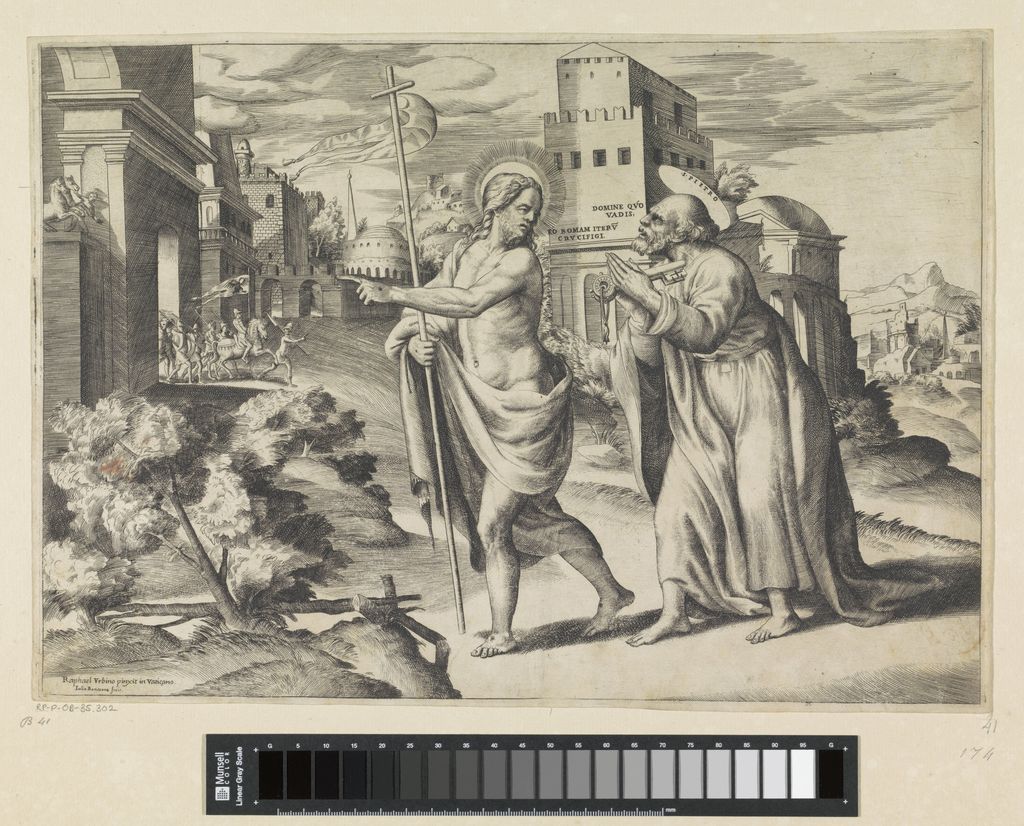
Giulio Bonasone, Christ Appears to Peter at the Gate of Rome. Rijksmuseum, RP-P-OB-35.302. Image source. CC0 / Public domain.
Annotated Details from Jesus and Saint Peter (Domine, Quo Vadis?)
The numbered points identify visible features discussed in this article. Return from each detail to the numbered overview. Annibale Carracci, Christ Appearing to Saint Peter on the Appian Way. The National Gallery, London, NG9. Image source. Public domain.
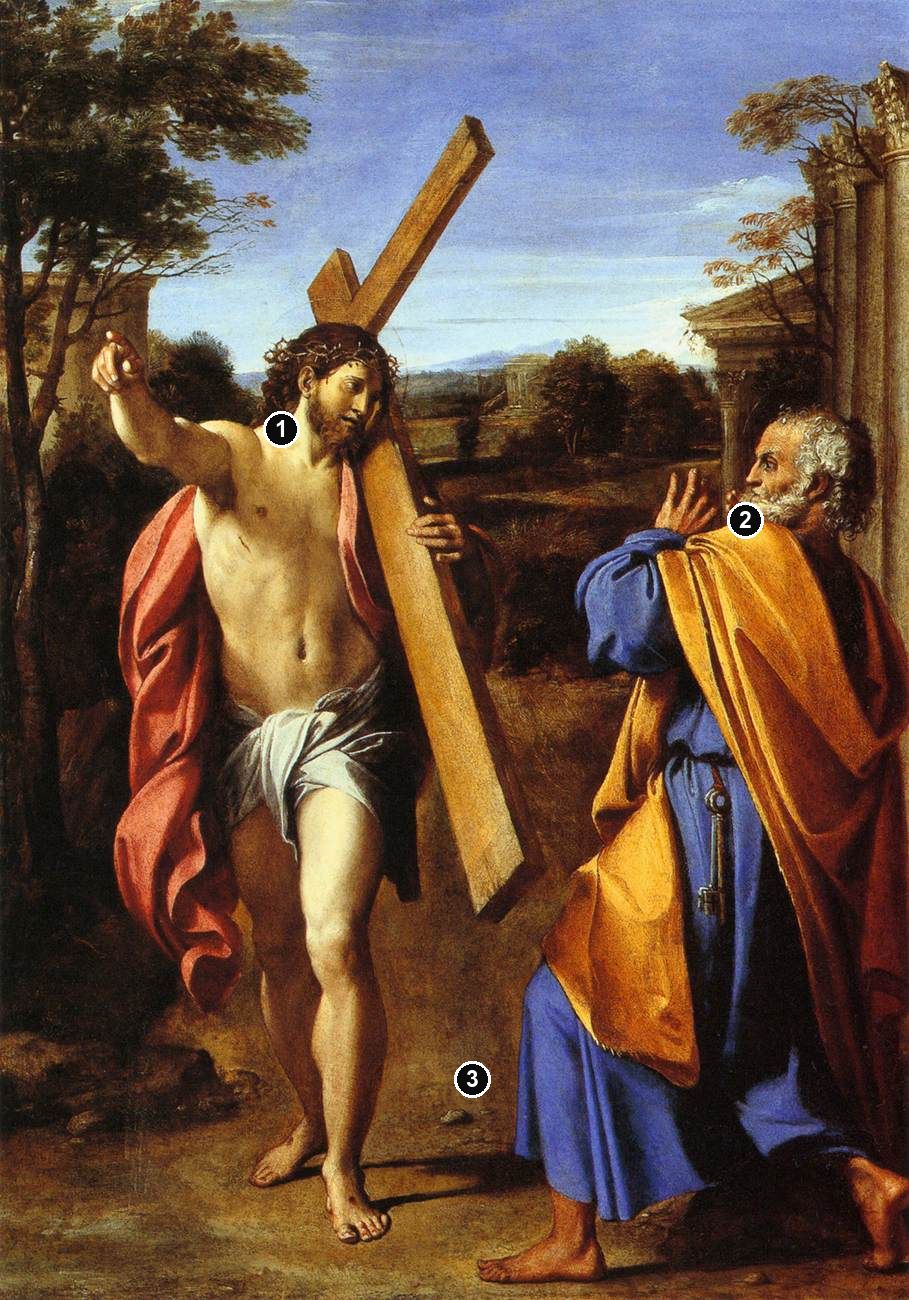
Details from JESUS AND SAINT PETER (DOMINE, QUO VADIS?)
Compare the cropped details with the source images above. Notice how their colours, shapes and positions contribute to the larger compositions.
The two hands of Christ
Christ keeps one hand extended while the other steadies the cross. The two movements establish his direction across the road.
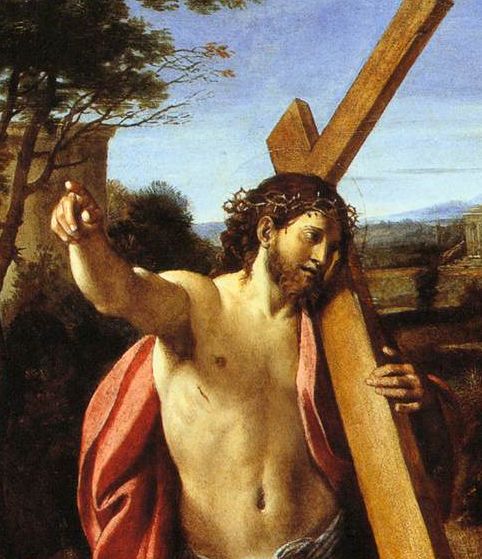
Peter’s response
Peter turns from the far side of the path and raises a hand. The exposed palm and the head in profile make his reaction visible from across the picture.
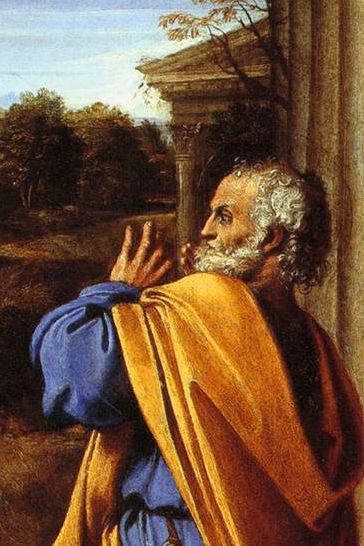
The road between the figures
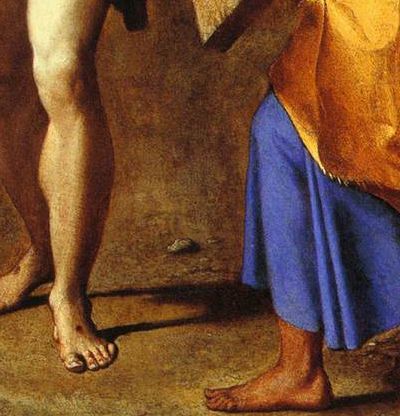
Bare feet and shadows occupy the last stretch of open road. The clear space is narrow enough to put the exchange within speaking distance.
The cross, the glance and the road
Christ holds the upright of the cross low enough for most of the timber to rise above his head. Its upper end leans away from him into the open sky, where the angular wood is easy to distinguish from the branching trees. He wraps his left hand around the wood and braces it against his shoulder. The crown of thorns sits above a downward-turned face, while the exposed torso, twisting waist and advance of his bare feet give him the physical presence of a traveller. The colour and sweep of the red mantle carry that movement down through the figure. It is easy to imagine the wood moving past Peter before the latter has gathered himself to answer. [1]
Peter’s deep blue garment and gold-coloured mantle have the opposite effect. Folds pile up across his near arm, swing round his back and gather over his bent leg. The outline of his body swells into the right side of the panel as he pulls away. Look down and a key hanging at his waist comes into view. Look up again and the most immediate point of contact is the exchange of glances. Peter’s hands almost enter that narrow space between the heads. Carracci separates the figures at the level of the feet and brings them together at the level of the face, so that physical recoil and recognition happen together. [1] [8]
Beyond them, bands of green and grey lead back towards low hills beneath a blue sky. A dark bank and trees stand on the left. On the right, upright columns and the receding edge of a classical building give the setting a Roman character. The two tall margins constrict the action, while the gap between the heads gives a view directly into the distance. The far country offers a possible way out for Peter. Christ’s gesture brings attention back towards the space in front of the painting. Seen from a short distance, the contrast makes the viewer feel close to the path Christ is taking. [1] [9]
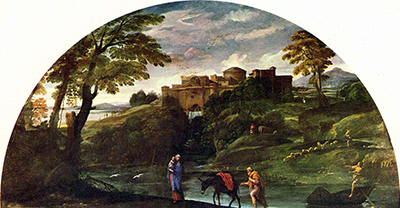
Carracci put another sacred journey into a much wider setting in one of the Aldobrandini chapel lunettes, the Landscape with the Flight into Egypt now in the Doria Pamphilj Gallery. In that horizontal canvas, the Holy Family travels through an inhabited country where buildings, water and routes occupy much of the pictorial space. Here the ground that separates Peter and Christ is only a few strides across. The terrain gives the encounter a direction, but the figures’ exchange takes up most of the picture. Both paintings make travelling consequential, on very different scales. [1] [10]
The studies and the change under the paint
Carracci had already worked out a version for the Cerasi Chapel in Santa Maria del Popolo, Rome. The Albertina preserves a sheet of pen studies, inventory 2160r, with alternatives for the encounter and the city gate behind it. It connects the sheet to the scene executed on the chapel vault by Innocenzo Tacconi. In this design Christ is clothed, and Peter is on his knees. The chapel puts the encounter above Caravaggio’s painting of Peter’s later crucifixion, so a worshipper could see the moment of recognition and the end of the story in the same part of the building. Antonio Vannugli notes that in the fresco Christ points towards the city within the picture. The London panel redirects his gesture towards a place just beyond the painted scene. Its upright format also puts more weight on the near figures. Christ advances with his chest uncovered, and Peter is still on his feet. [1] [9] [11] [12]
There is also a related study in the Staatliche Graphische Sammlung in Munich. In the 1999 exhibition catalogue The Drawings of Annibale Carracci, Catherine Loisel connects the sheet to a 1696 inventory of the collector Everhard Jabach. The inventory describes Christ carrying his cross and meeting Peter on his knees, drawn in pen with wash and highlights on green paper. The prominence of the kneeling pose links the Munich study to Carracci’s earlier thinking about the encounter. A drawing at the Real Academia de Bellas Artes de San Fernando in Madrid records a detail of that earlier design. According to the Louvre’s drawings catalogue, one part of the sheet studies the feet of Christ for the Appian Way fresco and another works out an angel’s crossed arms for the neighbouring Coronation. The surviving drawings range from the placing of two figures against a city gate to the exact turn of a foot. [12] [13]
The oil medium on wood is documented in Larry Keith’s National Gallery Technical Bulletin study. The Gallery’s X-rays supply the clearest evidence of how the painted design developed. Carracci first set Peter closer to Christ, upright and in profile. He retained Peter’s left foot but changed the rest of the pose, opening a gap through which the glance can travel and giving the saint room to throw up his hands. Changing the kneeling Peter of the earlier design into a standing figure altered how the bodies occupied the upright format. Reworking the standing figure on the panel altered the speed and surprise of their encounter. Keith also found the panel’s landscape passages better preserved than comparable areas on the Montalto copper. The difference matters when setting the two pictures side by side, since an apparently simpler landscape can owe some of its appearance to the condition of its paint. [1] [8] [11]
The cardinal who collected the panel
Pietro Aldobrandini, the nephew of Pope Clement VIII, had a personal connection to the name of the apostle. A Roman newsletter of 2 June 1601, preserved in the Biblioteca Casanatense and transcribed by Roberto Zapperi, connects the unveiling of the vault of Odoardo Farnese’s gallery to Aldobrandini’s interest in a small painting of Christ and Peter. It also reports the gift of a gold chain and a large medal to Carracci. The National Gallery considers the commission by or for Aldobrandini almost certain. Its earliest clear ownership record is item 174 of the cardinal’s inventory taken in early 1603. The newsletter gives the episode a context in the Roman patronage of 1601, while the inventory puts the picture in a specific collection by early 1603. [1] [12] [14]
The early records also help explain how a picture of this size could matter in a cardinal’s collection. The upright field brings both figures forward on a scale large enough to read their expressions, yet it is possible to take in the full route of their eyes, hands and feet in a single look. In a private devotional setting that proximity makes Peter’s uncertainty especially immediate. Saskia Rubin has argued that the scene addresses the cardinal directly, inviting him to consider the obligations of his office. She also reads its classical architecture and its echoes of Raphael and Michelangelo in the light of Aldobrandini’s collecting tastes and the interests of his secretary, Giovanni Battista Agucchi. That interpretation brings the cultivated setting of the panel into the same discussion as Peter’s response to the figure bearing down on him. [15]
Carracci used a different support for another painting made for a Roman cardinal, the small Montalto Madonna for Alessandro Peretti Montalto, painted on copper. Keith sees the stricter classical arrangement of the Appian Way panel as a development from the earlier work. Here the clear intervals between the figures, limbs and cross serve a scene in which the direction of movement has moral weight. [1] [8]
Copies, collectors and changing titles
Giulio Mancini records the picture among Carracci’s works in his early seventeenth-century Considerazioni sulla pittura. Giovanni Pietro Bellori describes it at the Aldobrandini villa on the Quirinal in his 1672 Vite. The panel passed through Cardinal Ippolito Aldobrandini to Olimpia Aldobrandini Pamphili and appears in later family inventories. The Nationalmuseum in Stockholm sees Carracci’s composition as an important starting point for later versions, including one by Giovanni Battista Gaulli and its own painting attributed to Marco Benefial. The latter was formerly described as a free copy after Carracci. Its narrower canvas still brings two large figures together on the road, but their clothes, the distribution of light and the angle of approach have changed. The Stockholm catalogue treats Gaulli’s version as another likely point of reference for the later painter. That record shows how artists could inherit both a subject and a solution for staging it, then reshape the meeting for a new picture. [1] [9] [16]
The London panel had left Italy by the time Alexander Day exhibited it in London in 1800–01. It passed through Lord Northwick and Thomas Hamlet before the National Gallery purchased it in 1826. As part of the 1956 exhibition of the Carracci in Bologna, Cesare Gnudi placed the picture alongside works such as the Aldobrandini lunette in which he saw a meeting of classical models and northern Italian painting. The London picture was later included in the National Gallery’s 2014 exhibition Making Colour. Its strongly modelled reds, yellows and blues help distinguish the two figures against their subdued surroundings. [1] [17]
The Gallery’s printed catalogue of 1840 called it Christ Appearing to Simon Peter after his Resurrection and described Christ’s reply as an explicit rebuke and command to return. In the older apocryphal account Peter must make the connection to his own fate himself. Carracci gives us the brief interval between hearing and acting, when Peter’s raised hands still show his surprise and the empty road lies open in both directions. [1] [2] [18]
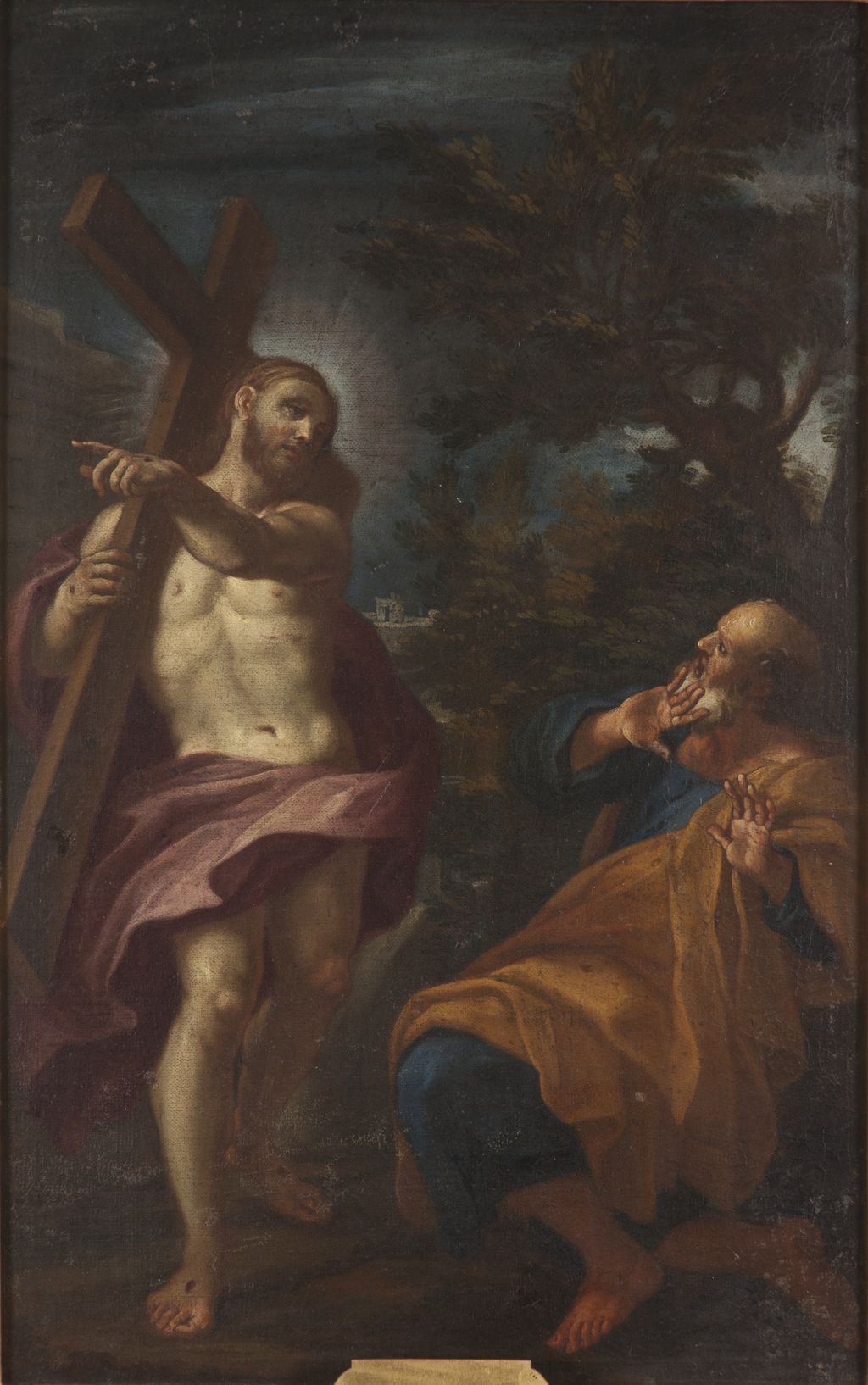
Attributed to Marco Benefial, Domine, Quo Vadis? Nationalmuseum, Stockholm, NM 25. Image source. Public domain.
Artworks directory
Paintings, frescoes, drawings and prints, with separate entries for documented versions and collaborative projects.
Discussion
Look again at the images and ideas explored in Jesus and Saint Peter (Domine, Quo Vadis?). These editorial prompts invite your observations.
Reader Insights
Which feature of the encounter reveals Peter’s surprise?
What does the road add to the story beyond giving the figures somewhere to stand?
Join the Conversation
Share a detail, comparison or question about Jesus and Saint Peter (Domine, Quo Vadis?) below.
References
- National Gallery, Christ Appearing to Saint Peter on the Appian Way (Domine, Quo Vadis?), NG9 View source.
- North American Society for the Study of Christian Apocryphal Literature, Acts of Peter View source.
- John 13:36, King James Version View source.
- Acts of Peter, chapters 35–38, translated by M. R. James in The Apocryphal New Testament (1924) View source.
- National Gallery on Google Arts & Culture, Christ Appearing to Saint Peter on the Appian Way and the Golden Legend View source.
- Turismo Roma, Church of Domine Quo Vadis (Santa Maria delle Piante) View source.
- Rijksmuseum, Giulio Bonasone, Christ Appears to Peter at the Gate of Rome View source.
- Larry Keith, Annibale Carracci’s Montalto Madonna, National Gallery Technical Bulletin 29 (2008) View source.
- Antonio Vannugli, Il committente del ‘Cristo e la Samaritana’ di Annibale Carracci, Bollettino d’Arte 10 (2011), pp. 89–92 View source.
- Galleria Doria Pamphilj, Annibale Carracci, Landscape with the Flight into Egypt View source.
- Albertina, Annibale Carracci, Zwei Skizzen zur Darstellung Domine Quo Vadis mit Stadttor im Hintergrund, 2160r View source.
- National Gallery of Art and others, The Drawings of Annibale Carracci (1999), pp. 30, 36–37 and 248–50 View source.
- Musée du Louvre, Étude de la main gauche du Christ, INV 7400, entry on related drawings for the Cerasi Chapel View source.
- Roberto Zapperi, Per la datazione degli affreschi della Galleria Farnese (1981), p. 822 View source.
- Saskia Rubin, Domine, Quo Vadis? Annibale Carracci Approaches an Old Theme Anew, Artibus et Historiae (2018) View source.
- Nationalmuseum, Domine, Quo Vadis?, attributed to Marco Benefial, NM 25 View source.
- Francesca Mari, La mostra dei Carracci del 1956: questioni di allestimento, p. 77 View source.
- A Catalogue of the Pictures in the National Gallery (1840), p. 5, no. 9 View source.