

 by Tom Gurney
Tom Gurney BSc (Hons) is an art history expert with over 20 years experience
Published on June 19, 2020 / Updated on August 29, 2026
Email: tomgurney1@gmail.com / Phone: +44 7429 011000
Overview
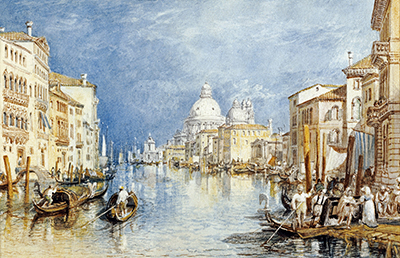
J. M. W. Turner's Venice, from the Porch of Madonna della Salute is the Metropolitan Museum of Art object often associated with the shorter title The Grand Canal, Venice. The Met records the painting as by Joseph Mallord William Turner, dated ca.1835, oil on canvas, with object number 99.31.[1] Its canvas measures 36 x 48 1/8 in., or 91.4 x 122.2 cm, and entered the museum through the Bequest of Cornelius Vanderbilt, 1899.[1]
The painting shows Venice from a viewpoint connected with Santa Maria della Salute, looking out across the Grand Canal. Turner uses the scene to bring together architecture, water, reflections, boats and lagoon light. The subject is specific, but the handling is not a hard architectural inventory. Palaces, quays and craft are held in a field of light, where the foundations of buildings seem to merge with the water.
The Met's interpretation is especially important for this work. According to the museum, an 1819 pencil study gave Turner an early compositional prompt, while the finished canvas belongs more directly to his renewed Venetian experience in 1833.[1] The work was exhibited at the Royal Academy, London, in 1835, where the Met says it received wide acclaim.[1]
This means the painting should not be treated as a simple on-the-spot view. It draws on travel, memory, sketch material and studio transformation. The short title The Grand Canal, Venice is useful for orientation, but the Met title is the safer object identity: Venice, from the Porch of Madonna della Salute.
At a Glance
- ArtistJoseph Mallord William Turner
- Met titleVenice, from the Porch of Madonna della Salute
- Dateca. 1835
- MediumOil on canvas
- Overall size91.4 x 122.2 cm
- CollectionThe Metropolitan Museum of Art, New York
- Object number99.31
- CreditBequest of Cornelius Vanderbilt, 1899
- ExhibitedRoyal Academy, London, 1835
- Display statusGallery 808 at source verification; check before visiting
Contents
- Overview
- Object Identity
- The View from the Salute
- Water, Reflections and Palaces
- Boats and Canal Life
- 1819, 1833 and 1835
- Venice and Turner's Working Method
- The Grand Canal as Image Problem
- Oil Paint and Watercolour Brilliance
- Exhibition and Reception
Object Identity
The authoritative title used here is Venice, from the Porch of Madonna della Salute.[1] The local short title The Grand Canal, Venice can help readers recognize the subject, but it should not replace the Met title. Turner's Venetian views are numerous, and titles can easily blur across different works.
The title does more than name the city. It fixes the viewing position near Santa Maria della Salute and therefore narrows a subject that could otherwise become generic. "Grand Canal" can point to many Venetian images by Turner and other artists. "From the Porch of Madonna della Salute" identifies this painting's particular way of entering the canal: from a threshold associated with a church, looking across water into the city's open, reflective space.
The Met gives the date as ca.1835.[1] That approximate date should be preserved because it reflects the catalogued status of the object. The painting was exhibited at the Royal Academy in 1835, but its making involved earlier and recent Venetian material: a pencil drawing from 1819 and the renewed experience of Venice in 1833.[1]
The medium is oil on canvas.[1] The painting is not a watercolour or a sketchbook leaf, even though the Met emphasizes Turner's watercolour brilliance in explaining how he made the view.[1] This matters because the canvas translates watercolour-like luminosity into oil paint.
The dimensions are 91.4 x 122.2 cm, or 36 x 48 1/8 in.[1] That horizontal scale suits the Grand Canal. It gives enough breadth for architecture and water to unfold across the surface, while still keeping the viewer close to the canal edge and the buildings around the Salute.
The Met records the work as part of European Paintings, object number 99.31, and as a bequest from Cornelius Vanderbilt in 1899.[1] It also lists the painting as on view at The Met Fifth Avenue in Gallery 808 at the time of verification.[1] Display status can change, so the object record should be checked before a visit.
Those identifying facts keep the discussion tied to one object. The title, date, medium, dimensions, accession number and credit line all point to the Met canvas rather than to a general Venetian motif. That discipline is necessary because Turner's Venice production crosses oil paintings, watercolours, sketchbooks and later studio works. The painting's identity begins with the museum entry, then opens into the broader Venetian field.
The View from the Salute
Santa Maria della Salute provides the viewing anchor. The title places the viewer at or near the church porch, looking outward toward the Grand Canal. That position is important because it lets Turner frame Venice from one of its most charged architectural thresholds: a church at the canal's edge, facing water, palaces and movement.
The view is not merely a record of a fixed spot. The Met notes that the composition is based on an 1819 pencil drawing but shaped by the 1833 visit.[1] That layered origin means the painting should be read as constructed from experience, not as a camera-like transcript. Turner joins remembered drawing and later observation into a single Venetian image.
The Grand Canal gives the painting its spatial sweep. Water leads the eye away from the foreground and through the city. Boats and buildings create a rhythm across the surface, while the canal itself keeps the composition open. Venice appears as a city organized by water rather than by streets.
The porch viewpoint also matters symbolically. The viewer stands near a major church, but the painting looks outward to the life of the canal. Sacred architecture, civic display, domestic palaces, boats and commercial movement all share one field. Turner does not isolate the Salute as an object; he uses it as a place from which Venice becomes visible.
This distinguishes the painting from a more conventional frontal view of a landmark. Turner is less interested in presenting the church as a monument than in using the church's threshold to open a wider Venetian prospect.
That threshold gives the painting a subtle double character. It begins from a highly recognisable building, but the eye is not held there. Instead, the porch works almost like a point of release. The viewer senses the solidity of stone nearby, then moves into a scene where water and air loosen solid form. Turner uses the Salute not as a closed subject but as a hinge between architecture and lagoon space.
The result is a view that feels placed without becoming rigid. The viewer knows why the scene is Venetian and why the Grand Canal matters, yet the painting avoids the mechanical clarity of a measured prospect. The position is precise enough to orient the eye, while the handling remains open enough to make Venice appear as an experience of light.
Water, Reflections and Palaces
The Met describes the painting as a view in which the foundations of the palaces of Venice merge into the waters of the lagoon through delicate reflections.[1] That sentence captures the central visual problem. Turner makes architecture and water interdependent. Buildings do not simply rise above the canal; they seem to grow out of, and return into, reflected light.
The reflections are not decorative additions. They are structural. Without them, the palaces would become static facades. With them, the buildings become part of a moving surface. The canal does not just occupy the lower portion of the canvas; it actively changes the city's appearance.
The water also controls pace. A street view might pull the eye along linear perspective. Here the canal produces a slower, more fluid movement. Boats, reflections and facades draw the viewer forward, but the light keeps the path open and shifting.
Turner's Venice is therefore both solid and unstable. The city is built from stone, but its image is made in water. This is why the Grand Canal suited him so well. It offered architecture that could be named and recognized, while giving him a surface that constantly transformed that architecture.
The painting's light is not merely atmospheric sweetness. It tests how much clarity a city needs. The viewer can read the scene as Venice, but much of that recognition comes through relationships: water to palace, boat to reflection, porch to canal, distance to haze.
The palace fronts therefore matter even when they are softened. Turner does not erase them; he lets them retain enough presence to hold the scene together. Their verticals, edges and pale masses answer the horizontal breadth of the canal. They give the light something to act on. The city becomes visible through a balance between built form and optical dissolution.
This balance is especially important in a Venetian subject. Venice can easily become a display of famous buildings, each one separated for recognition. Turner instead lets the buildings belong to one atmosphere. The eye may pause on architectural details, but it continually returns to the water, where the palaces are remade as reflection.
Boats and Canal Life
Boats are essential to the painting's scale and movement. Venice without boats would be visually incomplete, but Turner does not turn the scene into a narrative of individual passengers. Craft and figures are part of the canal's rhythm. They stitch together foreground, middle distance and far distance.
The boats also keep the painting from becoming only an architectural reverie. They remind the viewer that the Grand Canal is a working and social space. It is a waterway through the city, a reflective field, and a place of daily movement at the same time.
The Met's record classifies the subject area through buildings, cities, canals and boats.[1] That combination is useful because no single category is enough. The painting is not just a cityscape, not just a marine view and not just an architectural study. It depends on the interaction of all those elements.
The craft also help Turner manage depth. Near boats anchor the viewer, while smaller or more distant forms carry the eye deeper into the scene. The canal becomes a sequence of intervals rather than an empty gap.
This is one way Turner avoids making Venice passive. The city is not merely admired from a distance. It is active, traversed and reflected. The boats show that the water is lived space.
Their scale is also useful. Against the palaces and the broad canal, the boats introduce human measure without requiring anecdote. The viewer can sense ordinary passage and labour, but no single figure needs to take over the painting. Turner keeps human activity present as rhythm rather than drama.
That restraint supports the wider composition. If the boats became too anecdotal, the picture would narrow into a genre scene. If they vanished, the canal would risk becoming a mirror with architecture above it. Turner keeps them in between: small enough to belong to the view, significant enough to make the water socially alive.
1819, 1833 and 1835
The chronology of the painting is important. Turner first visited Venice in 1819. The Met connects the composition to a modest pencil study from that initial encounter with the city.[1] That drawing supplied an early framework, but it was not the whole basis of the finished painting.
The Met then links the finished painting more strongly with Turner's second Venice visit, in 1833.[1] This makes the work an image of return. Turner had first encountered the city, stored visual material, and then renewed his experience before making the Royal Academy canvas.
The painting was exhibited in 1835.[1] That exhibition moment matters because the finished canvas entered public view as one of Turner's major Venetian statements. It was not a private study left in the studio. It was a public oil painting made from travel, memory and painterly ambition.
The Correr archive gives helpful broader context, noting Turner's three Venice visits in 1819, 1833 and 1840, and describing how the later works drew on sketchbooks, watercolours and repeated experience of the city.[2] For this painting, that context supports the Met's specific account without replacing it.
The result is a painting built across time. The visible image may feel immediate, but its making involves at least three layers: the first trip in 1819, the second visit in 1833, and the exhibition canvas of 1835.
This layered chronology changes how the painting should be understood. The 1819 drawing is not a minor footnote, because it shows that the structure of the view had a long memory. The 1833 return is not a minor travel detail, because the Met treats it as central to the finished work's formation. The 1835 exhibition then converts those private acts of looking and remembering into a public oil painting.
That sequence is typical of Turner's mature practice in one important sense: travel material could remain active long after it was first gathered. A pencil note, a remembered effect and a later encounter could all be reworked into a canvas whose apparent immediacy conceals a more extended process. In this Venice painting, the process matters because the view depends on accumulated looking rather than a single recorded moment.
Venice and Turner's Working Method
Turner's Venice was not produced from a single encounter. The Correr archive notes that Turner spent less than four weeks in Venice across three visits, yet developed a close artistic association with the city.[2] That concentration is revealing. Venice became important not because Turner lived there for years, but because it gave him an exceptionally rich visual problem.
The city offered architecture already famous through Canaletto and other veduta traditions, but Turner did not simply imitate those models. The Correr archive notes that Canaletto helped Turner's generation imagine Venice before arrival, while Turner absorbed earlier principles and made something different, especially in later work.[2]
This painting shows that difference. It includes recognisable architecture and canal space, but it is not chiefly a lesson in exact Venetian masonry. It is about the meeting of remembered viewpoint, oil paint, light, water and reflection. Turner takes the tradition of Venetian views and makes it more atmospheric.
Warrell's writing on Turner and Venice is relevant here because it treats the city as a sustained artistic subject rather than a single travel episode.[4] The Met painting belongs to that sustained engagement. It is not merely picturesque. It is a carefully made oil painting that transforms observation through memory.
The use of an 1819 pencil drawing also shows how Turner's sketching could remain productive years later. A small drawing did not simply document a place; it could become a seed for a major painting after further travel and studio work.
A related Tate works-on-paper entry, The Grand Canal, Venice, off the Steps of Santa Maria della Salute, records a crayon, pencil and watercolour view on grey wove paper, dated c.1833 or 1840.[3] It should not be treated as the Met canvas, but it helps show how the Salute and Grand Canal motif also existed for Turner in more portable media. The oil painting belongs to a larger practice of returning to the same Venetian zone through different materials.
The Correr archive's emphasis on sketchbooks and watercolours also helps explain why this canvas feels so fluid.[2] Turner was not simply transferring a building outline onto a large support. He was bringing together a habit of quick notation, a memory of light, and the stronger public finish required by an exhibited oil. The painting's precision lies in the orchestration of those elements, not in a surveyor's exactness.
The Grand Canal as Image Problem
The Grand Canal is an obvious Venetian subject, but Turner makes it difficult in a productive way. The canal is a waterway, a reflective surface, a stage for boats and a corridor of architecture. To paint it is to decide which of those functions should dominate.
In Venice, from the Porch of Madonna della Salute, none of them dominates alone. The water leads the eye, but the palaces and boats keep it anchored. The architecture frames the space, but reflections loosen the buildings. The viewpoint is tied to the Salute, but the view opens beyond it.
This is why the painting should not be reduced to a scenic postcard. Turner is working through a problem of perception. Venice is famous enough to be instantly named, but the act of seeing it remains unstable. The Grand Canal is recognizable, yet it is also a field of changing light.
The painting's horizontal format helps. The 48 1/8 inch width allows Turner to stretch the canal experience across the viewer's field.[1] The scene breathes laterally. It does not rush to a single central monument.
The Grand Canal also lets Turner combine marine and architectural experience. The Met explicitly connects the painting to his experience as a marine painter and to his brilliance as a watercolourist.[1] The view is Venetian, but it also belongs to Turner's broader command of water, light and atmosphere.
That combination prevents the painting from falling into a single category. A purely marine picture might treat the water as open expanse and weather. A purely architectural picture might treat the palaces as stable facts. Turner needs both. His experience with water lets the canal become active, while the Venetian buildings keep that activity tethered to a named city.
The painting also asks the viewer to hold near and far together. The porch position suggests bodily nearness, but the canal opens into distance. The immediate architecture gives weight to the foreground, while haze and reflection loosen the far space. This tension between nearness and distance is part of the work's energy.
Oil Paint and Watercolour Brilliance
The Met's comment that Turner drew on his brilliance as a watercolourist is crucial.[1] This is an oil painting, but its lightness and reflections depend on habits of seeing developed through watercolour. Turner understood how pale tones, reserves, delicate transitions and small accents could make water and air feel alive.
In oil, those effects require different means. Townsend's work on Turner's materials and techniques helps keep the discussion grounded: late effects depend on paint handling, surface and colour decisions, not only on inspiration.[6] In this painting, oil paint carries a watercolour-like delicacy without ceasing to be oil.
The canvas therefore sits between media in a productive sense. It is materially oil on canvas, yet visually informed by watercolour practice. This helps explain why the palaces seem to merge into the lagoon rather than sit heavily above it.
The handling also softens the boundary between architecture and atmosphere. Turner does not need every wall, window or cornice to be equally sharp. He can give the viewer enough information to recognize Venice while letting light dissolve the rest.
That balance is one of the painting's achievements. Too much detail would harden the view. Too little would make the city vanish. Turner keeps the image at the point where Venice is both legible and luminous.
The painting's surface should therefore be read as active evidence, not merely as style. Softness is doing work. Pale tonal shifts make water and air continuous. Sharper accents keep the image from dissolving. The relation between these passages creates the sensation of Venetian light without requiring every object to be equally described.
This is where the Met's reference to Turner's marine experience and watercolour brilliance is useful.[1] It does not mean the oil painting imitates a watercolour mechanically. It means Turner brought habits of light, wash-like breadth and atmospheric economy into a larger, more public medium. The result is a canvas that feels radiant because oil has been made to behave with unusual delicacy.
Exhibition and Reception
The painting was exhibited at the Royal Academy, London, in 1835.[1] The Met says the canvas was shown to wide acclaim.[1] That reception matters because it confirms that Turner's Venetian handling could succeed publicly, not only retrospectively.
The Royal Academy context also places the painting among Turner's public ambitions. He was not simply making travel souvenirs. He was presenting Venice as a major subject for British exhibition culture, able to stand beside other landscape, history and marine works.
The painting's success in 1835 also helps distinguish it from some later Turner works that faced sharper criticism for looseness or difficulty. Here, Turner's atmospheric Venice could be admired as brilliance rather than dismissed as obscurity. The view balances innovation with enough recognisable structure to meet public standards for a finished picture.
Butlin and Joll remain important for placing the painting within Turner's painted oeuvre and exhibition history.[5] The Met record supplies the core object facts, while the catalogue tradition helps situate the work within Turner's broader career.
The painting's later history at the Met, through the Vanderbilt bequest of 1899, added another public chapter.[1] A Venice painting made for the Royal Academy audience became part of a major New York museum collection, where it remains associated with European painting and Turner's international reputation.
That shift from Royal Academy exhibition to museum collection changes the conditions of viewing. In 1835, the painting competed within a crowded exhibition culture and announced Turner's Venetian ambition to a contemporary audience. In the Met, it is encountered through the slower habits of collection display, where object number, credit line, gallery placement and conservation history frame the experience. The painting has therefore had more than one public life.
Its reception also helps explain why the work can be approached as both accessible and advanced. The subject is familiar: Venice, the Grand Canal, the Salute, boats and luminous water. The method is more searching: the city is built from reflection and atmosphere as much as from masonry. That combination made the painting legible enough for acclaim while allowing Turner to push Venetian view painting toward a less fixed vision.
Not Other Grand Canal Works
Turner made several works involving Venice, the Grand Canal, the Salute, the Dogana and related viewpoints. This painting should not be merged with them. The Met object is Venice, from the Porch of Madonna della Salute, ca.1835, object number 99.31.[1]
It should not be confused with The Dogana and Santa Maria della Salute, Venice, the 1843 National Gallery of Art painting discussed separately in this Turner sequence. That work has a different title, date, collection, accession and composition. It should also not be merged with the Huntington's Grand Canal: Scene - a Street in Venice or with other Grand Canal subjects.
Nor should the Tate works-on-paper entry with a related Salute-area title be treated as a substitute for the Met painting.[3] Its medium, date range and holding context are different. It is useful as evidence that Turner repeatedly worked around the Grand Canal and Salute motif, but the Met canvas remains the object under discussion here.
The local short title The Grand Canal, Venice is useful only after the Met title has been established. Without that anchoring title, the phrase can become too broad. Many Venice views include the Grand Canal; not all of them are this painting.
This distinction is not fussy. It protects the interpretation. The 1819 drawing, the 1833 visit, the 1835 Royal Academy exhibition, the Vanderbilt bequest and the Met's current gallery listing all belong to this object.[1]
Clear object identity also helps the viewer look better. Once the painting is separated from other Venetian works, its particular structure becomes easier to see: the Salute viewpoint, the canal sweep, the merging palace foundations and the delicate reflections.
How to Look at the Painting
Begin with the Met title: Venice, from the Porch of Madonna della Salute.[1] That title gives the viewing position and distinguishes the work from other Grand Canal images. The local short title can help, but the Met title should lead.
Next, look at the viewpoint. The viewer is placed at a threshold near the Salute, looking outward across water. This position gives the painting both architectural closeness and lagoon breadth.
Then follow the canal. The water is not blank space. It is the main visual passage through the painting. Reflections, boats and palaces all depend on it.
After that, look at how the buildings meet the water. The Met's description of palace foundations merging into lagoon reflections is the key to the work.[1] Venice appears where architecture and water become hard to separate.
Finally, notice how the painting is both observed and constructed. It draws on an 1819 pencil drawing and the 1833 visit, then becomes a Royal Academy painting in 1835.[1] The image is immediate in effect, but layered in origin.
It is also worth looking for what Turner refuses to separate. He does not isolate water from architecture, or memory from observation, or public finish from sketch-based invention. The strength of the painting lies in the way those categories remain joined. The Grand Canal is not just a setting; it is the means by which the city becomes light, reflection and movement.
Viewed this way, the painting rewards slow looking. Start with the solid facts: title, artist, date, medium and collection. Then let the image become less solid. Palaces lose hard edges, boats become intervals, the canal gathers light, and the Salute viewpoint turns into a wider meditation on how Venice can be seen.
Why the Painting Matters
Venice, from the Porch of Madonna della Salute matters because it is one of Turner's major public Venetian oils. It brings together marine experience, watercolour sensitivity and oil painting on a grand canal subject.
It also matters because it shows Turner's Venice as memory and construction, not only direct observation. The Met's account of the 1819 drawing and the 1833 visit explains why the painting feels both specific and transformed.[1]
The work is important for its treatment of reflection. Turner makes the city depend on water. Palaces merge into the lagoon, boats animate the surface, and the Grand Canal becomes the painting's organising force.
It also matters as a collection object. The Met records the painting as object number 99.31, Bequest of Cornelius Vanderbilt, 1899, and on view at The Met Fifth Avenue in Gallery 808 at verification.[1] Its museum history has helped sustain its modern public role.
Finally, the painting matters because it shows Turner changing the tradition of Venetian views. He preserves enough architecture for recognition, but makes light and water central to meaning. Venice is not only represented; it is reimagined through atmosphere.
That reimagining is not a departure from Venice but an argument about it. Turner understood that the city is never seen only as stone. It is seen through glare, weather, water, reflected colour and the motion of boats. In this painting, those conditions are not secondary effects. They are the subject's core. The canvas matters because it makes Venice visible as an unstable union of place and perception.
The work also shows why Turner's Venetian paintings remain central to his late career. They bring together travel, memory, exhibition ambition and technical experiment in a subject already loaded with artistic precedent. Venice, from the Porch of Madonna della Salute stands at that crossing point: a named view, a public oil painting, a memory image, and a demonstration of how far reflection and atmosphere could carry representation.
Frequently Asked Questions
It is an oil painting by J. M. W. Turner, dated ca.1835 by the Metropolitan Museum of Art and held as object number 99.31.[1]
The shorter title The Grand Canal, Venice is often used for orientation, but the Met title is Venice, from the Porch of Madonna della Salute.[1]
It is an oil painting on canvas. The Met gives the size in both metric and imperial form: 91.4 by 122.2 cm, or 36 by 48 1/8 inches.[1]
At verification, the Met placed it in Gallery 808 at The Met Fifth Avenue.[1] Check the museum entry before visiting because display status can change.
The Met connects the finished canvas to an 1819 pencil study and to Turner's renewed Venetian experience in 1833.[1]
The Met records that Turner exhibited the canvas at the Royal Academy, London, in 1835.[1]
It is a major Turner Venice oil that combines a Salute viewpoint, Grand Canal reflections, marine experience and watercolour-like luminosity in oil paint.
Discussion
How does Turner keep the Grand Canal and its palaces recognisable while allowing water, reflection and Venetian light to loosen their forms?
Reader Insights
How does the Salute porch position shape the canal view?
Where do buildings seem to merge into water?
How do boats animate the broad horizontal space?
Join the Conversation
Share a close observation or a source-based question for other readers.
References
- Metropolitan Museum of Art, "Venice, from the Porch of Madonna della Salute." https://www.metmuseum.org/art/collection/search/437853
- Museo Correr archive, "Turner and Venice: Itinerary." https://archivio-correr.visitmuve.it/en/mostre-en/archivio-mostre-en/turner-and-venice-1/2011/10/4499/layout/
- Tate Research Publication, "The Grand Canal, Venice, off the Steps of Santa Maria della Salute." https://www.tate.org.uk/art/research-publications/jmw-turner/joseph-mallord-william-turner-the-grand-canal-venice-off-the-steps-of-santa-maria-della-r1197061
- Ian Warrell, *Venice with Turner*, Tate Publishing, 2020. ISBN 9781849767033.
- Martin Butlin and Evelyn Joll, *The Paintings of J. M. W. Turner*, revised edition, Yale University Press, 1984.
- Joyce H. Townsend, *How Turner Painted: Materials & Techniques*, Thames & Hudson, 2019.