

 by Tom Gurney
Tom Gurney BSc (Hons) is an art history expert with over 20 years experience
Published on June 19, 2020 / Updated on August 29, 2026
Email: tomgurney1@gmail.com / Phone: +44 7429 011000
Introduction
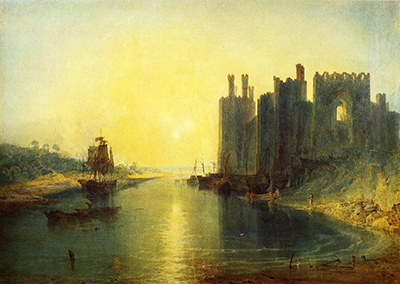
J. M. W. Turner's Caernarvon Castle is a late watercolour of a place he had known, imagined and reworked across much of his career. The British Museum identifies the work as a drawing and print study of about 1833, made in watercolour over graphite on paper and now registered as 1958,0712.439. Its subject is the great medieval fortress at Caernarfon, seen from across the water, with boats, shore figures and bathers animating the foreground while the castle holds the middle distance. The record also ties the sheet to the engraved version made by William Radclyffe in 1835 for Picturesque Views in England and Wales.[1]
That identity matters because Turner made several Caernarvon or Caernarfon works. Earlier in his career the North Welsh fortress had offered him a subject for heroic watercolour, Royal Academy ambition and romantic historical drama. The 1833 sheet is different. It belongs to a later moment, when Turner was translating British scenery into designs for a cultivated print market, and when his landscape art often let atmosphere do as much interpretive work as architecture. The castle is still unmistakable, but it is no longer allowed to dominate every part of the scene. It becomes one presence within a harbour world of light, heat, children, boats, water and recollection.[1][3]
The older spelling "Caernarvon" is retained here for the artwork title because that is the wording used by the British Museum. The modern Welsh and official heritage spelling is "Caernarfon", and that form is used when discussing the castle and town as a historical place. The difference is not cosmetic. It reminds us that Turner's image belongs both to nineteenth-century British topography and to a much longer Welsh history in which naming, conquest, tourism and memory have never been neutral.[5][6]
At a Glance
- ArtistJ. M. W. Turner (1775-1851)
- TitleCaernarvon Castle
- Datec.1833
- MediumWatercolour over graphite on paper
- Object typeDrawing; print study
- Dimensions278 x 418 mm
- CollectionBritish Museum, London
- Registration1958,0712.439
- Related printWilliam Radclyffe, 1835
- SubjectCaernarfon Castle, Gwynedd
- Display noteBritish Museum record: not on display
Contents
- Introduction
- At a Glance
- Title and Place
- A Drawing Made for Engraving
- What Turner Shows
- Caernarfon Before Turner
- Edwardian Power and Modern Heritage
- Turner's Welsh Memory
- Heat, Light and Colour
- Figures, Boats and Coracles
Title and Place
The title Caernarvon Castle points to a historical spelling that was common in English-language art catalogues and travel literature. The fortified complex itself is now generally called Caernarfon Castle in official Welsh heritage contexts. The difference can be handled without confusion if the artwork and the place are kept distinct: Turner's sheet is catalogued as Caernarvon Castle; the building it shows is Castell Caernarfon, a fortress-palace on the River Seiont in Gwynedd.[1][5]
Caernarfon was never a neutral picturesque ruin. It was a functioning sign of royal power, planted after conquest and designed to be read. Cadw describes the castle as a fortress-palace on the banks of the River Seiont, grouped with Edward I's castles at Conwy, Beaumaris and Harlech under a World Heritage designation. Edward and Master James of St George built castle, town walls and quay together, a campaign that Cadw says took forty-seven years and cost about 25,000 pounds. The polygonal towers, eagle statues and coloured stonework were not merely defensive choices; they carried messages of authority, dynasty and imperial aspiration.[5]
Turner gives that charged building a hazier and more ambiguous role. The castle remains readable, but he keeps it across a stretch of water and air. Its towers and walls are part of a larger climate rather than an isolated architectural diagram. This is a decisive compositional move. Instead of presenting Caernarfon as a bare emblem of Edwardian domination, Turner makes the viewer approach it through a lived waterside scene. The foreground is not empty; it is busy with people, boats and leisure. The monument still carries history, but the eye must cross contemporary life before reaching it.[1][2]
A Drawing Made for Engraving
The British Museum calls the work a drawing and a print study, and its comments identify William Radclyffe as the engraver of the 1835 plate for England and Wales.[1] That status should guide any reading of the watercolour. It was not only a private act of recollection or a free response to a Welsh view. It was a finished design made with translation into print in mind: a composition strong enough to survive the move from transparent colour to engraved line, tonal structure and reproducible contrast.
Picturesque Views in England and Wales was one of the major projects through which Turner entered the homes, libraries and portfolios of a wider public. The Library of Congress record for the publication describes it as Picturesque views in England and Wales, from drawings by J. M. W. Turner, engraved under Charles Heath's supervision, with descriptive and historical illustrations by H. E. Lloyd, and issued in a substantial two-volume plate format.[3] The Manchester Turner prints project places such publications within the broader nineteenth-century culture of reproductive engraving, in which Turner collaborated with publishers and specialist engravers to make highly worked landscape designs circulate beyond the market for unique watercolours.[4]
That print destination helps explain the clarity beneath the haze. The picture could not rely only on delicate colour, because Radclyffe's engraving would have to carry the subject through line and tone. Turner therefore arranges the sheet around large readable relationships: the horizontal water, the distant castle mass, the darker right bank, the small foreground boat, the pale sky and the human incidents that enliven the lower half. The scene is atmospheric, but not shapeless. Its softness is disciplined by an underlying structure that an engraver could parse.
There is also a productive tension between the coloured original and the engraved afterlife. The British Museum's commentary stresses pale yellows, vermilion, purple and twilight mist.[1] Those effects are inseparable from watercolour. Yet the design was destined for a medium that would largely restate colour as gradation. Turner had to build an image that worked twice: as a luminous sheet and as a printable composition. Caernarvon Castle is impressive because it does not treat those tasks as contradictory. The colour makes the air tremble; the arrangement keeps the subject firm.
What Turner Shows
The British Museum's description is concise but rich. It records the castle in the middle distance; a boat with two female figures in the foreground; two swimmers nearby; further boats beyond; and figures on the shore to the right.[1] Those details describe a carefully tiered scene. The lower foreground contains the most intimate human activity. The middle area opens into water, boats and reflections. The castle then rises beyond, not in isolation, but as a public landmark within a shared waterside environment.
The foreground figures are central to the image's tone. Bathing bodies and small craft shift the mood away from terror, siege or military inspection. They make the harbour feel warm, slow and exposed. The British Museum Shop describes the picture as a hazy summer view in which women and children play and swim, and it highlights Turner's use of pale yellows with vermilion and purple to suggest the heat near the end of the day.[2] This is not a storm piece. Nor is it a documentary architectural elevation. It is a social weather image: a castle scene in which temperature, leisure and human scale decide how history enters the eye.
The result is subtler than simple prettification. The fortress is still there. The viewer knows that Caernarfon Castle is a formidable medieval structure; Cadw and UNESCO both stress its scale, defensive power and unusual architectural ambition.[5][6] Turner does not deny that power. He distances it. He bathes it in late light and makes it share the field with children, bathers, boats and air. The political monument is absorbed into a day in which people are living around it.
This approach also changes the role of the water. In many castle views, water operates as a reflective foreground or a picturesque device. Here it is also a zone of contact. Boats float, bodies enter, and the river or harbour edge becomes a place where the viewer can imagine movement. Water separates the viewer from the castle, but it also connects every register of the image. It carries reflections, cools the figures, holds the boats and gives the old walls a shimmering threshold.
Caernarfon Before Turner
The castle that Turner depicts began as part of Edward I's conquest architecture in north Wales. Cadw's listed-building report states that the present stone castle was begun in 1283 and remained incomplete when building ceased around 1330. It combined fortification, palace and administrative centre. The report also records earlier occupation: a late eleventh-century motte-and-bailey castle associated with Hugh of Chester, later held by Welsh rulers after Gwynedd regained control. Edward's building campaign followed the death of Llywelyn ap Gruffudd in 1282 and was meant to consolidate English power in the region.[7]
That history is crucial for a Turner reading because Caernarfon was not merely old masonry. It was a memory machine. The King's Gate, Eagle Tower, town walls and quay presented authority at multiple scales: military, administrative, dynastic, symbolic. The Cadw report notes that the design echoed imperial Roman architecture, particularly the walls of Constantinople, through polygonal towers and banded stonework. Cadw's public overview likewise stresses the eagle statues, multi-coloured masonry and legendary associations with Macsen Wledig, making the fortress an act of political theatre as well as military planning.[5][7]
The building phases also matter visually. The listed report describes a polygonal plan, upper and lower wards, curtain walls, three-stage polygonal towers, arrow loops, wall walks, the King's Gate, and the large Eagle Tower with its higher turrets. Such forms are precisely the features that made Caernarfon attractive to artists. The castle offered varied silhouettes, broken outlines, waterfront access, massive walls and a setting where the town, river and mountains could be combined in different ways.[7]
By Turner's day, the castle had also become a destination within the culture of travel and sketching. Visitors came for medieval memory, Welsh scenery, picturesque variety and moral reflection on conquest. The Paul Mellon Centre's Thomas Girtin catalogue shows that Caernarfon views were popular among amateur and professional artists in the late eighteenth century, particularly those involving the Eagle Tower, river foreground and lively port activity.[8] Turner entered a crowded visual field. His achievement was not finding an unknown monument; it was making a familiar one newly unstable through light.
Edwardian Power and Modern Heritage
UNESCO places Caernarfon within the group called the Castles and Town Walls of King Edward in Gwynedd, alongside Beaumaris, Conwy and Harlech. Its summary describes the group as among the finest examples of late thirteenth- and early fourteenth-century military architecture in Europe, connected with Edward I and James of St George. The designation also stresses the survival of fortified towns at Caernarfon and Conwy, the documentation of construction, and the continuing importance of coastal settings and significant views.[6]
That modern heritage frame clarifies what Turner softens but does not erase. The castle was designed to project power across land and water. Its setting by the Seiont was not scenic happenstance. Water mattered to supply, trade, approach and command. The town walls and quay were part of the same political design as the castle. When Turner makes the water shimmer and fills it with activity, he is transforming a strategic environment into a human and pictorial one. The military edge becomes an atmospheric interval.
The image therefore sits between two kinds of historical imagination. One is documentary and architectural: date, builder, plan, towers, gate, walls, World Heritage designation. The other is painterly and temporal: twilight, summer heat, reflection, bathing, a softened horizon. Turner needs both. Without the first, the subject would become generic castle scenery. Without the second, it would remain antiquarian record. The force of Caernarvon Castle lies in the way the two readings coexist.
This coexistence is not politically innocent. By the 1830s, picturesque views of Wales were consumed by audiences who could enjoy castles as relics while remaining at a distance from the violence that produced them. Turner complicates that distance. He does not preach. Instead, he makes the monument both gorgeous and reduced, splendid and partially dissolved. The castle still embodies conquest, but it appears in an atmosphere that belongs to no single ruler. Air and water refuse to behave like possession.
Turner's Welsh Memory
Turner's relationship with Welsh subjects began early. The Wallace Collection notes that his early reputation rested heavily on ambitious watercolours drawn from summer tours through more remote parts of England, Wales and Scotland, and that by the end of 1799 he had gained enough recognition to be elected Associate Royal Academician.[13] Caernarfon belonged to this same formative geography. It offered architecture, mountain distance, water, national history and dramatic silhouette at exactly the moment when Turner was using travel to expand the expressive reach of topographical art.
The British Museum commentary explicitly contrasts the 1833 sheet with Turner's more romantic and often sublime North Welsh interpretations after his first visits in the late 1790s. It also notes that in 1800 he exhibited a Claudian vision of Caernarvon at the Royal Academy, with the castle functioning as a focal point in the distance.[1] This is important: the 1833 design is not an artist discovering Caernarfon for the first time. It is an artist returning to a known subject with altered priorities.
In the late 1790s, Welsh castles helped Turner test whether topography could bear historical and poetic gravity. Dolbadarn, Conwy and Caernarfon all belonged to a world in which ruin, mountain, water and national memory could be made grand. By 1833, Turner still understood those associations, but his touch had changed. He had absorbed decades of experiment in watercolour, oil, print collaboration, continental travel and atmospheric effect. The later Caernarvon does not need to declare sublimity in the old way. It lets a fortress fade into heat and still remain powerful.
The comparison with Girtin sharpens this point. The Paul Mellon Centre records that Girtin made Caernarfon views after his 1798 North Wales tour, and that Turner made a very similar sketch a few weeks after Girtin's visit, probably in August 1798.[8] Both young artists were working within the same tourist and professional circuits. Yet Turner's later watercolour shows how far he carried the subject beyond immediate sketching. The 1833 sheet is not just an on-the-spot response; it is a recollection shaped by publishing, colour theory, market expectation and accumulated memory.
Heat, Light and Colour
The colour of Caernarvon Castle is not an embellishment added after the composition. It is the means by which the whole subject is reinterpreted. The British Museum commentary, citing Sloan, describes a diffuse floating mass of light and notes Turner's use of very pale yellows with touches of vermilion and purple. The British Museum Shop similarly emphasizes the warm haze of a summer view near day's end.[1][2] Such colour language tells us that the scene is built around atmosphere rather than around masonry alone.
The pale sky does several kinds of work. It pushes the castle away from the viewer, reducing the sense of immediate threat. It also suspends the moment between day and evening, so that the water seems caught in a slow interval. The chromatic warmth helps explain the bathers. They are not arbitrary staffage. Their presence makes sensory sense because the scene feels hot, airless and still. Boats sit without urgent motion; bodies seek relief in the water; the castle's reflection and outline become part of the same suspended condition.
Turner's colour also refuses a purely grey medievalism. The castle is ancient, but the scene is not monochrome antiquity. Vermilion and purple introduce warmth, bodily presence and optical vibration. The building's roseate or purplish inflections mean that stone is seen through weather, distance and perception. That move is characteristic of Turner at his best: architecture remains factual enough to identify, but light changes its emotional register.
Ruskin's later admiration confirms that this was not a minor effect. The British Museum record notes that Ruskin was fond of the watercolour, hung it among favourites in his bedroom and retained it until his death. It also records his defence of the primrose-coloured sky and twilight mist against objections that the colour was too light or unusual.[1] Ruskin's response is valuable because it notices exactly what makes the work modern: Turner does not darken the castle to make twilight conventionally dramatic. He allows brightness, warmth and mist to carry seriousness.
Figures, Boats and Coracles
The foreground of Caernarvon Castle is more than decorative incident. The British Museum description identifies a boat with two female figures, two swimmers nearby, further boats and shore figures.[1] Its longer commentary also notes children in Welsh costume and a coracle, which help identify the Welsh setting even if the castle outline were less clear.[1] These details keep the image local without reducing it to architectural naming. Place is established through people as well as through stone.
The bathing motif is unusually delicate. In a fortress view, the viewer might expect soldiers, tourists, fishermen or a staged historical anecdote. Turner gives us women and children near the water, with small boats nearby. The British Museum commentary reads the scene as an effort to find relief from heat, and it notes the blend of classical nymph-like bodies with nineteenth-century modesty.[1] Turner is therefore playing across registers: the figures can be read as everyday bathers, as poetic forms, and as compositional notes of flesh, gesture and scale.
The coracle is equally important. It acts as a local sign, a small craft associated with Welsh waters, and it counterbalances the monumental architecture behind. A coracle is light, handmade, close to the body and dependent on intimate knowledge of water. Caernarfon Castle is massive, dynastic and administrative. Placing such things in the same visual world changes both. The fortress becomes less remote; the humble craft becomes part of a grand pictorial structure.
Boats also connect the image to Turner's larger practice. Throughout his career he treated vessels as instruments of movement, commerce, danger and observation. In this watercolour they are quieter than in storm or harbour scenes, but they still matter. They mark the water as usable space. They create scale. They let the viewer feel that the scene belongs to a working and recreational waterfront, not to a frozen antiquarian specimen.
Technique and Finish
The medium recorded by the British Museum is watercolour over graphite.[1] That phrase gives a useful starting point. Graphite implies an underlying drawing structure: enough line to place architecture, boats, figures and banks. Watercolour then allows Turner to build tonal and chromatic atmosphere around that scaffolding. In a print study, this balance between drawing and wash was particularly important. The engraver needed legible forms; Turner wanted light to remain the subject's true drama.
The Wallace Collection's discussion of Turner's watercolour methods emphasizes the variety of papers, washes, stopping-out, lifting, scraping and other procedures available to him.[10] Those general techniques should not be assigned mechanically to this particular sheet without a technical report, but they help explain how a watercolour could combine bright reserves, softened edges and precise accents. Turner was not simply tinting a drawing. He was using the paper, the transparency of washes and the control of edges to choreograph vision.
David Blayney Brown's Tate account of Turner watercolours is useful here because it places the medium across the whole range of Turner's activity, from travel equipment and sketchbooks to exhibition-scale ambition and private colour experiment.[11] Caernarvon Castle belongs to that broad practice. It has the portability and memory of travel behind it, but it is too resolved to be treated as a casual note. It is a worked sheet in which graphite, wash and hue are coordinated toward a public design. That combination of travel recollection and studio discipline is one reason the picture can feel both observed and invented.
The National Gallery's Turner biography also helps fix the larger career frame. It identifies his early art with the topographical tradition, notes his Royal Academy training, and describes a practice that included watercolours, oils and engravings.[12] Caernarvon Castle sits exactly at that intersection. It is topographical enough to name a specific Welsh landmark; painterly enough to make light and atmosphere the real drama; and reproductive enough to participate in the engraved culture that carried Turner's designs to a larger audience. The sheet is therefore not a side channel away from his main achievement. It is one of the places where his different professional identities meet.
The recorded dimensions, 278 x 418 mm, also matter.[1] The sheet is not tiny. It gives Turner enough horizontal breadth to stage a full relationship between foreground activity, water, castle and sky. Yet it remains intimate compared with a large exhibition oil. That middle scale suits a design intended for reproduction: expansive enough for complexity, compact enough for strong tonal organization.
One reason the work feels so complete is that Turner avoids overcrowding the upper half. The sky and atmosphere are allowed to breathe. The major incidents sit low and across the surface, so the viewer feels the mass of air above the water. This is a technical and interpretive decision. The castle is powerful, but not allowed to fill the world. The surrounding light becomes an equal protagonist.
Ruskin, Provenance and Reception
The British Museum provenance gives the work a remarkable later history. It passed through Hugh Andrew Johnstone Munro of Novar's collection and was bought by John Ruskin at Christie's in 1877 through Arthur Severn. Ruskin retained it until his death, after which it passed through Severn, the Fine Art Society, Agnew's, R. E. Tatham, Walter Jones and ultimately Robert Wylie Lloyd, whose bequest brought it to the British Museum in 1958.[1]
This chain is more than ownership trivia. Munro, Ruskin, the Fine Art Society, Agnew's and Lloyd all belong to the nineteenth- and early twentieth-century construction of Turner as a major British artist whose watercolours deserved serious collecting and study. A sheet made for an engraving project later became a prized individual object. The movement from print study to collector's treasure tells us how Turner's works on paper changed status over time.
Ruskin's response is especially revealing. The British Museum record notes his admiration for the twilight mist and his defence of the light sky. He objected to the idea that Turner should have darkened the colours to force a conventional twilight effect.[1] In other words, Ruskin valued the very quality that some viewers might have found strange: the refusal of heavy contrast. For him, the delicate brightness was not weakness but truth to colour.
This reception helps modern viewers resist a common mistake. It is tempting to treat pale late Turner watercolours as unfinished, faded or merely decorative. Caernarvon Castle shows another possibility. Its paleness is purposeful. The castle is not made grand by blackness. It is made memorable by being seen through warmth, distance and evaporating air.
Related Works and Print Afterlife
Turner's Caernarfon subjects form a small constellation rather than a single isolated image. The British Museum commentary points back to a Royal Academy Caernarvon of 1800 and to earlier North Wales works after the late-1790s tours.[1] MASP's record for the related oil Carnaevon Castle, dated 1830-35, also notes earlier 1799 and 1800 watercolours and connects the 1833 drawing to Radclyffe's engraving for Picturesque Views in England and Wales.[9] The exact identities should not be collapsed, but the recurrence is meaningful.
Caernarfon allowed Turner to return to a problem he cared about: how can a recognisable place carry history, atmosphere and pictorial invention at once? The early answers were more openly grand, tied to Royal Academy ambition and the sublime possibilities of Welsh scenery. The later answer, in the British Museum sheet, is quieter and more socially textured. It treats the castle not as a lone protagonist but as one element in an atmosphere shared by people, boats and water.
The engraved afterlife reinforces that shift. A print after the watercolour would have circulated the composition to viewers who might never see the original sheet. It would have translated Turner's warm colour into a tonal design and placed Caernarfon within a national sequence of English and Welsh views. In that setting, the castle became both local and comparative: one subject among many in a printed geography of Britain.[3][4]
This print context should not diminish the watercolour's originality. On the contrary, it shows how Turner could make a reproducible design feel intensely specific. The image had to belong to a series, but it did not become formulaic. Its special character lies in the odd balance between fortress and bathers, medieval power and summer softness, Welsh local signs and broad atmospheric experiment.
Looking Closely
A close reading begins with distance. The castle is not pressed against the viewer. It is held beyond water, softened by air and placed slightly away from the immediate human action. This distance lets the viewer register both recognition and removal. We know what the building is, but we do not confront it as a hard wall. We encounter it across a field of light.
Next comes the foreground boat. It provides a small stage within the larger scene, organizing the viewer's first movement across the lower edge. The two female figures in the boat and the swimmers nearby create a rhythm of seated, floating and immersed bodies. These gestures are quiet, but they are essential. Without them the image would risk becoming a conventional castle view. With them, it becomes a lived moment.
The shore figures to the right and the additional boats extend this social field. They prevent the foreground from feeling like a private vignette detached from place. The whole water edge is active. Turner scatters incident carefully, not evenly, so that the eye can move from people to boat, from boat to water, from water to castle, from castle to sky and back again.
The castle itself should be read for degree rather than outline alone. Some parts are more certain; others dissolve into the haze. This variation is the point. Turner is not asking whether Caernarfon can be identified. It can. He is asking what happens when a known monument is made to depend on light for its emotional force. The answer is a painting of history made porous.
Why It Matters
Caernarvon Castle matters because it turns an old symbol of power into a complex modern image of seeing. The castle is medieval, Edwardian, Welsh, touristic, picturesque and political. The watercolour is also a print study, a collector's object, a Ruskin favourite and a late expression of Turner's mastery of atmosphere. Few works so quietly hold that many identities together.
It also matters within Turner's career because it revisits a formative subject without merely repeating youthful grandeur. The artist who had once used Welsh scenery to announce ambition now uses the same place to test delicacy, heat and distance. The shift is not a retreat from seriousness. It is a different kind of seriousness, one in which the smallest colour adjustment can change the meaning of a fortress.
Finally, the work matters because it demonstrates Turner's unusual fairness to complexity. He does not simplify Caernarfon into ruin, castle, conquest, tourist view, harbour anecdote or sunset effect. He lets all of those readings remain available. The viewer is left with a picture in which bathers cool themselves before a monument of domination, children and coracles localize a national print project, and evening light gives the hard architecture an atmosphere that no ruler could command.
Discussion
How does Turner make an Edwardian fortress share its pictorial authority with bathers, boats, summer heat and reflected light?
Reader Insights
What changes when the artwork's historical Caernarvon spelling is separated from modern Caernarfon?
How do pale colour and twilight mist alter the castle's political weight?
Which compositional relationships seem designed to survive engraving?
Join the Conversation
Share a close observation or a source-based question for other readers.
References
- British Museum, collection record for J. M. W. Turner, *Caernarvon Castle*, 1958,0712.439. https://www.britishmuseum.org/collection/object/P_1958-0712-439
- British Museum Shop, "Caernarvon Castle; J.M.W. Turner." https://www.britishmuseumshoponline.org/caernarvon-castle.html
- Library of Congress, *Picturesque views in England and Wales, from drawings by J.M.W. Turner*. https://www.loc.gov/pictures/item/22004476/
- *J.M.W. Turner's Prints*, Original Publications, University of Manchester. https://jmwturnersprints.manchester.ac.uk/original-publications/
- Cadw, "Castell Caernarfon." https://cadw.gov.wales/visit/places-to-visit/castell-caernarfon?lang=en
- UNESCO World Heritage Centre, "Castles and Town Walls of King Edward in Gwynedd." https://whc.unesco.org/en/list/374/
- Cadw listed-building full report, Caernarfon Castle, ID 3814. https://cadwpublic-api.azurewebsites.net/reports/listedbuilding/FullReport?id=3814
- Paul Mellon Centre, Thomas Girtin catalogue, *The Eagle Tower, Caernarfon Castle*. https://www.thomasgirtin.com/collection/catalogue/the-eagle-tower-caernarfon-castle-8517
- MASP, *Carnaevon Castle*, MASP.00203. https://masp.org.br/en/collections/works/carnaevon-castle
- Joyce Townsend, "Turner's Watercolour Materials and Techniques," Wallace Collection. https://www.wallacecollection.org/explore/explore-in-depth/turner/turners-watercolors/turners-watercolour-materials-and-techniques/
- David Blayney Brown, *JMW Turner Watercolours*, Tate Publishing / Tate Shop. https://shop.tate.org.uk/jmw-turner-watercolours/23603.html
- National Gallery, London, "Joseph Mallord William Turner." https://www.nationalgallery.org.uk/artists/joseph-mallord-william-turner
- Wallace Collection, "Who was Turner?" https://www.wallacecollection.org/explore/explore-in-depth/turner/the-artist/who-was-turner/