

 by Tom Gurney
Tom Gurney BSc (Hons) is an art history expert with over 20 years experience
Published on June 19, 2020 / Updated on August 29, 2026
Email: tomgurney1@gmail.com / Phone: +44 7429 011000
Overview
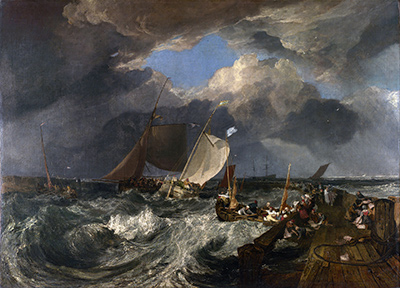
J. M. W. Turner's Calais Pier, with French Poissards preparing for Sea: an English Packet arriving is one of the great early marine paintings of his career. The National Gallery dates it to 1803, records the medium as oil on canvas, gives the dimensions as 172 x 240 cm and identifies the work as NG472, acquired through the Turner Bequest in 1856. [1] The short title Calais Pier is convenient, but the full title matters because it names the two forces that collide in the picture: French fishworkers preparing for sea and an English ferry arriving in rough weather.
The scene is crowded, unstable and deliberately difficult to settle. A cross-Channel ferry, loaded with passengers and flying the British flag, approaches Calais. Around it, French fishing boats move out toward open water. Dark clouds gather, the sea is rough, sunlight breaks through to strike the central white sail and a small boat in the lower right tries to avoid being battered against the pier. [1] The composition looks almost overloaded because Turner wants arrival, departure, weather, labour and national difference to press into the same moment.
The painting grew from Turner's own first journey abroad. The National Gallery records that, on 15 July 1802, he travelled from Dover to Calais and noted in his sketchbook that the landing was "Nearly swampt." [1] That short phrase should be handled carefully. It does not turn the picture into a literal diary illustration. It does show that Turner converted a bodily experience of Channel danger into a large exhibition painting.
When exhibited at the Royal Academy in 1803, Calais Pier received a mixed response. The National Gallery says that criticism focused especially on Turner's treatment of the foreground and the sea, including visible brushwork and impasto. [1] This is central to the painting's importance. Its subject was stormy, but its handling was also stormy. Viewers were asked to confront the physical energy of paint as well as the roughness of the Channel.
The picture stands between traditions. Dutch maritime painting supplied an important precedent, and the National Gallery notes that Turner may have been stimulated by seeing and sketching Jacob van Ruisdael's stormy coastal picture in the Louvre. [1] Yet Calais Pier is not a Dutch picture transplanted to France. It is a British artist's Channel scene, made after the Peace of Amiens, full of working people, cross-border movement, rough weather and comic disorder.
That mixture makes the painting unusually rich. It is a marine picture, a travel memory, an exhibition challenge, a study in material handling and a scene of social theatre. Turner turns the Channel into a place where weather, nationality, labour and paint all become active.
At a Glance
- ArtistJoseph Mallord William Turner
- Full titleCalais Pier, with French Poissards preparing for Sea: an English Packet arriving
- Date1803
- MediumOil on canvas
- Dimensions172 x 240 cm
- CollectionNational Gallery, London
- InventoryNG472
- AcquisitionTurner Bequest, 1856
- SubjectCross-Channel arrival and French fishing labour
- ReceptionMixed at the Royal Academy in 1803
Contents
- Overview
- Object Identity
- Turner's Channel Crossing
- Ferry, Poissards and Harbour Theatre
- Rough Sea and Collision Risk
- Dutch Maritime Precedent
- Paint Handling and Impasto
- Royal Academy Reception
- Why Calais Pier Matters
- How to Read Calais Pier
Object Identity
The National Gallery's full title is long because it does interpretive work. It tells the viewer where the scene is, who is preparing to leave, and what is arriving. The painting is not simply a view of Calais. It is a moment of conflicting movement at the edge of the harbour. [1]
The word "poissards" needs context. In the National Gallery's account, Turner uses the term for the French fishing boats and appears to adapt it idiosyncratically from the French word poissarde, meaning fishwife. [1] The term should therefore not be treated as decorative foreign colour. It points toward the fishing economy, the women and workers on the pier, and Turner's interest in a noisy working waterfront.
The painting's object facts are firm: Turner, 1803, oil on canvas, 172 x 240 cm, National Gallery, NG472, Turner Bequest, 1856. [1] Those facts also reveal ambition. This is a large painting by a young artist recently elected a Royal Academician. It has the scale of a public challenge rather than a modest travel recollection.
The scale changes the subject. A small Calais view might have been picturesque; at 172 x 240 cm, the scene becomes immersive and confrontational. Figures, waves, boats, sails, clouds and pier structures all compete for attention. The viewer is not invited to consider a tidy harbour. The viewer is dropped into a working marine disturbance.
Butlin and Joll's catalogue remains the oil-painting backbone for Turner's exhibited works, dating, provenance and title control. [6] For a painting with a long descriptive title and complex reception history, that discipline matters. Loose reference to "Calais Pier" is acceptable after the full title is established, but the object should not be detached from its complete identity.
The collection history also matters. The painting remained in Turner's possession when it was unsold after exhibition, and it later entered the National Gallery through the Turner Bequest. [1] That afterlife places Calais Pier within the group of works Turner kept and the nation later inherited, rather than only within the market history of works bought by patrons.
The painting's original frame, also described by the National Gallery, adds a quieter but useful object detail. The Gallery identifies a nineteenth-century English frame made for Calais Pier and most likely chosen by Turner. [1] This does not change the marine subject, but it reinforces the point that the work was a major object in Turner's own presentation of himself. He was not treating it as a passing sketch enlarged by chance.
Turner's Channel Crossing
The biographical trigger for Calais Pier was Turner's 1802 crossing from Dover to Calais, his first trip abroad. The National Gallery anchors the event precisely to 15 July 1802 and records Turner's sketchbook note that the landing at Calais was "Nearly swampt." [1] The Google Arts & Culture partner record, from the National Gallery, likewise describes the work as based on Turner's experience of a storm at sea during that journey. [2]
The crossing matters because it gave Turner physical knowledge of Channel weather. He was not inventing rough water from a studio formula alone. He had experienced the instability of the ferry, the danger of landing and the confusion of arrival. The painting is not simply topographical Calais; it is Calais remembered through bodily disturbance.
Still, the picture is not a straightforward document. Turner enlarged, organized and theatricalized the event. The ferry, fishing boats, pier, figures and weather are brought together in a compressed visual drama. The sketchbook phrase gives evidence of experience, but the painting transforms experience into public art.
The Peace of Amiens gives the crossing further weight. Turner's first foreign journey came during a brief pause in war between Britain and France. The Channel in this context was not merely a strip of water. It was a political, commercial and emotional boundary, newly passable but still charged.
The English vessel flying its flag and the French fishworkers on the pier make that boundary visible. The painting stages contact rather than harmony. Arrival and departure occur at the same time, under difficult weather, among people who are working, shouting, helping, resisting and trying to avoid collision. The Channel becomes a scene of encounter under pressure.
This is one reason the painting should not be reduced to anecdote. The near-disaster of Turner's landing is important, but it is only one layer. The larger subject is the complexity of arrival: national, bodily, maritime, comic and dangerous.
Ferry, Poissards and Harbour Theatre
The National Gallery describes a fully laden cross-Channel ferry approaching the port of Calais while small French fishing boats head out to sea. [1] This opposing movement is the structural engine of the painting. One vessel arrives from England; others prepare to leave from France. The harbour is not a place of rest but a point where movements collide.
The English ferry is socially and politically loaded. It carries passengers and the British flag. It belongs to travel, communication and cross-Channel exchange. Its arrival suggests the renewed possibility of movement after war, but the rough water and crowded harbour deny any easy confidence.
The French fishing boats carry a different kind of energy. They are linked to work, local economy and the women on the pier. The "poissards" of the title direct attention to ordinary labour rather than grand naval action. Turner fills the scene with the human bustle of departure, preparation and response.
The National Gallery notes that the painting includes one of Turner's most ambitious figure groups, with French fishermen trying to cast off while agitated women look on from the windswept pier. [1] This matters because the painting is not only a sea effect. It is a social scene embedded in a marine event.
There is also comedy in the disorder. The National Gallery points to an almost comic element recalling Hogarth, including a departing sailor holding up a flagon to be filled by a woman with a bottle. [1] This detail prevents the painting from becoming solemn in a single register. Danger and farce coexist.
That coexistence is part of Turner's originality. A lesser marine picture might separate storm drama from comic incident. Turner lets them interfere. The eye moves from rough water to figures, from the English ferry to local boats, from national symbol to bodily action. The result is not tidy storytelling but harbour theatre under stress.
The women on the pier are especially important because they keep the scene from becoming only a vessel picture. They belong to the fishing economy and to the social life of the waterfront. Their gestures, urgency and proximity to the departing boats make the pier a human stage, not merely an architectural edge.
The result is a painting about transition in every sense. People move from land to water; a British ferry moves from sea to harbour; weather moves between darkness and sunlight; comedy moves alongside danger. Turner makes the pier the place where these transitions become visible.
Rough Sea and Collision Risk
The National Gallery's description is direct: the water is rough, storm clouds gather and the whole scene appears chaotic, with a risk of collision. [1] That risk is the painting's central physical fact. Boats are not serenely arranged for display. They are pressed together by weather, harbour space and opposing purposes.
The lower right foreground is especially important. The National Gallery identifies a small fishing boat trying to get away so that it will not be battered against the pier. [1] This is a concrete danger. It keeps the viewer from reading the foreground as mere decorative surf or picturesque activity.
The sea is dark and mobile, but not empty. It carries the pressure of the scene. Waves interfere with steering, landing and departure. The water pushes bodies and vessels into awkward relations. Turner makes the sea an agent, not a setting.
The shaft of sunlight that illuminates the central white sail does not calm the picture. It intensifies it. The bright sail becomes an anchor for the eye, but it is surrounded by rough water, clouds and crowded movement. Light reveals danger rather than resolving it.
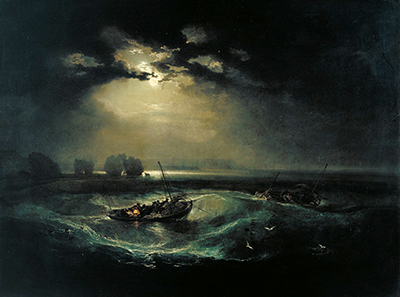
This is where Turner's early marine ambition is clearest. In Fishermen at Sea, the sea tested working boats under moonlight. In Calais Pier, the sea tests an entire harbour event: ferry arrival, fishing departure, pier crowd, national encounter and exhibition drama. The subject has expanded, but the core problem remains human action under marine force.
The collision risk also has visual consequences. The composition denies simple hierarchy. There is no calm central hero. Instead, attention breaks across the ferry, boats, people, waves and sky. That broken attention is part of the painting's meaning. The viewer must work through disorder just as the figures must work through rough water.
The roughness also changes the status of the harbour. A harbour normally suggests arrival, shelter and control. Turner's Calais offers none of these with confidence. The pier is close, but it is also a hazard. The shore is visible, but landing remains difficult. Safety and danger occupy the same edge.
Dutch Maritime Precedent
Turner was looking at older marine art as he made Calais Pier. The National Gallery states that Dutch maritime painting was an important precedent and that Turner may have been stimulated by seeing and sketching Ruisdael's storm picture in the Louvre near the end of his trip. [1] This places the picture within a long marine tradition.
The Dutch precedent matters because it offered models for rough seas, shipping, weather and coastal danger. Turner did not begin from ignorance of earlier sea painting. He entered a field already rich with examples and demands. The challenge was to respond competitively rather than merely imitate.
The 2013 Turner & the Sea study by Christine Riding and Richard Johns places Turner within a broad maritime field: inherited sea painting, naval conflict, travel, print culture and changing modern conditions. [3][4] Calais Pier fits that pattern precisely. It looks back to marine precedent while testing what a British exhibition painting could do with paint, disorder and contemporary travel.
The Ruisdael connection also helps explain the painting's seriousness. This is not simply a travel anecdote made large. Turner is measuring a recent personal experience against an established visual tradition. The storm at Calais becomes an arena in which to compete with the art of the sea.
At the same time, the painting resists being absorbed into Dutch tradition. Its French and English identities, its ferry arrival, its figure comedy and its heavy impasto make it unmistakably Turner's. The old marine precedent supplies pressure; Turner answers it with a scene of modern cross-Channel confusion.
That is why Calais Pier can feel both historical and immediate. It has learned from earlier paintings, but it refuses polished distance. Its sea is worked, crowded and materially insistent. Turner makes tradition unstable by making paint and incident more aggressive.
Paint Handling and Impasto
The painting's early reception cannot be separated from its surface. The National Gallery notes that criticism at the Royal Academy focused especially on Turner's treatment of the foreground and the sea. Viewers used to smoother marine paintings resisted his visible brushwork and thickly applied paint, including passages laid on with a palette knife. [1]
This criticism tells us how radical the painting's material presence could seem. The problem was not only what Turner showed, but how he showed it. Foam, water and weather were not rendered as discreet, polished description. They were built through paint that announced itself.
The National Gallery points especially to the white foam of the waves as a place where the handling can be seen. [1] Foam is an ideal subject for such treatment because it is broken, unstable and luminous. Thick paint can make wave action feel physical rather than merely drawn.
Joyce Townsend's How Turner Painted provides a broader technical frame for discussing Turner's materials, paint media, colour, compositional practice and technical imaging. [5] For Calais Pier, that caution is useful: the painting's storm effect is not only iconography. It depends on how paint is applied, layered, dragged and made visible.
Impasto also changes the relation between surface and subject. In a smooth marine picture, paint may disappear into illusion. In Calais Pier, the paint remains active. The sea is not only represented by pigment; it is made forceful through the handling of pigment. That is part of why some early viewers found the foreground disturbing.
The hostile comparisons recorded by the National Gallery, including complaints likening Turner's paint to messy substances, are revealing because they show viewers struggling with material excess. [1] What seemed like a fault to some critics later became central to Turner's achievement: paint itself could carry energy, weather and instability.
The material boldness also suits the subject. A smooth, distant handling might have made the crossing feel picturesque. Turner's rougher surface brings the viewer closer to the physical trouble of the scene. The painting asks the eye to feel the sea as broken substance, not merely as a named element within a composition.
This does not mean that the surface is uncontrolled. The visible paint is directed toward specific effects: foam, spray, agitation, pressure, interruption. The criticism tells us that Turner's choices were noticeable. The survival of the painting lets modern viewers see why those choices mattered.
The scale intensifies that material risk. At 172 x 240 cm, the painting asks the viewer to confront storm, harbour and human activity at nearly theatrical breadth. Thick paint in a small study might read as shorthand. In this large public oil, it becomes a direct challenge to polished marine convention. Turner is not hiding the work of making the sea; he is making that work part of the sea's force.
Royal Academy Reception
When Calais Pier was shown at the Royal Academy in 1803, it did not receive an uncomplicated welcome. The National Gallery describes the response as mixed and notes that the criticism marked the beginning of a pattern of disapproval that would continue around Turner's work. [1] The painting was admired for ambition but attacked for handling.
This mixed reception should not be simplified into rejection. Turner was already a serious young artist, and the painting was too ambitious to ignore. The problem was that its ambition strained familiar habits. It asked viewers to accept a turbulent surface and crowded composition as appropriate to a stormy maritime subject.
Ruskin's later praise is part of the painting's afterlife. The National Gallery records that Ruskin described it as the first painting to show signs of Turner's "colossal power" and elsewhere called it the "richest, wildest and most difficult composition." [1] These phrases are useful because they show how the qualities that troubled early critics could later be claimed as signs of greatness.
Ruskin's response should not replace the 1803 reception, however. The painting's importance lies partly in the gap between first response and later interpretation. Early viewers saw visible brushwork, impasto and unruly sea. Ruskin saw the emergence of a major power. Both reactions help define the work's place in Turner's career.
The painting remained unsold and stayed with Turner. [1] That fact adds another layer. Public exhibition did not immediately translate into purchase, yet Turner retained the work. Its later entry into the Turner Bequest means that a painting once resisted in the market became part of the national Turner inheritance.
The reception history therefore echoes the painting's subject. Arrival is difficult. Contact is unstable. The work enters public view amid admiration, resistance and misunderstanding. Turner makes a storm at Calais, and the picture itself creates a storm around paint.
This helps explain why the painting remains a turning point rather than only an episode from a journey. Turner found in the Channel crossing a subject that could carry weather, national difference, labour, discomfort and comic detail at once. The pier is a boundary, but it is also a pressure point. Everything converges there: water, bodies, boats, sunlight, language, travel and the problem of how modern marine painting should look.
Why Calais Pier Matters
Calais Pier matters because it joins personal experience, marine tradition and technical risk at a pivotal moment in Turner's early career. It follows his first continental journey, but it does not settle for travel illustration. It makes the Channel crossing into a complex public drama.
It also expands the ambitions visible in Fishermen at Sea. The earlier painting tested small boats against night and the sublime sea. Calais Pier adds a harbour, a cross-Channel ferry, national identity, working women and men, comic incident, sunlight, rough weather and large-scale exhibition density. Turner is increasing the number of pressures a marine painting can hold.
The full title helps explain that expansion. The picture is not just a place. It is a situation: French fishworkers preparing for sea while an English ferry arrives. The subject is movement at a threshold. Harbour, nation, weather and labour meet at the pier.
The painting also matters for its material boldness. The National Gallery's account of early criticism around visible brushwork and impasto shows how Turner's surface could become controversial. [1] This is a key step toward the later Turner, whose handling would often challenge viewers as much as his subjects did.
The Dutch precedent gives the painting historical depth. Turner responds to earlier maritime art, including Ruisdael, while making the scene newly physical and contemporary. [1] He does not reject tradition. He makes tradition answer to his own experience of Channel weather and modern travel.
Finally, Calais Pier matters because it refuses one tone. It is dangerous, comic, national, bodily, technical and theatrical. The ferry arrives, the fishworkers prepare, the sea interferes and the paint refuses to behave politely. Few early Turner works show so clearly how much energy he could extract from a single maritime encounter.
Its size is part of that achievement. Turner gives a working harbour subject the physical scale of major exhibition painting. The canvas is large enough to make viewers feel the spread of water and sky, but crowded enough to keep them aware of human pressure. The work's ambition lies in holding both scale and incident at once.
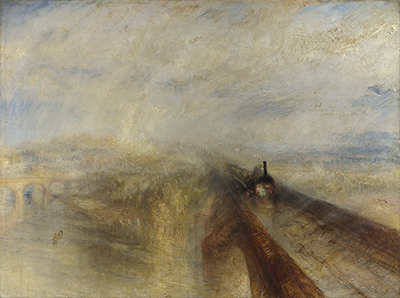
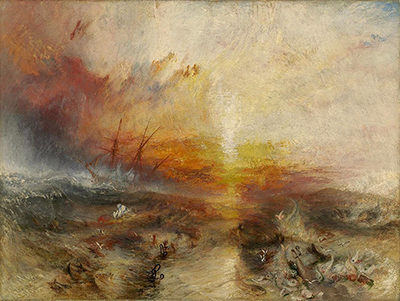
The painting is also a bridge between Turner's early marine credentials and his later readiness to make the sea carry modern history. Nothing here is yet as politically severe as The Slave Ship or as technologically charged as Rain, Steam, and Speed, but the method is already visible. Turner lets a specific journey become more than private recollection. He makes transport, weather, labour and national contact occupy the same pictorial field.
This is why the painting still rewards slow looking. Its first impression may be confusion, but that confusion has structure. Each passage adds pressure: the arriving English vessel, the departing French boats, the women at the pier, the rough foreground, the illuminated sail, the troubled sky and the heavily worked surface. The more clearly these parts are separated, the more forcefully their collision can be felt.
How to Read Calais Pier
Begin with the full title. It identifies not only Calais but the conflict of actions: French poissards preparing for sea and an English ferry arriving. Once that structure is clear, the apparent disorder becomes more intelligible. The picture is built around contrary movements.
Next, find the English vessel and the fishing boats. The arriving craft does not enter an empty harbour; it enters a busy working scene. The French boats are not accessories. They are named in the title and essential to the drama. The painting is about shared water under pressure.
Then look at the weather and light. Dark clouds and rough sea dominate the mood, but a shaft of sunlight catches the central sail. [1] That light does not make the scene peaceful. It makes the confusion more visible, breaking the darkness into sharp incidents.
Pay close attention to the lower right foreground. The small boat trying to avoid the pier gives the danger a specific focus. [1] Without that detail, the sea might read as general turbulence. With it, the rough water becomes an immediate hazard.
Finally, look at the paint. The visible handling of foam and water was central to early criticism of the picture. [1] The surface is not a neutral vehicle for the scene. It is part of the subject. Turner's paint behaves like weather: broken, forceful and hard to smooth into calm description.
Read in this order, Calais Pier becomes less chaotic without becoming less energetic. Its disorder is constructed. Turner organizes a crowded harbour, cross-Channel arrival, working boats, comic figures, rough sea and contested paint into a single demanding image.
Frequently Asked Questions
The National Gallery's full title names Calais, the French fishworkers and the arriving English ferry, making the opposing actions part of the official identity of the work. [1]
The National Gallery explains that Turner appears to adapt the term from the French poissarde, meaning fishwife. In the painting it points to the French fishing community preparing for sea. [1]
The National Gallery dates the painting to 1803. [1]
The painting is in the National Gallery, London, as inventory number NG472. It entered the collection through the Turner Bequest in 1856. [1]
Yes. The National Gallery connects it to Turner's Dover-to-Calais crossing on 15 July 1802, when he recorded that the landing was "Nearly swampt." [1]
The National Gallery notes that criticism focused especially on the foreground and sea, including Turner's visible brushwork and impasto. Some viewers expected smoother marine painting and resisted the physical handling of paint. [1]
Discussion
How does Turner make a harbour arrival feel at once comic, dangerous and materially turbulent?
Reader Insights
How do arriving and departing vessels compete for attention?
What keeps the fishworkers and pier figures central to the scene?
How does visible impasto make the rough sea feel physical?
Join the Conversation
Share a close observation or a question for other readers.
References
- National Gallery, London, "Joseph Mallord William Turner, Calais Pier." https://www.nationalgallery.org.uk/paintings/joseph-mallord-william-turner-calais-pier
- Google Arts & Culture / National Gallery, London, "Calais Pier, with French Poissards preparing for Sea: an English Packet arriving." https://artsandculture.google.com/asset/calais-pier-with-french-poissards-preparing-for-sea-an-english-packet-arriving-joseph-mallord-william-turner/9AGg9EoW3ozFmg?hl=en
- Royal Museums Greenwich, "Turner & the sea / Christine Riding and Richard Johns." https://www.rmg.co.uk/collections/library/rmgl-152360
- Christine Riding and Richard Johns, *Turner & the Sea*. London: Thames & Hudson / National Maritime Museum, 2013.
- Thames & Hudson, Joyce H. Townsend with Tony Smibert, *How Turner Painted*. https://www.thamesandhudsonusa.com/books/how-turner-painted-softcover
- Martin Butlin and Evelyn Joll, *The Paintings of J. M. W. Turner*, revised edition. New Haven and London: Yale University Press, 1984.