

 by Tom Gurney
Tom Gurney BSc (Hons) is an art history expert with over 20 years experience
Published on June 19, 2020 / Updated on August 29, 2026
Email: tomgurney1@gmail.com / Phone: +44 7429 011000
A Gate Between Sunlight and Storm
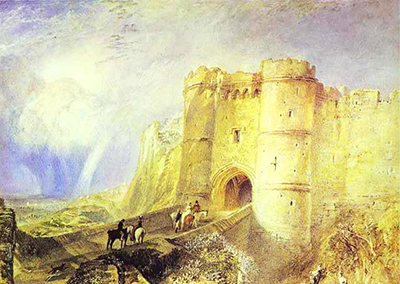
Carisbrooke Castle does not wait on a distant hill in J. M. W. Turner's watercolour. Its gatehouse rises immediately in front of the spectator, filling most of the sheet. A causeway climbs towards the black opening of the portal. Horses and travellers approach in small groups, dwarfed by round towers that catch a sudden, yellowed light. At the far left, Newport lies beneath blue-violet rain, and a pale rainbow descends through the storm. Architecture, weather and human movement converge at one defended entrance.
Turner made Carisbrooke Castle, Isle of Wight around 1828. It is a watercolour measuring 29.2 by 41.2 centimetres and is now in Carisbrooke Castle Museum, accession NETCC:2008:20.[1][3] It entered the museum following acceptance by HM Government in lieu of Inheritance Tax and allocation in 2007. That transfer made it the first work by Turner to enter a public collection on the Isle of Wight.[1]
The spelling varies across its history. The museum and modern heritage authorities use “Carisbrooke,” while Charles Westwood's 1830 engraving was issued as Carisbrook Castle, Isle of Wight. Nineteenth-century catalogues commonly omit the final “e.” The two forms identify the same place and composition, not different versions.
This close gatehouse design was made for Picturesque Views in England and Wales, Turner's largest engraved topographical undertaking. Its finished surface belongs to the late 1820s, but the visual knowledge behind it reaches back to his first Isle of Wight tour in 1795. The official Acceptance in Lieu account identifies an entrance study from that early visit as the detailed architectural basis, despite Turner's return to the island in the 1820s.[1] The image is therefore a mature reimagining of information gathered over more than thirty years.
The castle's history extends much further. Its hilltop had an Anglo-Saxon fortification around the year 1000; a Norman motte-and-bailey followed; the present gatehouse grew in medieval phases; and Elizabethan ramparts answered the threat of Spanish invasion. Charles I was held there in 1647-48.[13][15] Yet Turner does not stage a medieval assault or royal imprisonment. His travellers wear the image's own contemporary character. They approach a monument that had ceased to be a central defence and was becoming a destination.
Light makes that transition visible. The entrance remains a dark, potentially forbidding void, while the road is open and occupied. The gatehouse still commands the body through scale, slope and enclosure, but the visitors proceed towards it freely. The rainbow, appearing where rain meets illumination, makes the ancient threshold part of a changing present rather than an inert relic.
Essential Details
Object, Collection and Publication
- ArtistJoseph Mallord William Turner (1775-1851)
- TitleCarisbrooke Castle, Isle of Wight
- Historic print titleCarisbrook Castle, Isle of Wight
- Datecirca 1828
- Mediumwatercolour
- Dimensions29.2 x 41.2 cm
- CollectionCarisbrooke Castle Museum, Isle of Wight
- AccessionNETCC:2008:20
- Allocationaccepted in lieu of Inheritance Tax and allocated in 2007
- Purposefinished design for Picturesque Views in England and Wales
- EngraverCharles Westwood
- Print date1830
Contents
- A Gate Between Sunlight and Storm
- Close Enough to Enter
- The Towers and the Dark Portal
- The Rising Causeway and Its Visitors
- Newport, Rain and Rainbow
- What Watercolour Can Carry
- Turner on the Isle of Wight in 1795
- The First Carisbrooke Sequence
- A Subject Revisited Over Three Decades
- How Memory Became Design
The object is unusually well placed. A watercolour of Carisbrooke's entrance is held by the museum within the castle it represents. The museum's current Highlights guide puts the Turner first in its selection and calls it one of the finest designs in the England and Wales series.[2] That institutional emphasis establishes its importance without guaranteeing that a light-sensitive work on paper is continuously on display.
The secure dimensions and medium come from the government report on the 2007 tax settlement.[1] Public records describe the finished object simply as watercolour. Turner's general practice often included pencil, opaque colour, reserve, lifting and abrasion, but none of those should be assigned to this sheet as a documented fact without an object-specific technical examination.
The accession number can initially appear to conflict with the allocation date. It does not. The government allocated the work in 2007, while the museum identifier incorporates 2008. Both belong in the record: one marks the transfer process, the other the institution's registration.
The title also needs precision. “Carisbrooke Castle” may refer to numerous Turner drawings, a circa-1796 watercolour, later colour studies, the finished museum sheet or Westwood's print. The date, dimensions and accession distinguish the primary object. They prevent a close, luminous publication design from being confused with small graphite records or distant prospects in the Turner Bequest.[4]
The 2007 transfer joined the work with another Turner watercolour offered in the same tax settlement, Rome from San Pietro in Montorio. That Italian view was allocated to the Courtauld, while the island subject went to Carisbrooke.[1] The pairing is suggestive: one sheet emerged from Turner's first Roman journey and the other from repeated engagement with an English fortress. Their separate destinations restored each to a collection with a strong relationship to its subject.
Close Enough to Enter
Turner chooses a position below the gate rather than across the valley. The spectator seems to stand near the lower end of the approach, where the causeway rises towards the entrance. That low station enlarges the towers and shortens the visible road. It also prevents the castle from settling comfortably into a broad landscape panorama.
The gatehouse occupies roughly the right two-thirds of the composition. Its outer wall is cut by the right edge, implying that the fortification continues beyond what the sheet can contain. Cropping makes the structure feel larger than a complete miniature would. The viewer receives the gate in an encounter, not as an inventory of the entire castle.
At left, open country and Newport provide release from the masonry. The town is low and distant, spread beneath rain and hills. The official object account specifically identifies Newport there.[1] This topographical anchor matters because Carisbrooke stands inland, south-west of the town. The blue weather is not spray from a coastal storm, and the road does not rise from a harbour.
Turner's viewpoint also determines what the image excludes. The shell keep on its high motte, one of the castle's most conspicuous features from other directions, is not the leading motif. Nor does the Elizabethan artillery circuit dominate. Turner concentrates on the place where a visitor's body crosses from outside to inside.
That focus gives the scene an implicit sequence. The spectator begins below, follows figures and animals up the diagonal, reaches the dark arch and imagines space beyond it. A distant castle prospect offers survey; this design offers approach. Even a viewer who has never entered Carisbrooke can understand the physical demand of the climb and the compression of the gateway.
The road's parapet strengthens that bodily reading. Its upper edge catches light and traces a firm line from foreground towards the portal. The opposite bank is darker and less regular. Together they create a narrowing channel. Horses and pedestrians do not wander through an open field; they are funnelled towards a defended aperture.
Yet the image is not claustrophobic. Sky remains visible above the towers, and the left landscape opens towards the town. The causeway connects rather than seals. Turner balances the gateway's pressure with weather and distance, allowing the spectator to experience fortification and prospect in the same glance.
The mounted figures are essential to scale. English Heritage explicitly notes that Turner included visitors on horseback to demonstrate the gatehouse's vastness.[3] A horse is a substantial body, but here horse and rider together remain small against one cylindrical tower. The architecture's size is understood through comparison with living movement.
This low, close composition also separates the work from Turner's own earlier distant views. In 1795 and again around 1826 he drew Carisbrooke as a landmark across fields and valleys.[4] The finished design chooses the opposite experience: no long anticipation, only the moment when stone rises over the road.
The Towers and the Dark Portal
Two cylindrical towers flank the entrance, but Turner does not light them equally. The broad tower at right receives the most continuous warmth. Its curved surface turns gradually from pale gold into cooler shadow, making mass legible through colour rather than outline alone. The left tower is narrower in the composition and more interrupted by shade, adjoining wall and the broken silhouette of its upper works.
The arched portal between them is nearly black. It forms the deepest local dark and the image's visual destination. The closer the road comes to entry, the less it reveals. This reversal is psychologically effective: bright stone announces the gate, while darkness withholds the interior.
The entrance arch is not merely a hole cut into a facade. Recessed mouldings create a sequence of curves around it. Westwood's engraving makes these architectural bands especially clear, but they are already present as warm and red-brown accents in the watercolour. The arch gathers the converging causeway and the round forms of the towers into one concentrated threshold.
Small openings interrupt the masonry. Slits, windows and the cross-shaped form on the right tower register defensive use without turning the sheet into an architectural elevation. Some are crisp; others almost disappear in illumination. Turner supplies enough evidence for recognition while allowing sunlight to dissolve minor joints.
The tower's curvature is central to the light effect. On a flat wall, the passage from gold to shadow might read as a cast shape. Across the cylinder, it describes volume. The fortress appears solid because colour wraps around it. At the same time, the brightest area approaches the hue of the sky, so mass seems momentarily lightened rather than simply weighed down.
Historic England's phased account explains why the front is not one building campaign. A timber entrance of about 1100 had been replaced in stone by 1136. Isabella de Fortibus probably built the core of the present gatehouse in the late thirteenth century. Cylindrical flanking towers were added in 1335-36, heightened around 1380 and altered again in 1470.[14] What looks like one imposing face is an accumulation of defensive decisions.
Turner does not diagram those phases, but he responds to their resulting irregularity. Tower heights, parapets, wall planes and openings do not form perfect bilateral symmetry. Light further differentiates them. The gatehouse is coherent enough to command the approach and varied enough to carry history on its surface.
The right crop intensifies that effect. The wall continues beyond the sheet as a pale, imperfect field. Instead of closing the castle with a picturesque silhouette, Turner makes the visible front part of a larger enclosure. The image cannot possess the whole fortress, just as the arriving visitors cannot survey all its defences from below.
Dark vegetation at the base prevents the tower from floating in light. Bushes, broken earth and shadow tie masonry to the slope. Their irregular textures contrast with the large rounded stone forms, making the construction appear both engineered and embedded in ground altered over centuries.
The Rising Causeway and Its Visitors
The causeway is the composition's main directional force. It begins near the lower middle edge, rises to the right and terminates inside the portal. Its incline opposes the vertical towers and the broad horizontal spread of Newport. The whole design turns around this meeting of road, wall and gate.
Visitors are distributed along the climb rather than assembled as one theatrical group. Dark horses and figures gather lower down. Paler animals and riders appear closer to the entrance. Their changing size and colour reinforce recession, but they also create pauses in the ascent. The approach feels inhabited, not ceremonially staged.
Turner gives no names to these people. They should not be identified as soldiers, retainers, Charles I's guards or participants in an escape. Their dress, riding and leisurely relation to the monument belong more plausibly to contemporary travel. English Heritage calls them visitors, a description that fits their pictorial role.[3]
That role is more complex than scale alone. The figures show that the once-defended approach is traversable. The darkest opening still possesses menace, but horsemen proceed towards it without resistance. A military machine has become a place encountered through touring.
The horses also link old and new forms of movement. Mounted travel was practical on the island, while the rise of picturesque tourism encouraged visitors to seek castles, ruins and prospects. The figures bring an everyday mode of transport into a composition made for national circulation through prints. Physical journey and reproduced image meet on the causeway.
Their smallness does not make them insignificant. One pale horse near the arch catches enough light to mark the transition into shadow. Darker animals below punctuate the sloping road. These accents stop the causeway from becoming an empty geometric wedge.
The parapet conceals parts of the bodies. This partial visibility makes the incline credible: legs and lower forms drop behind the wall while riders remain above it. Turner thereby uses obstruction to establish spatial depth. The road is not painted as a flat stripe laid across the castle front.
Human movement also controls tempo. The architecture is immobile, while the weather seems fleeting. The mounted party occupies an intermediate duration. It climbs slowly enough for the spectator to follow, but its journey will end. The castle has outlasted generations of such arrivals, while the rainbow may vanish within minutes.
In the engraved image, Westwood sharpens the riders, horses and roadside vegetation through fine lines. Their outlines are easier to count than in the colour reproduction, yet their tonal subordination remains. They guide the eye without competing with the towers.
The causeway therefore does four jobs at once. It explains access, creates depth, carries contemporary life and turns viewing into an imagined act of entry. Without it, the castle would be an illuminated object. With it, the image becomes a passage from open country into historical enclosure.
Newport, Rain and Rainbow
The left side is small in area but immense in implication. Beyond the lower road, land falls away towards Newport. Low buildings and fields are compressed beneath distant hills, making the island's principal town appear vulnerable beside the gatehouse. The fortress controls the foreground; weather controls the distance.
A dense blue-violet mass occupies the far left sky. It can be read as rain or a storm curtain rather than a solid cloud alone, because its colour descends towards the land. The museum-associated account describes stormy cloud threatening Newport while the castle shines like yellowed ivory.[6] That contrast gives the town and gate different atmospheric conditions within one view.
The rainbow appears along the boundary between darkness and clearer light. In the inherited colour reproduction it is easy to mistake for a shaft of brightness, partly because the image is small and cropped. Westwood's complete engraving resolves the form as a curved pale band descending through the rain. The arc is not lightning.
Turner places no full semicircle across the sky. Only a segment is needed. Its incompleteness suits the crop and the close viewpoint: the spectator receives one local sign that sun and rain coexist. The rainbow points down towards the landscape rather than crowning the castle as a heraldic emblem.
The direction of illumination creates a second diagonal. Light travels across the gatehouse front, while the causeway rises towards the gate. These vectors interact without coinciding exactly. The road is a human course; the beam and rainbow belong to atmospheric optics. Their convergence makes the entrance feel momentarily chosen by weather.
No document establishes that Turner observed this exact event at Carisbrooke. The image may combine remembered architecture, renewed island experience and a weather effect selected in the studio. Its truth is pictorial and topographical, not a timestamped report.
The colour opposition is nevertheless specific. Warm ochre and cream give the right tower apparent substance. Cool blue and purple deepen the left distance. Red-brown around the arch and road links masonry to earth, while pale sky separates the towers from the storm. Turner avoids a one-note golden spectacle by sustaining cold weather beside the light.
The rainbow also changes the meaning of ruin. It is not merely a cheerful sign after rain. Because the portal remains black and the storm still hangs over Newport, improvement is provisional. Clear and dark conditions coexist. The old castle appears enduring, but its appearance changes under forces it cannot command.
This weather is one reason the view exceeds conventional architectural portraiture. A measured record could describe tower, arch and wall. Turner makes their visibility contingent. Sun reveals the cylinder, rain veils the town, and the rainbow marks the unstable boundary between them.
What Watercolour Can Carry
The official object record calls the work watercolour.[1] That concise medium description should govern any account of technique. It does not prevent close looking, but it separates what the eye can describe from what only conservation examination could prove.
Large areas of sky appear thin and luminous. Pale colour allows the support to contribute brightness, especially above the left landscape and around the upper gatehouse. Darker blue-violet passages accumulate at the rain front without covering every variation beneath them. The result is atmospheric depth rather than a uniformly painted backdrop.
Masonry requires a different handling. Warm fields establish the great tower, then small darker marks articulate openings, joints and edges. Some contours are softened where light is strongest. Turner can therefore make the castle both specific and irradiated: architectural information survives, but illumination prevents it from hardening into a diagram.
The portal depends on concentration. Deep brown, purple and near-black colour creates a compact recess against the larger pale wall. Its darkness is not spread evenly across the castle. By reserving the strongest value contrast for the entrance, Turner gives a small area disproportionate force.
Foreground vegetation is more broken. Short marks, stains and irregular darks build a rough base beneath the smooth tower. The causeway lies between those modes. Its parapet has a relatively firm edge, but figures and road surface remain compressed and mobile.
General accounts of Turner's watercolour practice explain that he could combine transparent washes with opaque touches, reserve the paper, lift colour and abrade surfaces.[22] Those processes are useful possibilities, not an object report. It would be unsafe to identify bodycolour, scratching, sponge work, gum or named pigments here solely from reproduction.
The distinction matters because Westwood's print can mislead technical inference. Engraving turns every colour and wash into lines, dots or unmarked paper. A highlight in the plate may correspond to pale wash, untouched support, lifted colour or an opaque accent in the watercolour. The translation proves visual hierarchy, not a recipe.
Turner's control is clearest in the relation of hard and soft. The arch and selected windows hold; distant Newport diffuses. The parapet guides; storm colour spreads. Tower edges alternate between firm silhouette and luminous dissolution. These variations are compositional decisions whether or not their exact tools are known.
The modest dimensions heighten the achievement. At 29.2 by 41.2 centimetres, the sheet must contain monumental architecture, a town, weather, figures and a legible approach within a space made for reduction into print.[1] Detail cannot be unlimited. Turner chooses marks that survive both close viewing and reproductive compression.
Watercolour carries temporal difference as well as form. Stone suggests centuries, travellers suggest minutes of movement, and the rainbow suggests an instant of changing light. The medium's ability to move from stain to accent lets those durations occupy one surface without becoming separate illustrations.
Turner on the Isle of Wight in 1795
Turner first reached the Isle of Wight in 1795, aged twenty. The journey formed part of a southern campaign that included Winchester, Southampton, Netley and Salisbury before the island. He was already building a career from travel, topographical drawing and the possibility that finished watercolours would be engraved.
The island offered concentrated variety: harbours and ships at Cowes, churches and farms, cliffs around the south coast, wooded valleys, Newport and Carisbrooke's fortress. The surviving sequence shows that he did not pass quickly through one famous place. He examined how landmarks changed with distance and approach.
At Chale he made careful pencil records of a church and medieval farm. One resulting watercolour, Chale Farm, Isle of Wight, was exhibited at the Royal Academy in 1796.[8] This conversion from tour drawing to public work provides a contemporary model for Turner's early practice: observation was gathered economically, then selected and developed in London.
The same source records an approach from the printmaker John Landseer, who proposed a series called Views in the Isle of Wight. Turner listed subjects for the order, but the scheme did not proceed.[8] Carisbrooke's later inclusion in Picturesque Views in England and Wales should not be treated as a direct continuation of that abandoned commission. It does show, however, that island topography and reproduction were linked in Turner's thinking from the start.
His 1795 records were not tourist souvenirs in the casual sense. They supplied reusable visual knowledge. A castle drawn at twenty could return as the basis for a major publication design in his fifties. The long delay demonstrates the value Turner placed on his archive of travel.
The tour also belongs to a moment when watercolour was central to his advancement. He had entered the Royal Academy Schools in 1789, exhibited architectural subjects, worked under Thomas Malton and absorbed the demanding topographical culture around Dr Thomas Monro. Direct travel allowed him to test that training against irregular buildings and changing weather.
Carisbrooke posed both architectural and landscape problems. The gate required close description of cylindrical towers, openings and a steep approach. Distant views required the castle to remain identifiable as a small profile. Newport added relations between fortress, town and surrounding land. Turner recorded all three scales.
The 1795 campaign therefore did more than provide one outline. It established a mental geography of the castle and its surroundings. By the time Turner made the 1828 watercolour, he could choose which part of that geography best served a national print series: not the whole hilltop, but the threshold where history meets the visitor.
The First Carisbrooke Sequence
Tate's current collection data identifies three consecutive 1795 subjects. D00431 is Distant View of Carisbrooke Castle, Isle of Wight. D00432 is Carisbrooke Castle, Isle of Wight. D00433 is Carisbrooke Castle, Isle of Wight: The Gateway.[4] The first two are landscape-format sheets measuring 204 by 264 millimetres. The gateway sheet reverses those dimensions and is upright.
Orientation alone reveals different aims. A horizontal leaf can set the castle within broad ground. An upright leaf is better suited to the entrance's height, flanking cylinders and vertical pressure. The finished watercolour returns to a horizontal format but imports the gateway's close architectural authority into a wider field of weather and landscape.
The historic inventory of the Turner Bequest describes leaf 24 as a distant Carisbrooke view, leaf 25 as a slightly different distant view, and leaf 25a as the gate.[5] It also says that leaf 25 was in watercolour and the gate partly finished in watercolour. Tate's current open metadata records D00431-D00433 as graphite on paper.[4]
That disagreement should not be hidden or carelessly resolved. Catalogues change as works are re-examined, titles are matched to accessions and material descriptions become more conservative. The safest account is that current Tate metadata calls the sheets graphite, while the 1906 inventory saw colour in two of them. The discrepancy concerns those early studies, not the medium of the finished museum watercolour.
John Ruskin knew the gate sheet under its old National Gallery number 532. His catalogue described it as a drawing advanced in colour by sections and used it to discuss Turner's habit of completing one area before another.[7] This is valuable nineteenth-century testimony about how the sheet then appeared, but it is not a modern material analysis.
Another 1795 record expands the topography. D00452, Newport, Isle of Wight, with Carisbrooke Castle in the Distance, places town and fortress together.[4] That relation reappears in the finished design, where Newport is compressed at the left of the gatehouse. The later image does not invent the town's relevance even though weather transforms it.
The government panel specifically states that the detailed entrance-gatehouse sketch used for the circa-1828 watercolour dates to 1795.[1] It does not identify one accession in isolation. Given the sequence of distant castle, closer view, upright gateway and Newport prospect, the mature composition is better understood as a synthesis of archived knowledge than an enlargement of one leaf.
This synthesis explains why the finished scene can feel both observed and newly composed. Tower forms and the ascending way possess the confidence of study. The crop, visitors, rainbow and diagonal illumination organise those facts for a different audience and format.
A Subject Revisited Over Three Decades
Turner did not put Carisbrooke away after 1795. Tate D00881, A Sluice and a Watermill, with a Distant View of Carisbrooke Castle, is dated about 1796 and measures 202 by 270 millimetres.[4] The fortress there becomes a small landmark beyond working water infrastructure, demonstrating how quickly Turner could shift it from principal subject to geographical marker.
A later sheet, D08274, is titled Carisbrooke Castle and dated broadly to circa 1807-19. Tate records graphite and watercolour on paper, 231 by 319 millimetres.[4] The old Bequest inventory related a later Carisbrooke drawing to the 1795 leaf-25 view.[5] Even with imprecise dating, the object proves that the early material was developed or reconsidered before the England and Wales commission.
The subject then recurs in a cluster around Turner's renewed island travel. D20212, A Distant View of Carisbrooke Castle, is a small watercolour dated circa 1826. D20213 and D20214, both titled Carisbrooke Castle, are graphite and watercolour studies dated about 1826-27. D20316 is a graphite Carisbrooke view of about 1826.[4]
These objects matter because they prevent an overly simple story in which Turner copied a youthful sketch after three decades without looking again. He returned to the castle in different media, scales and degrees of finish. The 1820s sheets refreshed his understanding of Carisbrooke near the moment when the publication watercolour was made.
At the same time, later date does not automatically mean direct source. The Acceptance in Lieu panel still identifies the detailed gatehouse record as a product of 1795.[1] The museum guide cautiously suggests that Turner's 1827 stay with John Nash at East Cowes Castle may have been when relevant sketches were made.[2] These statements can coexist if the final design draws architectural precision from the early sequence and renewed atmospheric or topographical knowledge from the later visits.
The Nash connection should remain proportionate. Turner was on the island in the 1820s and stayed at East Cowes Castle during the regatta period, but there is no secure evidence that Nash commissioned Carisbrooke Castle. The large Cowes regatta oils belong to a distinct patronage and production history.
Repeated engagement also changes the meaning of memory. Turner did not have to preserve one static impression from youth. Each return could revise what mattered: first the outline, then a distant role in landscape, then colour and weather, finally a monumental entrance designed for print.
The surviving sequence is particularly instructive because it ranges from graphite notation to finished public watercolour and engraving. Carisbrooke can be followed through the stages by which a place entered Turner's visual archive, remained available, acquired new associations and reached a broad audience.
How Memory Became Design
The circa-1828 composition is not a neutral accumulation of studies. Turner chooses, compresses and rearranges. The gatehouse comes close, Newport remains visible, visitors establish scale, and extraordinary weather divides the field. These elements form an argument about encountering the past.
Architecture supplies resistance. Towers are heavy, openings small and the portal dark. The road cannot avoid the gate because its walls direct every traveller there. The fortress retains the bodily logic of defence even when no guard blocks passage.
Weather supplies change. Sunlight moves across stone, rain veils the town and a rainbow appears only under a particular relation of moisture and illumination. These effects deny the castle an unchanging appearance. Its history may be long, but every act of seeing is temporary.
Figures supply the present. Their horses and movement bring the early nineteenth century to a medieval entrance. They neither reenact the castle's past nor ignore it. Their scale acknowledges its power while their progress demonstrates altered use.
Turner binds these components with diagonals. The causeway rises into the gate. Illumination cuts across the facade. The rainbow descends at left. None is merely decorative. Together they prevent the huge vertical mass from settling into static symmetry.
The darkest and brightest areas are adjacent near the entrance. Warm tower surfaces almost glow, while the arch absorbs light. This opposition makes entry uncertain. The eye is invited by the road and stopped by darkness at the same time.
Memory is visible in the design's confidence, not as blur. Turner remembers enough to make the gateway convincing, but he does not treat memory as a requirement to reproduce every stone. Decades of study permit selection. He knows which features establish Carisbrooke and which can yield to atmosphere.
The title names only the place, following topographical convention. The image adds a more complicated proposition: a fortress can be an inherited structure, a tourist experience, a weather event and a reproducible national image simultaneously. No subtitle needs to spell out that argument.
This is why the work differs from a picturesque ruin assembled solely for pleasing irregularity. Carisbrooke was still Crown property and retained military, political and local significance. Its gate was not an anonymous fragment. Turner's design allows beauty and historical authority to remain in tension.
Picturesque Views in England and Wales
Charles Heath conceived Picturesque Views in England and Wales as an ambitious publication built around Turner designs. Work began in the mid-1820s, and the series was issued from 1827 to 1838. A projected 120 subjects ultimately became ninety-six published views.[9]
The scale of the undertaking mattered. Turner was not illustrating one linear journey or a single county. The sequence moved across England and Wales, joining castles, abbeys, rivers, towns, industrial sites, coasts and mountains. Weather and human activity differentiated subjects that might otherwise have become a repetitive national album.
Carisbrooke offered several attractions. It was architecturally distinctive, historically associated with Crown power and Charles I, and situated on an island increasingly visited for scenery. Turner had unusually deep source material. Its gatehouse also reduced effectively into a compact plate because tower, arch, causeway and figures formed a clear tonal structure.
Heath depended on specialist engravers to translate the watercolours. Turner supplied finished designs rich enough to reward close inspection but organised strongly enough to survive monochrome reduction. The collaboration extended an original work's reach far beyond one collector's walls.
The commercial arrangement was demanding. Heath sought first-rate engraving and invested heavily in drawings and plates. The project stopped short of its intended total, and Turner eventually acquired the engraved matrices and unsold impressions for GBP 3,000.[9][17] That afterlife underlines the material scale of publication: the images existed not only as watercolours but as metal plates, proofs, impressions and bound volumes.
Elizabeth Helsinger has argued that the series reveals a nation transformed rather than a timeless countryside.[19] Carisbrooke supports that reading. An ancient gate dominates, but modern visitors occupy its road. The monument survives while its function changes from defence towards heritage and travel.
The image does not present industrialisation directly, as some England and Wales subjects do. Its modernity lies in circulation and spectatorship. Riders approach the castle, printed impressions carry it elsewhere, and an old political stronghold becomes available to a national audience through commodity and culture.
The series title promises the picturesque, but Turner does not restrict that category to gentle decay. The portal is severe, storm threatens Newport and the rainbow depends on unsettled weather. Beauty emerges from opposition rather than comfort alone.
Carisbrooke's place in the project also completes an early possibility. The unrealised Landseer proposal of the 1790s would have circulated Isle of Wight views.[8] More than thirty years later, Turner finally brought this gatehouse into an extensive engraved survey, under different patronage and with mature command of light.
Charles Westwood's 1830 Engraving
Charles Westwood translated the watercolour for publication in 1830. Tate preserves both an etching, T04554, and a line engraving, T04555, each with an image area of 166 by 235 millimetres.[4] Yale records impressions made with etching and engraving, including a first published state on chine colle.[11]
The print bears the shorter historic spelling Carisbrook Castle, Isle of Wight. In a bound sequence it appears as plate 31, immediately before Cowes among the 1830 subjects.[10][12] That proximity linked two very different island experiences: the inland medieval gate and the modern harbour.
Westwood retains the principal composition faithfully. The gatehouse fills the right, the road rises into the arch, mounted visitors approach, Newport spreads at left and a rainbow descends through the storm. The complete print also restores lower and outer details lost from tightly cropped reproductions of the watercolour.
Monochrome changes the means by which light is understood. Dense parallel and crossed lines build the dark portal, shadowed tower and weather mass. Sparser hatching allows the right cylinder to appear illuminated. Areas of open paper carry the greatest brightness.
The rainbow becomes especially legible. In colour it is a subtle pale-violet and cream transition against blue rain. In the engraving, Westwood must state the arc as a discrete light interval within darker lines. Translation clarifies its shape even while losing its hue.
Masonry gains graphic detail. Courses, openings, parapets and rough surfaces can be articulated with repeated marks. The travellers become easier to separate, and foreground plants acquire crisp textures. This precision suits the smaller printed image and the expectations of topographical publication.
What disappears is equally important. No arrangement of black ink can reproduce the direct opposition of warm ivory stone and saturated violet weather. The print can preserve value - bright against dark - but not the chromatic vibration that makes the castle seem struck by transient sun.
The engraving also stabilises softness. Watercolour edges can bleed, fade or dissolve into light; engraved contours have to be cut or etched. Westwood compensates through varied line density, allowing some cloud and distance to remain open, yet the medium inevitably gives architecture a firmer skeleton.
This is collaboration, not mechanical copying. Westwood interprets tone, texture and scale within the capabilities of steel engraving. Turner's design determines the image, but Westwood's craft determines how thousands of readers encounter it. Turner did not engrave the plate himself.
Proof, plate and published state also alter temporality. The watercolour is one light-sensitive object; impressions can exist in many collections and conditions. Through repetition, the fleeting rainbow and sunlight became durable features of Carisbrooke's nineteenth-century visual identity.
The plate also changes the implied audience. A visitor on horseback had to reach the island, travel inland and climb towards the entrance. A purchaser of the published series could encounter the same approach at home, alongside views from distant counties. Westwood's impression does not eliminate travel, but it converts a geographically specific journey into a sequence that can be turned sheet by sheet.
That portability strengthens Turner's decision to work close to the gate. A remote silhouette would identify Carisbrooke; the rising causeway lets a reader imagine arrival. The printed spectator follows the riders into the picture and receives a bodily relation to a place that may never be visited. Reproduction thus extends the causeway beyond the depicted road, making visual access one of the series' forms of national connection.
The print's title margin performs another kind of work. The engraved words fix place beneath an image in which rain, crop and close scale could otherwise make identification uncertain. Name and view cooperate: the title supplies geographical certainty, while the design gives Carisbrooke an atmospheric identity unlike any generic castle plate.
A Gate Built in Stages
The entrance Turner painted is the visible result of centuries of alteration. Historic England traces an early timber gate to about 1100 and a stone replacement by 1136. The present gatehouse was probably built in the late thirteenth century for Isabella de Fortibus, the last de Redvers ruler of the island.[14]
Its cylindrical towers were added in 1335-36 during a period of French raids. Those forms dominate Turner's composition, so the government report's description of a fourteenth-century gatehouse captures the appearance even though the core is earlier.[1][14]
After a French attack in 1377 failed to take the castle, the towers were heightened around 1380. Their additions included inverted-keyhole gunports designed for early handguns. In 1470 a projecting platform was added from which defenders could attack anyone immediately below. Anthony Woodville's arms marked late-medieval authority on the parapet.[14]
This phased construction explains the gate's combination of round mass, narrow apertures, projecting upper works and heraldic surface. It was repeatedly adapted as weapons and threats changed. Turner responds to the accumulated front rather than reconstructing one ideal medieval moment.
The causeway is equally important to defensive design. A gate's power depends on controlling approach. The road narrows movement, exposes arrivals and directs them beneath towers. Even without reconstructing a functioning drawbridge, Turner's composition makes that channel of control understandable.
He also paints from below, where defenders would have possessed height. The visitors' smallness recreates the gate's intended psychological effect. Architectural scale communicates authority before anyone reaches the arch.
Sunlight complicates that authority. It reveals warm stone and makes the tower visually attractive, but it does not erase slits, recesses or the dark entrance. Picturesque pleasure and defensive form coexist. The spectator can admire what earlier travellers would have had reason to fear.
The current gatehouse should not be used as an unchanged confirmation of every detail. Percy Stone restored it in 1897, replacing a roof and upper floor.[13][14] Turner's sheet predates that intervention by about seventy years. It is evidence for a pre-restoration appearance, although not a measured survey of medieval fabric.
The distinction enriches the work's documentary value. Turner records a historical building at one stage in its long material life: after military decline but before Victorian reconstruction. His atmospheric transformation does not cancel that position in the architecture's chronology.
Fortress, Crown and Island
Carisbrooke's hilltop had strategic importance before the Norman castle. Archaeology identifies a sixth-century Anglo-Saxon cemetery as the earliest certain use. Around the year 1000, a rectangular fortified settlement or burh was built, probably as refuge against Viking attack.[13][15]
After the Norman Conquest, the burh was converted into a castle. Henry I created a powerful island lordship for Baldwin de Redvers in 1100, and Baldwin probably formed the massive motte-and-bailey that still dominates the hilltop. Stone walls existed by 1136, when water shortage forced surrender during conflict between Stephen and Matilda.[13]
The de Redvers family held the island for almost two centuries. Isabella de Fortibus transformed the castle into a residence suited to a great magnate, developing hall, chambers, chapel and defences. She sold her estates to Edward I in 1293, and the castle remained Crown property.[13][15]
French raiding kept the island vulnerable during the fourteenth century. Carisbrooke resisted the 1377 siege, while work on towers and gunports updated its entrance. The gate Turner chose therefore embodies the point where insular geography met international warfare.
Under Elizabeth I, George Carey again adapted the castle in response to invasion fears. He renovated domestic accommodation and secured funding for a low artillery enclosure with five bastions, built between 1597 and 1602 against Spain. It was a modern defensive circuit for its time but never tested in action.[13]
Turner does not survey those bastions. Their history still matters because it prevents the castle from being reduced to a purely medieval ruin. Carisbrooke was repeatedly modernised. Every period inherited a defensive complex and altered it according to present danger.
The watercolour's rainbow and visitors introduce another inheritance. By the early nineteenth century, the castle no longer stood at the centre of active coastal defence. New forts and naval systems guarded the island. Carisbrooke's power increasingly belonged to memory, local identity and the experience of its fabric.
Newport at left makes this shift visible. The town had overtaken Carisbrooke in civic and commercial importance, while the castle remained a symbolic centre. Turner places modern settlement beyond an entrance built to command a different political order.
The result is neither simple triumph nor decline. The gate still overwhelms the travellers, but it no longer controls an island lordship. It catches transient sun while rain passes over the town. Turner presents authority as materially persistent and functionally transformed.
Charles I and the Burden of Memory
Carisbrooke's most famous prisoner was Charles I. Parliamentary forces controlled the castle from 1642. After escaping house arrest at Hampton Court, Charles came to the Isle of Wight in November 1647, hoping for greater freedom, but was confined at Carisbrooke.[13]
He lived with a household in the hall range rather than in the gatehouse Turner depicts. An enclosure was adapted as a bowling green. Charles attempted escape twice, in March and May 1648, but failed. Later that year he was moved to Newport for negotiations, then taken towards London and executed on 30 January 1649.[13]
His children added to the castle's royal tragedy. Princess Elizabeth and Prince Henry were also held there. Elizabeth died at the castle in 1650 aged fourteen.[13][15] These events made Carisbrooke a place of national memory long after its direct military role diminished.
The history would have been available to Turner's audience, but the watercolour does not illustrate it. No mounted figure is Charles, no guard is identified, and the causeway is not shown during an escape. The travellers belong to a later culture of access.
That refusal of literal reenactment is significant. Turner allows history to affect the gate's reception without supplying a costume drama. The portal can feel ominous because of its darkness and associations, yet it remains part of a contemporary landscape.
The direction of movement even reverses the prison narrative. Charles sought to get out; Turner's visitors willingly go in. They enter to encounter a place whose former coercive function has become an object of interest. Tourism converts confinement into chosen passage, though the architecture preserves the imbalance of scale.
The rainbow should not be turned into a providential symbol for Charles. It belongs first to the weather structure. Any broader association with trial, hope or reconciliation is interpretive, not documented intention.
Likewise, the illuminated stone does not absolve the castle of political violence. The black arch remains. Turner holds attractiveness and historical discomfort together. A visitor may be drawn towards the gate while remembering that it once controlled prisoners as well as armies.
This approach distinguishes landscape from conventional history painting. Named events are not enacted in foreground figures. Instead, place carries accumulated memory, and present-day bodies measure their relation to it. Carisbrooke's past is felt through threshold, scale and darkness.
From Defence to Picturesque Destination
After the Restoration, Carisbrooke continued as an occasional residence of island governors and retained a residual military role. Over time, strategic attention moved towards the coast. Repairs became intermittent, buildings deteriorated and the old fortress increasingly attracted visitors.[13]
By the mid-nineteenth century the gatehouse roof and floors had been removed, parts of the domestic ranges were ruinous, and the complex was also serving the Isle of Wight Artillery Militia. English Heritage describes it as much visited by then.[13] Turner's 1828 scene stands near the beginning of that transition rather than at its endpoint.
His horsemen make the change visible before guidebook tourism fully reorganised the monument. They come by the historical road, not through a modern visitor facility. Their encounter retains effort and uncertainty: the causeway climbs, the gate looms and weather remains unsettled.
Earlier artists had already made Carisbrooke part of a topographical culture. Edward Dayes painted a 1788 view through an archway, combining pen, ink and watercolour during Isle of Wight travel.[20] Philip James de Loutherbourg's Gate of Carisbrook Castle circulated as a colour aquatint in 1805.[21] These works show that the place and entrance were visually established before Turner's mature publication design.
Turner differs by bringing the viewer much closer and making weather divide the composition. The monument is neither framed at a picturesque distance nor presented as an antiquarian plate. Its approach becomes action, and its surface becomes the meeting place of storm and sun.
The date of Turner's design is important here. It falls before the Office of Works campaign and long before Stone's rebuilding. The sheet belongs to a period when historic buildings could be valued aesthetically while their fabric remained unstable and their preservation uneven. Turner does not argue a conservation policy, but he records the gatehouse at a moment later interventions would make impossible to recover by direct observation.
Its documentary usefulness has limits. Illumination suppresses some joints, the right edge cuts the wall, and the viewpoint was chosen for force rather than completeness. Yet those transformations are themselves evidence of early nineteenth-century looking. The castle was understood not only through plans and antiquarian description but through arrival, weather, scale and emotional response.
Official care began in 1856, when the Office of Works took responsibility. Philip Hardwick carried out initial restoration, but funds were limited. Later in the century, Percy Stone's scholarship and architecture reshaped the castle under renewed royal interest.[13]
Stone restored the gatehouse in 1897, adding back a roof and an upper floor. The first Isle of Wight Museum opened there in 1898 in memory of Prince Henry of Battenberg.[13][16] The museum later moved into the more spacious hall range, but its origin remained physically tied to the entrance Turner had painted.
This sequence gives the watercolour an unusual afterlife. A picturesque image of visitors entering a deteriorating fortress eventually joined a museum founded inside the restored gatehouse. Representation, preservation and collecting converged at the same threshold.
The modern monument is therefore not simply the object Turner saw cleaned and maintained. It is the result of choices about repair, display and historical meaning. His sheet helps preserve an earlier visual state while also reminding viewers that every depiction selects and transforms.
There is a revealing circularity in the sequence. Turner painted a road leading into a gatehouse that had lost its original defensive purpose. Victorian restoration then adapted that same entrance to house a museum. The museum eventually moved elsewhere within the castle, and more than a century after its foundation it received Turner's image of its first home. The watercolour did not merely return to the island in an abstract sense; it entered an institution whose own history had unfolded inside the architecture on the sheet.
That connection does not make the work a transparent record. The gatehouse in the museum visitor's present has a restored roof and upper floor, while Turner's is filtered through pre-restoration fabric and designed weather. Comparison should reveal change, not invite a search for perfect correspondence. The value lies in seeing how structure, representation and stewardship each occupy a different historical layer.
Windus, Ruskin and Public Return
The finished watercolour entered the collection of Benjamin Godfrey Windus, one of the most important nineteenth-century collectors of Turner. Windus began acquiring Turner watercolours in the 1830s and made his house and library accessible to interested visitors. His collection became a major resource for the young John Ruskin.[18]
Ruskin's relation to Carisbrooke operated on two levels. He studied and catalogued the early gate drawing in the Turner Bequest, using it to think about Turner's developing colour method.[7] Separately, the published notes in his collected works record that he bought the finished Carisbrook Castle from the Windus collection and that it later belonged to J. E. Taylor.[7]
Those objects must remain distinct. The early study belonged to the national Turner Bequest and carried the old National Gallery number 532. The luminous circa-1828 sheet was the finished design that passed through private hands before its government allocation.
Publicly available records do not provide a complete ownership chain from J. E. Taylor to the 2007 Acceptance in Lieu offer. The gap should remain visible. Provenance is not improved by filling it with plausible dealers or descendants for whom no evidence has been secured.
The government accepted two Turner watercolours in the 2007-08 scheme. The panel judged them of special artistic, art-historical and scholarly importance. It allocated the Roman view to the Samuel Courtauld Trust and Carisbrooke to the castle museum.[1]
The island allocation carried particular force because no Turner had previously entered a public collection there. The subject was not merely an Isle of Wight view in a general museum. It represented the entrance of the institution's own monument.
The return also altered access. Windus had shared his collection unusually generously, and Ruskin's acquisition brought the work into another influential private context. Allocation placed it under public stewardship, even though works on paper require controlled display and may not always be visible.
Carisbrooke Castle Museum now cares for the object within a broader collection of island history. Its Highlights guide leads with the Turner, joining art history to the castle's archaeology, royal associations and material culture.[2] The watercolour can therefore be read not only as a masterpiece by an individual artist but as evidence in the continuing life of one place.
Its deepest achievement lies in that combination. Turner compresses medieval architecture, early travel records, mature watercolour, modern visitors and reproductive ambition into a small sheet. Westwood carries the design into print. Windus and Ruskin place it within the formation of Turner's reputation. Government allocation brings it back to Carisbrooke.
The final image remains unsettled despite that satisfying destination. Rain still hangs over Newport, the arch remains dark, and the rainbow is incomplete. The travellers have not yet crossed the threshold. Turner's castle endures not as a fixed emblem but as a structure continually approached, interpreted and changed.
Discussion
How does Turner transform a defended entrance into a route shared by visitors, weather and historical memory?
Reader Insights
Why does the brightest architecture surround the darkest opening?
How do rain, sunlight and rainbow reshape the gatehouse?
What survives from Turner's 1795 studies in the mature design?
Join the Conversation
Share a close observation or a source-based question for other readers.
References
- Arts Council England, *Acceptance in Lieu Report 2007/08*, section 24, “J. M. W. Turner: Two Watercolours,” pp. 32-33: https://www.artscouncil.org.uk/sites/default/files/download-file/Cultural_Gifts_Scheme_and_Acceptance_in_Lieu_report_200708.pdf
- Carisbrooke Castle Museum, *Museum Highlights*, “Turner Painting”: https://www.carisbrookecastlemuseum.org.uk/wp-content/uploads/Highlights.pdf
- English Heritage, “Quiz: Guess the English Heritage sites painted by JMW Turner,” answer 1: https://www.english-heritage.org.uk/visit/inspire-me/jmw-turner-quiz/
- Tate, official open collection data, records D00431-D00433, D00452, D00881, D08274, D20212-D20214, D20316, T04554 and T04555: https://github.com/tategallery/collection
- National Gallery, *A Complete Inventory of the Drawings of the Turner Bequest*, vol. 1, Turner Bequest XXIV: https://upload.wikimedia.org/wikipedia/commons/b/bf/A_complete_inventory_of_the_drawings_of_the_Turner_bequest_-_with_which_are_included_the_twenty-three_drawings_bequeathed_by_Mr._Henry_Vaughan_%28IA_completeinventor01nati_0%29.pdf
- Turner in Tottenham, “Carisbrooke Castle: returned to the Nation”: https://www.turnerintottenham.uk/carisbrooke-castle.html
- E. T. Cook and Alexander Wedderburn, eds., *The Works of John Ruskin*, vol. 13, catalogues and notes on “The Gate of Carisbrook Castle”: https://the-ruskin.co.uk/wp-content/uploads/2025/07/13Turner.pdf
- Sotheby's, J. M. W. Turner, *Chale Farm, Isle of Wight*, 2024: https://www.sothebys.com/en/buy/auction/2024/master-works-on-paper-from-five-centuries-l24040/chale-farm-isle-of-wight
- British Museum, *Stone Henge*, 1850,0112.15, series history for *Picturesque Views in England and Wales*: https://www.britishmuseum.org/collection/object/P_1850-0112-15
- W. G. Rawlinson, *The Engraved Work of J. M. W. Turner, R.A.*, England and Wales plate list: https://upload.wikimedia.org/wikipedia/commons/4/40/The_engraved_work_of_J._M._W._Turner%2C_R.A._%28IA_gri_33125001464789%29.pdf
- Yale Center for British Art, collection records for Charles Westwood after Turner, *Carisbrook Castle, Isle of Wight*: https://collections.britishart.yale.edu/?f%5BearliestDate_is%5D%5B%5D=1827&f%5Btype_ss%5D%5B%5D=Prints&sort=score+desc&view=list
- Lytham St Annes Art Collection, “Turner: Picturesque Views in England and Wales”: https://www.lythamstannesartcollection.org/turner-picturesque-views-in-england-and-wales.html
- English Heritage, “History of Carisbrooke Castle”: https://www.english-heritage.org.uk/visit/places/carisbrooke-castle/history/
- Historic England, “Gatehouse, Carisbrooke Castle, Carisbrooke, Isle of Wight,” PLB/N080386: https://historicengland.org.uk/education/schools-resources/educational-images/gatehouse-carisbrooke-castle-carisbrooke-isle-of-wight-plb-n080386
- Historic England, “Carisbrooke Castle: a shell keep castle on the site of a Saxon burh,” list entry 1013870: https://historicengland.org.uk/listing/the-list/list-entry/1013870/
- Carisbrooke Castle Museum, “Museum History”: https://carisbrookecastlemuseum.org.uk/museum-history/
- Turner in Tottenham, “Charles Heath”: https://www.turnerintottenham.uk/charles-heath.html
- Turner in Tottenham, “Two Turner Collectors; Friends of Ruskin”: https://www.turnerintottenham.uk/two-turner-collectors-friends-of-ruskin.html
- Elizabeth K. Helsinger, “Turner's England and Wales,” in *Rural Scenes and National Representation: Britain, 1815-1850*: https://www.jstor.org/stable/j.ctt7ztrkz.11
- Christie's, Edward Dayes, *Carisbrooke Castle, Isle of Wight, seen through an archway*, 1788: https://www.christies.com/lot/lot-5812615
- Government Art Collection, Philip James de Loutherbourg, *Gate of Carisbrook Castle*, 1805: https://artcollection.dcms.gov.uk/artwork/13797/
- Wallace Collection, “Turner's Watercolour Materials and Techniques”: https://www.wallacecollection.org/explore/explore-in-depth/turner/turners-watercolors/turners-watercolour-materials-and-techniques/