

 by Tom Gurney
Tom Gurney BSc (Hons) is an art history expert with over 20 years experience
Published on June 19, 2020 / Updated on August 29, 2026
Email: tomgurney1@gmail.com / Phone: +44 7429 011000
Overview
J. M. W. Turner did not pass from neglect into fame in a simple straight line. He was successful in his lifetime, active at the Royal Academy, bought by collectors, criticised by conservative reviewers, defended by John Ruskin, honoured at death and then reshaped by the fate of the Turner Bequest. His legacy belongs to all of these phases. Ruskin is central to the story, but he is not the whole story.
Turner's reputation was unusually contested because his art changed so visibly. Early topographical skill, marine drama and ambitious history painting gave critics recognizable ways to praise him. Later, looser handling, stronger colour, more uncertain space and subjects of storm, smoke, modern machinery or dissolving light provoked sharper disagreement. Some viewers saw insight; others saw excess. That split became part of Turner's public identity.
Ruskin's importance lies in the fact that he gave Turner's supporters a language of seriousness. The National Gallery describes Ruskin as one of the Victorian period's great thinkers and arguably its most influential art critic. It also notes that Ruskin's own collection was dominated by Turner and that the first volume of Modern Painters was written primarily in defence of the artist. [1] Ruskin did not merely say that Turner was impressive. He argued that Turner's landscape art possessed truth, discipline and imaginative power where detractors saw confusion.
That defence mattered, but it also created a problem for later readers. Turner can become too dependent on Ruskin's vocabulary. The artist's achievement then risks being treated as a case proved by one critic rather than as a body of paintings, watercolours, drawings, prints and exhibition acts that must be examined on their own terms. A balanced account keeps Ruskin close while also leaving room for Turner before Ruskin, Turner beyond Ruskin and Turner after the Bequest.
The institutional afterlife is equally important. The National Gallery's Turner Bequest account describes an immense national gift: roughly three hundred oils and tens of thousands of works on paper, with hundreds of sketchbooks, most now associated with Tate Britain's Clore Gallery. [4] That enormous survival changed the way Turner could be studied. Later generations did not inherit only a reputation; they inherited an archive of practice.
Turner's legacy is therefore not just a verdict about greatness. It is a history of looking: the hostile review, the sympathetic defence, the collector's desire, the artist's will, the legal settlement, the museum arrangement, the scholarly catalogue, the conservation record and the modern viewer's encounter with works that still resist easy labels.
At a Glance
- Lifetime standingSuccessful, prominent and also contested
- Royal AcademyMember, professor and active exhibitor
- Ruskin's roleA sustained defence of Turner's late work
- Modern PaintersFirst volume published in 1843
- Critical principleTruth to nature through disciplined looking
- Key limitRuskin's Turner was powerful but selective
- Turner BequestHundreds of oils and tens of thousands of works on paper
- Historical comparisonTurner asked to be displayed beside Claude
- Museum afterlifePreservation, display and scholarship continually reshape reception
- Reading cautionSeparate lifetime criticism from posthumous legacy
Contents
- Overview
- Turner's Reputation in His Lifetime
- Ruskin Before Modern Painters
- Modern Painters and Truth to Nature
- The Artist and the Advocate
- The Limits of Ruskin's Turner
- The Turner Bequest
- Museums and the Making of Legacy
- Later Views of Modern Turner
- How to Read Reception Evidence
Turner's Reputation in His Lifetime
Turner was never simply an outsider ignored by official art culture. The Met's Heilbrunn essay notes that he became a full member of the Royal Academy at twenty-six, was elected Professor of Perspective five years later and remained active in Academy affairs, even serving briefly as acting president in 1845. [5] These facts matter because they prevent the easy myth of a neglected artist standing wholly apart from institutions.
At the same time, institutional success did not protect Turner from hostility. The same Met account observes that conservative critics could respond with disdain to his later work, and identifies a severe review in 1836 as one spur for Ruskin's defence. [5] The key point is not that Turner was misunderstood by everyone. It is that admiration and rejection existed together.
The Royal Academy was central to this tension. Turner used exhibition culture to present ambitious works before a large public, and that exposure made critical disagreement visible. A small private picture might be quietly disliked. A Royal Academy work was judged in public, among rivals, patrons, journalists and friends. Turner's late handling made that judgment unusually charged.
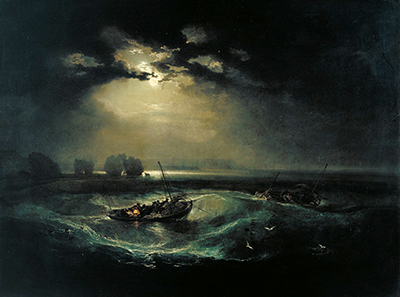
His reputation also differed by medium and subject. A marine picture, a topographical watercolour, a classical landscape and a late Venetian haze did not invite identical responses. Some viewers admired his command of atmosphere while doubting his extremes. Others valued his earlier precision but resisted his later freedom. Reception was not one opinion; it was a field of reactions to a changing career.
Turner's colleagues could also read him differently from reviewers. The National Portrait Gallery describes him as one of Britain's most famous and innovative artists and records Constable's response to his late landscapes as "airy visions painted with tinted steam." [6] That phrase is valuable because it comes from a fellow painter and catches both admiration and bewilderment. Turner could look astonishing even to artists who understood the difficulty of his effects.
The market adds another layer. Turner sold works, cultivated patrons, protected certain pictures and managed his public presence with care. He was not a helpless victim of opinion. Yet commercial success did not settle the meaning of the art. A collector might prize a watercolour for its brilliance while a reviewer attacked an oil for its looseness. A patron might admire Turner as a virtuoso while another viewer wondered whether the late canvases had gone beyond legibility.
The point is that Turner's lifetime reputation was active, uneven and changing. The same career could produce respect for professional achievement, irritation at eccentricity, suspicion toward late style and deep loyalty from admirers. That mixture is more historically useful than the simpler claim that Turner was first rejected and then vindicated. The evidence shows a painter already prominent enough to be attacked and defended in serious terms.
This mixed lifetime reception is the foundation for everything that follows. Ruskin did not create Turner out of nothing. He entered an argument already made urgent by exhibition culture, critical anxiety, collector interest and the visual force of the works themselves. The defence became famous because the paintings had already forced a question: what kind of truth could landscape painting claim?
Ruskin Before Modern Painters
Ruskin's relationship with Turner began before Modern Painters. Lancaster University's Ruskin material records that Ruskin later traced his first careful attention to Turner to engravings in Samuel Rogers's Italy, received as a thirteenth-birthday gift in 1832. [3] That beginning is telling. Ruskin first encountered Turner through reproduction and reading, not only through finished canvases in galleries.
By the late 1830s Ruskin was seeing Turner's works at annual exhibitions and through engravings, including material connected with the Liber Studiorum. [3] His response developed through repeated contact. It was not a single awakening before one picture. It involved published images, exhibitions, collecting and personal access.
Ruskin and his father began collecting original works by Turner in 1839. Lancaster records that, by the time of Turner's death, they owned more than thirty watercolours and two important oil paintings. [3] This collecting history matters because Ruskin was not only a critic writing at a distance. He lived with Turner's works, studied them closely and made them part of his family's artistic identity.
The first meeting between Ruskin and Turner took place in 1840 at the house of the picture dealer Thomas Griffith. Lancaster connects that meeting with Ruskin's belief in Turner as the foremost artist of the age. [3] Personal admiration, however, should not be confused with blind approval. Ruskin's later writing shows intense attachment, but also strong preferences and exclusions.
Ruskin's early Turner was a painter of natural truth, especially in landscape, weather, light and distance. This emphasis suited the critic's own moral and religious habits of looking. Nature was not decoration for Ruskin. It was a field of truth that demanded attention. Turner mattered because Ruskin believed he saw and rendered that field more deeply than his rivals.
This helps explain why Turner's late difficulty did not repel Ruskin in the way it repelled some others. Loose handling could be treated not as technical decay but as a necessary response to complex perception. Haze, distance, storm and light did not have to be drawn like furniture in a room. For Ruskin, they required a different measure of fidelity.
Ruskin's youth also matters. He was not an elderly guardian of settled taste defending a familiar monument. He was a young critic forming his powers through Turner. That gave the defence urgency and risk. He argued with inherited judgments while still building his own authority. Turner supplied the test case through which Ruskin could define what a modern landscape painter should know, see and render.
The family setting is part of that formation. Ruskin's father's taste for contemporary watercolours, the family's collecting of Turner and the private study of original works gave Ruskin access that many critics lacked. His writing is therefore both public argument and the product of close private looking. That double position helped make his defence so forceful.
Modern Painters and Truth to Nature
The first volume of Modern Painters appeared in 1843 and became the decisive public form of Ruskin's defence. The National Gallery states that Ruskin wrote five volumes over a seventeen-year period, from 1843 to 1860, and that the first volume was primarily written in defence of Turner. [1] Lancaster likewise connects the work's development to Ruskin's indignation at attacks on Turner at the Royal Academy in 1842. [3]
The book's argument was not simply that Turner was more exciting than earlier landscape painters. Ruskin presented a theory of modern landscape art grounded in attentive truth to nature. In the public-domain text of Modern Painters, he writes that his aim was to make "the neglected master" admired more, not merely to reduce admiration for established favourites. [2] That short phrase helps reveal the polemical balance: Ruskin was both defending Turner and challenging inherited taste.
Ruskin's language was powerful because it made Turner's apparent freedoms answerable to observation. Clouds, rocks, sea, distance, vegetation and light were not loose decorative matter. They were tests of perception. In Ruskin's view, the painter who knew nature deeply might depart from conventional finish and still be more truthful than the painter who described surfaces with tidy accuracy.
This argument had consequences for Turner's reception. It allowed sympathetic viewers to see late Turner not as incompetence or eccentricity, but as a more demanding form of seeing. The critic's defence gave intellectual cover to works that seemed visually unstable. It told readers that the difficulty was not a failure of art but a failure of conventional assumption.
At the same time, Modern Painters also shaped Turner in Ruskin's image. The Turner who emerges from Ruskin is a painter of natural truth, moral seriousness and imaginative power. That Turner is real, but not complete. The artist was also a commercial professional, a Royal Academician, a maker of prints, a painter of classical ambition, a traveller, a collector of effects and a highly strategic exhibitor.
Ruskin's method was comparative. He did not defend Turner by isolating him from art history. He placed Turner against older landscape authorities and asked what counted as truth. That comparison was often severe, especially when Ruskin judged earlier painters by their treatment of clouds, mountains, water or distance. For readers accustomed to inherited names, this could feel like an overturning of priorities.
It is important, though, that Ruskin's "truth" was not mere copying. He cared about knowledge, relation and expressive force. A painter could be accurate in detail and still fail to grasp the life of a natural effect. Conversely, a Turner passage that looked loose might claim a higher kind of fidelity if it grasped movement, atmosphere or changing light. This is why Ruskin's defence had such power for late Turner.
Ruskin's defence should therefore be read as an intervention, not a final explanation. It changed the terms of debate, and its intensity helped secure Turner's late reputation. But Turner is not reducible to the claims made on his behalf. The paintings continue to exceed the framework that helped rescue them.
The Artist and the Advocate
The relationship between Turner and Ruskin was close enough to matter and uneven enough to resist simplification. Lancaster records hospitality between Turner and the Ruskin household in the 1840s, including Turner's visits to Denmark Hill. [3] The connection was not merely abstract admiration. There was social contact, collecting, gratitude and later strain.
Turner rarely commented publicly on Modern Painters, but Lancaster notes that he formally thanked Ruskin in October 1844. [3] That detail is important because it avoids two extremes. Turner did not loudly build his identity around Ruskin's defence, but neither was he indifferent to it. The artist accepted the value of a defence that came at a difficult moment in his public career.
The relationship was not permanently smooth. Lancaster notes an apparent estrangement in 1846, repaired by 1848, when Ruskin was nominated as an executor of Turner's will. Ruskin declined that responsibility, but later helped sort the vast body of Bequest drawings between 1856 and 1858. [3] This sequence shows a relationship moving through admiration, tension, repair and posthumous labour.
Ruskin's later role with the Bequest also complicates his position. He was not only a defender of Turner's living reputation. After Turner's death, he became one of the figures through whom the enormous material remainder of the career was ordered for viewing. That placed Ruskin inside the making of Turner's posthumous image.
Yet Ruskin did not admire all Turner equally. Lancaster notes his criticism of the classical subjects that mattered deeply to Turner, calling them "nonsense pictures." [3] The phrase is blunt, and it matters because it shows the limit of Ruskin's authority. A critic may defend an artist magnificently while still failing to value parts of the artist's ambition.
The executor episode is especially revealing. Being named in connection with Turner's will suggests trust or at least recognition, while Ruskin's refusal shows that admiration did not make the relationship simple. His later willingness to help sort drawings points to a different kind of responsibility: not legal control, but interpretive and practical labour around the material left behind.
That labour could never be neutral. Choosing, arranging and describing works affects how an artist is understood. Ruskin's eye brought sensitivity to Turner's watercolours and late topographical subjects, but it also brought preferences. The same discernment that made him a great advocate could make him an uneven mediator of the full career.
The best way to understand the artist and advocate is therefore relational rather than devotional. Ruskin helped many readers see Turner as serious when hostile criticism made that difficult. Turner gave Ruskin a central subject through which to build one of the major critical projects of the nineteenth century. Each changed the other's historical shape, but neither explains the other completely.
The Limits of Ruskin's Turner
Ruskin's Turner is indispensable, but it is selective. He cared especially for natural truth, close looking, moral seriousness, modern landscape and certain kinds of late beauty. Those commitments opened Turner to generations of readers, but they also emphasized some parts of the career more than others.
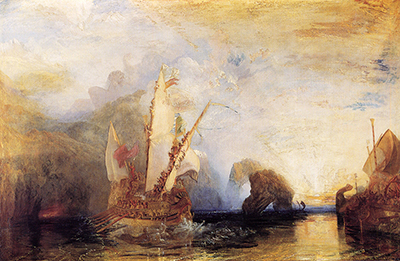
Turner's classical ambitions are one obvious pressure point. The National Gallery's Turner Bequest account stresses that Turner wanted two of his own paintings to hang with two works by Claude, ensuring that his association with that earlier master would endure after his death. [4] This was not a minor wish. Turner deliberately placed himself in relation to a European landscape tradition that Ruskin often treated with suspicion.
If Ruskin's defence is allowed to dominate the story, that Claude relationship can become awkward or secondary. But Turner himself made it central. His will, his retained paintings and his imagined museum afterlife all show an artist thinking about historical comparison, not only natural observation. Turner wanted to be seen beside Claude, not just defended against critics of modern painting.
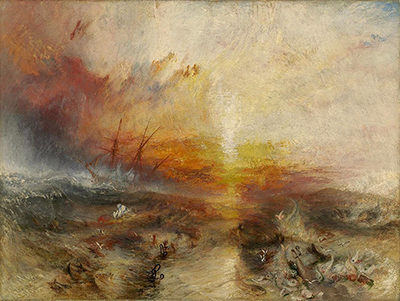
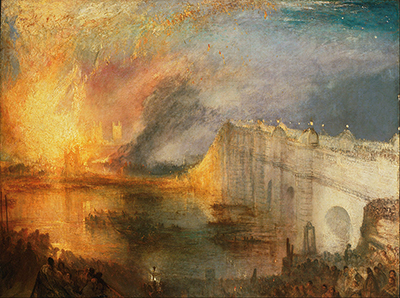
Ruskin's emphasis can also narrow Turner's range of subject. The painter of mountains, seas, skies and Venetian light is vital, but Turner also painted war, fire, empire, slavery, ancient myth, modern steam, architecture, disaster and commerce. A reception history must hold these together. The legacy is diminished if Turner becomes only the painter Ruskin most wanted him to be.
There is also the matter of style. Later viewers have often linked Turner to impressionistic or even abstract tendencies. That language can be useful if handled carefully, but it does not belong to Ruskin's own critical world in the same way. Ruskin defended Turner's truth to nature, not his escape from representation. Modern admiration often values the very uncertainty that earlier defenders needed to justify.
This does not make Ruskin wrong. It makes him historical. His defence responded to the problems of his own moment: attacks on Turner's late work, inherited reverence for older landscape models and the need to explain why looseness might still be disciplined seeing. Later viewers ask different questions because they inherit different visual traditions.
Ruskin's selectivity also helps protect individual artworks from overgeneralisation. A praise of late watercolour cannot automatically explain a classical canvas. A defence of atmospheric truth cannot settle the meaning of a subject tied to war, enslavement, myth or modern industry. Turner's career needs many interpretive doors. Ruskin opens one of the most important, but not all of them.
For that reason, the phrase "Ruskin's Turner" should be treated as a useful historical construction. It names the Turner Ruskin saw most powerfully and defended most urgently. It should not replace Turner the maker, Turner the exhibitor, Turner the self-mythologising professional, Turner the student of Claude or Turner the subject of later museum scholarship.
The Turner Bequest
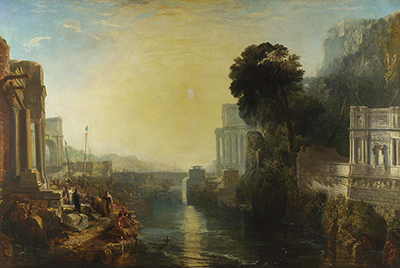
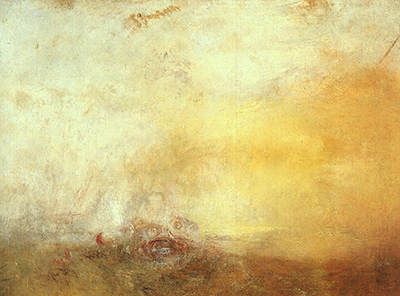
Turner's posthumous legacy changed decisively through the Bequest. The National Gallery records that Turner left a large number of paintings to the nation, including Dido building Carthage and Sun Rising through Vapour, with the condition that those two works should be displayed alongside two paintings by Claude. [4] This arrangement reveals Turner thinking carefully about how future viewers would compare him with a revered predecessor.
The Bequest was not straightforward. The National Gallery states that Turner's cousins contested his will and that a settlement eventually resulted in a much larger gift of works of art to the nation. [4] Legacy here is not only a matter of admiration. It is also legal, institutional and material. What survived, where it went and how it was displayed all affected how Turner would be understood.
The scale was extraordinary. The National Gallery's summary points to hundreds of oils and a far larger body of drawings, watercolours and sketchbooks. [4] The Met gives a related summary, describing 300 oil paintings and more than 20,000 works on paper entering the Tate Gallery collection. [5] The difference in numbers reflects different institutional summaries, but both convey the same essential fact: the surviving body was vast.
That scale transformed Turner studies. A painter known only through finished exhibition works would be one kind of legacy. Turner, by contrast, can be studied through sketchbooks, colour beginnings, unfinished canvases, watercolours, studio material and major oils. The Bequest opened his process to later scholarship in a way few artists' estates allow.
Ruskin's involvement in sorting drawings after Turner's death made the Bequest another chapter in the critic's role. Lancaster records his work between 1856 and 1858, including selections for exhibition at Marlborough House. [3] Ruskin helped mediate the enormous collection for viewers, but the collection also exceeded him. No single critic could exhaust such a body of work.
The Bequest also fixed a tension that remains central to Turner. He wished some paintings to be seen in relation to Claude, yet most of the collection's modern life developed through national museum care and, eventually, Tate Britain. Turner's own historical ambition, Ruskin's critical defence and institutional collecting all became intertwined.
The Bequest also changed the balance between finished and unfinished work. Exhibition pictures show what Turner chose to present. Studio remains can show trials, beginnings, reworkings and unresolved ideas. That evidence does not make every fragment equally important, but it broadens the record. Turner becomes visible as a worker across decades, not only as the author of celebrated public images.
This matters for legacy because unfinished or private material can alter taste. A later viewer may find in a colour beginning or a sketchbook sequence a daring that nineteenth-century exhibition audiences never saw in that form. The Bequest therefore expanded Turner beyond the works through which he first made his fame. It preserved both the official and the experimental Turner.
Museums and the Making of Legacy
Museums did not simply preserve Turner's reputation; they shaped it. The National Gallery's account of the Bequest emphasizes display, contested ownership, settlement and the later presence of most of the material in the Clore Gallery at Tate Britain. [4] These conditions affect interpretation. A work seen beside Claude, a watercolour shown under conservation limits and a sketchbook studied as process each produce different Turners.
The public idea of Turner depends heavily on what institutions can show. A handful of famous oils may suggest one artist: heroic, dramatic, theatrical and national. The Bequest drawings and watercolours suggest another: experimental, restless, technical and serial. The two are not opposed. They are parts of the same career, but museum display can make one more visible than the other.
The National Portrait Gallery adds another dimension by preserving Turner's public image and portrait network. Its person record identifies him as a landscape painter associated with numerous portraits and describes his innovation, Alpine subjects, sublime nature and late effects of light and colour. [6] Portrait records remind us that reception is not only about works; it also concerns the public identity of the artist.
Museum afterlife also disciplines myth. Accurate titles, dates, media, provenance, conservation evidence and exhibition histories prevent broad claims from drifting into legend. Turner attracts strong language because the works are dramatic, but strong language needs anchors. Institutional records make it possible to discuss his legacy without relying only on inherited admiration.
Display history also changes emphasis over time. A national collection can make Turner appear established; a study display can make him appear experimental; a conservation discussion can make him appear technical; a portrait record can make him social and institutional. None of these Turners is false, but each depends on arrangement and context. Legacy is made by what viewers are invited to compare.
The Bequest's survival also means that Turner's reputation can be revised without abandoning evidence. New technical study, fresh catalogue work and changing interpretive questions can return to the objects themselves. That is one reason Turner remains so resilient. His reputation is not supported only by famous anecdotes or a few iconic images; it rests on a large body that can keep generating new readings.
The Bequest made Turner unusually available to scholarship and to the public, but it also made him difficult to summarize. The same artist can appear as a national painter, a technical experimenter, a watercolourist, a proto-modern hero, a painter of empire and disaster, a lover of Claude, a Royal Academician and a private worker whose studio material later became public evidence.
That multiplicity is the point. Turner's legacy was made not by one verdict, but by repeated acts of preservation, display, selection and argument. Museums turned the surviving material into a continuing conversation.
Later Views of Modern Turner
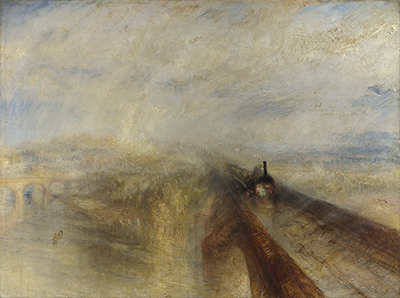
Later reception often emphasizes Turner's modernity. The Met describes Rain, Steam, and Speed as evoking the Industrial Revolution through strong diagonals, bold contrasts and tumultuous handling. [5] The National Portrait Gallery describes his later landscapes as remarkable for dazzling effects of light and colour, while noting that some viewers were bewildered by his impressionistic style. [6] These assessments show how Turner came to be valued for qualities that earlier critics often found disturbing.
Modern Turner is not a single idea. Sometimes it means his response to modern subjects: steam, fire, industry, abolition, empire and contemporary war. Sometimes it means his technique: loose paint, luminous colour, open space and works that seem to approach abstraction. Sometimes it means his institutional afterlife, in which a national collection allowed generations to study unfinished and experimental material.
Ruskin's Turner and modern Turner's Turner overlap, but they are not identical. Ruskin defended fidelity to nature and the seriousness of late landscape. Later viewers may be drawn to dissolving forms, the instability of perception or the way an unfinished work exposes process. What looked risky in the nineteenth century became part of what later viewers found prophetic.
The word "modern" must still be handled cautiously. Turner did not paint as an Impressionist, an Abstract Expressionist or a twentieth-century modernist. Those movements came later, with different aims and conditions. But later art changed what viewers could see in Turner. Once painting had moved further into broken colour, open handling and abstraction, Turner's late works appeared newly legible.
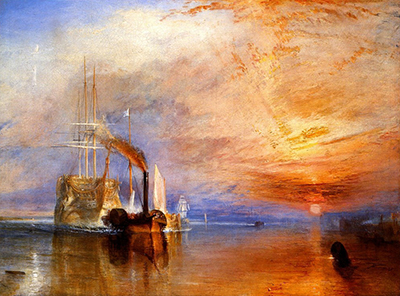
His legacy also remains bound to British cultural memory. Works such as The Fighting Temeraire and Rain, Steam, and Speed have become public images through museum display, reproduction and national storytelling. Yet that fame can flatten them. The more familiar a painting becomes, the more carefully it must be looked at again.
Turner's later reputation is strongest when it allows contradiction. He can be both historical and modern, academic and experimental, public and elusive, celebrated and resistant. His legacy is not a settled monument. It is an active argument about what landscape painting can hold.
The same contradiction explains why Turner remains useful to very different audiences. A historian of nineteenth-century Britain may look for empire, industry, war and nation. A conservator may look at medium, surface and alteration. A painter may look at the handling of tone and colour. A museum visitor may respond first to light. Ruskin's defence belongs within that wider field, not above it.
This wider field keeps Turner from becoming a slogan for progress. His late work did not simply march toward the art of the future. It also looked back to Claude, poetry, marine tradition, history painting and the Royal Academy. The modern Turner is compelling because those pressures coexist. He is difficult to place because he worked across past and future at once.
How to Read Reception Evidence
Reception evidence should be read by phase. A hostile review from Turner's lifetime, Ruskin's defence, Turner's will, a Bequest record, a museum label and a modern scholarly essay do not perform the same work. Each belongs to a different moment in the making of reputation.
Start with chronology. Turner had an established career before Ruskin. Ruskin's defence arose in response to criticism of late work. Turner died in 1851. The Bequest then passed through legal and institutional processes. Later museum display and scholarship transformed access to the works. Without that sequence, reception becomes a vague tale of genius recognized too late.
Next, separate criticism from collecting. A critic's words may change public understanding, but ownership and preservation change what can be seen. Ruskin's writing gave Turner's late work a powerful defence. The Bequest gave later viewers an enormous body of material to study. Both matter, but they matter differently.
Then ask what part of Turner is being discussed. A claim about Venice, the sea, industrial modernity, Claude, watercolour, late colour or sketchbook process may draw on different evidence. A broad judgment about Turner can become misleading if it is really based on only one cluster of works.
It is also useful to notice when admiration becomes myth. Turner does not need to be made lonely, wholly rejected or incomprehensible in order to be great. His achievement is more interesting because he was both successful and controversial. He was inside official culture and pushing against its assumptions at the same time.
Quotations need the same discipline. Ruskin is so quotable that stray phrases can easily stand in for argument. A short verified quotation can illuminate his position, but the quotation should not be asked to do all the work. The larger pattern of books, collecting, exhibition response and Bequest labour matters more than any single aphorism.
Finally, keep Ruskin in proportion. Without Ruskin, Turner's nineteenth-century reception is hard to explain. With only Ruskin, Turner becomes too small. The best reading lets the critic illuminate the artist while allowing the paintings, drawings, watercolours, Bequest and later museum history to keep their own authority.
Frequently Asked Questions
Ruskin gave a sustained intellectual defence of Turner when the artist's later work was attacked for its loose handling and visual difficulty. The first volume of Modern Painters was primarily a defence of Turner, and it helped readers see his art as disciplined truth to nature rather than eccentric excess. [1][3]
No. Turner was a Royal Academician, Professor of Perspective and a highly visible exhibitor. He was also criticised, especially for later works that challenged conventional finish. His reputation combined success and controversy. [5]
No. Ruskin was a powerful defender but also a selective one. Lancaster records his criticism of Turner's classical subjects, even though those subjects mattered deeply to Turner himself. [3]
The Bequest placed a vast body of Turner's work in national care, from hundreds of oils to a much larger group of drawings, watercolours and sketchbooks. It made Turner available not only through famous finished works but through evidence of process, experiment and revision. [4]
Turner was not modern in the sense of belonging to later movements, but later viewers have often found modern qualities in his handling of light, colour, motion, weather and industrial subjects. The point is strongest when used as comparison rather than as a simple label.
Discussion
How should Ruskin's defence, Turner's own ambitions and the Bequest be balanced when judging his legacy?
Reader Insights
Which evidence belongs to Turner's lifetime, and which belongs to his posthumous reputation?
Where does Ruskin clarify Turner, and where do his preferences narrow the career?
How do preservation, selection and display change the Turner later audiences encounter?
Join the Conversation
Share a close observation or a question for other readers.
References
- National Gallery, London, "John Ruskin and the National Gallery." https://www.nationalgallery.org.uk/paintings/john-ruskin-and-the-national-gallery
- John Ruskin, *Modern Painters*, Vol. I, Project Gutenberg. https://www.gutenberg.org/files/29907/29907-h/29907-h.htm
- Lancaster University, "Ruskin and Turner." https://www.lancaster.ac.uk/fass/ruskin/empi/notes/gsturnerz02.htm
- National Gallery, London, "The Turner Bequest." https://www.nationalgallery.org.uk/about-us/history/the-turner-bequest
- Elizabeth E. Barker, "Joseph Mallord William Turner (1775-1851)," Heilbrunn Timeline of Art History, The Metropolitan Museum of Art. https://www.metmuseum.org/essays/joseph-mallord-william-turner-1775-1851
- National Portrait Gallery, "J.M.W. Turner." https://www.npg.org.uk/collections/search/person/mp04566/joseph-mallord-william-turner