

 by Tom Gurney
Tom Gurney BSc (Hons) is an art history expert with over 20 years experience
Published on June 19, 2020 / Updated on August 29, 2026
Email: tomgurney1@gmail.com / Phone: +44 7429 011000
Overview
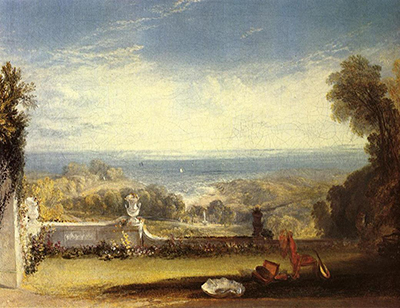
J. M. W. Turner's full title for the Boston work is recorded as View from the Terrace of a Villa at Niton[1], Isle of Wight, from Sketches by a Lady. It is an 1826 oil on canvas in the Museum of Fine Arts, Boston, where it carries accession number 1993.46 and object ID 35491.[1][2][3] The final phrase matters because it records that Turner was working from another person's drawings rather than only from his own direct observation.
The painting shows a cultivated terrace opening toward a bright coastal distance. A pale balustrade, urns, garden flowers, trees, a seated figure and a wide view toward water organize the scene. The foreground belongs to domestic and social space; the distance belongs to sea, sky and island light.
This is not a Tate-held work. Tate Research is useful here because its entry for Niton Church, Isle of Wight, from the South notes that no finished view of that church by Turner is known and then identifies the related Niton villa oil in the Museum of Fine Arts, Boston.[4] The two works should not be merged.
The painting should be read as a transformation of mediated material. Turner turns another person's sketches into a finished oil, shaping a view that combines terrace, villa culture, Niton locality and luminous coastal space. The result is both a landscape and a record of social viewpoint.
The picture is unusually poised. It has the refinement of a country-house view, but the distance is not merely polite scenery. Turner makes the sea and sky open beyond the terrace with enough luminosity to change the emotional center of the work. The garden is the starting point; the coastal light is the release.
At a Glance
- ArtistJoseph Mallord William Turner
- Full titleView from the Terrace of a Villa at Niton, Isle of Wight, from Sketches by a Lady
- Date1826
- MediumOil on canvas
- Dimensions45.7 x 61 cm
- CollectionMuseum of Fine Arts, Boston
- Accession1993.46
- MFA object ID35491
- Source sketchesJulia Gordon
- Object boundaryNot Tate's 1795 Niton Church drawing
Contents
- Overview
- Object Identity
- The Full Title
- Terrace and Viewpoint
- Niton and the Isle of Wight
- From Sketches by Julia Gordon
- Composition
- Light and Distance
- Oil on Canvas
- Not the Tate Niton Church Drawing
Object Identity
The preferred full title has been given above because it carries essential information about source drawings, place and viewpoint.[1][2][3] The artist is Joseph Mallord William Turner. The date is 1826, and the medium is oil on canvas.[1][2][3]
The painting is in the Museum of Fine Arts, Boston, under accession number 1993.46.[1][2][3] Its MFA object ID is 35491, the number embedded in the direct MFA collection URL and repeated in Commons and Wikidata records.[1][2][3] The dimensions are 45.7 x 61 cm, or 61 cm wide by 45.7 cm high.[2][3]
The direct MFA object URL was rechecked for this account, but the museum's server returned a Cloudflare challenge rather than readable object metadata. Because of that access barrier, the object facts are anchored to the MFA URL as cited by Commons and Wikidata, with Tate Research used for contextual confirmation that the finished Niton villa oil is the Boston painting.[1][2][3][4]
The object identity must remain separate from Tate's Niton Church sketch material. Tate's research entry concerns a 1795 drawing of Niton Church, not this 1826 Boston oil.[4] The Tate entry is valuable because it distinguishes the church sketch from the finished Niton villa picture and supplies the Julia Gordon context.
Butlin and Joll remain important for placing the painting within Turner's oil catalogue, especially because the title, date and mediated source need to be treated as object evidence rather than decorative wording.[5] Hamilton's biography is useful only for broad career context; the object record and Tate Research carry the specific facts used here.[7]
The Full Title
The title is unusually informative. It tells the viewer four things at once: the type of view, the terrace position, the Niton and Isle of Wight location, and the fact that the source drawings were by a woman.
The phrase "from Sketches by a Lady" should not be shortened away. It changes the painting's meaning. Turner is not simply presenting himself as a solitary traveller looking from a terrace. He is translating another person's visual record into oil paint.
Tate Research identifies the "Lady" as Julia Gordon, formerly Bennet, and states that she became a pupil of Turner's in 1797 and maintained a friendship with him until the 1830s.[4] That gives the phrase a human and artistic context, though the painting should not be overloaded with unsupported biography.
The title also tells the viewer how to approach the scene. This is a view from a terrace, not a walk along the shore. It begins in a cultivated setting and opens outward. The terrace establishes position, privilege and framing before the eye reaches sea and sky.
The long title therefore becomes part of the evidence. It points to collaboration, place and viewpoint, and it helps prevent a too-simple reading of the painting as a generic coastal prospect.
That evidence changes the painting's pace. A viewer who ignores the title may see a graceful villa landscape. A viewer who reads it carefully sees a more layered process: a woman sketches, Turner interprets, and the finished oil frames the view from a social space. The title is almost a compact history of making.
Terrace and Viewpoint
The terrace is more than foreground decoration. It is the viewing platform from which the landscape is organized. The pale wall, urns and cultivated garden edge create a threshold between domestic space and distant nature.
Turner places the viewer within that threshold. We are not floating above the island or standing on open ground. We are positioned at a villa, looking over a designed foreground into a luminous distance.
That position matters because it makes the scene social. The terrace implies property, leisure and cultivated taste. The painting is not only about Niton's geography; it is about a view shaped by architecture and habitation.
The foreground figure reinforces this social setting. The seated figure and nearby objects make the terrace feel occupied rather than empty. They suggest that the landscape is being enjoyed, framed and lived with.
The balustrade also controls movement. It holds the foreground in place while letting the eye pass beyond it. Turner uses it as a visual hinge: near and far, built and natural, garden and coast.
The terrace also changes the viewer's bodily relation to the landscape. We do not stand amid rough coastal ground. We stand, imaginatively, on prepared and tended ground. That makes the view feel chosen and possessed. The scene is beautiful, but it is beautiful from a particular vantage point shaped by comfort and design.
The urns are small, but they matter. They bring classical and ornamental associations into the foreground, reminding viewers that this is a cultivated prospect. Nature has not been left alone; it has been arranged for looking.
Niton and the Isle of Wight
Niton is a village near the southern part of the Isle of Wight. Tate Research describes it as just inland from St Catherine's Point, the island's southernmost tip.[4] That context helps explain why a terrace view at Niton could open toward dramatic coastal light.
The painting, however, should not be treated as a precise topographical survey. Its title gives the place, and the composition gives a terrace prospect toward water and distance. It does not supply enough evidence to identify every feature in the view with certainty.
This restraint is important. Turner often made place vivid through light and atmosphere rather than exhaustive description. Here, the island setting is carried by recession, sea light, garden framing and distant haze.
The Isle of Wight had long been important to Turner. Tate's Niton Church entry belongs to his 1795 Isle of Wight sketchbook material, while the Boston painting belongs to 1826.[4] That gap matters. The oil is not the 1795 sketch, but it sits within a longer relationship between Turner and the island.
By 1826, the Isle of Wight could operate for Turner as both remembered and mediated landscape. The title says he used sketches by Julia Gordon. The finished image therefore joins Turner's own island knowledge, another person's drawings and the conventions of villa landscape.
The year also places the painting near other ambitious works in Turner's 1820s practice. Hamilton's broad account of Turner in this period helps situate the artist as deeply engaged with exhibition, travel, patrons and the transformation of landscape subjects into public oil paintings.[7] The Niton oil is quieter than many large works, but it belongs to the same mature confidence.
It is also important that Niton is not used as a mere label. The village and island setting give the painting its geography, but the image works by turning geography into experience. The viewer sees distance, garden order and coastal light rather than a checklist of local features.
From Sketches by Julia Gordon
Tate Research's identification of Julia Gordon gives the title's "Lady" a specific name.[4] The painting should still be discussed carefully. The available evidence supports her role as the maker of source sketches, not a detailed reconstruction of exactly which drawings Turner saw or how he changed each one.
This makes the painting a useful challenge to simple stories of artistic originality. Turner remains the painter of the oil, but the view passed through another hand before reaching the canvas. The finished work is an act of transformation.
That transformation is visible in the way the composition balances intimate foreground and broad distance. Turner does not merely record a terrace. He stages a movement from domestic enclosure to open light.
The collaboration implied by the title also changes the emotional tone. The painting feels less like a conquest of scenery than a response to an existing view valued by someone else. It has a private, social origin even though it becomes a public painted image.
This is one reason the full title is essential. Without it, the viewer might miss the mediated nature of the work and read the scene only as Turner's own villa prospect.
The word "Lady" also asks for care. Tate Research identifies Julia Gordon, but the painting itself does not invite a speculative biography of her life, feelings or exact viewpoint.[4] The responsible reading acknowledges her role while staying close to what the title and cited research support.
That restraint gives her presence more, not less, significance. She is not turned into anecdote. She remains part of the picture's making: the person whose sketches formed a basis for Turner's oil.
Composition
The composition is organized in three broad zones. The foreground contains terrace, garden edge, figure and objects. The middle distance holds trees, slopes and a descending view. The far distance opens into water, pale sky and light.
The left side is framed by a pale architectural edge and vegetation. The right side is held by darker trees and shadow. Between them, the view opens toward the center. Turner uses this side framing to make the distance feel discovered through the terrace.
The balustrade and urns establish a designed foreground. They also introduce vertical accents against the horizontal spread of sea and sky. The terrace is cultivated, ordered and close; the distance is broad, bright and atmospheric.
The seated figure near the lower right adds scale and intimacy. The figure is small enough not to dominate, but important enough to mark human presence. The view is not empty nature. It is a landscape seen from a lived position.
The eye moves outward gradually. It begins with the terrace and figure, crosses the garden wall, passes over slopes and trees, and finally reaches the gleaming water. That movement gives the painting much of its grace.
The foreground objects make this outward movement more vivid. The seated figure and nearby items hold the eye low and close before it travels into distance. Turner uses them to delay the view, so that the water does not appear all at once. It is approached through layers.
The right-hand trees deepen the stage-like effect. Their darker mass contrasts with the open center and helps the distance glow. The left edge, with pale architecture and vegetation, gives a different kind of frame: more vertical, more built, and closer to the viewer.
The composition is therefore both open and controlled. It opens toward the sea, but every approach to that opening is guided by terrace, trees, wall and figure.
Light and Distance
Light is the painting's unifying force. The foreground has warmer, darker tones, while the distance opens into blue, cream and pale gold. Turner uses the shift in light to create depth and emotional release.
The sea is not described with hard detail. It appears as a luminous band beyond the land, crossed by small marks that may suggest boats or distant activity. The main effect is not maritime narrative but spatial opening.
The sky is broad and calm compared with many Turner seascapes. Soft clouds and pale blue create a sense of airy distance. The weather is not violent; it is gentle, expansive and suffused with light.
This gentleness does not mean the picture is simple. Turner carefully manages transitions from dark foreground to bright distance. The terrace shadow gives weight to the lower part of the painting, while the open distance prevents the composition from feeling enclosed.
The light also connects domestic and natural space. The same atmosphere that illuminates the sea seems to enter the garden. The painting's mood depends on this continuity between cultivated terrace and coastal world.
The far water is especially delicate. It is not a dark maritime force like the sea in many Turner storm pictures. It is a pale distance, a band of light that helps the garden breathe. The sea is present less as danger than as atmosphere and expansion.
The sky extends that openness. It occupies a broad upper field and softens the boundary between land and distance. Turner makes the air feel spacious without making it empty. Small cloud touches and tonal shifts keep it active.
This kind of light suits the painting's social mood. It does not overwhelm the terrace; it enlarges it. The villa view becomes a place where cultivated life and coastal air seem briefly harmonized.
Oil on Canvas
The painting is oil on canvas.[1][2][3] That medium supports its balance between finish and atmospheric softness. Turner can build richer darks in the trees and foreground while keeping the distance light and hazy.
The local detail image shows the surface's variety. The sky has soft, pale handling; the trees are built from more broken and textured touches; the terrace and urns are more defined; the distance is held in delicate transitions.
Townsend's work on Turner's materials and techniques is useful for remembering that effects of light are material achievements.[6] In this painting, the brightness of the distance depends on painted relations: warm and cool colour, thickness and thinness, sharp and soft edge.
The oil medium also allows the foreground to carry social detail without overwhelming the view. The seated figure, scattered objects and garden edge are legible, but they do not become anecdotal clutter. Turner keeps them subordinate to the larger movement into light.
This is one reason the painting feels refined. It is not as openly experimental as some late Turner oils, but it still depends on delicate control of surface, atmosphere and depth.
The handling also supports the painting's layered subject. Near details are clearer, but not harsh. Distant forms are softer, but not blank. Turner varies the finish so that the viewer can sense recession as a change in paint, not just in drawing.
The trees show this especially well. They are built with touches that suggest leaves and branches without counting them. The terrace details are more legible, while the water and sky become increasingly atmospheric. The paint itself participates in the movement from social foreground to open distance.
Not the Tate Niton Church Drawing
This painting should not be merged with Tate's Niton Church, Isle of Wight, from the South. Tate's entry is for a 1795 sketchbook drawing, with Turner Bequest numbering and an inscription naming Niton Church.[4]
Tate explicitly notes that no finished view of Niton Church by Turner is known, then points to the later oil scene at Niton in the Museum of Fine Arts, Boston.[4] That distinction is crucial. The Boston oil is not a finished version of the church sketch.
The difference is visible in subject as well as record. The Tate drawing concerns a church view. The Boston painting concerns a terrace at a villa, with garden foreground and a prospect toward the coast.
Keeping them separate protects both works. The sketchbook drawing belongs to Turner's 1795 Isle of Wight material. The Boston oil belongs to 1826 and to the "from Sketches by a Lady" context.
The shared word "Niton" is not enough to collapse them into one object. Turner engaged with the same locality in different forms, times and circumstances.
This distinction also prevents a mistaken chronology. The drawing belongs to 1795; the Boston oil is dated 1826.[1][2][3][4] More than thirty years separate them. Treating them as the same work would obscure Turner's long and changing engagement with the Isle of Wight.
Tate's note that no finished view of Niton Church is known is especially useful.[4] It closes off a tempting but unsupported connection and directs attention back to what the Boston picture actually shows: terrace, villa context, garden and coastal prospect.
Patronage and Social Landscape
The painting's title and terrace setting invite a social reading. A villa terrace is not neutral ground. It is a place of ownership, leisure and cultivated display. Turner makes the view from that position beautiful, but also carefully framed.
The phrase "from Sketches by a Lady" adds another social layer. It points to a woman's visual participation in the making of the scene, even though Turner is the painter of the finished oil. Tate Research identifies her as Julia Gordon.[4]
This does not diminish Turner. It makes the painting richer. The work shows Turner responding to another person's sketches and turning them into a landscape that carries both private origin and public polish.
The foreground objects strengthen this reading. The seated figure, chair, fabric or clothing, terrace edge and urns suggest a lived outdoor room. Landscape enters the world of sociability rather than remaining remote scenery.
The painting is therefore not just a coastal view. It is a view from somewhere, for someone, and from someone else's prior sketches. The social conditions of looking are part of its subject.
This social dimension sits comfortably within Turner's broader career. He often worked with patrons, exhibitions, commissions, travel opportunities and existing visual traditions. The myth of the isolated artist is too narrow for a work like this. The Niton oil shows Turner working inside relationships while still producing a distinctly Turnerian field of light.
The painting also gives unusual prominence to cultivated leisure. The figure in the foreground is not struggling against nature or voyaging through danger. The figure inhabits a place made for looking outward. This makes the image quieter than Turner's storm and shipwreck subjects, but no less revealing.
How to Look at the Painting
Begin with the terrace. Notice the pale wall, urns, garden edge and seated figure. These elements establish the place from which the landscape is seen.
Then follow the view outward. The eye moves over the balustrade into trees and sloping land, then toward the bright band of water. Turner builds recession as a gentle passage rather than a dramatic leap.
Next, study the side framing. Vegetation and architectural edges hold the scene on the left, while darker trees gather on the right. The open distance is made more luminous by these enclosing forms.
After that, look at the title again. The phrase "from Sketches by a Lady" should change the viewing experience. The scene has a prior visual source, and Turner is translating that source into oil.
Finally, keep the Boston identity clear. The work is in the Museum of Fine Arts, Boston, not Tate. Tate's Niton Church material is useful context, but it is not the object under discussion.
A second viewing can begin with the seated figure. Notice how small that figure is compared with the spread of land, sea and sky, yet how strongly it marks the foreground as inhabited. The figure helps turn landscape into experience.
A third viewing can focus on the distance. The water and sky are not full of precise description, but they are carefully balanced against the darker framing trees. Turner's distance is made through restraint.
The final step is to return to the phrase "from Sketches by a Lady." It should remain in mind because it changes the status of the view. The painting is not simply seen; it is received, interpreted and remade.
Why the Painting Matters
The Niton terrace painting matters because it gives Turner a landscape structured by social viewpoint. The terrace is not incidental; it is the condition from which the view unfolds.
It matters because the title preserves another participant in the making of the work. Julia Gordon's role, identified by Tate Research, complicates the idea that the image began only with Turner's own observation.[4]
It matters because the painting belongs to the Museum of Fine Arts, Boston, under accession number 1993.46, and should not be folded into Tate's Niton Church drawing or the Turner Bequest sketchbook material.[1][2][3][4]
It matters because Turner turns a cultivated foreground into an opening toward light. The picture moves from villa terrace to coast, from social space to luminous distance, without losing either side of that relation.
Most of all, the painting matters because it shows Turner as a transformer of views. He could take sketches made by another person and create an oil painting that feels spacious, refined and deeply attentive to the act of looking from a particular place.
It also matters because it is a comparatively quiet Turner that still rewards close attention. The drama is not shipwreck, fire or sublime weather. The drama is the reshaping of a terrace view into a luminous relation between social foreground and coastal distance.
The painting's Boston location matters as well. Turner studies are often discussed through Tate and the Turner Bequest, but this object belongs to the Museum of Fine Arts, Boston. Keeping that identity clear preserves the geography of the collection record as well as the geography of the view.
Frequently Asked Questions
Tate Research identifies the lady as Julia Gordon, formerly Bennet, who became a pupil of Turner in 1797 and remained a friend into the 1830s.[4]
No. Tate's Niton Church, Isle of Wight, from the South is a separate 1795 sketchbook drawing. Tate Research distinguishes it from the finished Niton villa oil in Boston.[4]
Discussion
How does Turner transform another person's sketches into a finished oil structured by terrace, social viewpoint and coastal light?
Reader Insights
How does “from Sketches by a Lady” change the work's meaning?
How do the balustrade, urns and seated figure shape the act of looking outward?
How does light release the view from the darker cultivated foreground?
Join the Conversation
Share a close observation or a source-based question for other readers.
References
- Museum of Fine Arts, Boston, "View from the Terrace of a Villa at Niton, Isle of Wight, from Sketches by a Lady." https://www.mfa.org/collections/object/view-from-the-terrace-of-a-villa-at-niton-isle-of-wight-from-sketches-by-a-lady-35491
- Wikimedia Commons, "Joseph Mallord William Turner - View from the Terrace of a Villa at Niton, Isle of Wight, from Sketches by a Lady - 1993.46 - Museum of Fine Arts.jpg." https://commons.wikimedia.org/wiki/File:Joseph_Mallord_William_Turner_-_View_from_the_Terrace_of_a_Villa_at_Niton,_Isle_of_Wight,_from_Sketches_by_a_Lady_-_1993.46_-_Museum_of_Fine_Arts.jpg
- Wikidata, "View from the Terrace of a Villa at Niton, Isle of Wight, from Sketches by a Lady." https://www.wikidata.org/wiki/Q20540896
- Tate Research Publication, "Joseph Mallord William Turner, 'Niton Church, Isle of Wight, from the South' 1795." https://www.tate.org.uk/art/research-publications/jmw-turner/joseph-mallord-william-turner-niton-church-isle-of-wight-from-the-south-r1141018
- Martin Butlin and Evelyn Joll, *The Paintings of J. M. W. Turner*, revised edition, Yale University Press, 1984.
- Joyce H. Townsend, *How Turner Painted: Materials & Techniques*, Thames & Hudson, 2019.
- James Hamilton, *Turner: A Life*, Sceptre, 1998.