

 by Tom Gurney
Tom Gurney BSc (Hons) is an art history expert with over 20 years experience
Published on June 19, 2020 / Updated on August 29, 2026
Email: tomgurney1@gmail.com / Phone: +44 7429 011000
Overview
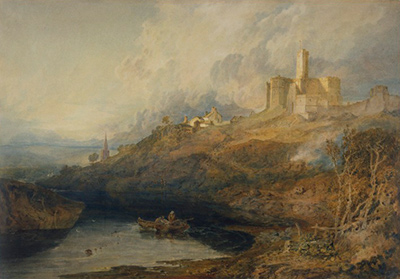
J. M. W. Turner's Warkworth Castle, Northumberland is a 1799 watercolour associated with the Victoria and Albert Museum and recorded by Art UK under accession FA.547.[1] V&A Images describes the work as watercolour with some bodycolour and scraping out on paper, made in England in 1799.[2] Art UK records the measurements as 42 x 58.4 cm and identifies the artist as Joseph Mallord William Turner.[1]
The longer inherited title, Warkworth Castle, Northumberland: Thunderstorm approaching at Sunset, is useful because it names the weather drama that shapes the image. It should be introduced after the shorter V&A/Art UK title, not used to turn the work into an oil painting or a general castle-history essay. The object is a finished watercolour on paper.
The image belongs to Turner's early northern work. Tate research records Warkworth studies in the North of England Sketchbook of 1797, including views of the castle and village from the River Coquet.[3] Those drawings help explain how Turner could later make a finished watercolour from travel material. The work is not a casual view taken straight from the bank. It is a composed sheet in which castle, river, sunset and storm are made to answer one another.
The castle itself carried historical associations. English Heritage describes Warkworth as a powerful Northumbrian castle and a favoured residence of the Percy family from the fourteenth to the seventeenth centuries.[6] Turner does not need to narrate that history in detail. He uses the place's fortress character and northern setting to give the weather more weight.
The watercolour matters because it shows an ambitious young Turner making works on paper compete with the seriousness of oil landscape. Storm and sunset do not soften the castle into scenery. They make the ruin feel alive with weather, distance and historical memory.
At a Glance
- ArtistJoseph Mallord William Turner
- Primary titleWarkworth Castle, Northumberland
- Date1799
- MediumWatercolour with bodycolour and scraping out on paper
- Dimensions42 x 58.4 cm
- Collection associationVictoria and Albert Museum
- AccessionFA.547
- PlaceWarkworth, Northumberland
- RiverCoquet
- Exhibition titleThunderstorm approaching at Sunset
Contents
- Overview
- Object Identity
- Title and Weather
- Warkworth and the River Coquet
- The 1797 Northern Sketches
- Watercolour, Bodycolour and Scraping Out
- Castle, Village and Human Scale
- Storm and Sunset
- Exhibition and Early Ambition
- Not an Oil Painting
Object Identity
The primary public title should be Warkworth Castle, Northumberland.[1][2] The artist is Joseph Mallord William Turner, and the date is 1799.[1][2] Art UK gives the V&A-associated accession number as FA.547 and the dimensions as 42 x 58.4 cm.[1]
The medium must be stated as watercolour, not oil. V&A Images gives the more specific description: watercolour with some bodycolour and scraping out, on paper.[2] That wording matters because it explains how light and storm can operate materially. The sheet is made through transparent wash, opaque touches, and removal or disturbance of the surface to recover light.
The longer wording, Warkworth Castle, Northumberland: Thunderstorm approaching at Sunset, belongs to the wider title tradition for the work and is especially helpful for interpretation. Tate research notes that a finished watercolour of this subject was exhibited at the Royal Academy in 1799 with a title referring to a thunder storm approaching at sunset.[4] That helps connect the V&A watercolour with its exhibition identity, but the object facts should remain anchored in V&A Images and Art UK.
The holder context is the Victoria and Albert Museum through Art UK and V&A Images.[1][2] The object should not be assigned to English Heritage. English Heritage is valuable for the castle's history, but it is not the artwork authority for the Turner watercolour.
The work also needs to be kept apart from other Warkworth watercolours. A Sotheby's catalogue entry for Warkworth Castle, Sunset describes another large-scale watercolour of the subject and states that Turner made two finished watercolours of Warkworth around this date.[7] That note supports the need for object separation. Similar subject matter does not mean the same work.
Title and Weather
The title brings together place and meteorology. Warkworth Castle, Northumberland gives the named location, while the longer thunderstorm-and-sunset wording gives the event. Turner asks the viewer to read the castle through approaching weather and failing light.
"Thunderstorm approaching at Sunset" should not be treated as loose atmosphere. It tells us what kind of visual drama to expect. The sky is not merely decorative. It bears down on the landscape and changes the emotional force of the castle.
Sunset also matters because it changes the role of light. The castle is seen at a threshold between day and night, brightness and storm. Turner uses that threshold to make the watercolour feel temporary, as if the whole view is held in a brief interval before darkness or rain takes over.
The word "approaching" is equally important. The storm has not simply arrived and settled. It is coming in. That gives the image direction and suspense. The viewer senses a future change within the present view.
This is why the work should not be reduced to a castle view. The ruin matters, but the title turns it into an event in weather. Castle, river, sky and sunset must be read together.
The title also helps distinguish this work from other Turner castle subjects. Dolbadarn, Caernarvon, Conway and Warkworth all involve architecture, memory and landscape, but Warkworth's identity depends strongly on the meeting of sunset and storm.
Warkworth and the River Coquet
Warkworth Castle stands in Northumberland above the River Coquet. Tate research records a 1797 Turner drawing titled Warkworth Castle and Village from the River Coquet, placing the castle and village in relation to the river during the northern tour.[3] Sotheby's, discussing another Warkworth watercolour, describes a view west across the Coquet toward the fortress.[7]
The river context matters for Turner's composition. Water gives the eye a path toward the castle and a surface for changing light. Under sunset and storm, the river can carry brightness, dark reflection and distance at once.
English Heritage describes Warkworth Castle as a major Northumbrian fortress and notes its Percy family residence history.[6] Such facts help explain why the castle could carry historical weight for late eighteenth-century viewers. A fortified ruin in Northumberland was not just a picturesque object. It pointed to border power, noble residence and long regional memory.
Yet that history should remain proportionate. Turner is not writing a chronicle of the Percy family in paint. He gives the castle enough emphasis to suggest history, then lets weather and water convert that history into mood.
The Coquet setting also helps separate Warkworth from Turner's Welsh castles. Dolbadarn rises in a mountain pass; Warkworth is understood through river, village and northern sky. Turner changes his language for each place.
The work is therefore topographical, but not only topographical. It depends on Warkworth's recognisable position, yet it transforms that position through weather, sunset and the controlled resources of watercolour.
The castle's relationship to the river also changes the emotional tempo of the view. A fortress on high ground can imply command, but a river foreground introduces movement and reflection. Turner lets the Coquet setting soften the approach while the storm hardens the sky. The viewer is held between travel and threat, between a navigable foreground and a darkening horizon.
The 1797 Northern Sketches
Tate research places Turner's Warkworth drawings within the North of England Sketchbook and dates them to 1797.[3][4] Those studies are important because they show that the finished watercolour grew from travel observation. Turner had looked at the castle from different positions before making the 1799 exhibition sheet.
The northern tour was a formative moment for him. Sotheby's notes that both finished Warkworth watercolours drew on Turner's 1797 northern sketching tour and that he used the North of England Sketchbook and the Tweed and Lakes Sketchbook during that journey.[7] The Tate records give the stable institutional anchor for the sketchbook material.
Sketching did not bind Turner to a single viewpoint. It gave him a store of forms and spatial relations. When he returned to the subject in a finished sheet, he could adjust weather, light and emphasis while retaining enough local structure to make Warkworth legible.
This process matters because the watercolour feels both observed and composed. The castle and river have local grounding, but the approaching storm and sunset give the sheet a deliberately heightened character.
The work also shows Turner's habit of reusing travel material later. A pencil drawing could become the basis for a finished watercolour, an exhibition work, or a design with another public purpose. In Warkworth, the move from sketchbook to finished sheet is central to the work's meaning.
This point should be made without repeating general sketchbook biography. The evidence here is specific: Tate preserves Warkworth views from 1797, while V&A Images and Art UK identify the finished watercolour of 1799.[1][2][3]
Watercolour, Bodycolour and Scraping Out
The medium is central to the image. V&A Images gives a detailed works-on-paper description that includes watercolour, bodycolour and scraping out.[2] That combination gives Turner several ways to make weather visible.
Watercolour wash can create broad tonal fields: sky, distance, river and shadow. Bodycolour can strengthen opaque passages where light or form needs more force. Scraping out can recover sharp brightness by disturbing or removing colour from the paper surface.
The Wallace Collection's account of Turner's watercolour methods explains that artists could create lights by removing paint to reveal the paper beneath, using water, sponge or sharp tools.[5] It also notes Turner's use of fine brushes, scratched details and gum arabic in works on paper.[5] Those general technical points help explain how a sheet like Warkworth can produce bright accents within a storm-darkened scene.
The statement should stay general unless a technical report for this exact object is being cited. V&A Images confirms bodycolour and scraping out for this work.[2] The Wallace essay supplies broader technique vocabulary.[5] Together they allow a careful reading without guessing individual pigments.
This matters because the thunderstorm and sunset depend on paper technique. Light is not only painted in; it may also be reserved, lifted or scratched from the darker field. The material support participates in the weather effect.
Turner's early watercolours can look deceptively immediate, but they are often carefully constructed. In this work, the apparent drama of storm is supported by deliberate handling of wash, opacity and highlight.
Bodycolour is especially important for a subject like this because the view needs moments of firmness inside unstable weather. Opaque touches can strengthen architecture, cloud edge or reflected light where transparent wash alone might become too soft. Scraping out works in the other direction: it can sharpen brightness by recovering the pale ground. Between those methods, Turner could make the sheet feel both fluid and exact.
The technique also suits the time of day. Sunset asks for light that is both intense and short-lived. A watercolour can suggest that fragile quality through thin wash and exposed paper, while bodycolour and scratched accents prevent the scene from dissolving. Material handling and title therefore support one another.
Castle, Village and Human Scale
Warkworth Castle commands the composition, but it is not alone. The surrounding village, river, boats or small figures help place the fortress within lived landscape. They make the castle feel large because they give it human scale.
Small details also prevent the work from becoming a pure weather study. The storm is dramatic, but it happens over a place where people live, travel and work. The castle's history and the village's everyday presence meet within the same view.
This balance is one of Turner's strengths. He can make the sky feel urgent while still keeping architecture legible. The castle is not swallowed by weather; it is intensified by it.
The village context also matters because Warkworth was not merely an isolated ruin. Tate's drawing title includes both castle and village from the River Coquet.[3] The finished watercolour inherits that relation between fortified height and settled low ground.
Human scale should therefore be read quietly. The figures or boats do not supply a major narrative. They give measure, movement and vulnerability. Against the storm and castle, their smallness becomes meaningful.
The river contributes to that sense of scale. It opens the foreground and gives the eye a way to travel through the sheet. It also creates a surface where sunset, storm and village life can meet.
Storm and Sunset
The longer title's weather phrase is the key to the work's feeling. A thunderstorm approaching at sunset is a double transition. Weather is changing, and daylight is ending. Turner turns that double change into the sheet's main drama.
The storm gives weight to the sky. The sunset gives it colour and direction. Together they make the castle appear as a form under pressure, caught between illumination and darkening atmosphere.
This is not the same kind of storm Turner would later make in marine oil paintings. Here, weather is scaled to a castle watercolour. It approaches, gathers and changes the view, but it does not erase the place.
The drama is therefore controlled. Turner keeps the castle, river and village readable while making them depend on the sky. The viewer understands Warkworth through the changing conditions around it.
Sunset also introduces memory. A ruin at sunset can easily become sentimental, but Turner complicates that possibility with storm. The work is not only nostalgic. It is tense, active and meteorological.
The image's power lies in this balance. Castle history gives depth; storm gives pressure; sunset gives transition; watercolour technique makes the moment visible.
The storm's approach also affects how the viewer senses time. The image feels as though it belongs to the minutes before weather changes fully. Boats, village, river and castle all seem to pause within that interval. Turner is not recording a settled condition. He is making a landscape out of impending change.
This kind of temporal pressure is one reason the watercolour remains persuasive. The eye keeps returning to the sky because the sky decides what will happen next. Yet the castle resists that movement. Its mass holds the view steady while the weather suggests instability.
Exhibition and Early Ambition
Tate research states that a finished watercolour of the Warkworth subject was exhibited at the Royal Academy in 1799 under a title referring to a thunderstorm approaching at sunset.[4] That makes the work part of Turner's early public exhibition career, not only a private travel study.
The 1799 date is important. Turner was still in his twenties, but he was already using watercolour at a high level of ambition. A castle view could become a serious public statement through weather, scale and finish.
The National Gallery notes that Turner began exhibiting watercolours at the Royal Academy in 1790 and oils from 1796.[8] Warkworth belongs to that early exhibition environment, where Turner was building reputation across media.
Watercolour had particular significance in this period. The Wallace Collection notes that in Turner's youth the medium was often seen as inferior, yet Turner raised its status.[5] Warkworth helps show how that could happen. The sheet uses paper, wash and highlight to produce an effect as dramatic as many oil landscapes.
This does not mean the work should be described as revolutionary in loose terms. Its achievement is more concrete. Turner made a Northumbrian castle, river setting and approaching storm into a finished watercolour of public ambition.
The exhibition context also explains the title's drama. The weather wording helps the work compete for attention. It tells viewers to expect not only Warkworth, but Warkworth under the pressure of an approaching storm at the end of the day.
Not an Oil Painting
The most important correction is medium. This work is a watercolour on paper, with bodycolour and scraping out noted by V&A Images.[2] It should not be discussed with oil-painting assumptions.
That correction changes how the image is read. In oil, sunset and storm would be built through different material behaviours: opaque paint, glazes, impasto or canvas texture. In this watercolour, effects depend on paper brightness, transparent washes, bodycolour and disturbed surface.
The medium also changes the work's place in Turner's career. It belongs to the ambitious early watercolour tradition, not to the line of large exhibited oils represented by works such as Buttermere Lake or Dolbadarn Castle's larger Academy context.
This does not make the work minor. Turner was a major watercolourist, and works on paper were central to his practice. Warkworth shows how much scale and weather drama could be carried by a sheet.
The Art UK and V&A details should therefore lead the article: title, date, medium, size, accession and museum association.[1][2] Place history and castle romance come after those object facts, not before them.
Keeping the medium clear also prevents confusion with other Northumberland subjects by Turner, including oil paintings of castles or coast. Warkworth is a finished watercolour, and that identity is essential.
Related Warkworth Works
There is more than one Turner Warkworth work. Tate records 1797 sketchbook views.[3][4] V&A Images and Art UK identify the V&A watercolour of 1799.[1][2] Sotheby's discusses another finished watercolour, Warkworth Castle, Sunset, with different dimensions and provenance.[7]
This group of works shows Turner's repeated interest in the subject. He did not simply glance at Warkworth once. He studied it, returned to it on paper, and made finished watercolours from that material.
The existence of related works should sharpen rather than blur object identity. A Tate sketchbook drawing is not the V&A watercolour. The Beaverbrook-related watercolour discussed by Sotheby's is not the same object as FA.547. Shared subject matter is evidence of sustained interest, not evidence that all titles point to one work.
The relation also helps explain Turner's method. Travel sketches could become a reservoir of forms. Finished sheets could then vary weather, light and viewpoint. Warkworth offered him castle, river, village and northern sky in a compact set of motifs.
This is why the title should remain controlled. The short title Warkworth Castle, Northumberland identifies the V&A/Art UK object. The thunderstorm-and-sunset title phrase helps interpret the exhibition identity. Other Warkworth titles belong to other related works or studies.
How to Look at Warkworth Castle
Begin with the castle. Notice how Turner keeps it identifiable while placing it inside changing weather. It is both landmark and historical sign.
Then follow the river or foreground movement toward the distance. The water and low ground give the eye a path through the sheet and a surface for reflected light.
Next, study the sky. The approaching storm and sunset are not background. They control the mood and pace of looking.
After that, look for small human signs: boats, figures, village structures or other details that set the castle's scale. These details make the weather feel larger.
Finally, remember the medium. This is a watercolour with bodycolour and scraping out on paper. Its drama depends on the particular resources of a sheet, not on oil-painting weight.
Why the Work Matters
Warkworth Castle, Northumberland matters because it shows Turner using watercolour for a major early landscape effect. The work is not a preliminary note. It is a finished sheet with public ambition.
It matters because the title and medium work together. A thunderstorm approaching at sunset gives the image its drama, while watercolour technique gives Turner the means to make that drama visible.
It matters because it connects travel sketching with exhibition. Tate's 1797 Warkworth studies and the 1799 finished watercolour show how Turner transformed northern observation into a worked-out composition.[1][3][4]
The work also matters because it treats a Northumbrian castle as both place and memory. English Heritage's castle history explains why Warkworth could carry noble and regional associations, while Turner's image converts that history into atmospheric force.[6]
Most of all, the watercolour matters because it shows restraint and drama working together. The castle remains legible. The river remains a path into space. The storm remains approaching rather than total. Turner uses that balance to make a familiar ruin feel momentary, unstable and alive.
The work also matters within Batch 7's narrower British subjects because it offers a different answer from Buttermere and Dolbadarn. Buttermere turns rain across a lake into an event. Dolbadarn uses mountain enclosure and Welsh history. Warkworth depends on paper technique, river approach and a sky changing at sunset. The shared concern is landscape under pressure, but the solution is specific to this Northumbrian watercolour.
Frequently Asked Questions
The watercolour is by Joseph Mallord William Turner. Art UK identifies Turner as the artist.[1]
V&A Images describes it as watercolour with some bodycolour and scraping out on paper.[2]
Art UK gives the dimensions as 42 x 58.4 cm.[1]
Art UK associates the work with the Victoria and Albert Museum and gives the accession number FA.547.[1]
That longer title phrase belongs to the work's exhibition and title tradition. Tate research records a 1799 Royal Academy title for a finished Warkworth watercolour that refers to a thunder storm approaching at sunset.[4]
Discussion
How do storm, sunset and works-on-paper technique turn Warkworth Castle into more than a topographical record?
Reader Insights
Where does the approaching storm exert the greatest pressure on the view?
How do wash, bodycolour and scraped highlights shape the light?
How do castle, village and River Coquet remain legible within the atmosphere?
Join the Conversation
Share a close observation or a source-based question for other readers.
References
- Art UK, "Warkworth Castle, Northumberland." https://artuk.org/discover/artworks/warkworth-castle-northumberland-671111
- V&A Images, "Warkworth Castle, Northumberland, by J.M.W. Turner. England, 1799." https://www.vandaimages.com/2006BA1085-Warkworth-Castle-Northumberland-by-J-M-W-Turner.html
- Tate Research Publication, "Warkworth Castle and Village from the River Coquet." https://www.tate.org.uk/art/research-publications/jmw-turner/joseph-mallord-william-turner-warkworth-castle-and-village-from-the-river-coquet-r1150101
- Tate Research Publication, "Warkworth Castle from the North." https://www.tate.org.uk/art/research-publications/jmw-turner/joseph-mallord-william-turner-warkworth-castle-from-the-north-r1150103
- Joyce Townsend, "Turner's Watercolour Materials and Techniques," The Wallace Collection. https://www.wallacecollection.org/explore/explore-in-depth/turner/turners-watercolors/turners-watercolour-materials-and-techniques/
- English Heritage, "History of Warkworth Castle and Hermitage." https://www.english-heritage.org.uk/visit/places/warkworth-castle-and-hermitage/history/
- Sotheby's, "Joseph Mallord William Turner, R.A., Warkworth Castle, Sunset." https://www.sothebys.com/en/buy/auction/2023/master-works-on-paper-from-five-centuries-2/warkworth-castle-sunset
- National Gallery, London, "Joseph Mallord William Turner." https://www.nationalgallery.org.uk/artists/joseph-mallord-william-turner