

 by Tom Gurney
Tom Gurney BSc (Hons) is an art history expert with over 20 years experience
Published on June 19, 2020 / Updated on August 2, 2026
Email: tomgurney1@gmail.com / Phone: +44 7429 011000
Contents
- Introduction
- What The Painting Shows
- Homer, Harper's Weekly And Camp Life
- Race, Labor And Interpretation
- Relationship To Other Homer Works
- Why This Painting Matters
Introduction
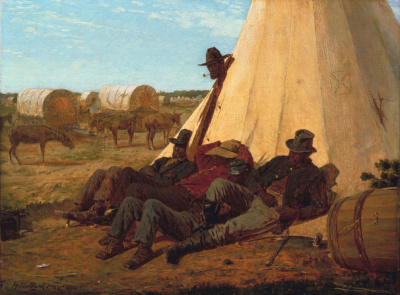
Winslow Homer's The Bright Side is a small Civil War painting with a difficult subject. Painted in 1865, it shows Black men connected to Union army camp life resting by a tent, with supply wagons and horses behind them. The scene appears quiet, even casual, but its subject is not simple. Homer is looking at Black labor around the war, the army's dependence on teamsters and camp workers, and the uncertain social meaning of rest, freedom and military service in the final year of the conflict. [1]
The Fine Arts Museums of San Francisco/de Young object route records the work as The Bright Side, made in 1865, oil on canvas. The object is small, about 12 3/4 by 17 inches, so the painting's force comes from compression rather than scale. Homer does not build a battlefield epic. He gives the viewer a camp scene in which bodies, tent, wagons and sunlight have to carry the historical weight. [2]
This article should sit near Prisoners from the Front, The Veteran in a New Field and the Reconstruction-related paintings A Visit from the Old Mistress and The Cotton Pickers. Those works are not the same kind of image, but together they show why Homer cannot be understood only through marine painting, childhood scenes or later Prouts Neck seascapes. His Civil War and postwar subjects repeatedly ask how American history appears in ordinary bodies after the obvious action has paused. [3]
What The Painting Shows
The composition centers on a tent and a group of Black men at rest. Three figures sit or recline near the tent opening, while another figure appears above them, looking outward from the tent and smoking a pipe. Behind them, covered wagons and horses indicate the logistics of army movement. The subject is not a charge, surrender or command meeting. It is the waiting world that made an army function. [4]
That focus matters. Teamsters and laborers were essential to Civil War armies. They moved supplies, handled wagons, worked around camps and occupied dangerous positions that could be targeted when supply lines were attacked. The FAMSF/Google Arts object route frames the scene through African American service and labor during the Civil War, including the vulnerability of Black teamsters whose work supported Union operations. The painting's restfulness therefore not be read as idleness in a simple or stereotyped way. Rest is part of labor. Waiting is part of military life. [5]
Homer's title also needs care. The Bright Side can be read literally, as the sunny side of the tent, but the phrase is unstable. It may point toward the Union side and its promise of freedom for enslaved people. It may also carry uncomfortable color language and period humor at the expense of the Black figures. The painting was also associated with the title Light and Shade, which keeps the problem of brightness, shadow and racialized language in view. [6]
The safest reading is not to choose one meaning too quickly. Homer gives the viewer a scene that can be sympathetic, observational and troubling at the same time. The men are not in combat, but they are not outside the war. They are visible in a military environment whose cause and outcome were inseparable from slavery and emancipation. The title's ambiguity belongs to the painting's difficulty. [1]
Homer, Harper's Weekly And Camp Life
Homer's wartime eye was shaped by his work for Harper's Weekly. As an artist-correspondent and illustrator, he learned to look at the Civil War beyond heroic battle scenes. He observed camps, uniforms, fatigue, waiting and the small social arrangements that surrounded army life. That background helps explain The Bright Side. It has the compressed legibility of an illustration, but the oil painting asks for slower attention. [2]
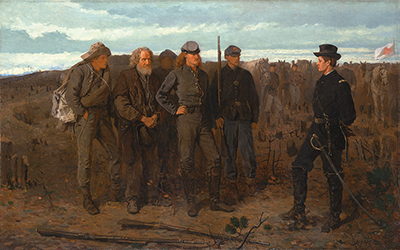
The scene is also different from Prisoners from the Front, painted in 1866. In Prisoners from the Front, Homer turns a confrontation between a Union officer and captured Confederate soldiers into a modern history painting about defeat, authority and national fracture. The Bright Side is quieter and more oblique. It shows people near the edges of official military drama, where the war's labor system and racial politics become visible without a formal confrontation. [3]
That edge-of-action quality is important to Homer's Civil War work. The Civil War was not only made of battles. It was also made of roads, tents, horses, wagons, guards, delays, supply lines, danger and exhaustion. By placing Black teamsters or camp laborers in this visual world, Homer makes a different part of the war available for interpretation. [4]
Race, Labor And Interpretation
The painting is best handled as a source-led image of Black life around the Union army, not as a generic camp scene. The men in the picture are at rest, but their rest exists inside a system of wartime work. The FAMSF/Google Arts framing notes that large numbers of African Americans served the Union cause, including as soldiers and teamsters, and that Black teamsters could face severe danger if captured. Those facts complicate any reading that treats the figures as merely idle or comic. [5]
The responsible position is to keep the tension open. Homer may have observed an actual camp moment, but the finished painting is not neutral evidence. It is a shaped image made for viewers in 1865, when the end of slavery, Black service, Union victory and the beginning of Reconstruction were all current questions. The painting asks modern readers to notice both what it records and what it risks. [6]
This is why The Bright Side is best linked to Homer's later Black-subject works. A Visit from the Old Mistress stages a post-emancipation domestic encounter in which old obligation has been changed but not erased. The Cotton Pickers turns to Black labor after emancipation and the unresolved economic world of the postwar South. The Bright Side comes earlier, in the war's immediate frame, but it belongs to the same broad problem: how Homer pictured Black Americans within a country being remade by war and emancipation. [1]
Relationship To Other Homer Works
The Veteran in a New Field is an important companion because it also dates from 1865 and also considers the Civil War through aftermath rather than combat. There, Homer shows a Union veteran cutting wheat after laying aside military objects. In The Bright Side, the signs of war are tents, wagons, horses and military labor. Both paintings refuse a simple battlefield identity for the war. [2]
Prisoners from the Front gives the cluster a more public Civil War scene. Its officer and captives stand in a damaged landscape, while The Bright Side stays in the camp's working background. Together they show Homer's range: confrontation and pause, command and labor, white military encounter and Black wartime presence. [3]
The painting also belongs in Biography and Prints context because it grows from Homer's early career as an observer for illustrated media. It should appear in Paintings as a Civil War support work, not as a decorative genre scene. The article can help readers move from Homer's war images into the Reconstruction paintings without flattening either group. [4]
Why This Painting Matters
The Bright Side matters because it asks viewers to read a quiet camp scene as part of the Civil War's racial and labor history. The painting does not offer a clean moral statement. It places Black figures at rest beside a military tent and supply wagons, then leaves the viewer with questions about work, freedom, representation and title. [5]
Its modest size does not need to be mistaken for minor historical value. The work gives the Homer cluster a needed bridge between Civil War observation and later post-emancipation subjects. It shows that the war's meaning appeared not only in surrender scenes and veteran allegories, but also in the bodies of Black men whose labor supported the army and whose freedom was bound up with the Union cause. [6]
For a modern reader, the best approach is to hold two truths together. Homer was attentive to the ordinary texture of army life, and that attention can make overlooked labor visible. But the painting also arrives from a nineteenth-century visual culture capable of racial stereotyping and uneasy wordplay. A strong page does not need to smooth that away. It should let the image remain as complicated as its history. [1]
Discussion
Winslow Homer rewards close looking because his strongest images rarely close down into one easy meaning. Use the prompts below to test how the work changes as you move between subject, place, medium and history.
Reader Insights
First Look
What detail in The Bright Side changes how the whole work feels?
Homer's Method
Where do you see Homer's balance between clear observation and unresolved meaning?
Cluster Context
Which related Homer work helps you read this page more carefully?
Join the Conversation
Share a thoughtful observation below, especially if a detail, source connection or related Homer page changed the way you read the work.
References
- Fine Arts Museums of San Francisco/de Young, object route for Winslow Homer, The Bright Side, 1865.
- Google Arts and Culture/FAMSF-linked object record for The Bright Side, 1865.
- Smithsonian Institution, Inventories of American Painting and Sculpture record for The Bright Side, accession
1979.7.56. - National Gallery of Art artist record for Winslow Homer.
- The Metropolitan Museum of Art, Heilbrunn Timeline of Art History essay on Winslow Homer.
- Winslow Homer Phase 1 approval brief, provisional URL decision matrix, homepage/biography source packets, green-route packets, internal-link ledger, quote ledger, glossary ledger and Tom image-policy record, 2026-07-20.
 Winslow Homer.jpg)