

 by Tom Gurney
Tom Gurney BSc (Hons) is an art history expert with over 20 years experience
Published on June 19, 2020 / Updated on August 2, 2026
Email: tomgurney1@gmail.com / Phone: +44 7429 011000
Contents
- Introduction
- What The Painting Shows
- Reconstruction And The Cotton Economy
- Two Women, Two Kinds Of Time
- Comparison With A Visit From The Old Mistress
- Why The Field Is Not Pastoral
- Place In Homer's Career
- Why This Painting Matters
- Annotated Details
Introduction
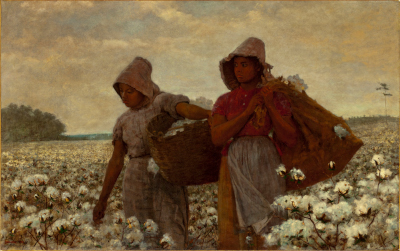
Winslow Homer's The Cotton Pickers is one of the artist's most important paintings about Black life in the Reconstruction-era South. Painted in 1876, the same year as A Visit from the Old Mistress, it shows two Black women working in a cotton field. One bends toward the crop. The other stands upright and looks into the distance. The setting is agricultural, but the painting is not a simple scene of harvest. Homer turns the field into a place where labor, freedom, memory and uncertainty meet. [1]
The painting belongs to the Los Angeles County Museum of Art. LACMA records it as an oil on canvas measuring 24 1/16 x 38 1/8 inches, with the accession number M.77.68. Its date is central to its meaning. The Civil War had ended little more than a decade earlier. Slavery had been abolished, but the cotton economy had not disappeared, and the people whose labor had been forced under slavery now faced new forms of economic constraint, racial violence and political struggle. [2]
Homer does not show a plantation owner, an overseer or a literal act of coercion. He also does not turn the scene into pastoral comfort. The two women occupy the center of the painting with gravity and scale. Their presence is monumental, but their future is not presented as secure. The work asks viewers to look at cotton as a crop that carries history: the wealth it produced, the suffering attached to it, and the uncertain possibilities of life after emancipation. [3]
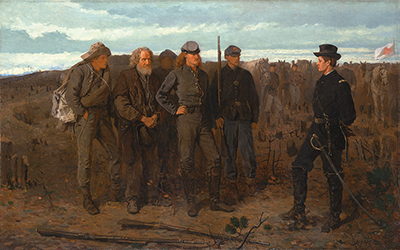
That tension makes The Cotton Pickers an essential page in Homer's cluster. The painting sits between his Civil War subjects, his Reconstruction images, and his later interest in figures placed under pressure by large environments. Unlike Prisoners from the Front, the drama is not military. Unlike many of his coastal works, the danger is not storm or sea. Here the pressure comes from land, labor and history. [4]
What The Painting Shows
The composition is direct. Two women stand in a broad cotton field beneath a pale sky. Homer gives them enough space to read as individual figures and enough shared placement to make them a pair. Their bodies create the human structure of the picture. The field stretches around them, but the painting is not primarily interested in landscape for its own sake. The land matters because of what it has demanded from the people who work it. [5]
The woman at the right bends toward the cotton. Her action identifies the work of picking, and it keeps the picture connected to immediate physical labor. She is close to the plants and to the daily task that gives the painting its title. Homer does not romanticize that labor. The gesture is plain, repetitive and grounded in necessity. [6]
The standing woman at the left changes the emotional temperature of the work. She is not simply another worker in a harvest scene. She looks beyond the field, and that outward gaze opens the painting beyond the present task. LACMA's interpretation emphasizes her poised relation to an uncertain future. That point is best handled carefully: Homer does not tell the viewer exactly what she sees or imagines. The power of the figure lies in the fact that her attention has moved past the cotton rows without leaving them behind. [7]
The painting's scale reinforces this seriousness. The figures are not tiny details in a picturesque rural view. They are large enough to carry the moral weight of the scene. Their dark clothing and vertical presence stand against the lighter field and sky. The field surrounds them, but it does not diminish them. Homer makes the viewer confront the people before interpreting the crop. [1]
Annotated Details from The Cotton Pickers
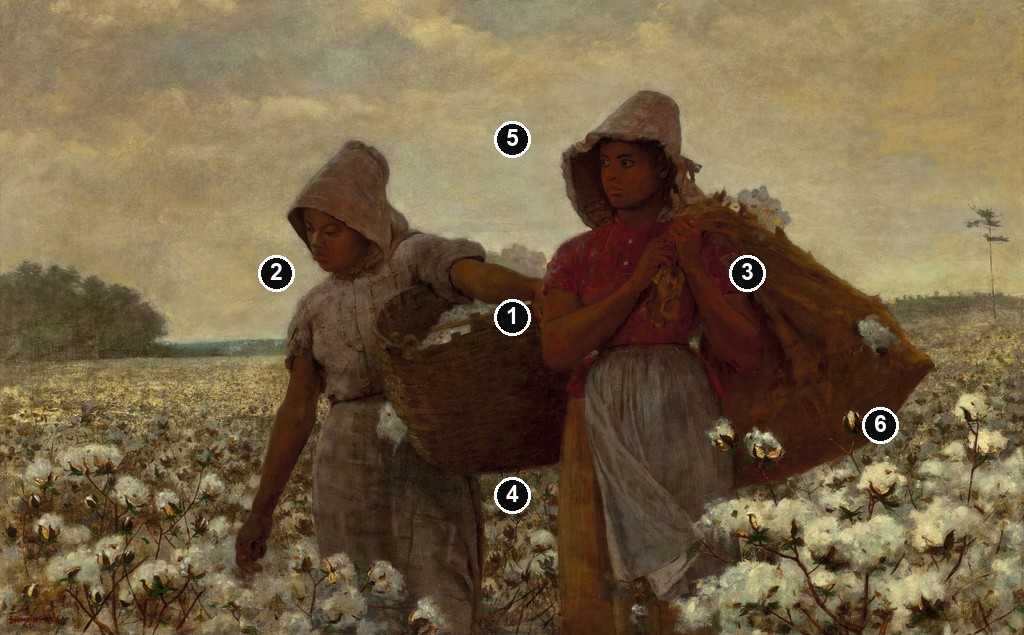
Details from THE COTTON PICKERS
Close looking follows the composition through figure, setting, foreground and surrounding visual pressure.
Central Action
The central passage carries the first act of close looking, where pose, spacing and surrounding detail establish the main visual problem.
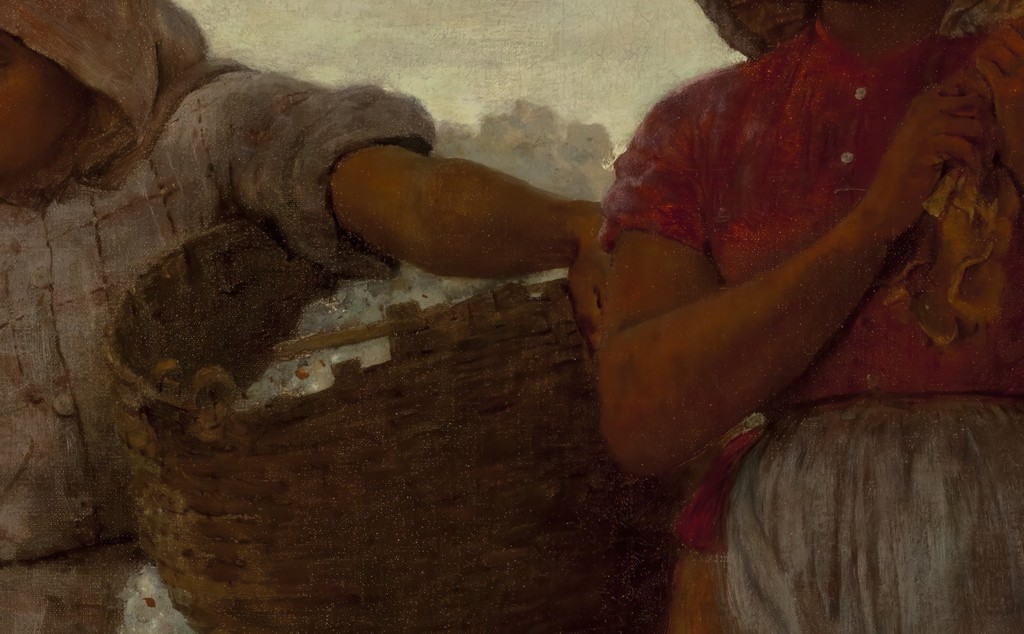
Left-Hand Structure
The left side helps frame the composition and shows how Homer balances incident against the broader setting.
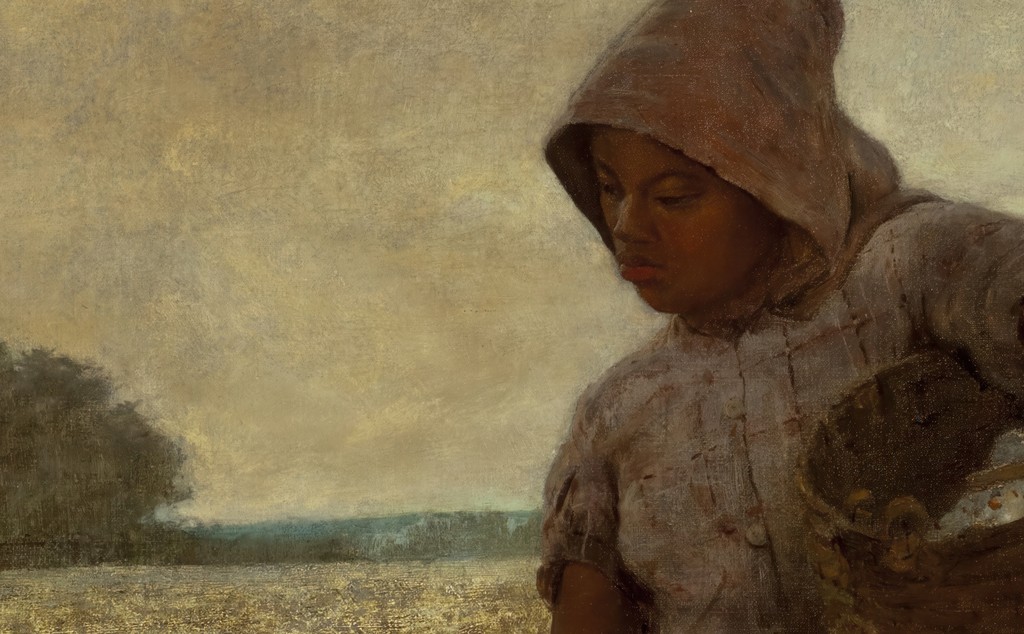
Right-Hand Structure
The right side answers the central group with a second visual pressure, often through movement, distance or environmental force.
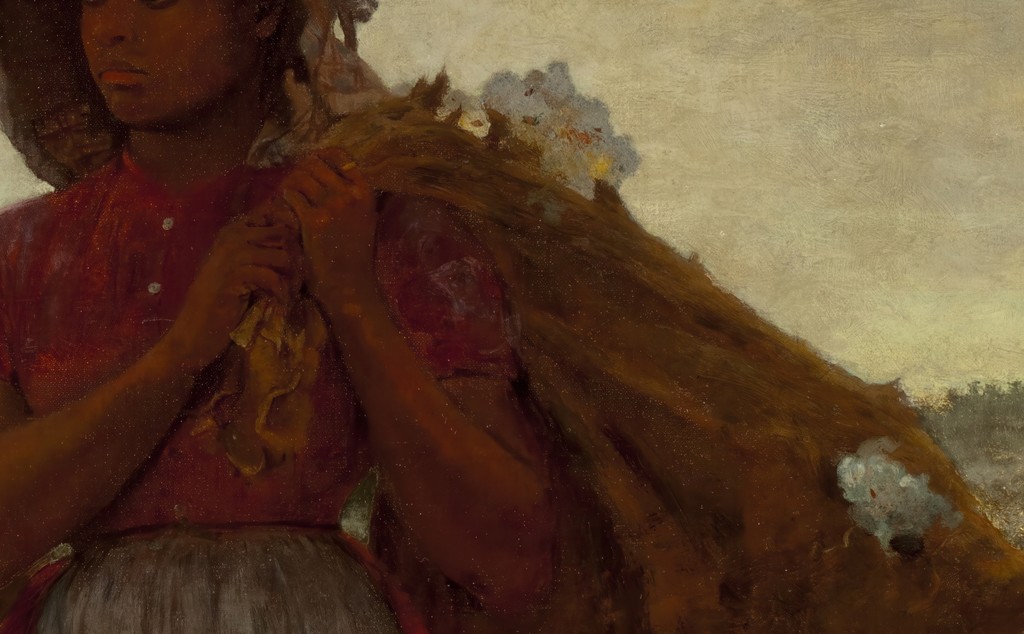
Foreground Detail
The foreground gives the viewer a threshold into the image and often contains the practical evidence of work, risk or play.
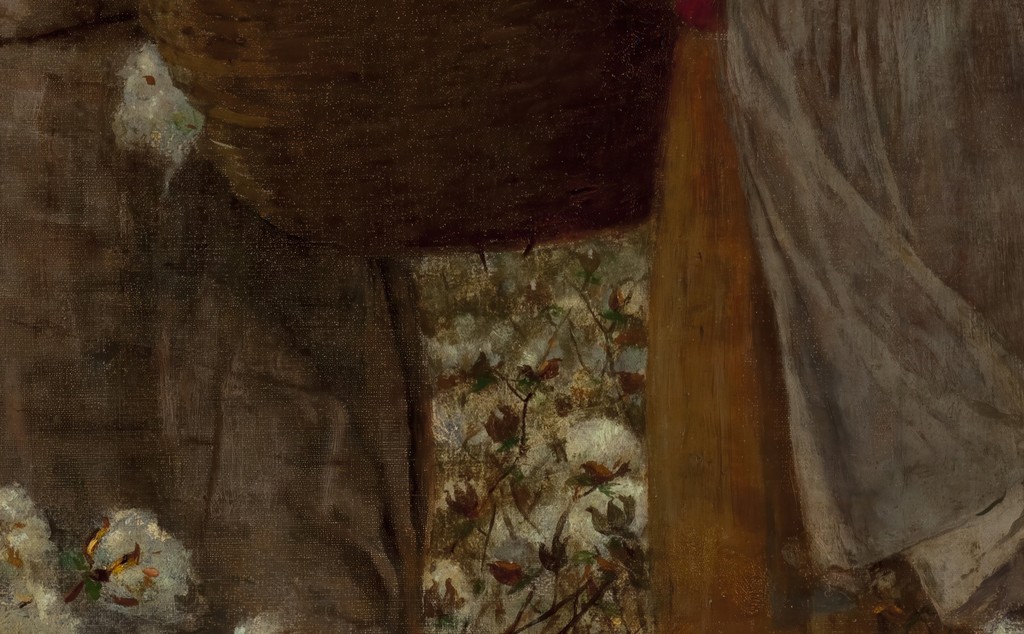
Background Distance
The background opens the picture into weather, landscape or social space, making the scene larger than the immediate figures.
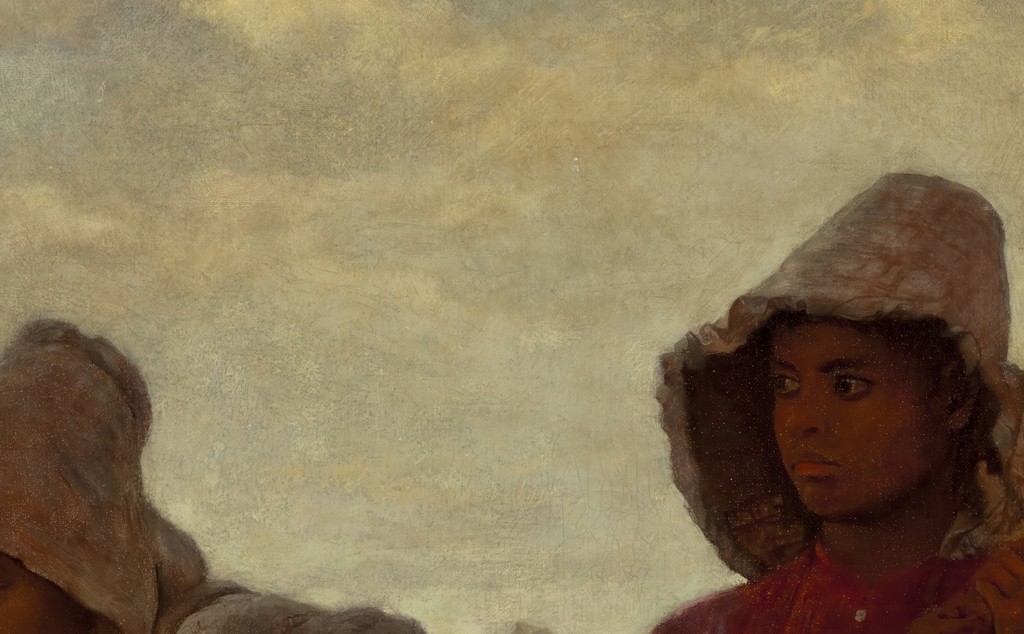
Edge Rhythm
A detail near the edge shows how the composition keeps the eye moving instead of closing around a single motif.
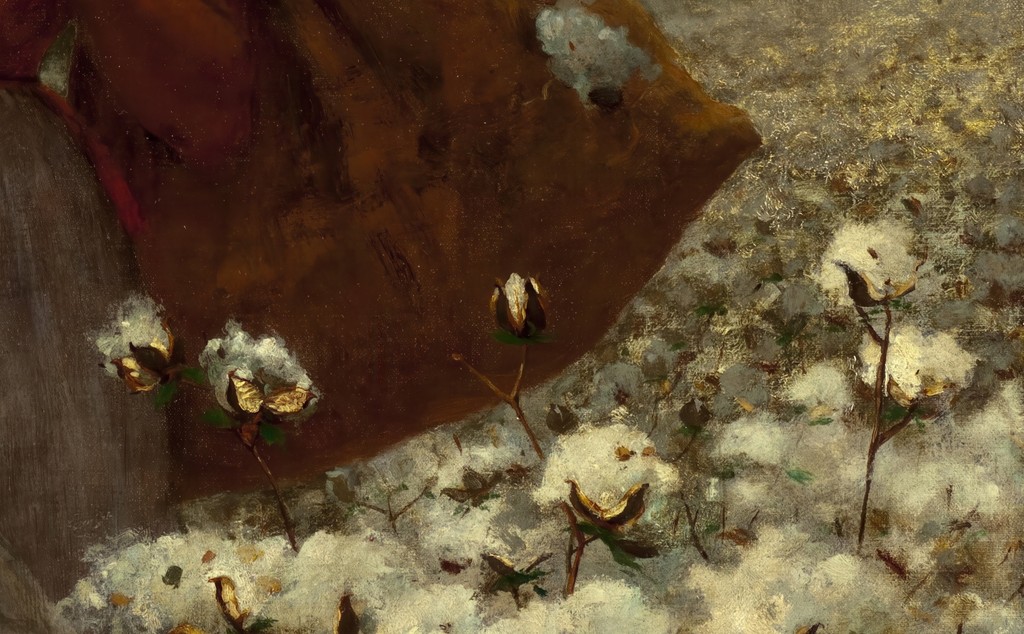
Reconstruction And The Cotton Economy
The Cotton Pickers belongs to Homer's Reconstruction-era engagement with Virginia and the postwar South. The local source packet identifies Homer's travel in Reconstruction-era Virginia as a key context for the work, and LACMA frames the painting through the lives of newly emancipated Black Americans in the South. That framing is important because the painting is often misunderstood if it is reduced to a generic image of slavery or rural work. [2]
The painting was made after emancipation. That does not make cotton neutral. Cotton had been central to the wealth of slaveholding society and to the wider Atlantic economy that profited from enslaved labor. After the Civil War, many Black Americans remained tied to agricultural labor through sharecropping, wage arrangements, debt and limited political protection. The legal fact of freedom did not automatically create economic freedom. [3]
Homer's painting is powerful because it holds these truths together. The women are not shown as enslaved. They are not portrayed as passive objects within an antebellum plantation fantasy. At the same time, the crop around them carries the memory of slavery and the continuing reality of postwar labor. The field is both present work and historical burden. [4]
This is why the standing figure's gaze matters so much. It does not cancel the field. It creates a tension between the body still caught in labor and the mind or attention directed elsewhere. The painting asks what a future could mean when the economic landscape remains shaped by the crop that had helped sustain slavery. [5]
The date 1876 also connects the work to a national moment of contradiction. The United States was publicly marking its centennial, while Reconstruction was under severe pressure and the gains of emancipation were being contested. Homer does not paint a public ceremony, a political meeting or a legal debate. He paints two women in a field. The choice makes history visible at the level of labor and bodily presence. [6]
That restraint is characteristic of Homer's strongest postwar work. He often avoids telling the viewer what to think through obvious theatrical devices. Instead, he organizes a scene so that posture, spacing and setting become evidence. In The Cotton Pickers, the evidence is the crop, the field, the caught apron, the bending body and the outward gaze. [7]
Two Women, Two Kinds Of Time
One way to understand the painting is to notice how the two figures create different kinds of time. The bending woman belongs to the repeated time of work. Her movement is tied to the next boll, the next plant and the ongoing rhythm of picking. She gives the painting its immediate present. [1]
The standing woman introduces another time. Her gaze points beyond the work in front of her. She appears suspended between the crop at her feet and something outside the visible field. That outward attention does not make her idle. It gives the painting a reflective pause. The viewer is invited to ask what can be imagined from within a landscape still shaped by exploitation. [2]
Homer's decision to pair the women rather than isolate one figure is crucial. A single standing figure might become an emblem. A single bending figure might become a labor type. Together, the two women make the painting more difficult and more human. They suggest that post-emancipation life cannot be reduced to one posture, one mood or one historical conclusion. [3]
The painting is also careful about dignity. Homer does not sentimentalize the women by making them decorative, and he does not strip them of agency by turning them into mere symbols of suffering. Their placement gives them presence. Their silence does not make them empty. It asks the viewer to read what their bodies and surroundings make visible. [4]
Comparison With A Visit From The Old Mistress
The Cotton Pickers is best read beside A Visit from the Old Mistress, but the two paintings does not need to be collapsed into the same argument. Both were painted in 1876. Both belong to Homer's Reconstruction-era attention to Black life after the Civil War. Both ask what emancipation changes, and what it cannot immediately undo. [5]
The difference is setting. A Visit from the Old Mistress is an interior encounter. Its drama lies in posture, spacing and a meeting between Black women and a white woman identified by the title as a former mistress. The painting concentrates on altered social obligation. The former hierarchy is present, but the old gestures of deference no longer operate in the same way. [6]
The Cotton Pickers moves the question outdoors into the field. There is no former mistress visible, no domestic meeting and no explicit confrontation between figures from the old order and the newly emancipated. Instead, the old order is present through the crop itself. Cotton becomes the historical actor that remains in the scene even when the enslaver is absent. [7]
This difference makes the two works complementary. In A Visit from the Old Mistress, Homer shows the unsettled social relation after slavery. In The Cotton Pickers, he shows the unsettled economic landscape after slavery. One painting asks how people face each other after emancipation. The other asks how people stand within a labor system and a crop history that emancipation did not erase. [1]
The comparison also helps protect both works from weak readings. A Visit from the Old Mistress does not need to be softened into reconciliation. The Cotton Pickers does not need to be softened into pastoral labor. Both paintings are quieter than their subjects might suggest, but their quietness is not avoidance. It is the means by which Homer makes historical pressure visible. [2]
Together, these works expand the familiar story of Homer beyond marine peril, childhood scenes and late coastal drama. They show that his American modernity also includes Reconstruction, Black labor, changed social relations and the unresolved aftermath of slavery. The Winslow Homer cluster needs both pages because each reveals a different part of his postwar imagination. [3]
Why The Field Is Not Pastoral
The cotton field might first appear open and calm. That calm is deceptive. Homer uses the breadth of the setting to create exposure rather than comfort. The women are visible in a landscape that seems to continue beyond them, and the light does not rescue the scene from its history. [4]
Pastoral art often turns rural labor into harmony: land, worker and season appear naturally ordered. The Cotton Pickers resists that tradition. The crop is not a neutral sign of abundance. Cotton had helped shape the violence and profit of slavery, and in the postwar South it remained bound to unequal labor arrangements. The painting's beauty must be read alongside that history. [5]
The standing figure's caught apron is therefore more than a descriptive detail. It prevents the viewer from separating the figure's dignity from the crop's hold. She is upright, and the picture gives her a commanding presence, but cotton still physically touches and tugs at her. Homer makes that relation visible without turning it into melodrama. [6]
The bending figure deepens the same point. Her labor is not staged as picturesque industry. It is repetitive, necessary work in a field whose economic meaning cannot be separated from racial history. She anchors the painting in the bodily reality of picking cotton. [7]
The painting's restraint can make it easy to underestimate. There is no dramatic storm, no battle smoke, no shipwreck and no visible instrument of violence. But the field itself carries the violence of history. Homer lets that history press through ordinary details. [1]
Place In Homer's Career
By 1876 Homer had already built a reputation through illustration, Civil War subjects and early oil paintings. His work for Harper's Weekly and his experience with wartime imagery had trained him to make compact scenes carry public meaning. After the war, he turned increasingly to oil painting and to subjects in which American life could be examined without academic grandiosity. [2]
The Cotton Pickers belongs to that postwar turn. It is not a battlefield picture, but it remains a history painting in the broad sense because it addresses the consequences of national history through human figures. The painting's seriousness comes from the way it refuses both spectacle and anecdotal explanation. [3]
The work also sits within a broader group of Homer's Black subjects from the 1870s. The Bright Side and Dressing for the Carnival is best treated as related routes once their own source packets are fully developed. Those pages can help readers see that Homer returned to Black subjects in different conditions: wartime aftermath, Reconstruction labor, social encounter and public celebration. [4]
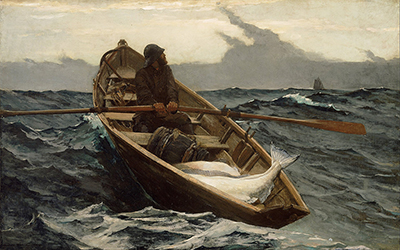
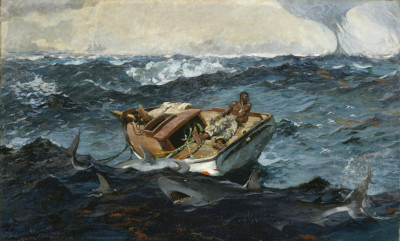
At the same time, The Cotton Pickers does not need to be isolated from Homer's better-known late works. In later marine paintings such as The Fog Warning, The Herring Net and The Gulf Stream, Homer often places figures against environments that exceed them. The Cotton Pickers does something related on land. The field is not a wave or storm, but it is a large force, historically and economically. The women are not overwhelmed visually, yet they stand inside a system that the picture makes impossible to ignore. [5]
This connection does not mean that all Homer's subjects say the same thing. It means that his best paintings often use compressed figure arrangements to reveal pressure. In 1876 that pressure could be postwar social relation or cotton labor. In the 1880s and 1890s it might be the sea, rescue technology, fishing work or weather. The method changes with the subject, but the attention to bodies under force remains central. [6]
Why This Painting Matters
The Cotton Pickers matters because it makes cotton visible as both crop and historical burden. Homer does not need to show the full machinery of slavery or Reconstruction to make the subject serious. He shows two women, a field and a moment of suspended attention, then lets the history of the crop enter the picture. [7]
The painting also matters because it grants the figures scale and dignity while refusing false reassurance. The standing woman looks beyond the immediate work, but she is still physically connected to the crop. The bending woman continues the labor that structures the scene. Freedom is present, but it is not simplified into escape. [1]
For modern readers, the most important discipline is to avoid making the painting easier than it is. It is not a nostalgic rural image. It is not a generic slavery illustration. It is not a solved allegory of progress. It is a Reconstruction painting about newly emancipated Black women in a cotton economy that still binds the future to the past. [2]
That is why the work belongs beside A Visit from the Old Mistress as one of Homer's key postwar pictures. One painting stages the old social order returning to a room where its authority has changed. The other stages Black women in a field where the crop of slavery's economy still reaches toward them. In both, Homer makes history out of stillness. [3]
Discussion
Winslow Homer rewards close looking because his strongest images rarely close down into one easy meaning. Use the prompts below to test how the work changes as you move between subject, place, medium and history.
Reader Insights
First Look
What detail in The Cotton Pickers changes how the whole work feels?
Homer's Method
Where do you see Homer's balance between clear observation and unresolved meaning?
Cluster Context
Which related Homer work helps you read this page more carefully?
Join the Conversation
Share a thoughtful observation below, especially if a detail, source connection or related Homer page changed the way you read the work.
References
- Los Angeles County Museum of Art, object record
M.77.68, The Cotton Pickers, 1876, https://collections.lacma.org/object/79639. - Winslow Homer Phase 1 Page/Source Packets - Wave 1, 2026-07-20, The Cotton Pickers packet.
- Winslow Homer Source Leads Ledger, 2026-07-20, LACMA row for The Cotton Pickers.
- Winslow Homer Quote Ledger, 2026-07-20, quote-status guidance for The Cotton Pickers.
- Winslow Homer Glossary Ledger, 2026-07-20, Reconstruction term guidance.
- Winslow Homer Tom Image Policy - Issue-Bearing PD Assets, 2026-07-20.
- Public manuscript draft for A Visit from the Old Mistress, used only for source-backed cluster comparison.
 Winslow Homer.jpg)