

 by Tom Gurney
Tom Gurney BSc (Hons) is an art history expert with over 20 years experience
Published on June 19, 2020 / Updated on September 6, 2026
Email: tomgurney1@gmail.com / Phone: +44 7429 011000
Bathsheba by Artemisia Gentileschi
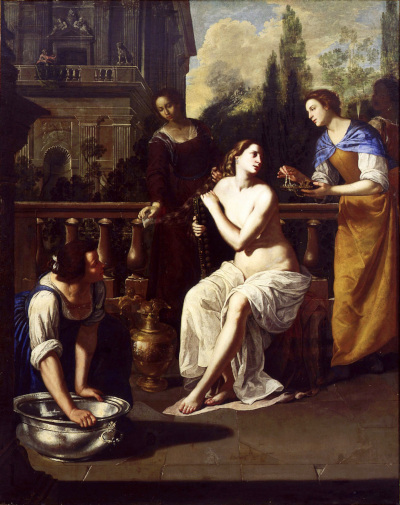
Artemisia Gentileschi's Bathsheba is a large, late-career treatment of one of the most charged bathing scenes in biblical art. The painting treated here is the Columbus Museum of Art work usually identified simply as Bathsheba, or in some exhibition contexts as Bathsheba and David. It should not be confused with the separate Bathsheba at Her Bath versions that circulated through private collections and auction records. [1][2][3][4]
That distinction is important because Artemisia returned to the subject in more than one form. The Columbus painting belongs to the Bathsheba group, but it has its own object identity, scale, collection history and collaborative context. A careful reading begins there: not with a generic story of Bathsheba, and not with every Bathsheba version at once, but with one painting in which a woman's private space becomes the centre of a public moral crisis.
The subject comes from the Second Book of Samuel. King David sees Bathsheba bathing, desires her, summons her, and sets in motion a story of adultery, pregnancy, concealment and the death of Bathsheba's husband Uriah. Artemisia's version does not need explicit violence to feel tense. The danger lies in looking, power and the distance between Bathsheba's absorbed world and the royal gaze that changes her life.
Image reference: A&AePortal object record.
At a Glance
- ArtistArtemisia Gentileschi
- TitleBathsheba. [1][2]
- Related titleBathsheba and David. [3]
- Dateabout 1635-37 or c. 1636-37. [1][2][3]
- Mediumoil on canvas. [2][3]
- Dimensions104 1/2 x 82 1/2 in. (265.4 x 209.6 cm). [2]
- CollectionColumbus Museum of Art, Ohio. [1][2][3]
- Accession number1967.006. [2]
- CollaboratorsViviano Codazzi and Domenico Gargiulo are named for architectural and landscape elements. [2][3]
- Version cautionnot the private or auctioned Bathsheba at Her Bath pictures. [4][5]
Contents
- Which Bathsheba Is This?
- Bathsheba's Story
- Scale, Setting and Collaboration
- Looking, Privacy and Power
- Bathsheba and Susanna
- Naples and Artemisia's Mature Career
- Not Bathsheba at Her Bath
- How to Read the Painting Today
- Where to Go Next
Which Bathsheba Is This?
The safest object anchor for this article is the Columbus Museum of Art painting. Columbus lists Artemisia Gentileschi's Bathsheba, c. 1636-37, among its collection highlights, and its 2025 exhibition announcement describes the work as a key painting from Artemisia's early years in Naples. [1][6] Getty's 2025 exhibition checklist identifies a related title, Bathsheba and David, about 1635-37, by Artemisia Gentileschi, with Viviano Codazzi responsible for the building and Domenico Gargiulo for the landscape. [3]
A&AePortal gives the fuller object metadata: title Bathsheba, creation date c. 1636-37, oil on canvas, 104 1/2 x 82 1/2 in., Columbus Museum of Art, accession 1967.006, and creator names Artemisia Gentileschi, Viviano Codazzi and Domenico Gargiulo. [2] Those details make the Columbus work distinct enough to support its own page.
The collaboration note is not a weakness. Large seventeenth-century paintings often involved specialist hands, and Artemisia's Naples years were part of a city where painters, decorators, architects and landscape specialists could work around ambitious commissions. The core figure subject remains tied to Artemisia, while the architecture and setting remind us that the painting was made within a broader Neapolitan artistic environment.
The title also needs care. Bathsheba, Bathsheba and David and Bathsheba at Her Bath can sound interchangeable, but on this site they should not behave that way. This account follows the Columbus object as Bathsheba and treats the private or auctioned Bathsheba at Her Bath material as a related version field rather than the object under discussion.
Bathsheba's Story
The biblical story begins with a look from above. David, king of Israel, sees Bathsheba bathing. She is the wife of Uriah the Hittite, one of David's soldiers. David sends for her, sleeps with her, and when she becomes pregnant he tries to conceal what has happened. Uriah is eventually placed in deadly battle, and Bathsheba becomes David's wife.
The story is often described as a seduction or a moral fall, but that wording can hide the imbalance of power. David is the king. Bathsheba is seen, summoned and drawn into a sequence controlled by someone with authority over her household and her husband's fate. For a modern viewer, the moral drama does not lie only in desire. It lies in the use of power against privacy.
That makes the subject a natural fit for Artemisia's art, though not because it should be turned into biography. Artemisia often found force in stories where a woman's body is watched, judged, threatened or made politically meaningful by the actions of others. Susanna and the Elders is the closest comparison in the cluster: another bathing story in which looking is not neutral. But Bathsheba's story is different. Susanna resists a false accusation; Bathsheba becomes entangled in royal desire, pregnancy, death and dynastic history.
The viewer should therefore look for pressure rather than for a simple moral label. Bathsheba's bathing is private, but the story around her is not. Artemisia turns that contradiction into a large, courtly image.
Scale, Setting and Collaboration
The Columbus painting is physically imposing. A&AePortal records it at more than eight feet high and nearly seven feet wide. [2] That scale matters because Bathsheba is not treated as a small cabinet subject or a minor devotional anecdote. She occupies a monumental pictorial world.
The named collaborators help explain the scale and setting. Getty identifies Viviano Codazzi with the building and Domenico Gargiulo with the landscape. [3] Codazzi was known for architectural painting, while Gargiulo was active in the Neapolitan world of landscape and figure-rich compositions. In the Bathsheba painting, their presence suggests a work built from several kinds of expertise: figure, architecture, landscape, costume, fabric and narrative staging.
This does not turn the painting into a committee exercise. Instead, it helps place Artemisia in Naples as a mature artist able to work within large, complex production systems. The Columbus Museum's 2025 exhibition announcement makes that context explicit, presenting Bathsheba alongside the rediscovered Hercules and Omphale as part of Artemisia's Neapolitan-era achievement. [6]
The painting's setting also changes how the story feels. Bathsheba is not simply isolated against a blank background. She belongs to an environment of walls, terraces, attendants, vessels, fabrics and implied distance. That distance is crucial: David's act begins as looking from elsewhere. The painting lets privacy and architecture occupy the same drama.
Looking, Privacy and Power
Bathsheba has often been painted as an opportunity for artists to show a nude or partially clothed female body under the authority of a biblical subject. Artemisia's treatment is more complicated. The body is visible, but the scene's meaning depends on the conditions of visibility. Who sees? From where? With what power?
In descriptions of the Columbus work, Bathsheba is surrounded by female attendants and domestic objects. The Getty exhibition text describes the selected work as a nude wrapped in a sheet, in conversation with other female figures, including a kneeling figure with a silver bowl. [3] The bath is therefore not a lonely display. It is a social, intimate space of service and preparation, one that should have been protected from royal intrusion.
That is where the painting becomes morally sharp. Bathsheba's world is full of touch, fabric, water, vessels and attention. David's world is distance and command. Even when he is not visually dominant, the story depends on him. The viewer understands that this apparently ordered scene is vulnerable to a gaze from outside it.
Artemisia's women are often compelling because they are not passive symbols. Bathsheba may be seated and attended, but the painting asks viewers to see her as the centre of the scene rather than as an excuse for David's desire. Her body is not the whole subject. The subject is the dangerous conversion of private presence into royal possession.
Bathsheba and Susanna
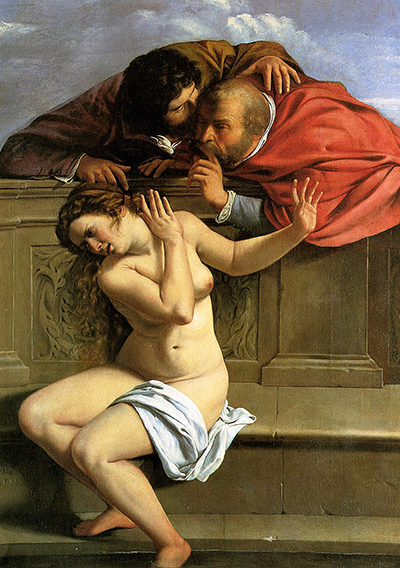
The comparison with Susanna and the Elders is useful because both stories involve bathing, looking and male authority. Yet the differences are just as important. Susanna is confronted directly by two elders who threaten to ruin her unless she yields. Artemisia's 1610 painting makes that pressure painfully physical: Susanna twists away, compressed by the men leaning over her.
Bathsheba's danger arrives through another structure. David is king, not merely an elder or a voyeur. The consequences reach into war, family, kingship and succession. Bathsheba's vulnerability is not only that she is seen while bathing; it is that the person who sees her can turn desire into command.
Seen together, the two subjects show how Artemisia could return to questions of looking without repeating herself. Susanna gives the viewer the terror of immediate coercion. Bathsheba gives the viewer a slower, more courtly disaster: the private body drawn into public power.
The comparison should stay at the level of subject, gaze and pictorial pressure. It should not force Bathsheba into a simple personal key, and it should not make every biblical heroine in Artemisia's art say the same thing. Artemisia's strength lies in how differently she handles each woman's situation.
Naples and Artemisia's Mature Career
The dating of the Columbus painting places it in Artemisia's Naples years, around the mid-1630s. Columbus describes Bathsheba as part of her early years in Naples, while Getty's exhibition material gives about 1635-37. [3][6] This period matters because Artemisia was no longer only the young painter of the Rome and Florence stories. She was a mature artist working in one of Europe's major artistic centres.
Naples gave Artemisia access to large commissions, international patrons and a busy artistic market. It also placed her among painters whose specialties could complement her own. The collaboration with Codazzi and Gargiulo is part of that story. It points to scale, ambition and production complexity.
Bathsheba also broadens the way readers understand Artemisia's late work. The painting is not a Judith scene, not a self-portrait, and not a compact devotional image. It is a grand biblical subject with a large architectural world. Its drama is not a blade or a trial, but the tension between courtly beauty and moral violation.
That makes it a useful bridge to works such as The Birth of Saint John the Baptist, Lucretia and the later Magdalene paintings. In each case, Artemisia works with a familiar subject while finding a precise emotional pressure inside it.
Not Bathsheba at Her Bath
The Bathsheba subject becomes confusing because several works, versions and related compositions are associated with Artemisia. Sotheby's sold a large Bathsheba at Her Bath in 2020, noting earlier provenance through Baron Deichmann and private collections, a probable 1640s date, version relationships and possible collaboration with Bernardo Cavallino. [4] Christie's later offered another Bathsheba at Her Bath, also tied to private collection history and version comparisons. [5]
Those works are important for the wider Bathsheba group, but they should not be folded into the Columbus page. The Columbus Bathsheba has a public collection anchor, a different recorded size, a c. 1636-37 date in A&AePortal, and named collaborators Codazzi and Gargiulo. [2] The auctioned Bathsheba at Her Bath works have their own measurements, histories and attribution discussions. [4][5]
Keeping the distinction clear helps the reader. It prevents the page from borrowing facts from the wrong object. It also shows something true about Artemisia's reputation: her subjects survive through versions, variants, collaborations, auctions, rediscoveries and changing scholarly language. A responsible article should make that complexity clearer, not hide it.
For now, the safest reading is simple: this is the Columbus Bathsheba; related Bathsheba at Her Bath versions belong to a companion route and should be compared only when the object facts remain separate.
How to Read the Painting Today
Begin with the setting. A bath scene might suggest intimacy, but the painting is monumental and architectural. Bathsheba's private world has been enlarged into public history.
Then look at the arrangement of women. Attendants, fabric, water and vessels create a space of care around Bathsheba. The story's danger enters from outside that circle. The picture therefore asks viewers to hold two realities at once: a domestic scene and a royal act of looking that will destroy its privacy.
Look also at the scale. The size recorded by A&AePortal makes this one of the substantial Bathsheba images associated with Artemisia's Neapolitan period. [2] It is a painting of ambition, not a footnote. Its subject allowed Artemisia to paint the female body, sumptuous fabrics, architectural depth and narrative tension at a grand scale.
Finally, compare it with Artemisia's other women without turning them into a formula. Susanna resists direct harassment. Lucretia faces a tragic decision after violence. Judith acts with brutal purpose. Bathsheba is caught earlier in a chain of events, before the full disaster has unfolded. That is the painting's particular charge. It shows the moment when privacy is still visible, just before power makes it impossible.
Where to Go Next
For the broader shape of Artemisia's career, start with the biography and paintings hub. For the closest subject comparison, read Susanna and the Elders, where a bathing scene becomes a confrontation with coercive looking. For another woman caught in the aftermath of sexual violence and public honour, read Lucretia.
The companion Bathsheba at Her Bath article is best read as a related version route, not as the same object. Together, the Bathsheba articles can help readers understand why Artemisia's corpus needs exact object attention: the same subject may lead to different paintings, different sources and different degrees of certainty.
Related Pages
- Artemisia Gentileschi
- Artemisia Gentileschi Biography
- Artemisia Gentileschi Paintings
- Susanna and the Elders
- Lucretia
- Bathsheba at Her Bath
Frequently Asked Questions
Discussion
What should readers notice when looking closely at Artemisia Gentileschi's Bathsheba?
Reader Insights
What details help keep the Columbus painting separate from other Bathsheba versions?
How does the painting turn a bathing scene into a question about sight and power?
Where do the scale, architecture and collaborator evidence suggest Artemisia's mature Neapolitan context?
Join the Conversation
Share your reading of this painting below.
References
- Columbus Museum of Art, Collection highlights, including Artemisia Gentileschi, Bathsheba, c. 1636-37.
- A&AePortal, Bathsheba image detail, recording Artemisia Gentileschi, Viviano Codazzi and Domenico Gargiulo, c. 1636-37, oil on canvas, Columbus Museum of Art, accession 1967.006. The local page image is used as an image reference; reproduction rights, licence and final credit wording should be checked against the source before publication reuse.
- Getty Exhibitions, Artemisia's Strong Women: Rescuing a Masterpiece, selected works entry for Bathsheba and David.
- Sotheby's, Artemisia Gentileschi, Bathsheba at Her Bath, Master Paintings Evening Sale, lot 41.
- Christie's, Artemisia Gentileschi, Bathsheba at Her Bath, lot 6381788.
- Columbus Museum of Art, Columbus Museum of Art Presents Artemisia Gentileschi: Naples to Beirut.
 Artemisia Gentileschi.jpg)
 Artemisia Gentileschi.jpg)