* As an Amazon Associate, and partner with Google Adsense and Ezoic, I earn from qualifying purchases.
by Tom Gurney Tom Gurney BSc (Hons) is an art history expert with over 20 years experience
Published on June 19, 2020 / Updated on September 28, 2026
Email: tomgurney1@gmail.com / Phone: +44 7429 011000
Degas Dancer Adjusting Her Slipper: Introduction
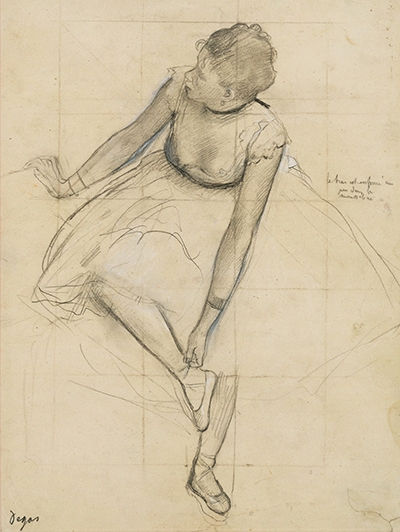
The dancer bends almost into her own skirt. One hand reaches down to a slipper while the other stretches outward, as if to hold her balance. She is neither performing a spectacular step nor posing upright for a portrait. Edgar Degas chose the small adjustment before or between movements as a problem worth studying. In Dancer Adjusting Her Slipper, the sweep of the skirt, the pull of the arm and the tilted head make a moment of preparation feel physically exact. [1][6]
This drawing is in the Metropolitan Museum of Art, New York, accession 29.100.941. The museum dates it 1873 and describes graphite heightened with black and white chalk on pink wove paper, now faded, squared for transfer. The sheet measures 33 × 24.4 cm. These details matter because the image is plainly a working study. Its visible grid and exploratory lines tell us that Degas was thinking about how to move a figure into another composition, not merely recording an attractive dancer in isolation. [1]
At a glance
ArtistEdgar Degas
TitleDancer Adjusting Her Slipper
Date1873
MediumGraphite heightened with black and white chalk on pink wove paper, squared for transfer
Sheet33 × 24.4 cm
CollectionMetropolitan Museum of Art, New York, 29.100.941
The precise object number is useful here. Degas drew several dancers adjusting shoes in the early 1870s, and more than one museum has a work called Dancer Adjusting Her Slipper. This page concerns the Met sheet with a pink support, a visible grid, a single dancer bent toward her shoe and an annotation at the right. The Detroit Institute of Arts owns a different drawing with the same title, dated about 1879 and numbered 67.273. Identification by composition and accession keeps the evidence attached to the correct image. [1][5]
A pause with a difficult balance
The figure sits or crouches low, but she is not at rest in a simple way. Her torso twists toward the shoe. One arm drops steeply to the foot; the other reaches sideways, establishing a counterweight. Her head turns down and back across her shoulder. Degas draws the body's parts as a connected system: move the hand toward the slipper and the shoulder, neck, skirt and supporting arm all have to adjust. The ordinary act becomes a study of balance. [1]
The skirt expands around the dancer in quick arcs. Some lines are light and tentative; others are reinforced. The dress gives the body a broad, almost circular field, but the leg and shoe cut through it sharply. Our eye follows the long descending arm to the hand and then to the slipper. From there it can climb back through the leg and torso. That path makes the pose readable even where the fabric is only suggested. Degas did not need to finish every fold to explain the action. [1]
The other hand matters as much as the one near the shoe. It reaches away from the center, its fingers held at the edge of the skirt or in the air beside it. Without that extension, the pose could feel like a simple bend. With it, the body seems to negotiate gravity. A dancer's balance is usually celebrated in a leap or on pointe. Here Degas finds it in a practical adjustment, where control has not disappeared just because the performance has paused. This is a visual reading of the drawn pose, rather than a documented account of one dancer's actual rehearsal. [1]
The face is turned downward, so the drawing offers little basis for a psychological story. We can see concentration implied by the task, but we do not know what the model felt. No name is supplied in the Met record. The drawing's strength lies in the observable coordination of limbs and clothing. It lets a viewer attend to a dancer as a person managing a body and an item of working dress, rather than as a distant decorative figure. [1]
Pencil, chalk and pink paper
The Met specifies graphite, with black and white chalk for emphasis. In a reproduction, the dark strokes may look uniformly gray, but the material description warns us that several drawing effects are present. Graphite can set out fine contours and repeated searching lines. Chalk can strengthen darks or catch a highlight against the colored paper. The support's pink tone, though faded now, gives the sheet a middle value against which light and dark marks can work. [1]
The figure is developed unevenly. The head, upper body and extended arm are carefully modeled, while parts of the skirt remain open, their contours crossed by searching strokes. That difference is productive. It directs attention to the body's turn and the hand-shoe connection while leaving the dress free enough to suggest movement and volume. A highly finished rendering of every fold might have hidden the decision making visible on the page. [1]
Look at the head and neck. Small marks establish hair gathered up, the ear, the face angled downward and the shoulder beneath it. The line is firmer around the bodice and upper arm. In the broad skirt, long curves and short corrections coexist. This changing pressure and density makes the sheet legible both as an image of a dancer and as evidence of someone testing a pose. The drawing asks us to follow how the figure is constructed, not only what it depicts. [1]
The museum says the paper was originally pink and is now faded. That qualification keeps us from imagining an unchanged nineteenth-century color. A present-day digital image records the sheet in its current condition and under a particular photographic setup. Its pale tone still helps separate the paper from the graphite and chalk, but it should not be used to reconstruct the exact color Degas saw in 1873. [1]
What the grid tells us
Faint horizontal and vertical lines cross the sheet. The Met calls it squared for transfer. Squaring is a practical way of relating a figure on one surface to a later composition, helping an artist keep proportions while changing scale or placement. On this sheet, the grid remains visible instead of being hidden beneath a finished scene. It is one of the clearest signs that Degas considered this pose reusable. [1]
The grid does not make the drawing mechanical. The dancer's contour is not a sequence of flat coordinates. The graphite searches and doubles back around the skirt, while the stronger marks resolve the torso, arms and legs. Measurement and revision meet on the same paper. Degas's interest in a convincing bodily movement required both: a structure that could be carried forward and a responsive line that could discover what the movement felt like visually. [1]
The Met identifies a specific later use. It says that the squared figure appears in the 1874 pastel Dancers Resting, now in a private collection. That connection is stronger than a general observation that Degas often repeated poses. It ties this exact sheet to a named ballet composition. The short museum record does not lay out a full step-by-step method of transfer, so every stage cannot be reconstructed from it. It is enough to know that the figure moved beyond the isolated study. [1]
The handwritten annotation at the right of the sheet and the signature at lower left are visible in the museum image. The short object record used here does not transcribe the annotation. Its presence reinforces the impression of a working surface, but its exact wording should not be guessed from an enlargement. The grid, note and searching marks together show a sheet that preserves part of Degas's process without giving us a complete diary of it. [1]
Watch: Edgar Degas
Explore his paintings, drawings and sculpture in three short videos.
Degas, The Dance Class
Smarthistory
Look closely at Degas’s off-duty dancers and his unusual view into the rehearsal room.
The Met says that between 1873 and 1874 Degas made several studies of dancers adjusting their shoes, seen from different positions and angles. This subject was not exhausted by one neat solution. Bending to a slipper changes shape dramatically when the viewer moves around the body: the skirt may obscure the legs, an arm may project forward, or a head may turn into profile. Repetition let Degas test those changes. [1]
The museum also points to the same dancer, shown in three-quarter view, in its The Rehearsal of the Ballet Onstage, accession 29.160.26. That work is a broader scene, tentatively dated around 1874, with many performers and preparatory studies. The Met notes that Degas made drawings for almost every figure in the composition. An individual shoe-adjusting study therefore belongs to a larger practice of building a crowded ballet scene from separately considered bodies. [1][2]
The Met has more than one version of the rehearsal composition. Its record says the relationship among three similar versions has troubled scholars, and that its own two works probably followed one another in a particular order. A separate Met pastel, The Rehearsal Onstage (29.100.39), varies figures from the first. Those distinctions prevent a tidy but unsupported story in which this one sheet simply became one final, unchanging picture. Degas could revisit poses and rearrange scenes. The documented connection is valuable precisely when it is stated at the level the evidence supports. [2][3]
In a large ballet picture, a dancer adjusting a shoe might initially look incidental. On its own sheet, the action fills the field. That reversal changes how we see Degas's full scenes. Their apparently scattered performers are often carefully devised figures, each with a posture strong enough to survive close inspection. The drawing exposes the labor behind an effect that can seem casual in a crowded composition. [1][2]
Work before the spectacle
Degas is widely associated with ballet, but this drawing contains little of the stage spectacle viewers might expect. There is no scenery, audience or dramatic costume lighting. The dancer's skirt identifies the world of ballet, while her hand at the slipper emphasizes maintenance and preparation. A shoe must fit; a body must find its balance. Degas selected the interval when performance depends on such practical work. [1]
That focus should not be confused with proof of an unobserved backstage encounter. The Met describes a series of studies made from varied viewpoints and the later use of this figure in a pastel. Those facts speak to artistic construction. The pose could derive from an arranged model session, an observed action, or a combination of looking and later work; the concise source does not decide among them. The image has the immediacy of a caught moment because Degas made the bodily action persuasive. [1]
There is dignity in taking this small act seriously. The dancer is not reduced to a decorative silhouette. Her neck, shoulder, arms and legs carry the effort of the movement. The task is modest, but the study is exacting. Degas makes the practical gesture a way to understand a professional body at work. Such attention helps explain why his ballet pictures can feel both theatrical and unsentimental: they often include waiting, adjusting and fatigue along with performance. [1][2]
The drawing also asks viewers to slow down. The first glance finds a bent dancer. The next finds the grid; the next, the uncertain skirt lines and the contrast of dark and light chalk. As those marks become visible, the image changes from a snapshot-like scene into a record of decisions. The artwork is compelling partly because it does not conceal the work of making it. [1]
A small sheet with a public life
The Met credits the drawing to the H. O. Havemeyer Collection, received through the 1929 bequest of Mrs. H. O. Havemeyer. Its accession number, 29.100.941, ties this specific sheet to the museum's medium, date and image. That number matters more than a generic English title, which can describe other Degas drawings. The Met identifies the object as a drawing and makes a public-domain image available through Open Access. [1][4]
The Met’s high-resolution reproduction reveals the full sheet: the pale edge of the pink paper, the complete grid and the note to the right. A tight crop would convey the pose but hide the paper as a working surface. Those margins matter to the story of drawing and transfer as much as the ballerina’s bent figure. [1][4]
Return finally to the two hands. One seeks the slipper; the other makes the awkward position possible. The whole study turns on that relationship. Degas's grid suggests the pose could travel into another picture, but its searching lines preserve the direct interest of the drawing itself. Dancer Adjusting Her Slipper is both preparation and a rewarding object to look at on its own: an 1873 study of how an ordinary movement becomes a carefully balanced figure. For related work, see Degas's drawings and his ballet dancers. [1]
Artworks directory
A selected index of documented works, combining owner records with entries sampled across Michel Schulman’s digital catalogue raisonné. It is not a complete catalogue. View the full catalogue
Share what you notice in Degas’s dancer adjusting her slipper.
Reader Insights
Close Looking
How does the outstretched hand counter the bend toward the shoe?
Context
What does the visible grid reveal about Degas’s process?
Open Question
Which part of the pose is documented in a later ballet work?
Join the Conversation
Share your reading of these works below.
References
Metropolitan Museum of Art, Dancer Adjusting Her Slipper, 29.100.941, object record, accessed 27 September 2026. View source
Metropolitan Museum of Art, The Rehearsal of the Ballet Onstage, 29.160.26, object record, accessed 27 September 2026. View source
Metropolitan Museum of Art, The Rehearsal Onstage, 29.100.39, object record, accessed 27 September 2026. View source
Metropolitan Museum of Art, Open Access policy, image reuse statement, accessed 27 September 2026. View source
Detroit Institute of Arts, Dancer Adjusting Her Slipper, 67.273, separate charcoal drawing dated about 1879. View source
Splash image: Edgar Degas, Dancer Adjusting Her Slipper, 1873, graphite heightened with black and white chalk on pink wove paper (now faded); squared for transfer. The Metropolitan Museum of Art, 29.100.941. Collection record. View source
Tom Gurney is an art history expert. He received a BSc (Hons) degree from Salford University, UK, and has also studied famous artists and art movements for over 20 years.
Tom has also published a number of books related to art history and continues to contribute to a number of different art websites. You can read more on Tom Gurney here.



 Buy Art Prints Now
 by Tom Gurney