


 by Tom Gurney
Tom Gurney BSc (Hons) is an art history expert with over 20 years experience
Published on June 19, 2020 / Updated on November 6, 2026
Email: tomgurney1@gmail.com / Phone: +44 7429 011000
Introduction
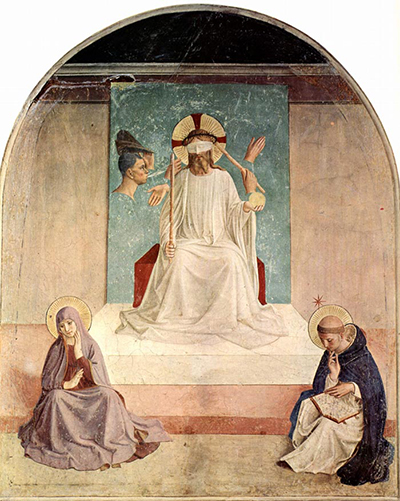
Fra Angelico’s Mocking of Christ in cell 7 at San Marco is one of the most original images of the Passion in Early Renaissance painting. Christ sits at the centre. He is blindfolded. The Virgin Mary and Saint Dominic appear below or beside the sacred vision in meditative relation to him. Yet the people mocking and striking Christ are largely absent.
Instead, Angelico represents fragments of their actions: hands, a head and gestures of abuse appear without complete bodies. The result is startling. A biblical event becomes almost abstract. Violence is reduced to its essential signs. The Museo di San Marco describes the fresco as an image centred on Christ’s suffering and humiliation during the Passion. Its location inside cell 7 is crucial. The fresco was designed for prolonged private meditation rather than public narrative instruction.
A friar living in the cell knew the Passion story already. Angelico therefore did not need to reconstruct the whole scene historically. He could compress it. The disappearance of the tormentors changes the viewer’s response. There are no colourful villains to study. No crowded action distracts from Christ. Humiliation itself becomes visible. Saint Dominic supplies the model for how the friar should respond: not with spectacle, but contemplation. [1]
At a Glance
- ArtistFra Angelico and workshop context [4]
- TitleThe Mocking of Christ / Christ Mocked [1]
- Datewithin the San Marco dormitory campaign, broadly late 1430s–1440s [1]
- Mediumfresco [1]
- Locationcell 7, Museo di San Marco, Florence [2]
- Principal figureChrist [1]
- Devotional witnessesVirgin Mary and Saint Dominic [5]
- Distinctive featuredisembodied hands and head represent Christ’s tormentors [1]
- Subjecthumiliation of Christ during the Passion [1]
- Original functionprivate Dominican cell meditation [3]
- Museum interpretationmeditation on suffering and humiliation [2]
Contents
- Introduction
- The Biblical Mocking
- Christ at the Centre
- Disembodied Hands
- Why Remove the Tormentors?
- The Virgin Mary
- Saint Dominic
- The Cell Setting
- Symbol versus Narrative
- Why The Mocking of Christ Matters
The Biblical Mocking
The Gospels describe Christ being mocked and abused during the Passion. He is struck. He is insulted. His claims to kingship or prophetic authority are ridiculed. In some accounts he is blindfolded and challenged to identify who struck him. Pain is therefore combined with humiliation. The scene is not merely physical violence. The tormentors attempt to reduce Christ’s dignity. Artists traditionally represented the episode with groups of soldiers or persecutors surrounding him. Angelico chooses another solution. [1]
Christ at the Centre
Christ is physically central and psychologically isolated. His blindfold removes direct eye contact. He cannot return the viewer’s gaze. This intensifies vulnerability. At the same time, his posture remains controlled. The torment does not destroy his dignity. The contrast between abuse and composure is fundamental. Angelico presents suffering without making Christ visually chaotic. [1]
The blindfold refers to the Gospel mockery in which Christ is challenged to prophesy who struck him. It creates several layers of meaning. His tormentors treat inability to see as weakness. Christian theology understands Christ as possessing a deeper knowledge. The blindfold therefore becomes an ironic symbol. Those who mock him are themselves spiritually blind. Christ’s covered eyes do not represent lack of truth. [1]
Disembodied Hands
The hands are the fresco’s most famous invention. They strike, gesture or threaten without belonging to visible complete bodies. This has a profound effect. The viewer sees violence without conventional perpetrators. The acts become universalised. The fresco does not ask us to study the personalities of Roman soldiers. It isolates what is being done. Humiliation becomes almost symbolic. [1]
A detached head or face adds to the strange atmosphere. Like the hands, it compresses narrative identity into the act of mockery. The tormentor becomes less a historical individual than an embodiment of contempt. This visual reduction is one reason the fresco can feel unexpectedly modern. Angelico uses fragmentation to intensify concentration. [1]
Why Remove the Tormentors?
A private Dominican cell did not need a complete theatrical scene. Removing the bodies solves a devotional problem. A crowd creates anecdote. Who is this soldier? What is that figure wearing? Where is the action taking place? Angelico removes these questions. The viewer faces Christ and the signs of abuse. Narrative becomes meditation. [1]
The Virgin Mary
Mary appears as a meditative witness. Her presence does not belong literally to the biblical mocking episode in the same form. She functions devotionally. The mother contemplates the humiliation of her son. Her inclusion invites compassionate identification. The viewer is not asked to join the mockers. He is asked to join Mary. [1]
Saint Dominic
Saint Dominic performs an even more explicit pedagogical role. He lived centuries after Christ and therefore cannot be a historical witness. His presence makes the fresco deliberately transhistorical. Dominic shows how a Dominican friar should contemplate the Passion. The real occupant of the cell looks at Dominic looking towards Christ. This creates a chain of devotion. [5]
Dominic’s repeated presence throughout San Marco is one of the keys to the entire fresco cycle. He acts almost like an internal viewer. His posture guides response. When he kneels, the friar is invited to kneel spiritually. When he contemplates, the friar should contemplate. In the Mocking of Christ, this becomes particularly important because the tormentors are absent. Dominic represents the correct human presence before Christ. [5]
The pairing of Mary and Dominic also connects universal Christian compassion with specifically Dominican identity. Mary grieves as mother. Dominic meditates as founder and friar. The two different witnesses create complementary forms of devotion. The real friar can enter the image through Dominic while also learning compassionate response from Mary. [5]
Humiliation
The Museo di San Marco emphasises humiliation as a central meaning of the fresco. This distinguishes the scene from other Passion images concerned mainly with physical pain. Mockery attacks dignity. Christ is treated as ridiculous. The king is blindfolded. The prophet is challenged. The sacred body is turned into entertainment for tormentors. Angelico’s stripped-down composition forces the viewer to confront that degradation directly. [1]
The theme would have resonated strongly within a religious order committed to humility. Christ accepts humiliation without self-defence. His response provides a model radically opposed to pride. For a friar, the image could therefore function as moral discipline. Humility is not merely a rule imposed by the convent. It is grounded in imitation of Christ. [5]
The fresco feels silent despite representing a noisy event. The Gospel mocking would have involved laughter, accusation and violence. Angelico suppresses that sound visually. The detached gestures seem almost frozen. Christ’s stillness dominates. This transformation is central to San Marco. Historical noise becomes contemplative silence. [1]
The Cell Setting
Cell 7 was a private dormitory space. The image therefore existed within ordinary monastic routines. The friar slept, prayed and reflected beneath or before it. This repeated proximity changed the work’s function. The fresco was not an image to visit occasionally. It was part of the room. The wall itself carried Passion meditation. [3]
A public church fresco might need many figures to communicate narrative clearly to a broad audience. A private cell could assume biblical knowledge. Angelico uses that freedom. He does not explain the Passion. He extracts one psychological core from it. This is why the San Marco frescoes can seem so radical despite their devotional conservatism. The audience allowed visual experimentation. [3]
Comparison with the Chapter House Crucifixion
The Chapter House Crucifixion represents the opposite scale of Passion imagery. There, an enormous sacred assembly surrounds Christ. The image serves communal Dominican identity. In cell 7, almost everyone disappears. The same artist moves from maximal sacred community to radical reduction. The difference is not chronology alone. It is function. [1]
Other cells contain Crucifixion scenes with Saint Dominic. These also simplify narrative, but they retain a more familiar Passion iconography. The Mocking of Christ goes further. It fragments the aggressors themselves. This makes it one of the most conceptually daring images in the dormitory. [3]
The Santa Trinita Deposition is crowded with mourners whose gestures carefully coordinate emotional response. The Mocking of Christ achieves emotional force through absence. The comparison shows Angelico’s range. He could organise complex group psychology. He could also make empty space and fragments carry emotion. [1]
Symbol versus Narrative
The fresco sits between narrative and symbol. Christ is still represented within a specific Gospel episode. The blindfold and mocking gestures identify it. Yet the removal of full tormentors makes the event less historically particular. The image becomes an emblem of humiliation. This shift allows the friar to meditate on the spiritual meaning rather than reconstruct the chronological event. [1]
Mocking narratives often involve ironic royal imagery. Christ is mocked as king. The theological paradox is obvious to Christian viewers. The tormentors intend ridicule. The believer understands true kingship. Angelico’s image therefore contains dramatic irony. Those humiliating Christ misunderstand the person before them. [1]
The blindfold can intensify this irony. Christ’s physical sight is covered. The mockers possess physical sight but fail to recognise divine identity. The real blindness is therefore theirs. This reversal would have been particularly suitable for contemplation. The friar is asked implicitly whether he sees correctly. [1]
The fresco is itself an object of sight. A viewer looks at a Christ who cannot visibly look back. This makes the act of contemplation unusually self-conscious. The friar must supply attention. Dominic models that attention. The painting becomes almost an exercise in correct seeing. [5]
The image is executed in fresco as part of the wall. The medium reinforces the cell’s devotional integration. This was not a panel that could be closed, moved or exchanged. The Passion image belonged permanently to the room. The plaster surface and cell architecture form one object. [4]
Colour
Colour is restrained but meaningful. Christ’s robes and the garments of Mary and Dominic establish hierarchy against the pale wall. The detached tormenting elements are visually subordinate. This ensures that fragmentation does not create chaos. Christ remains the focus. [4]
Despite the conceptual abstraction of the tormentors, Christ’s body is volumetric. He occupies real space. This balance is important. Angelico combines Renaissance bodily presence with non-naturalistic symbolic fragmentation. The fresco therefore demonstrates that naturalism and abstraction could coexist within Early Renaissance painting. [4]
Modern viewers often respond strongly to the Mocking of Christ because the floating hands and head seem almost surreal. It would be misleading to describe Angelico as anticipating modern art in any direct historical sense. His purpose was Dominican meditation. Yet the comparison helps explain why the image remains visually striking. He reduces narrative to fragments in a way that breaks expectations of straightforward realism. [4]
Angelico’s economy is not merely stylistic elegance. It is theological discipline. Everything unnecessary to meditation is removed. Christ. Mockery. Mary. Dominic. The scene becomes a distilled Passion image. This economy gives the fresco exceptional durability. A friar could return repeatedly without exhausting it. [1]
The Museo di San Marco continues to present cell 7 through the themes of suffering and humiliation. Recent curatorial projects have also used the cell in dialogue with modern art. Such exhibitions belong to the fresco’s reception history rather than its original meaning. They nevertheless demonstrate the continuing expressive force of Angelico’s reduction. [2]
Why The Mocking of Christ Matters
The Mocking of Christ matters because it demonstrates just how inventive Fra Angelico could become when devotional function allowed him to abandon ordinary narrative completeness. The Gospel episode is violent and crowded. Angelico turns it into silence. The perpetrators fragment into hands and a head. Christ remains whole. The contrast is the point. Those who attack him lose individuality. The humiliated figure retains dignity. Mary and Dominic then establish the correct alternative to mockery. They contemplate. The friar occupying the cell was invited to do the same.
The fresco therefore stages three forms of relationship with Christ: abuse; compassion; contemplation. The occupant must choose the latter two. Artistically, the work is equally important because it combines Renaissance bodily realism with radical symbolic abbreviation. Christ has volume. The room has space. Yet the tormentors do not obey ordinary naturalistic logic. Angelico therefore shows that Early Renaissance innovation was not a simple march towards greater realism. Realism could be suspended whenever spiritual meaning demanded something else. That is why the Mocking of Christ remains one of the most memorable images at San Marco. [2]
Frequently Asked Questions
Discussion
Which visual decision most strongly concentrates the Mocking of Christ into an image of humiliation?
Reader Insights
How do the disembodied hands and head alter the violence of the Gospel scene?
What roles do the Virgin Mary and Saint Dominic play beside Christ?
How would repeated private viewing in Cell 7 change the fresco’s effect?
Join the Conversation
Share your reading of The Mocking of Christ below.
References
- Direzione regionale Musei nazionali Toscana, Museo di San Marco institutional collection resources. Museo di San Marco collection.
- Direzione regionale Musei nazionali Toscana, current description of cell 7 and Christ Mocked as meditation on suffering and humiliation. Current Museo di San Marco Cell 7 description.
- Direzione regionale Musei nazionali Toscana, resources on the forty-four dormitory cells and differentiated devotional programmes. San Marco dormitory cells and devotional programmes.
- National Gallery, London, Fra Angelico artist biography and Early Renaissance context. National Gallery Fra Angelico biography.
- Museo di San Marco, institutional research on Dominican spirituality and Angelico’s cell frescoes. Museo di San Marco institutional collection; National Gallery Dominican context.
.jpg)



 Fra Angelico.jpg)


