


 by Tom Gurney
Tom Gurney BSc (Hons) is an art history expert with over 20 years experience
Published on June 19, 2020 / Updated on November 29, 2026
Email: tomgurney1@gmail.com / Phone: +44 7429 011000
Introduction
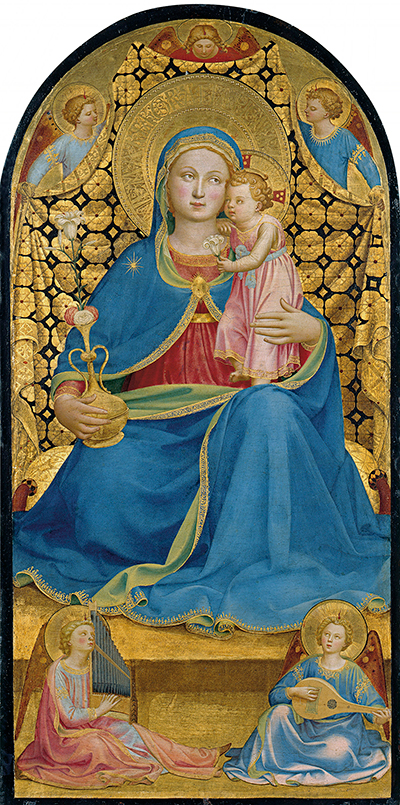
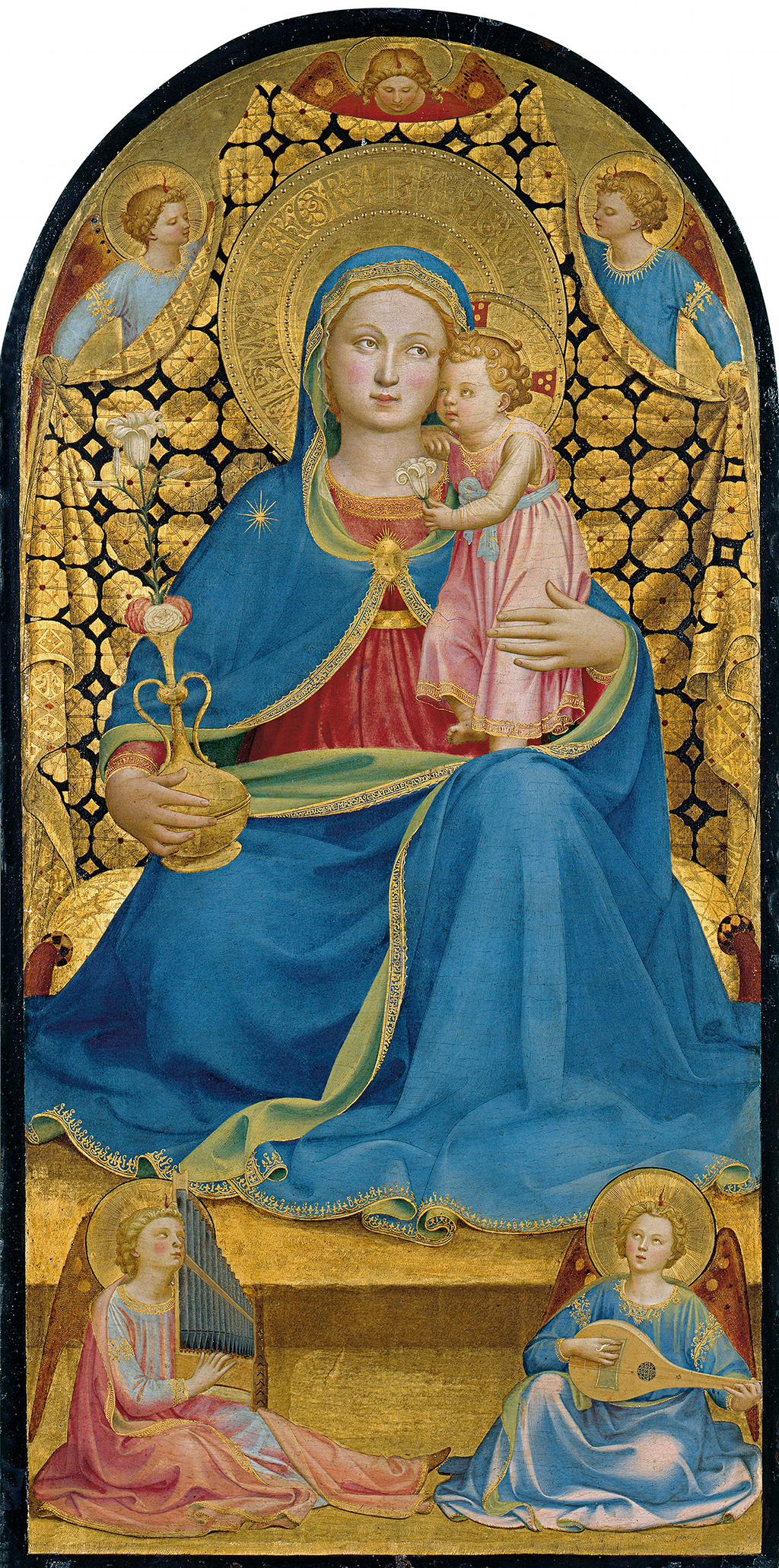
In Fra Angelico’s Madonna of Humility, Christ stands on Mary’s lap and rests his forehead against her cheek. Her head inclines towards him while her body faces outwards. Below them, two angels look up from their instruments. Three more hold a cloth of honour above the Virgin, who sits on a cushion on the ground. This is the tall, narrow Thyssen-Bornemisza panel, inventory no. 7 (1986.10), on long-term deposit at the Museu Nacional d’Art de Catalunya (MNAC) in Barcelona. [1] [2]
At a Glance
- ArtistFra Angelico (Fra Giovanni da Fiesole). [1]
- DateAround 1425 in the Thyssen and 2025 Florence records. The MNAC entry gives 1433–35. [1] [2] [3]
- MediumTempera and gold on wood. [3]
- Panel dimensions98.6 × 49.2 cm. [1] [3]
- Collection and locationThyssen-Bornemisza Collection, on long-term deposit at the Museu Nacional d’Art de Catalunya, Barcelona. [1] [2]
- Inventory numbersThyssen no. 7 (1986.10), MNAC 212817-000. [1] [2]
A cushion, a cheek and two lilies
The cushion puts Mary close to the ground, the defining feature of the Virgin of Humility, a type already current in the fourteenth century. Its low position also changes the way we read the whole panel. Mary’s blue mantle spreads over her knees and falls towards the little musicians, so that her body seems to take up most of the space between the angels. The turned-back edge of the mantle traces the rise of one knee in a strip of pale green, then curls across the cushion. The same pose that brings her down to earth gives the figure its breadth. Angelico then raises the cloth behind her like a canopy, giving a woman seated at floor level the ceremonial presence of a queen. [1] [4]
Christ’s posture makes sense only in relation to his mother’s body. She steadies his legs on her lap and he leans far enough to bring their faces together. The touch is slight and takes up very little of the painted surface, especially beside the wide blue mantle and the great disc of Mary’s halo. Once you notice it, the arrangement of the larger shapes becomes easier to read. Her inclined head interrupts the strict frontality of the shoulders, and the curve of the arm that supports him brings the eye back towards the point where their faces meet. [2] [4]
The flowers carry that exchange out into the space in front of them. The child offers a single white lily. Mary holds a vessel with another lily rising above three roses. The tall stem on one side answers the upright body of the child on the other. Mar Borobia, writing for the Thyssen, connects the lilies with Mary’s purity and the cluster of roses with the Marian image of the rose without thorns. She also raises the possibility that the mixture of salmon pink and white evokes Christ’s future Passion. Machtelt Brüggen Israëls reads the flowers through the Song of Songs, connecting the lily among roses with the lily among thorns in verse 2:2 and the child’s flower with the lily of verse 2:1. Both readings start from the care Angelico takes to give each figure a flower of their own. [1] [4]
The angels and the cloth of honour
The three angels at the top are partly hidden by the hanging they support. The two at the sides show how the cloth is held. The third is squeezed into the top of the arch, where the red of its wings picks up the red cross in the Child’s halo. Along its edges the folds turn and the pattern bends with them, so the hanging can be read both as a shining field behind the figures and as a fabric that hangs in space. At ground level the musicians make a corresponding pair. The player at the left has a small portable organ, or organetto, and the one at the right holds a lute. The upright pipes and the long slant of the lute’s neck give the two figures different silhouettes. Both look up towards Mary and Christ. [1] [2] [4]
Brüggen Israëls draws attention to the moment just before the music begins. One player has fingers at the keys and the other holds the plectrum above the strings. She links their readiness to play with the angelic greeting that runs round Mary’s halo. The words Ave Maria are part of the painted surface, and the instruments invite the viewer to imagine how the greeting might sound. The Christ Child’s halo carries Alpha and Omega, giving the small figure a second, more solemn identity through the inscription that surrounds his head. [4] [5]
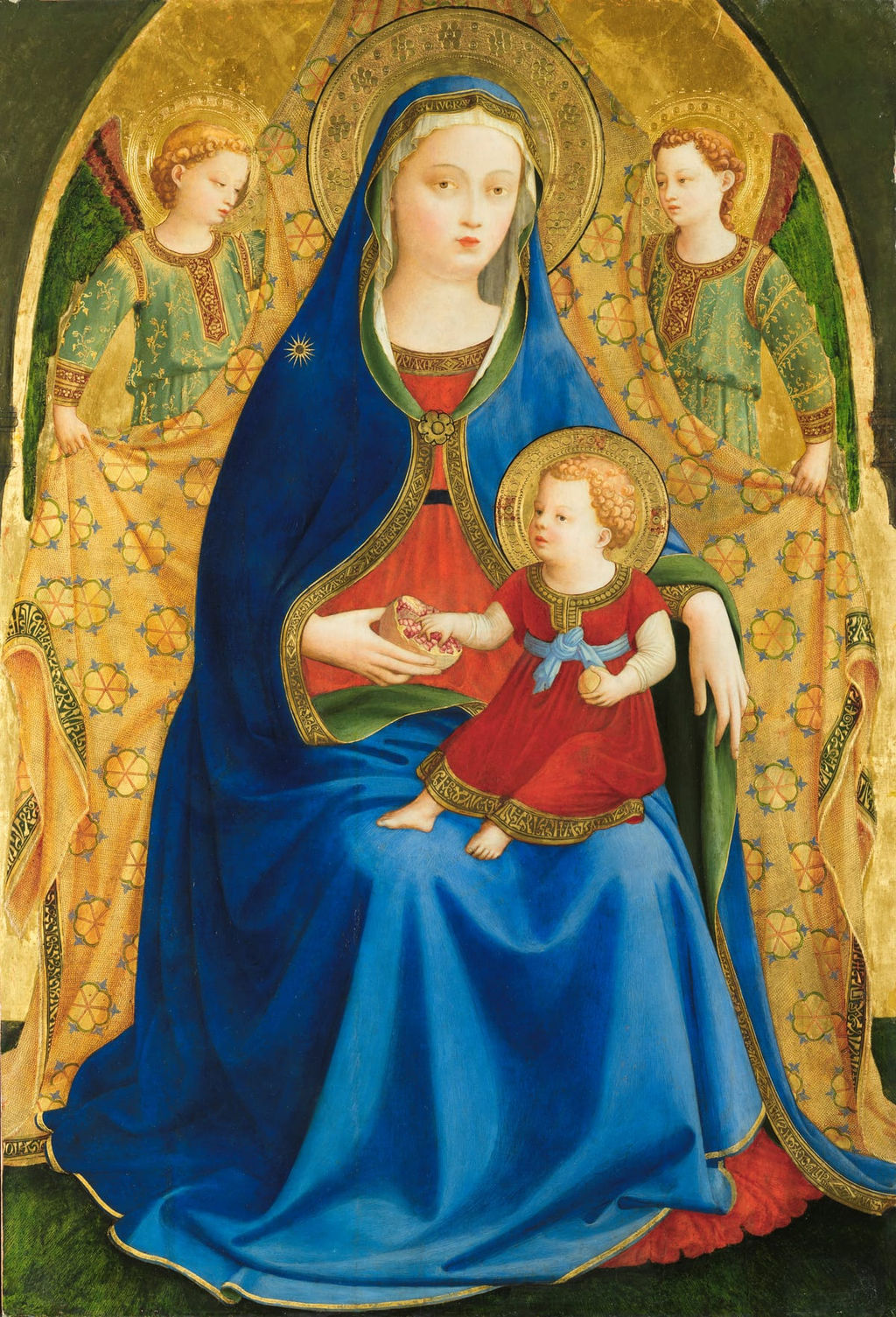
The Prado’s Virgin of the Pomegranate. The fruit, brought forward by two small gestures, sits against the red of the Virgin’s dress. Image source. Public domain. Proportional web resize.
Why the date is disputed
The Thyssen’s current collection entry dates the panel to around 1425. The 2025 Florence exhibition organised by Fondazione Palazzo Strozzi and the Museo di San Marco lists it as Virgin of Humility, with Five Angels, by Fra Angelico, around 1425, in checklist item 16. In the accompanying catalogue, Brüggen Israëls adopts the same date and follows Laurence Kanter’s 2005 reasoning about the short, rounded proportions of the figures. She also sees the frontal Virgin and the angels as a response to Sant’Anna Metterza, the panel the Uffizi dates to around 1424–25 and attributes jointly to Masolino and Masaccio. Daniela Parenti’s Uffizi entry assigns its solidly modelled Virgin and Child to Masaccio. In the Thyssen picture, the breadth of Mary’s forward-facing body makes a particularly clear point of comparison. [1] [4] [3] [6]
The MNAC’s Catalan entry still gives 1433–35. As Borobia explains, Miklós Boskovits arrived at that later date by comparing figures with those in Angelico’s Linaioli Tabernacle, the Louvre Coronation of the Virgin and the Lamentation at San Marco. She sets these comparisons alongside the earlier dating advanced by Kanter in 2005 and Carl Brandon Strehlke in 2019. In her account, the forms of the letters on the two haloes and along the border of Mary’s mantle fit the mid-1420s better. The two chronologies give different weight to details within the same painting. Around 1425 follows the owner’s current catalogue and the recent Florence exhibition. The range 1433–35 remains part of the painting’s dating history and is still the date visitors encounter in the MNAC’s online record. [1] [2] [4] [3]
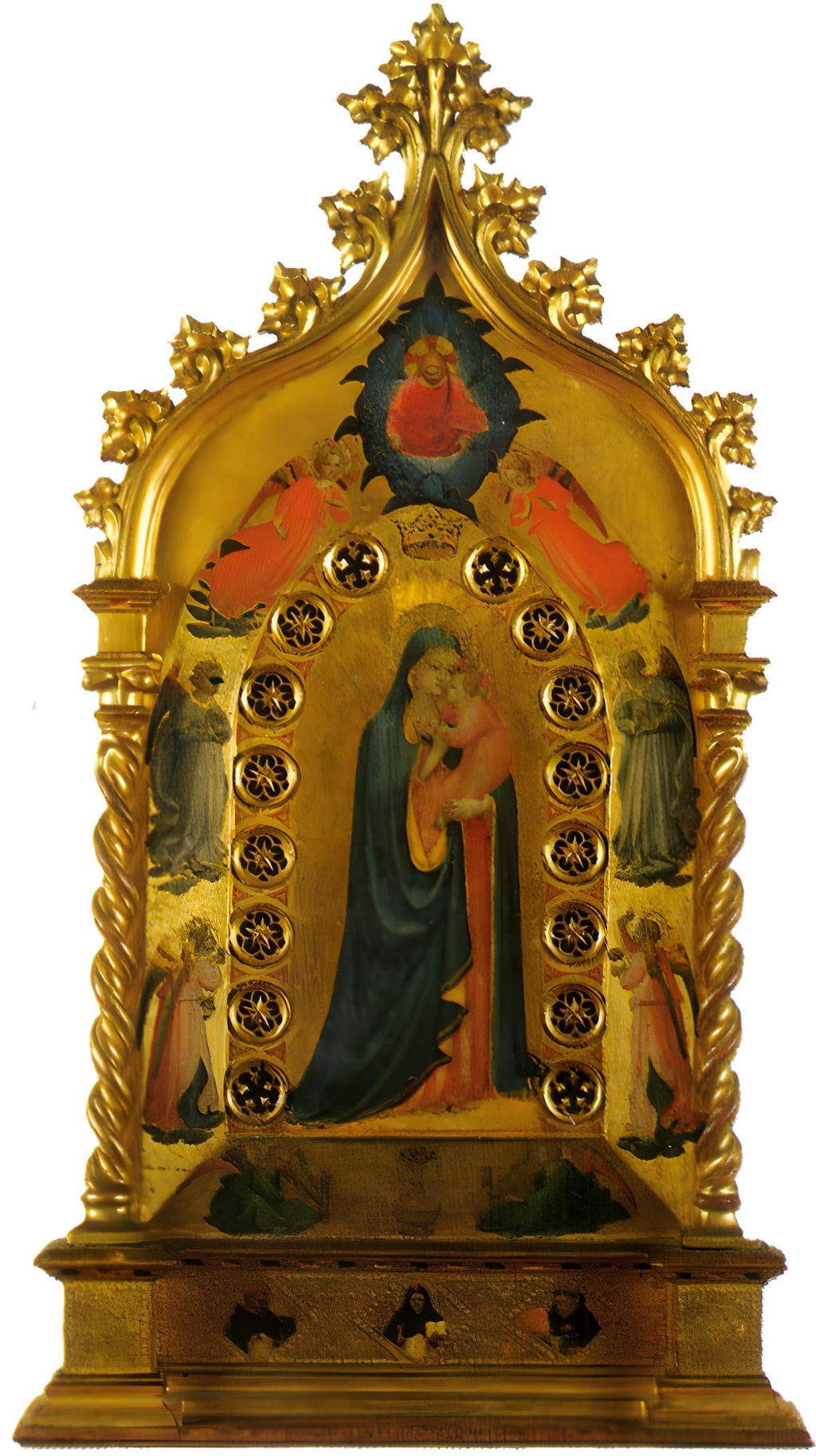
The Madonna of the Star on display with its architectural surround. Compare the central figures with the small images encircling them. Image source. Public domain. Proportional web resize.
What the restoration revealed
The Thyssen’s technical study distinguishes marks made to plan the composition from marks made to ornament the gold. Infrared examination revealed drawing beneath the paint and incisions that helped fix boundaries between painted areas and gilding. Further incisions laid out folds and facial features. In the X-radiograph of Mary’s head, the first positions of the features can be compared with their finished positions. Angelico painted the eyes higher than he had initially marked them. A decision made while painting thus survives beside the measured layout of the face. The red-brown lines around the fingers are another kind of mark. They give the small forms enough definition to remain legible against surrounding colour and gold. [5] [7]
The museum identified both water gilding and oil gilding. Incised lines and repeated impressions break up the surface of the cloth and the haloes, while small gilded ornaments also pick out details on the angels’ robes and the lute. The laboratory looked at colour on a much smaller scale. A cross-section from a reddish-blue area on one musician showed a red glaze coloured with kermes beneath a translucent layer containing lead white, lapis lazuli and calcium carbonate. The red remains visible through the blue. This is evidence from a particular spot on the musician’s costume and shows how Angelico could make a hue by superimposing thin layers. [5] [7]
The conservators removed aged varnish and overpaint that had obscured the distinctions between colours and muted the modelling of faces and folds. X-rays also revealed the extent of damage in Mary’s face, including a hole passing through the wood below the lips. The team observed a wooden insert at the back and considered a projectile one possible explanation for the hole. The circumstances of the damage remain unknown. The museum showed the restored work in Madrid from December 2022 to December 2023, alongside instruments similar to those in the painting. The installation allowed visitors to see the reverse of the panel as well as the painted face. [5] [7] [8]
Where the panel may have belonged
A sixteenth-century reference offers one possible Florentine setting. Some scholars have linked the panel to a painting Vasari mentioned in his 1568 account of works in the Palazzo Gondi. The Thyssen points out that the description is too imprecise to make the identification secure. A different possibility begins with something visible in the painting. Gold discs appear on the angels’ red wings and on the red cross in Christ’s halo. Strehlke compared them with the gold discs on the red arms of Florence’s Bankers’ Guild. Brüggen Israëls suggests that the work might have been among the Madonnas in tabernacles inventoried in 1454 at the guild-supervised hospital of San Matteo, or that it might have hung at the guild’s headquarters. The painted details give the proposal a basis, while the inventory supplies a possible setting. The panel’s original destination is still uncertain. [1] [4]
Brüggen Israëls traces the picture to England by 1816, when the future George IV gave it to Princess Charlotte of Wales on her marriage. The Thyssen records its purchase from the Pierpont Morgan Library by Heinrich Thyssen-Bornemisza in 1935. It passed to his daughter, Margit Batthyáni, and her brother Hans Heinrich bought it for his collection in 1986. MNAC records the collection’s deposit of the work there in 2004. [2] [4] [9]
Other Madonnas of Humility
Fra Angelico returned to the subject in the panel now at the Rijksmuseum, SK-A-3011. In the Amsterdam composition Mary herself holds a lily and wraps her other arm around the legs of the standing child. The museum’s Dutch catalogue dates it to about 1440, while Brüggen Israëls dates it to about 1434–35 in the 2025 Florence catalogue. The hanging in Amsterdam originally had angels of its own. The catalogue identifies the surviving upper-left angel as a fragment in the Wadsworth Atheneum in Hartford. The Amsterdam work’s present outline gives a different impression from the tall Barcelona panel, where the cloth-bearers and the two musicians still frame the composition above and below. [4] [10]
In the National Gallery of Art’s Madonna of Humility in Washington, accession 1937.1.5, two angels carry the hanging and the child lies across Mary’s lap as she crosses her hands at her breast. The Washington gallery dates the work to around 1430. The Louvre’s Virgin of Humility Nursing the Child, MI 381, is a separate panel catalogued as the workshop of Lorenzo Monaco. The act of nursing there gives the low-seated Virgin a different reason to bend over the infant. Ground-level seating recurs across these works, while the child’s position, the flowers and the angels identify the particular scene. [11] [12]
Fra Angelico artworks directory
Explore documented works and surviving parts of larger ensembles. Catalogue links identify individual records. Attribution and dating can vary across collections and publications. Search the Federico Zeri Photo Archive by artist.
| Name | Date | Medium and sources |
|---|---|---|
| Adoration of the Magi | About 1440–60, NGA catalogue | Painting Catalogue. |
| Adoration of the Magi (Armadio degli Argenti) | About 1450–53 | Tempera and gold on wood. Catalogue. |
| Agony in the Garden (Armadio degli Argenti) | About 1450–53 | Tempera and gilding on wood Catalogue. |
| Annalena Altarpiece / Pala di Annalena | commonly c. 1435 | Tempera on panel Catalogue. |
| Annunciation (Armadio degli Argenti) | About 1450–53 | Tempera and gilding on wood. Catalogue. |
| Annunciation (Cortona) | generally placed in the 1430s; exact dating remains debated | Tempera on panel Catalogue. |
| Annunciation (Prado) | 1425–26 | Tempera on poplar panel Catalogue. |
| Annunciation (San Marco upper corridor) | commonly c. 1442 | Fresco Catalogue. |
| Annunciation with Saint Peter Martyr | About 1439–43 | Fresco on plaster. Catalogue. |
| Annunciatory Angel | 1450–55, Detroit catalogue | Gold leaf and tempera on wood panel. Catalogue. |
| Armadio degli Argenti (Silver Treasury) | principally c. 1450–52 | Tempera on panel Catalogue. |
| Arrest of Christ (Armadio degli Argenti) | About 1450–53 | Tempera and gilding on wood Catalogue. |
| Ascension (Armadio degli Argenti) | About 1450–53 | Tempera and gilding on wood Catalogue. |
| Baptism of Christ (Armadio, Alesso Baldovinetti) | About 1452–53 | Tempera and gilding on wood Catalogue. |
| Beheading of Saints Cosmas and Damian (San Marco Altarpiece) | About 1438–42 | Painted panel Catalogue. |
| Betrayal of Christ (Armadio degli Argenti) | About 1450–53 | Tempera and gilding on wood Catalogue. |
| Blessed Dominican, Possibly Jordan of Saxony (San Marco Altarpiece) | About 1438–42 | Painted panel Catalogue. |
| Blessed Vincent Ferrer (San Marco Altarpiece) | About 1438–42 | Painted panel Catalogue. |
| Burial of Saints Cosmas and Damian (San Marco Altarpiece) | About 1438–42 | Painted panel Catalogue. |
| Bust of a Cleric and a Group of Figures (recto and verso) | 15th century | Pen and ink on paper Catalogue. |
| Christ among the Doctors (Armadio degli Argenti) | About 1450–53 | Tempera and gilding on wood Catalogue. |
| Christ before Caiaphas (Armadio degli Argenti) | About 1450–53 | Tempera and gilding on wood Catalogue. |
| Christ Glorified in the Court of Heaven | About 1423–24 | Egg tempera on wood, probably poplar, with gold and silver leaf Catalogue. |
| Christ Seated in Judgment | 1447 | Fresco and gilding on plaster. Catalogue. |
| Christ Stripped of His Garments (Armadio degli Argenti) | About 1450–53 | Tempera and gilding on wood Catalogue. |
| Christ Washes the Apostles’ Feet (Armadio degli Argenti) | About 1450–53 | Tempera and gilding on wood Catalogue. |
| Circumcision of Christ (Armadio degli Argenti) | About 1450–53 | Tempera and gilding on wood. Catalogue. |
| Communion of the Apostles (Armadio degli Argenti) | About 1450–53 | Tempera and gilding on wood Catalogue. |
| Coronation of the Virgin (Armadio degli Argenti) | About 1450–53 | Tempera and gilding on wood Catalogue. |
| Coronation of the Virgin (Louvre) | Louvre: second quarter of the fifteenth century, 1425–50; often dated more narrowly c. 1434–35 | Tempera and gold on panel Catalogue. |
| Coronation of the Virgin (Uffizi) | 1431–35 | Tempera on wood, gold ground Catalogue. |
| Cortona Triptych | About 1437 | Tempera and gold on panel. Catalogue. |
| Crucifixion (Armadio degli Argenti) | About 1450–53 | Tempera and gilding on wood Catalogue. |
| Crucifixion and Saints | 1441–42 | Fresco Catalogue. |
| Deposition from the Cross / Santa Trinita Deposition | commissioned 1429–32; completed by Angelico within this period | Tempera on panel Catalogue. |
| Descent into Limbo (Armadio degli Argenti) | About 1450–53 | Tempera and gilding on wood Catalogue. |
| Entombment of Christ (San Marco Altarpiece) | About 1438–42 | Painted panel Catalogue. |
| Entry into Jerusalem (Armadio degli Argenti) | About 1450–53 | Tempera and gilding on wood Catalogue. |
| Expulsion and the Stoning of Saint Stephen | 1448–49, Vatican Museums | Fresco. Catalogue. |
| Fiesole San Domenico Altarpiece | early 1420s; predella about 1423–24 | Tempera on panel Catalogue. |
| Flagellation (Armadio degli Argenti) | About 1450–53 | Tempera and gilding on wood Catalogue. |
| Flight into Egypt | About 1450–53 | Tempera and gilding on wood. Catalogue. |
| Guidalotti Polyptych | c. 1447–49 | Tempera and oil on panel Catalogue. |
| Healing of Palladia and Saint Damian Accepting Her Gift (San Marco Altarpiece) | About 1438–42 | Painted panel Catalogue. |
| Holy Pilgrim, Possibly Saint Roch (San Marco Altarpiece) | About 1438–42 | Painted panel Catalogue. |
| Holy Women at the Tomb (Armadio degli Argenti) | About 1450–53 | Tempera and gilding on wood Catalogue. |
| Judas Receives Payment (Armadio degli Argenti) | About 1450–53 | Tempera and gilding on wood Catalogue. |
| Lamentation over Christ (Armadio degli Argenti) | About 1450–53 | Tempera and gilding on wood Catalogue. |
| Lamentation over the Dead Christ (Croce al Tempio Lamentation) | 1436–41, Zeri catalogue | Tempera and gilding on wood panel. Catalogue. |
| Last Judgement (Armadio degli Argenti) | About 1450–53 | Tempera and gilding on wood Catalogue. |
| Last Judgement (San Marco) | c. 1425–28 | Tempera and gold on panel Catalogue. |
| Last Supper (Armadio degli Argenti) | About 1450–53 | Tempera and gilding on wood Catalogue. |
| Lex Amoris (Armadio degli Argenti) | About 1450–53 | Tempera and gilding on wood Catalogue. |
| Madonna and Child with Saint Dominic and Saint Thomas Aquinas | About 1430, Hermitage catalogue | Detached fresco. Catalogue. |
| Madonna and Child with Saints | About 1411–13 | Tempera on wood panel, with a gold ground. Catalogue. |
| Madonna of Humility | About 1425, Thyssen catalogue | Tempera and gold on wood. Catalogue. |
| Madonna of the Star | 1431–34, Zeri catalogue | Tempera with oil glazes and gold on wood panel, as catalogued by the Gardner for the 2018 exhibition. Catalogue. |
| Marriage at Cana (Armadio, Alesso Baldovinetti) | About 1452–53 | Tempera and gilding on wood Catalogue. |
| Massacre of the Innocents (Armadio degli Argenti) | About 1450–53 | Tempera and gilding on wood Catalogue. |
| Miracle of the Black Leg (San Marco Altarpiece) | About 1438–42 | Painted panel Catalogue. |
| Mocking of Christ (Armadio degli Argenti) | About 1450–53 | Tempera and gilding on wood Catalogue. |
| Mystic Wheel (The Vision of Ezekiel) | About 1450–52 | Tempera and gilding on wood. Catalogue. |
| Nativity (Armadio degli Argenti) | About 1450–53 | Tempera and gilding on wood. Catalogue. |
| Niccoline Chapel frescoes | principally 1448–50 | Fresco Catalogue. |
| Noli me Tangere | broadly within Angelico’s San Marco campaign, late 1430s–1440s | Fresco Catalogue. |
| Ordination of Saint Lawrence | 1448 | Fresco. Catalogue. |
| Pentecost (Armadio degli Argenti) | About 1450–53 | Tempera and gilding on wood Catalogue. |
| Presentation of Christ at the Temple (Armadio degli Argenti) | About 1450–53 | Tempera and gilding on wood. Catalogue. |
| Presentation of Jesus at the Temple | Early 1440s | Fresco on plaster. Catalogue. |
| Raising of Lazarus (Armadio degli Argenti) | About 1450–53 | Tempera and gilding on wood Catalogue. |
| Rescue of Saints Cosmas and Damian and Exorcism of Lysias (San Marco Altarpiece) | About 1438–42 | Painted panel Catalogue. |
| Road to Calvary (Armadio degli Argenti) | About 1450–53 | Tempera and gilding on wood Catalogue. |
| Saint Anthony Abbot (San Marco Altarpiece) | About 1438–42 | Painted panel Catalogue. |
| Saint Bernard of Clairvaux or Saint Benedict (San Marco Altarpiece) | About 1438–42 | Painted panel Catalogue. |
| Saint Damian Receives Money from Palladia | About 1425–49 | Tempera and gilding on wood. Catalogue. |
| Saint Francis and a Bishop Saint, Saint John the Baptist and Saint Dominic | Late 1420s, Getty catalogue | Tempera and gold leaf on panel. Catalogue. |
| Saint James the Greater Freeing the Magician Hermogenes | About 1426–29 | Tempera and gold on panel Catalogue. |
| Saint Jerome (San Marco Altarpiece) | About 1438–42 | Painted panel Catalogue. |
| Saint Lawrence Giving Alms | About 1448 | Wall fresco. Catalogue. |
| Saint Lawrence Receiving the Treasures of the Church from Pope Sixtus II | About 1448–49 | Fresco on plaster. Catalogue. |
| Saint Romuald (San Marco Altarpiece) | About 1438–42 | Painted panel Catalogue. |
| Saint Stephen Addressing the Council | 1448–49, Vatican Museums | Fresco. Catalogue. |
| Saint Stephen Preaching | 1448–49, Vatican Museums | Wall fresco. Catalogue. |
| Saint Thomas Aquinas (San Marco Altarpiece) | About 1438–42 | Painted panel Catalogue. |
| Saints Cosmas and Damian and Their Brothers Survive the Stake | Second quarter of the 15th century | Tempera and gilding on wood. Catalogue. |
| Saints Cosmas and Damian at the Stake (San Marco Altarpiece) | About 1438–42 | Painted panel Catalogue. |
| Saints Cosmas and Damian before Lysias (San Marco Altarpiece) | About 1438–42 | Painted panel Catalogue. |
| Saints Cosmas and Damian Rescued by an Angel | Second quarter of the 15th century | Tempera and gilding on wood. Catalogue. |
| Saints Cosmas and Damian with Their Brothers before Proconsul Lysias | Second quarter of the 15th century | Tempera and gilding on wood. Catalogue. |
| San Marco Altarpiece / Pala di San Marco | 1438–43 | Tempera on panel Catalogue. |
| San Pietro Martire Triptych | About 1422–23, Strozzi exhibition | Tempera and gold on panel. Catalogue. |
| Scenes from the Lives of the Desert Fathers (Thebaid) | About 1420, Uffizi catalogue | Tempera on wood. Catalogue. |
| Sixteen Prophets | 1447 | Fresco and gilding on plaster Catalogue. |
| Stoning and Shooting of the Brothers (San Marco Altarpiece) | About 1438–42 | Painted panel Catalogue. |
| Tabernacle of the Linaioli | 1433–35 | Tempera on panel Catalogue. |
| The Attempted Crucifixion and Stoning of Saints Cosmas and Damian | Second quarter of the 15th century | Tempera and gilding on wood. Catalogue. |
| The Crucifixion | About 1420–23, Met catalogue | Tempera on wood, gold ground. Catalogue. |
| The Death and the Assumption of the Virgin | 1424–34 | Tempera with oil glazes and gold on panel Catalogue. |
| The Dominican Blessed (left end) (Fiesole predella) | About 1423–24 | Egg tempera and gold on wood Catalogue. |
| The Dominican Blessed (right end) (Fiesole predella) | About 1423–24 | Egg tempera and gold on wood Catalogue. |
| The Entombment of Christ | About 1450 | Tempera on poplar panel. Catalogue. |
| The Forerunners of Christ with Saints and Martyrs | About 1423–24 | Egg tempera on wood (probably poplar), with gold and silver leaf. Catalogue. |
| The Funeral of Saint Anthony Abbot | About 1426–30 | Tempera on poplar panel. Catalogue. |
| The Martyrdom of Saints Cosmas and Damian | About 1425–49 | Tempera and gilding on wood. Catalogue. |
| The Mocking of Christ / Christ Mocked | within the San Marco dormitory campaign, broadly late 1430s–1440s | Fresco Catalogue. |
| The Nativity | About 1425, Minneapolis catalogue | Tempera on poplar panel. Catalogue. |
| The Nativity in Cell 5 at San Marco | About 1439–43 | Fresco on plaster. Catalogue. |
| The Penitent Saint Jerome | 1419–20 | Tempera on wood panel Catalogue. |
| The Virgin and Child by Fra Angelico (Fogg Museum) | About 1430, Harvard catalogue | Tempera originally on panel, subsequently transferred to Masonite. Catalogue. |
| The Virgin Mary with the Apostles and Other Saints (Fiesole predella) | About 1423–24 | Egg tempera and gold on wood Catalogue. |
| Transfiguration (Armadio, Alesso Baldovinetti) | About 1452–53 | Tempera and gilding on wood Catalogue. |
| Transfiguration (San Marco Cell 6) | within the San Marco dormitory campaign, broadly late 1430s–1440s | Fresco Catalogue. |
| Virgin Mary Annunciate | 1450–55, Detroit catalogue | Gold leaf and tempera on wood panel. Catalogue. |
| Virgin of the Pomegranate | About 1426 | Tempera on panel with gilding Catalogue. |
Frequently Asked Questions
Discussion
Use these prompts to look again or share an observation.
Reader Insights
Look from the cushion to the canopy. How do these features give the Virgin different kinds of prominence?
What changes about Mary’s expression when you place the finished eyes beside the positions revealed by X-rays?
Join the Conversation
Share a detail or question about Madonna of Humility.
References
- Mar Borobia, La Virgen de la Humildad, Museo Nacional Thyssen-Bornemisza collection record, no. 7 (1986.10) (Spanish). View source.
- Museu Nacional d’Art de Catalunya, Mare de Déu de la Humilitat, 212817-000 (Catalan). View source.
- Fondazione Palazzo Strozzi and Museo di San Marco, Fra Angelico, 2025 exhibition press kit, checklist item 16. View source.
- Machtelt Brüggen Israëls, Virgin of Humility, with Five Angels and Virgin of Humility, entries 6.2 and 6.3 in Fra Angelico, 2025 Florence exhibition catalogue, pp. 248–51. View source.
- Museo Nacional Thyssen-Bornemisza, The Virgin of Humility, technical viewer and conservation notes. View source.
- Daniela Parenti, Sant’Anna Metterza, Gallerie degli Uffizi (Italian). View source.
- Museo Nacional Thyssen-Bornemisza, Fra Angelico, The Virgin of Humility, restoration and technical study. View source.
- Museo Nacional Thyssen-Bornemisza, Restoration of The Virgin of Humility, special display, 2022–23. View source.
- Museo Nacional Thyssen-Bornemisza, Angelico, Italian painting exhibition label and provenance summary (Spanish and English). View source.
- Rijksmuseum, Madonna van nederigheid, SK-A-3011 (Dutch). View source.
- National Gallery of Art, The Madonna of Humility, 1937.1.5. View source.
- Musée du Louvre, La Vierge d’Humilité allaitant l’Enfant, MI 381 (French). View source.
.jpg)



 Fra Angelico.jpg)


