


 by Tom Gurney
Tom Gurney BSc (Hons) is an art history expert with over 20 years experience
Published on June 19, 2020 / Updated on November 29, 2026
Email: tomgurney1@gmail.com / Phone: +44 7429 011000
Introduction
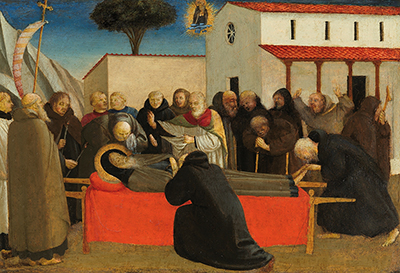
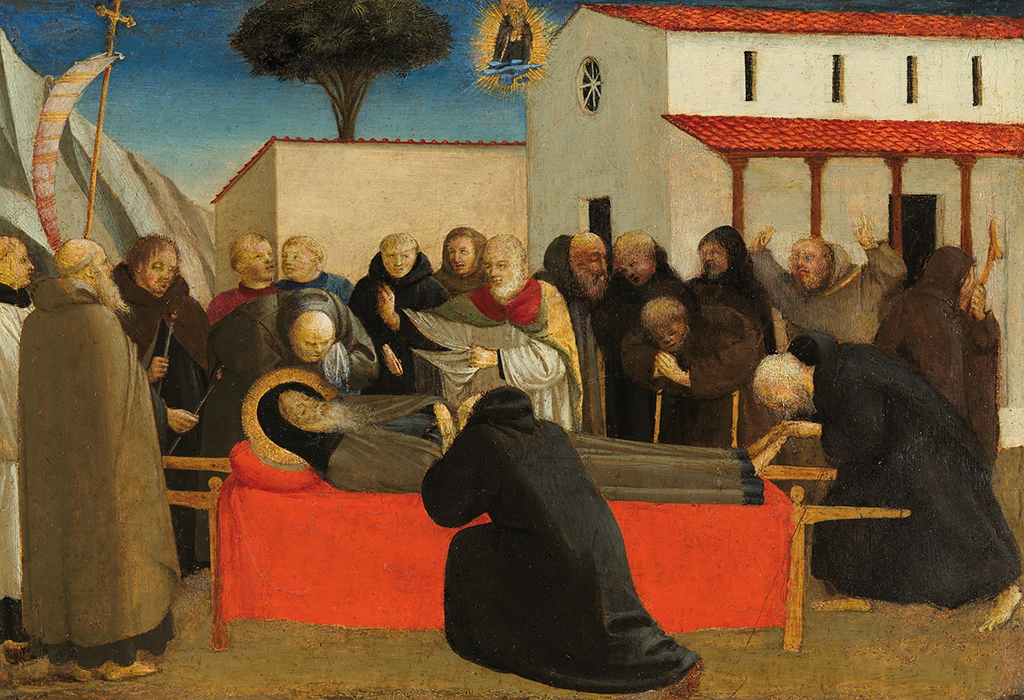
A monk kneels with his back to us so close to Saint Anthony’s bier that his dark habit cuts across the red funeral cloth. Above the mourners, a tiny figure rises on a cloud between a tree and a church roof. Fra Angelico gives the body and the ascending soul very different places in the same scene. The panel, painted around 1426–30 and now in the Museo del Prado, is less than 30 centimetres wide. Its small scale makes the contrast between the crowd below and the space above all the more striking. [1]
At a Glance
- ArtistFra Angelico, as attributed by the Museo del Prado. [1]
- DateAbout 1426–30. [1]
- MediumTempera on poplar panel. [1]
- Dimensions19.7 cm high × 29.3 cm wide. [1]
- CollectionMuseo Nacional del Prado, Madrid, P8234. [1]
- Original functionPredella scene from an unidentified altarpiece. [1]
The mourners around the bier
Anthony’s white beard lies against the dark hood, which the gold halo rims at the left. His grey-brown habit runs the length of the bier in shallow folds. The cloth underneath takes a sharper turn where it hangs over the front, making the place where the dead man lies easy to pick out among so many upright figures. Then the wooden rails project at either end, and the nearest monk’s trailing black habit comes forward onto the ground. In a very shallow foreground Angelico makes it possible to tell who is beside the body, who is behind it and where a mourner might kneel. [1]
Follow the figures from Anthony’s head to his feet. A hooded mourner bends low over his face. Behind the bier an officiant in pale vestments and a red collar raises a hand over the body. Farther right a monk bows his head over joined hands, while another brings his face close to the saint’s feet. Still farther back, a man raises both palms. These gestures give the company different kinds of attention. The officiant has a rite to perform. The bent figures seek closeness, and the monk with his back to us brings the foreground into the circle of mourners without giving us a face to read. [1]
The cross on a tall staff at the left and the figure in the sky pull the eye up out of that group. Between them is a steep flank of rock, a pale wall and a tree whose canopy spreads out against the blue. On the right, the church’s narrow windows, round opening and tiled porch set out a more measured pattern above the heads. The rock and the building bring two kinds of place into view at once, austere terrain and a place of communal worship. The small figure, read as Anthony’s soul, has a patch of sky to itself beside the church. Its radiance is a different scale of gold from the broad circle behind the saint’s head, which remains among the mourners. [1]
A hermit given a communal funeral
Anthony was an early Christian ascetic in Egypt whose withdrawal into the wilderness became a model for hermits and monks. In the fourth-century Life of Antony, Athanasius describes a man who sought solitude and still found himself responsible for teaching others. At the end, Anthony withdraws to his inner mountain retreat. He asks his two attendants to bury him secretly and keep the location to themselves, since he fears that his body will be kept above ground and displayed. After his death they wrap and bury him as asked. [2]
The painted funeral gives Anthony the gathering that his biographer’s burial account leaves out. There is no open grave in view. The companions can come near his body, and a church stands beside them. The difference gives the scene a particular tenderness. A man identified with withdrawal is shown through the sustained attention of a community. Athanasius himself dwells on the paradox of a man who sought obscurity and became known far beyond Egypt. His account offers a way to understand the tension in Angelico’s picture, although it does not establish which account of the saint’s death the painter or his patron knew. [1] [2]
A near-contemporary Sienese painting of the same subject, the Master of the Osservanza’s Death of Saint Anthony in Washington, also places a kneeling mourner in front of a bier draped in red. Its mourners gather inside a room, where a reader at the foot of the bed holds an open book and windows give glimpses of the world beyond. Angelico’s outdoor setting puts the landscape, church and ascending figure in the same view as the funeral. Comparing the panels brings out how differently two painters could picture a farewell to the desert saint. [1] [3]
The attribution and the comparison with Saint Francis
The Madrid panel was long treated as the work of Angelico’s school or circle. After the Prado studied and restored it, Miguel Falomir made the case for Angelico himself, citing similarities in technique, form and composition to comparable works. His closest example was the Funeral Mass for Saint Francis in Berlin, a much wider poplar panel that the Gemäldegalerie dates to 1429. Both pictures lay a dead saint horizontally among his brethren and show his soul above the mourners. In Berlin two angels carry Francis’s soul, while a man in red examines the body for the stigmata. In Madrid the officiant’s raised hand and the mourners stooping towards Anthony make the funeral rite and the farewell the centre of attention. [1] [4]
The Prado’s annual report records that Rafael Alonso completed the restoration in 2016. Falomir describes the panel as altered from its original format and the right side as better preserved than the left. He suggests that a blow damaged some of the monks’ faces and might date from the Spanish Civil War. The proposed occasion is conjectural. The report gives the grounds for the attribution in outline, so the visual parallels with Berlin are easier to follow than the individual technical findings behind the Prado’s judgement. [1]
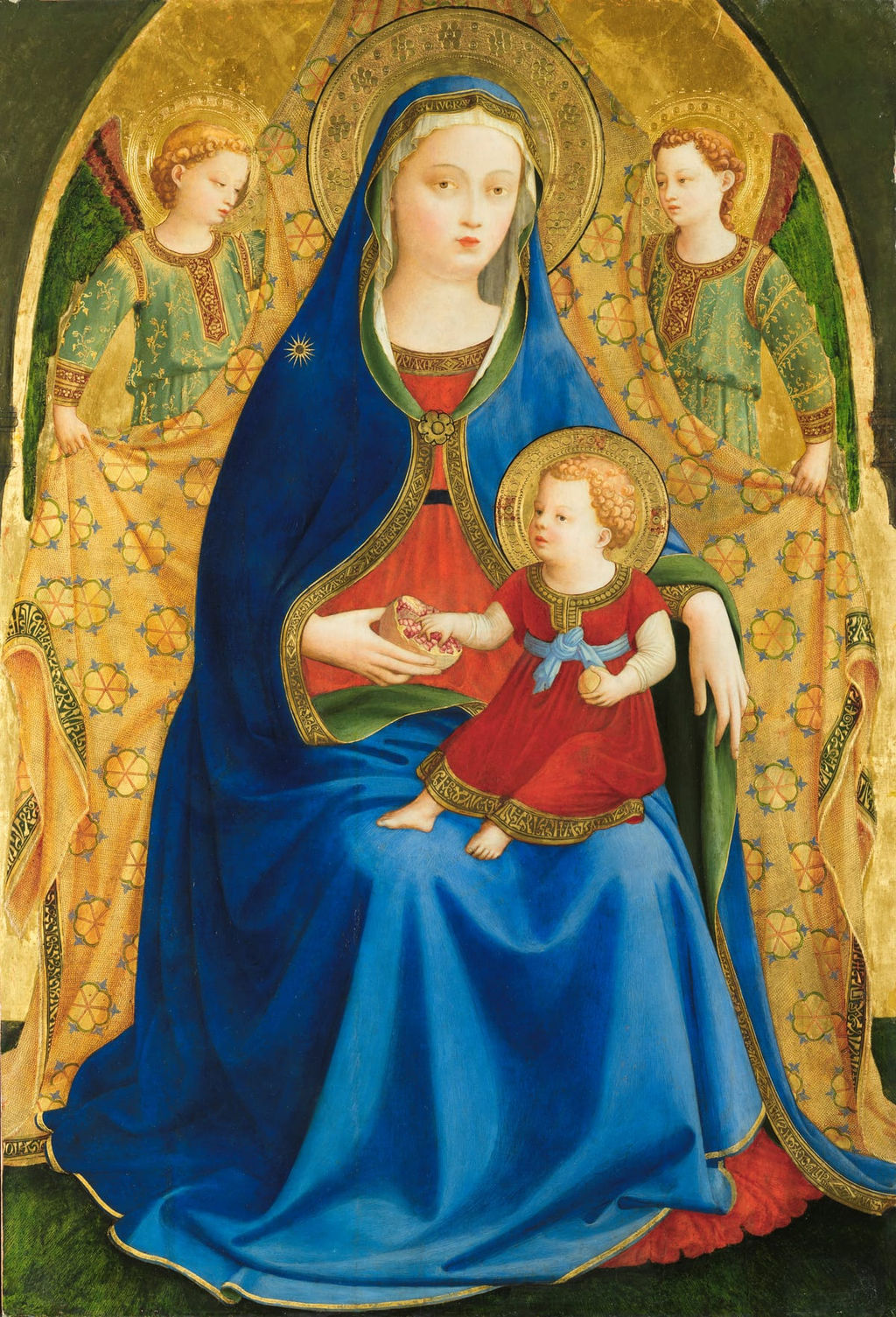
The Prado’s Virgin of the Pomegranate. The fruit, brought forward by two small gestures, sits against the red of the Virgin’s dress. Image source. Public domain. Proportional web resize.
A possible companion in Houston
A predella is the low painted section beneath the main image of an altarpiece. Falomir reads the Funeral as a surviving scene from such a strip and proposes that it originally formed part of one board with other episodes. Berlin’s Francis panels show how this could work. Examination by the Gemäldegalerie established that its scenes came from a single narrow board, subsequently sawn apart. In Anthony’s case the main altarpiece, its destination and the arrangement of its smaller scenes remain undocumented. [1] [5]
Falomir proposed Saint Anthony Abbot Shunning the Mass of Gold in Houston as a possible companion. Houston’s panel is 28.1 centimetres wide and the Prado’s 29.3, and both are 19.7 centimetres high. In the Houston scene Anthony recoils from a mass of gold, a temptation set in his path by the devil in Athanasius’s account. His cloak catches the movement as he turns away. A rocky path carries him towards buildings in the distance. The setting gives the lone figure room to flee, where the Prado’s nearer architecture gathers people around his body. Side by side, the panels set a moment of solitary resolve against a communal farewell. The Prado showed both works in Carl Brandon Strehlke’s 2019 exhibition on Angelico and the Florentine Renaissance. [1] [6] [7]
The shared subject and measurements make the proposal plausible. The dating is harder to reconcile, since Houston catalogues its panel around 1435 into the 1440s, later than the Prado’s date for the Funeral. Houston gives the Mass of Gold to Angelico, although Laurence Kanter proposed Zanobi Strozzi and the museum’s scholarly catalogue reviews the differing opinions. That catalogue also discusses a Florentine engraving of about 1460 in Pavia, where a reversed version of the gold episode appears among eleven scenes around a standing Anthony. The engraving shows how the episode could circulate in a cycle of the saint’s life. As evidence for the arrangement of painted panels, it is less secure. Houston’s catalogue points out that the dimensions of the gold panel and a proposed standing Anthony would prevent them from fitting together as the engraving shows them. [1] [6] [7] [8]
From the House of Alba to the Prado
Carlos Miguel Fitz-James Stuart y Silva, the 14th Duke of Alba, acquired the panel in Florence in 1817. Gonzalo Redín Michaus’s study of the duke’s collecting records that it was acquired as a Masaccio, a striking instance of how differently the panel was understood in the nineteenth century. It stayed with the Alba family until Carlos Fitz-James Stuart y Martínez de Irujo, the 19th Duke, donated it to the Museo del Prado in 2016. [1] [9] [10]
On 26 January 2016 the Prado presented the gift alongside the Virgin of the Pomegranate, which it had purchased from the same collection. The two panels share a journey from Florence through the House of Alba to Madrid. They serve different purposes. The Madonna holds the viewer’s attention on the exchange between mother and child, while the small predella scene leads the eye from a body surrounded by mourners to a soul with the sky to itself. [1] [10]
Fra Angelico artworks directory
Explore documented works and surviving parts of larger ensembles. Catalogue links identify individual records. Attribution and dating can vary across collections and publications. Search the Federico Zeri Photo Archive by artist.
| Name | Date | Medium and sources |
|---|---|---|
| Adoration of the Magi | About 1440–60, NGA catalogue | Painting Catalogue. |
| Adoration of the Magi (Armadio degli Argenti) | About 1450–53 | Tempera and gold on wood. Catalogue. |
| Agony in the Garden (Armadio degli Argenti) | About 1450–53 | Tempera and gilding on wood Catalogue. |
| Annalena Altarpiece / Pala di Annalena | commonly c. 1435 | Tempera on panel Catalogue. |
| Annunciation (Armadio degli Argenti) | About 1450–53 | Tempera and gilding on wood. Catalogue. |
| Annunciation (Cortona) | generally placed in the 1430s; exact dating remains debated | Tempera on panel Catalogue. |
| Annunciation (Prado) | 1425–26 | Tempera on poplar panel Catalogue. |
| Annunciation (San Marco upper corridor) | commonly c. 1442 | Fresco Catalogue. |
| Annunciation with Saint Peter Martyr | About 1439–43 | Fresco on plaster. Catalogue. |
| Annunciatory Angel | 1450–55, Detroit catalogue | Gold leaf and tempera on wood panel. Catalogue. |
| Armadio degli Argenti (Silver Treasury) | principally c. 1450–52 | Tempera on panel Catalogue. |
| Arrest of Christ (Armadio degli Argenti) | About 1450–53 | Tempera and gilding on wood Catalogue. |
| Ascension (Armadio degli Argenti) | About 1450–53 | Tempera and gilding on wood Catalogue. |
| Baptism of Christ (Armadio, Alesso Baldovinetti) | About 1452–53 | Tempera and gilding on wood Catalogue. |
| Beheading of Saints Cosmas and Damian (San Marco Altarpiece) | About 1438–42 | Painted panel Catalogue. |
| Betrayal of Christ (Armadio degli Argenti) | About 1450–53 | Tempera and gilding on wood Catalogue. |
| Blessed Dominican, Possibly Jordan of Saxony (San Marco Altarpiece) | About 1438–42 | Painted panel Catalogue. |
| Blessed Vincent Ferrer (San Marco Altarpiece) | About 1438–42 | Painted panel Catalogue. |
| Burial of Saints Cosmas and Damian (San Marco Altarpiece) | About 1438–42 | Painted panel Catalogue. |
| Bust of a Cleric and a Group of Figures (recto and verso) | 15th century | Pen and ink on paper Catalogue. |
| Christ among the Doctors (Armadio degli Argenti) | About 1450–53 | Tempera and gilding on wood Catalogue. |
| Christ before Caiaphas (Armadio degli Argenti) | About 1450–53 | Tempera and gilding on wood Catalogue. |
| Christ Glorified in the Court of Heaven | About 1423–24 | Egg tempera on wood, probably poplar, with gold and silver leaf Catalogue. |
| Christ Seated in Judgment | 1447 | Fresco and gilding on plaster. Catalogue. |
| Christ Stripped of His Garments (Armadio degli Argenti) | About 1450–53 | Tempera and gilding on wood Catalogue. |
| Christ Washes the Apostles’ Feet (Armadio degli Argenti) | About 1450–53 | Tempera and gilding on wood Catalogue. |
| Circumcision of Christ (Armadio degli Argenti) | About 1450–53 | Tempera and gilding on wood. Catalogue. |
| Communion of the Apostles (Armadio degli Argenti) | About 1450–53 | Tempera and gilding on wood Catalogue. |
| Coronation of the Virgin (Armadio degli Argenti) | About 1450–53 | Tempera and gilding on wood Catalogue. |
| Coronation of the Virgin (Louvre) | Louvre: second quarter of the fifteenth century, 1425–50; often dated more narrowly c. 1434–35 | Tempera and gold on panel Catalogue. |
| Coronation of the Virgin (Uffizi) | 1431–35 | Tempera on wood, gold ground Catalogue. |
| Cortona Triptych | About 1437 | Tempera and gold on panel. Catalogue. |
| Crucifixion (Armadio degli Argenti) | About 1450–53 | Tempera and gilding on wood Catalogue. |
| Crucifixion and Saints | 1441–42 | Fresco Catalogue. |
| Deposition from the Cross / Santa Trinita Deposition | commissioned 1429–32; completed by Angelico within this period | Tempera on panel Catalogue. |
| Descent into Limbo (Armadio degli Argenti) | About 1450–53 | Tempera and gilding on wood Catalogue. |
| Entombment of Christ (San Marco Altarpiece) | About 1438–42 | Painted panel Catalogue. |
| Entry into Jerusalem (Armadio degli Argenti) | About 1450–53 | Tempera and gilding on wood Catalogue. |
| Expulsion and the Stoning of Saint Stephen | 1448–49, Vatican Museums | Fresco. Catalogue. |
| Fiesole San Domenico Altarpiece | early 1420s; predella about 1423–24 | Tempera on panel Catalogue. |
| Flagellation (Armadio degli Argenti) | About 1450–53 | Tempera and gilding on wood Catalogue. |
| Flight into Egypt | About 1450–53 | Tempera and gilding on wood. Catalogue. |
| Guidalotti Polyptych | c. 1447–49 | Tempera and oil on panel Catalogue. |
| Healing of Palladia and Saint Damian Accepting Her Gift (San Marco Altarpiece) | About 1438–42 | Painted panel Catalogue. |
| Holy Pilgrim, Possibly Saint Roch (San Marco Altarpiece) | About 1438–42 | Painted panel Catalogue. |
| Holy Women at the Tomb (Armadio degli Argenti) | About 1450–53 | Tempera and gilding on wood Catalogue. |
| Judas Receives Payment (Armadio degli Argenti) | About 1450–53 | Tempera and gilding on wood Catalogue. |
| Lamentation over Christ (Armadio degli Argenti) | About 1450–53 | Tempera and gilding on wood Catalogue. |
| Lamentation over the Dead Christ (Croce al Tempio Lamentation) | 1436–41, Zeri catalogue | Tempera and gilding on wood panel. Catalogue. |
| Last Judgement (Armadio degli Argenti) | About 1450–53 | Tempera and gilding on wood Catalogue. |
| Last Judgement (San Marco) | c. 1425–28 | Tempera and gold on panel Catalogue. |
| Last Supper (Armadio degli Argenti) | About 1450–53 | Tempera and gilding on wood Catalogue. |
| Lex Amoris (Armadio degli Argenti) | About 1450–53 | Tempera and gilding on wood Catalogue. |
| Madonna and Child with Saint Dominic and Saint Thomas Aquinas | About 1430, Hermitage catalogue | Detached fresco. Catalogue. |
| Madonna and Child with Saints | About 1411–13 | Tempera on wood panel, with a gold ground. Catalogue. |
| Madonna of Humility | About 1425, Thyssen catalogue | Tempera and gold on wood. Catalogue. |
| Madonna of the Star | 1431–34, Zeri catalogue | Tempera with oil glazes and gold on wood panel, as catalogued by the Gardner for the 2018 exhibition. Catalogue. |
| Marriage at Cana (Armadio, Alesso Baldovinetti) | About 1452–53 | Tempera and gilding on wood Catalogue. |
| Massacre of the Innocents (Armadio degli Argenti) | About 1450–53 | Tempera and gilding on wood Catalogue. |
| Miracle of the Black Leg (San Marco Altarpiece) | About 1438–42 | Painted panel Catalogue. |
| Mocking of Christ (Armadio degli Argenti) | About 1450–53 | Tempera and gilding on wood Catalogue. |
| Mystic Wheel (The Vision of Ezekiel) | About 1450–52 | Tempera and gilding on wood. Catalogue. |
| Nativity (Armadio degli Argenti) | About 1450–53 | Tempera and gilding on wood. Catalogue. |
| Niccoline Chapel frescoes | principally 1448–50 | Fresco Catalogue. |
| Noli me Tangere | broadly within Angelico’s San Marco campaign, late 1430s–1440s | Fresco Catalogue. |
| Ordination of Saint Lawrence | 1448 | Fresco. Catalogue. |
| Pentecost (Armadio degli Argenti) | About 1450–53 | Tempera and gilding on wood Catalogue. |
| Presentation of Christ at the Temple (Armadio degli Argenti) | About 1450–53 | Tempera and gilding on wood. Catalogue. |
| Presentation of Jesus at the Temple | Early 1440s | Fresco on plaster. Catalogue. |
| Raising of Lazarus (Armadio degli Argenti) | About 1450–53 | Tempera and gilding on wood Catalogue. |
| Rescue of Saints Cosmas and Damian and Exorcism of Lysias (San Marco Altarpiece) | About 1438–42 | Painted panel Catalogue. |
| Road to Calvary (Armadio degli Argenti) | About 1450–53 | Tempera and gilding on wood Catalogue. |
| Saint Anthony Abbot (San Marco Altarpiece) | About 1438–42 | Painted panel Catalogue. |
| Saint Bernard of Clairvaux or Saint Benedict (San Marco Altarpiece) | About 1438–42 | Painted panel Catalogue. |
| Saint Damian Receives Money from Palladia | About 1425–49 | Tempera and gilding on wood. Catalogue. |
| Saint Francis and a Bishop Saint, Saint John the Baptist and Saint Dominic | Late 1420s, Getty catalogue | Tempera and gold leaf on panel. Catalogue. |
| Saint James the Greater Freeing the Magician Hermogenes | About 1426–29 | Tempera and gold on panel Catalogue. |
| Saint Jerome (San Marco Altarpiece) | About 1438–42 | Painted panel Catalogue. |
| Saint Lawrence Giving Alms | About 1448 | Wall fresco. Catalogue. |
| Saint Lawrence Receiving the Treasures of the Church from Pope Sixtus II | About 1448–49 | Fresco on plaster. Catalogue. |
| Saint Romuald (San Marco Altarpiece) | About 1438–42 | Painted panel Catalogue. |
| Saint Stephen Addressing the Council | 1448–49, Vatican Museums | Fresco. Catalogue. |
| Saint Stephen Preaching | 1448–49, Vatican Museums | Wall fresco. Catalogue. |
| Saint Thomas Aquinas (San Marco Altarpiece) | About 1438–42 | Painted panel Catalogue. |
| Saints Cosmas and Damian and Their Brothers Survive the Stake | Second quarter of the 15th century | Tempera and gilding on wood. Catalogue. |
| Saints Cosmas and Damian at the Stake (San Marco Altarpiece) | About 1438–42 | Painted panel Catalogue. |
| Saints Cosmas and Damian before Lysias (San Marco Altarpiece) | About 1438–42 | Painted panel Catalogue. |
| Saints Cosmas and Damian Rescued by an Angel | Second quarter of the 15th century | Tempera and gilding on wood. Catalogue. |
| Saints Cosmas and Damian with Their Brothers before Proconsul Lysias | Second quarter of the 15th century | Tempera and gilding on wood. Catalogue. |
| San Marco Altarpiece / Pala di San Marco | 1438–43 | Tempera on panel Catalogue. |
| San Pietro Martire Triptych | About 1422–23, Strozzi exhibition | Tempera and gold on panel. Catalogue. |
| Scenes from the Lives of the Desert Fathers (Thebaid) | About 1420, Uffizi catalogue | Tempera on wood. Catalogue. |
| Sixteen Prophets | 1447 | Fresco and gilding on plaster Catalogue. |
| Stoning and Shooting of the Brothers (San Marco Altarpiece) | About 1438–42 | Painted panel Catalogue. |
| Tabernacle of the Linaioli | 1433–35 | Tempera on panel Catalogue. |
| The Attempted Crucifixion and Stoning of Saints Cosmas and Damian | Second quarter of the 15th century | Tempera and gilding on wood. Catalogue. |
| The Crucifixion | About 1420–23, Met catalogue | Tempera on wood, gold ground. Catalogue. |
| The Death and the Assumption of the Virgin | 1424–34 | Tempera with oil glazes and gold on panel Catalogue. |
| The Dominican Blessed (left end) (Fiesole predella) | About 1423–24 | Egg tempera and gold on wood Catalogue. |
| The Dominican Blessed (right end) (Fiesole predella) | About 1423–24 | Egg tempera and gold on wood Catalogue. |
| The Entombment of Christ | About 1450 | Tempera on poplar panel. Catalogue. |
| The Forerunners of Christ with Saints and Martyrs | About 1423–24 | Egg tempera on wood (probably poplar), with gold and silver leaf. Catalogue. |
| The Funeral of Saint Anthony Abbot | About 1426–30 | Tempera on poplar panel. Catalogue. |
| The Martyrdom of Saints Cosmas and Damian | About 1425–49 | Tempera and gilding on wood. Catalogue. |
| The Mocking of Christ / Christ Mocked | within the San Marco dormitory campaign, broadly late 1430s–1440s | Fresco Catalogue. |
| The Nativity | About 1425, Minneapolis catalogue | Tempera on poplar panel. Catalogue. |
| The Nativity in Cell 5 at San Marco | About 1439–43 | Fresco on plaster. Catalogue. |
| The Penitent Saint Jerome | 1419–20 | Tempera on wood panel Catalogue. |
| The Virgin and Child by Fra Angelico (Fogg Museum) | About 1430, Harvard catalogue | Tempera originally on panel, subsequently transferred to Masonite. Catalogue. |
| The Virgin Mary with the Apostles and Other Saints (Fiesole predella) | About 1423–24 | Egg tempera and gold on wood Catalogue. |
| Transfiguration (Armadio, Alesso Baldovinetti) | About 1452–53 | Tempera and gilding on wood Catalogue. |
| Transfiguration (San Marco Cell 6) | within the San Marco dormitory campaign, broadly late 1430s–1440s | Fresco Catalogue. |
| Virgin Mary Annunciate | 1450–55, Detroit catalogue | Gold leaf and tempera on wood panel. Catalogue. |
| Virgin of the Pomegranate | About 1426 | Tempera on panel with gilding Catalogue. |
Frequently Asked Questions
The figure on the cloud can be read as Anthony’s soul ascending. It appears between the tree canopy and the church roof, while his body remains visible on the red-draped bier. [1]
Discussion
Use these prompts to look again or share an observation.
Reader Insights
Compare the positions of the monks’ heads around Anthony’s body. How does the rough landscape frame their gathering?
Find the figures occupied with different parts of the burial. Which activity catches your eye first, and what makes it legible?
Join the Conversation
Share a detail or question about The Funeral of Saint Anthony Abbot.
References
- Miguel Falomir, Funeral de san Antonio abad, Museo Nacional del Prado, Memoria de Actividades 2016, pp. 82–83, with the restoration register in Appendix III (in Spanish). View source.
- Athanasius of Alexandria, Life of Antony, translated by H. Ellershaw, especially §§ 89–94. View source.
- National Gallery of Art, Washington, The Death of Saint Anthony, Master of the Osservanza, 1952.5.73. View source.
- Gemäldegalerie, Staatliche Museen zu Berlin, Die Totenmesse für den heiligen Franziskus, 61A. View source.
- Gemäldegalerie, Staatliche Museen zu Berlin, Three Scenes from a Predella by Fra Angelico: Research into the Artwork’s Original Context. View source.
- Museum of Fine Arts, Houston, Saint Anthony Abbot Shunning the Mass of Gold, 44.550. View source.
- Helga Kessler Aurisch, Saint Anthony Abbot Shunning the Mass of Gold, no. 10 in the Straus Collection online scholarly catalogue, Museum of Fine Arts, Houston. View source.
- Musei Civici di Pavia and Regione Lombardia, Sant’Antonio Abate con undici scene della sua vita, St. Mal. 1596, SIRBeC F0130-00302 (in Italian). View source.
- Gonzalo Redín Michaus, Una galería de pintura italiana antigua para el VII duque de Berwick y XIV duque de Alba, Archivo Español de Arte 97, no. 388, 2024 (in Spanish). View source.
- Miguel Falomir, Obra comentada: La “Virgen de la granada” y el “Funeral de san Antonio Abad”, Museo Nacional del Prado, 2016 (in Spanish). View source.
.jpg)



 Fra Angelico.jpg)


