 by Tom Gurney
Tom Gurney BSc (Hons) is an art history expert with over 20 years experience
Published on June 19, 2020 / Updated on November 29, 2026
Email: tomgurney1@gmail.com / Phone: +44 7429 011000
Introduction
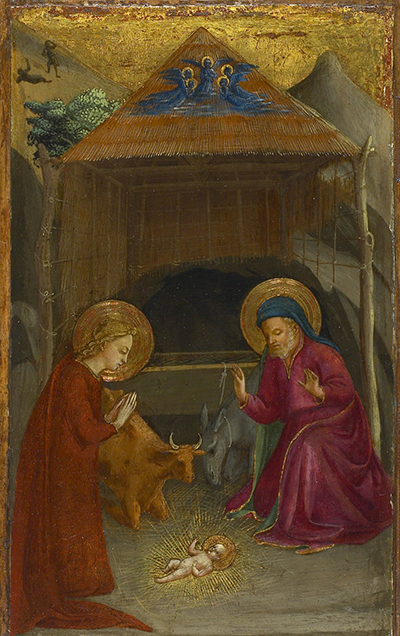
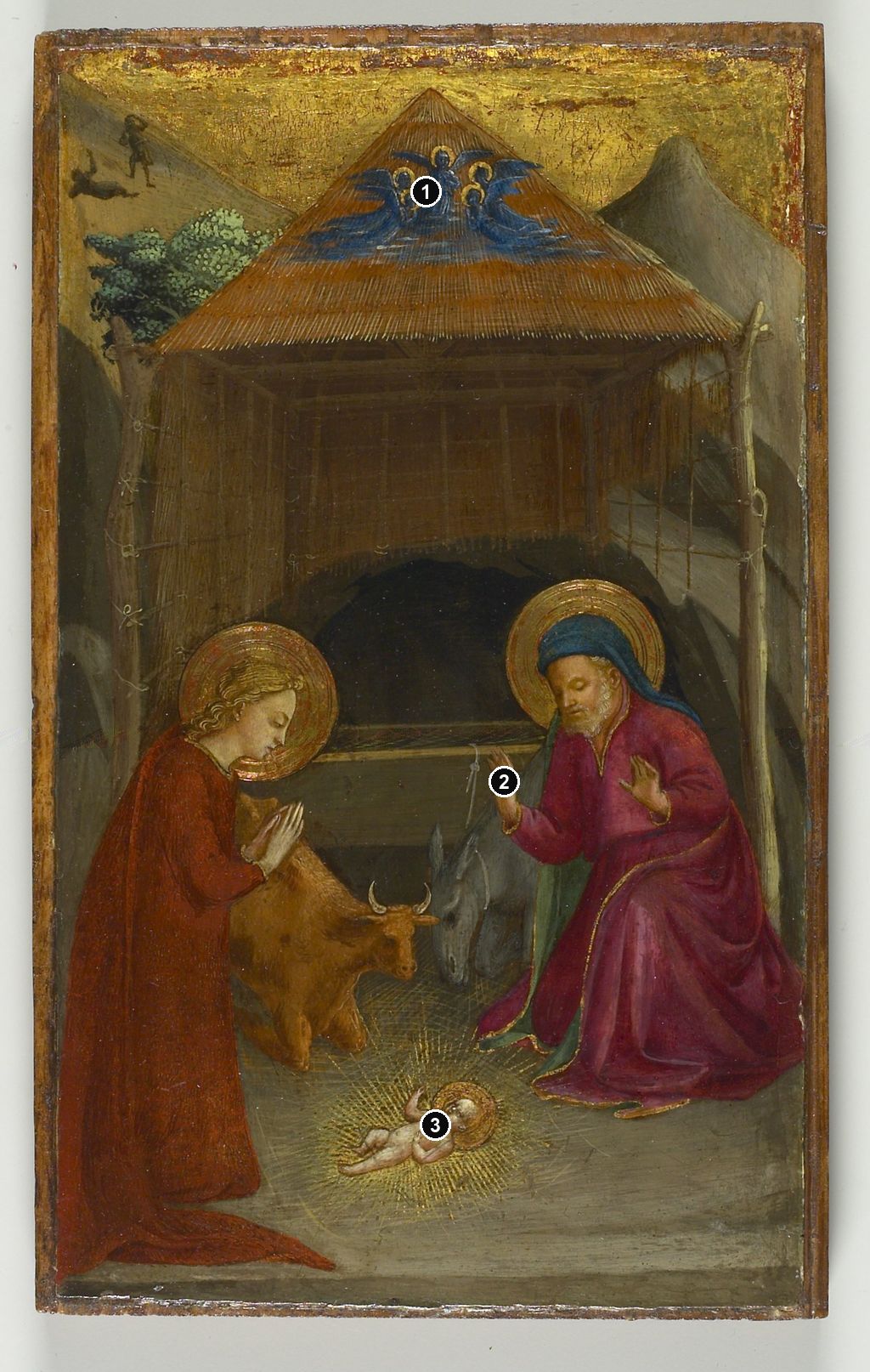
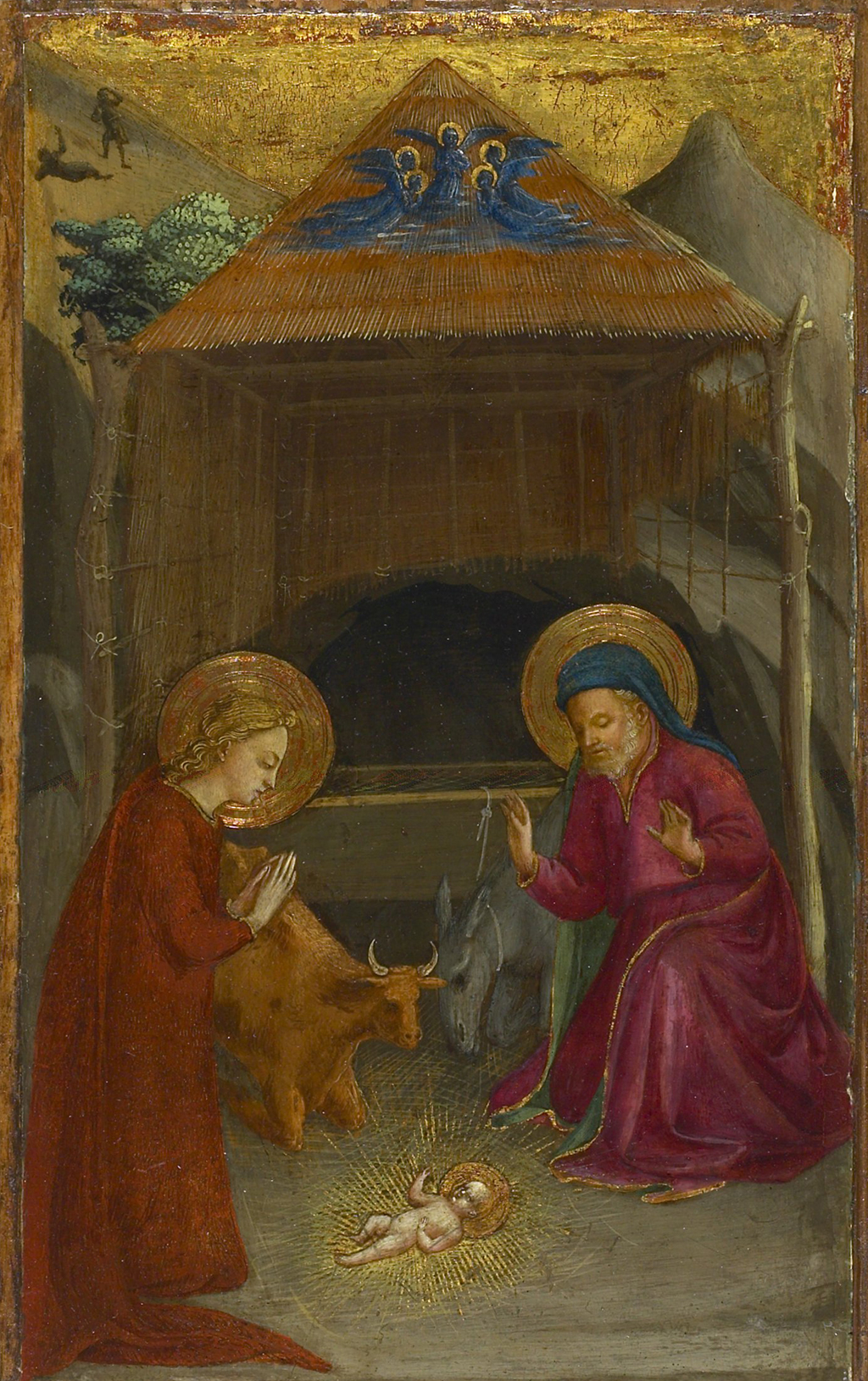
Five blue angels gather on the face of a thatched roof. Directly beneath them, at the foot of the painting, the newborn Christ lies in a burst of fine gold lines. Mary clasps her hands and Joseph raises his open palms. The Minneapolis Institute of Art catalogues this small tempera painting on poplar as the work of Fra Angelico, made about 1425. An earlier attribution to his workshop survives in the catalogue literature. [1] [2] [3]
At a Glance
- ArtistFra Angelico, according to the Minneapolis Institute of Art. An earlier workshop attribution is recorded. [1] [2]
- TitleThe Nativity. [1]
- DateAbout 1425. [1]
- MediumTempera on poplar panel. [1]
- Dimensions28.26 × 16.51 cm (panel). [1]
- CollectionMinneapolis Institute of Art, accession 68.41.8. Bequest of Miss Tessie Jones in memory of Herschel V. Jones. [1]
From the roof to the ground
The shelter fills much of the narrow panel. The eaves project beyond the uprights and the tight rows of fine strokes at their edge give the thatch a ragged fringe. Beneath it, the darker beams lead back towards a woven screen. The poles and their pale ties are particularly clear on the left, where the shelter meets a patch of green foliage. Hills rise on both sides against the gold sky. Their slopes frame the roof, with glimpses of the landscape on either side. [3]
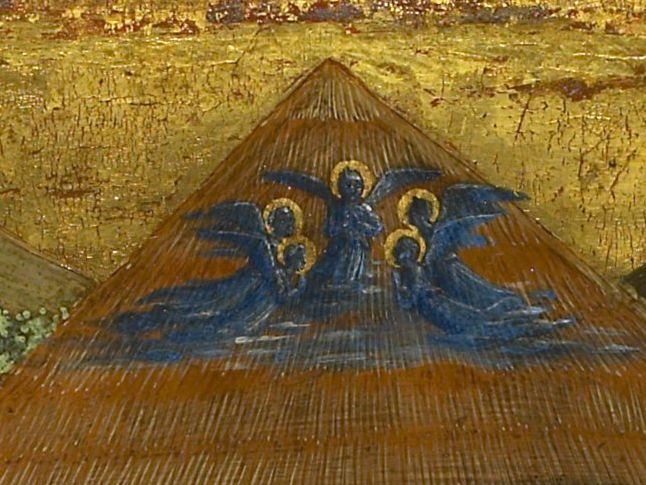
The blue angels belong to the steep triangle of the roof. One rises near its centre, with the others arranged in pairs on either side. Their outstretched wings spread across the thatch, where the bright rings around their heads make each figure distinct. Lower down, the shelter opens into shadow. The gap is broadest just above the figures of Mary and Joseph, and their gold haloes are especially legible there. The largest area of darkness separates the two groups, giving the roof its own gathering and the family room around the child. [3]
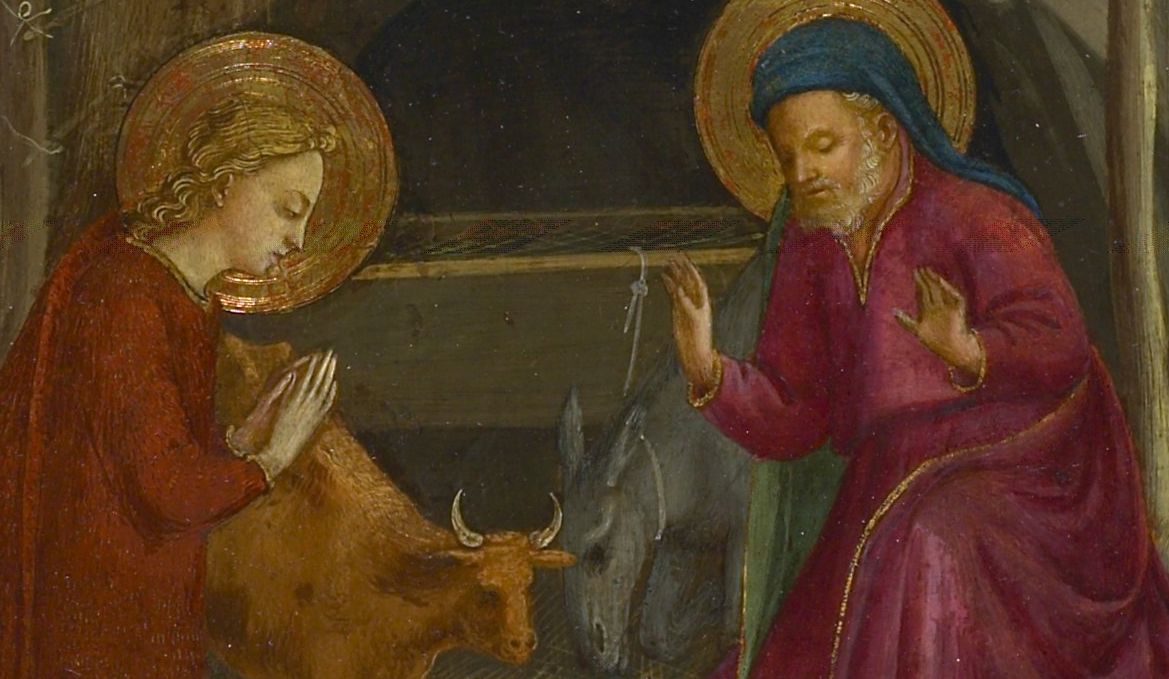
Mary’s russet mantle falls to the bottom edge, where a fold runs towards the middle. Joseph’s rose-coloured robe, with its narrow gold edging and glimpses of green lining, bunches around the bent knee. His blue head covering picks up the colour of the angels. Their gestures give the two sides different rhythms. Mary’s hands come together in a single slant beneath her face. Joseph holds his hands apart and lowers his gaze between them. A horned ox and a grey ass occupy the gap between the adults, giving way in the foreground to the infant’s small, exposed body. [3]
A birth told through gestures
Luke describes Mary wrapping her firstborn and laying him in a manger. He also tells how an angel brought news of the birth to shepherds keeping watch at night, before a host of angels joined in praise. In the Minneapolis panel, two small figures on the upper left hillside can be read as shepherds. One is upright and the other is low to the ground. Their distance from the family gives the announcement a place of its own, while the angels and the infant share the central line of the composition. [3] [4]
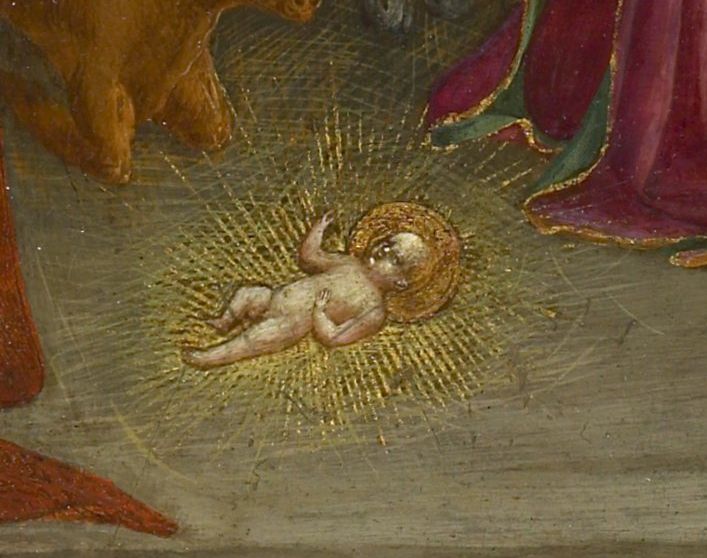
The painter has put the naked child on the ground in front of the feeding trough and made the adults kneel. The gold strokes nearest him spread out in several directions and thin at the edges, giving the impression of light where it meets the duller earth. The strokes are finer than the lines of the thatch, but both sets of marks gather around figures with gold haloes. Luke supplies the manger and the shepherds. The ox and ass belong to a familiar pictorial tradition associated with Isaiah’s image of animals that know where they are fed. Here the ass has a visible tether, a small stable detail beside the radiant child. [3] [4] [5]
The radiant child on the ground and Mary’s clasped hands also recall the vision of the Nativity recorded by Saint Bridget of Sweden. The art historian Keith Christiansen identifies both details in Lorenzo Monaco’s earlier painting of the birth. Their appearance in Minneapolis places the panel within a way of picturing the Nativity that was already familiar in Florence. [3] [6]
At just over 28 centimetres tall, the panel rewards the distance at which a viewer can follow a tether or distinguish one hand from another. The two hillside figures almost disappear when the picture is seen from further away. The roof, the kneeling adults and the bright patch at their feet remain easy to pick out. That balance between a readily grasped design and details that emerge slowly suits a picture for close attention. Andrea Kibler Maxwell, writing in the Clowes collection catalogue, suggests that the panel was a hinged part of a triptych. Its original setting and any companion panels remain uncertain. [1] [3]
Annotated Details from The roof, the witnesses and the child
The numbered points identify visible features discussed in this article. Return from each detail to the numbered overview. Minneapolis Institute of Art, accession 68.41.8. The sparse stable separates the angelic choir from the kneeling adults. Image source. Public domain. Proportional web resize.
Details from THE ROOF, THE WITNESSES AND THE CHILD
Compare the cropped details with the source images above. Notice how their colours, shapes and positions contribute to the larger compositions.
Five blue angels
The angels form a close group over the thatch, setting their blue wings against the warm roof and gold sky.
Mary and Joseph respond
Mary presses her hands together. Joseph holds his hands apart. Their gestures direct attention towards the child between them.
Light on the ground
Fine golden lines spread around the newborn lying on the stable floor. The darker ground makes the edges of the light easy to follow.
Whose hand painted it?
The Fondazione Federico Zeri records a note in Everett Fahy’s own hand on the back of a photograph, attributing the work to Angelico. The same archive entry records a workshop attribution from the bibliography and links to a photograph titled as a workshop picture. The current museum record names Angelico and gives an approximate date. Its dimensions also help explain a discrepancy between catalogues. The archive’s 37.2 × 22.9 cm corresponds closely to the museum’s outer frame measurement, while the painted panel is 28.26 × 16.51 cm. [1] [2]
Minneapolis records the bequest of Tessie Jones in memory of Herschel V. Jones. An inscription on the reverse names the Galerie Borghèse, and the museum also records stamps and a removals sticker. The Borghèse name is a clue to the painting’s earlier history. The museum’s published record leaves the ownership history before the bequest open. The museum’s educators have paired the panel with Leonora Carrington’s Dear Diary—Never Since We Left Prague. The comparison turns on perspective, a way to approach the angled beams and the space behind the figures without following the story of the birth. [1] [7]
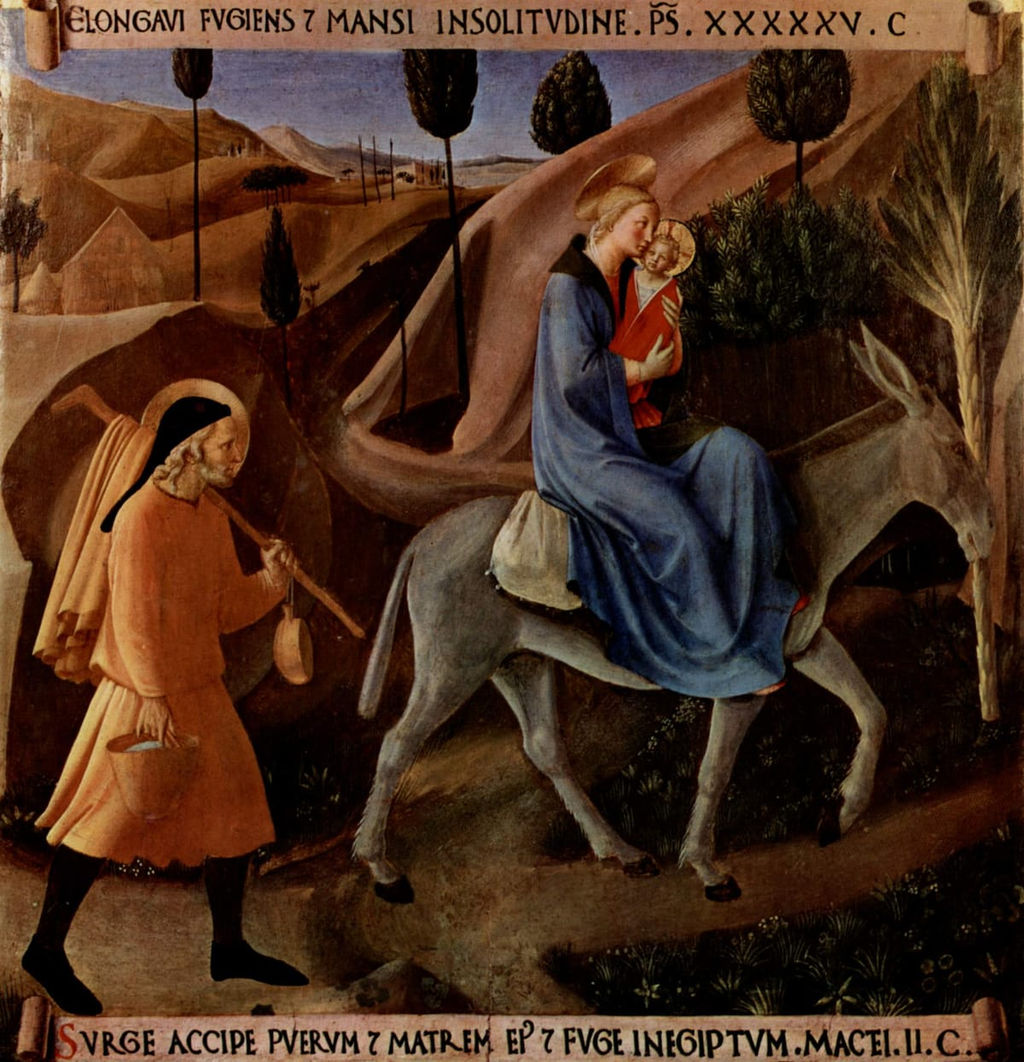
The Flight into Egypt in the Armadio, 0900191187A-7. The inscriptions sit directly above and below the road and its travellers. Image source. Public domain. Proportional web resize.
The same subject on panel and plaster
Lorenzo Monaco’s Nativity of about 1406–10, at the Metropolitan Museum of Art, shows how differently a Florentine painter could arrange similar elements. There, the shelter fits a broad field with a four-lobed outline. Joseph turns towards the angel and shepherds on the right, directing the eye out of the family group. In Minneapolis his gaze returns to the child, and the angelic gathering occupies the steep roof above him. The difference is visible even before one looks closely at the figures. [3] [8]
Maxwell also compares the blue angels with the heavenly company over the stable in Fra Angelico’s Nativity at Forlì. Forlì’s panel is almost the same height and slightly wider, at 28 × 18.9 cm, and the city dates it to about 1428–29. It survives with an Agony in the Garden. The pair gives a sense of how a picture of this size might relate to another scene when seen at close quarters. The Minneapolis panel’s setting is less clear. Maxwell also considers the two works in the context of Roberto Longhi’s account of Angelico’s response to Masaccio, singling out the solid bodies in the Forlì pictures. The recurrence of angels above the stable is easier to establish than the hand that painted the Minneapolis group. [3] [9]
In the Nativity in Cell 5 at San Marco, dated about 1439–43 by the Italian state catalogue, the scene occupies a wall in a Dominican friar’s cell. Saint Catherine of Alexandria and Saint Peter Martyr join the adoration. Their presence brings the life of the saints into the scene of Christ’s birth. The catalogue credits Angelico and assistants, and reports that scholars have especially discerned another hand in the angels above. That judgement concerns the fresco’s own division of labour. [10]
The Nativity from the Armadio degli Argenti, painted about 1450–53, gives the stable and its angels a place in a sequence from Christ’s life. The scene is the third compartment from the left in the upper row of its board. The painted bands link a prophecy from Isaiah above to Luke’s account of the birth below. On the Minneapolis panel, the eye travels from the distant witnesses and the gathering on the roof to the child at the viewer’s feet. On the cabinet, there is also a painted text to read and another scene alongside it. [3] [11] [12]
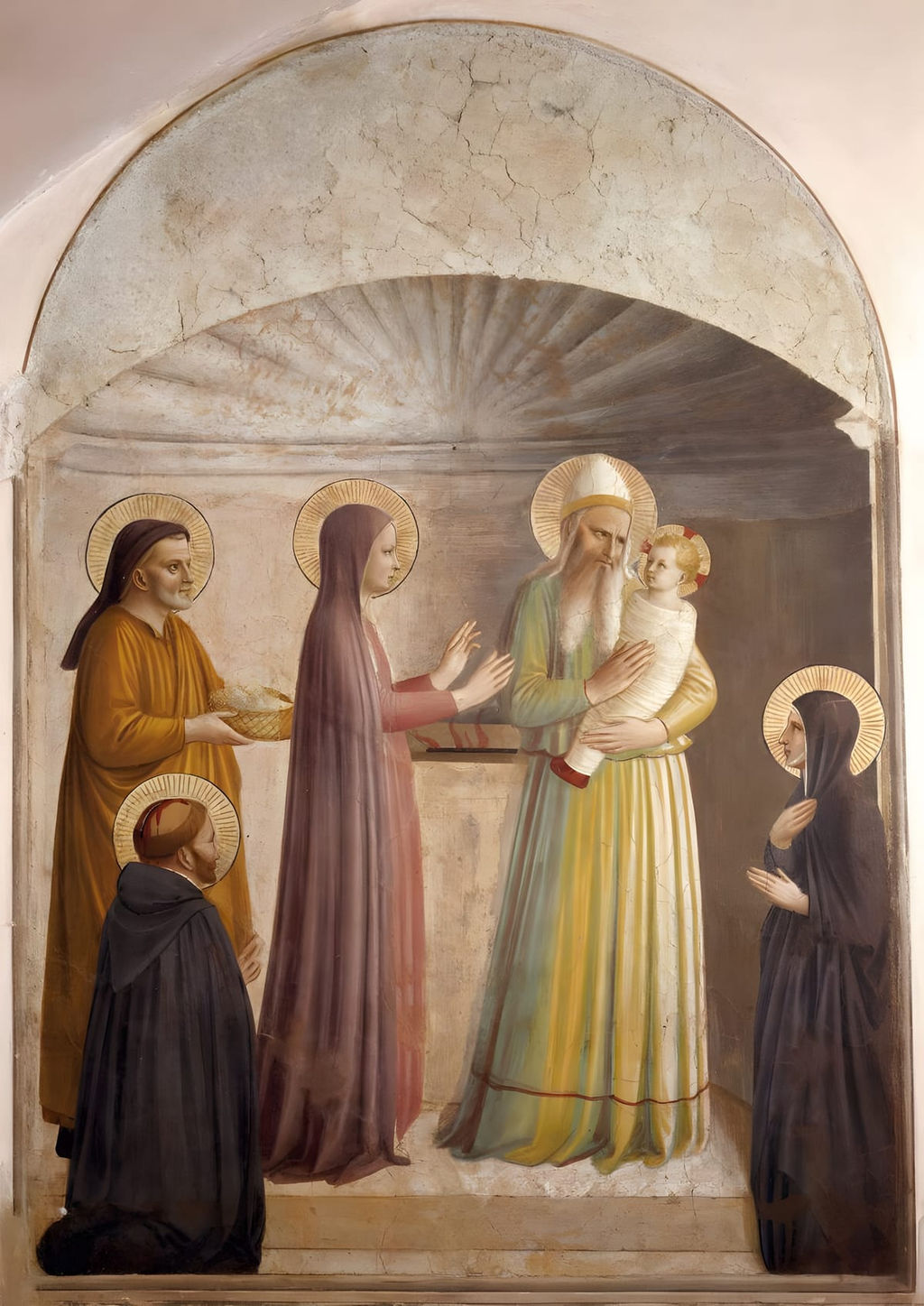
Presentation in the Temple in Cell 10, San Marco. Observe how the witnesses occupy the edges of the arched scene. Image source. Public domain. Proportional web resize.
Fra Angelico artworks directory
Explore documented works and surviving parts of larger ensembles. Catalogue links identify individual records. Attribution and dating can vary across collections and publications. Search the Federico Zeri Photo Archive by artist.
| Name | Date | Medium and sources |
|---|---|---|
| Adoration of the Magi | About 1440–60, NGA catalogue | Painting Catalogue. |
| Adoration of the Magi (Armadio degli Argenti) | About 1450–53 | Tempera and gold on wood. Catalogue. |
| Agony in the Garden (Armadio degli Argenti) | About 1450–53 | Tempera and gilding on wood Catalogue. |
| Annalena Altarpiece / Pala di Annalena | commonly c. 1435 | Tempera on panel Catalogue. |
| Annunciation (Armadio degli Argenti) | About 1450–53 | Tempera and gilding on wood. Catalogue. |
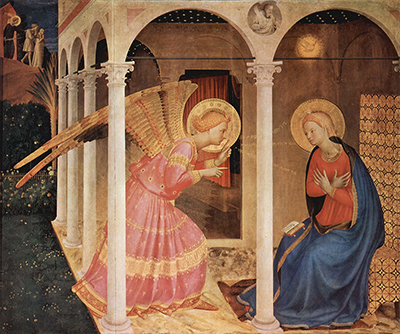
| Annunciation (Cortona) | generally placed in the 1430s; exact dating remains debated | Tempera on panel Catalogue. |
| Annunciation (Prado) | 1425–26 | Tempera on poplar panel Catalogue. |
| Annunciation (San Marco upper corridor) | commonly c. 1442 | Fresco Catalogue. |
| Annunciation with Saint Peter Martyr | About 1439–43 | Fresco on plaster. Catalogue. |
| Annunciatory Angel | 1450–55, Detroit catalogue | Gold leaf and tempera on wood panel. Catalogue. |
| Armadio degli Argenti (Silver Treasury) | principally c. 1450–52 | Tempera on panel Catalogue. |
| Arrest of Christ (Armadio degli Argenti) | About 1450–53 | Tempera and gilding on wood Catalogue. |
| Ascension (Armadio degli Argenti) | About 1450–53 | Tempera and gilding on wood Catalogue. |
| Baptism of Christ (Armadio, Alesso Baldovinetti) | About 1452–53 | Tempera and gilding on wood Catalogue. |
| Beheading of Saints Cosmas and Damian (San Marco Altarpiece) | About 1438–42 | Painted panel Catalogue. |
| Betrayal of Christ (Armadio degli Argenti) | About 1450–53 | Tempera and gilding on wood Catalogue. |
| Blessed Dominican, Possibly Jordan of Saxony (San Marco Altarpiece) | About 1438–42 | Painted panel Catalogue. |
| Blessed Vincent Ferrer (San Marco Altarpiece) | About 1438–42 | Painted panel Catalogue. |
| Burial of Saints Cosmas and Damian (San Marco Altarpiece) | About 1438–42 | Painted panel Catalogue. |
| Bust of a Cleric and a Group of Figures (recto and verso) | 15th century | Pen and ink on paper Catalogue. |
| Christ among the Doctors (Armadio degli Argenti) | About 1450–53 | Tempera and gilding on wood Catalogue. |
| Christ before Caiaphas (Armadio degli Argenti) | About 1450–53 | Tempera and gilding on wood Catalogue. |
| Christ Glorified in the Court of Heaven | About 1423–24 | Egg tempera on wood, probably poplar, with gold and silver leaf Catalogue. |
| Christ Seated in Judgment | 1447 | Fresco and gilding on plaster. Catalogue. |
| Christ Stripped of His Garments (Armadio degli Argenti) | About 1450–53 | Tempera and gilding on wood Catalogue. |
| Christ Washes the Apostles’ Feet (Armadio degli Argenti) | About 1450–53 | Tempera and gilding on wood Catalogue. |
| Circumcision of Christ (Armadio degli Argenti) | About 1450–53 | Tempera and gilding on wood. Catalogue. |
| Communion of the Apostles (Armadio degli Argenti) | About 1450–53 | Tempera and gilding on wood Catalogue. |
| Coronation of the Virgin (Armadio degli Argenti) | About 1450–53 | Tempera and gilding on wood Catalogue. |
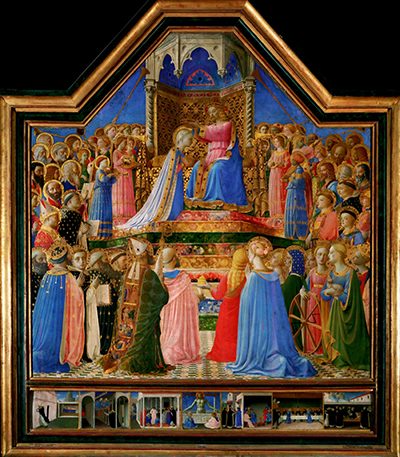
| Coronation of the Virgin (Louvre) | Louvre: second quarter of the fifteenth century, 1425–50; often dated more narrowly c. 1434–35 | Tempera and gold on panel Catalogue. |
| Coronation of the Virgin (Uffizi) | 1431–35 | Tempera on wood, gold ground Catalogue. |
| Cortona Triptych | About 1437 | Tempera and gold on panel. Catalogue. |
| Crucifixion (Armadio degli Argenti) | About 1450–53 | Tempera and gilding on wood Catalogue. |
| Crucifixion and Saints | 1441–42 | Fresco Catalogue. |
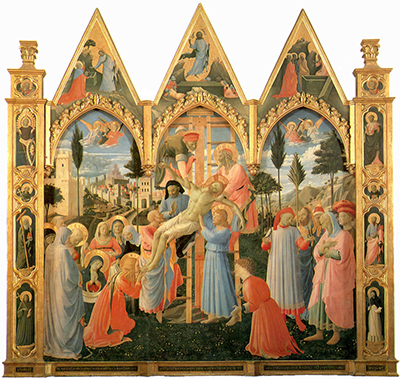
| Deposition from the Cross / Santa Trinita Deposition | commissioned 1429–32; completed by Angelico within this period | Tempera on panel Catalogue. |
| Descent into Limbo (Armadio degli Argenti) | About 1450–53 | Tempera and gilding on wood Catalogue. |
| Entombment of Christ (San Marco Altarpiece) | About 1438–42 | Painted panel Catalogue. |
| Entry into Jerusalem (Armadio degli Argenti) | About 1450–53 | Tempera and gilding on wood Catalogue. |
| Expulsion and the Stoning of Saint Stephen | 1448–49, Vatican Museums | Fresco. Catalogue. |
| Fiesole San Domenico Altarpiece | early 1420s; predella about 1423–24 | Tempera on panel Catalogue. |
| Flagellation (Armadio degli Argenti) | About 1450–53 | Tempera and gilding on wood Catalogue. |
| Flight into Egypt | About 1450–53 | Tempera and gilding on wood. Catalogue. |
| Guidalotti Polyptych | c. 1447–49 | Tempera and oil on panel Catalogue. |
| Healing of Palladia and Saint Damian Accepting Her Gift (San Marco Altarpiece) | About 1438–42 | Painted panel Catalogue. |
| Holy Pilgrim, Possibly Saint Roch (San Marco Altarpiece) | About 1438–42 | Painted panel Catalogue. |
| Holy Women at the Tomb (Armadio degli Argenti) | About 1450–53 | Tempera and gilding on wood Catalogue. |
| Judas Receives Payment (Armadio degli Argenti) | About 1450–53 | Tempera and gilding on wood Catalogue. |
| Lamentation over Christ (Armadio degli Argenti) | About 1450–53 | Tempera and gilding on wood Catalogue. |
| Lamentation over the Dead Christ (Croce al Tempio Lamentation) | 1436–41, Zeri catalogue | Tempera and gilding on wood panel. Catalogue. |
| Last Judgement (Armadio degli Argenti) | About 1450–53 | Tempera and gilding on wood Catalogue. |
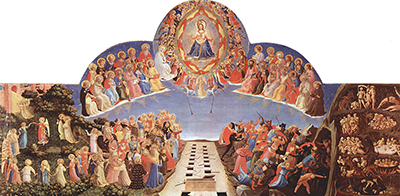
| Last Judgement (San Marco) | c. 1425–28 | Tempera and gold on panel Catalogue. |
| Last Supper (Armadio degli Argenti) | About 1450–53 | Tempera and gilding on wood Catalogue. |
| Lex Amoris (Armadio degli Argenti) | About 1450–53 | Tempera and gilding on wood Catalogue. |
| Madonna and Child with Saint Dominic and Saint Thomas Aquinas | About 1430, Hermitage catalogue | Detached fresco. Catalogue. |
| Madonna and Child with Saints | About 1411–13 | Tempera on wood panel, with a gold ground. Catalogue. |
| Madonna of Humility | About 1425, Thyssen catalogue | Tempera and gold on wood. Catalogue. |
| Madonna of the Star | 1431–34, Zeri catalogue | Tempera with oil glazes and gold on wood panel, as catalogued by the Gardner for the 2018 exhibition. Catalogue. |
| Marriage at Cana (Armadio, Alesso Baldovinetti) | About 1452–53 | Tempera and gilding on wood Catalogue. |
| Massacre of the Innocents (Armadio degli Argenti) | About 1450–53 | Tempera and gilding on wood Catalogue. |
| Miracle of the Black Leg (San Marco Altarpiece) | About 1438–42 | Painted panel Catalogue. |
| Mocking of Christ (Armadio degli Argenti) | About 1450–53 | Tempera and gilding on wood Catalogue. |
| Mystic Wheel (The Vision of Ezekiel) | About 1450–52 | Tempera and gilding on wood. Catalogue. |
| Nativity (Armadio degli Argenti) | About 1450–53 | Tempera and gilding on wood. Catalogue. |
| Niccoline Chapel frescoes | principally 1448–50 | Fresco Catalogue. |
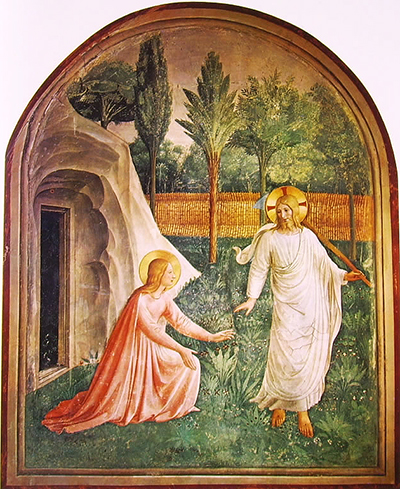
| Noli me Tangere | broadly within Angelico’s San Marco campaign, late 1430s–1440s | Fresco Catalogue. |
| Ordination of Saint Lawrence | 1448 | Fresco. Catalogue. |
| Pentecost (Armadio degli Argenti) | About 1450–53 | Tempera and gilding on wood Catalogue. |
| Presentation of Christ at the Temple (Armadio degli Argenti) | About 1450–53 | Tempera and gilding on wood. Catalogue. |
| Presentation of Jesus at the Temple | Early 1440s | Fresco on plaster. Catalogue. |
| Raising of Lazarus (Armadio degli Argenti) | About 1450–53 | Tempera and gilding on wood Catalogue. |
| Rescue of Saints Cosmas and Damian and Exorcism of Lysias (San Marco Altarpiece) | About 1438–42 | Painted panel Catalogue. |
| Road to Calvary (Armadio degli Argenti) | About 1450–53 | Tempera and gilding on wood Catalogue. |
| Saint Anthony Abbot (San Marco Altarpiece) | About 1438–42 | Painted panel Catalogue. |
| Saint Bernard of Clairvaux or Saint Benedict (San Marco Altarpiece) | About 1438–42 | Painted panel Catalogue. |
| Saint Damian Receives Money from Palladia | About 1425–49 | Tempera and gilding on wood. Catalogue. |
| Saint Francis and a Bishop Saint, Saint John the Baptist and Saint Dominic | Late 1420s, Getty catalogue | Tempera and gold leaf on panel. Catalogue. |
| Saint James the Greater Freeing the Magician Hermogenes | About 1426–29 | Tempera and gold on panel Catalogue. |
| Saint Jerome (San Marco Altarpiece) | About 1438–42 | Painted panel Catalogue. |
| Saint Lawrence Giving Alms | About 1448 | Wall fresco. Catalogue. |
| Saint Lawrence Receiving the Treasures of the Church from Pope Sixtus II | About 1448–49 | Fresco on plaster. Catalogue. |
| Saint Romuald (San Marco Altarpiece) | About 1438–42 | Painted panel Catalogue. |
| Saint Stephen Addressing the Council | 1448–49, Vatican Museums | Fresco. Catalogue. |
| Saint Stephen Preaching | 1448–49, Vatican Museums | Wall fresco. Catalogue. |
| Saint Thomas Aquinas (San Marco Altarpiece) | About 1438–42 | Painted panel Catalogue. |
| Saints Cosmas and Damian and Their Brothers Survive the Stake | Second quarter of the 15th century | Tempera and gilding on wood. Catalogue. |
| Saints Cosmas and Damian at the Stake (San Marco Altarpiece) | About 1438–42 | Painted panel Catalogue. |
| Saints Cosmas and Damian before Lysias (San Marco Altarpiece) | About 1438–42 | Painted panel Catalogue. |
| Saints Cosmas and Damian Rescued by an Angel | Second quarter of the 15th century | Tempera and gilding on wood. Catalogue. |
| Saints Cosmas and Damian with Their Brothers before Proconsul Lysias | Second quarter of the 15th century | Tempera and gilding on wood. Catalogue. |
| San Marco Altarpiece / Pala di San Marco | 1438–43 | Tempera on panel Catalogue. |
| San Pietro Martire Triptych | About 1422–23, Strozzi exhibition | Tempera and gold on panel. Catalogue. |
| Scenes from the Lives of the Desert Fathers (Thebaid) | About 1420, Uffizi catalogue | Tempera on wood. Catalogue. |
| Sixteen Prophets | 1447 | Fresco and gilding on plaster Catalogue. |
| Stoning and Shooting of the Brothers (San Marco Altarpiece) | About 1438–42 | Painted panel Catalogue. |
| Tabernacle of the Linaioli | 1433–35 | Tempera on panel Catalogue. |
| The Attempted Crucifixion and Stoning of Saints Cosmas and Damian | Second quarter of the 15th century | Tempera and gilding on wood. Catalogue. |
| The Crucifixion | About 1420–23, Met catalogue | Tempera on wood, gold ground. Catalogue. |
| The Death and the Assumption of the Virgin | 1424–34 | Tempera with oil glazes and gold on panel Catalogue. |
| The Dominican Blessed (left end) (Fiesole predella) | About 1423–24 | Egg tempera and gold on wood Catalogue. |
| The Dominican Blessed (right end) (Fiesole predella) | About 1423–24 | Egg tempera and gold on wood Catalogue. |
| The Entombment of Christ | About 1450 | Tempera on poplar panel. Catalogue. |
| The Forerunners of Christ with Saints and Martyrs | About 1423–24 | Egg tempera on wood (probably poplar), with gold and silver leaf. Catalogue. |
| The Funeral of Saint Anthony Abbot | About 1426–30 | Tempera on poplar panel. Catalogue. |
| The Martyrdom of Saints Cosmas and Damian | About 1425–49 | Tempera and gilding on wood. Catalogue. |
| The Mocking of Christ / Christ Mocked | within the San Marco dormitory campaign, broadly late 1430s–1440s | Fresco Catalogue. |
| The Nativity | About 1425, Minneapolis catalogue | Tempera on poplar panel. Catalogue. |
| The Nativity in Cell 5 at San Marco | About 1439–43 | Fresco on plaster. Catalogue. |
| The Penitent Saint Jerome | 1419–20 | Tempera on wood panel Catalogue. |
| The Virgin and Child by Fra Angelico (Fogg Museum) | About 1430, Harvard catalogue | Tempera originally on panel, subsequently transferred to Masonite. Catalogue. |
| The Virgin Mary with the Apostles and Other Saints (Fiesole predella) | About 1423–24 | Egg tempera and gold on wood Catalogue. |
| Transfiguration (Armadio, Alesso Baldovinetti) | About 1452–53 | Tempera and gilding on wood Catalogue. |
| Transfiguration (San Marco Cell 6) | within the San Marco dormitory campaign, broadly late 1430s–1440s | Fresco Catalogue. |
| Virgin Mary Annunciate | 1450–55, Detroit catalogue | Gold leaf and tempera on wood panel. Catalogue. |
| Virgin of the Pomegranate | About 1426 | Tempera on panel with gilding Catalogue. |
Frequently Asked Questions
It belongs to the Minneapolis Institute of Art, where its accession number is 68.41.8. The museum’s collection data lists Gallery 343. [1]
Discussion
Use these prompts to look again or share an observation.
Reader Insights
Follow the thatched roof from the blue angels down to the rays around the infant. Where does the change from light to shadow make the two groups distinct?
Compare the small painted witnesses with the figures in the San Marco cell fresco. How does seeing each at its intended scale affect what you notice?
Join the Conversation
Share a detail or question about The Nativity.
References
- Minneapolis Institute of Art, The Nativity, accession 68.41.8, open collection record 1680. View source.
- Fondazione Federico Zeri, Guido di Pietro, Natività di Gesù, catalogue entry 107129 and related photograph 179245. View source.
- Andrea Kibler Maxwell, Nativity, Masterpieces from the Clowes Collection, paragraphs 8–10, figures 8–9 and note 12. View source.
- Gospel of Luke, 2:6–20, New American Bible, Revised Edition. View source.
- Jean Sorabella, The Birth and Infancy of Christ in Italian Painting, Metropolitan Museum of Art. View source.
- Keith Christiansen, Early Renaissance Narrative Painting in Italy, The Metropolitan Museum of Art Bulletin 41, no. 2 (1983), pp. 3–5, figures 1–2. View source.
- Minneapolis Institute of Art, Dear Diary—Never Since We Left Prague, teaching resource, Key Idea Two. View source.
- Metropolitan Museum of Art, Lorenzo Monaco, The Nativity, 1975.1.66, collection entry and commentary by Dita Amory and Laurence Kanter. View source.
- Comune di Forlì, loan determination 2623 of 18 September 2025, Natività, inv. 111bis. See also the Italian Ministry of Culture’s loan record. View source 1. View source 2.
- Ministero della Cultura, Natività di Gesù, Museo di San Marco, record 0900295806. View source.
- Ministero della Cultura, Natività di Gesù, Armadio degli Argenti, component 0900191187A-3. View source.
- Gerardo de Simone, Un’iconostasi di “figure piccole” del Beato Angelico, in Beato Angelico. Storie dell’infanzia di Cristo. Anta dell’Armadio degli Argenti (2023), figure 3 and inscription table, no. 3. View source.
- Minneapolis Institute of Art, The Nativity, engraving, accession P.68.95, open collection record 50625. View source.
.jpg)
 Fra Angelico.jpg)