


 Fra Angelico.jpg)
 by Tom Gurney
Tom Gurney BSc (Hons) is an art history expert with over 20 years experience
Published on June 19, 2020 / Updated on November 29, 2026
Email: tomgurney1@gmail.com / Phone: +44 7429 011000
Introduction
The brightest part of this Nativity is the roof of the stable. Angels gather on either side of its pale centre, while Mary and Joseph kneel below, on either side of a child small enough to miss at first glance. Now in the Museo di San Marco in Florence, the painting is the upper-right scene of the surviving nine-part board from the Armadio degli Argenti, a cabinet made to protect precious offerings at the church of Santissima Annunziata. Two bands of painted Latin frame the birth. One gives it the authority of ancient prophecy. The other tells it in the spare language of Luke’s Gospel. [1] [2]
At a Glance
- ArtistFra Angelico and assistants, according to the Italian national catalogue. [1]
- TitleNativity (Natività di Gesù), from the Armadio degli Argenti. [1]
- DateAbout 1450–53. [1]
- MediumTempera and gilding on wood. [1]
- Dimensions38.5 × 37.5 cm (height × width, individual scene). [3]
- CollectionMuseo di San Marco, Florence. Inventory 1890, no. 8489. [1] [4]
- Catalogue number0900191187A-3. [1]
Under the stable roof
Mary’s blue cloak spreads low across the ground at the left. Her joined hands and lowered head draw the eye towards the infant. Joseph bends forward opposite her, his hands held across his chest. Against the yellow folds of his garment, his dark head covering gives particular weight to the tilt of his head. Christ lies naked between them, one arm raised and his head ringed by a halo. The gap between the adults gives his small body room to be seen. Both kneeling figures have been brought almost to the lower edge, where their prayer comes close to the viewer. [1]
Behind them, the manger is tucked away in the shadow of the shelter. The ox and ass are easy to overlook there, with the ox’s horns catching the light above the child. Luke describes Mary wrapping her firstborn in swaddling clothes and putting him in a manger. The painted scene separates the child from the feeding trough and shows his bare body, with a pale glow spreading around him on the ground. The arrangement makes room for adoration within the birth story. The two shepherds, whom Luke brings to Bethlehem after the angelic announcement, appear at the far left, peering round the side of the shelter. That glimpse of faces gives the gathering a further point of view beyond the two figures at its centre. [1] [5]
The stable takes up almost the full width of the picture. Its front edge runs straight across, and the rafters and openings behind Mary and Joseph let us see how little shelter the structure provides. There are glimpses of hillside and vegetation at the sides and distant buildings to the right. The landscape establishes a world beyond the birth while the low roof gathers attention back to it. Dark hills rise behind the roof on either side, making the illuminated middle stand out all the more. [1] [2]
The angels above
The pale roof opens upwards between the wings and coloured robes of the angels. Their figures follow a curve around the light, which the art historian Gerardo de Simone describes as part of a circle. The curve is easiest to see if you follow the figures from the lower edge of the roof towards the back, where they crowd more closely together. The eaves give this gathering an abrupt lower boundary. Directly beneath them the space darkens again, until the glow around the child catches the eye. [2]
Luke moves from the birth to an angel appearing to the shepherds, then to a heavenly host praising God and the shepherds setting off to find the child. The picture brings these elements within sight of one another. The shepherds stay at the margin and the angels seem to have a place of their own, close to the timber shelter but set above the human figures. The arc overhead and the two kneeling parents below give the scene a similar inward pull at two different scales. The roof both divides and joins the two groups. [1] [2] [5]
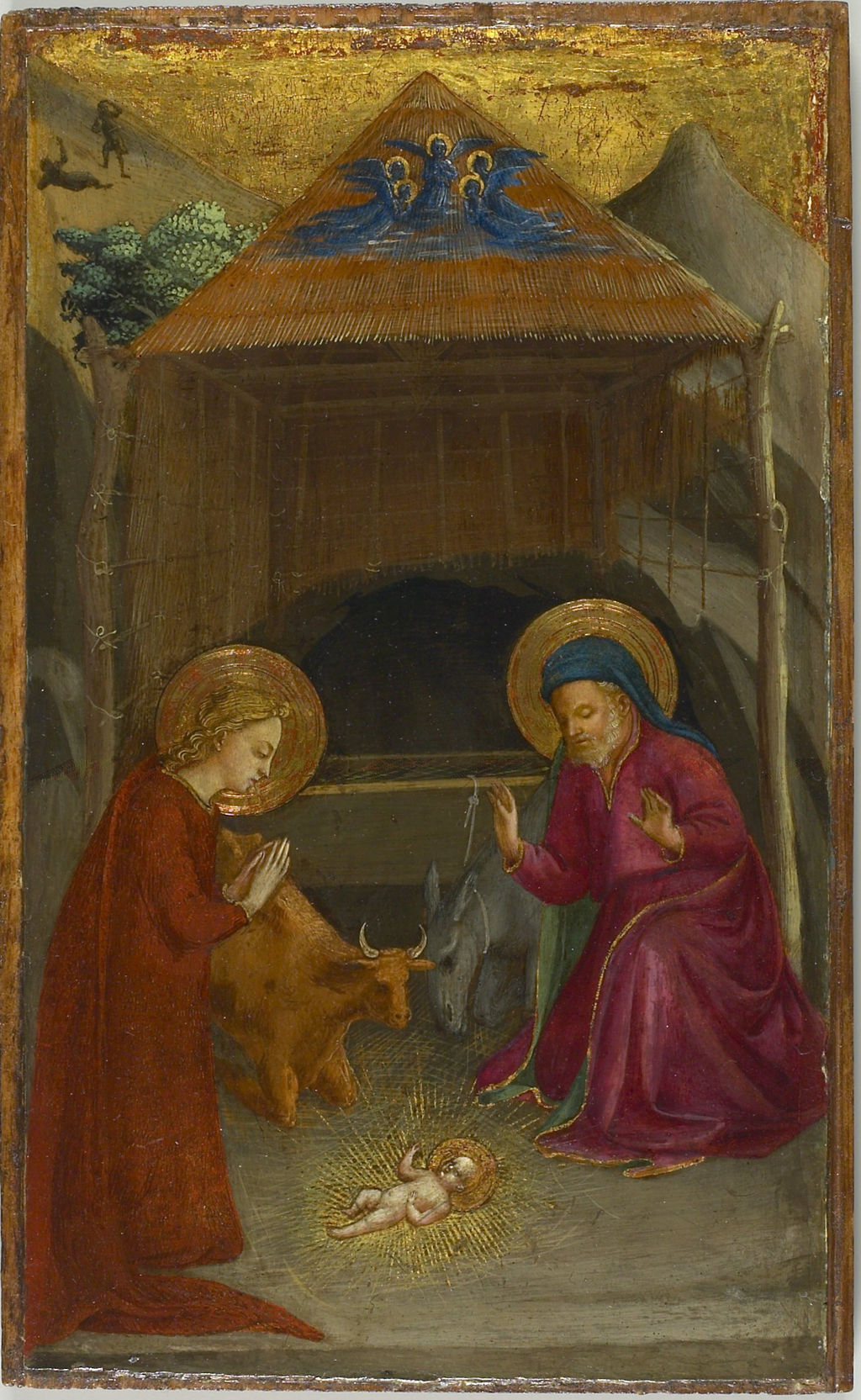
Minneapolis Institute of Art, accession 68.41.8. The sparse stable separates the angelic choir from the kneeling adults. Image source. Public domain. Proportional web resize.
The two Latin inscriptions
Above the angels, a painted scroll takes words from Isaiah 9:5, in the numbering used by de Simone. It announces that a child has been born and a son given, then places dominion upon his shoulder. The lower strip, from Luke 2:6–7, says that Mary’s time came and that she bore her firstborn son. It ends there, before the swaddling and the manger. The abbreviations at the ends identify Isaiah chapter nine and Luke chapter two. The two excerpts meet on the fact of birth, but only the upper one speaks of power. In between lies a child whose size and exposed body make that promise a remarkable thing to read over him. [2] [5] [6]
The pairing belongs to a medieval Christian way of reading the two Testaments together. The Mystic Wheel opens the cabinet cycle by placing prophets and New Testament writers in concentric circles. The Nativity puts that relationship to work in a single episode. Isaiah’s words can be understood in their earlier setting as language about Davidic kingship. Here the cycle reads them through the birth of Christ. The even lettering and repeated position of the scrolls make it possible to read upwards from Gospel to prophecy as readily as downwards from prophecy to birth. [2] [6] [7]
From the Annunciation to the naming of Jesus
The preceding Annunciation also pairs Isaiah with Luke. There both texts speak of a birth still to come. The Nativity closes the top row with the birth itself, and the sequence turns down to the Circumcision at the left of the row below. That scene takes up Luke’s account of the eighth day, when the child is named Jesus. Reading across and then down brings a sequence into view that the Nativity alone only begins. A child is promised, born and named. [2] [5]
Colour helps hold these shifts of setting together. Mecthilde Airiau has traced the recurring clothes of Mary and Joseph across the cabinet. Joseph’s yellow and dark hood make him easy to find again, and Mary’s blue cloak, set against pink and green, is familiar from other episodes. Within the Nativity the two masses of colour direct attention towards the smaller figure between them. Across the cabinet, their recurrence allows a viewer to pick up the story as people move from shelter to road or into a different room. [8]
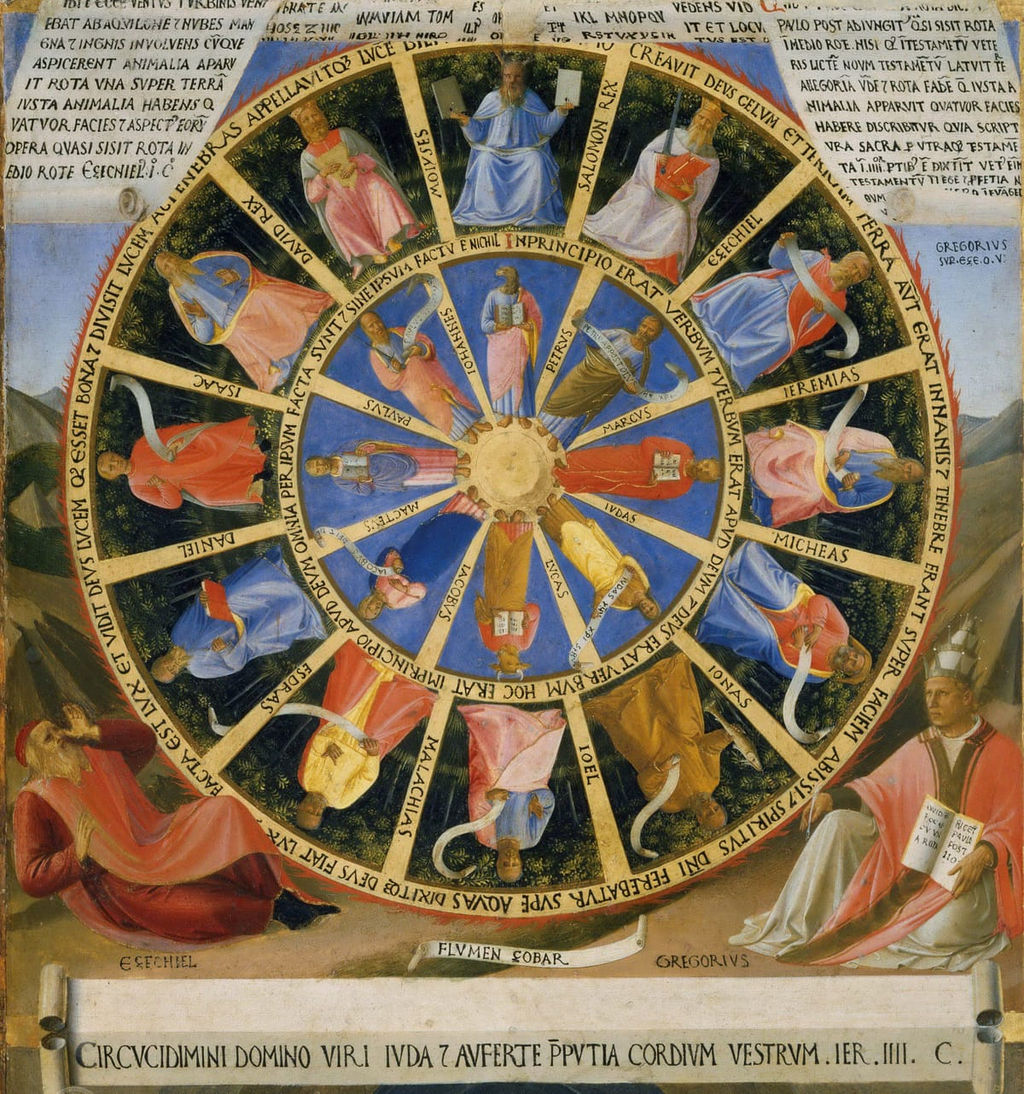
The Mystic Wheel, 0900191187A-1. The painted spokes connect differently positioned witnesses and writers. Image source. Public domain. Proportional web resize.
The cabinet and its painters
With the patronage of Piero di Cosimo de’ Medici, the Servite church of Santissima Annunziata provided a treasury beside its revered Annunciation fresco. The wooden cabinet held precious offerings brought to that image, including objects in silver. De Simone discusses evidence that the cabinet was in place by 1453 and that a later mechanism, installed in the 1460s, raised its painted front like a shutter. Andrea De Marchi has proposed that two tall hinged leaves originally carried the scenes. His reconstruction sets the nine childhood fields beside three scenes of Christ’s adult life painted by Alesso Baldovinetti. De Simone counts thirty-six surviving fields, with the Last Judgement taking up two. The earlier configuration and the number originally painted are debated. [2] [4]
The paintings were removed from the cabinet in the seventeenth century, and the surviving sections have been at San Marco since 1922. The square grouping on display preserves the movement from the Mystic Wheel into the stories of Christ’s childhood. In the church, those stories also formed the painted face of a piece of furniture, visible when it was closed over the offerings. [2]
The state catalogue assigns this Nativity to Fra Angelico and assistants and dates it to about 1450–53. It also lists Zanobi Strozzi as an alternative attribution and records two different judgements about Benozzo Gozzoli. Mario Salmi saw Gozzoli’s hand in Mary and the shepherds. Anna Padoa Rizzo proposed that he painted the whole scene from Angelico’s design. The attribution to Angelico and assistants leaves the division of work open. [1]
The Nativity measures 38.5 cm high by 37.5 cm wide in the state catalogue. The conservation project describes the nine-scene board as 123 cm square. Non-invasive analysis revealed a varied palette across that board, including lapis lazuli blue and different materials for reds that can look similar to the eye. The published examples that distinguish reds in individual garments come from the Flight into Egypt. In the Nativity, looking closely shows what the colours do in the composition, while identifying their ingredients would require evidence for those particular passages. [3] [9]
Fra Angelico artworks directory
Explore documented works and surviving parts of larger ensembles. Catalogue links identify individual records. Attribution and dating can vary across collections and publications. Search the Federico Zeri Photo Archive by artist.
| Name | Date | Medium and sources |
|---|---|---|
| Adoration of the Magi | About 1440–60, NGA catalogue | Painting Catalogue. |
| Adoration of the Magi (Armadio degli Argenti) | About 1450–53 | Tempera and gold on wood. Catalogue. |
| Agony in the Garden (Armadio degli Argenti) | About 1450–53 | Tempera and gilding on wood Catalogue. |
| Annalena Altarpiece / Pala di Annalena | commonly c. 1435 | Tempera on panel Catalogue. |
| Annunciation (Armadio degli Argenti) | About 1450–53 | Tempera and gilding on wood. Catalogue. |
| Annunciation (Cortona) | generally placed in the 1430s; exact dating remains debated | Tempera on panel Catalogue. |
| Annunciation (Prado) | 1425–26 | Tempera on poplar panel Catalogue. |
| Annunciation (San Marco upper corridor) | commonly c. 1442 | Fresco Catalogue. |
| Annunciation with Saint Peter Martyr | About 1439–43 | Fresco on plaster. Catalogue. |
| Annunciatory Angel | 1450–55, Detroit catalogue | Gold leaf and tempera on wood panel. Catalogue. |
| Armadio degli Argenti (Silver Treasury) | principally c. 1450–52 | Tempera on panel Catalogue. |
| Arrest of Christ (Armadio degli Argenti) | About 1450–53 | Tempera and gilding on wood Catalogue. |
| Ascension (Armadio degli Argenti) | About 1450–53 | Tempera and gilding on wood Catalogue. |
| Baptism of Christ (Armadio, Alesso Baldovinetti) | About 1452–53 | Tempera and gilding on wood Catalogue. |
| Beheading of Saints Cosmas and Damian (San Marco Altarpiece) | About 1438–42 | Painted panel Catalogue. |
| Betrayal of Christ (Armadio degli Argenti) | About 1450–53 | Tempera and gilding on wood Catalogue. |
| Blessed Dominican, Possibly Jordan of Saxony (San Marco Altarpiece) | About 1438–42 | Painted panel Catalogue. |
| Blessed Vincent Ferrer (San Marco Altarpiece) | About 1438–42 | Painted panel Catalogue. |
| Burial of Saints Cosmas and Damian (San Marco Altarpiece) | About 1438–42 | Painted panel Catalogue. |
| Bust of a Cleric and a Group of Figures (recto and verso) | 15th century | Pen and ink on paper Catalogue. |
| Christ among the Doctors (Armadio degli Argenti) | About 1450–53 | Tempera and gilding on wood Catalogue. |
| Christ before Caiaphas (Armadio degli Argenti) | About 1450–53 | Tempera and gilding on wood Catalogue. |
| Christ Glorified in the Court of Heaven | About 1423–24 | Egg tempera on wood, probably poplar, with gold and silver leaf Catalogue. |
| Christ Seated in Judgment | 1447 | Fresco and gilding on plaster. Catalogue. |
| Christ Stripped of His Garments (Armadio degli Argenti) | About 1450–53 | Tempera and gilding on wood Catalogue. |
| Christ Washes the Apostles’ Feet (Armadio degli Argenti) | About 1450–53 | Tempera and gilding on wood Catalogue. |
| Circumcision of Christ (Armadio degli Argenti) | About 1450–53 | Tempera and gilding on wood. Catalogue. |
| Communion of the Apostles (Armadio degli Argenti) | About 1450–53 | Tempera and gilding on wood Catalogue. |
| Coronation of the Virgin (Armadio degli Argenti) | About 1450–53 | Tempera and gilding on wood Catalogue. |
| Coronation of the Virgin (Louvre) | Louvre: second quarter of the fifteenth century, 1425–50; often dated more narrowly c. 1434–35 | Tempera and gold on panel Catalogue. |
| Coronation of the Virgin (Uffizi) | 1431–35 | Tempera on wood, gold ground Catalogue. |
| Cortona Triptych | About 1437 | Tempera and gold on panel. Catalogue. |
| Crucifixion (Armadio degli Argenti) | About 1450–53 | Tempera and gilding on wood Catalogue. |
| Crucifixion and Saints | 1441–42 | Fresco Catalogue. |
| Deposition from the Cross / Santa Trinita Deposition | commissioned 1429–32; completed by Angelico within this period | Tempera on panel Catalogue. |
| Descent into Limbo (Armadio degli Argenti) | About 1450–53 | Tempera and gilding on wood Catalogue. |
| Entombment of Christ (San Marco Altarpiece) | About 1438–42 | Painted panel Catalogue. |
| Entry into Jerusalem (Armadio degli Argenti) | About 1450–53 | Tempera and gilding on wood Catalogue. |
| Expulsion and the Stoning of Saint Stephen | 1448–49, Vatican Museums | Fresco. Catalogue. |
| Fiesole San Domenico Altarpiece | early 1420s; predella about 1423–24 | Tempera on panel Catalogue. |
| Flagellation (Armadio degli Argenti) | About 1450–53 | Tempera and gilding on wood Catalogue. |
| Flight into Egypt | About 1450–53 | Tempera and gilding on wood. Catalogue. |
| Guidalotti Polyptych | c. 1447–49 | Tempera and oil on panel Catalogue. |
| Healing of Palladia and Saint Damian Accepting Her Gift (San Marco Altarpiece) | About 1438–42 | Painted panel Catalogue. |
| Holy Pilgrim, Possibly Saint Roch (San Marco Altarpiece) | About 1438–42 | Painted panel Catalogue. |
| Holy Women at the Tomb (Armadio degli Argenti) | About 1450–53 | Tempera and gilding on wood Catalogue. |
| Judas Receives Payment (Armadio degli Argenti) | About 1450–53 | Tempera and gilding on wood Catalogue. |
| Lamentation over Christ (Armadio degli Argenti) | About 1450–53 | Tempera and gilding on wood Catalogue. |
| Lamentation over the Dead Christ (Croce al Tempio Lamentation) | 1436–41, Zeri catalogue | Tempera and gilding on wood panel. Catalogue. |
| Last Judgement (Armadio degli Argenti) | About 1450–53 | Tempera and gilding on wood Catalogue. |
| Last Judgement (San Marco) | c. 1425–28 | Tempera and gold on panel Catalogue. |
| Last Supper (Armadio degli Argenti) | About 1450–53 | Tempera and gilding on wood Catalogue. |
| Lex Amoris (Armadio degli Argenti) | About 1450–53 | Tempera and gilding on wood Catalogue. |
| Madonna and Child with Saint Dominic and Saint Thomas Aquinas | About 1430, Hermitage catalogue | Detached fresco. Catalogue. |
| Madonna and Child with Saints | About 1411–13 | Tempera on wood panel, with a gold ground. Catalogue. |
| Madonna of Humility | About 1425, Thyssen catalogue | Tempera and gold on wood. Catalogue. |
| Madonna of the Star | 1431–34, Zeri catalogue | Tempera with oil glazes and gold on wood panel, as catalogued by the Gardner for the 2018 exhibition. Catalogue. |
| Marriage at Cana (Armadio, Alesso Baldovinetti) | About 1452–53 | Tempera and gilding on wood Catalogue. |
| Massacre of the Innocents (Armadio degli Argenti) | About 1450–53 | Tempera and gilding on wood Catalogue. |
| Miracle of the Black Leg (San Marco Altarpiece) | About 1438–42 | Painted panel Catalogue. |
| Mocking of Christ (Armadio degli Argenti) | About 1450–53 | Tempera and gilding on wood Catalogue. |
| Mystic Wheel (The Vision of Ezekiel) | About 1450–52 | Tempera and gilding on wood. Catalogue. |
| Nativity (Armadio degli Argenti) | About 1450–53 | Tempera and gilding on wood. Catalogue. |
| Niccoline Chapel frescoes | principally 1448–50 | Fresco Catalogue. |
| Noli me Tangere | broadly within Angelico’s San Marco campaign, late 1430s–1440s | Fresco Catalogue. |
| Ordination of Saint Lawrence | 1448 | Fresco. Catalogue. |
| Pentecost (Armadio degli Argenti) | About 1450–53 | Tempera and gilding on wood Catalogue. |
| Presentation of Christ at the Temple (Armadio degli Argenti) | About 1450–53 | Tempera and gilding on wood. Catalogue. |
| Presentation of Jesus at the Temple | Early 1440s | Fresco on plaster. Catalogue. |
| Raising of Lazarus (Armadio degli Argenti) | About 1450–53 | Tempera and gilding on wood Catalogue. |
| Rescue of Saints Cosmas and Damian and Exorcism of Lysias (San Marco Altarpiece) | About 1438–42 | Painted panel Catalogue. |
| Road to Calvary (Armadio degli Argenti) | About 1450–53 | Tempera and gilding on wood Catalogue. |
| Saint Anthony Abbot (San Marco Altarpiece) | About 1438–42 | Painted panel Catalogue. |
| Saint Bernard of Clairvaux or Saint Benedict (San Marco Altarpiece) | About 1438–42 | Painted panel Catalogue. |
| Saint Damian Receives Money from Palladia | About 1425–49 | Tempera and gilding on wood. Catalogue. |
| Saint Francis and a Bishop Saint, Saint John the Baptist and Saint Dominic | Late 1420s, Getty catalogue | Tempera and gold leaf on panel. Catalogue. |
| Saint James the Greater Freeing the Magician Hermogenes | About 1426–29 | Tempera and gold on panel Catalogue. |
| Saint Jerome (San Marco Altarpiece) | About 1438–42 | Painted panel Catalogue. |
| Saint Lawrence Giving Alms | About 1448 | Wall fresco. Catalogue. |
| Saint Lawrence Receiving the Treasures of the Church from Pope Sixtus II | About 1448–49 | Fresco on plaster. Catalogue. |
| Saint Romuald (San Marco Altarpiece) | About 1438–42 | Painted panel Catalogue. |
| Saint Stephen Addressing the Council | 1448–49, Vatican Museums | Fresco. Catalogue. |
| Saint Stephen Preaching | 1448–49, Vatican Museums | Wall fresco. Catalogue. |
| Saint Thomas Aquinas (San Marco Altarpiece) | About 1438–42 | Painted panel Catalogue. |
| Saints Cosmas and Damian and Their Brothers Survive the Stake | Second quarter of the 15th century | Tempera and gilding on wood. Catalogue. |
| Saints Cosmas and Damian at the Stake (San Marco Altarpiece) | About 1438–42 | Painted panel Catalogue. |
| Saints Cosmas and Damian before Lysias (San Marco Altarpiece) | About 1438–42 | Painted panel Catalogue. |
| Saints Cosmas and Damian Rescued by an Angel | Second quarter of the 15th century | Tempera and gilding on wood. Catalogue. |
| Saints Cosmas and Damian with Their Brothers before Proconsul Lysias | Second quarter of the 15th century | Tempera and gilding on wood. Catalogue. |
| San Marco Altarpiece / Pala di San Marco | 1438–43 | Tempera on panel Catalogue. |
| San Pietro Martire Triptych | About 1422–23, Strozzi exhibition | Tempera and gold on panel. Catalogue. |
| Scenes from the Lives of the Desert Fathers (Thebaid) | About 1420, Uffizi catalogue | Tempera on wood. Catalogue. |
| Sixteen Prophets | 1447 | Fresco and gilding on plaster Catalogue. |
| Stoning and Shooting of the Brothers (San Marco Altarpiece) | About 1438–42 | Painted panel Catalogue. |
| Tabernacle of the Linaioli | 1433–35 | Tempera on panel Catalogue. |
| The Attempted Crucifixion and Stoning of Saints Cosmas and Damian | Second quarter of the 15th century | Tempera and gilding on wood. Catalogue. |
| The Crucifixion | About 1420–23, Met catalogue | Tempera on wood, gold ground. Catalogue. |
| The Death and the Assumption of the Virgin | 1424–34 | Tempera with oil glazes and gold on panel Catalogue. |
| The Dominican Blessed (left end) (Fiesole predella) | About 1423–24 | Egg tempera and gold on wood Catalogue. |
| The Dominican Blessed (right end) (Fiesole predella) | About 1423–24 | Egg tempera and gold on wood Catalogue. |
| The Entombment of Christ | About 1450 | Tempera on poplar panel. Catalogue. |
| The Forerunners of Christ with Saints and Martyrs | About 1423–24 | Egg tempera on wood (probably poplar), with gold and silver leaf. Catalogue. |
| The Funeral of Saint Anthony Abbot | About 1426–30 | Tempera on poplar panel. Catalogue. |
| The Martyrdom of Saints Cosmas and Damian | About 1425–49 | Tempera and gilding on wood. Catalogue. |
| The Mocking of Christ / Christ Mocked | within the San Marco dormitory campaign, broadly late 1430s–1440s | Fresco Catalogue. |
| The Nativity | About 1425, Minneapolis catalogue | Tempera on poplar panel. Catalogue. |
| The Nativity in Cell 5 at San Marco | About 1439–43 | Fresco on plaster. Catalogue. |
| The Penitent Saint Jerome | 1419–20 | Tempera on wood panel Catalogue. |
| The Virgin and Child by Fra Angelico (Fogg Museum) | About 1430, Harvard catalogue | Tempera originally on panel, subsequently transferred to Masonite. Catalogue. |
| The Virgin Mary with the Apostles and Other Saints (Fiesole predella) | About 1423–24 | Egg tempera and gold on wood Catalogue. |
| Transfiguration (Armadio, Alesso Baldovinetti) | About 1452–53 | Tempera and gilding on wood Catalogue. |
| Transfiguration (San Marco Cell 6) | within the San Marco dormitory campaign, broadly late 1430s–1440s | Fresco Catalogue. |
| Virgin Mary Annunciate | 1450–55, Detroit catalogue | Gold leaf and tempera on wood panel. Catalogue. |
| Virgin of the Pomegranate | About 1426 | Tempera on panel with gilding Catalogue. |
Frequently Asked Questions
Look for the angels on the broad roof and the Latin scrolls above and below. The Nativity fresco in cell 5 belongs to the Dominican dormitory at San Marco. It shares the ox and ass but was painted directly on the cell wall. The smaller Nativity panel in Minneapolis has a tall, arched composition and belongs to a different, earlier work on wood. [10] [11]
Discussion
Use these prompts to look again or share an observation.
Reader Insights
Compare the light under the roof with the positions of the shepherds. Where does the painting mark the change between their space and the child’s?
What happens to the pace of the infancy board as you move from the Annunciation to the Nativity and then to the naming scene?
Join the Conversation
Share a detail or question about Nativity (Armadio degli Argenti).
References
- Italian Ministry of Culture, Natività di Gesù, national catalogue 0900191187A-3 (in Italian). View source.
- Gerardo de Simone, Un’iconostasi di “figure piccole” del Beato Angelico. L’Armadio degli Argenti per la Santissima Annunziata, in Beato Angelico. Storie dell’infanzia di Cristo, exhibition catalogue, Milan, 2023, pp. 35–64, especially the discussion of the painted ensemble and Appendix I, scene 3 (in Italian). View source.
- Italian Ministry of Culture, measurement records for catalogue 0900191187A-3. View source.
- Italian Ministry of Culture, Episodi del Nuovo Testamento, national catalogue 0900191187A-0, parent board (in Italian). View source.
- New American Bible, Revised Edition, Luke 2. View source.
- New American Bible, Revised Edition, Isaiah 9, especially verse 5 and its note. View source.
- Cyril Gerbron, Le Christ est une page. Exégèse et mémoire dans l’armadio degli argenti de Fra Angelico, Histoire de l’art 71, 2012, pp. 51–62 (in French). View source.
- Mecthilde Airiau, Colour as Guideline in Fra Angelico’s Work, caiana 23, 2024, pp. 61–74, section on the Armadio. View source.
- Fondazione Bracco, Art from Inside. Capolavori svelati tra arte e scienza, Annex A, first section of the Armadio degli Argenti (in Italian). View source.
- Museo di San Marco, Alla ricerca degli animali nascosti nel Museo di San Marco, with the two Nativities illustrated (in Italian). View source.
- Minneapolis Institute of Art, The Nativity, illustrated in Dear Diary—Never Since We Left Prague. View source.
.jpg)



 Fra Angelico.jpg)


