 by Tom Gurney
Tom Gurney BSc (Hons) is an art history expert with over 20 years experience
Published on June 19, 2020 / Updated on November 29, 2026
Email: tomgurney1@gmail.com / Phone: +44 7429 011000
Introduction
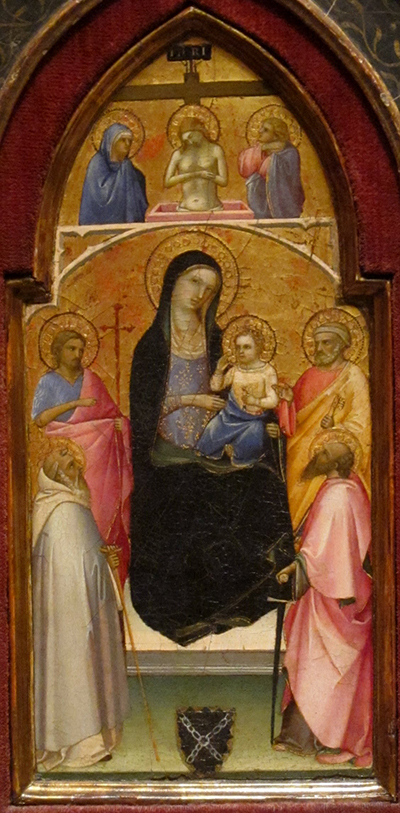
The Christ Child raises a hand in blessing from his mother’s lap. Directly above him, beneath the point of the same panel, Christ bows his head over the edge of a tomb. A painted arch divides the two scenes, and a tiny shield with crossed chains sits at the foot of the picture. These details identify the San Diego Museum of Art’s Madonna and Child with Saints, a small Florentine devotional panel that the museum dates to about 1411–13 and attributes to the young Fra Angelico. [1]
At a Glance
- ArtistFra Angelico, according to the San Diego Museum of Art. Formerly attributed to Lorenzo Monaco. [1]
- DateAbout 1411–13, according to the museum. [1]
- MediumTempera on wood panel, with a gold ground. [1]
- DimensionsApproximately 43 × 22 cm, as listed for the 2019 Prado loan. [2]
- CollectionSan Diego Museum of Art, gift of Anne R. and Amy Putnam, accession 1946.18. [1]
Four saints around the throne
Mary’s dark mantle spreads across the middle of the panel in a broad sweep. At its centre, the Child’s bare torso catches the light above the blue cloth gathered around his legs. Mary inclines her head and steadies him with her hands. The tip of her halo almost touches the underside of the painted arch. Below, the pale ledge under her mantle makes the height of her seat clear: the feet of the two nearest saints rest on the green floor below it. The gold behind the figures gives them a common setting, while the small differences in their footing tell us how they stand in relation to the throne. [1]
On the viewer’s left, John the Baptist points towards the Child. His slender cross rises beside Mary’s shoulder, above the white hood of Saint Romuald, who looks up from the foreground. Peter, across from the Baptist, holds a key against his yellow mantle. Paul stands forward of him in pink, with his sword lowered to the floor. The key and sword help distinguish the two apostles even where their robes and bodies overlap. Paul and Romuald turn inwards at comparable angles, but the folds lead the eye differently. Romuald’s pale habit falls almost straight to the floor, while Paul’s mantle bends back across his arm and drops in a long diagonal. [1]
John’s pointing finger gives the group a focus that the other saints reinforce through their stance and gaze. The saints share the same narrow space as Mary and the Child, an arrangement often described as a sacra conversazione, or sacred conversation. Here the figures’ gestures are quiet. The Baptist draws attention to the blessing and the foreground saints show how to look up towards it. The format makes those gestures easy to follow at close range. The Child’s hand and the Baptist’s answering gesture are only a short distance apart on a panel roughly 43 centimetres high. Its dimensions suit close viewing, although its first setting is uncertain. [1] [2]
The painted arch and the Man of Sorrows
The panel has two arches of a kind. Its outer silhouette rises to a point, while the painted opening over Mary forms a shallow curve. Follow the light-coloured front edge of that curve towards the right and you can see a strip of the arch’s underside. Where that underside meets the gold, the curve reads as a structure projecting forward from the background. The gold continues on either side of the boundary, yet the painted stone distinguishes the space occupied by the enthroned group from the scene above. At the same time, the upper edge gives the pink rim of Christ’s tomb a firm horizontal beneath it. [1]
In the upper scene, Christ’s arms cross over his torso and a dark cross rises behind him. The Virgin and John the Evangelist stand on either side, their bodies turned towards him. This is the Man of Sorrows, a devotional image of the dead Christ displaying the marks of the Passion. His upright body at the tomb presents his suffering for contemplation. Mary appears twice on the panel, first as the mother supporting her child, then as the mourner beside his tomb. The close alignment of the two bodies of Christ invites the viewer to consider his infancy and death together. Beneath the arch the Baptist directs attention to the Child. Above it the mourners’ inclined heads lead the eye back to Christ. [1] [3]
Romuald’s presence brings a more particular religious association into this gathering. The white-robed saint founded the hermitage of Camaldoli, from which the Camaldolese tradition took its name. Lorenzo Monaco was himself a monk at the Camaldolese monastery of Santa Maria degli Angeli in Florence. His inscribed Coronation of the Virgin, completed in 1414 for that church’s high altar and now in the Uffizi, gives a documented example of his work for the community. Romuald helps explain why a Camaldolese connection is plausible for the San Diego panel. The saint alone cannot place the painting in that monastery. [1] [4] [5]
The Alberti shield and the date
The shield takes up barely a fraction of the space given to the figures. Its light chains meet in a ring at the centre of a dark field. San Diego identifies the device as the arms of the Florentine Alberti family. The Florentine State Archive describes this branch’s arms as four chains running in from the corners to a ring on a blue field. On the panel the shield is small but conspicuous, centred below the throne and level with the saints’ feet. A viewer who knew the emblem would have recognised the family without a written name. The particular person and destination remain uncertain. [1] [6]
San Diego uses the heraldry to support its date of about 1411–13, taking 1411 as the end of the family’s exile from Florence. The historical record is more complicated. Historian Kurt Weissen describes restrictions imposed in stages, an attempted uprising in 1412 and a gradual series of exemptions for individual branches before the banishment of many family members was lifted in 1428. This leaves 1411 uncertain as a firm earliest date for the panel. The chains identify a family, and the history of its exile raises a further question about where the panel might have been used. A family emblem could travel with its owners. [1] [7]
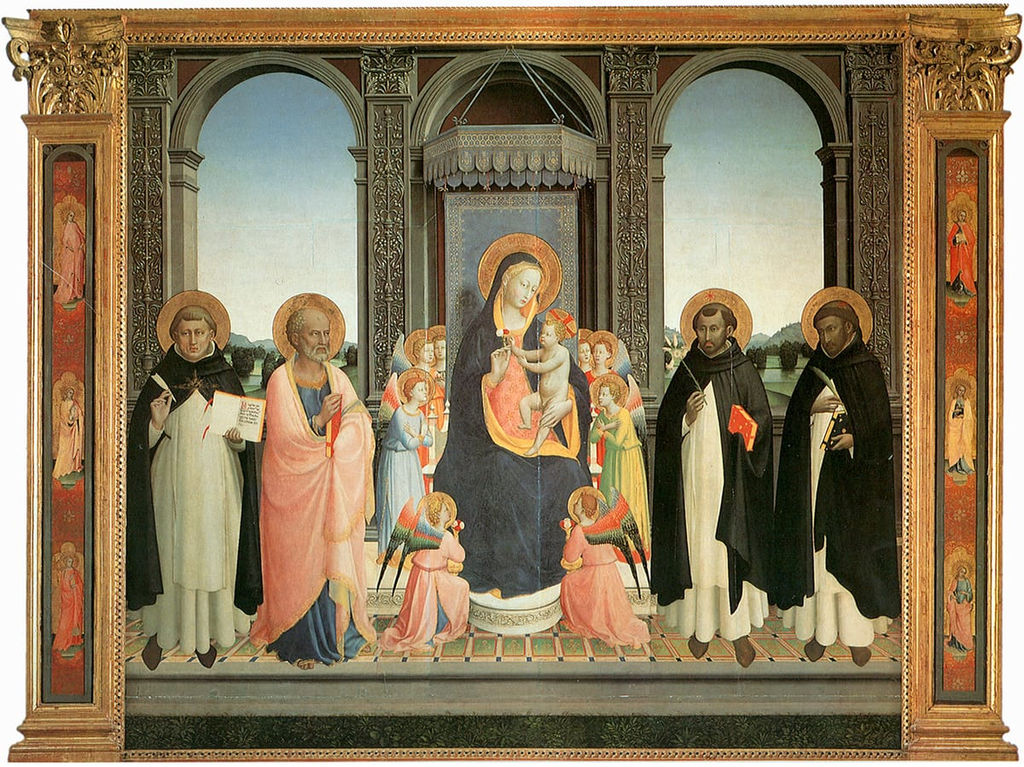
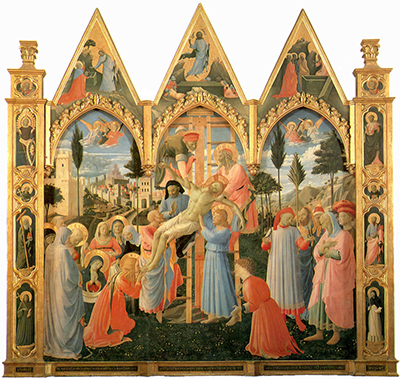
The main Fiesole altarpiece as it survives after Lorenzo di Credi’s alterations. Its detached predella is in London. Image source. Public domain. Proportional web resize.
Why the panel was attributed to Fra Angelico
For many years the painting was considered a work by Lorenzo Monaco. The small, pointed panel, gold ground and long contours of the garments are understandable points of contact with his work. San Diego puts more weight on the way the folds describe the bodies beneath them and on the foreshortened arch. Look at the way Paul’s elbow changes the direction of his cloak, or how the mass of Mary’s knees pushes her mantle out over the seat. The painted architecture and the handling of the figures suggest a painter interested in how bodies occupy space. The museum sees these features as signs of the young Angelico’s hand. [1] [5]
Writing in 2005, Laurence Kanter compared the painted arch to the stone tracery of a narrow Gothic church window. He also noticed how the positions of the saints describe a semicircle around Mary. These observations explain why the picture can feel surprisingly roomy. The front pair stand far enough forward to suggest space between them and the two saints behind, and their turn towards the throne continues the curve of the arch in the placement of bodies. Kanter proposed the young Angelico as the painter, with a question mark. He compared the panel with works associated with Lorenzo’s shop and pointed to the foreshortened angels in a Madonna in the Hermitage as one possible link with Angelico’s subsequent work. [8]
Carl Brandon Strehlke also saw the young Angelico’s hand in the panel. Angelo Tartuferi has questioned the grounds for placing Angelico’s training in Lorenzo’s workshop. In 2019 the panel travelled to the Museo del Prado for Fra Angelico and the Rise of the Florentine Renaissance. It appeared in the opening section on Angelico’s early work and was presented there under a joint attribution to Angelico and Lorenzo’s workshop. San Diego catalogues it under Angelico’s name. The two presentations give different weight to the workshop’s contribution, something the drapery and arch alone cannot settle. [2] [9] [10] [11]
A comparison with Angelico’s later Cortona Triptych makes the San Diego painter’s choices easier to see. In Cortona, gilded uprights separate the standing saints from the central throne, and episodes from Saint Dominic’s life run along the foot of the altarpiece. A Crucifixion crowns the central section. Angelico could also make the saints share a single space in a triptych, as the San Pietro Martire Triptych shows. [11] [12]
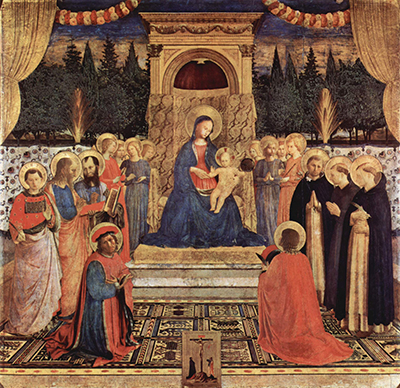
In the later Bosco ai Frati Altarpiece, Angelico placed the Man of Sorrows below the enthroned Madonna, at the centre of the row of smaller scenes and figures known as the predella. Saints Peter and Paul appear in that lower row. The position of the Passion image changes the route through each picture. In San Diego, the arch gives the eye a place to pause on a short upward journey from the Child’s blessing to the figure at the tomb. [1] [12]
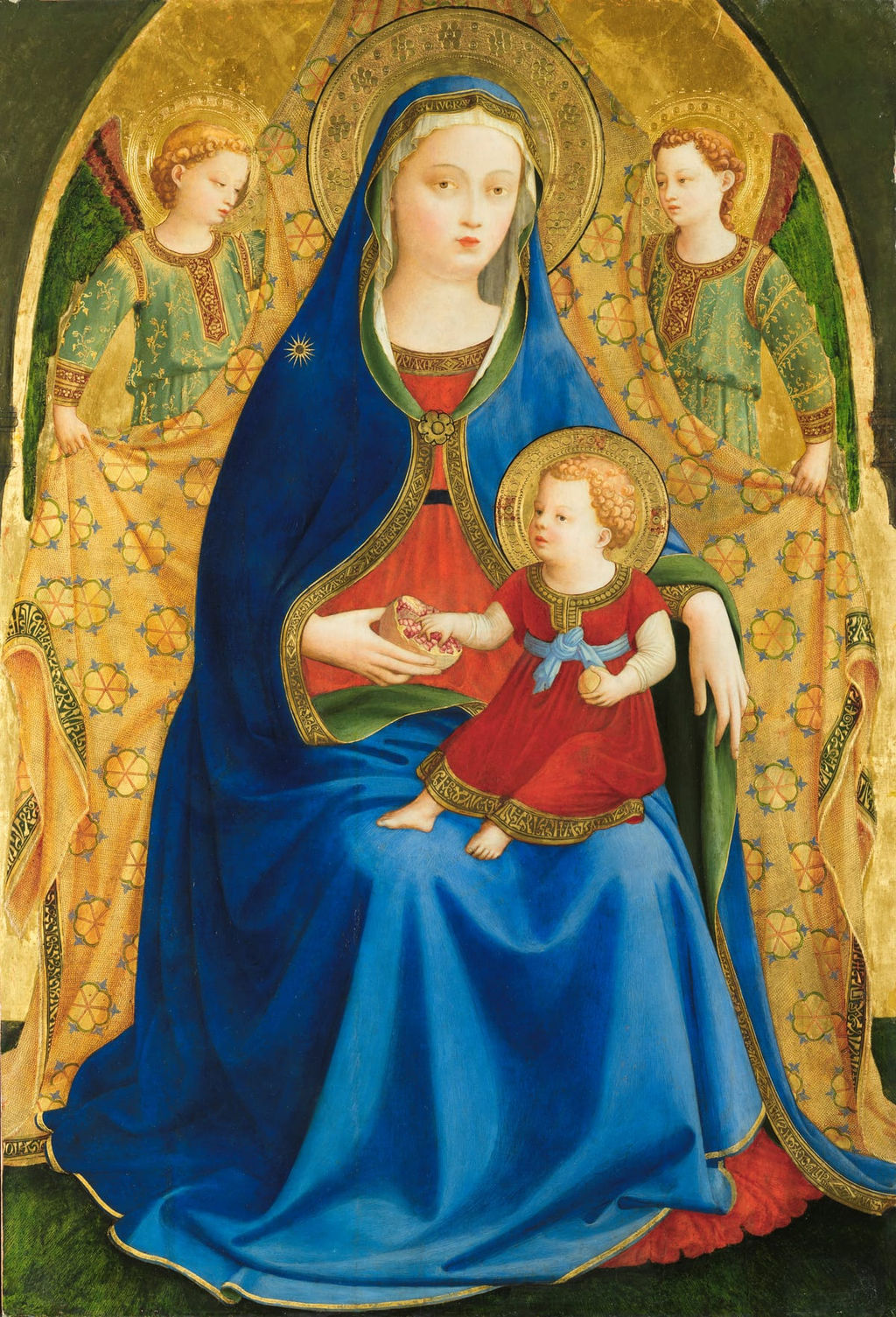
The Prado’s Virgin of the Pomegranate. The fruit, brought forward by two small gestures, sits against the red of the Virgin’s dress. Image source. Public domain. Proportional web resize.
Fra Angelico artworks directory
Explore documented works and surviving parts of larger ensembles. Catalogue links identify individual records. Attribution and dating can vary across collections and publications. Search the Federico Zeri Photo Archive by artist.
| Name | Date | Medium and sources |
|---|---|---|
| Adoration of the Magi | About 1440–60, NGA catalogue | Painting Catalogue. |
| Adoration of the Magi (Armadio degli Argenti) | About 1450–53 | Tempera and gold on wood. Catalogue. |
| Agony in the Garden (Armadio degli Argenti) | About 1450–53 | Tempera and gilding on wood Catalogue. |
| Annalena Altarpiece / Pala di Annalena | commonly c. 1435 | Tempera on panel Catalogue. |
| Annunciation (Armadio degli Argenti) | About 1450–53 | Tempera and gilding on wood. Catalogue. |
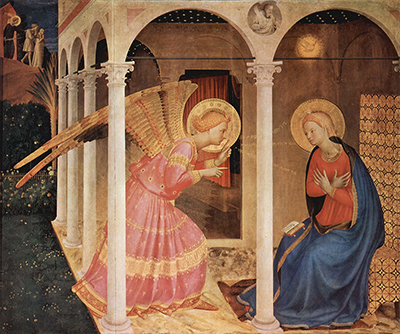
| Annunciation (Cortona) | generally placed in the 1430s; exact dating remains debated | Tempera on panel Catalogue. |
| Annunciation (Prado) | 1425–26 | Tempera on poplar panel Catalogue. |
| Annunciation (San Marco upper corridor) | commonly c. 1442 | Fresco Catalogue. |
| Annunciation with Saint Peter Martyr | About 1439–43 | Fresco on plaster. Catalogue. |
| Annunciatory Angel | 1450–55, Detroit catalogue | Gold leaf and tempera on wood panel. Catalogue. |
| Armadio degli Argenti (Silver Treasury) | principally c. 1450–52 | Tempera on panel Catalogue. |
| Arrest of Christ (Armadio degli Argenti) | About 1450–53 | Tempera and gilding on wood Catalogue. |
| Ascension (Armadio degli Argenti) | About 1450–53 | Tempera and gilding on wood Catalogue. |
| Baptism of Christ (Armadio, Alesso Baldovinetti) | About 1452–53 | Tempera and gilding on wood Catalogue. |
| Beheading of Saints Cosmas and Damian (San Marco Altarpiece) | About 1438–42 | Painted panel Catalogue. |
| Betrayal of Christ (Armadio degli Argenti) | About 1450–53 | Tempera and gilding on wood Catalogue. |
| Blessed Dominican, Possibly Jordan of Saxony (San Marco Altarpiece) | About 1438–42 | Painted panel Catalogue. |
| Blessed Vincent Ferrer (San Marco Altarpiece) | About 1438–42 | Painted panel Catalogue. |
| Burial of Saints Cosmas and Damian (San Marco Altarpiece) | About 1438–42 | Painted panel Catalogue. |
| Bust of a Cleric and a Group of Figures (recto and verso) | 15th century | Pen and ink on paper Catalogue. |
| Christ among the Doctors (Armadio degli Argenti) | About 1450–53 | Tempera and gilding on wood Catalogue. |
| Christ before Caiaphas (Armadio degli Argenti) | About 1450–53 | Tempera and gilding on wood Catalogue. |
| Christ Glorified in the Court of Heaven | About 1423–24 | Egg tempera on wood, probably poplar, with gold and silver leaf Catalogue. |
| Christ Seated in Judgment | 1447 | Fresco and gilding on plaster. Catalogue. |
| Christ Stripped of His Garments (Armadio degli Argenti) | About 1450–53 | Tempera and gilding on wood Catalogue. |
| Christ Washes the Apostles’ Feet (Armadio degli Argenti) | About 1450–53 | Tempera and gilding on wood Catalogue. |
| Circumcision of Christ (Armadio degli Argenti) | About 1450–53 | Tempera and gilding on wood. Catalogue. |
| Communion of the Apostles (Armadio degli Argenti) | About 1450–53 | Tempera and gilding on wood Catalogue. |
| Coronation of the Virgin (Armadio degli Argenti) | About 1450–53 | Tempera and gilding on wood Catalogue. |
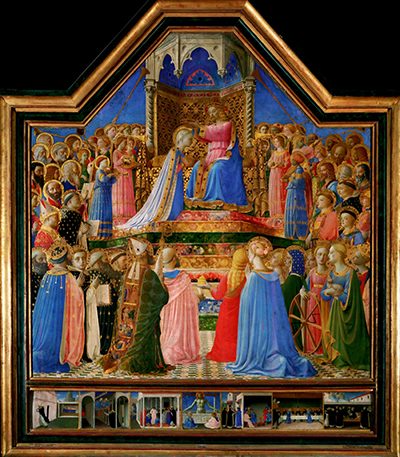
| Coronation of the Virgin (Louvre) | Louvre: second quarter of the fifteenth century, 1425–50; often dated more narrowly c. 1434–35 | Tempera and gold on panel Catalogue. |
| Coronation of the Virgin (Uffizi) | 1431–35 | Tempera on wood, gold ground Catalogue. |
| Cortona Triptych | About 1437 | Tempera and gold on panel. Catalogue. |
| Crucifixion (Armadio degli Argenti) | About 1450–53 | Tempera and gilding on wood Catalogue. |
| Crucifixion and Saints | 1441–42 | Fresco Catalogue. |
| Deposition from the Cross / Santa Trinita Deposition | commissioned 1429–32; completed by Angelico within this period | Tempera on panel Catalogue. |
| Descent into Limbo (Armadio degli Argenti) | About 1450–53 | Tempera and gilding on wood Catalogue. |
| Entombment of Christ (San Marco Altarpiece) | About 1438–42 | Painted panel Catalogue. |
| Entry into Jerusalem (Armadio degli Argenti) | About 1450–53 | Tempera and gilding on wood Catalogue. |
| Expulsion and the Stoning of Saint Stephen | 1448–49, Vatican Museums | Fresco. Catalogue. |
| Fiesole San Domenico Altarpiece | early 1420s; predella about 1423–24 | Tempera on panel Catalogue. |
| Flagellation (Armadio degli Argenti) | About 1450–53 | Tempera and gilding on wood Catalogue. |
| Flight into Egypt | About 1450–53 | Tempera and gilding on wood. Catalogue. |
| Guidalotti Polyptych | c. 1447–49 | Tempera and oil on panel Catalogue. |
| Healing of Palladia and Saint Damian Accepting Her Gift (San Marco Altarpiece) | About 1438–42 | Painted panel Catalogue. |
| Holy Pilgrim, Possibly Saint Roch (San Marco Altarpiece) | About 1438–42 | Painted panel Catalogue. |
| Holy Women at the Tomb (Armadio degli Argenti) | About 1450–53 | Tempera and gilding on wood Catalogue. |
| Judas Receives Payment (Armadio degli Argenti) | About 1450–53 | Tempera and gilding on wood Catalogue. |
| Lamentation over Christ (Armadio degli Argenti) | About 1450–53 | Tempera and gilding on wood Catalogue. |
| Lamentation over the Dead Christ (Croce al Tempio Lamentation) | 1436–41, Zeri catalogue | Tempera and gilding on wood panel. Catalogue. |
| Last Judgement (Armadio degli Argenti) | About 1450–53 | Tempera and gilding on wood Catalogue. |
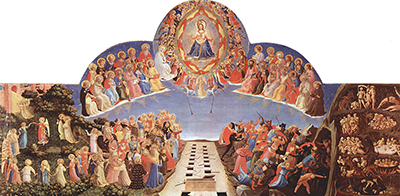
| Last Judgement (San Marco) | c. 1425–28 | Tempera and gold on panel Catalogue. |
| Last Supper (Armadio degli Argenti) | About 1450–53 | Tempera and gilding on wood Catalogue. |
| Lex Amoris (Armadio degli Argenti) | About 1450–53 | Tempera and gilding on wood Catalogue. |
| Madonna and Child with Saint Dominic and Saint Thomas Aquinas | About 1430, Hermitage catalogue | Detached fresco. Catalogue. |
| Madonna and Child with Saints | About 1411–13 | Tempera on wood panel, with a gold ground. Catalogue. |
| Madonna of Humility | About 1425, Thyssen catalogue | Tempera and gold on wood. Catalogue. |
| Madonna of the Star | 1431–34, Zeri catalogue | Tempera with oil glazes and gold on wood panel, as catalogued by the Gardner for the 2018 exhibition. Catalogue. |
| Marriage at Cana (Armadio, Alesso Baldovinetti) | About 1452–53 | Tempera and gilding on wood Catalogue. |
| Massacre of the Innocents (Armadio degli Argenti) | About 1450–53 | Tempera and gilding on wood Catalogue. |
| Miracle of the Black Leg (San Marco Altarpiece) | About 1438–42 | Painted panel Catalogue. |
| Mocking of Christ (Armadio degli Argenti) | About 1450–53 | Tempera and gilding on wood Catalogue. |
| Mystic Wheel (The Vision of Ezekiel) | About 1450–52 | Tempera and gilding on wood. Catalogue. |
| Nativity (Armadio degli Argenti) | About 1450–53 | Tempera and gilding on wood. Catalogue. |
| Niccoline Chapel frescoes | principally 1448–50 | Fresco Catalogue. |
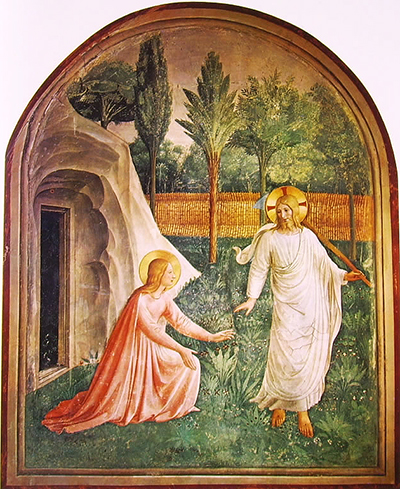
| Noli me Tangere | broadly within Angelico’s San Marco campaign, late 1430s–1440s | Fresco Catalogue. |
| Ordination of Saint Lawrence | 1448 | Fresco. Catalogue. |
| Pentecost (Armadio degli Argenti) | About 1450–53 | Tempera and gilding on wood Catalogue. |
| Presentation of Christ at the Temple (Armadio degli Argenti) | About 1450–53 | Tempera and gilding on wood. Catalogue. |
| Presentation of Jesus at the Temple | Early 1440s | Fresco on plaster. Catalogue. |
| Raising of Lazarus (Armadio degli Argenti) | About 1450–53 | Tempera and gilding on wood Catalogue. |
| Rescue of Saints Cosmas and Damian and Exorcism of Lysias (San Marco Altarpiece) | About 1438–42 | Painted panel Catalogue. |
| Road to Calvary (Armadio degli Argenti) | About 1450–53 | Tempera and gilding on wood Catalogue. |
| Saint Anthony Abbot (San Marco Altarpiece) | About 1438–42 | Painted panel Catalogue. |
| Saint Bernard of Clairvaux or Saint Benedict (San Marco Altarpiece) | About 1438–42 | Painted panel Catalogue. |
| Saint Damian Receives Money from Palladia | About 1425–49 | Tempera and gilding on wood. Catalogue. |
| Saint Francis and a Bishop Saint, Saint John the Baptist and Saint Dominic | Late 1420s, Getty catalogue | Tempera and gold leaf on panel. Catalogue. |
| Saint James the Greater Freeing the Magician Hermogenes | About 1426–29 | Tempera and gold on panel Catalogue. |
| Saint Jerome (San Marco Altarpiece) | About 1438–42 | Painted panel Catalogue. |
| Saint Lawrence Giving Alms | About 1448 | Wall fresco. Catalogue. |
| Saint Lawrence Receiving the Treasures of the Church from Pope Sixtus II | About 1448–49 | Fresco on plaster. Catalogue. |
| Saint Romuald (San Marco Altarpiece) | About 1438–42 | Painted panel Catalogue. |
| Saint Stephen Addressing the Council | 1448–49, Vatican Museums | Fresco. Catalogue. |
| Saint Stephen Preaching | 1448–49, Vatican Museums | Wall fresco. Catalogue. |
| Saint Thomas Aquinas (San Marco Altarpiece) | About 1438–42 | Painted panel Catalogue. |
| Saints Cosmas and Damian and Their Brothers Survive the Stake | Second quarter of the 15th century | Tempera and gilding on wood. Catalogue. |
| Saints Cosmas and Damian at the Stake (San Marco Altarpiece) | About 1438–42 | Painted panel Catalogue. |
| Saints Cosmas and Damian before Lysias (San Marco Altarpiece) | About 1438–42 | Painted panel Catalogue. |
| Saints Cosmas and Damian Rescued by an Angel | Second quarter of the 15th century | Tempera and gilding on wood. Catalogue. |
| Saints Cosmas and Damian with Their Brothers before Proconsul Lysias | Second quarter of the 15th century | Tempera and gilding on wood. Catalogue. |
| San Marco Altarpiece / Pala di San Marco | 1438–43 | Tempera on panel Catalogue. |
| San Pietro Martire Triptych | About 1422–23, Strozzi exhibition | Tempera and gold on panel. Catalogue. |
| Scenes from the Lives of the Desert Fathers (Thebaid) | About 1420, Uffizi catalogue | Tempera on wood. Catalogue. |
| Sixteen Prophets | 1447 | Fresco and gilding on plaster Catalogue. |
| Stoning and Shooting of the Brothers (San Marco Altarpiece) | About 1438–42 | Painted panel Catalogue. |
| Tabernacle of the Linaioli | 1433–35 | Tempera on panel Catalogue. |
| The Attempted Crucifixion and Stoning of Saints Cosmas and Damian | Second quarter of the 15th century | Tempera and gilding on wood. Catalogue. |
| The Crucifixion | About 1420–23, Met catalogue | Tempera on wood, gold ground. Catalogue. |
| The Death and the Assumption of the Virgin | 1424–34 | Tempera with oil glazes and gold on panel Catalogue. |
| The Dominican Blessed (left end) (Fiesole predella) | About 1423–24 | Egg tempera and gold on wood Catalogue. |
| The Dominican Blessed (right end) (Fiesole predella) | About 1423–24 | Egg tempera and gold on wood Catalogue. |
| The Entombment of Christ | About 1450 | Tempera on poplar panel. Catalogue. |
| The Forerunners of Christ with Saints and Martyrs | About 1423–24 | Egg tempera on wood (probably poplar), with gold and silver leaf. Catalogue. |
| The Funeral of Saint Anthony Abbot | About 1426–30 | Tempera on poplar panel. Catalogue. |
| The Martyrdom of Saints Cosmas and Damian | About 1425–49 | Tempera and gilding on wood. Catalogue. |
| The Mocking of Christ / Christ Mocked | within the San Marco dormitory campaign, broadly late 1430s–1440s | Fresco Catalogue. |
| The Nativity | About 1425, Minneapolis catalogue | Tempera on poplar panel. Catalogue. |
| The Nativity in Cell 5 at San Marco | About 1439–43 | Fresco on plaster. Catalogue. |
| The Penitent Saint Jerome | 1419–20 | Tempera on wood panel Catalogue. |
| The Virgin and Child by Fra Angelico (Fogg Museum) | About 1430, Harvard catalogue | Tempera originally on panel, subsequently transferred to Masonite. Catalogue. |
| The Virgin Mary with the Apostles and Other Saints (Fiesole predella) | About 1423–24 | Egg tempera and gold on wood Catalogue. |
| Transfiguration (Armadio, Alesso Baldovinetti) | About 1452–53 | Tempera and gilding on wood Catalogue. |
| Transfiguration (San Marco Cell 6) | within the San Marco dormitory campaign, broadly late 1430s–1440s | Fresco Catalogue. |
| Virgin Mary Annunciate | 1450–55, Detroit catalogue | Gold leaf and tempera on wood panel. Catalogue. |
| Virgin of the Pomegranate | About 1426 | Tempera on panel with gilding Catalogue. |
Frequently Asked Questions
Discussion
Use these prompts to look again or share an observation.
Reader Insights
Look for different ways individual saints are scaled or placed around the enthroned Madonna. Where does the arrangement feel most unified?
Which specific folds, borders or changes of surface would you compare when considering the different views of authorship?
Join the Conversation
Share a detail or question about Madonna and Child with Saints.
References
- The San Diego Museum of Art, European Art gallery labels, p. 13, entry for Madonna and Child with Saints, 1946.18. View source.
- Boletín Oficial del Estado, Order CUD/392/2019, §3 and annex, item 18 (in Spanish). View source.
- Getty Research Institute, Cultural Objects Name Authority, Christ as the Man of Sorrows, iconography record. View source.
- Camaldoli Cultura, Storia, section on Saint Romuald and the origins of the hermitage (in Italian). View source.
- Gallerie degli Uffizi, Incoronazione della Vergine, Lorenzo Monaco, collection entry (in Italian). View source.
- Archivio di Stato di Firenze, Famiglia Alberti, Raccolta Ceramelli Papiani, fasc. 45, blazon (in Italian). View source.
- Kurt Weissen, Florentine Banks in Germany, Heidelberg University Publishing, 2024, chapter 4, pp. 133–35, on exile and exemptions. View source.
- Laurence Kanter, “Fra Angelico: The Early Works (about 1410–21)”, in Fra Angelico, The Metropolitan Museum of Art, 2005, pp. 9–11, fig. 10. View source.
- Alessandro Santini, Inchiesta sulla giovinezza del Beato Angelico, Museo di San Marco e Cenacoli, 2026, discussion of the early works proposed by Kanter and Strehlke (in Italian). View source.
- Fiammetta Campagnoli, Fra Angelico ou quand le couvent n’est plus une tour d’ivoire, account of the Prado exhibition, discussion of the first room and note 7 (in French). View source.
- Museo di San Marco e Cenacoli, interview with Angelo Tartuferi on Fra Angelico’s early work, 2025 (in Italian). View source.
- Fondazione Palazzo Strozzi, Fra Angelico, 2025 exhibition checklist, items 19 and 21, Cortona Triptych and Bosco ai Frati Altarpiece. View source.
.jpg)
 Fra Angelico.jpg)