 by Tom Gurney
Tom Gurney BSc (Hons) is an art history expert with over 20 years experience
Published on June 19, 2020 / Updated on November 29, 2026
Email: tomgurney1@gmail.com / Phone: +44 7429 011000
Introduction
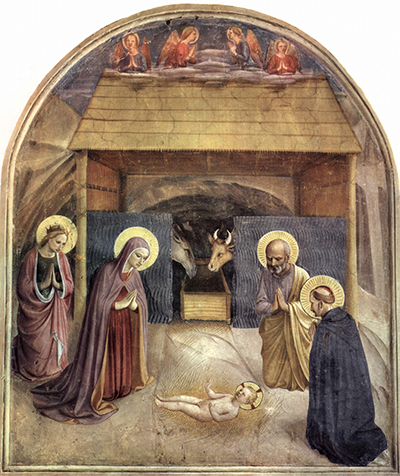
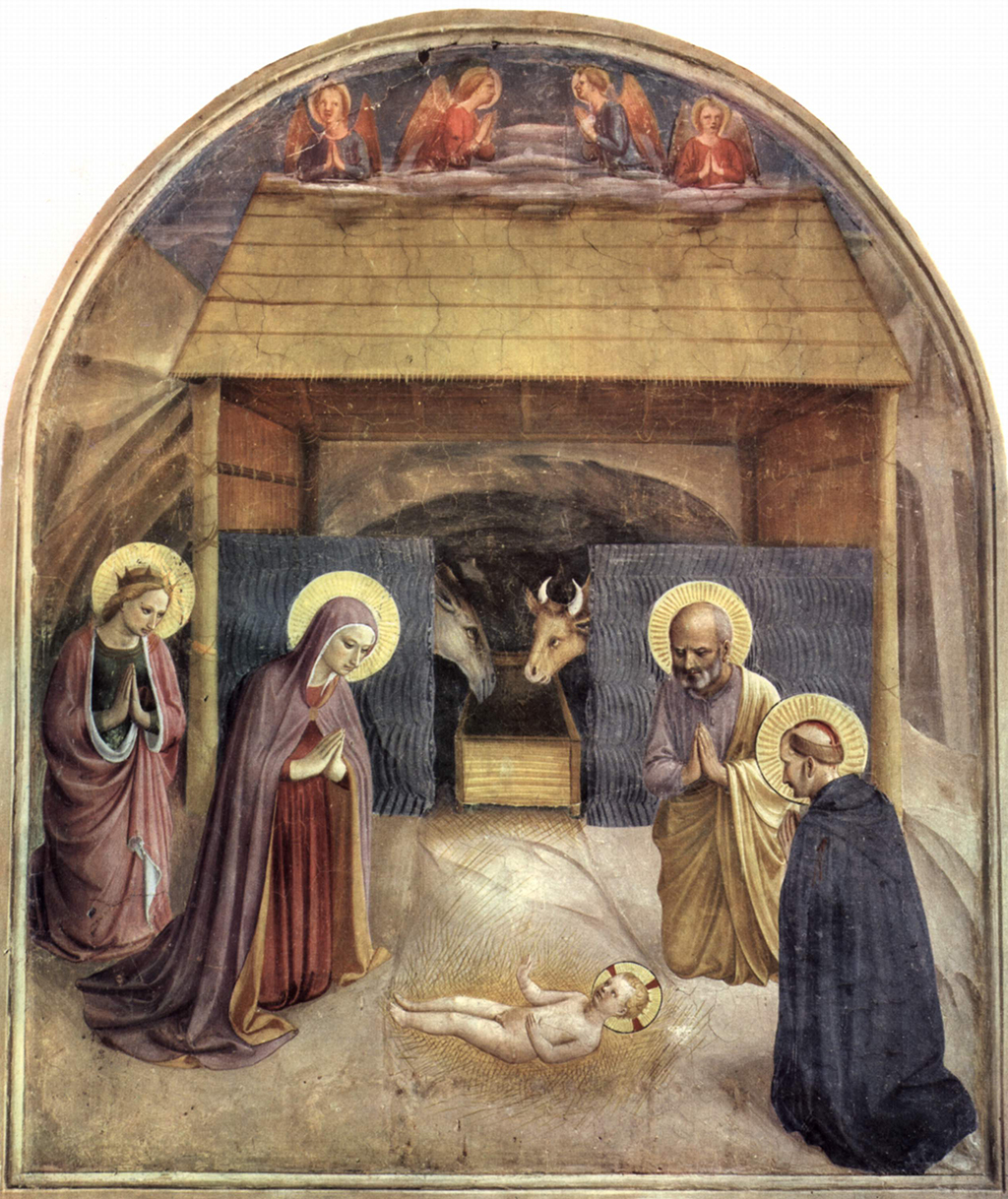
A newborn lies on a scattering of straw in the foreground. Behind him, an ox and a donkey put their heads over a feeding trough. Mary and Joseph bow towards the child, and two saints from later centuries kneel beside them. In the Nativity painted around 1439–43 for cell 5 of the Dominican convent of San Marco in Florence, Fra Angelico and his assistants turned the story of Christ's birth into a scene a friar could return to in prayer. [1] [2]
At a Glance
- ArtistFra Angelico and assistants. [1]
- DateAbout 1439–43. [1]
- MediumFresco on plaster. [1]
- Dimensions193 × 164 cm (height × width). [3]
- LocationCell 5 of the upper-floor dormitory at the Museo di San Marco, Florence. [2] [3]
- SubjectThe birth and adoration of Christ with Saint Catherine of Alexandria and Saint Peter Martyr. [1] [2]
The child in front of the stable
The roof is the broadest shape in the picture. Its straight lower edge cuts across the curved frame, and its two front posts divide the space below. Behind them, a dark opening leads into the rock. At the centre, the heads of the donkey and the ox meet over a rectangular feeding trough. The long ears of one and the pale horns of the other stand out against the dark. As the eye comes forward from the trough, it finds the child lower down, on a thin spread of straw. The stable establishes where the birth happened, while the open ground in front of it makes the little body easy to see. [1] [4]
The child has one arm raised, and his bare legs stretch almost horizontally across the foreground. The red cross on his halo is an early sign of the Passion, visible in a scene devoted to his birth. Mary's mantle falls towards the lower left, where its folds pool along the edge of the straw. She brings her palms together as she bows her head. Across from her, Joseph holds his hands at almost the same height. His balding head and beard catch the light, and the warm folds that cover his knees give his figure weight. The two adults take up much more space than the child, but the inclinations of their faces bring attention back to him. [1] [4]
Luke's Gospel describes Mary wrapping the newborn and laying him in a manger. It then moves to the angel's announcement to the shepherds, who come to find the child. The fresco keeps the manger in view, places the unwrapped child on the ground and gives the places around him to kneeling figures. That arrangement recalls a form of the Nativity popular in fifteenth-century Florence. In the fourteenth-century vision of Saint Bridget of Sweden, Mary knelt to adore the newborn while he still lay naked on the ground. The resemblance helps explain why Renaissance viewers could recognise both the birth and the act of adoration in a single image. [4] [5] [6]
Catherine of Alexandria and Peter Martyr
At the left edge, a crown peeks out beneath the halo of Saint Catherine of Alexandria. Her joined hands and bowed face echo Mary's, although the post of the stable separates Catherine from the central opening. At the lower right, Saint Peter Martyr kneels with his dark Dominican cloak turned towards us. The wound visible on his head identifies him as the martyr Peter of Verona. His back and shoulder partly screen Joseph's mantle, placing the friar close to the front of the painted space. The two saints come from different centuries, and their presence makes the birth a scene of devotion that later believers can enter. [1] [2] [4]
Peter's posture offers a particularly direct way into the scene. We see the infant from nearly the same side that Peter does, and can follow the slight turn of his head towards the ground. William Hood has related the gestures of the later saints in the San Marco frescoes to the Dominican tradition of prayer described in De modo orandi, a treatise on Saint Dominic's ways of praying. In cell 5, a friar would have seen a member of his own order kneeling near his side of the picture. Catherine, Mary and Joseph each give their attention to the same child from a different position. The poses make it possible to linger over what each person is doing, even once the story is familiar. [1] [4] [7]
The image belonged to a room in the dormitory that Michelozzo designed as part of the rebuilding of San Marco, supported by the Medici. Marco Mozzo notes that the Observant Dominican rules allowed certain small religious images, while painting substantial frescoes inside individual cells was an unusual undertaking. At almost two metres high, this work would have had a considerable presence in a friar's room. Its arched painted frame sets out the extent of the scene, and the empty strip of ground below the child leaves a little space between the gathering and the person in the cell. [3] [4] [8]
Four angels and several painters
Four angels occupy the narrow band above the roof. The two in the middle turn towards each other in profile, and the outer pair face more nearly forward. Their wings and clothing fit under the arch. Their joined hands repeat the gestures beneath them on a smaller scale, while the roof separates the two groups. The painted architecture gives each group a place of its own, even though the same act of worship joins them. [4]
The angels have also become central to the question of who painted the fresco. Italy's national catalogue records that Germain Bazin attributed the work to an unnamed Master of the Nativity, and John Pope-Hennessy to the painter he called the Master of Cell 2. Its preferred entry credits Angelico and assistants, reflecting the view that Angelico painted part of the fresco and that an assistant's contribution is most evident above the roof. [1]
Dino Dini restored the Nativity during the campaign that began in 1967. The cell 5 fresco had already received treatment when Luciano Bellosi became director of the Museo di San Marco in 1976. Writing in 1984 after the dormitory campaign, Bellosi argued that the early work of a young Benozzo Gozzoli could be seen in several cell frescoes executed under Angelico's supervision. For cell 5 he singled out the angels, and the Museo Benozzo Gozzoli also identifies the angel group as the assistant's contribution. [9] [10]
Magnolia Scudieri gives a different account in the Metropolitan Museum of Art's 2005 catalogue. She associates the angels with Zanobi Strozzi, a follower of Angelico also known for panels and illuminated books, and notes that Anna Maria Francini Ciaranfi had already made that connection. Scudieri discusses the angels in the course of comparing passages across the dormitory with Strozzi's manner, including the crisp drawing and schematic highlights she sees in works associated with him. She also explains how studying the areas of plaster prepared for each day's work, known as giornate, helps distinguish passages made separately in the San Marco frescoes. Plaster joins can help to establish how the work was divided. The comparison of painted forms is what led Scudieri to put forward Strozzi’s name. [4] [11]
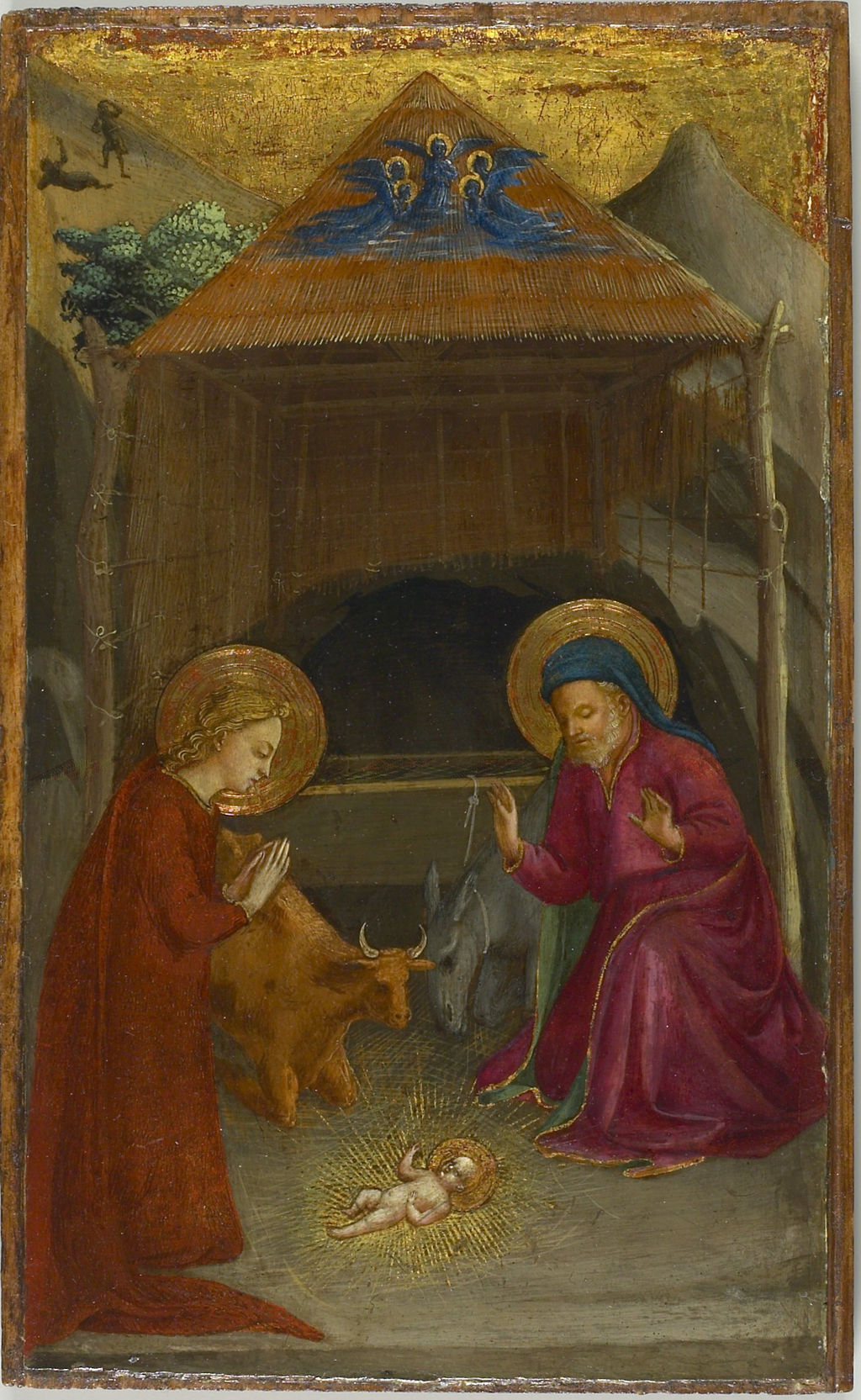
Minneapolis Institute of Art, accession 68.41.8. The sparse stable separates the angelic choir from the kneeling adults. Image source. Public domain. Proportional web resize.
Two other Nativities
The Minneapolis Institute of Art has an earlier Nativity in tempera on a small poplar panel, which the museum dates to about 1425–30. The Museo di San Marco also holds the Nativity from the later Armadio degli Argenti, the painted covering of a cabinet made for offerings at the Florentine church of Santissima Annunziata. In 1853, the Dominican writer Vincenzo Marchese saw a resemblance between the conception of that scene and the cell fresco. Both have the ox and donkey at the stable, but the cabinet's episode forms part of a sequence from the life of Christ, accompanied by scriptural inscriptions. The cell fresco offers a larger, single scene, with Catherine and Peter kneeling where a friar could see them day after day. [2] [4] [12] [13] [14]
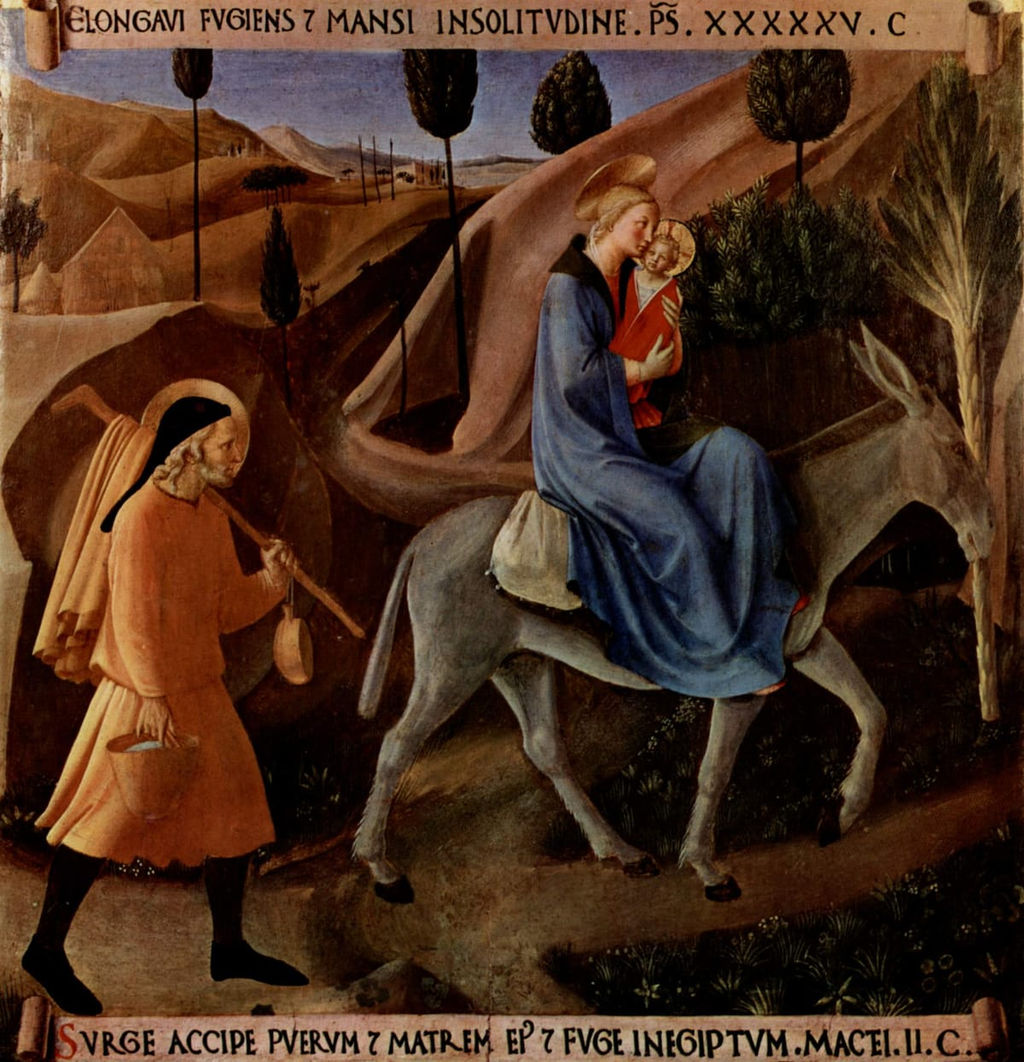
The Flight into Egypt in the Armadio, 0900191187A-7. The inscriptions sit directly above and below the road and its travellers. Image source. Public domain. Proportional web resize.
Further reading
Explore a catalogue or scholarly study related to this article.
Fra Angelico. Painter, Friar, Mystic. Timothy Verdon. Brepols, 2021.
Verdon situates the cell paintings within the religious life of the convent. See the publisher’s description.
Fra Angelico artworks directory
Explore documented works and surviving parts of larger ensembles. Catalogue links identify individual records. Attribution and dating can vary across collections and publications. Search the Federico Zeri Photo Archive by artist.
| Name | Date | Medium and sources |
|---|---|---|
| Adoration of the Magi | About 1440–60, NGA catalogue | Painting Catalogue. |
| Adoration of the Magi (Armadio degli Argenti) | About 1450–53 | Tempera and gold on wood. Catalogue. |
| Agony in the Garden (Armadio degli Argenti) | About 1450–53 | Tempera and gilding on wood Catalogue. |
| Annalena Altarpiece / Pala di Annalena | commonly c. 1435 | Tempera on panel Catalogue. |
| Annunciation (Armadio degli Argenti) | About 1450–53 | Tempera and gilding on wood. Catalogue. |
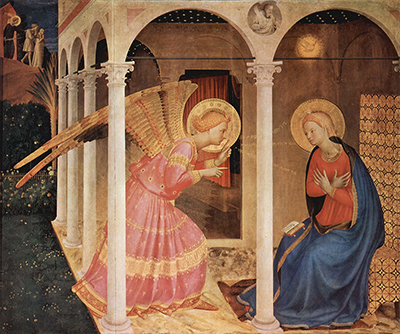
| Annunciation (Cortona) | generally placed in the 1430s; exact dating remains debated | Tempera on panel Catalogue. |
| Annunciation (Prado) | 1425–26 | Tempera on poplar panel Catalogue. |
| Annunciation (San Marco upper corridor) | commonly c. 1442 | Fresco Catalogue. |
| Annunciation with Saint Peter Martyr | About 1439–43 | Fresco on plaster. Catalogue. |
| Annunciatory Angel | 1450–55, Detroit catalogue | Gold leaf and tempera on wood panel. Catalogue. |
| Armadio degli Argenti (Silver Treasury) | principally c. 1450–52 | Tempera on panel Catalogue. |
| Arrest of Christ (Armadio degli Argenti) | About 1450–53 | Tempera and gilding on wood Catalogue. |
| Ascension (Armadio degli Argenti) | About 1450–53 | Tempera and gilding on wood Catalogue. |
| Baptism of Christ (Armadio, Alesso Baldovinetti) | About 1452–53 | Tempera and gilding on wood Catalogue. |
| Beheading of Saints Cosmas and Damian (San Marco Altarpiece) | About 1438–42 | Painted panel Catalogue. |
| Betrayal of Christ (Armadio degli Argenti) | About 1450–53 | Tempera and gilding on wood Catalogue. |
| Blessed Dominican, Possibly Jordan of Saxony (San Marco Altarpiece) | About 1438–42 | Painted panel Catalogue. |
| Blessed Vincent Ferrer (San Marco Altarpiece) | About 1438–42 | Painted panel Catalogue. |
| Burial of Saints Cosmas and Damian (San Marco Altarpiece) | About 1438–42 | Painted panel Catalogue. |
| Bust of a Cleric and a Group of Figures (recto and verso) | 15th century | Pen and ink on paper Catalogue. |
| Christ among the Doctors (Armadio degli Argenti) | About 1450–53 | Tempera and gilding on wood Catalogue. |
| Christ before Caiaphas (Armadio degli Argenti) | About 1450–53 | Tempera and gilding on wood Catalogue. |
| Christ Glorified in the Court of Heaven | About 1423–24 | Egg tempera on wood, probably poplar, with gold and silver leaf Catalogue. |
| Christ Seated in Judgment | 1447 | Fresco and gilding on plaster. Catalogue. |
| Christ Stripped of His Garments (Armadio degli Argenti) | About 1450–53 | Tempera and gilding on wood Catalogue. |
| Christ Washes the Apostles’ Feet (Armadio degli Argenti) | About 1450–53 | Tempera and gilding on wood Catalogue. |
| Circumcision of Christ (Armadio degli Argenti) | About 1450–53 | Tempera and gilding on wood. Catalogue. |
| Communion of the Apostles (Armadio degli Argenti) | About 1450–53 | Tempera and gilding on wood Catalogue. |
| Coronation of the Virgin (Armadio degli Argenti) | About 1450–53 | Tempera and gilding on wood Catalogue. |
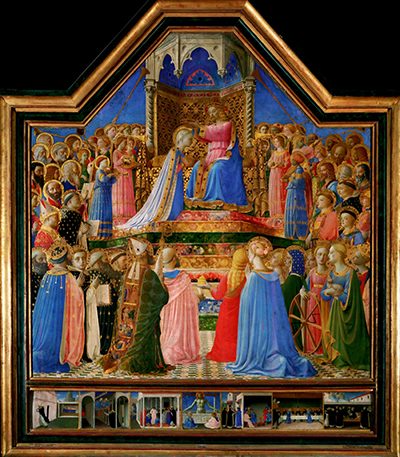
| Coronation of the Virgin (Louvre) | Louvre: second quarter of the fifteenth century, 1425–50; often dated more narrowly c. 1434–35 | Tempera and gold on panel Catalogue. |
| Coronation of the Virgin (Uffizi) | 1431–35 | Tempera on wood, gold ground Catalogue. |
| Cortona Triptych | About 1437 | Tempera and gold on panel. Catalogue. |
| Crucifixion (Armadio degli Argenti) | About 1450–53 | Tempera and gilding on wood Catalogue. |
| Crucifixion and Saints | 1441–42 | Fresco Catalogue. |
| Deposition from the Cross / Santa Trinita Deposition | commissioned 1429–32; completed by Angelico within this period | Tempera on panel Catalogue. |
| Descent into Limbo (Armadio degli Argenti) | About 1450–53 | Tempera and gilding on wood Catalogue. |
| Entombment of Christ (San Marco Altarpiece) | About 1438–42 | Painted panel Catalogue. |
| Entry into Jerusalem (Armadio degli Argenti) | About 1450–53 | Tempera and gilding on wood Catalogue. |
| Expulsion and the Stoning of Saint Stephen | 1448–49, Vatican Museums | Fresco. Catalogue. |
| Fiesole San Domenico Altarpiece | early 1420s; predella about 1423–24 | Tempera on panel Catalogue. |
| Flagellation (Armadio degli Argenti) | About 1450–53 | Tempera and gilding on wood Catalogue. |
| Flight into Egypt | About 1450–53 | Tempera and gilding on wood. Catalogue. |
| Guidalotti Polyptych | c. 1447–49 | Tempera and oil on panel Catalogue. |
| Healing of Palladia and Saint Damian Accepting Her Gift (San Marco Altarpiece) | About 1438–42 | Painted panel Catalogue. |
| Holy Pilgrim, Possibly Saint Roch (San Marco Altarpiece) | About 1438–42 | Painted panel Catalogue. |
| Holy Women at the Tomb (Armadio degli Argenti) | About 1450–53 | Tempera and gilding on wood Catalogue. |
| Judas Receives Payment (Armadio degli Argenti) | About 1450–53 | Tempera and gilding on wood Catalogue. |
| Lamentation over Christ (Armadio degli Argenti) | About 1450–53 | Tempera and gilding on wood Catalogue. |
| Lamentation over the Dead Christ (Croce al Tempio Lamentation) | 1436–41, Zeri catalogue | Tempera and gilding on wood panel. Catalogue. |
| Last Judgement (Armadio degli Argenti) | About 1450–53 | Tempera and gilding on wood Catalogue. |
| Last Judgement (San Marco) | c. 1425–28 | Tempera and gold on panel Catalogue. |
| Last Supper (Armadio degli Argenti) | About 1450–53 | Tempera and gilding on wood Catalogue. |
| Lex Amoris (Armadio degli Argenti) | About 1450–53 | Tempera and gilding on wood Catalogue. |
| Madonna and Child with Saint Dominic and Saint Thomas Aquinas | About 1430, Hermitage catalogue | Detached fresco. Catalogue. |
| Madonna and Child with Saints | About 1411–13 | Tempera on wood panel, with a gold ground. Catalogue. |
| Madonna of Humility | About 1425, Thyssen catalogue | Tempera and gold on wood. Catalogue. |
| Madonna of the Star | 1431–34, Zeri catalogue | Tempera with oil glazes and gold on wood panel, as catalogued by the Gardner for the 2018 exhibition. Catalogue. |
| Marriage at Cana (Armadio, Alesso Baldovinetti) | About 1452–53 | Tempera and gilding on wood Catalogue. |
| Massacre of the Innocents (Armadio degli Argenti) | About 1450–53 | Tempera and gilding on wood Catalogue. |
| Miracle of the Black Leg (San Marco Altarpiece) | About 1438–42 | Painted panel Catalogue. |
| Mocking of Christ (Armadio degli Argenti) | About 1450–53 | Tempera and gilding on wood Catalogue. |
| Mystic Wheel (The Vision of Ezekiel) | About 1450–52 | Tempera and gilding on wood. Catalogue. |
| Nativity (Armadio degli Argenti) | About 1450–53 | Tempera and gilding on wood. Catalogue. |
| Niccoline Chapel frescoes | principally 1448–50 | Fresco Catalogue. |
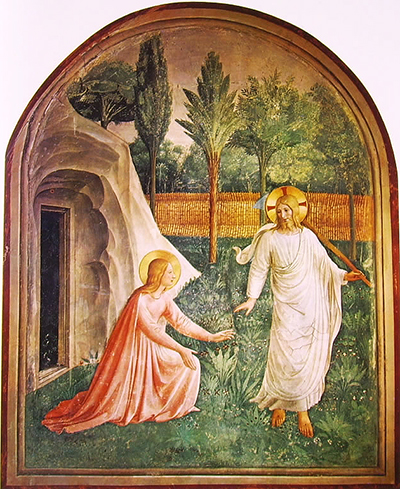
| Noli me Tangere | broadly within Angelico’s San Marco campaign, late 1430s–1440s | Fresco Catalogue. |
| Ordination of Saint Lawrence | 1448 | Fresco. Catalogue. |
| Pentecost (Armadio degli Argenti) | About 1450–53 | Tempera and gilding on wood Catalogue. |
| Presentation of Christ at the Temple (Armadio degli Argenti) | About 1450–53 | Tempera and gilding on wood. Catalogue. |
| Presentation of Jesus at the Temple | Early 1440s | Fresco on plaster. Catalogue. |
| Raising of Lazarus (Armadio degli Argenti) | About 1450–53 | Tempera and gilding on wood Catalogue. |
| Rescue of Saints Cosmas and Damian and Exorcism of Lysias (San Marco Altarpiece) | About 1438–42 | Painted panel Catalogue. |
| Road to Calvary (Armadio degli Argenti) | About 1450–53 | Tempera and gilding on wood Catalogue. |
| Saint Anthony Abbot (San Marco Altarpiece) | About 1438–42 | Painted panel Catalogue. |
| Saint Bernard of Clairvaux or Saint Benedict (San Marco Altarpiece) | About 1438–42 | Painted panel Catalogue. |
| Saint Damian Receives Money from Palladia | About 1425–49 | Tempera and gilding on wood. Catalogue. |
| Saint Francis and a Bishop Saint, Saint John the Baptist and Saint Dominic | Late 1420s, Getty catalogue | Tempera and gold leaf on panel. Catalogue. |
| Saint James the Greater Freeing the Magician Hermogenes | About 1426–29 | Tempera and gold on panel Catalogue. |
| Saint Jerome (San Marco Altarpiece) | About 1438–42 | Painted panel Catalogue. |
| Saint Lawrence Giving Alms | About 1448 | Wall fresco. Catalogue. |
| Saint Lawrence Receiving the Treasures of the Church from Pope Sixtus II | About 1448–49 | Fresco on plaster. Catalogue. |
| Saint Romuald (San Marco Altarpiece) | About 1438–42 | Painted panel Catalogue. |
| Saint Stephen Addressing the Council | 1448–49, Vatican Museums | Fresco. Catalogue. |
| Saint Stephen Preaching | 1448–49, Vatican Museums | Wall fresco. Catalogue. |
| Saint Thomas Aquinas (San Marco Altarpiece) | About 1438–42 | Painted panel Catalogue. |
| Saints Cosmas and Damian and Their Brothers Survive the Stake | Second quarter of the 15th century | Tempera and gilding on wood. Catalogue. |
| Saints Cosmas and Damian at the Stake (San Marco Altarpiece) | About 1438–42 | Painted panel Catalogue. |
| Saints Cosmas and Damian before Lysias (San Marco Altarpiece) | About 1438–42 | Painted panel Catalogue. |
| Saints Cosmas and Damian Rescued by an Angel | Second quarter of the 15th century | Tempera and gilding on wood. Catalogue. |
| Saints Cosmas and Damian with Their Brothers before Proconsul Lysias | Second quarter of the 15th century | Tempera and gilding on wood. Catalogue. |
| San Marco Altarpiece / Pala di San Marco | 1438–43 | Tempera on panel Catalogue. |
| San Pietro Martire Triptych | About 1422–23, Strozzi exhibition | Tempera and gold on panel. Catalogue. |
| Scenes from the Lives of the Desert Fathers (Thebaid) | About 1420, Uffizi catalogue | Tempera on wood. Catalogue. |
| Sixteen Prophets | 1447 | Fresco and gilding on plaster Catalogue. |
| Stoning and Shooting of the Brothers (San Marco Altarpiece) | About 1438–42 | Painted panel Catalogue. |
| Tabernacle of the Linaioli | 1433–35 | Tempera on panel Catalogue. |
| The Attempted Crucifixion and Stoning of Saints Cosmas and Damian | Second quarter of the 15th century | Tempera and gilding on wood. Catalogue. |
| The Crucifixion | About 1420–23, Met catalogue | Tempera on wood, gold ground. Catalogue. |
| The Death and the Assumption of the Virgin | 1424–34 | Tempera with oil glazes and gold on panel Catalogue. |
| The Dominican Blessed (left end) (Fiesole predella) | About 1423–24 | Egg tempera and gold on wood Catalogue. |
| The Dominican Blessed (right end) (Fiesole predella) | About 1423–24 | Egg tempera and gold on wood Catalogue. |
| The Entombment of Christ | About 1450 | Tempera on poplar panel. Catalogue. |
| The Forerunners of Christ with Saints and Martyrs | About 1423–24 | Egg tempera on wood (probably poplar), with gold and silver leaf. Catalogue. |
| The Funeral of Saint Anthony Abbot | About 1426–30 | Tempera on poplar panel. Catalogue. |
| The Martyrdom of Saints Cosmas and Damian | About 1425–49 | Tempera and gilding on wood. Catalogue. |
| The Mocking of Christ / Christ Mocked | within the San Marco dormitory campaign, broadly late 1430s–1440s | Fresco Catalogue. |
| The Nativity | About 1425, Minneapolis catalogue | Tempera on poplar panel. Catalogue. |
| The Nativity in Cell 5 at San Marco | About 1439–43 | Fresco on plaster. Catalogue. |
| The Penitent Saint Jerome | 1419–20 | Tempera on wood panel Catalogue. |
| The Virgin and Child by Fra Angelico (Fogg Museum) | About 1430, Harvard catalogue | Tempera originally on panel, subsequently transferred to Masonite. Catalogue. |
| The Virgin Mary with the Apostles and Other Saints (Fiesole predella) | About 1423–24 | Egg tempera and gold on wood Catalogue. |
| Transfiguration (Armadio, Alesso Baldovinetti) | About 1452–53 | Tempera and gilding on wood Catalogue. |
| Transfiguration (San Marco Cell 6) | within the San Marco dormitory campaign, broadly late 1430s–1440s | Fresco Catalogue. |
| Virgin Mary Annunciate | 1450–55, Detroit catalogue | Gold leaf and tempera on wood panel. Catalogue. |
| Virgin of the Pomegranate | About 1426 | Tempera on panel with gilding Catalogue. |
Frequently Asked Questions
Discussion
Use these prompts to look again or share an observation.
Reader Insights
Compare Mary’s direction of gaze with that of the kneeling saints. How does the little child gather them into one scene?
Where do the shape of the wall and the roof make the most obvious boundary between the foreground and the angels?
Join the Conversation
Share a detail or question about The Nativity in Cell 5 at San Marco.
References
- Catalogo Generale dei Beni Culturali, Natività di Gesù, record 0900295806 (Italian). View source.
- Istituto Nazionale di Studi sul Rinascimento, Natività di Cristo, presenti i Santi Caterina d’Alessandria e Pietro martire, Fototeca, Brogi photograph, inv. 1334 (Italian). View source.
- Alister E. McGrath, Christianity: An Introduction, third edition, fig. 1.2, p. 12, Wiley-Blackwell, 2015. View source.
- Museo di San Marco, Alla ricerca degli animali nascosti nel Museo di San Marco, including photographs of the cell 5 fresco and the Armadio degli Argenti scene (Italian). View source.
- The Holy See, New American Bible, Luke 2:1–20. View source.
- Philadelphia Museum of Art, Bartolomeo di Giovanni, The Adoration of the Christ Child, on the Florentine tradition and Saint Bridget's vision. View source.
- William Hood, “Saint Dominic’s Manners of Praying: Gestures in Fra Angelico’s Cell Frescoes at S. Marco”, The Art Bulletin 68, no. 2 (1986), pp. 195–206. View source.
- Marco Mozzo, “The Frescoes in the Convent of San Marco”, in the Fra Angelico exhibition press kit, Fondazione Palazzo Strozzi and Museo di San Marco, 2025. View source.
- Luciano Bellosi, “Il Museo di San Marco”, Prospettiva 37 (1984), reprinted with an introduction by Alessandro Santini, Museo di San Marco, 2023 (Italian). View source.
- Museo Benozzo Gozzoli, “Frescos painted in collaboration with ‘il Beato Angelico’”. View source.
- Magnolia Scudieri, “The Frescoes by Fra Angelico at San Marco”, in Fra Angelico, The Metropolitan Museum of Art, 2005, pp. 179–183 and p. 189, note 4. View source.
- Minneapolis Institute of Art, Fra Angelico's The Nativity in “Dear Diary—Never Since We Left Prague”. View source.
- Vincenzo Marchese, San Marco convento dei padri predicatori in Firenze illustrato e inciso (1853), excerpt reprinted by the Museo di San Marco (Italian). View source.
- Museo di San Marco, Beato Angelico “eccellente pittore e miniatore”, on the purpose and inscriptions of the Armadio degli Argenti (Italian). View source.
.jpg)
 Fra Angelico.jpg)