 by Tom Gurney
Tom Gurney BSc (Hons) is an art history expert with over 20 years experience
Published on June 19, 2020 / Updated on November 29, 2026
Email: tomgurney1@gmail.com / Phone: +44 7429 011000
Introduction
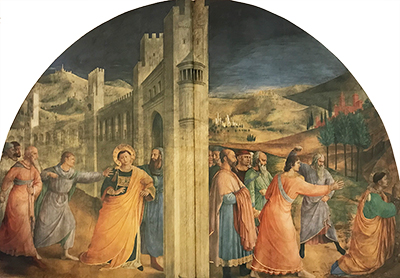
A pale gate tower rises almost to the crown of the arch in Fra Angelico’s Expulsion and the Stoning of Saint Stephen. To its left, a man reaches for Stephen’s shoulder as a group drives him out of Jerusalem. To its right, Stephen appears again, kneeling in much the same golden mantle as one of his attackers raises a stone. A single stretch of painted wall holds the two moments together. The fresco fills the east lunette of the Niccoline Chapel in the Vatican Apostolic Palace, where it concludes the story of Stephen in the upper tier. [1] [2] [3]
At a Glance
- ArtistFra Angelico, who led the chapel fresco campaign with assistants including Benozzo Gozzoli. [1] [4] [5]
- Date1448–49 in the Vatican Museums’ caption for this scene. The Federico Zeri Foundation catalogues it as 1447–49. [1] [2]
- MediumFresco. [1] [2]
- Dimensions322 × 473 cm for the paired scene, as catalogued by the Federico Zeri Foundation. [2]
- LocationEast-wall lunette, Niccoline Chapel, Vatican Apostolic Palace, Vatican City. [1] [2] [3]
- PatronPope Nicholas V. [4]
- SubjectStephen is driven out of Jerusalem and stoned, episodes from Acts 7:54–60. [1] [6]
From the council to the city gate
The two halves of the lunette pick up the action from Saint Stephen Addressing the Council. On the preceding wall, the dispute shares its arch with Saint Stephen Preaching. Acts describes accusations brought against Stephen before the council, followed by his long speech. At its close he says that he sees heaven open and the Son of Man standing at God’s right hand. Those who hear him cover their ears, rush at him and drive him out of the city. The gate and its formidable tower give substance to a boundary that the text passes over in a few words. [3] [6] [7]
The expulsion is already under way when we meet Stephen on the left. One man strides towards him with his arm level with Stephen’s shoulder. A bearded figure close behind the saint is partly framed by the shadow of the gateway. The bodies bunch together near the opening, where there is barely enough dark space to see the figure behind Stephen in full. Stephen’s head tilts towards the men approaching from the left while the long folds of his mantle sweep down across the foreground. His turned head and the crowd’s forward movement make the passage through the gate feel forced. [1]
The clothes help keep him in view. Beneath the mantle, the dark blue-green vestment carries a broad band of gold ornament, particularly clear across his chest in the first scene. His halo stands out against the masonry. Across the tower his face has turned into profile, and the small halo is easier to miss against the darker ground. It is the sweep of the gold around his knees that first recalls the figure we saw standing. The repeated clothing lets the change in posture tell us how much has happened in the space of a few feet of painted wall. [1]
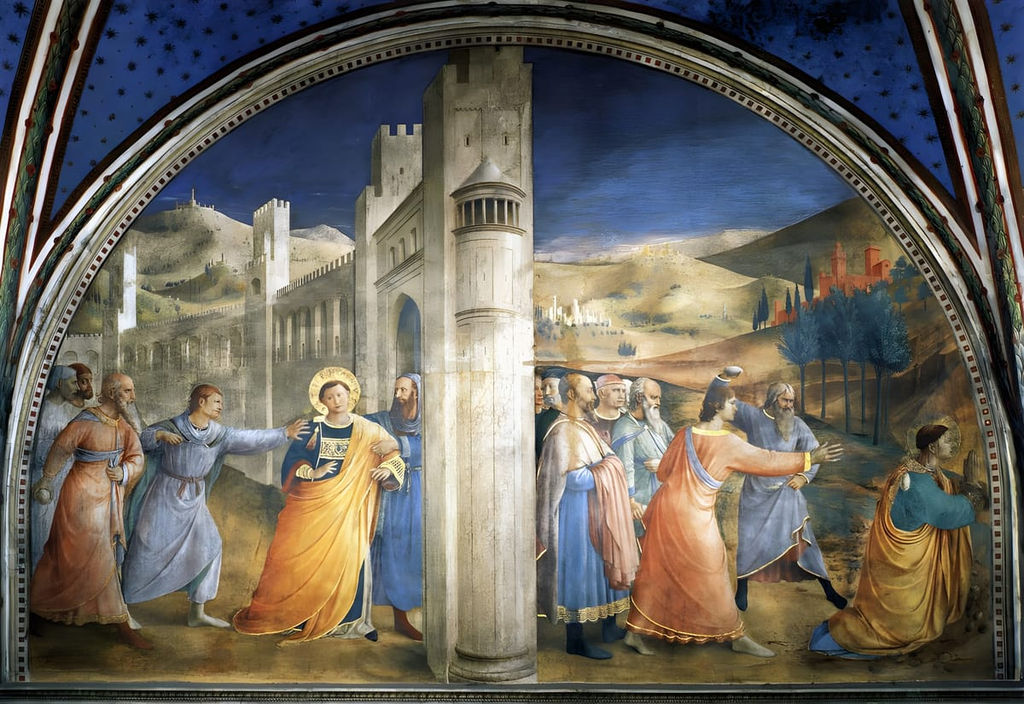
The Expulsion and Stoning lunette in the Niccoline Chapel. The gateway separates the two moments. Image source. Public domain. Proportional web resize.
The tower and the shape of the lunette
The tower stands close to the middle, but its two sides have very different effects. The walls on the left bend away from the gateway, their long run of openings and battlements stepping back towards smaller towers. That line takes the eye into the city even as the figures advance across the foreground to leave it. On the right the ground opens into slopes, with small settlements set at different heights and a dark stand of trees behind the attackers. The spaces pull the eye in different directions while the two groups carry the action across the arch from left to right. [1] [3]
The rising tower also makes sense when seen from below. Its rounded projection and the squared masonry behind it extend from the bottom of the scene nearly to the curve of the arch. Small features in the hills recede, while the tower remains as easy to locate as the two figures in gold. The art historian Livia Lupi observes that the tower seems almost to support the arch, linking the architecture within the story to the form of the chapel itself. In the preceding lunette a painted pilaster helps divide the preaching from the dispute. Here the equivalent division has become a place Stephen must pass through. [1] [3]
Lupi also notes that the gate and walls were painted as a single giornata, the area of fresh plaster set out for one day’s work. The unit of painting thus corresponds to a substantial element of the composition. From the towers receding at the left to the masonry in the foreground, that continuous stretch of architecture had to hold together both while it was being painted and when the scene was viewed from below. [3]
What the wall represents is Jerusalem, although its architecture would have had more familiar associations for a fifteenth-century viewer. In his study of Angelico’s Roman work, Gerardo de Simone reports Arnold Nesselrath’s comparison of this long arm of masonry to Rome’s Aurelian Walls. The resemblance is most suggestive in the combination of fortified towers and a long, rhythmically punctuated wall. It gives the biblical city the presence of a place a contemporary viewer could recognise without requiring a particular Roman gate as the model. [1] [8]
The stoning and Stephen’s last prayer
In the right half, a man in orange steps forward with his arm extended towards Stephen. Behind him an older, grey-bearded man in violet raises a stone. The space between that hand and the kneeling figure is still open. Several men stand nearer the tower with their arms much lower, crowded shoulder to shoulder where the wall ends. They give the attack witnesses within the painting and make the gestures of the two men who advance into the open more conspicuous. Stephen kneels near the curve of the arch with his hands lifted in prayer. His face turns away from the attackers and up towards the edge of the scene. [1]
In Acts, Stephen asks Jesus to receive his spirit during the stoning. He then kneels and asks that the sin of those killing him be forgiven. The fresco gives the prayer a visible form in his upright torso and raised hands. The attackers’ gestures are directed at his body, while his own attention lies beyond them. The similar warmth of his mantle and the orange garment of the man striding towards him brings their opposed gestures into sharper focus. The biblical account invites a further comparison: Stephen’s prayer for his executioners echoes the death of Jesus. The kneeling figure gives that likeness a place in the chapel even as the stone above him makes the manner of his death unmistakable. [1] [6] [7]
Acts also places a young man named Saul at the execution. The witnesses lay their cloaks at his feet, and the next chapter says he assented to the killing. In the fresco, one of the onlookers by the tower has a generous fold of fabric looped over an arm, but the figure’s identity is uncertain. A later painter made this part of the story easier to see. In Vittore Carpaccio’s Martyrdom of St Stephen in Stuttgart, Saul is the figure seated low at the left, looking upwards like Stephen. Angelico gives the immediate action to the two men who step forward and the saint who kneels. [1] [6] [9] [10]
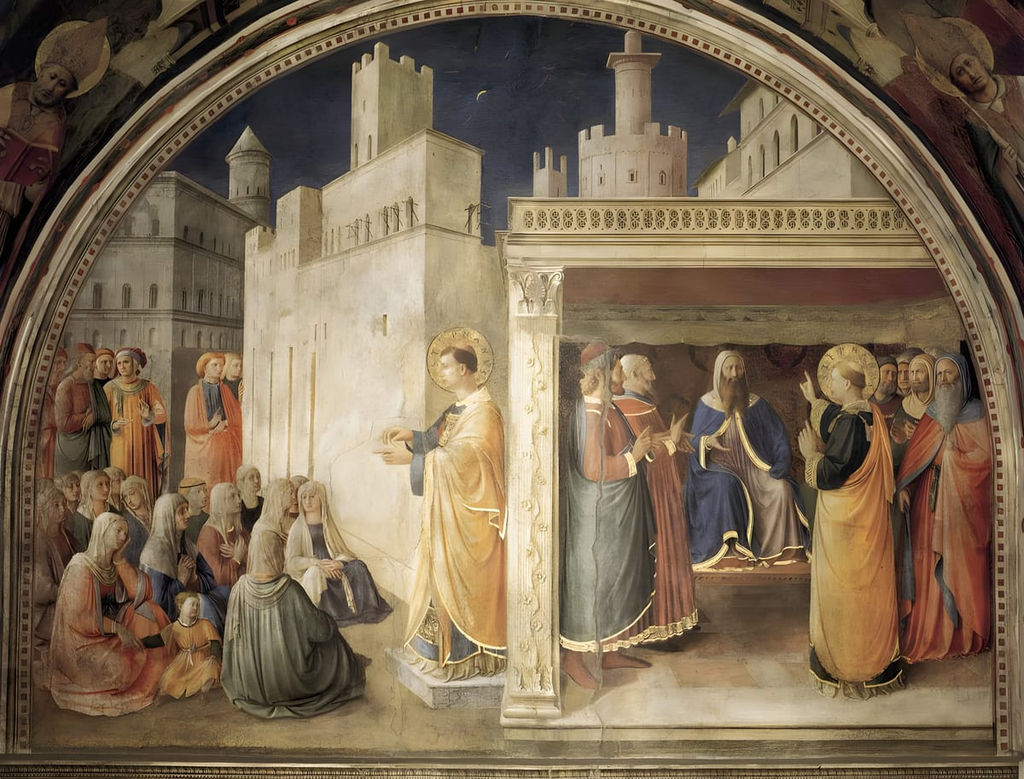
The paired Niccoline lunette. The architecture separates the preaching on the left from the council hearing on the right. Image source. Public domain. Proportional web resize.
The last lunette in Stephen’s story
The east wall brings the two deacons’ lives to a close at different heights. Stephen’s expulsion and death occupy the arch, above the scenes of Lawrence before the Roman ruler and Lawrence’s martyrdom. The final pair gains force from the episodes that come before it. Stephen is traditionally honoured as the first Christian martyr. Earlier in the Saint Stephen cycle, ordination gives him a place in the early Church and the distribution of alms shows how he uses that office. His vestment is still legible when he is driven out. The Saint Lawrence cycle traces a comparable movement from ordination and service to death. Reading down this wall brings the two endings together in a way a view of the lunette alone cannot convey. [3] [4] [5] [11]
Nicholas V commissioned the decoration for his chapel, and the Vatican Museums record two payments to Angelico in February and March 1448. Lupi notes a payment on 15 February for ultramarine for the private chapel. It anchors the campaign within the broader dates assigned to the lunette and gives a sense of the materials ordered for the room. The entry concerns the chapel as a whole. The Museo Benozzo Gozzoli notes that scholars have found Benozzo’s contribution especially plausible in the upper scenes, with Stephen’s ordination the clearest example it gives. As Lupi notes, conservators Carlo Giantomassi and Donatella Zari distinguished several painters’ hands across the chapel during the 1990s restoration. Their finding concerns the cycle as a whole. The division of hands within the expulsion and stoning is less certain. What can be seen across the chapel is the consistency of the design: architecture gives each episode its own setting, and a few echoes of costume and gesture keep the lives of the deacons recognisable from wall to wall. [1] [2] [3] [4] [5]
Inside the Niccoline Chapel
See the frescoes in the rooms where their painted stories meet.
Cappella Niccolina – Niccoline Chapel
See how the painted lives of Stephen and Lawrence occupy the two registers of the chapel.
Watch on YouTubeFra Angelico artworks directory
Explore documented works and surviving parts of larger ensembles. Catalogue links identify individual records. Attribution and dating can vary across collections and publications. Search the Federico Zeri Photo Archive by artist.
| Name | Date | Medium and sources |
|---|---|---|
| Adoration of the Magi | About 1440–60, NGA catalogue | Painting Catalogue. |
| Adoration of the Magi (Armadio degli Argenti) | About 1450–53 | Tempera and gold on wood. Catalogue. |
| Agony in the Garden (Armadio degli Argenti) | About 1450–53 | Tempera and gilding on wood Catalogue. |
| Annalena Altarpiece / Pala di Annalena | commonly c. 1435 | Tempera on panel Catalogue. |
| Annunciation (Armadio degli Argenti) | About 1450–53 | Tempera and gilding on wood. Catalogue. |
| Annunciation (Cortona) | generally placed in the 1430s; exact dating remains debated | Tempera on panel Catalogue. |
| Annunciation (Prado) | 1425–26 | Tempera on poplar panel Catalogue. |
| Annunciation (San Marco upper corridor) | commonly c. 1442 | Fresco Catalogue. |
| Annunciation with Saint Peter Martyr | About 1439–43 | Fresco on plaster. Catalogue. |
| Annunciatory Angel | 1450–55, Detroit catalogue | Gold leaf and tempera on wood panel. Catalogue. |
| Armadio degli Argenti (Silver Treasury) | principally c. 1450–52 | Tempera on panel Catalogue. |
| Arrest of Christ (Armadio degli Argenti) | About 1450–53 | Tempera and gilding on wood Catalogue. |
| Ascension (Armadio degli Argenti) | About 1450–53 | Tempera and gilding on wood Catalogue. |
| Baptism of Christ (Armadio, Alesso Baldovinetti) | About 1452–53 | Tempera and gilding on wood Catalogue. |
| Beheading of Saints Cosmas and Damian (San Marco Altarpiece) | About 1438–42 | Painted panel Catalogue. |
| Betrayal of Christ (Armadio degli Argenti) | About 1450–53 | Tempera and gilding on wood Catalogue. |
| Blessed Dominican, Possibly Jordan of Saxony (San Marco Altarpiece) | About 1438–42 | Painted panel Catalogue. |
| Blessed Vincent Ferrer (San Marco Altarpiece) | About 1438–42 | Painted panel Catalogue. |
| Burial of Saints Cosmas and Damian (San Marco Altarpiece) | About 1438–42 | Painted panel Catalogue. |
| Bust of a Cleric and a Group of Figures (recto and verso) | 15th century | Pen and ink on paper Catalogue. |
| Christ among the Doctors (Armadio degli Argenti) | About 1450–53 | Tempera and gilding on wood Catalogue. |
| Christ before Caiaphas (Armadio degli Argenti) | About 1450–53 | Tempera and gilding on wood Catalogue. |
| Christ Glorified in the Court of Heaven | About 1423–24 | Egg tempera on wood, probably poplar, with gold and silver leaf Catalogue. |
| Christ Seated in Judgment | 1447 | Fresco and gilding on plaster. Catalogue. |
| Christ Stripped of His Garments (Armadio degli Argenti) | About 1450–53 | Tempera and gilding on wood Catalogue. |
| Christ Washes the Apostles’ Feet (Armadio degli Argenti) | About 1450–53 | Tempera and gilding on wood Catalogue. |
| Circumcision of Christ (Armadio degli Argenti) | About 1450–53 | Tempera and gilding on wood. Catalogue. |
| Communion of the Apostles (Armadio degli Argenti) | About 1450–53 | Tempera and gilding on wood Catalogue. |
| Coronation of the Virgin (Armadio degli Argenti) | About 1450–53 | Tempera and gilding on wood Catalogue. |
| Coronation of the Virgin (Louvre) | Louvre: second quarter of the fifteenth century, 1425–50; often dated more narrowly c. 1434–35 | Tempera and gold on panel Catalogue. |
| Coronation of the Virgin (Uffizi) | 1431–35 | Tempera on wood, gold ground Catalogue. |
| Cortona Triptych | About 1437 | Tempera and gold on panel. Catalogue. |
| Crucifixion (Armadio degli Argenti) | About 1450–53 | Tempera and gilding on wood Catalogue. |
| Crucifixion and Saints | 1441–42 | Fresco Catalogue. |
| Deposition from the Cross / Santa Trinita Deposition | commissioned 1429–32; completed by Angelico within this period | Tempera on panel Catalogue. |
| Descent into Limbo (Armadio degli Argenti) | About 1450–53 | Tempera and gilding on wood Catalogue. |
| Entombment of Christ (San Marco Altarpiece) | About 1438–42 | Painted panel Catalogue. |
| Entry into Jerusalem (Armadio degli Argenti) | About 1450–53 | Tempera and gilding on wood Catalogue. |
| Expulsion and the Stoning of Saint Stephen | 1448–49, Vatican Museums | Fresco. Catalogue. |
| Fiesole San Domenico Altarpiece | early 1420s; predella about 1423–24 | Tempera on panel Catalogue. |
| Flagellation (Armadio degli Argenti) | About 1450–53 | Tempera and gilding on wood Catalogue. |
| Flight into Egypt | About 1450–53 | Tempera and gilding on wood. Catalogue. |
| Guidalotti Polyptych | c. 1447–49 | Tempera and oil on panel Catalogue. |
| Healing of Palladia and Saint Damian Accepting Her Gift (San Marco Altarpiece) | About 1438–42 | Painted panel Catalogue. |
| Holy Pilgrim, Possibly Saint Roch (San Marco Altarpiece) | About 1438–42 | Painted panel Catalogue. |
| Holy Women at the Tomb (Armadio degli Argenti) | About 1450–53 | Tempera and gilding on wood Catalogue. |
| Judas Receives Payment (Armadio degli Argenti) | About 1450–53 | Tempera and gilding on wood Catalogue. |
| Lamentation over Christ (Armadio degli Argenti) | About 1450–53 | Tempera and gilding on wood Catalogue. |
| Lamentation over the Dead Christ (Croce al Tempio Lamentation) | 1436–41, Zeri catalogue | Tempera and gilding on wood panel. Catalogue. |
| Last Judgement (Armadio degli Argenti) | About 1450–53 | Tempera and gilding on wood Catalogue. |
| Last Judgement (San Marco) | c. 1425–28 | Tempera and gold on panel Catalogue. |
| Last Supper (Armadio degli Argenti) | About 1450–53 | Tempera and gilding on wood Catalogue. |
| Lex Amoris (Armadio degli Argenti) | About 1450–53 | Tempera and gilding on wood Catalogue. |
| Madonna and Child with Saint Dominic and Saint Thomas Aquinas | About 1430, Hermitage catalogue | Detached fresco. Catalogue. |
| Madonna and Child with Saints | About 1411–13 | Tempera on wood panel, with a gold ground. Catalogue. |
| Madonna of Humility | About 1425, Thyssen catalogue | Tempera and gold on wood. Catalogue. |
| Madonna of the Star | 1431–34, Zeri catalogue | Tempera with oil glazes and gold on wood panel, as catalogued by the Gardner for the 2018 exhibition. Catalogue. |
| Marriage at Cana (Armadio, Alesso Baldovinetti) | About 1452–53 | Tempera and gilding on wood Catalogue. |
| Massacre of the Innocents (Armadio degli Argenti) | About 1450–53 | Tempera and gilding on wood Catalogue. |
| Miracle of the Black Leg (San Marco Altarpiece) | About 1438–42 | Painted panel Catalogue. |
| Mocking of Christ (Armadio degli Argenti) | About 1450–53 | Tempera and gilding on wood Catalogue. |
| Mystic Wheel (The Vision of Ezekiel) | About 1450–52 | Tempera and gilding on wood. Catalogue. |
| Nativity (Armadio degli Argenti) | About 1450–53 | Tempera and gilding on wood. Catalogue. |
| Niccoline Chapel frescoes | principally 1448–50 | Fresco Catalogue. |
| Noli me Tangere | broadly within Angelico’s San Marco campaign, late 1430s–1440s | Fresco Catalogue. |
| Ordination of Saint Lawrence | 1448 | Fresco. Catalogue. |
| Pentecost (Armadio degli Argenti) | About 1450–53 | Tempera and gilding on wood Catalogue. |
| Presentation of Christ at the Temple (Armadio degli Argenti) | About 1450–53 | Tempera and gilding on wood. Catalogue. |
| Presentation of Jesus at the Temple | Early 1440s | Fresco on plaster. Catalogue. |
| Raising of Lazarus (Armadio degli Argenti) | About 1450–53 | Tempera and gilding on wood Catalogue. |
| Rescue of Saints Cosmas and Damian and Exorcism of Lysias (San Marco Altarpiece) | About 1438–42 | Painted panel Catalogue. |
| Road to Calvary (Armadio degli Argenti) | About 1450–53 | Tempera and gilding on wood Catalogue. |
| Saint Anthony Abbot (San Marco Altarpiece) | About 1438–42 | Painted panel Catalogue. |
| Saint Bernard of Clairvaux or Saint Benedict (San Marco Altarpiece) | About 1438–42 | Painted panel Catalogue. |
| Saint Damian Receives Money from Palladia | About 1425–49 | Tempera and gilding on wood. Catalogue. |
| Saint Francis and a Bishop Saint, Saint John the Baptist and Saint Dominic | Late 1420s, Getty catalogue | Tempera and gold leaf on panel. Catalogue. |
| Saint James the Greater Freeing the Magician Hermogenes | About 1426–29 | Tempera and gold on panel Catalogue. |
| Saint Jerome (San Marco Altarpiece) | About 1438–42 | Painted panel Catalogue. |
| Saint Lawrence Giving Alms | About 1448 | Wall fresco. Catalogue. |
| Saint Lawrence Receiving the Treasures of the Church from Pope Sixtus II | About 1448–49 | Fresco on plaster. Catalogue. |
| Saint Romuald (San Marco Altarpiece) | About 1438–42 | Painted panel Catalogue. |
| Saint Stephen Addressing the Council | 1448–49, Vatican Museums | Fresco. Catalogue. |
| Saint Stephen Preaching | 1448–49, Vatican Museums | Wall fresco. Catalogue. |
| Saint Thomas Aquinas (San Marco Altarpiece) | About 1438–42 | Painted panel Catalogue. |
| Saints Cosmas and Damian and Their Brothers Survive the Stake | Second quarter of the 15th century | Tempera and gilding on wood. Catalogue. |
| Saints Cosmas and Damian at the Stake (San Marco Altarpiece) | About 1438–42 | Painted panel Catalogue. |
| Saints Cosmas and Damian before Lysias (San Marco Altarpiece) | About 1438–42 | Painted panel Catalogue. |
| Saints Cosmas and Damian Rescued by an Angel | Second quarter of the 15th century | Tempera and gilding on wood. Catalogue. |
| Saints Cosmas and Damian with Their Brothers before Proconsul Lysias | Second quarter of the 15th century | Tempera and gilding on wood. Catalogue. |
| San Marco Altarpiece / Pala di San Marco | 1438–43 | Tempera on panel Catalogue. |
| San Pietro Martire Triptych | About 1422–23, Strozzi exhibition | Tempera and gold on panel. Catalogue. |
| Scenes from the Lives of the Desert Fathers (Thebaid) | About 1420, Uffizi catalogue | Tempera on wood. Catalogue. |
| Sixteen Prophets | 1447 | Fresco and gilding on plaster Catalogue. |
| Stoning and Shooting of the Brothers (San Marco Altarpiece) | About 1438–42 | Painted panel Catalogue. |
| Tabernacle of the Linaioli | 1433–35 | Tempera on panel Catalogue. |
| The Attempted Crucifixion and Stoning of Saints Cosmas and Damian | Second quarter of the 15th century | Tempera and gilding on wood. Catalogue. |
| The Crucifixion | About 1420–23, Met catalogue | Tempera on wood, gold ground. Catalogue. |
| The Death and the Assumption of the Virgin | 1424–34 | Tempera with oil glazes and gold on panel Catalogue. |
| The Dominican Blessed (left end) (Fiesole predella) | About 1423–24 | Egg tempera and gold on wood Catalogue. |
| The Dominican Blessed (right end) (Fiesole predella) | About 1423–24 | Egg tempera and gold on wood Catalogue. |
| The Entombment of Christ | About 1450 | Tempera on poplar panel. Catalogue. |
| The Forerunners of Christ with Saints and Martyrs | About 1423–24 | Egg tempera on wood (probably poplar), with gold and silver leaf. Catalogue. |
| The Funeral of Saint Anthony Abbot | About 1426–30 | Tempera on poplar panel. Catalogue. |
| The Martyrdom of Saints Cosmas and Damian | About 1425–49 | Tempera and gilding on wood. Catalogue. |
| The Mocking of Christ / Christ Mocked | within the San Marco dormitory campaign, broadly late 1430s–1440s | Fresco Catalogue. |
| The Nativity | About 1425, Minneapolis catalogue | Tempera on poplar panel. Catalogue. |
| The Nativity in Cell 5 at San Marco | About 1439–43 | Fresco on plaster. Catalogue. |
| The Penitent Saint Jerome | 1419–20 | Tempera on wood panel Catalogue. |
| The Virgin and Child by Fra Angelico (Fogg Museum) | About 1430, Harvard catalogue | Tempera originally on panel, subsequently transferred to Masonite. Catalogue. |
| The Virgin Mary with the Apostles and Other Saints (Fiesole predella) | About 1423–24 | Egg tempera and gold on wood Catalogue. |
| Transfiguration (Armadio, Alesso Baldovinetti) | About 1452–53 | Tempera and gilding on wood Catalogue. |
| Transfiguration (San Marco Cell 6) | within the San Marco dormitory campaign, broadly late 1430s–1440s | Fresco Catalogue. |
| Virgin Mary Annunciate | 1450–55, Detroit catalogue | Gold leaf and tempera on wood panel. Catalogue. |
| Virgin of the Pomegranate | About 1426 | Tempera on panel with gilding Catalogue. |
Frequently Asked Questions
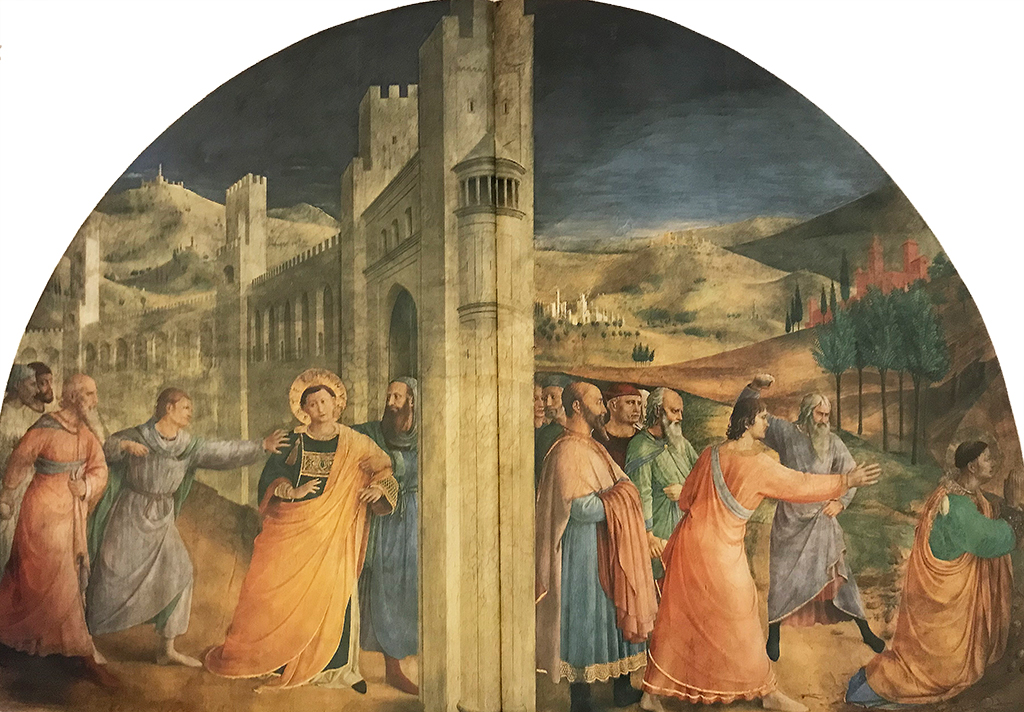
It remains in the upper part of the east wall of the Niccoline Chapel in the Vatican Apostolic Palace. Two nineteenth-century prints in the Detroit Institute of Arts record the expulsion and the stoning separately. Giuseppe Ferretti made the print of Stephen being led away, and Annibale Costa made the print of the stoning. [1] [2] [3] [12] [13]
Discussion
Use these prompts to look again or share an observation.
Reader Insights
Follow Stephen through the gate and then find him again. How does the wall let you distinguish the moments?
How does the foreground landscape separate the stoning from the expulsion while keeping them part of one lunette?
Join the Conversation
Share a detail or question about Expulsion and the Stoning of Saint Stephen.
References
- Vatican Museums and Vatican News, Beauty that Unites! 65, caption and photographs of the Capture and Stoning of Saint Stephen (2020). View source.
- Fondazione Federico Zeri, Università di Bologna, Santo Stefano espulso dalla città, Lapidazione di santo Stefano, artwork entry 13031, catalogue number 11686 (Italian). View source.
- Livia Lupi, Rhetoric of Pictorial Place, University of York doctoral thesis (2016), vol. I, pp. 157, 159–60, 170–72, 179–80 and 183–85, referencing figs. 135–36. View source.
- Vatican Museums, Cappella Niccolina, chapel history, payments and arrangement of the cycles (Italian). View source.
- Museo Benozzo Gozzoli, Stories of Saint Stephen and Saint Lawrence, narrative sources and workshop attribution. View source.
- Acts of the Apostles, 7:54–60, New American Bible, Revised Edition. View source.
- Acts of the Apostles, 6:8–15, New American Bible, Revised Edition. View source.
- Gerardo de Simone, Velut alter Apelles. Il decennio romano del Beato Angelico, in Beato Angelico. L’alba del Rinascimento (Skira, 2009), discussion of the final Stephen lunette, fig. 7 (Italian). View source.
- Acts of the Apostles, 8:1, New American Bible, Revised Edition. View source.
- Staatsgalerie Stuttgart, Vittore Carpaccio, Martyrdom of St. Stephen, museum guide to the composition. View source.
- Vatican Museums, Cappella Niccolina, virtual tour of the chapel (Italian). View source.
- Detroit Institute of Arts, Giuseppe Ferretti after Fra Angelico, Saint Stephen Conducted to Martyrdom, collection record 09.1S486. View source.
- Detroit Institute of Arts, Annibale Costa after Fra Angelico, Stoning of St. Stephen, collection record 09.1S326. View source.
.jpg)
 Fra Angelico.jpg)