


 Fra Angelico.jpg)
 by Tom Gurney
Tom Gurney BSc (Hons) is an art history expert with over 20 years experience
Published on June 19, 2020 / Updated on November 29, 2026
Email: tomgurney1@gmail.com / Phone: +44 7429 011000
Introduction
A tall, pale window rises directly above the infant Christ. Below it, Simeon bends his head towards the child while Mary keeps her hands close to him. Two columns set the encounter apart from Joseph and Anna, who stand in the side bays. Above and below, painted strips of Latin connect the arrival of a family in Jerusalem with a prophecy about the Lord entering his temple. This small painting in Florence’s Museo di San Marco belongs to the Armadio degli Argenti, a cabinet made to house precious offerings at Santissima Annunziata. The Italian state catalogue dates this scene to about 1450–53 and attributes it to Fra Angelico and assistants. [1] [2] [3]
At a Glance
- ArtistFra Angelico and assistants, according to the Italian state catalogue. [1]
- DateAbout 1450–53. [1]
- MediumTempera and gilding on wood. [1]
- Dimensions38.5 cm high × 37.5 cm wide, according to the individual scene record. [1]
- CollectionMuseo di San Marco, Florence. [1]
- InventoryInv. 1890, no. 8491. National catalogue record 0900191187A-6. [1]
- PositionRight-hand scene in the middle row of the nine-field infancy board, catalogue record 0900191187A-0. [2]
A small scene on the Silver Cupboard
The Armadio degli Argenti took its name from the valuable votive gifts it protected. Worshippers had dedicated those offerings to the revered image of the Annunciation at the Servite church of Santissima Annunziata. The Museo di San Marco identifies Piero di Cosimo de’ Medici as the patron. Writing in the fifteenth century, the Dominican poet Domenico da Corella describes silver vessels behind a surface painted by Fra Giovanni. The often repeated date of 1448 for the commission is less secure. The state catalogue distinguishes that tradition from a 1453 reference to a window above the cabinet, and Gerardo de Simone cites a payment for fitting the jambs in December of the same year. These records concern the installation and leave the month or year of the individual scene’s execution open. The catalogue also preserves Zanobi Strozzi as an alternative attribution, without assigning individual passages to particular hands. [4] [2] [3] [1]
In the sequence, the Presentation follows the Adoration of the Magi and precedes the Flight into Egypt. The Magi’s gifts and Joseph’s birds are two very different offerings, and the cabinet’s original contents give their proximity a particular resonance. The opening Vision of Ezekiel precedes the eight infancy episodes on the board and introduces the cycle’s concern with correspondences between the Old and New Testaments. In the three-by-three arrangement on view, the Presentation is the sixth field. Its own inventory number, 8491, is one of three grouped under the larger board’s catalogue entry. [3] [2] [1]
The square grouping seen today is one part of a larger ensemble. In Andrea De Marchi’s reconstruction, discussed by de Simone, the original cabinet had two tall doors, each two scenes wide. The nine fields of the infancy board would have occupied the upper part of the arrangement alongside three scenes by Alesso Baldovinetti. A later modification converted the doors into a single sliding closure in the 1460s. De Simone counts thirty-five surviving episodes across thirty-six fields because the Last Judgement occupies two. The original total remains debated. [3] [2]
How the columns organise the encounter
Mary and Simeon face one another in the middle bay, beside the partly obscured altar. The child’s head sits just beneath the bright opening at the back. Simeon’s bowed head, high headdress and salmon-coloured robe carry the eye down from that window to the small cluster of hands. Mary’s blue mantle does almost the reverse. It runs from the pale floor up into the narrow space between their bodies. The two long silhouettes make their gestures easy to follow, even at the scale of a cabinet compartment. [1] [3]
Joseph stands on the left with the pale birds held close to his body. In the opposite bay Anna inclines her head and brings her hands together. Their inward turns keep them part of the exchange despite the intervening columns. A red floor reaches across the scene behind the pale foreground step, and the dark recesses behind Joseph and Anna make their ochre and green garments stand out. Look back above them and the rhythm changes. Small pairs of openings repeat in the upper storey while the high central arch and narrow window establish a single vertical axis. The architecture gives the figures a common interior while allowing each gesture its own space. [1] [3]
De Simone sees an echo of Florence’s Baptistery of San Giovanni in the red pavement bounded by a white marble octagon and the two tiers of galleries. The Baptistery itself has eight sides, with horizontal beams and columns at the lower level and a gallery above. The painting compresses such architectural forms around the encounter. The pale columns at the front and the darker arcades behind make the space seem deeper than the narrow band of floor visible beneath the group. De Simone also points to an earlier pictorial model in the infancy frescoes associated with Giotto in the Lower Basilica at Assisi. That comparison concerns the composition’s pictorial ancestry, while the Baptistery helps explain the local character of the painted interior. [3] [5]
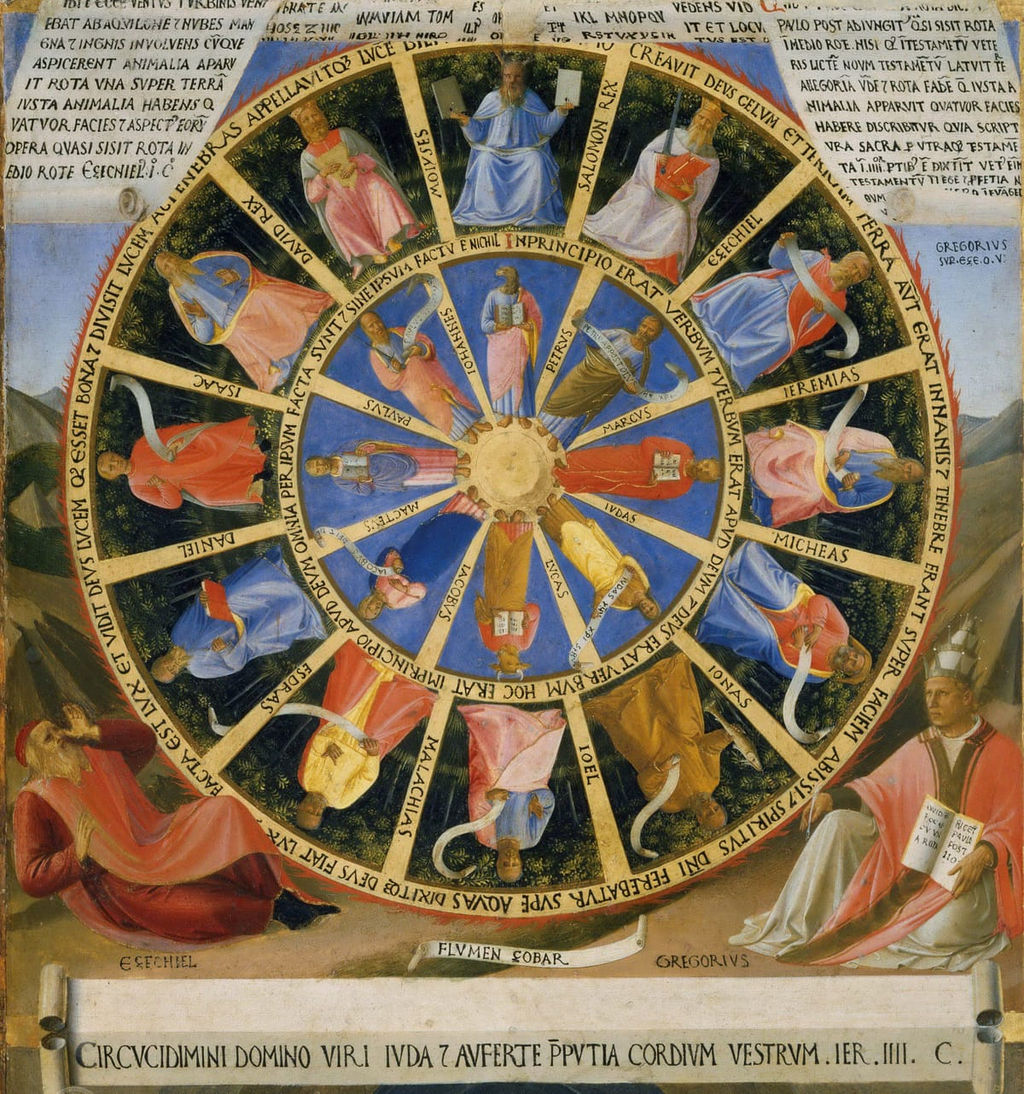
The Mystic Wheel, 0900191187A-1. The painted spokes connect differently positioned witnesses and writers. Image source. Public domain. Proportional web resize.
The promise above and the offering below
Luke describes Mary and Joseph bringing Jesus to Jerusalem in observance of the law. The consecration of the firstborn and the offering for purification are distinct obligations brought together in the account. Leviticus provides for two birds when the mother cannot afford a lamb. The birds in Joseph’s hands give that provision a visible place. Simeon, whom Luke describes as a devout man led to the Temple by the Spirit, takes the child in his arms and speaks of salvation and light. Anna, a prophet who worships at the Temple, gives thanks and speaks about the child. By placing Anna opposite Joseph and apart from Mary, the painting gives the prophet a clear place among the witnesses. [6] [7] [1]
The upper band adapts Malachi 3:1, which announces that the Lord will suddenly come to his temple and names the messenger of the covenant. The painted chapter label uses the numeral II. [1] [3] [8]
The lower band condenses Luke 2:22–24, saying that Jesus was brought to Jerusalem so that an offering could be made. It stops before Simeon speaks. The two bands guide the viewer from promise to event, while the figures between them carry the account further. Joseph’s offering answers the lower text directly. Simeon’s bent head and the child placed beneath the window invite a viewer who knows the next verses to recall his words about seeing salvation. The bright opening can also suggest the light of which he speaks. [3] [8] [6] [1]
The strips have rolled ends, as though pieces of parchment had been fastened across the painted surface. Cyril Gerbron connects this device to the way the cabinet adapts the format of an illustrated manuscript, making scripture something the viewer reads alongside the image. An illustrated manuscript in Venice’s Biblioteca Marciana pairs the corresponding episodes with many of the same prophecies. The resemblance places the cabinet within a tradition of reading the two Testaments together that Fra Angelico adapted to the scale of a cabinet. [9] [3] In the Presentation, it is possible to follow the architecture with the eye from Joseph across to Anna, or to read vertically from Malachi down through the encounter to Luke. The compact scene accommodates both kinds of attention. [9] [3]
The other Presentation at San Marco
The Presentation of Jesus at the Temple in cell 10 treats the same Gospel episode on a convent wall. In that fresco, kneeling witnesses bring the scene into the devotional world of San Marco. The state catalogue identifies one as Saint Peter Martyr and tentatively names the other as Blessed Villana. The cupboard panel keeps Joseph and Anna upright in the flanking bays and asks the viewer to read the two passages of scripture across its edges. The fresco’s single recessed setting and the panel’s divided interior make the contrast in how the witnesses attend the ceremony immediately visible. [10] [11] [1] [3]
The board on view
De Simone traces the paintings through remounting and display at Florence’s Accademia before their installation at San Marco from 1922. [3] The infancy board travelled from San Marco to the Museo Diocesano in Milan for the 2023–24 exhibition. For that loan it was examined under the supervision of San Marco using non-invasive imaging and spectroscopy. These methods helped distinguish pigments that look similar in ordinary light. The project’s published false-colour map plots the main pigments across the nine fields. Fondazione Bracco’s published survey gives 123 × 123 cm for the whole first section, while the state catalogue’s measurement fields record 115.5 × 112.5 cm for the board. The Presentation itself is only 38.5 cm high. [12] [13] [2] [1]
In her account of the restoration, Silvia Verdianelli describes working under high magnification to clean the painted surfaces, which had been obscured by yellowed varnish, overpainting and later retouching. The scale of the work mattered to the treatment. Some of the details the conservators were trying to make legible were as small as those in manuscript illumination. [14]
San Marco now exhibits the Armadio without the frame added in the early twentieth century. Seeing the board whole makes it easier to understand how the tiny strips of lettering work across the cycle. Each pair gives its scene a reading of its own, while the repeated bands tie episodes set in very different spaces into a single sequence. [15] [3]
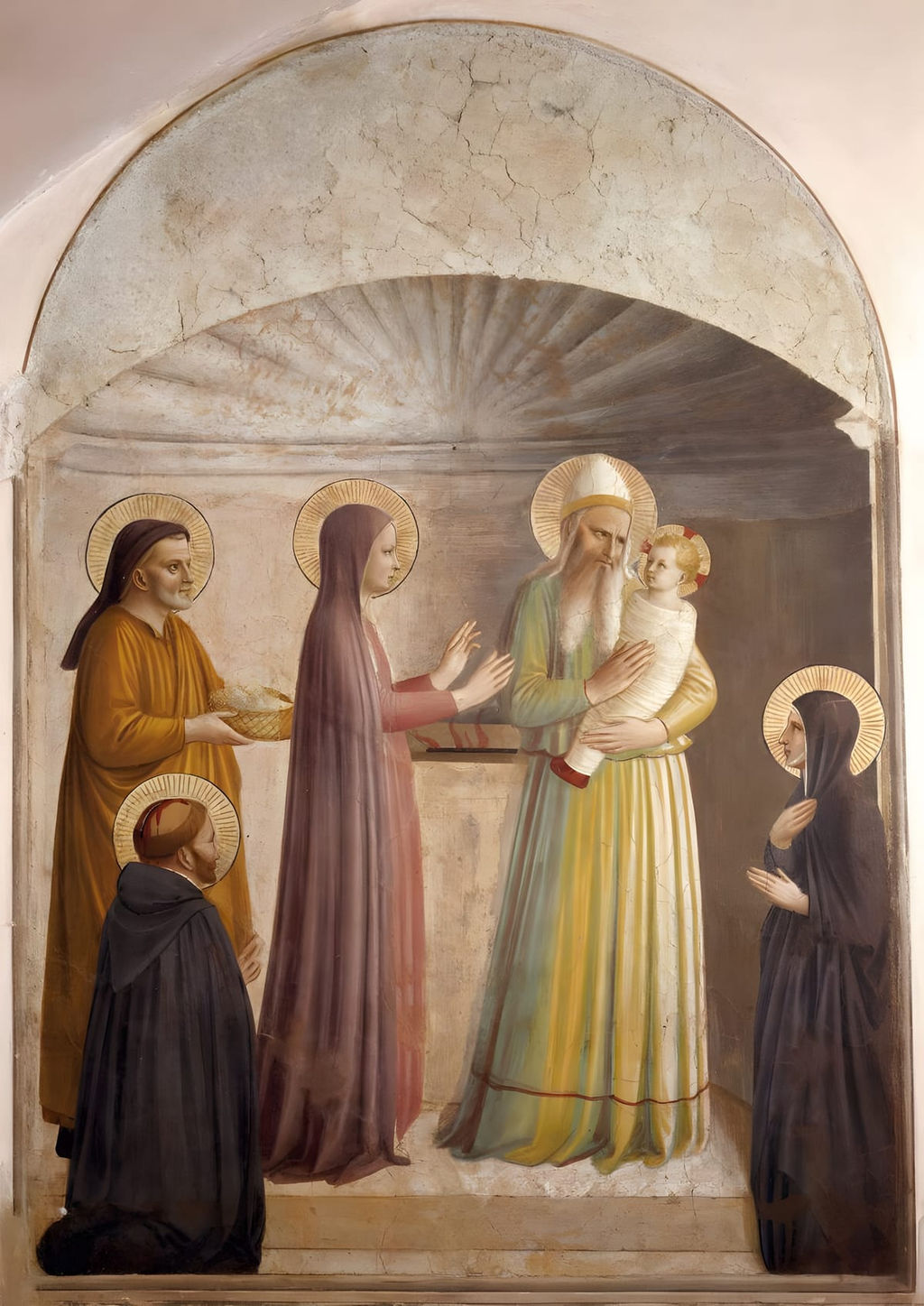
Presentation in the Temple in Cell 10, San Marco. Observe how the witnesses occupy the edges of the arched scene. Image source. Public domain. Proportional web resize.
Fra Angelico artworks directory
Explore documented works and surviving parts of larger ensembles. Catalogue links identify individual records. Attribution and dating can vary across collections and publications. Search the Federico Zeri Photo Archive by artist.
| Name | Date | Medium and sources |
|---|---|---|
| Adoration of the Magi | About 1440–60, NGA catalogue | Painting Catalogue. |
| Adoration of the Magi (Armadio degli Argenti) | About 1450–53 | Tempera and gold on wood. Catalogue. |
| Agony in the Garden (Armadio degli Argenti) | About 1450–53 | Tempera and gilding on wood Catalogue. |
| Annalena Altarpiece / Pala di Annalena | commonly c. 1435 | Tempera on panel Catalogue. |
| Annunciation (Armadio degli Argenti) | About 1450–53 | Tempera and gilding on wood. Catalogue. |
| Annunciation (Cortona) | generally placed in the 1430s; exact dating remains debated | Tempera on panel Catalogue. |
| Annunciation (Prado) | 1425–26 | Tempera on poplar panel Catalogue. |
| Annunciation (San Marco upper corridor) | commonly c. 1442 | Fresco Catalogue. |
| Annunciation with Saint Peter Martyr | About 1439–43 | Fresco on plaster. Catalogue. |
| Annunciatory Angel | 1450–55, Detroit catalogue | Gold leaf and tempera on wood panel. Catalogue. |
| Armadio degli Argenti (Silver Treasury) | principally c. 1450–52 | Tempera on panel Catalogue. |
| Arrest of Christ (Armadio degli Argenti) | About 1450–53 | Tempera and gilding on wood Catalogue. |
| Ascension (Armadio degli Argenti) | About 1450–53 | Tempera and gilding on wood Catalogue. |
| Baptism of Christ (Armadio, Alesso Baldovinetti) | About 1452–53 | Tempera and gilding on wood Catalogue. |
| Beheading of Saints Cosmas and Damian (San Marco Altarpiece) | About 1438–42 | Painted panel Catalogue. |
| Betrayal of Christ (Armadio degli Argenti) | About 1450–53 | Tempera and gilding on wood Catalogue. |
| Blessed Dominican, Possibly Jordan of Saxony (San Marco Altarpiece) | About 1438–42 | Painted panel Catalogue. |
| Blessed Vincent Ferrer (San Marco Altarpiece) | About 1438–42 | Painted panel Catalogue. |
| Burial of Saints Cosmas and Damian (San Marco Altarpiece) | About 1438–42 | Painted panel Catalogue. |
| Bust of a Cleric and a Group of Figures (recto and verso) | 15th century | Pen and ink on paper Catalogue. |
| Christ among the Doctors (Armadio degli Argenti) | About 1450–53 | Tempera and gilding on wood Catalogue. |
| Christ before Caiaphas (Armadio degli Argenti) | About 1450–53 | Tempera and gilding on wood Catalogue. |
| Christ Glorified in the Court of Heaven | About 1423–24 | Egg tempera on wood, probably poplar, with gold and silver leaf Catalogue. |
| Christ Seated in Judgment | 1447 | Fresco and gilding on plaster. Catalogue. |
| Christ Stripped of His Garments (Armadio degli Argenti) | About 1450–53 | Tempera and gilding on wood Catalogue. |
| Christ Washes the Apostles’ Feet (Armadio degli Argenti) | About 1450–53 | Tempera and gilding on wood Catalogue. |
| Circumcision of Christ (Armadio degli Argenti) | About 1450–53 | Tempera and gilding on wood. Catalogue. |
| Communion of the Apostles (Armadio degli Argenti) | About 1450–53 | Tempera and gilding on wood Catalogue. |
| Coronation of the Virgin (Armadio degli Argenti) | About 1450–53 | Tempera and gilding on wood Catalogue. |
| Coronation of the Virgin (Louvre) | Louvre: second quarter of the fifteenth century, 1425–50; often dated more narrowly c. 1434–35 | Tempera and gold on panel Catalogue. |
| Coronation of the Virgin (Uffizi) | 1431–35 | Tempera on wood, gold ground Catalogue. |
| Cortona Triptych | About 1437 | Tempera and gold on panel. Catalogue. |
| Crucifixion (Armadio degli Argenti) | About 1450–53 | Tempera and gilding on wood Catalogue. |
| Crucifixion and Saints | 1441–42 | Fresco Catalogue. |
| Deposition from the Cross / Santa Trinita Deposition | commissioned 1429–32; completed by Angelico within this period | Tempera on panel Catalogue. |
| Descent into Limbo (Armadio degli Argenti) | About 1450–53 | Tempera and gilding on wood Catalogue. |
| Entombment of Christ (San Marco Altarpiece) | About 1438–42 | Painted panel Catalogue. |
| Entry into Jerusalem (Armadio degli Argenti) | About 1450–53 | Tempera and gilding on wood Catalogue. |
| Expulsion and the Stoning of Saint Stephen | 1448–49, Vatican Museums | Fresco. Catalogue. |
| Fiesole San Domenico Altarpiece | early 1420s; predella about 1423–24 | Tempera on panel Catalogue. |
| Flagellation (Armadio degli Argenti) | About 1450–53 | Tempera and gilding on wood Catalogue. |
| Flight into Egypt | About 1450–53 | Tempera and gilding on wood. Catalogue. |
| Guidalotti Polyptych | c. 1447–49 | Tempera and oil on panel Catalogue. |
| Healing of Palladia and Saint Damian Accepting Her Gift (San Marco Altarpiece) | About 1438–42 | Painted panel Catalogue. |
| Holy Pilgrim, Possibly Saint Roch (San Marco Altarpiece) | About 1438–42 | Painted panel Catalogue. |
| Holy Women at the Tomb (Armadio degli Argenti) | About 1450–53 | Tempera and gilding on wood Catalogue. |
| Judas Receives Payment (Armadio degli Argenti) | About 1450–53 | Tempera and gilding on wood Catalogue. |
| Lamentation over Christ (Armadio degli Argenti) | About 1450–53 | Tempera and gilding on wood Catalogue. |
| Lamentation over the Dead Christ (Croce al Tempio Lamentation) | 1436–41, Zeri catalogue | Tempera and gilding on wood panel. Catalogue. |
| Last Judgement (Armadio degli Argenti) | About 1450–53 | Tempera and gilding on wood Catalogue. |
| Last Judgement (San Marco) | c. 1425–28 | Tempera and gold on panel Catalogue. |
| Last Supper (Armadio degli Argenti) | About 1450–53 | Tempera and gilding on wood Catalogue. |
| Lex Amoris (Armadio degli Argenti) | About 1450–53 | Tempera and gilding on wood Catalogue. |
| Madonna and Child with Saint Dominic and Saint Thomas Aquinas | About 1430, Hermitage catalogue | Detached fresco. Catalogue. |
| Madonna and Child with Saints | About 1411–13 | Tempera on wood panel, with a gold ground. Catalogue. |
| Madonna of Humility | About 1425, Thyssen catalogue | Tempera and gold on wood. Catalogue. |
| Madonna of the Star | 1431–34, Zeri catalogue | Tempera with oil glazes and gold on wood panel, as catalogued by the Gardner for the 2018 exhibition. Catalogue. |
| Marriage at Cana (Armadio, Alesso Baldovinetti) | About 1452–53 | Tempera and gilding on wood Catalogue. |
| Massacre of the Innocents (Armadio degli Argenti) | About 1450–53 | Tempera and gilding on wood Catalogue. |
| Miracle of the Black Leg (San Marco Altarpiece) | About 1438–42 | Painted panel Catalogue. |
| Mocking of Christ (Armadio degli Argenti) | About 1450–53 | Tempera and gilding on wood Catalogue. |
| Mystic Wheel (The Vision of Ezekiel) | About 1450–52 | Tempera and gilding on wood. Catalogue. |
| Nativity (Armadio degli Argenti) | About 1450–53 | Tempera and gilding on wood. Catalogue. |
| Niccoline Chapel frescoes | principally 1448–50 | Fresco Catalogue. |
| Noli me Tangere | broadly within Angelico’s San Marco campaign, late 1430s–1440s | Fresco Catalogue. |
| Ordination of Saint Lawrence | 1448 | Fresco. Catalogue. |
| Pentecost (Armadio degli Argenti) | About 1450–53 | Tempera and gilding on wood Catalogue. |
| Presentation of Christ at the Temple (Armadio degli Argenti) | About 1450–53 | Tempera and gilding on wood. Catalogue. |
| Presentation of Jesus at the Temple | Early 1440s | Fresco on plaster. Catalogue. |
| Raising of Lazarus (Armadio degli Argenti) | About 1450–53 | Tempera and gilding on wood Catalogue. |
| Rescue of Saints Cosmas and Damian and Exorcism of Lysias (San Marco Altarpiece) | About 1438–42 | Painted panel Catalogue. |
| Road to Calvary (Armadio degli Argenti) | About 1450–53 | Tempera and gilding on wood Catalogue. |
| Saint Anthony Abbot (San Marco Altarpiece) | About 1438–42 | Painted panel Catalogue. |
| Saint Bernard of Clairvaux or Saint Benedict (San Marco Altarpiece) | About 1438–42 | Painted panel Catalogue. |
| Saint Damian Receives Money from Palladia | About 1425–49 | Tempera and gilding on wood. Catalogue. |
| Saint Francis and a Bishop Saint, Saint John the Baptist and Saint Dominic | Late 1420s, Getty catalogue | Tempera and gold leaf on panel. Catalogue. |
| Saint James the Greater Freeing the Magician Hermogenes | About 1426–29 | Tempera and gold on panel Catalogue. |
| Saint Jerome (San Marco Altarpiece) | About 1438–42 | Painted panel Catalogue. |
| Saint Lawrence Giving Alms | About 1448 | Wall fresco. Catalogue. |
| Saint Lawrence Receiving the Treasures of the Church from Pope Sixtus II | About 1448–49 | Fresco on plaster. Catalogue. |
| Saint Romuald (San Marco Altarpiece) | About 1438–42 | Painted panel Catalogue. |
| Saint Stephen Addressing the Council | 1448–49, Vatican Museums | Fresco. Catalogue. |
| Saint Stephen Preaching | 1448–49, Vatican Museums | Wall fresco. Catalogue. |
| Saint Thomas Aquinas (San Marco Altarpiece) | About 1438–42 | Painted panel Catalogue. |
| Saints Cosmas and Damian and Their Brothers Survive the Stake | Second quarter of the 15th century | Tempera and gilding on wood. Catalogue. |
| Saints Cosmas and Damian at the Stake (San Marco Altarpiece) | About 1438–42 | Painted panel Catalogue. |
| Saints Cosmas and Damian before Lysias (San Marco Altarpiece) | About 1438–42 | Painted panel Catalogue. |
| Saints Cosmas and Damian Rescued by an Angel | Second quarter of the 15th century | Tempera and gilding on wood. Catalogue. |
| Saints Cosmas and Damian with Their Brothers before Proconsul Lysias | Second quarter of the 15th century | Tempera and gilding on wood. Catalogue. |
| San Marco Altarpiece / Pala di San Marco | 1438–43 | Tempera on panel Catalogue. |
| San Pietro Martire Triptych | About 1422–23, Strozzi exhibition | Tempera and gold on panel. Catalogue. |
| Scenes from the Lives of the Desert Fathers (Thebaid) | About 1420, Uffizi catalogue | Tempera on wood. Catalogue. |
| Sixteen Prophets | 1447 | Fresco and gilding on plaster Catalogue. |
| Stoning and Shooting of the Brothers (San Marco Altarpiece) | About 1438–42 | Painted panel Catalogue. |
| Tabernacle of the Linaioli | 1433–35 | Tempera on panel Catalogue. |
| The Attempted Crucifixion and Stoning of Saints Cosmas and Damian | Second quarter of the 15th century | Tempera and gilding on wood. Catalogue. |
| The Crucifixion | About 1420–23, Met catalogue | Tempera on wood, gold ground. Catalogue. |
| The Death and the Assumption of the Virgin | 1424–34 | Tempera with oil glazes and gold on panel Catalogue. |
| The Dominican Blessed (left end) (Fiesole predella) | About 1423–24 | Egg tempera and gold on wood Catalogue. |
| The Dominican Blessed (right end) (Fiesole predella) | About 1423–24 | Egg tempera and gold on wood Catalogue. |
| The Entombment of Christ | About 1450 | Tempera on poplar panel. Catalogue. |
| The Forerunners of Christ with Saints and Martyrs | About 1423–24 | Egg tempera on wood (probably poplar), with gold and silver leaf. Catalogue. |
| The Funeral of Saint Anthony Abbot | About 1426–30 | Tempera on poplar panel. Catalogue. |
| The Martyrdom of Saints Cosmas and Damian | About 1425–49 | Tempera and gilding on wood. Catalogue. |
| The Mocking of Christ / Christ Mocked | within the San Marco dormitory campaign, broadly late 1430s–1440s | Fresco Catalogue. |
| The Nativity | About 1425, Minneapolis catalogue | Tempera on poplar panel. Catalogue. |
| The Nativity in Cell 5 at San Marco | About 1439–43 | Fresco on plaster. Catalogue. |
| The Penitent Saint Jerome | 1419–20 | Tempera on wood panel Catalogue. |
| The Virgin and Child by Fra Angelico (Fogg Museum) | About 1430, Harvard catalogue | Tempera originally on panel, subsequently transferred to Masonite. Catalogue. |
| The Virgin Mary with the Apostles and Other Saints (Fiesole predella) | About 1423–24 | Egg tempera and gold on wood Catalogue. |
| Transfiguration (Armadio, Alesso Baldovinetti) | About 1452–53 | Tempera and gilding on wood Catalogue. |
| Transfiguration (San Marco Cell 6) | within the San Marco dormitory campaign, broadly late 1430s–1440s | Fresco Catalogue. |
| Virgin Mary Annunciate | 1450–55, Detroit catalogue | Gold leaf and tempera on wood panel. Catalogue. |
| Virgin of the Pomegranate | About 1426 | Tempera on panel with gilding Catalogue. |
Frequently Asked Questions
Discussion
Use these prompts to look again or share an observation.
Reader Insights
Follow the columns down to the floor and then across the side bays. How do Joseph and Anna stay part of the action?
Read Luke below and Malachi above. Where do you first see the connection between the words and the encounter?
Join the Conversation
Share a detail or question about Presentation of Christ at the Temple (Armadio degli Argenti).
References
- Ministero della Cultura, ArCo, Presentazione di Gesù al tempio, record 0900191187A-6, inv. 1890, no. 8491 (in Italian). View source.
- Ministero della Cultura, ArCo, Armadio degli Argenti, episodi del Nuovo Testamento, first board 0900191187A-0, with linked scene and measurement records (in Italian). View source.
- Gerardo de Simone, “Un’iconostasi di ‘figure piccole’ del Beato Angelico”, in Beato Angelico. Storie dell’infanzia di Cristo. Anta dell’Armadio degli Argenti, 2023, pp. 35–64, especially fig. 6 on p. 20, figs. 7, 14 and 18 and appendix I, scene 6 (in Italian). View source.
- Museo di San Marco, “Beato Angelico ‘eccellente pittore e miniatore’”, 2024, section on the Armadio degli Argenti (in Italian). View source.
- Opera di Santa Maria del Fiore, “Baptistery of San Giovanni”, architectural description. View source.
- New American Bible, Revised Edition, Luke 2:22–38 and notes, United States Conference of Catholic Bishops. View source.
- New American Bible, Revised Edition, Leviticus 12:1–8, United States Conference of Catholic Bishops. View source.
- New American Bible, Revised Edition, Malachi 3:1, United States Conference of Catholic Bishops. View source.
- Cyril Gerbron, “Le Christ est une page. Exégèse et mémoire dans l’armadio degli argenti de Fra Angelico”, Histoire de l’art 71, 2012, pp. 51–62, especially p. 52 (in French). View source.
- Ministero della Cultura, ArCo, Presentazione di Gesù al tempio, San Pietro Martire, Beata Villana (?), cell fresco 0900290508 (in Italian). View source.
- Museo di San Marco, “L’Angelico a San Marco raccontato da Padre Marchese”, part five, section and photographs for cell 10 (in Italian). View source.
- Fondazione Bracco, “A Masterpiece for Milan 2023”, loan and scientific examination of the infancy board. View source.
- Fondazione Bracco, Art from Inside, press kit, “Primo scomparto dell’Armadio degli Argenti” and image captions (in Italian). View source.
- Silvia Verdianelli and Fondazione Palazzo Strozzi, “Racconti di restauro”, published account of the Armadio degli Argenti intervention, 2026 (in Italian). View source.
- Direzione regionale Musei nazionali Toscana, “Il Museo di San Marco dalla riapertura della Sala dell’Angelico a Mark Rothko”, section on the new display (in Italian). View source.
.jpg)



 Fra Angelico.jpg)


