 by Tom Gurney
Tom Gurney BSc (Hons) is an art history expert with over 20 years experience
Published on June 19, 2020 / Updated on November 29, 2026
Email: tomgurney1@gmail.com / Phone: +44 7429 011000
Introduction
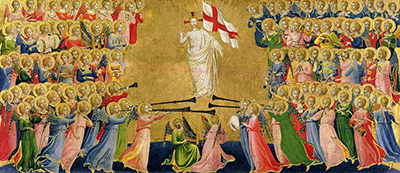
Six trumpeters aim their instruments into the space below the risen Christ. The figure above them scarcely seems to move. In Christ Glorified in the Court of Heaven, Fra Angelico gives the noise and movement of celebration to the angels and leaves Christ suspended on wisps of cloud. Painted about 1423–24, this small panel now in the National Gallery, London, once occupied the centre of the lowest tier of the high altarpiece at San Domenico in Fiesole. The angelic court was the focus of a gathering that continued into the flanking panels, where rows of saints turn towards the light. [1] [2]
At a Glance
- ArtistFra Angelico
- DateAbout 1423–24
- MediumEgg tempera on wood, probably poplar, with gold and silver leaf
- Dimensions31.7 × 73 cm (painted surface, height × width)
- Original settingCentre of the high-altarpiece predella at San Domenico, Fiesole
- CollectionNational Gallery, London, NG663.1
- AcquisitionBought in 1860. [1] [2]
Christ in the open gold
Christ raises his right hand in blessing and holds the white banner of the Resurrection in his left. Its red cross repeats the cross in his halo. Look closely at the raised palm and the sign of the Crucifixion is still there. Gordon’s National Gallery catalogue notes that the wounds are picked out in gold. The body is strikingly pale even beside the white robe, and only faint traces of the clouds remain below the falling hem. The banner rises and bends above him while the folds of the robe fall almost straight. These opposing movements make the body seem all the more still. [1] [2]
The clear patch of gold around Christ is as important to that stillness as the figure itself. Fine lines cut into the leaf radiate from his body, giving the gold a direction. At the edges of this opening, the angels crowd so closely that their haloes overlap. The change from dense pattern to open space makes Christ legible at a glance, and the lines give the impression that the light starts with him. A green wreath reaches into this space from the upper right. The National Gallery suggests that the fresh leaves may recall the crown of thorns by inversion. The wreath approaches the head of a figure who still bears the wounds of the Passion, so the two details can be read together even if the precise allusion remains uncertain. [1] [2]
How the angels make music
The angels are arranged in five ranks on either side. High up, red seraphim on the viewer’s left and blue cherubim on the right give the two banks of figures distinct colours. In the lower ranks, pinks, blues, greens and reds alternate more freely. Angelico lets the rows break into individual actions. Two angels at the lower left seem to dance, and the sweep of one extended arm carries the eye across the gowns and wings behind it. Others pray or seem to sing. The arc of blue beneath the foreground figures may represent the vault of heaven. It gives the kneeling players a surface from which to lean or turn. [1] [2]
The long trumpets extend from either side below Christ’s feet. Their near-horizontal lines cut across the upright bodies and guide the eye towards the middle. Two kneeling angels play portative organs, small instruments that could be carried, and a harp is visible higher in the company. At the front of the third rank on the viewer’s right, the armoured figure identified as the Archangel Michael stands out among the players. His sword and armour interrupt the succession of instruments and coloured robes. Michael’s role in the weighing of souls helps explain why the painting has been associated with images of the Last Judgement, even as the banner and gestures of acclaim make the glorification of the risen Christ the immediate subject. [1] [2]
What the surface tells us
The dark instruments visible today are a poor guide to their original brilliance. Examination by Dillian Gordon, Martin Wyld and Ashok Roy found that the silver leaf on trumpets, pipes and portative organs had oxidised and flaked. On a small trumpet at the lower right, they could still see how the adhesive layer had been put over the blue drapery, then silvered and glazed with lapis lazuli and black. Michael’s sword and helmet and an angel’s cymbals have kept more of their shine. A sample from the helmet showed a thin glaze of ultramarine and black over the silver, which the researchers suggest helped to protect it. The surviving flashes make it easier to imagine how the instruments once stood out against the crowded, richly coloured robes. [3]
The conservators distinguished the burnished gold ground from the small gold details laid over adhesive on the costumes and wings. The rings and tiny punched marks on the haloes catch light differently from a broad expanse of gold leaf. The fine lines on a pink robe also reveal something about the work that preceded gilding and painting. A sample from an exposed line in the robe of an angel on the right indicated iron gall ink, which helps explain why infrared examination registered so little of the underdrawing. Gordon identifies a small adjustment to the length of a trumpet, a reminder that even within the tightly ordered design Angelico revised the placement of individual forms. Gordon judges the centre to be substantially his own work, with more evident workshop participation elsewhere in the ensemble. [2] [3]
The surface also records the painting’s years in London. On acquiring the panels in 1860, the Gallery’s director, Charles Eastlake, asked that repairs should preserve the slight sheen of the tempera. By 1999, discoloured retouching and a greyed varnish had made treatment necessary. After cleaning, conservators repaired small losses, leaving the many gaps in the gilded ornament visible. Where a pattern breaks off across a fold, the interruption can therefore belong to the surface history of the painting. [3]
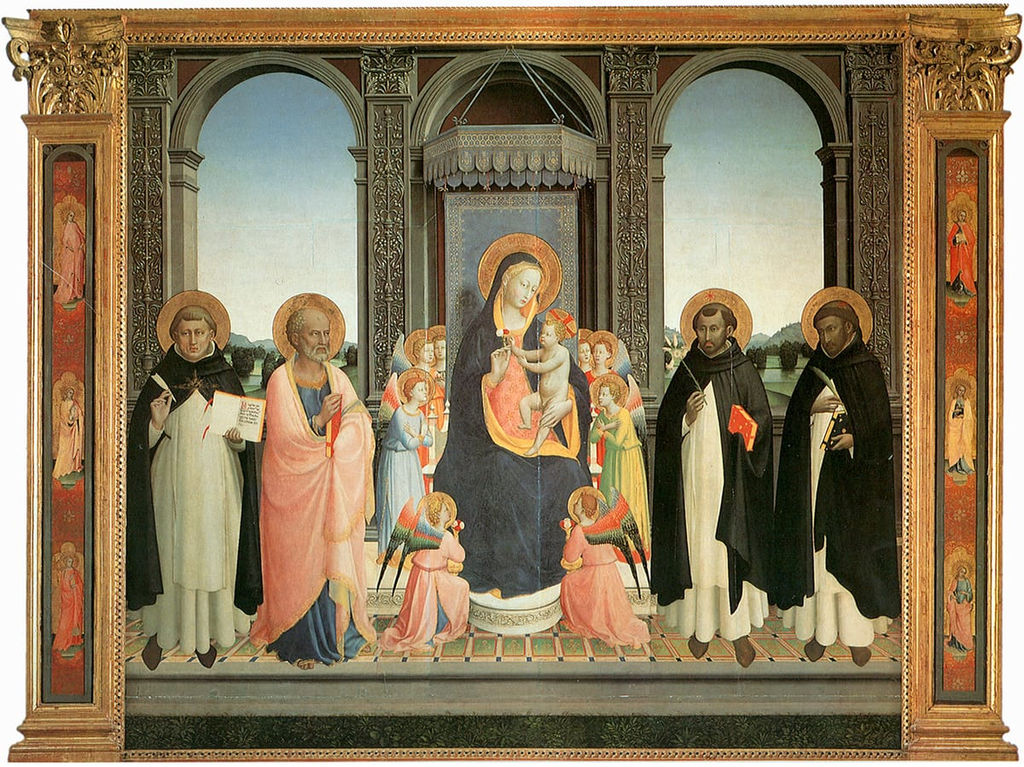
The main Fiesole altarpiece as it survives after Lorenzo di Credi’s alterations. Its detached predella is in London. Image source. Public domain. Proportional web resize.
The court beyond the central panel
The predella, the low band beneath the main image of an altarpiece, often gave painters a space to tell episodes from sacred lives. At Fiesole the long format served a different purpose. To the left of Christ, the Virgin heads the company of apostles and other saints. On the right, The Forerunners of Christ with Saints and Martyrs brings Old Testament figures and Christian saints into the gathering. Their attention turns towards the angelic centre. Two narrower panels of revered Dominican men and women probably belonged at the feet of the framing pilasters, where they would have stood slightly forward of the three main compartments. The members of the order thus occupied a recognisable place within a much wider company. [1] [2] [3]
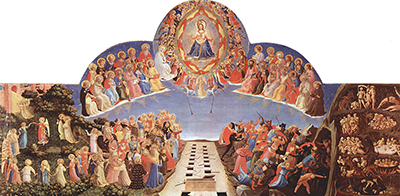
The composition brings several kinds of sacred image into contact. Gordon points to the standing, banner-bearing Christ of Florentine Resurrection pictures and to Ascension imagery in which musicians accompany him. The trumpets, Michael and the ordered ranks also recall the Last Judgement. In the Dominican church of Santa Maria Novella in Florence, the Strozzi di Mantova chapel gives Paradise and the Judgement separate walls. That comparison helps explain what Angelico has concentrated in the narrow band at Fiesole. The ranks gather round Christ in glory, with the divisions and verdict of a Judgement scene left outside the picture. Gordon also draws a parallel with a Lenten letter by Giovanni Dominici, the founder of the Fiesole convent, who asks his reader to imagine ascending through the blessed to God. The letter gives a sense of how such hierarchies could serve meditation. Its use by Angelico remains conjectural. [1] [2] [4]
From the high altar to the National Gallery
The wood itself helps explain how the three inner scenes belonged together. The horizontal grain continues across the backs of the panels, and X-rays show the linen that lay between the plank and the preparation for painting. The separate scenes were painted on one long support. Conservators estimated gaps of about eight centimetres either side of Christ where there were probably framing divisions. The grain on the two narrow Dominican panels runs vertically, supporting their proposed place on the pilasters. The findings establish an original continuity across the central group while leaving the design of the mouldings and the appearance of the intervening bands open. [2] [3]
According to the convent chronicle, the high altar was consecrated in October 1435, when the painting was already in place. Gordon suggests that money left by the Florentine benefactor Barnaba degli Agli for the church and its furnishings may have helped pay for the altarpiece. His family’s arms are documented on the altarcloth. Their possible presence on the predella, in the lost spaces between or beside the panels, remains a hypothesis. [2] [3]
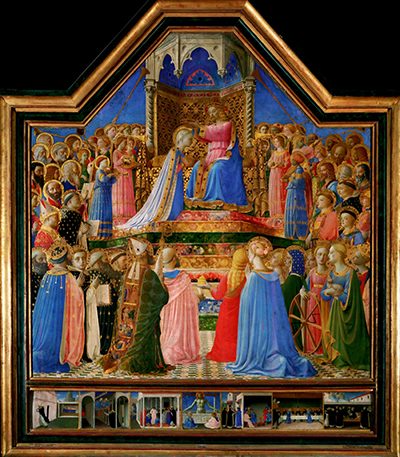
The principal tier of the San Domenico Altarpiece remains in the church in Fiesole. Its enthroned Virgin and Child are accompanied by angels and Saints Thomas Aquinas, Barnabas, Dominic and Peter Martyr. The Italian checklist for the 2025–26 Florence exhibition dates that main tier to 1420–23 and identifies Lorenzo di Credi’s remodelling with 1501. He gave the earlier altarpiece a continuous setting with a landscape in place of the gold ground. In 1568 Giorgio Vasari complained that repainting had harmed the main tier but singled out the better-preserved predella for praise, dwelling on the effect of its multitude of tiny figures. The National Gallery catalogue finds no evidence that Lorenzo repainted the predella. [2] [5] [6]
The painted ensemble was probably set up again on the high altar in 1502, after the rebuilding of the choir, and later moved from that position. The predella passed from the friars to dealers in Florence before 1827, and subsequently into the Valentini collection in Rome. The National Gallery acquired it in 1860. The circumstances of that purchase survive on the panels themselves. The back of the centre bears the names of Otto Mündler, who went to Rome to identify the painting, and C. J. Newton, the British consul who helped with the purchase. [1] [2]
Fra Angelico artworks directory
Explore documented works and surviving parts of larger ensembles. Catalogue links identify individual records. Attribution and dating can vary across collections and publications. Search the Federico Zeri Photo Archive by artist.
| Name | Date | Medium and sources |
|---|---|---|
| Adoration of the Magi | About 1440–60, NGA catalogue | Painting Catalogue. |
| Adoration of the Magi (Armadio degli Argenti) | About 1450–53 | Tempera and gold on wood. Catalogue. |
| Agony in the Garden (Armadio degli Argenti) | About 1450–53 | Tempera and gilding on wood Catalogue. |
| Annalena Altarpiece / Pala di Annalena | commonly c. 1435 | Tempera on panel Catalogue. |
| Annunciation (Armadio degli Argenti) | About 1450–53 | Tempera and gilding on wood. Catalogue. |
| Annunciation (Cortona) | generally placed in the 1430s; exact dating remains debated | Tempera on panel Catalogue. |
| Annunciation (Prado) | 1425–26 | Tempera on poplar panel Catalogue. |
| Annunciation (San Marco upper corridor) | commonly c. 1442 | Fresco Catalogue. |
| Annunciation with Saint Peter Martyr | About 1439–43 | Fresco on plaster. Catalogue. |
| Annunciatory Angel | 1450–55, Detroit catalogue | Gold leaf and tempera on wood panel. Catalogue. |
| Armadio degli Argenti (Silver Treasury) | principally c. 1450–52 | Tempera on panel Catalogue. |
| Arrest of Christ (Armadio degli Argenti) | About 1450–53 | Tempera and gilding on wood Catalogue. |
| Ascension (Armadio degli Argenti) | About 1450–53 | Tempera and gilding on wood Catalogue. |
| Baptism of Christ (Armadio, Alesso Baldovinetti) | About 1452–53 | Tempera and gilding on wood Catalogue. |
| Beheading of Saints Cosmas and Damian (San Marco Altarpiece) | About 1438–42 | Painted panel Catalogue. |
| Betrayal of Christ (Armadio degli Argenti) | About 1450–53 | Tempera and gilding on wood Catalogue. |
| Blessed Dominican, Possibly Jordan of Saxony (San Marco Altarpiece) | About 1438–42 | Painted panel Catalogue. |
| Blessed Vincent Ferrer (San Marco Altarpiece) | About 1438–42 | Painted panel Catalogue. |
| Burial of Saints Cosmas and Damian (San Marco Altarpiece) | About 1438–42 | Painted panel Catalogue. |
| Bust of a Cleric and a Group of Figures (recto and verso) | 15th century | Pen and ink on paper Catalogue. |
| Christ among the Doctors (Armadio degli Argenti) | About 1450–53 | Tempera and gilding on wood Catalogue. |
| Christ before Caiaphas (Armadio degli Argenti) | About 1450–53 | Tempera and gilding on wood Catalogue. |
| Christ Glorified in the Court of Heaven | About 1423–24 | Egg tempera on wood, probably poplar, with gold and silver leaf Catalogue. |
| Christ Seated in Judgment | 1447 | Fresco and gilding on plaster. Catalogue. |
| Christ Stripped of His Garments (Armadio degli Argenti) | About 1450–53 | Tempera and gilding on wood Catalogue. |
| Christ Washes the Apostles’ Feet (Armadio degli Argenti) | About 1450–53 | Tempera and gilding on wood Catalogue. |
| Circumcision of Christ (Armadio degli Argenti) | About 1450–53 | Tempera and gilding on wood. Catalogue. |
| Communion of the Apostles (Armadio degli Argenti) | About 1450–53 | Tempera and gilding on wood Catalogue. |
| Coronation of the Virgin (Armadio degli Argenti) | About 1450–53 | Tempera and gilding on wood Catalogue. |
| Coronation of the Virgin (Louvre) | Louvre: second quarter of the fifteenth century, 1425–50; often dated more narrowly c. 1434–35 | Tempera and gold on panel Catalogue. |
| Coronation of the Virgin (Uffizi) | 1431–35 | Tempera on wood, gold ground Catalogue. |
| Cortona Triptych | About 1437 | Tempera and gold on panel. Catalogue. |
| Crucifixion (Armadio degli Argenti) | About 1450–53 | Tempera and gilding on wood Catalogue. |
| Crucifixion and Saints | 1441–42 | Fresco Catalogue. |
| Deposition from the Cross / Santa Trinita Deposition | commissioned 1429–32; completed by Angelico within this period | Tempera on panel Catalogue. |
| Descent into Limbo (Armadio degli Argenti) | About 1450–53 | Tempera and gilding on wood Catalogue. |
| Entombment of Christ (San Marco Altarpiece) | About 1438–42 | Painted panel Catalogue. |
| Entry into Jerusalem (Armadio degli Argenti) | About 1450–53 | Tempera and gilding on wood Catalogue. |
| Expulsion and the Stoning of Saint Stephen | 1448–49, Vatican Museums | Fresco. Catalogue. |
| Fiesole San Domenico Altarpiece | early 1420s; predella about 1423–24 | Tempera on panel Catalogue. |
| Flagellation (Armadio degli Argenti) | About 1450–53 | Tempera and gilding on wood Catalogue. |
| Flight into Egypt | About 1450–53 | Tempera and gilding on wood. Catalogue. |
| Guidalotti Polyptych | c. 1447–49 | Tempera and oil on panel Catalogue. |
| Healing of Palladia and Saint Damian Accepting Her Gift (San Marco Altarpiece) | About 1438–42 | Painted panel Catalogue. |
| Holy Pilgrim, Possibly Saint Roch (San Marco Altarpiece) | About 1438–42 | Painted panel Catalogue. |
| Holy Women at the Tomb (Armadio degli Argenti) | About 1450–53 | Tempera and gilding on wood Catalogue. |
| Judas Receives Payment (Armadio degli Argenti) | About 1450–53 | Tempera and gilding on wood Catalogue. |
| Lamentation over Christ (Armadio degli Argenti) | About 1450–53 | Tempera and gilding on wood Catalogue. |
| Lamentation over the Dead Christ (Croce al Tempio Lamentation) | 1436–41, Zeri catalogue | Tempera and gilding on wood panel. Catalogue. |
| Last Judgement (Armadio degli Argenti) | About 1450–53 | Tempera and gilding on wood Catalogue. |
| Last Judgement (San Marco) | c. 1425–28 | Tempera and gold on panel Catalogue. |
| Last Supper (Armadio degli Argenti) | About 1450–53 | Tempera and gilding on wood Catalogue. |
| Lex Amoris (Armadio degli Argenti) | About 1450–53 | Tempera and gilding on wood Catalogue. |
| Madonna and Child with Saint Dominic and Saint Thomas Aquinas | About 1430, Hermitage catalogue | Detached fresco. Catalogue. |
| Madonna and Child with Saints | About 1411–13 | Tempera on wood panel, with a gold ground. Catalogue. |
| Madonna of Humility | About 1425, Thyssen catalogue | Tempera and gold on wood. Catalogue. |
| Madonna of the Star | 1431–34, Zeri catalogue | Tempera with oil glazes and gold on wood panel, as catalogued by the Gardner for the 2018 exhibition. Catalogue. |
| Marriage at Cana (Armadio, Alesso Baldovinetti) | About 1452–53 | Tempera and gilding on wood Catalogue. |
| Massacre of the Innocents (Armadio degli Argenti) | About 1450–53 | Tempera and gilding on wood Catalogue. |
| Miracle of the Black Leg (San Marco Altarpiece) | About 1438–42 | Painted panel Catalogue. |
| Mocking of Christ (Armadio degli Argenti) | About 1450–53 | Tempera and gilding on wood Catalogue. |
| Mystic Wheel (The Vision of Ezekiel) | About 1450–52 | Tempera and gilding on wood. Catalogue. |
| Nativity (Armadio degli Argenti) | About 1450–53 | Tempera and gilding on wood. Catalogue. |
| Niccoline Chapel frescoes | principally 1448–50 | Fresco Catalogue. |
| Noli me Tangere | broadly within Angelico’s San Marco campaign, late 1430s–1440s | Fresco Catalogue. |
| Ordination of Saint Lawrence | 1448 | Fresco. Catalogue. |
| Pentecost (Armadio degli Argenti) | About 1450–53 | Tempera and gilding on wood Catalogue. |
| Presentation of Christ at the Temple (Armadio degli Argenti) | About 1450–53 | Tempera and gilding on wood. Catalogue. |
| Presentation of Jesus at the Temple | Early 1440s | Fresco on plaster. Catalogue. |
| Raising of Lazarus (Armadio degli Argenti) | About 1450–53 | Tempera and gilding on wood Catalogue. |
| Rescue of Saints Cosmas and Damian and Exorcism of Lysias (San Marco Altarpiece) | About 1438–42 | Painted panel Catalogue. |
| Road to Calvary (Armadio degli Argenti) | About 1450–53 | Tempera and gilding on wood Catalogue. |
| Saint Anthony Abbot (San Marco Altarpiece) | About 1438–42 | Painted panel Catalogue. |
| Saint Bernard of Clairvaux or Saint Benedict (San Marco Altarpiece) | About 1438–42 | Painted panel Catalogue. |
| Saint Damian Receives Money from Palladia | About 1425–49 | Tempera and gilding on wood. Catalogue. |
| Saint Francis and a Bishop Saint, Saint John the Baptist and Saint Dominic | Late 1420s, Getty catalogue | Tempera and gold leaf on panel. Catalogue. |
| Saint James the Greater Freeing the Magician Hermogenes | About 1426–29 | Tempera and gold on panel Catalogue. |
| Saint Jerome (San Marco Altarpiece) | About 1438–42 | Painted panel Catalogue. |
| Saint Lawrence Giving Alms | About 1448 | Wall fresco. Catalogue. |
| Saint Lawrence Receiving the Treasures of the Church from Pope Sixtus II | About 1448–49 | Fresco on plaster. Catalogue. |
| Saint Romuald (San Marco Altarpiece) | About 1438–42 | Painted panel Catalogue. |
| Saint Stephen Addressing the Council | 1448–49, Vatican Museums | Fresco. Catalogue. |
| Saint Stephen Preaching | 1448–49, Vatican Museums | Wall fresco. Catalogue. |
| Saint Thomas Aquinas (San Marco Altarpiece) | About 1438–42 | Painted panel Catalogue. |
| Saints Cosmas and Damian and Their Brothers Survive the Stake | Second quarter of the 15th century | Tempera and gilding on wood. Catalogue. |
| Saints Cosmas and Damian at the Stake (San Marco Altarpiece) | About 1438–42 | Painted panel Catalogue. |
| Saints Cosmas and Damian before Lysias (San Marco Altarpiece) | About 1438–42 | Painted panel Catalogue. |
| Saints Cosmas and Damian Rescued by an Angel | Second quarter of the 15th century | Tempera and gilding on wood. Catalogue. |
| Saints Cosmas and Damian with Their Brothers before Proconsul Lysias | Second quarter of the 15th century | Tempera and gilding on wood. Catalogue. |
| San Marco Altarpiece / Pala di San Marco | 1438–43 | Tempera on panel Catalogue. |
| San Pietro Martire Triptych | About 1422–23, Strozzi exhibition | Tempera and gold on panel. Catalogue. |
| Scenes from the Lives of the Desert Fathers (Thebaid) | About 1420, Uffizi catalogue | Tempera on wood. Catalogue. |
| Sixteen Prophets | 1447 | Fresco and gilding on plaster Catalogue. |
| Stoning and Shooting of the Brothers (San Marco Altarpiece) | About 1438–42 | Painted panel Catalogue. |
| Tabernacle of the Linaioli | 1433–35 | Tempera on panel Catalogue. |
| The Attempted Crucifixion and Stoning of Saints Cosmas and Damian | Second quarter of the 15th century | Tempera and gilding on wood. Catalogue. |
| The Crucifixion | About 1420–23, Met catalogue | Tempera on wood, gold ground. Catalogue. |
| The Death and the Assumption of the Virgin | 1424–34 | Tempera with oil glazes and gold on panel Catalogue. |
| The Dominican Blessed (left end) (Fiesole predella) | About 1423–24 | Egg tempera and gold on wood Catalogue. |
| The Dominican Blessed (right end) (Fiesole predella) | About 1423–24 | Egg tempera and gold on wood Catalogue. |
| The Entombment of Christ | About 1450 | Tempera on poplar panel. Catalogue. |
| The Forerunners of Christ with Saints and Martyrs | About 1423–24 | Egg tempera on wood (probably poplar), with gold and silver leaf. Catalogue. |
| The Funeral of Saint Anthony Abbot | About 1426–30 | Tempera on poplar panel. Catalogue. |
| The Martyrdom of Saints Cosmas and Damian | About 1425–49 | Tempera and gilding on wood. Catalogue. |
| The Mocking of Christ / Christ Mocked | within the San Marco dormitory campaign, broadly late 1430s–1440s | Fresco Catalogue. |
| The Nativity | About 1425, Minneapolis catalogue | Tempera on poplar panel. Catalogue. |
| The Nativity in Cell 5 at San Marco | About 1439–43 | Fresco on plaster. Catalogue. |
| The Penitent Saint Jerome | 1419–20 | Tempera on wood panel Catalogue. |
| The Virgin and Child by Fra Angelico (Fogg Museum) | About 1430, Harvard catalogue | Tempera originally on panel, subsequently transferred to Masonite. Catalogue. |
| The Virgin Mary with the Apostles and Other Saints (Fiesole predella) | About 1423–24 | Egg tempera and gold on wood Catalogue. |
| Transfiguration (Armadio, Alesso Baldovinetti) | About 1452–53 | Tempera and gilding on wood Catalogue. |
| Transfiguration (San Marco Cell 6) | within the San Marco dormitory campaign, broadly late 1430s–1440s | Fresco Catalogue. |
| Virgin Mary Annunciate | 1450–55, Detroit catalogue | Gold leaf and tempera on wood panel. Catalogue. |
| Virgin of the Pomegranate | About 1426 | Tempera on panel with gilding Catalogue. |
Frequently Asked Questions
Discussion
Use these prompts to look again or share an observation.
Reader Insights
Follow the rows of figures towards Christ in the centre. Where do the angels and their instruments change the rhythm?
What do you learn from seeing all five panels together that a close view of Christ’s court leaves outside the image?
Join the Conversation
Share a detail or question about Christ Glorified in the Court of Heaven.
References
- National Gallery, Christ Glorified in the Court of Heaven, NG663.1, collection record. View source.
- Dillian Gordon, Fiesole San Domenico Altarpiece, NG663.1–5, The Fifteenth Century Italian Paintings, vol. 1, National Gallery, 2003. View source.
- Dillian Gordon, Martin Wyld and Ashok Roy, ‘Fra Angelico’s Predella for the High Altarpiece of San Domenico, Fiesole’, National Gallery Technical Bulletin 23, 2002, pp. 4–19. View source.
- Santa Maria Novella, Cappella Strozzi (di Mantova), o di San Tommaso d’Aquino (in Italian). View source.
- Fondazione Palazzo Strozzi and Museo di San Marco, Beato Angelico, 2025–26 exhibition press kit, checklist and curatorial notes (in Italian). View source.
- Giorgio Vasari, ‘Fra’ Giovanni da Fiesole’, Le vite, Giuntina edition, 1568, Fondazione Memofonte transcription, p. 264 (in Italian). View source.
.jpg)
 Fra Angelico.jpg)