


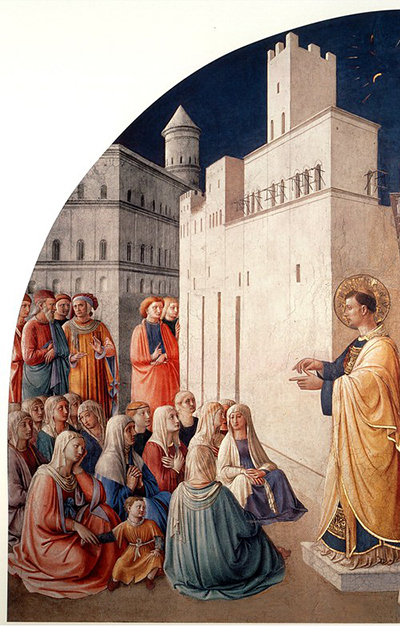
 by Tom Gurney
Tom Gurney BSc (Hons) is an art history expert with over 20 years experience
Published on June 19, 2020 / Updated on November 29, 2026
Email: tomgurney1@gmail.com / Phone: +44 7429 011000
Introduction
Stephen stands on a low stone step, counting out the points of his argument with his fingers. Women and a child sit close to him, with standing listeners behind them. Fra Angelico sets this gathering outdoors, where the pale wall of a towered building makes even the preacher’s small movements easy to see. The scene occupies the left half of the entrance-wall lunette in the Niccoline Chapel, the private chapel of Pope Nicholas V in the Vatican Apostolic Palace. The Vatican dates the pair of scenes in the lunette to 1448–49. [1]
At a Glance
- ArtistFra Angelico (Fra Giovanni da Fiesole), with workshop collaboration in the chapel. [2] [3]
- Date1448–49 in the Vatican’s caption for the paired scenes. [1]
- MediumWall fresco. [4]
- LocationUpper register, left side of the entrance-wall lunette, Niccoline Chapel, Apostolic Palace, Vatican City. [1] [2]
- PatronPope Nicholas V. [2]
- Dimensions322 × 412 cm for the full lunette containing the two episodes, as catalogued by the Fondazione Federico Zeri. [4]
The people who stop to listen
Stephen is at the right edge of the preaching scene, facing left across a strip of open ground. A patterned gold-coloured halo frames his head. His yellow-gold outer vestment falls in long folds over a dark blue garment, with a decorated band visible near his feet. The finery marks out the deacon among the people of the city and helps the eye find him high on the wall. The low step lifts him just enough to address the seated group. From there, his gaze and both hands reach into the space that separates him from his listeners. [1]
The congregation has a shape of its own. Several women in pale veils make an uneven arc across the foreground. At the near edge, a seated figure in a blue-green mantle presents her back, her head turned towards Stephen. The folds of her cloak spread out across the ground like the skirts of the women facing her. A small child in ochre sits near the woman in red at the left. Further in, one woman presses a hand to her chest, another holds her hands together and a third rests her hands across her lap. Their different postures give the eye several ways into a scene whose main action is listening. [1]
Behind them, men in caps and long coloured robes stand in small groups. An opening between those groups leaves a narrow view into the space beside the buildings. At the rear, some heads overlap and others turn at an angle, so attention looks less uniform than it does among the women closest to Stephen. The composition makes room for people who might have arrived together, stayed at the edge or turned as they heard him. The figures’ names and their reasons for stopping remain open. [1]
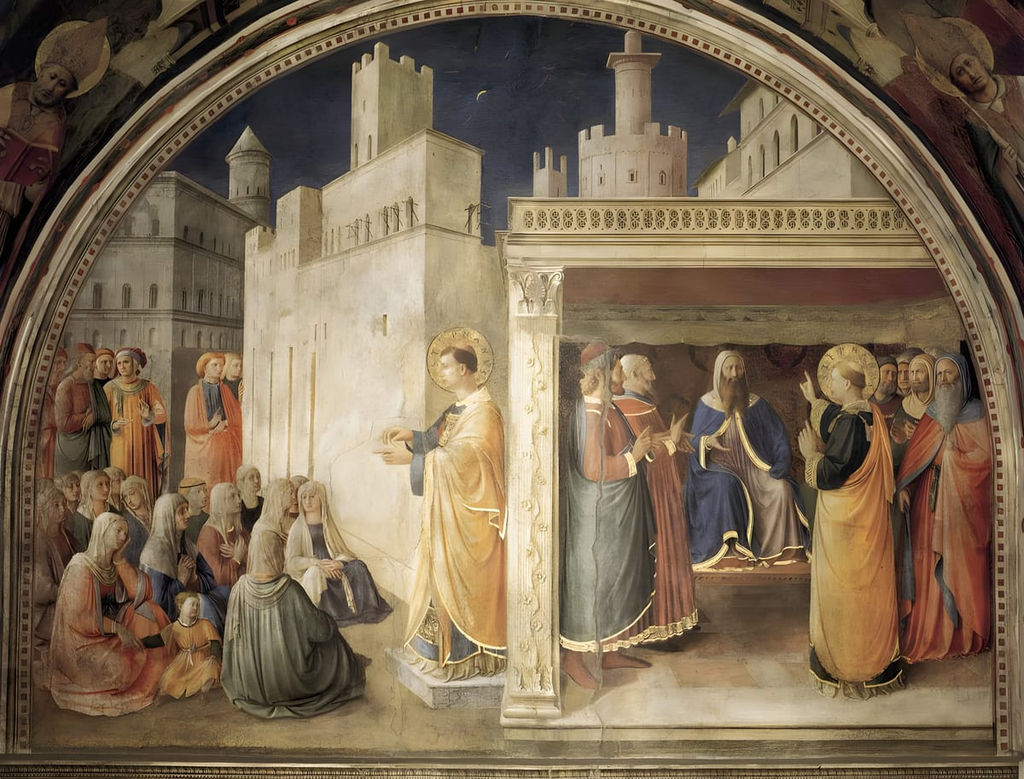
The paired Niccoline lunette. The architecture separates the preaching on the left from the council hearing on the right. Image source. Public domain. Proportional web resize.
Where the sermon fits in Acts
In Acts 6, the Jerusalem community chooses Stephen and six others after Greek-speaking believers complain that their widows are being overlooked in the daily distribution. Stephen then comes into conflict with opponents who cannot match his wisdom in argument. They bring him before the council on accusations concerning Moses, God, the holy place and the law. Acts describes his public activity and the disputes that follow. It gives no transcript of an outdoor sermon to the gathering pictured here. The presence of women in the foreground therefore resonates with the chapter’s concern for the community without identifying them as the widows in the text. [5]
The long speech preserved in Acts 7 belongs to Stephen’s appearance before the council. It recounts Israel’s history before turning to an accusation against his hearers. The fresco gives the earlier, less precisely described public activity a scene of its own. The distinction is visible across the lunette. On the left, a community gathers at street level. On the right, a seated authority and a more tightly arranged company receive Stephen inside a chamber. The yellow and blue of his clothes make him recognisable in both episodes. [1] [5] [6]
A city square beneath the arch
The architecture leaves its clearest surface directly behind Stephen’s hands. The pale wall is almost bare at his height, then rises past a line of delicate metalwork to a square tower with battlements. At the left, a grey building punctuated by rows of small arched windows and a round turret presses close to the plaster curve. The two buildings meet at an angle that opens the foreground into a square. Their upper outlines follow the changing height of the arch, allowing a tall tower near the middle and lowering the roofs towards the outer edge. Much of the painted city sits above the heads of the crowd, yet the recession of its walls directs the eye back towards the people gathered on the ground. [1] [7]
A single painted pier divides the square from Stephen’s appearance before the council. The street-side wall recedes towards the left, while the tiled chamber on the other side opens to the right. Livia Lupi argues that these shifts in viewpoint allow two successive events to have distinct settings while keeping them in one continuous city. Beyond the council roof, the towers and upper storeys carry the skyline across the divide. The street can thus feel open to passers-by and the chamber closed around the men who hear the case, even though both belong to the same painted Jerusalem. [1] [7]
Alessandro Zuccari compares the chapel’s painted architecture with fifteenth-century Florentine buildings and sees in it a parallel between the early Church and the papal Rome of Nicholas V. Lupi reports his comparison of the grey palace at the left with Florence’s Palazzo Rucellai. The comparison suggests a way a Renaissance viewer might recognise the habits of a contemporary city in a biblical one. The painted towers and streets make Jerusalem a place where people can assemble, speak and be overheard. [7] [8]
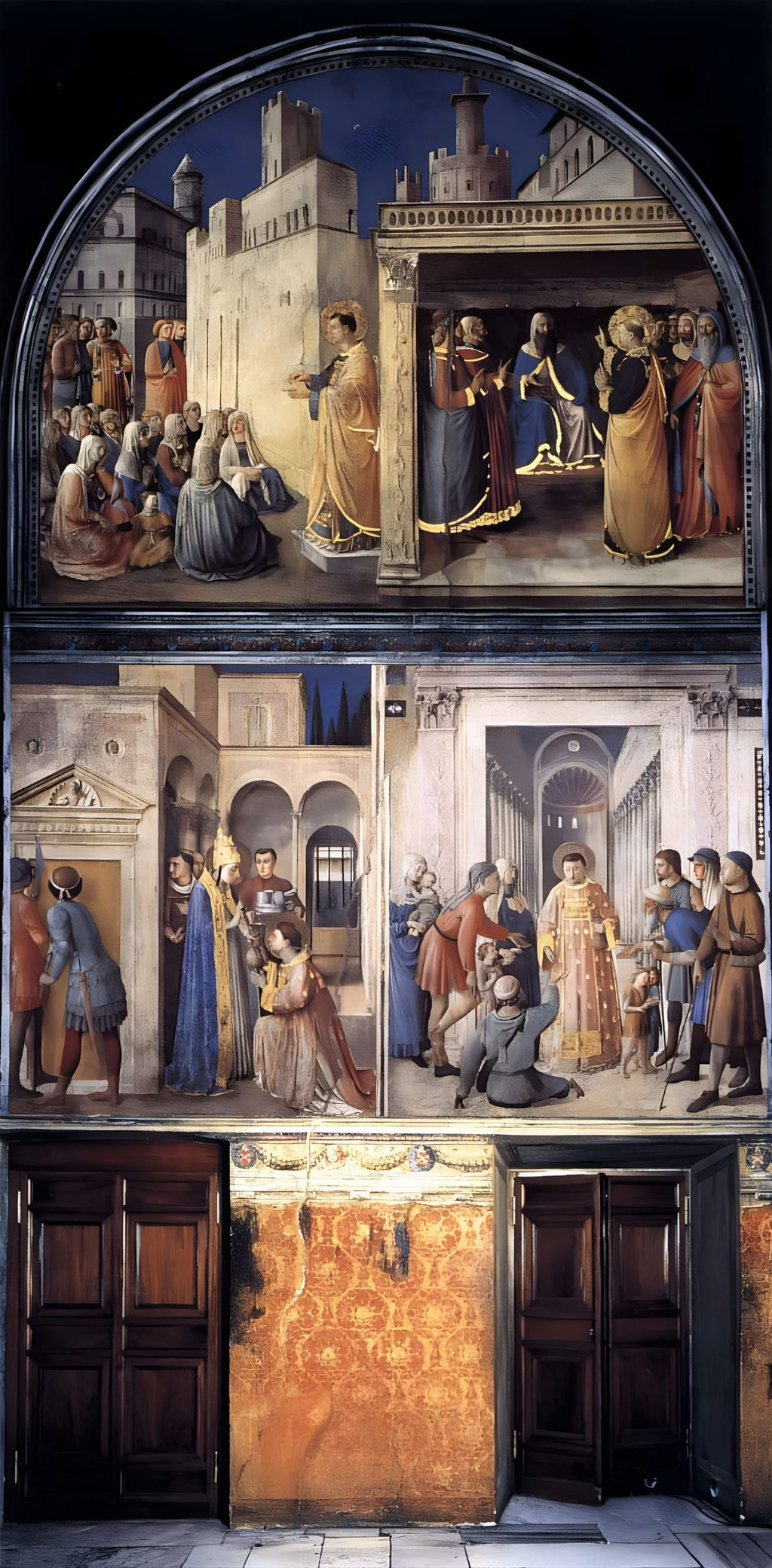
One wall of the Niccoline Chapel. The paired Stephen scenes above and the Lawrence scenes below occupy separate registers. Image source. Public domain. Proportional web resize.
What survives of Stephen’s gesture
Lupi relates the finger-counting to a convention used by Renaissance orators to enumerate points. In the fresco, one hand comes down towards the fingers of the other. The space left around the gesture gives it a prominence out of proportion to its size. There is a complication in reading those fingers closely. As Lupi reports from the chapel’s restoration history, opening a small window beside Stephen damaged the plaster where his hands were painted. They were repainted under Gregory XIII in the late sixteenth century, then repainted again in 1948 in the form visible today. The gesture can still be read as part of the composition, but the surviving paint gives us the restored form of the hands. The Vatican Museums’ photograph of the lunette shows its appearance after the chapel’s later restoration in 1995–96. [1] [7] [9]
In an albumen photograph of both episodes taken by Fratelli Alinari around 1860–1900, the hands were already visible in the gap between preacher and crowd. A dark vertical break runs down the pale wall beside them. The photograph gives a glimpse of the lunette before the twentieth-century treatment and shows why the condition of that apparently empty patch of wall matters to the story. [10]
Two payments, dated 15 February and 30 March 1448 by art historian Gerardo de Simone, document Fra Angelico’s work on the decoration. The Museo Benozzo Gozzoli notes that scholars have particularly associated Benozzo with the Stephen lunettes, with the most specific case made for the ordination. For the preaching scene, the broader evidence of collaboration in the chapel leaves the authorship of individual faces, garments and buildings open. [2] [3] [11]
In 1902, Langton Douglas compared the women with the seated audience in Angelico’s earlier Linaioli Tabernacle. He thought the broad treatment of their drapery in the Vatican fresco showed Angelico’s hand and allowed that Gozzoli might have worked on some of the architecture. His comparison connects two scenes of preaching. The division of work between the painters remains open. [3] [12]
An earlier pairing of preaching and dispute
The sequence had a Florentine precedent. In 1408, Mariotto di Nardo placed the preaching and the hearing before the council on a single tempera panel for the base of an altarpiece at Santo Stefano in Pane, near Florence. The panel, now in Tokyo, also shows women gathered around a blue-clad Stephen on the left and the elders indoors on the right. De Simone has suggested that Mariotto’s cycle may have influenced Angelico. The parallel is especially close in the order and pairing of the scenes. Where Mariotto crowds the listeners beside a steep diagonal stair, Angelico spreads them across a square and carries a continuous skyline over the two scenes. [1] [11] [13]
A public sermon in a private chapel
The Niccoline Chapel sets the life of Stephen above that of Lawrence, a deacon of the Roman Church. Below the sermon and the dispute, Lawrence receives the Church’s treasures and distributes them. Their proximity puts two forms of public service within one view. Stephen makes his case with his hands while people sit at his feet. Below, Lawrence uses his hands to give to people who have come to him in need. Nicholas V used the chapel for private prayer, and the room could also accommodate ceremonies of the papal court. The lives of the two deacons bring the exercise of authority down to encounters between people. [1] [2] [7] [9] [11]
The tension in the painting comes in part from what the two halves allow us to see at once. The crowd gathers around Stephen as he speaks in the square. Across the painted pier, officials are already hearing his case. On the next wall, the expulsion and stoning carry the story through the city gate. Seen before those scenes, the preaching has a measured pace. The child sits on the ground, the adults turn towards a speaker, and the saint takes his argument one point at a time. [1] [6] [7]
Inside the Niccoline Chapel
See the frescoes in the rooms where their painted stories meet.
Cappella Niccolina – Niccoline Chapel
See how the painted lives of Stephen and Lawrence occupy the two registers of the chapel.
Watch on YouTubeFra Angelico artworks directory
Explore documented works and surviving parts of larger ensembles. Catalogue links identify individual records. Attribution and dating can vary across collections and publications. Search the Federico Zeri Photo Archive by artist.
| Name | Date | Medium and sources |
|---|---|---|
| Adoration of the Magi | About 1440–60, NGA catalogue | Painting Catalogue. |
| Adoration of the Magi (Armadio degli Argenti) | About 1450–53 | Tempera and gold on wood. Catalogue. |
| Agony in the Garden (Armadio degli Argenti) | About 1450–53 | Tempera and gilding on wood Catalogue. |
| Annalena Altarpiece / Pala di Annalena | commonly c. 1435 | Tempera on panel Catalogue. |
| Annunciation (Armadio degli Argenti) | About 1450–53 | Tempera and gilding on wood. Catalogue. |
| Annunciation (Cortona) | generally placed in the 1430s; exact dating remains debated | Tempera on panel Catalogue. |
| Annunciation (Prado) | 1425–26 | Tempera on poplar panel Catalogue. |
| Annunciation (San Marco upper corridor) | commonly c. 1442 | Fresco Catalogue. |
| Annunciation with Saint Peter Martyr | About 1439–43 | Fresco on plaster. Catalogue. |
| Annunciatory Angel | 1450–55, Detroit catalogue | Gold leaf and tempera on wood panel. Catalogue. |
| Armadio degli Argenti (Silver Treasury) | principally c. 1450–52 | Tempera on panel Catalogue. |
| Arrest of Christ (Armadio degli Argenti) | About 1450–53 | Tempera and gilding on wood Catalogue. |
| Ascension (Armadio degli Argenti) | About 1450–53 | Tempera and gilding on wood Catalogue. |
| Baptism of Christ (Armadio, Alesso Baldovinetti) | About 1452–53 | Tempera and gilding on wood Catalogue. |
| Beheading of Saints Cosmas and Damian (San Marco Altarpiece) | About 1438–42 | Painted panel Catalogue. |
| Betrayal of Christ (Armadio degli Argenti) | About 1450–53 | Tempera and gilding on wood Catalogue. |
| Blessed Dominican, Possibly Jordan of Saxony (San Marco Altarpiece) | About 1438–42 | Painted panel Catalogue. |
| Blessed Vincent Ferrer (San Marco Altarpiece) | About 1438–42 | Painted panel Catalogue. |
| Burial of Saints Cosmas and Damian (San Marco Altarpiece) | About 1438–42 | Painted panel Catalogue. |
| Bust of a Cleric and a Group of Figures (recto and verso) | 15th century | Pen and ink on paper Catalogue. |
| Christ among the Doctors (Armadio degli Argenti) | About 1450–53 | Tempera and gilding on wood Catalogue. |
| Christ before Caiaphas (Armadio degli Argenti) | About 1450–53 | Tempera and gilding on wood Catalogue. |
| Christ Glorified in the Court of Heaven | About 1423–24 | Egg tempera on wood, probably poplar, with gold and silver leaf Catalogue. |
| Christ Seated in Judgment | 1447 | Fresco and gilding on plaster. Catalogue. |
| Christ Stripped of His Garments (Armadio degli Argenti) | About 1450–53 | Tempera and gilding on wood Catalogue. |
| Christ Washes the Apostles’ Feet (Armadio degli Argenti) | About 1450–53 | Tempera and gilding on wood Catalogue. |
| Circumcision of Christ (Armadio degli Argenti) | About 1450–53 | Tempera and gilding on wood. Catalogue. |
| Communion of the Apostles (Armadio degli Argenti) | About 1450–53 | Tempera and gilding on wood Catalogue. |
| Coronation of the Virgin (Armadio degli Argenti) | About 1450–53 | Tempera and gilding on wood Catalogue. |
| Coronation of the Virgin (Louvre) | Louvre: second quarter of the fifteenth century, 1425–50; often dated more narrowly c. 1434–35 | Tempera and gold on panel Catalogue. |
| Coronation of the Virgin (Uffizi) | 1431–35 | Tempera on wood, gold ground Catalogue. |
| Cortona Triptych | About 1437 | Tempera and gold on panel. Catalogue. |
| Crucifixion (Armadio degli Argenti) | About 1450–53 | Tempera and gilding on wood Catalogue. |
| Crucifixion and Saints | 1441–42 | Fresco Catalogue. |
| Deposition from the Cross / Santa Trinita Deposition | commissioned 1429–32; completed by Angelico within this period | Tempera on panel Catalogue. |
| Descent into Limbo (Armadio degli Argenti) | About 1450–53 | Tempera and gilding on wood Catalogue. |
| Entombment of Christ (San Marco Altarpiece) | About 1438–42 | Painted panel Catalogue. |
| Entry into Jerusalem (Armadio degli Argenti) | About 1450–53 | Tempera and gilding on wood Catalogue. |
| Expulsion and the Stoning of Saint Stephen | 1448–49, Vatican Museums | Fresco. Catalogue. |
| Fiesole San Domenico Altarpiece | early 1420s; predella about 1423–24 | Tempera on panel Catalogue. |
| Flagellation (Armadio degli Argenti) | About 1450–53 | Tempera and gilding on wood Catalogue. |
| Flight into Egypt | About 1450–53 | Tempera and gilding on wood. Catalogue. |
| Guidalotti Polyptych | c. 1447–49 | Tempera and oil on panel Catalogue. |
| Healing of Palladia and Saint Damian Accepting Her Gift (San Marco Altarpiece) | About 1438–42 | Painted panel Catalogue. |
| Holy Pilgrim, Possibly Saint Roch (San Marco Altarpiece) | About 1438–42 | Painted panel Catalogue. |
| Holy Women at the Tomb (Armadio degli Argenti) | About 1450–53 | Tempera and gilding on wood Catalogue. |
| Judas Receives Payment (Armadio degli Argenti) | About 1450–53 | Tempera and gilding on wood Catalogue. |
| Lamentation over Christ (Armadio degli Argenti) | About 1450–53 | Tempera and gilding on wood Catalogue. |
| Lamentation over the Dead Christ (Croce al Tempio Lamentation) | 1436–41, Zeri catalogue | Tempera and gilding on wood panel. Catalogue. |
| Last Judgement (Armadio degli Argenti) | About 1450–53 | Tempera and gilding on wood Catalogue. |
| Last Judgement (San Marco) | c. 1425–28 | Tempera and gold on panel Catalogue. |
| Last Supper (Armadio degli Argenti) | About 1450–53 | Tempera and gilding on wood Catalogue. |
| Lex Amoris (Armadio degli Argenti) | About 1450–53 | Tempera and gilding on wood Catalogue. |
| Madonna and Child with Saint Dominic and Saint Thomas Aquinas | About 1430, Hermitage catalogue | Detached fresco. Catalogue. |
| Madonna and Child with Saints | About 1411–13 | Tempera on wood panel, with a gold ground. Catalogue. |
| Madonna of Humility | About 1425, Thyssen catalogue | Tempera and gold on wood. Catalogue. |
| Madonna of the Star | 1431–34, Zeri catalogue | Tempera with oil glazes and gold on wood panel, as catalogued by the Gardner for the 2018 exhibition. Catalogue. |
| Marriage at Cana (Armadio, Alesso Baldovinetti) | About 1452–53 | Tempera and gilding on wood Catalogue. |
| Massacre of the Innocents (Armadio degli Argenti) | About 1450–53 | Tempera and gilding on wood Catalogue. |
| Miracle of the Black Leg (San Marco Altarpiece) | About 1438–42 | Painted panel Catalogue. |
| Mocking of Christ (Armadio degli Argenti) | About 1450–53 | Tempera and gilding on wood Catalogue. |
| Mystic Wheel (The Vision of Ezekiel) | About 1450–52 | Tempera and gilding on wood. Catalogue. |
| Nativity (Armadio degli Argenti) | About 1450–53 | Tempera and gilding on wood. Catalogue. |
| Niccoline Chapel frescoes | principally 1448–50 | Fresco Catalogue. |
| Noli me Tangere | broadly within Angelico’s San Marco campaign, late 1430s–1440s | Fresco Catalogue. |
| Ordination of Saint Lawrence | 1448 | Fresco. Catalogue. |
| Pentecost (Armadio degli Argenti) | About 1450–53 | Tempera and gilding on wood Catalogue. |
| Presentation of Christ at the Temple (Armadio degli Argenti) | About 1450–53 | Tempera and gilding on wood. Catalogue. |
| Presentation of Jesus at the Temple | Early 1440s | Fresco on plaster. Catalogue. |
| Raising of Lazarus (Armadio degli Argenti) | About 1450–53 | Tempera and gilding on wood Catalogue. |
| Rescue of Saints Cosmas and Damian and Exorcism of Lysias (San Marco Altarpiece) | About 1438–42 | Painted panel Catalogue. |
| Road to Calvary (Armadio degli Argenti) | About 1450–53 | Tempera and gilding on wood Catalogue. |
| Saint Anthony Abbot (San Marco Altarpiece) | About 1438–42 | Painted panel Catalogue. |
| Saint Bernard of Clairvaux or Saint Benedict (San Marco Altarpiece) | About 1438–42 | Painted panel Catalogue. |
| Saint Damian Receives Money from Palladia | About 1425–49 | Tempera and gilding on wood. Catalogue. |
| Saint Francis and a Bishop Saint, Saint John the Baptist and Saint Dominic | Late 1420s, Getty catalogue | Tempera and gold leaf on panel. Catalogue. |
| Saint James the Greater Freeing the Magician Hermogenes | About 1426–29 | Tempera and gold on panel Catalogue. |
| Saint Jerome (San Marco Altarpiece) | About 1438–42 | Painted panel Catalogue. |
| Saint Lawrence Giving Alms | About 1448 | Wall fresco. Catalogue. |
| Saint Lawrence Receiving the Treasures of the Church from Pope Sixtus II | About 1448–49 | Fresco on plaster. Catalogue. |
| Saint Romuald (San Marco Altarpiece) | About 1438–42 | Painted panel Catalogue. |
| Saint Stephen Addressing the Council | 1448–49, Vatican Museums | Fresco. Catalogue. |
| Saint Stephen Preaching | 1448–49, Vatican Museums | Wall fresco. Catalogue. |
| Saint Thomas Aquinas (San Marco Altarpiece) | About 1438–42 | Painted panel Catalogue. |
| Saints Cosmas and Damian and Their Brothers Survive the Stake | Second quarter of the 15th century | Tempera and gilding on wood. Catalogue. |
| Saints Cosmas and Damian at the Stake (San Marco Altarpiece) | About 1438–42 | Painted panel Catalogue. |
| Saints Cosmas and Damian before Lysias (San Marco Altarpiece) | About 1438–42 | Painted panel Catalogue. |
| Saints Cosmas and Damian Rescued by an Angel | Second quarter of the 15th century | Tempera and gilding on wood. Catalogue. |
| Saints Cosmas and Damian with Their Brothers before Proconsul Lysias | Second quarter of the 15th century | Tempera and gilding on wood. Catalogue. |
| San Marco Altarpiece / Pala di San Marco | 1438–43 | Tempera on panel Catalogue. |
| San Pietro Martire Triptych | About 1422–23, Strozzi exhibition | Tempera and gold on panel. Catalogue. |
| Scenes from the Lives of the Desert Fathers (Thebaid) | About 1420, Uffizi catalogue | Tempera on wood. Catalogue. |
| Sixteen Prophets | 1447 | Fresco and gilding on plaster Catalogue. |
| Stoning and Shooting of the Brothers (San Marco Altarpiece) | About 1438–42 | Painted panel Catalogue. |
| Tabernacle of the Linaioli | 1433–35 | Tempera on panel Catalogue. |
| The Attempted Crucifixion and Stoning of Saints Cosmas and Damian | Second quarter of the 15th century | Tempera and gilding on wood. Catalogue. |
| The Crucifixion | About 1420–23, Met catalogue | Tempera on wood, gold ground. Catalogue. |
| The Death and the Assumption of the Virgin | 1424–34 | Tempera with oil glazes and gold on panel Catalogue. |
| The Dominican Blessed (left end) (Fiesole predella) | About 1423–24 | Egg tempera and gold on wood Catalogue. |
| The Dominican Blessed (right end) (Fiesole predella) | About 1423–24 | Egg tempera and gold on wood Catalogue. |
| The Entombment of Christ | About 1450 | Tempera on poplar panel. Catalogue. |
| The Forerunners of Christ with Saints and Martyrs | About 1423–24 | Egg tempera on wood (probably poplar), with gold and silver leaf. Catalogue. |
| The Funeral of Saint Anthony Abbot | About 1426–30 | Tempera on poplar panel. Catalogue. |
| The Martyrdom of Saints Cosmas and Damian | About 1425–49 | Tempera and gilding on wood. Catalogue. |
| The Mocking of Christ / Christ Mocked | within the San Marco dormitory campaign, broadly late 1430s–1440s | Fresco Catalogue. |
| The Nativity | About 1425, Minneapolis catalogue | Tempera on poplar panel. Catalogue. |
| The Nativity in Cell 5 at San Marco | About 1439–43 | Fresco on plaster. Catalogue. |
| The Penitent Saint Jerome | 1419–20 | Tempera on wood panel Catalogue. |
| The Virgin and Child by Fra Angelico (Fogg Museum) | About 1430, Harvard catalogue | Tempera originally on panel, subsequently transferred to Masonite. Catalogue. |
| The Virgin Mary with the Apostles and Other Saints (Fiesole predella) | About 1423–24 | Egg tempera and gold on wood Catalogue. |
| Transfiguration (Armadio, Alesso Baldovinetti) | About 1452–53 | Tempera and gilding on wood Catalogue. |
| Transfiguration (San Marco Cell 6) | within the San Marco dormitory campaign, broadly late 1430s–1440s | Fresco Catalogue. |
| Virgin Mary Annunciate | 1450–55, Detroit catalogue | Gold leaf and tempera on wood panel. Catalogue. |
| Virgin of the Pomegranate | About 1426 | Tempera on panel with gilding Catalogue. |
Frequently Asked Questions
The Vatican’s caption dates the lunette to 1448–49, and payments for Fra Angelico’s work on the chapel are documented in February and March 1448. The archive dates the pair more broadly to 1447–49. The payments establish when work on the chapel was under way, leaving the exact date of the preaching scene open. [1] [2] [4]
Discussion
Use these prompts to look again or share an observation.
Reader Insights
Follow Stephen’s gesture towards the people nearest him. Which figures appear to listen and which are absorbed by something else?
What can the early photograph tell you about the hand currently visible in the fresco? Which evidence comes from the restoration record?
Join the Conversation
Share a detail or question about Saint Stephen Preaching.
References
- Vatican Museums and Vatican News, Vatican Museums: Come, let us worship #6, caption and restored photograph of Preaching of St. Stephen and the Dispute in the Sanhedrin, 26 December 2020. View source.
- Vatican Museums, Cappella Niccolina, room history, payment records and fresco programme (in Italian). View source.
- Museo Benozzo Gozzoli, The Stories of the Deacon Martyr Saints Stephen and Lawrence, chapel cycle and the evidence for Benozzo’s collaboration. View source.
- Fondazione Federico Zeri, Università di Bologna, Predica di santo Stefano, Disputa di santo Stefano nel Sinedrio, Fototeca Zeri, catalogue record 11684 (in Italian). View source.
- Acts of the Apostles, chapter 6, New American Bible, revised edition, United States Conference of Catholic Bishops. View source.
- Acts of the Apostles, chapter 7, New American Bible, revised edition, United States Conference of Catholic Bishops. View source.
- Livia Lupi, Rhetoric of Pictorial Place, vol. I, University of York PhD thesis, 2016, chapters 4–5, especially pp. 170–72, 183–85 and 195. View source.
- Alessandro Zuccari, Roma, Firenze, Gerusalemme nella Cappella Niccolina, abstract in Sapienza Università di Roma’s research repository, 2008 (in Italian, with an English abstract). View source.
- Vatican Museums, Il Beato Angelico e la Cappella Niccolina. Storia e restauro, catalogue description of the volume edited by Francesco Buranelli, 2001 (in Italian). View source.
- Rijksmuseum, Fratelli Alinari’s albumen photograph of Saint Stephen Preaching and The Dispute in the Sanhedrin, c. 1860–1900, RP-F-1993-6-4 (in Dutch). View source.
- Gerardo de Simone, Velut alter Apelles. Il decennio romano del Beato Angelico, in Beato Angelico. L’alba del Rinascimento, Skira, 2009, pp. 132–33 and 136–37 (in Italian). View source.
- Langton Douglas, Fra Angelico, 2nd ed., George Bell and Sons, 1902, pp. 124–26, digitised by the Warburg Institute. View source.
- National Museum of Western Art, Tokyo, Mariotto di Nardo, Predella Panel Representing the Legend of St. Stephen, 1408, collection no. P.1993-0001. View source.
.jpg)



 Fra Angelico.jpg)


