


 by Tom Gurney
Tom Gurney BSc (Hons) is an art history expert with over 20 years experience
Published on June 19, 2020 / Updated on November 29, 2026
Email: tomgurney1@gmail.com / Phone: +44 7429 011000
Introduction
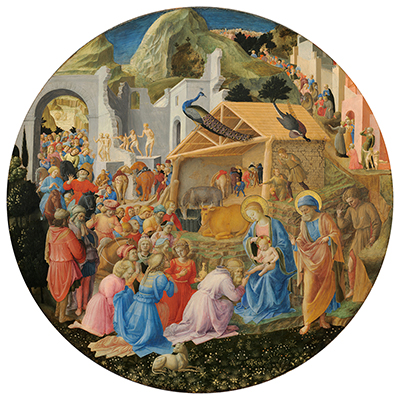
An old man bends towards a child's bare foot while a procession winds through the mountains behind him. Look for the child first, low and a little to the right of centre, then trace the crowd through the ruins and back into the landscape. The journey fills almost the entire circle. Its destination is an encounter small enough to be missed amid the horses, clothes and extraordinary birds. This is The Adoration of the Magi by Fra Angelico and Fra Filippo Lippi, a mid-fifteenth-century painting now in the National Gallery of Art in Washington, DC. It is also known as the Cook Tondo after the family who owned it in England. [1]
At a Glance
- Artists — Fra Angelico and Fra Filippo Lippi
- Date — About 1440–60
- Medium — Tempera on poplar panel
- Diameter — 137.3 cm
- Collection — National Gallery of Art, Washington, DC, Samuel H. Kress Collection, 1952.2.2 [1]
The long approach to Bethlehem
In Matthew's Gospel, visitors from the East follow a star in search of the newborn king of the Jews. They stop in Jerusalem, where Herod asks them to return with news of the child. Reaching Bethlehem, they find Jesus with Mary, bow and offer gold, frankincense and myrrh. Matthew leaves the number and names of the visitors unstated. The three gifts provided a basis for the later tradition of three kings, which gives the painters three distinct acts of homage to set before the child. [2]
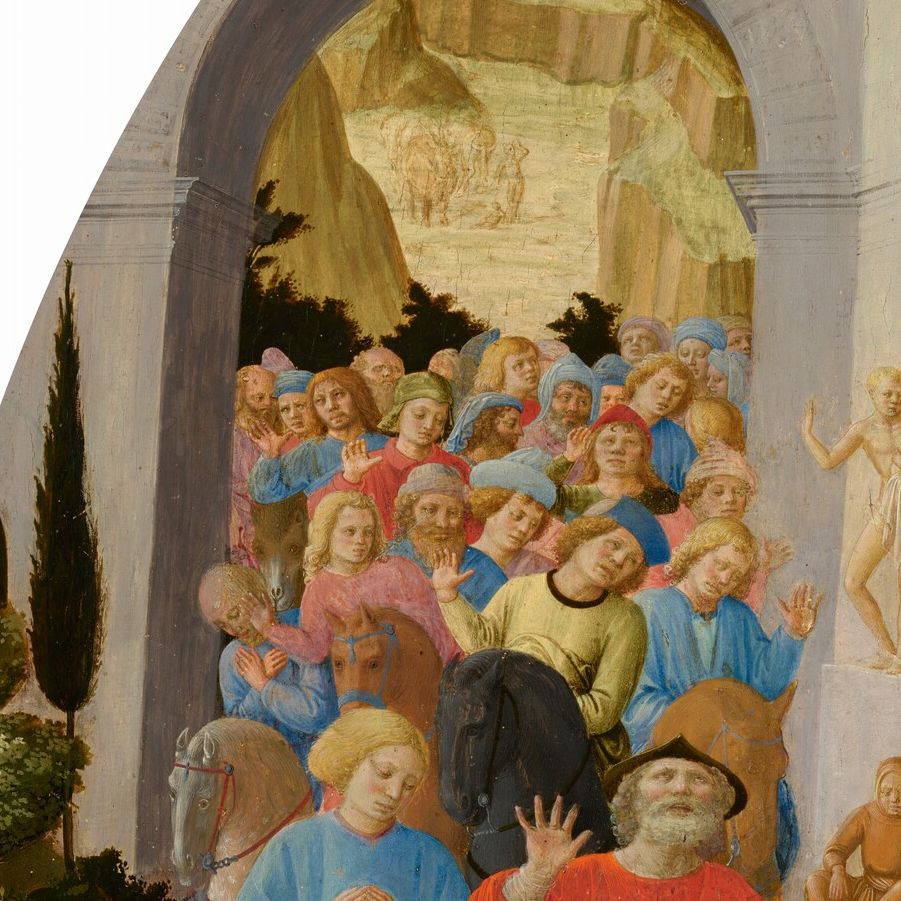
Start in the foreground and follow the line backwards. Further up the painting, the people pass beneath a pale stone arch on the left. Inside the arch, more heads emerge against the distant hillside. At the upper right, between the rocks and a row of buildings, headgear and patches of coral, blue and gold pick out another stretch of the route. Two camels appear among the distant travellers. Here a few marks are enough to suggest a rider and an animal. At the foot of the arch, the horses' flanks, bridles and turned heads give the column weight and slow its approach. The switches in scale make the road seem longer than the narrow gaps in the landscape would suggest. [1] [3]
The route continually slips out of sight. Buildings and rocky shoulders hide parts of it. The arch briefly frames the figures in a smaller opening within the larger one, and the shape of the hill takes over where the brush can mark only the smallest bodies. The gaps let us imagine people still on their way. They also let the landscape come forward in its own right. The mountain reaches almost to the top of the panel, where a band of blue sky is all the space the circle can spare. [1]
Look at how the crowd changes as it closes in. In the distance people have room to move in a line. Below the arch, the figures bunch up and begin to turn at different angles. One man holds both hands open, while others pray or lift a hand to their chest. The man on horseback in blue holds his hands close together as the red-clad man beside him throws both arms out. Near the Virgin, the standing spectators give way to kneeling figures. The change of posture takes the eye down towards the child more gradually than a straight procession could. [1] [3]
The kings and the child
The gifts occupy very little surface. The bright vessel held by the king in red is tucked into the space between bodies, and the leading king has already brought his face and hands almost to the level of Christ's feet. Their meeting is made legible by the small interval between the old man's bowed head and the child's body. Mary's pink dress and blue mantle form a broad, quiet patch of colour behind the child. Against that blue, the line of his leg carries the eye straight to the offerer's hands. Joseph, at Mary's left and our right, gathers his orange cloak across his body, leaving his blue tunic visible. His standing figure closes the scene against the edge. [1] [3]
The kings' clothes tell part of the story of their rank. Gold picks out the stiff edges and tiny repeated motifs of garments whose folds otherwise register as broad areas of lilac, red and blue. The red garment has decoration that the National Gallery of Art associates tentatively with the Medici's ostrich-feather emblem. The gold patterning and ornaments make the kings easy to pick out in a group where many people are kneeling. The dress of the travelling party also draws on Florentine ideas about the East. Its elaborate caps, turbans and riding gear recall the way dress and processional equipment were used to make the Magi's journey visible in local celebrations. The procession dresses a biblical journey in clothes a Florentine audience could read. [1] [3] [4]
Christ holds a small, round object in his lap. The Gallery suggests it is a pomegranate, whose clustered seeds could stand for believers united in one faith. The scale of the detail changes how you look. From across the room, the glowing halos and the strongest colours make the group easy to find. Up close, the child's grasp and the old king reaching for his foot take precedence. The open foreground gives you a place to pause, while the magi and their attendants remain turned towards what they came to see. [1] [3]
Annotated Details from The procession in the Washington tondo
The numbered points identify visible features discussed in this article. Return from each detail to the numbered overview. The complete Washington tondo, Fra Angelico and Fra Filippo Lippi, National Gallery of Art accession 1952.2.2. National Gallery of Art, Washington. Image source. CC0 / Public domain. Proportional web resize.
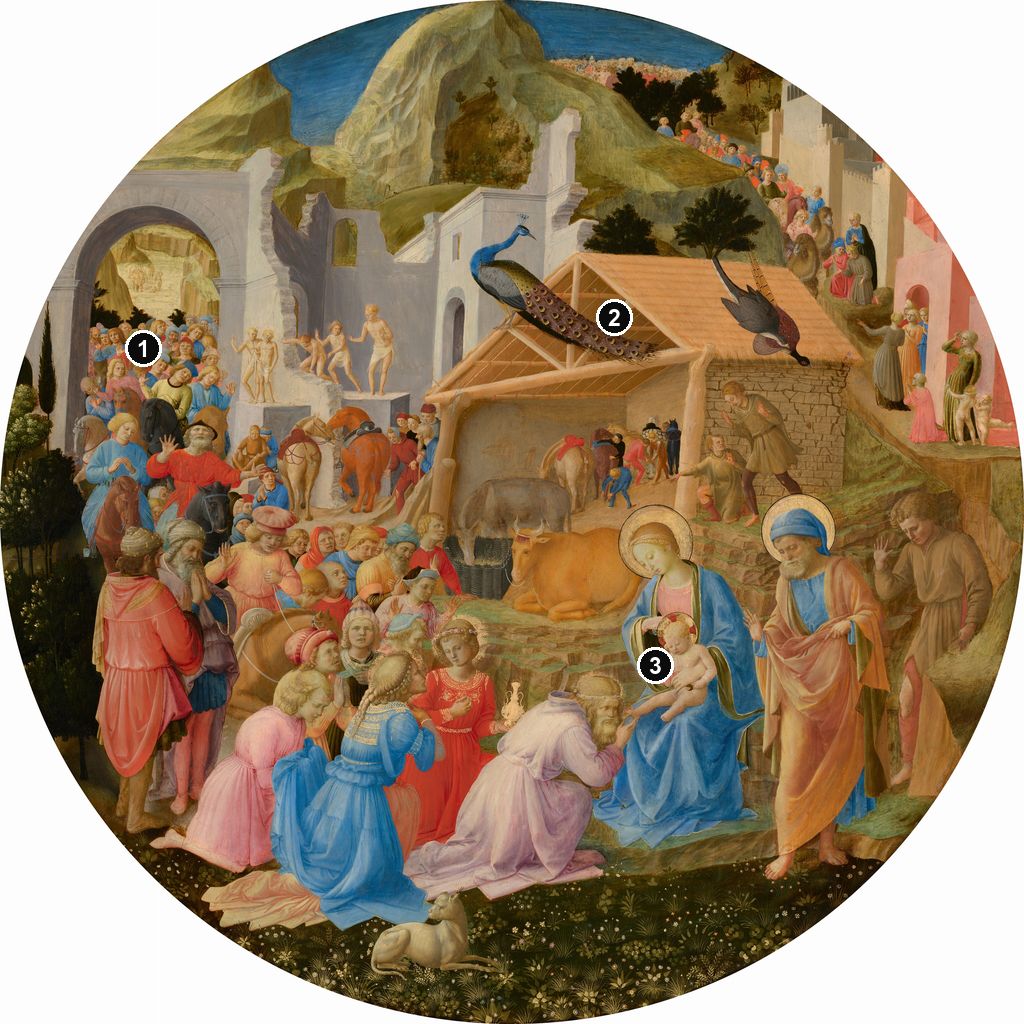
Details from THE PROCESSION IN THE WASHINGTON TONDO
Compare the cropped details with the source images above. Notice how their colours, shapes and positions contribute to the larger compositions.
The procession under the arch
The arch crowds together a group of travellers, then lets the procession widen across the ground in front of the stable.
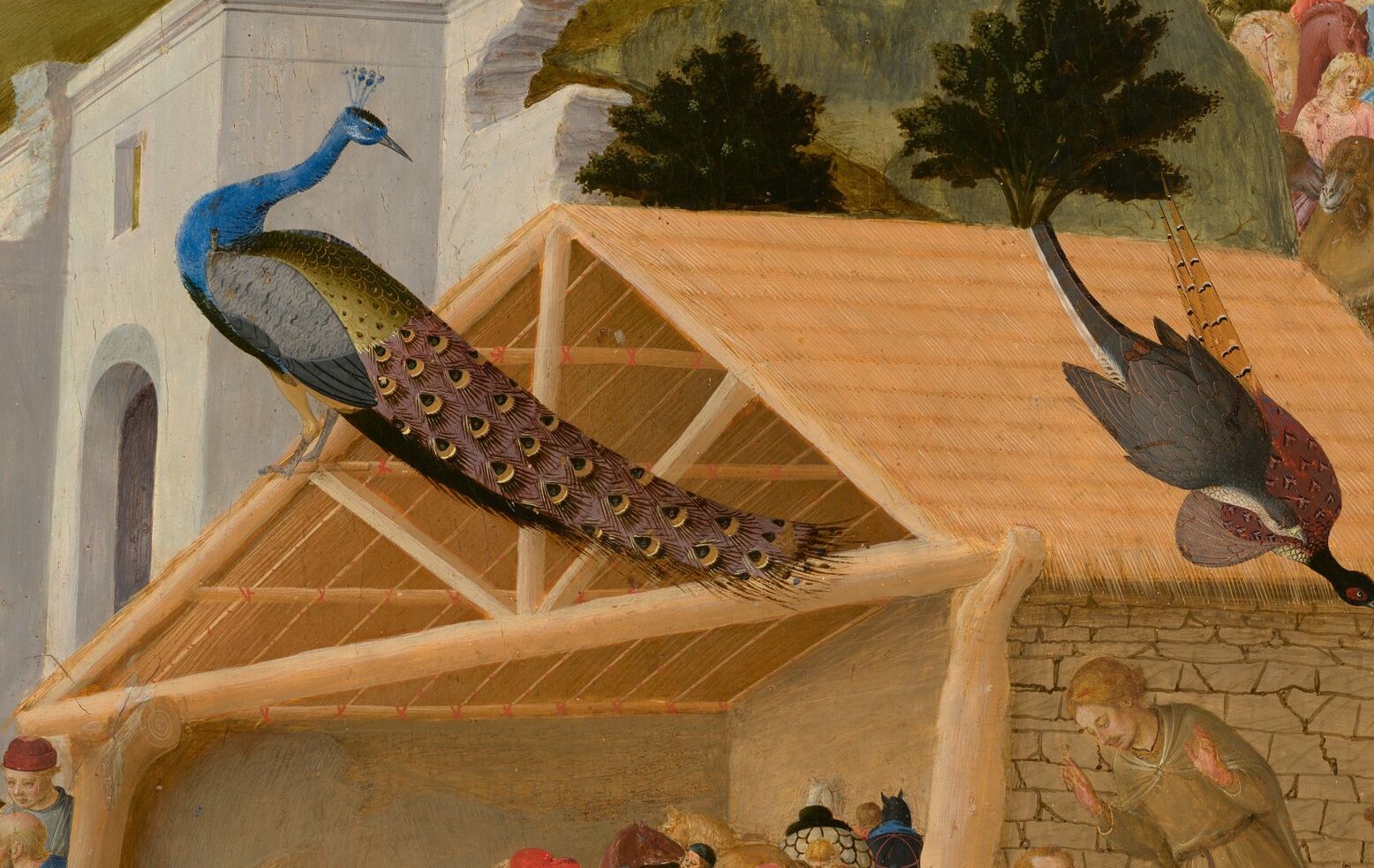
Birds on the roof
The peacock and the other birds give the thatched ridge a place of its own above the kneeling figures.
The exchange of gifts
Mary supports the child while a visitor kneels close to him. The near circle of heads and hands concentrates the movement of the procession.
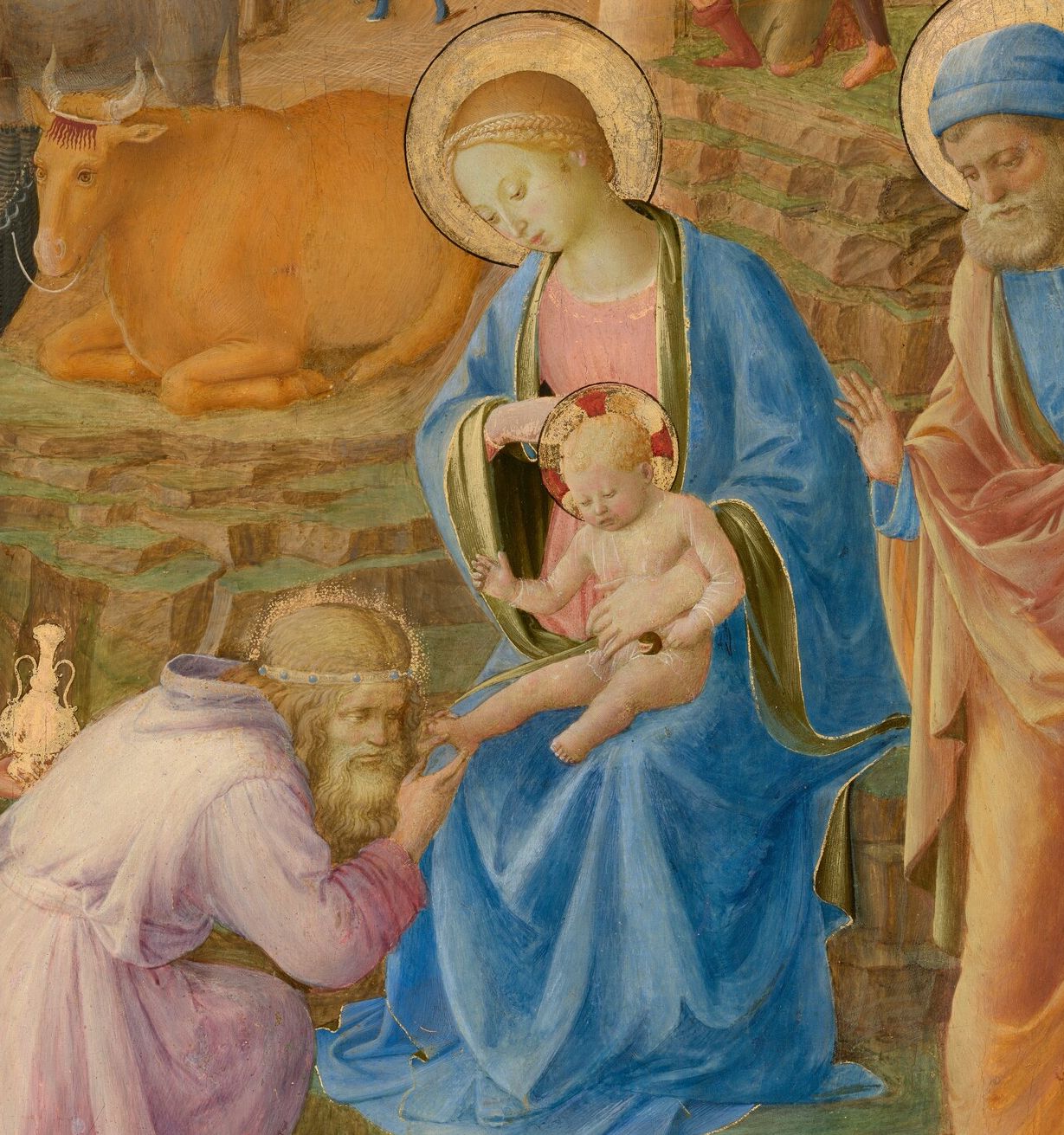
The shelter, the ruins and the birds
Matthew describes the visitors entering a house. The painting brings the Adoration into a shelter furnished with details familiar from images of Christ's birth. An ox rests on the ledge behind Mary, a donkey noses into its feed, and grooms attend to the horses further back. The ox's forehead fringe is part of a harness fitted around the horns. It helps keep flies away as well as tethering the animal. One groom crouches at a horse's hoof. Small jobs like these give substance to the travellers' arrival. The animals that have carried the company now have to be fed and tended. [2] [3]
The shelter also controls where the eye goes. Its open gable sits near the centre of the panel, above and to the left of Mary. The framing timbers make straight diagonals across the many bends in the road. On the far side, the wall and lean of the terrain send the eye towards the figures near the right edge. On the left, the smooth surface and rounded opening of the monumental arch give way sharply to a broken edge. The nearly naked figures beside it stand upright against pale masonry, while the coloured crowd passes underneath. One interpretation reads such figures and ruined architecture as signs of the passing of the ancient pagan world at Christ's coming. The setting supports that reading, although the individual gestures leave room for other meanings. [1] [3]
The peacock on the roof is almost impossible to miss. Its blue neck and long dark train cut across the light timbers, and the tail's repeated eyes slow the gaze just where the lines of the roof would carry it on. The bird could suggest immortality or paradise in Christian imagery. Further right, a bird of prey bears down on a pheasant. Its meaning is less clear. As a detail of the design, the flutter of wings gives the roof an abrupt accent after the long, still sweep of the peacock's tail. The Gallery considers the three roof birds likely late additions by Lippi. There is also a pale dog with clipped ears lying low at the bottom of the painting. A viewer tracing the lower curve can pass from the dog through the flowers to the edge of Joseph's robe, returning to the Adoration without having to follow the procession again. [1] [3]
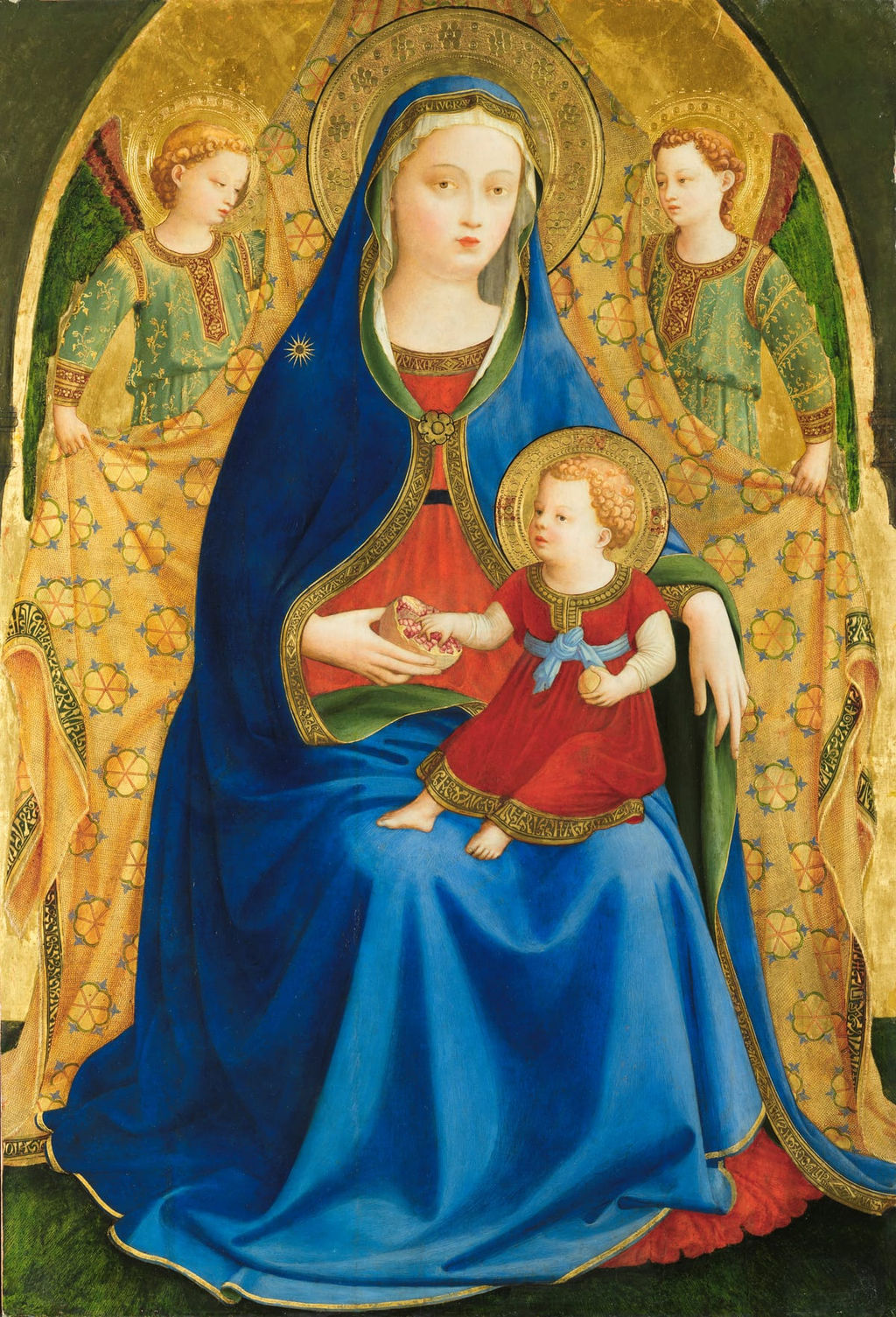
The Prado’s Virgin of the Pomegranate. The fruit, brought forward by two small gestures, sits against the red of the Virgin’s dress. Image source. Public domain. Proportional web resize.
What the circular panel makes possible
A tondo is a round work of art. This one is painted in tempera on a poplar panel and measures 137.3 centimetres across. At that size, you can step back to take in the sweep of the whole procession or move closer to make sense of a vessel, a face or the bits of colour on the mountain road. The circle is narrowest at its top and bottom. The painters use the upper part for the most distant land and the lowest part for the near meadow. The widest stretch can hold the arch, the roof and the rising ground at once. The meadow opens in front of the bodies, rather like the space left by a crowd at a doorway. [1]
The circle can organise the subject in several ways. Botticelli's later Adoration of the Kings in London's National Gallery raises Mary and Christ on a platform near the centre. His people and animals form bands that turn inwards. The Washington painters keep the destination low and give the road room to wind behind it. The resulting asymmetry makes the longest part of the journey look as though it might continue beyond what we can see. In London the crowd gathers around the holy figures. In Washington it takes a winding road to reach them. [1] [5]
Round paintings also had a place in Florentine homes. Elon Danziger notes that the grand early Magi tondi invite comparison with the painted trays made to celebrate a birth, an association suggested by Jeffrey Ruda. A surviving example made for the Medici family, Scheggia's Triumph of Fame, was kept in Lorenzo de' Medici's private quarters. It is much smaller, and its reverse carries the families' arms and Piero de' Medici's device of a ring with three ostrich feathers. Such objects show what a painted circle could mean within a household. The analogy is suggestive for a painting in which a newborn child receives an elaborate welcome. The Washington panel's original purpose and occasion remain open questions. [6] [7]
Florence and the Medici inventory
The Compagnia de' Magi, a Florentine lay confraternity connected to San Marco, staged a celebration of Epiphany. The Medici took part in the life of the confraternity, and the journey of the kings was a familiar sight in the city's religious pageantry. Costume, horses and the use of successive locations gave that performance something a single fixed scene might seem unable to offer: an approach that unfolded in stages. In the tondo, the eye follows the same succession of glimpses a spectator might have had at different points along the route. Gozzoli's later frescoes in the Medici palace give the travelling cavalcade an altogether different setting, leading it across the walls of a chapel towards an altar with an Adoration of the Child by Lippi. The Washington circle brings the riders and the meeting into one surface. [3] [4] [8] [9]
A large round picture generally identified with the Washington panel appears in the inventory drawn up after Lorenzo de' Medici's death in 1492. The surviving copy, made in 1512, places it in the large ground-floor room known as Lorenzo's chamber. It describes Mary, Christ and the approaching Magi, credits Fra Giovanni, the name Angelico used as a friar, and records a gilded frame. The picture was valued at 100 florins. In the same room a group of six paintings, including Uccello's three Battle of San Romano panels, was valued at 300 florins in all. The high price and the description suit an elaborate picture like this one, although the connection depends on matching words in an inventory to a surviving object. If the identification is right, the entry shows whose collection the painting had entered by the end of the century. The Gallery regards a commission by a member of the Medici family as probable, with Cosimo the Elder a candidate. An inventory taken decades after the painting was made cannot establish who first ordered it or when it was in the painters' hands. [1] [3] [6] [10]
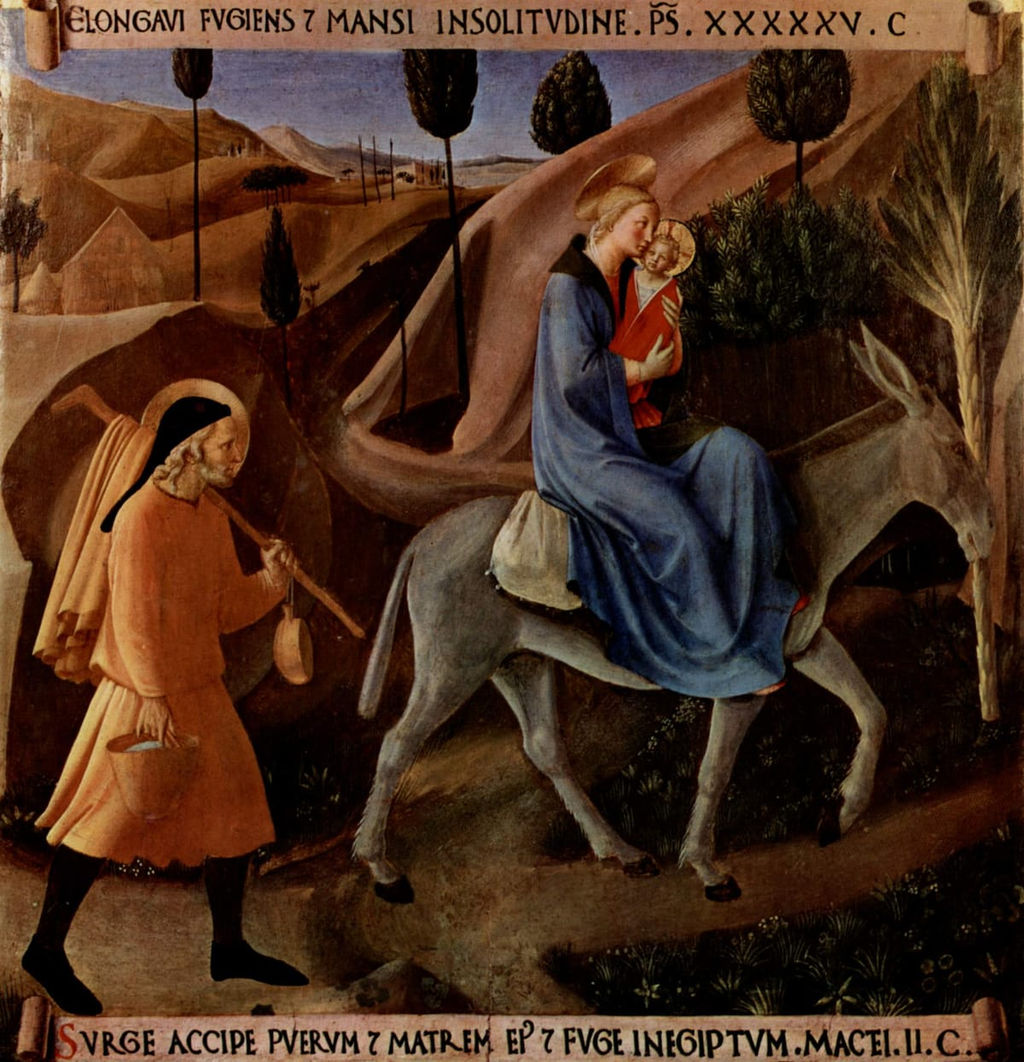
The Flight into Egypt in the Armadio, 0900191187A-7. The inscriptions sit directly above and below the road and its travellers. Image source. Public domain. Proportional web resize.
Two names and the painting's later journey
The National Gallery of Art credits both painters and understands the work as a picture begun by Fra Angelico and completed by Fra Filippo Lippi. Its broad dating, around 1440–60, accommodates the possibility of work in stages and spans Angelico's death in 1455. Scholars have disagreed about how early Lippi became involved and about whether the Angelico-like passages are his own. Jeffrey Ruda's 1975 study proposed Lippi working with an assistant or follower of Angelico, while the Palazzo Medici Riccardi's account also records Luciano Bellosi's proposed pairing of Lippi and Benozzo Gozzoli. [1] [3] [11]
Laurence Kanter proposed a different account of the sequence in the Metropolitan Museum of Art's 2005 exhibition catalogue. He suggests that Angelico may have brought the painting to an advanced stage, perhaps even completed it, before Lippi altered it. Some of the spectators on the right seem to look towards a part of the composition now taken up by the roof, while several on the left appear to look above or below the present position of Christ. For Kanter, these sightlines hint that the earlier composition may have directed attention elsewhere. Ruda also noticed that the meadow laps over the kings' robes. Kanter accepted the observation but questioned whether the meadow as it survives belonged to the first phase of painting. The evidence of which layer sits on top can help establish the order in which parts were painted, while identifying the painter of each layer requires separate evidence. [12]
Kanter also raised the possibility that the tondo once formed the climax to a group of paintings of the kings' journeys. Two possible companions survive, a panel he attributes to Pesellino in Williamstown and another he attributes to Zanobi Strozzi in Strasbourg. Their dates and themes are compatible with such a grouping. The Williamstown panel and Washington tondo were both owned by the nineteenth-century collector William Coningham, but there is no continuous record of the two passing together from one collection to the next. Kanter treats the proposed group and its possible connection to the confraternity's oratory at San Marco as hypotheses. The tondo's unusually long procession offers a reason for considering the relationship in the first place, since the journey has a scale and prominence of its own. [12]
The painting's later history helps explain why the range of names can be so wide. Two circular Adorations appear to be listed together in a seventeenth-century Guicciardini inventory. A later family inventory seems to identify the Washington work in particular, again under Angelico's name. The other round panel is usually identified with the Botticelli in London. The National Gallery of Art traces the pair with greater confidence once they turn up on the nineteenth-century art market, where subject, format and measurements can be compared with the surviving paintings. Even there, frames may account for differences between recorded sizes, and an old artist's name can be a poor guide to the object. The panel now in Washington left the Guicciardini collection in 1810 with an attribution to Botticelli and appeared under Angelico’s name in Samuel Woodburn’s London catalogue of 1826. At auction it was offered as a Filippo Lippi in 1849 and as a Filippino Lippi at the 1874 sale at which it was bought for Sir Francis Cook. [1] [5] [6]
The panel stayed in the Cook collection for several generations. It was sent to North America for safekeeping around the time of the Second World War, and was shown in Toledo, Ohio, and at two Canadian museums during the war's closing years. The Samuel H. Kress Foundation bought it in 1947 and gave it to the National Gallery of Art in 1952. The Cook name preserves one chapter of that journey. The double attribution at Washington records a different kind of history, the attempt to account for a complicated work whose earliest record may tell us only one of the names behind it. [1]
Other ways to paint the same visit
The Adoration of the Magi from the Armadio degli Argenti is part of a painted sequence made for the silver treasury of Santissima Annunziata and now kept at the Museo di San Marco. The episode occupies a compact scene accompanied by inscriptions. A viewer can read it in relation to what comes before and after on the cabinet panels, whereas the Washington tondo makes the build-up and arrival the work of one uninterrupted field. The 1426 Adoration by Masaccio, now in Berlin, is a long, low panel from the predella, or base, of the Pisa altarpiece. The footing and shadows of the horses on the right keep the story moving along a shallow horizontal space towards the group on the left. Each painting makes room for the approach, but in Washington a moment's glance moves from the travellers still high on the road to a king close enough to touch the child's foot. [1] [8] [13] [14]
Fra Angelico artworks directory
Explore documented works and surviving parts of larger ensembles. Catalogue links identify individual records. Attribution and dating can vary across collections and publications. Search the Federico Zeri Photo Archive by artist.
| Name | Date | Medium and sources |
|---|---|---|
| Adoration of the Magi | About 1440–60, NGA catalogue | Painting Catalogue. |
| Adoration of the Magi (Armadio degli Argenti) | About 1450–53 | Tempera and gold on wood. Catalogue. |
| Agony in the Garden (Armadio degli Argenti) | About 1450–53 | Tempera and gilding on wood Catalogue. |
| Annalena Altarpiece / Pala di Annalena | commonly c. 1435 | Tempera on panel Catalogue. |
| Annunciation (Armadio degli Argenti) | About 1450–53 | Tempera and gilding on wood. Catalogue. |
| Annunciation (Cortona) | generally placed in the 1430s; exact dating remains debated | Tempera on panel Catalogue. |
| Annunciation (Prado) | 1425–26 | Tempera on poplar panel Catalogue. |
| Annunciation (San Marco upper corridor) | commonly c. 1442 | Fresco Catalogue. |
| Annunciation with Saint Peter Martyr | About 1439–43 | Fresco on plaster. Catalogue. |
| Annunciatory Angel | 1450–55, Detroit catalogue | Gold leaf and tempera on wood panel. Catalogue. |
| Armadio degli Argenti (Silver Treasury) | principally c. 1450–52 | Tempera on panel Catalogue. |
| Arrest of Christ (Armadio degli Argenti) | About 1450–53 | Tempera and gilding on wood Catalogue. |
| Ascension (Armadio degli Argenti) | About 1450–53 | Tempera and gilding on wood Catalogue. |
| Baptism of Christ (Armadio, Alesso Baldovinetti) | About 1452–53 | Tempera and gilding on wood Catalogue. |
| Beheading of Saints Cosmas and Damian (San Marco Altarpiece) | About 1438–42 | Painted panel Catalogue. |
| Betrayal of Christ (Armadio degli Argenti) | About 1450–53 | Tempera and gilding on wood Catalogue. |
| Blessed Dominican, Possibly Jordan of Saxony (San Marco Altarpiece) | About 1438–42 | Painted panel Catalogue. |
| Blessed Vincent Ferrer (San Marco Altarpiece) | About 1438–42 | Painted panel Catalogue. |
| Burial of Saints Cosmas and Damian (San Marco Altarpiece) | About 1438–42 | Painted panel Catalogue. |
| Bust of a Cleric and a Group of Figures (recto and verso) | 15th century | Pen and ink on paper Catalogue. |
| Christ among the Doctors (Armadio degli Argenti) | About 1450–53 | Tempera and gilding on wood Catalogue. |
| Christ before Caiaphas (Armadio degli Argenti) | About 1450–53 | Tempera and gilding on wood Catalogue. |
| Christ Glorified in the Court of Heaven | About 1423–24 | Egg tempera on wood, probably poplar, with gold and silver leaf Catalogue. |
| Christ Seated in Judgment | 1447 | Fresco and gilding on plaster. Catalogue. |
| Christ Stripped of His Garments (Armadio degli Argenti) | About 1450–53 | Tempera and gilding on wood Catalogue. |
| Christ Washes the Apostles’ Feet (Armadio degli Argenti) | About 1450–53 | Tempera and gilding on wood Catalogue. |
| Circumcision of Christ (Armadio degli Argenti) | About 1450–53 | Tempera and gilding on wood. Catalogue. |
| Communion of the Apostles (Armadio degli Argenti) | About 1450–53 | Tempera and gilding on wood Catalogue. |
| Coronation of the Virgin (Armadio degli Argenti) | About 1450–53 | Tempera and gilding on wood Catalogue. |
| Coronation of the Virgin (Louvre) | Louvre: second quarter of the fifteenth century, 1425–50; often dated more narrowly c. 1434–35 | Tempera and gold on panel Catalogue. |
| Coronation of the Virgin (Uffizi) | 1431–35 | Tempera on wood, gold ground Catalogue. |
| Cortona Triptych | About 1437 | Tempera and gold on panel. Catalogue. |
| Crucifixion (Armadio degli Argenti) | About 1450–53 | Tempera and gilding on wood Catalogue. |
| Crucifixion and Saints | 1441–42 | Fresco Catalogue. |
| Deposition from the Cross / Santa Trinita Deposition | commissioned 1429–32; completed by Angelico within this period | Tempera on panel Catalogue. |
| Descent into Limbo (Armadio degli Argenti) | About 1450–53 | Tempera and gilding on wood Catalogue. |
| Entombment of Christ (San Marco Altarpiece) | About 1438–42 | Painted panel Catalogue. |
| Entry into Jerusalem (Armadio degli Argenti) | About 1450–53 | Tempera and gilding on wood Catalogue. |
| Expulsion and the Stoning of Saint Stephen | 1448–49, Vatican Museums | Fresco. Catalogue. |
| Fiesole San Domenico Altarpiece | early 1420s; predella about 1423–24 | Tempera on panel Catalogue. |
| Flagellation (Armadio degli Argenti) | About 1450–53 | Tempera and gilding on wood Catalogue. |
| Flight into Egypt | About 1450–53 | Tempera and gilding on wood. Catalogue. |
| Guidalotti Polyptych | c. 1447–49 | Tempera and oil on panel Catalogue. |
| Healing of Palladia and Saint Damian Accepting Her Gift (San Marco Altarpiece) | About 1438–42 | Painted panel Catalogue. |
| Holy Pilgrim, Possibly Saint Roch (San Marco Altarpiece) | About 1438–42 | Painted panel Catalogue. |
| Holy Women at the Tomb (Armadio degli Argenti) | About 1450–53 | Tempera and gilding on wood Catalogue. |
| Judas Receives Payment (Armadio degli Argenti) | About 1450–53 | Tempera and gilding on wood Catalogue. |
| Lamentation over Christ (Armadio degli Argenti) | About 1450–53 | Tempera and gilding on wood Catalogue. |
| Lamentation over the Dead Christ (Croce al Tempio Lamentation) | 1436–41, Zeri catalogue | Tempera and gilding on wood panel. Catalogue. |
| Last Judgement (Armadio degli Argenti) | About 1450–53 | Tempera and gilding on wood Catalogue. |
| Last Judgement (San Marco) | c. 1425–28 | Tempera and gold on panel Catalogue. |
| Last Supper (Armadio degli Argenti) | About 1450–53 | Tempera and gilding on wood Catalogue. |
| Lex Amoris (Armadio degli Argenti) | About 1450–53 | Tempera and gilding on wood Catalogue. |
| Madonna and Child with Saint Dominic and Saint Thomas Aquinas | About 1430, Hermitage catalogue | Detached fresco. Catalogue. |
| Madonna and Child with Saints | About 1411–13 | Tempera on wood panel, with a gold ground. Catalogue. |
| Madonna of Humility | About 1425, Thyssen catalogue | Tempera and gold on wood. Catalogue. |
| Madonna of the Star | 1431–34, Zeri catalogue | Tempera with oil glazes and gold on wood panel, as catalogued by the Gardner for the 2018 exhibition. Catalogue. |
| Marriage at Cana (Armadio, Alesso Baldovinetti) | About 1452–53 | Tempera and gilding on wood Catalogue. |
| Massacre of the Innocents (Armadio degli Argenti) | About 1450–53 | Tempera and gilding on wood Catalogue. |
| Miracle of the Black Leg (San Marco Altarpiece) | About 1438–42 | Painted panel Catalogue. |
| Mocking of Christ (Armadio degli Argenti) | About 1450–53 | Tempera and gilding on wood Catalogue. |
| Mystic Wheel (The Vision of Ezekiel) | About 1450–52 | Tempera and gilding on wood. Catalogue. |
| Nativity (Armadio degli Argenti) | About 1450–53 | Tempera and gilding on wood. Catalogue. |
| Niccoline Chapel frescoes | principally 1448–50 | Fresco Catalogue. |
| Noli me Tangere | broadly within Angelico’s San Marco campaign, late 1430s–1440s | Fresco Catalogue. |
| Ordination of Saint Lawrence | 1448 | Fresco. Catalogue. |
| Pentecost (Armadio degli Argenti) | About 1450–53 | Tempera and gilding on wood Catalogue. |
| Presentation of Christ at the Temple (Armadio degli Argenti) | About 1450–53 | Tempera and gilding on wood. Catalogue. |
| Presentation of Jesus at the Temple | Early 1440s | Fresco on plaster. Catalogue. |
| Raising of Lazarus (Armadio degli Argenti) | About 1450–53 | Tempera and gilding on wood Catalogue. |
| Rescue of Saints Cosmas and Damian and Exorcism of Lysias (San Marco Altarpiece) | About 1438–42 | Painted panel Catalogue. |
| Road to Calvary (Armadio degli Argenti) | About 1450–53 | Tempera and gilding on wood Catalogue. |
| Saint Anthony Abbot (San Marco Altarpiece) | About 1438–42 | Painted panel Catalogue. |
| Saint Bernard of Clairvaux or Saint Benedict (San Marco Altarpiece) | About 1438–42 | Painted panel Catalogue. |
| Saint Damian Receives Money from Palladia | About 1425–49 | Tempera and gilding on wood. Catalogue. |
| Saint Francis and a Bishop Saint, Saint John the Baptist and Saint Dominic | Late 1420s, Getty catalogue | Tempera and gold leaf on panel. Catalogue. |
| Saint James the Greater Freeing the Magician Hermogenes | About 1426–29 | Tempera and gold on panel Catalogue. |
| Saint Jerome (San Marco Altarpiece) | About 1438–42 | Painted panel Catalogue. |
| Saint Lawrence Giving Alms | About 1448 | Wall fresco. Catalogue. |
| Saint Lawrence Receiving the Treasures of the Church from Pope Sixtus II | About 1448–49 | Fresco on plaster. Catalogue. |
| Saint Romuald (San Marco Altarpiece) | About 1438–42 | Painted panel Catalogue. |
| Saint Stephen Addressing the Council | 1448–49, Vatican Museums | Fresco. Catalogue. |
| Saint Stephen Preaching | 1448–49, Vatican Museums | Wall fresco. Catalogue. |
| Saint Thomas Aquinas (San Marco Altarpiece) | About 1438–42 | Painted panel Catalogue. |
| Saints Cosmas and Damian and Their Brothers Survive the Stake | Second quarter of the 15th century | Tempera and gilding on wood. Catalogue. |
| Saints Cosmas and Damian at the Stake (San Marco Altarpiece) | About 1438–42 | Painted panel Catalogue. |
| Saints Cosmas and Damian before Lysias (San Marco Altarpiece) | About 1438–42 | Painted panel Catalogue. |
| Saints Cosmas and Damian Rescued by an Angel | Second quarter of the 15th century | Tempera and gilding on wood. Catalogue. |
| Saints Cosmas and Damian with Their Brothers before Proconsul Lysias | Second quarter of the 15th century | Tempera and gilding on wood. Catalogue. |
| San Marco Altarpiece / Pala di San Marco | 1438–43 | Tempera on panel Catalogue. |
| San Pietro Martire Triptych | About 1422–23, Strozzi exhibition | Tempera and gold on panel. Catalogue. |
| Scenes from the Lives of the Desert Fathers (Thebaid) | About 1420, Uffizi catalogue | Tempera on wood. Catalogue. |
| Sixteen Prophets | 1447 | Fresco and gilding on plaster Catalogue. |
| Stoning and Shooting of the Brothers (San Marco Altarpiece) | About 1438–42 | Painted panel Catalogue. |
| Tabernacle of the Linaioli | 1433–35 | Tempera on panel Catalogue. |
| The Attempted Crucifixion and Stoning of Saints Cosmas and Damian | Second quarter of the 15th century | Tempera and gilding on wood. Catalogue. |
| The Crucifixion | About 1420–23, Met catalogue | Tempera on wood, gold ground. Catalogue. |
| The Death and the Assumption of the Virgin | 1424–34 | Tempera with oil glazes and gold on panel Catalogue. |
| The Dominican Blessed (left end) (Fiesole predella) | About 1423–24 | Egg tempera and gold on wood Catalogue. |
| The Dominican Blessed (right end) (Fiesole predella) | About 1423–24 | Egg tempera and gold on wood Catalogue. |
| The Entombment of Christ | About 1450 | Tempera on poplar panel. Catalogue. |
| The Forerunners of Christ with Saints and Martyrs | About 1423–24 | Egg tempera on wood (probably poplar), with gold and silver leaf. Catalogue. |
| The Funeral of Saint Anthony Abbot | About 1426–30 | Tempera on poplar panel. Catalogue. |
| The Martyrdom of Saints Cosmas and Damian | About 1425–49 | Tempera and gilding on wood. Catalogue. |
| The Mocking of Christ / Christ Mocked | within the San Marco dormitory campaign, broadly late 1430s–1440s | Fresco Catalogue. |
| The Nativity | About 1425, Minneapolis catalogue | Tempera on poplar panel. Catalogue. |
| The Nativity in Cell 5 at San Marco | About 1439–43 | Fresco on plaster. Catalogue. |
| The Penitent Saint Jerome | 1419–20 | Tempera on wood panel Catalogue. |
| The Virgin and Child by Fra Angelico (Fogg Museum) | About 1430, Harvard catalogue | Tempera originally on panel, subsequently transferred to Masonite. Catalogue. |
| The Virgin Mary with the Apostles and Other Saints (Fiesole predella) | About 1423–24 | Egg tempera and gold on wood Catalogue. |
| Transfiguration (Armadio, Alesso Baldovinetti) | About 1452–53 | Tempera and gilding on wood Catalogue. |
| Transfiguration (San Marco Cell 6) | within the San Marco dormitory campaign, broadly late 1430s–1440s | Fresco Catalogue. |
| Virgin Mary Annunciate | 1450–55, Detroit catalogue | Gold leaf and tempera on wood panel. Catalogue. |
| Virgin of the Pomegranate | About 1426 | Tempera on panel with gilding Catalogue. |
Frequently Asked Questions
Sir Francis Cook acquired it in 1874, and the panel remained in his family until the Kress Foundation purchased it in 1947. The nickname comes from the collection. [1]
Discussion
Use these prompts to look again or share an observation.
Reader Insights
Trace a route from the ruined arch on the left to the child. Where does the painted crowd slow the procession?
Look at the figures who glance out or across the crowd. How do their gestures change the centre of attention inside the circle?
Join the Conversation
Share a detail or question about Adoration of the Magi.
References
- National Gallery of Art, Washington, The Adoration of the Magi, collection record 1952.2.2, image, artwork overview, provenance notes and bibliography. View source.
- United States Conference of Catholic Bishops, Matthew, chapter 2, verses 1–12 and accompanying annotations. View source.
- National Gallery of Art, Washington, Art up Close: Fra Angelico and Fra Filippo Lippi’s Spectacular “The Adoration of the Magi”. View source.
- Mediateca di Palazzo Medici Riccardi, Iconografia dei Magi in alcuni dipinti del Rinascimento fiorentino (Italian). View source.
- National Gallery, London, Sandro Botticelli, The Adoration of the Kings, NG1033. View source.
- Elon Danziger, Round Pictures of the Adoration of the Magi from Early Renaissance Florence, Association for Art History Newsletter 2, no. 2 (2002), pp. 5–7 and catalogue no. 1. View source.
- Metropolitan Museum of Art, Scheggia, The Triumph of Fame, 1995.7, including the description of the reverse. View source.
- Cyril Gerbron, Fra Angelico, les Médicis, les Mages et le concile de Florence. Une histoire de temps entrecroisés, Artibus et Historiae 33, no. 66 (2012), pp. 29–47 (French). View source.
- Mediateca di Palazzo Medici Riccardi, Cappella dei Magi detta, Cappella (Italian). View source.
- Fondazione Memofonte, Inventario del palagio di Firenze et sua masserizie, inventory after the death of Lorenzo de’ Medici in 1492, fol. 6, transcription (Italian). View source.
- Mediateca di Palazzo Medici Riccardi, Adorazione dei Magi (Tondo Cook), historical and attribution notes (Italian). View source.
- Laurence Kanter, Fra Angelico, Metropolitan Museum of Art and Yale University Press, 2005, fig. 172, pp. 280, 282–83, especially note 10. View source.
- Museo di San Marco, Alla ricerca degli animali nascosti nel Museo di San Marco, photograph and discussion of the Armadio's Adoration of the Magi (Italian). View source.
- Staatliche Museen zu Berlin, Gemäldegalerie, Masaccio, Altarpredella / Die Anbetung der Könige, 58A (German). View source.
.jpg)



 Fra Angelico.jpg)


