 by Tom Gurney
Tom Gurney BSc (Hons) is an art history expert with over 20 years experience
Published on June 19, 2020 / Updated on November 29, 2026
Email: tomgurney1@gmail.com / Phone: +44 7429 011000
Introduction
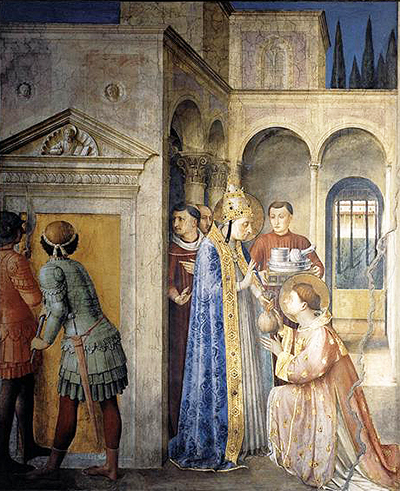
Two soldiers wait at a closed door while, just beyond it, Pope Sixtus II raises his hand over the kneeling Saint Lawrence. A purse and a tray of vessels make the purpose of their meeting visible. In this fresco by Fra Angelico and his workshop, the same painted building holds a threatened arrest and a quiet act of trust. The scene survives on the entrance wall of the Niccoline Chapel, in the Apostolic Palace at the Vatican, with Lawrence’s distribution of the treasures immediately to its right. [1] [2] [3] [4]
At a Glance
- ArtistFra Angelico and workshop. [1] [5] [6]
- DateAbout 1448–49. [2] [6]
- MediumFresco on plaster. [1] [6]
- LocationNiccoline Chapel, Apostolic Palace, Vatican City. [1] [2]
- PositionLeft-hand scene in the Lawrence register on the north entrance wall, beside Saint Lawrence Giving Alms. [3] [4]
- PatronPope Nicholas V. [2]
The soldiers at the door
The soldier nearest the centre bends towards the ochre door. His back is turned and his long sword angles down behind him. Part of a second soldier appears at the far left. The two are close enough to the pope for their presence to feel urgent, but the thick upright at the corner of the building cuts off their sightline. On the other side a man in clerical dress turns his head back towards the entrance. His glance links the groups across the masonry while Sixtus and Lawrence keep their attention on one another. [3] [4]
The historian Livia Lupi suggests reading the building as if part of its outer wall had been removed for the viewer. The doorway survives on the left, where the men have come to arrest Sixtus, while the right opens onto the place he occupies with Lawrence. As Lupi observes, the sweep of the robes makes the division less absolute at ground level. The viewer can follow both actions at once. The soldiers’ approach gives the encounter a deadline, although the measured pace of the blessing makes it seem as if the two saints still have time. [4]
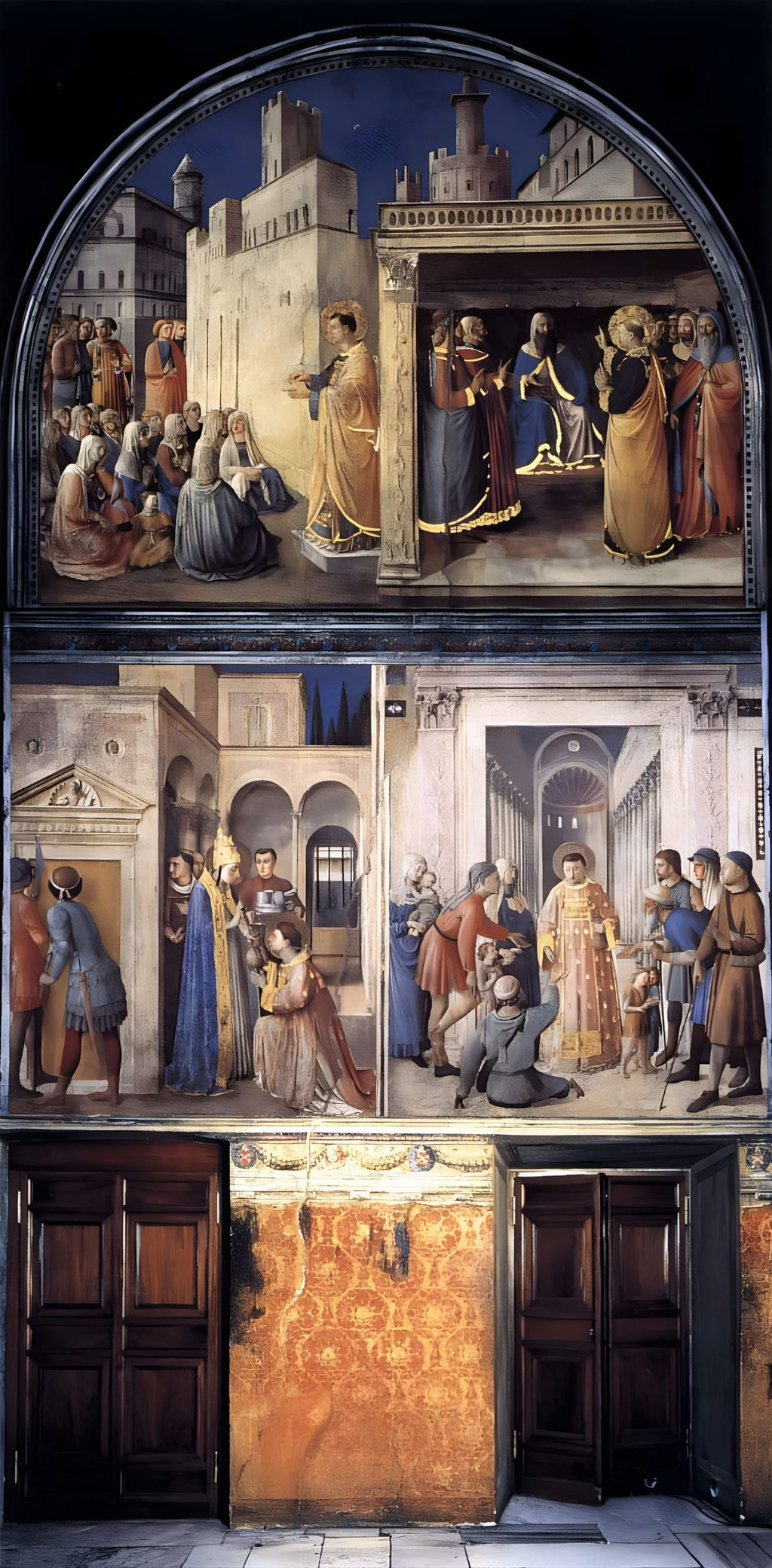
One wall of the Niccoline Chapel. The paired Stephen scenes above and the Lawrence scenes below occupy separate registers. Image source. Public domain. Proportional web resize.
A blessing and a transfer
Sixtus stands in a blue cope edged with gold. The long folds run almost straight down to his feet. Lawrence’s pale rose and gold vestment, by contrast, bends at his knees and trails to the right. Between the two heads, the pope’s raised fingers mark the blessing. A small, rounded purse hangs below the gesture, beside Lawrence’s lifted hands. Behind them an attendant in red supports a tray piled with gleaming vessels. The purse brings the transfer within reach of the deacon. The shapes and metallic highlights of the vessels suggest liturgical plate, so that at least some of the wealth about to leave the building appears to come from the furnishings of worship. [3] [4] [7]
The painting gives different kinds of weight to the valuables and the people handling them. The attendant steadies his load close to his body, while Lawrence looks up towards Sixtus. The pope’s blue sets off the pale hands at the centre of the group. Lower down, the deacon’s open hands remain visible against his clothes. His posture recalls the Ordination of Saint Lawrence on the preceding wall. There his kneeling belongs to the ceremony that makes him a deacon. Here it marks the moment his office requires him to act. [2] [3] [4]
What the Church’s treasures meant
In the account of Sixtus in Jacobus de Voragine’s thirteenth-century Golden Legend, Lawrence calls out as the pope is taken away. Sixtus tells his deacon that he will follow him in martyrdom and entrusts the Church’s property to him for distribution. The collection’s life of Lawrence gives a fuller version in which he disperses the goods and later presents poor people to the authorities as the lasting treasures of the Church. The painter brings forward the moment of entrustment and gives it a place of its own beside the distribution. [8] [5]
The nearer historical witness is Cyprian of Carthage. Writing to Successus in 258, he reports the emperor Valerian’s orders against Christian clergy and the execution of Sixtus with four deacons in a cemetery on 6 August. His letter says nothing about the handover. By the late fourth century, Ambrose of Milan was using Lawrence’s presentation of the poor to defend the use of sacred vessels to ransom captives. That argument helps explain the force of the shining metal in the fresco. Objects set aside for worship could also serve the people for whom the Church was responsible. [9] [10]
On the same wall, Saint Lawrence Giving Alms shows where the transfer leads. A narrow strip divides the two scenes, interrupting the sweep of Lawrence’s robe. The settings remain distinct, though the rounded arches and leafy capitals in both reward a glance across the join. Above are Saint Stephen Preaching and his dispute before the council. The chapel lets viewers follow each deacon’s story around the room and look across the two registers for corresponding acts of service, testimony and charity. [2] [3] [4]
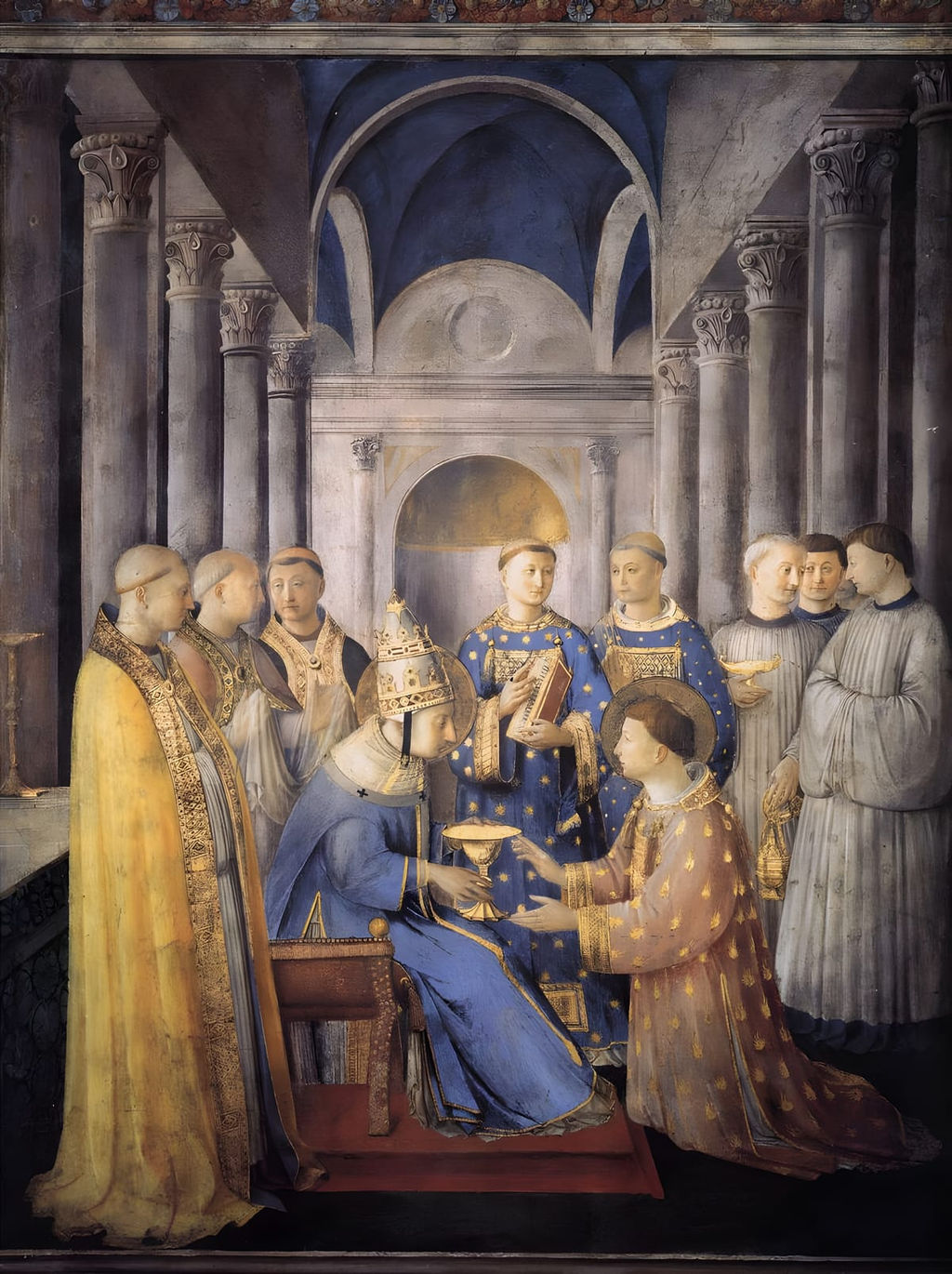
Sixtus ordains Lawrence. The arch at the back brings the clerics’ ceremony into one view. Image source. Public domain. Proportional web resize.
The architecture above the entrance
The painted door sits over a real doorway in the chapel. Its triangular pediment, the small round openings above it and the arches behind Sixtus give the building the character of a Renaissance invention. Past the foreground group a shadowed opening reveals a slender column and a further stretch of building. The tips of dark trees rise into a narrow band of blue. This short glimpse of depth is all the painter needs to suggest a cloister extending behind the ceremony. [3] [4]
Lupi compares the arrangement with The Healing of Palladia, a small panel from Fra Angelico’s San Marco Altarpiece now in Washington. There too a building turns a corner, and openings show actions that a continuous outer wall would hide. In the Vatican fresco the device gives the act of charity an immediate danger. Gerardo de Simone has also proposed that the scene alludes to the Lateran, Rome’s older papal seat. That reading gives the painted setting a possible resonance for Nicholas V’s household without requiring every column and window to identify a single building. [4] [11] [12]
Painting a wall for Nicholas V
Two payments, in February and March 1448, link Fra Angelico to the decoration of the Niccoline Chapel for Nicholas V. The patron was the fifteenth-century pope for whom the chapel was named. Sixtus II is the early Christian pope represented in the story. Scholars have proposed that Sixtus was given features of Nicholas, especially in the Ordination, a comparison that would bring the early papacy close to the people using the chapel. The Museo Benozzo Gozzoli places Benozzo’s clearest contributions primarily in the Stephen lunettes and sees his role in the Lawrence scenes as limited. The commission and the workshop’s participation are better documented than the authorship of any individual figure here. [2] [4] [5]
Anna Luce Sicurezza documents traces of a snapped cord in a detail of this scene’s painted architecture. A taut cord could lay down a straight guide across the plaster, a practical means of setting out the cornices that organise the wall above the figures. The Vatican Museums record the chapel’s restoration in 1995–96, more than five centuries after the lines were laid down. [6] [13]
The fresco also reached viewers beyond the chapel through reproduction. In 1865 the Arundel Society issued Eugen Eduard Schäffer’s engraving, whose lettering credits Josef Ernst Tunner for the drawing. Its title describes Sixtus giving money to Lawrence for alms, singling out the purse and its purpose. In the chapel the same gesture is more closely bound to its outcome. A few feet to the right, Lawrence is already giving the wealth away. [3] [7]
Inside the Niccoline Chapel
See the frescoes in the rooms where their painted stories meet.
Cappella Niccolina – Niccoline Chapel
See how the painted lives of Stephen and Lawrence occupy the two registers of the chapel.
Watch on YouTubeFra Angelico artworks directory
Explore documented works and surviving parts of larger ensembles. Catalogue links identify individual records. Attribution and dating can vary across collections and publications. Search the Federico Zeri Photo Archive by artist.
| Name | Date | Medium and sources |
|---|---|---|
| Adoration of the Magi | About 1440–60, NGA catalogue | Painting Catalogue. |
| Adoration of the Magi (Armadio degli Argenti) | About 1450–53 | Tempera and gold on wood. Catalogue. |
| Agony in the Garden (Armadio degli Argenti) | About 1450–53 | Tempera and gilding on wood Catalogue. |
| Annalena Altarpiece / Pala di Annalena | commonly c. 1435 | Tempera on panel Catalogue. |
| Annunciation (Armadio degli Argenti) | About 1450–53 | Tempera and gilding on wood. Catalogue. |
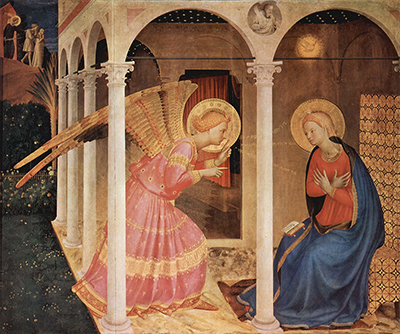
| Annunciation (Cortona) | generally placed in the 1430s; exact dating remains debated | Tempera on panel Catalogue. |
| Annunciation (Prado) | 1425–26 | Tempera on poplar panel Catalogue. |
| Annunciation (San Marco upper corridor) | commonly c. 1442 | Fresco Catalogue. |
| Annunciation with Saint Peter Martyr | About 1439–43 | Fresco on plaster. Catalogue. |
| Annunciatory Angel | 1450–55, Detroit catalogue | Gold leaf and tempera on wood panel. Catalogue. |
| Armadio degli Argenti (Silver Treasury) | principally c. 1450–52 | Tempera on panel Catalogue. |
| Arrest of Christ (Armadio degli Argenti) | About 1450–53 | Tempera and gilding on wood Catalogue. |
| Ascension (Armadio degli Argenti) | About 1450–53 | Tempera and gilding on wood Catalogue. |
| Baptism of Christ (Armadio, Alesso Baldovinetti) | About 1452–53 | Tempera and gilding on wood Catalogue. |
| Beheading of Saints Cosmas and Damian (San Marco Altarpiece) | About 1438–42 | Painted panel Catalogue. |
| Betrayal of Christ (Armadio degli Argenti) | About 1450–53 | Tempera and gilding on wood Catalogue. |
| Blessed Dominican, Possibly Jordan of Saxony (San Marco Altarpiece) | About 1438–42 | Painted panel Catalogue. |
| Blessed Vincent Ferrer (San Marco Altarpiece) | About 1438–42 | Painted panel Catalogue. |
| Burial of Saints Cosmas and Damian (San Marco Altarpiece) | About 1438–42 | Painted panel Catalogue. |
| Bust of a Cleric and a Group of Figures (recto and verso) | 15th century | Pen and ink on paper Catalogue. |
| Christ among the Doctors (Armadio degli Argenti) | About 1450–53 | Tempera and gilding on wood Catalogue. |
| Christ before Caiaphas (Armadio degli Argenti) | About 1450–53 | Tempera and gilding on wood Catalogue. |
| Christ Glorified in the Court of Heaven | About 1423–24 | Egg tempera on wood, probably poplar, with gold and silver leaf Catalogue. |
| Christ Seated in Judgment | 1447 | Fresco and gilding on plaster. Catalogue. |
| Christ Stripped of His Garments (Armadio degli Argenti) | About 1450–53 | Tempera and gilding on wood Catalogue. |
| Christ Washes the Apostles’ Feet (Armadio degli Argenti) | About 1450–53 | Tempera and gilding on wood Catalogue. |
| Circumcision of Christ (Armadio degli Argenti) | About 1450–53 | Tempera and gilding on wood. Catalogue. |
| Communion of the Apostles (Armadio degli Argenti) | About 1450–53 | Tempera and gilding on wood Catalogue. |
| Coronation of the Virgin (Armadio degli Argenti) | About 1450–53 | Tempera and gilding on wood Catalogue. |
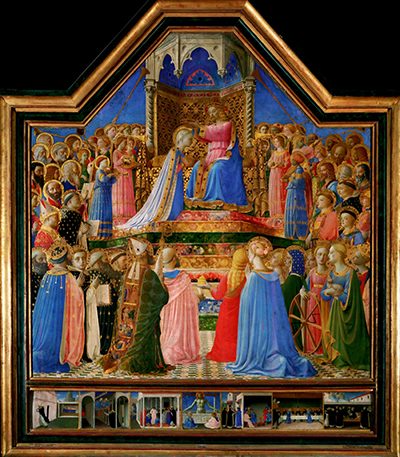
| Coronation of the Virgin (Louvre) | Louvre: second quarter of the fifteenth century, 1425–50; often dated more narrowly c. 1434–35 | Tempera and gold on panel Catalogue. |
| Coronation of the Virgin (Uffizi) | 1431–35 | Tempera on wood, gold ground Catalogue. |
| Cortona Triptych | About 1437 | Tempera and gold on panel. Catalogue. |
| Crucifixion (Armadio degli Argenti) | About 1450–53 | Tempera and gilding on wood Catalogue. |
| Crucifixion and Saints | 1441–42 | Fresco Catalogue. |
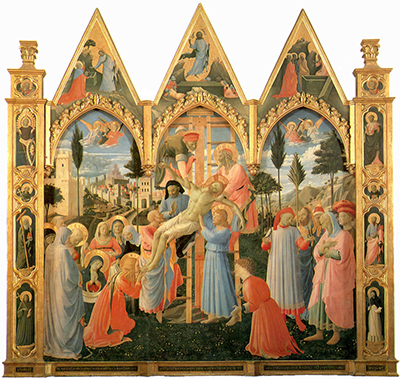
| Deposition from the Cross / Santa Trinita Deposition | commissioned 1429–32; completed by Angelico within this period | Tempera on panel Catalogue. |
| Descent into Limbo (Armadio degli Argenti) | About 1450–53 | Tempera and gilding on wood Catalogue. |
| Entombment of Christ (San Marco Altarpiece) | About 1438–42 | Painted panel Catalogue. |
| Entry into Jerusalem (Armadio degli Argenti) | About 1450–53 | Tempera and gilding on wood Catalogue. |
| Expulsion and the Stoning of Saint Stephen | 1448–49, Vatican Museums | Fresco. Catalogue. |
| Fiesole San Domenico Altarpiece | early 1420s; predella about 1423–24 | Tempera on panel Catalogue. |
| Flagellation (Armadio degli Argenti) | About 1450–53 | Tempera and gilding on wood Catalogue. |
| Flight into Egypt | About 1450–53 | Tempera and gilding on wood. Catalogue. |
| Guidalotti Polyptych | c. 1447–49 | Tempera and oil on panel Catalogue. |
| Healing of Palladia and Saint Damian Accepting Her Gift (San Marco Altarpiece) | About 1438–42 | Painted panel Catalogue. |
| Holy Pilgrim, Possibly Saint Roch (San Marco Altarpiece) | About 1438–42 | Painted panel Catalogue. |
| Holy Women at the Tomb (Armadio degli Argenti) | About 1450–53 | Tempera and gilding on wood Catalogue. |
| Judas Receives Payment (Armadio degli Argenti) | About 1450–53 | Tempera and gilding on wood Catalogue. |
| Lamentation over Christ (Armadio degli Argenti) | About 1450–53 | Tempera and gilding on wood Catalogue. |
| Lamentation over the Dead Christ (Croce al Tempio Lamentation) | 1436–41, Zeri catalogue | Tempera and gilding on wood panel. Catalogue. |
| Last Judgement (Armadio degli Argenti) | About 1450–53 | Tempera and gilding on wood Catalogue. |
| Last Judgement (San Marco) | c. 1425–28 | Tempera and gold on panel Catalogue. |
| Last Supper (Armadio degli Argenti) | About 1450–53 | Tempera and gilding on wood Catalogue. |
| Lex Amoris (Armadio degli Argenti) | About 1450–53 | Tempera and gilding on wood Catalogue. |
| Madonna and Child with Saint Dominic and Saint Thomas Aquinas | About 1430, Hermitage catalogue | Detached fresco. Catalogue. |
| Madonna and Child with Saints | About 1411–13 | Tempera on wood panel, with a gold ground. Catalogue. |
| Madonna of Humility | About 1425, Thyssen catalogue | Tempera and gold on wood. Catalogue. |
| Madonna of the Star | 1431–34, Zeri catalogue | Tempera with oil glazes and gold on wood panel, as catalogued by the Gardner for the 2018 exhibition. Catalogue. |
| Marriage at Cana (Armadio, Alesso Baldovinetti) | About 1452–53 | Tempera and gilding on wood Catalogue. |
| Massacre of the Innocents (Armadio degli Argenti) | About 1450–53 | Tempera and gilding on wood Catalogue. |
| Miracle of the Black Leg (San Marco Altarpiece) | About 1438–42 | Painted panel Catalogue. |
| Mocking of Christ (Armadio degli Argenti) | About 1450–53 | Tempera and gilding on wood Catalogue. |
| Mystic Wheel (The Vision of Ezekiel) | About 1450–52 | Tempera and gilding on wood. Catalogue. |
| Nativity (Armadio degli Argenti) | About 1450–53 | Tempera and gilding on wood. Catalogue. |
| Niccoline Chapel frescoes | principally 1448–50 | Fresco Catalogue. |
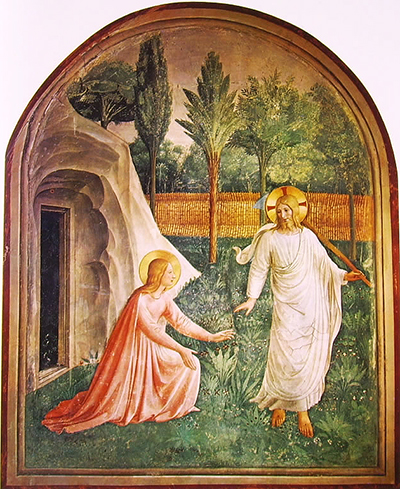
| Noli me Tangere | broadly within Angelico’s San Marco campaign, late 1430s–1440s | Fresco Catalogue. |
| Ordination of Saint Lawrence | 1448 | Fresco. Catalogue. |
| Pentecost (Armadio degli Argenti) | About 1450–53 | Tempera and gilding on wood Catalogue. |
| Presentation of Christ at the Temple (Armadio degli Argenti) | About 1450–53 | Tempera and gilding on wood. Catalogue. |
| Presentation of Jesus at the Temple | Early 1440s | Fresco on plaster. Catalogue. |
| Raising of Lazarus (Armadio degli Argenti) | About 1450–53 | Tempera and gilding on wood Catalogue. |
| Rescue of Saints Cosmas and Damian and Exorcism of Lysias (San Marco Altarpiece) | About 1438–42 | Painted panel Catalogue. |
| Road to Calvary (Armadio degli Argenti) | About 1450–53 | Tempera and gilding on wood Catalogue. |
| Saint Anthony Abbot (San Marco Altarpiece) | About 1438–42 | Painted panel Catalogue. |
| Saint Bernard of Clairvaux or Saint Benedict (San Marco Altarpiece) | About 1438–42 | Painted panel Catalogue. |
| Saint Damian Receives Money from Palladia | About 1425–49 | Tempera and gilding on wood. Catalogue. |
| Saint Francis and a Bishop Saint, Saint John the Baptist and Saint Dominic | Late 1420s, Getty catalogue | Tempera and gold leaf on panel. Catalogue. |
| Saint James the Greater Freeing the Magician Hermogenes | About 1426–29 | Tempera and gold on panel Catalogue. |
| Saint Jerome (San Marco Altarpiece) | About 1438–42 | Painted panel Catalogue. |
| Saint Lawrence Giving Alms | About 1448 | Wall fresco. Catalogue. |
| Saint Lawrence Receiving the Treasures of the Church from Pope Sixtus II | About 1448–49 | Fresco on plaster. Catalogue. |
| Saint Romuald (San Marco Altarpiece) | About 1438–42 | Painted panel Catalogue. |
| Saint Stephen Addressing the Council | 1448–49, Vatican Museums | Fresco. Catalogue. |
| Saint Stephen Preaching | 1448–49, Vatican Museums | Wall fresco. Catalogue. |
| Saint Thomas Aquinas (San Marco Altarpiece) | About 1438–42 | Painted panel Catalogue. |
| Saints Cosmas and Damian and Their Brothers Survive the Stake | Second quarter of the 15th century | Tempera and gilding on wood. Catalogue. |
| Saints Cosmas and Damian at the Stake (San Marco Altarpiece) | About 1438–42 | Painted panel Catalogue. |
| Saints Cosmas and Damian before Lysias (San Marco Altarpiece) | About 1438–42 | Painted panel Catalogue. |
| Saints Cosmas and Damian Rescued by an Angel | Second quarter of the 15th century | Tempera and gilding on wood. Catalogue. |
| Saints Cosmas and Damian with Their Brothers before Proconsul Lysias | Second quarter of the 15th century | Tempera and gilding on wood. Catalogue. |
| San Marco Altarpiece / Pala di San Marco | 1438–43 | Tempera on panel Catalogue. |
| San Pietro Martire Triptych | About 1422–23, Strozzi exhibition | Tempera and gold on panel. Catalogue. |
| Scenes from the Lives of the Desert Fathers (Thebaid) | About 1420, Uffizi catalogue | Tempera on wood. Catalogue. |
| Sixteen Prophets | 1447 | Fresco and gilding on plaster Catalogue. |
| Stoning and Shooting of the Brothers (San Marco Altarpiece) | About 1438–42 | Painted panel Catalogue. |
| Tabernacle of the Linaioli | 1433–35 | Tempera on panel Catalogue. |
| The Attempted Crucifixion and Stoning of Saints Cosmas and Damian | Second quarter of the 15th century | Tempera and gilding on wood. Catalogue. |
| The Crucifixion | About 1420–23, Met catalogue | Tempera on wood, gold ground. Catalogue. |
| The Death and the Assumption of the Virgin | 1424–34 | Tempera with oil glazes and gold on panel Catalogue. |
| The Dominican Blessed (left end) (Fiesole predella) | About 1423–24 | Egg tempera and gold on wood Catalogue. |
| The Dominican Blessed (right end) (Fiesole predella) | About 1423–24 | Egg tempera and gold on wood Catalogue. |
| The Entombment of Christ | About 1450 | Tempera on poplar panel. Catalogue. |
| The Forerunners of Christ with Saints and Martyrs | About 1423–24 | Egg tempera on wood (probably poplar), with gold and silver leaf. Catalogue. |
| The Funeral of Saint Anthony Abbot | About 1426–30 | Tempera on poplar panel. Catalogue. |
| The Martyrdom of Saints Cosmas and Damian | About 1425–49 | Tempera and gilding on wood. Catalogue. |
| The Mocking of Christ / Christ Mocked | within the San Marco dormitory campaign, broadly late 1430s–1440s | Fresco Catalogue. |
| The Nativity | About 1425, Minneapolis catalogue | Tempera on poplar panel. Catalogue. |
| The Nativity in Cell 5 at San Marco | About 1439–43 | Fresco on plaster. Catalogue. |
| The Penitent Saint Jerome | 1419–20 | Tempera on wood panel Catalogue. |
| The Virgin and Child by Fra Angelico (Fogg Museum) | About 1430, Harvard catalogue | Tempera originally on panel, subsequently transferred to Masonite. Catalogue. |
| The Virgin Mary with the Apostles and Other Saints (Fiesole predella) | About 1423–24 | Egg tempera and gold on wood Catalogue. |
| Transfiguration (Armadio, Alesso Baldovinetti) | About 1452–53 | Tempera and gilding on wood Catalogue. |
| Transfiguration (San Marco Cell 6) | within the San Marco dormitory campaign, broadly late 1430s–1440s | Fresco Catalogue. |
| Virgin Mary Annunciate | 1450–55, Detroit catalogue | Gold leaf and tempera on wood panel. Catalogue. |
| Virgin of the Pomegranate | About 1426 | Tempera on panel with gilding Catalogue. |
Frequently Asked Questions
They signal that Sixtus’s arrest is imminent. Their position outside lets the painter show the threat and the entrustment happening at the same time. [4]
Discussion
Use these prompts to look again or share an observation.
Reader Insights
How are hands and vessels arranged to make the transfer visible in a crowded interior?
Follow the treasures into the next episode. Which visual decision distinguishes an entrusted responsibility from its fulfilment?
Join the Conversation
Share a detail or question about Saint Lawrence Receiving the Treasures of the Church from Pope Sixtus II.
References
- Fondazione Federico Zeri, San Lorenzo riceve da papa Sisto II i tesori della chiesa, catalogue no. 11688. View source.
- Vatican Museums, Cappella Niccolina, Italian chapel and commission record. View source.
- Vatican Museums, Niccoline Chapel virtual tour, entrance wall. View source.
- Livia Lupi, Rhetoric of Pictorial Place, University of York, 2016, vol. 1, pp. 158–159 and 174–175, with entries for figs. 139 and 143. View source.
- Museo Benozzo Gozzoli, The Stories of the Deacon Martyr Saints Stephen and Lawrence, sources and workshop participation. View source.
- Anna Luce Sicurezza, Procedure disegnative nella pittura murale di primo Quattrocento, in Materiali e tecniche nella pittura murale del Quattrocento, vol. 2, p. 60, fig. 7. View source.
- Wellcome Collection, Saint Laurence of Rome receives money for alms from Saint Sixtus, Arundel Society engraving, 1865, 2267443i. View source.
- Jacobus de Voragine, The Golden Legend, vol. 4, lives of Sixtus and Lawrence, William Caxton’s English translation, Fordham University. View source.
- Cyprian of Carthage, Letter 80 to Successus, University of Fribourg, German translation. View source.
- Ambrose of Milan, De officiis, II.28, §§136–143, University of Fribourg, German and French translations. View source.
- National Gallery of Art, The Healing of Palladia by Saint Cosmas and Saint Damian, 1952.5.3. View source.
- Gerardo de Simone, Velut alter Apelles. Il decennio romano del Beato Angelico, in Beato Angelico. L’alba del Rinascimento, Rome, 2009, pp. 136–137. View source.
- Vatican Museums, Department of XV–XVI Century Art, research and restoration projects, Niccoline Chapel campaign. View source.
.jpg)
 Fra Angelico.jpg)