


 by Tom Gurney
Tom Gurney BSc (Hons) is an art history expert with over 20 years experience
Published on June 19, 2020 / Updated on November 29, 2026
Email: tomgurney1@gmail.com / Phone: +44 7429 011000
Introduction
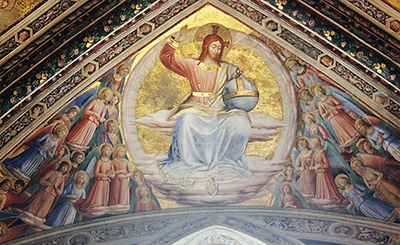
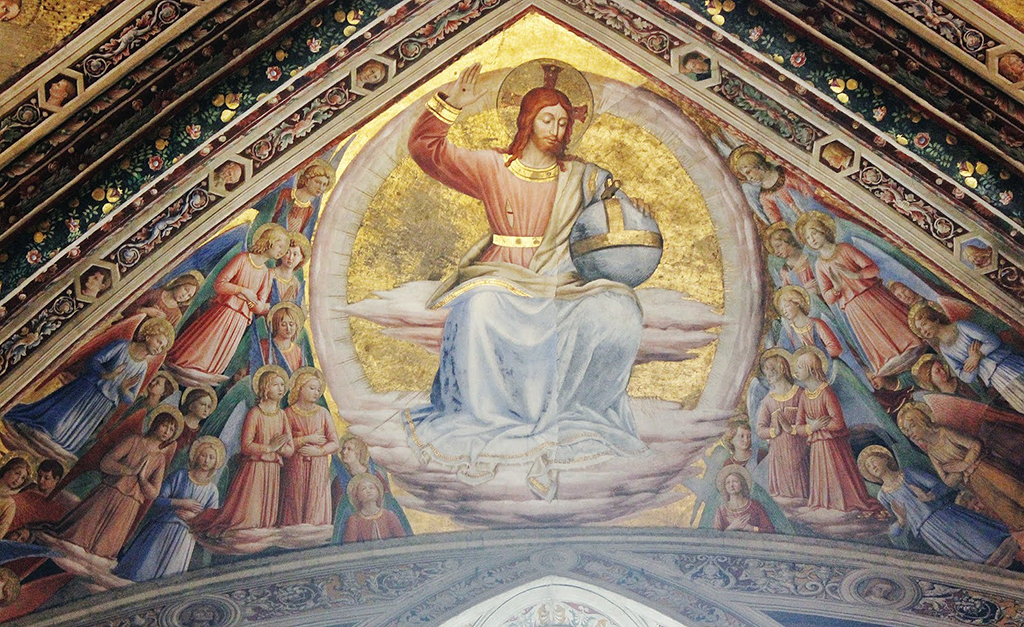
Christ raises his open right hand above the altar of Orvieto Cathedral’s Chapel of San Brizio. A blue globe rests on his left knee, and angels gather on either side of his throne of clouds. Fra Angelico and his assistants painted this compartment of the ribbed vault in 1447. The raised hand gives the scene its subject, the Last Judgement, and the scale of the figure lets the gesture carry all the way to the chapel floor. [1] [2]
At a Glance
- ArtistFra Angelico and assistants. Benozzo Gozzoli is documented on the commission. [1] [3]
- Date1447. [1]
- MediumFresco and gilding on plaster. [1]
- LocationVault above the altar, Chapel of San Brizio, Orvieto Cathedral, Italy. [2] [4]
- Italian title and catalogue numberCristo giudice, 1000066938. [1]
The Judge on a throne of clouds
The image turns on two gestures. Christ’s raised hand opens towards the viewer on the left of the composition, while his other arm steadies the orb on the right. A gold band circles the orb and a cross surmounts it, identifying it as a globus cruciger, an emblem of Christian sovereignty. The cross in Christ’s halo and the smaller cross on the globe belong to the same compact arrangement around his lowered face. The mass of pale-blue drapery below gives his seated body weight. Its broad folds spill over the cloud, whose softer, horizontal bands suggest that the seat can bear him without appearing solid. [1]
The halo marks the head, while the mandorla, an almond-shaped surround, encloses the whole body in radiance. Its pale rim makes a legible boundary where the gold behind Christ meets the wings and clothing of the nearest angels. The Gospel of Matthew describes the Son of Man arriving with his angels and taking his seat to judge the nations. Earlier in Matthew, he comes on clouds and sends angels to gather the elect with a trumpet call. These passages give a context for the throne and for the two angel musicians whom the Italian state catalogue places at the outer corners of the compartment. The cross-bearing orb gives visible form to the authority that Matthew describes. [1] [5] [6]
How the angels fit the vault
The painted field is a vela, one of the curved compartments divided by the vault’s ribs. Its plaster covers tuff masonry, while the ribs are made of travertine. The two banks of angels occupy the space between the mandorla and the sloping borders. Figures near the upper border lean with its slope. Lower down, some stand more upright and others show only their heads and shoulders above companions or clouds. The heads are staggered so that a halo or a turned face remains visible even where several bodies overlap. Pink, blue and green recur across the two groups, with the angles of heads and hands giving individual figures their own attitudes of attention or prayer. [1] [7]
From below, the eye can find the large figure before picking out those exchanges among the smaller ones. The ribs and painted bands lead up to the apex, then the cloud bank sends the eye out again through the angels. Look along the bands and there is a third scale of figure, the little heads set into hexagons among foliage and flowers. These belong to the border design. Their small, regular enclosures help the much larger halo and mandorla stand out. Conservator Carla Bertorello credits Angelico with devising the system of painted ribs and bands that frames the whole vault, including fields completed decades later. [1] [7]
What the 1447 documents tell us
In May 1447 the cathedral authorities discussed hiring Angelico for the summer months, when he could work around his obligations to the pope in Rome. The Opera del Duomo signed the contract on 14 June. A September settlement transcribed by the Orvieto archivist Luigi Fumi names Benozzo di Lese, better known as Benozzo Gozzoli, Giovanni d’Antonio of Florence and Giacomo Poli alongside Fra Giovanni, as Angelico was known. The local painter Pietro di Nicola Baroni joined in July. Another entry records the cost of a lock to secure the painting scaffold, and an August account reimburses Giovanni for a journey to buy materials, including ultramarine, azurite and gilded tin. The September settlement accounts for three and a half months of work. By the end of that campaign the painters had completed the two figural compartments of Christ and the Prophets. [2] [3] [8]
The Museo Benozzo Gozzoli notes that Benozzo earned substantially more than the other assistants, an indication of his standing on the project. The state catalogue records broad agreement among the scholars it surveys that Angelico painted the central Christ. It also records proposals that Benozzo painted some of the angels. The records establish who worked on the commission. They leave the division of the angel groups open, and the condition of the painted surface complicates any attempt to assign individual figures on style alone. [1] [7] [9]
Plaster, powdered charcoal and gold
The seams in the plaster show the order in which the painters worked. Bertorello found that they began at the apex of the decorative bands, then worked downwards through the mandorla and Christ in at least six giornate, or sections of fresh plaster laid for painting. They built the angel groups in similar sequences on either side, preparing separate patches for heads and garments and fitting the joins to edges such as a neckline or the border of a mantle. Bertorello suggests that this arrangement could have allowed painters to work on both sides at once, or someone skilled in faces to hand over to someone painting drapery. [7]
Charcoal dots are still discernible in the folds of Christ’s blue mantle. They came from spolvero, the transfer of a drawing by dusting powder through holes pricked along its outlines. Bertorello found the dots in the central figure, while brush lines in yellow or reddish earth survive on some of the angel wings. She also traced the outer angel on the left down to the waist and found that the tracing, flipped over, almost exactly matched the figure and instrument at the other end. The resemblance suggests that the painters may have reused a template for the silhouettes, leaving room to vary details such as faces and hands. In the surrounding bands, a snapped cord marked out straight lines and perforated patterns helped repeat the floral ornament and hexagons. [7]
The gilding has its own variations. In the halos and mandorla, a slightly raised layer of gilded tin was applied over an oil-based adhesive containing lead white and incised with fine rays. Bertorello suggests that the gold leaf on the wider background was laid over a simple glue size. Gold at the cuffs and necklines brings small points of light into the drapery. Some colours were also applied once the plaster had dried. Bertorello identifies lapis lazuli and azurite in the modelling of Christ’s blue mantle and reports that much of the azurite has been lost. The pale blue visible today gives a partial idea of how the painters articulated the folds. [7] [3]
The cathedral authorities were already concerned about rain damaging the new vault paintings in 1454. In 1665 a fall of plaster took part of the Redeemer and adjacent decoration with it. Salvi Castellucci filled the loss in fresco the following year. Bertorello identifies a separate repair in the angel group to the viewer’s right, involving seven figures, and tentatively dates it to the late eighteenth century. These repairs restored the continuity of the composition across the vault, while changing parts of the surface on which attributions of individual brushwork would have to depend. [7] [3]
From the vault to Signorelli’s walls
The Sixteen Prophets occupy their own compartment in the same bay over the altar. In Christ’s field the angels spread out around one figure. In the Prophets, rows of two and three figures rise into the narrowing vault. From the floor, the ribs hold the two arrangements apart, while the painted ornament makes them part of a continuous ceiling. Work on the ornament continued after Angelico left, but Benozzo’s attempt to take over the commission came to nothing. [7] [9] [10] [4]
The Opera commissioned Luca Signorelli to resume the work in April 1499. He completed the two remaining fields in the altar bay, the Apostles and the Angels with the Instruments of the Passion, using designs by Angelico made available by the cathedral authorities. The existing borders set the size and shape of the scenes, but the two workshops approached the plaster differently. Bertorello counted nineteen patches on the left side of Christ’s compartment and only five or six for a comparable area in the Instruments of the Passion. Signorelli’s painters could cover more of the composition at once. [2] [7] [4]
Signorelli also decorated the other bay and, under a new agreement in April 1500, took on the walls. Crowds, rising bodies and the terror of the damned enter the story in those lower scenes. A viewer can take them in by turning from wall to wall, then look up to the much older figure whose gesture presides over them. [2] [4]
In Angelico’s earlier Florentine panel of the Last Judgement, now at the Museo di San Marco, the open tombs draw the eye into the painted distance between the saved and the damned. At Orvieto that relationship unfolds across the building itself. The judgement has a place overhead, the consequences have room on the walls, and the viewer has to move and look up to bring them together. [2] [11]
Further reading
Explore a catalogue or scholarly study related to this article.
Fra Angelico. Painter, Friar, Mystic. Timothy Verdon. Brepols, 2021.
The survey follows the friar’s religious art into the late commissions. See the publisher’s description.
Fra Angelico artworks directory
Explore documented works and surviving parts of larger ensembles. Catalogue links identify individual records. Attribution and dating can vary across collections and publications. Search the Federico Zeri Photo Archive by artist.
| Name | Date | Medium and sources |
|---|---|---|
| Adoration of the Magi | About 1440–60, NGA catalogue | Painting Catalogue. |
| Adoration of the Magi (Armadio degli Argenti) | About 1450–53 | Tempera and gold on wood. Catalogue. |
| Agony in the Garden (Armadio degli Argenti) | About 1450–53 | Tempera and gilding on wood Catalogue. |
| Annalena Altarpiece / Pala di Annalena | commonly c. 1435 | Tempera on panel Catalogue. |
| Annunciation (Armadio degli Argenti) | About 1450–53 | Tempera and gilding on wood. Catalogue. |
| Annunciation (Cortona) | generally placed in the 1430s; exact dating remains debated | Tempera on panel Catalogue. |
| Annunciation (Prado) | 1425–26 | Tempera on poplar panel Catalogue. |
| Annunciation (San Marco upper corridor) | commonly c. 1442 | Fresco Catalogue. |
| Annunciation with Saint Peter Martyr | About 1439–43 | Fresco on plaster. Catalogue. |
| Annunciatory Angel | 1450–55, Detroit catalogue | Gold leaf and tempera on wood panel. Catalogue. |
| Armadio degli Argenti (Silver Treasury) | principally c. 1450–52 | Tempera on panel Catalogue. |
| Arrest of Christ (Armadio degli Argenti) | About 1450–53 | Tempera and gilding on wood Catalogue. |
| Ascension (Armadio degli Argenti) | About 1450–53 | Tempera and gilding on wood Catalogue. |
| Baptism of Christ (Armadio, Alesso Baldovinetti) | About 1452–53 | Tempera and gilding on wood Catalogue. |
| Beheading of Saints Cosmas and Damian (San Marco Altarpiece) | About 1438–42 | Painted panel Catalogue. |
| Betrayal of Christ (Armadio degli Argenti) | About 1450–53 | Tempera and gilding on wood Catalogue. |
| Blessed Dominican, Possibly Jordan of Saxony (San Marco Altarpiece) | About 1438–42 | Painted panel Catalogue. |
| Blessed Vincent Ferrer (San Marco Altarpiece) | About 1438–42 | Painted panel Catalogue. |
| Burial of Saints Cosmas and Damian (San Marco Altarpiece) | About 1438–42 | Painted panel Catalogue. |
| Bust of a Cleric and a Group of Figures (recto and verso) | 15th century | Pen and ink on paper Catalogue. |
| Christ among the Doctors (Armadio degli Argenti) | About 1450–53 | Tempera and gilding on wood Catalogue. |
| Christ before Caiaphas (Armadio degli Argenti) | About 1450–53 | Tempera and gilding on wood Catalogue. |
| Christ Glorified in the Court of Heaven | About 1423–24 | Egg tempera on wood, probably poplar, with gold and silver leaf Catalogue. |
| Christ Seated in Judgment | 1447 | Fresco and gilding on plaster. Catalogue. |
| Christ Stripped of His Garments (Armadio degli Argenti) | About 1450–53 | Tempera and gilding on wood Catalogue. |
| Christ Washes the Apostles’ Feet (Armadio degli Argenti) | About 1450–53 | Tempera and gilding on wood Catalogue. |
| Circumcision of Christ (Armadio degli Argenti) | About 1450–53 | Tempera and gilding on wood. Catalogue. |
| Communion of the Apostles (Armadio degli Argenti) | About 1450–53 | Tempera and gilding on wood Catalogue. |
| Coronation of the Virgin (Armadio degli Argenti) | About 1450–53 | Tempera and gilding on wood Catalogue. |
| Coronation of the Virgin (Louvre) | Louvre: second quarter of the fifteenth century, 1425–50; often dated more narrowly c. 1434–35 | Tempera and gold on panel Catalogue. |
| Coronation of the Virgin (Uffizi) | 1431–35 | Tempera on wood, gold ground Catalogue. |
| Cortona Triptych | About 1437 | Tempera and gold on panel. Catalogue. |
| Crucifixion (Armadio degli Argenti) | About 1450–53 | Tempera and gilding on wood Catalogue. |
| Crucifixion and Saints | 1441–42 | Fresco Catalogue. |
| Deposition from the Cross / Santa Trinita Deposition | commissioned 1429–32; completed by Angelico within this period | Tempera on panel Catalogue. |
| Descent into Limbo (Armadio degli Argenti) | About 1450–53 | Tempera and gilding on wood Catalogue. |
| Entombment of Christ (San Marco Altarpiece) | About 1438–42 | Painted panel Catalogue. |
| Entry into Jerusalem (Armadio degli Argenti) | About 1450–53 | Tempera and gilding on wood Catalogue. |
| Expulsion and the Stoning of Saint Stephen | 1448–49, Vatican Museums | Fresco. Catalogue. |
| Fiesole San Domenico Altarpiece | early 1420s; predella about 1423–24 | Tempera on panel Catalogue. |
| Flagellation (Armadio degli Argenti) | About 1450–53 | Tempera and gilding on wood Catalogue. |
| Flight into Egypt | About 1450–53 | Tempera and gilding on wood. Catalogue. |
| Guidalotti Polyptych | c. 1447–49 | Tempera and oil on panel Catalogue. |
| Healing of Palladia and Saint Damian Accepting Her Gift (San Marco Altarpiece) | About 1438–42 | Painted panel Catalogue. |
| Holy Pilgrim, Possibly Saint Roch (San Marco Altarpiece) | About 1438–42 | Painted panel Catalogue. |
| Holy Women at the Tomb (Armadio degli Argenti) | About 1450–53 | Tempera and gilding on wood Catalogue. |
| Judas Receives Payment (Armadio degli Argenti) | About 1450–53 | Tempera and gilding on wood Catalogue. |
| Lamentation over Christ (Armadio degli Argenti) | About 1450–53 | Tempera and gilding on wood Catalogue. |
| Lamentation over the Dead Christ (Croce al Tempio Lamentation) | 1436–41, Zeri catalogue | Tempera and gilding on wood panel. Catalogue. |
| Last Judgement (Armadio degli Argenti) | About 1450–53 | Tempera and gilding on wood Catalogue. |
| Last Judgement (San Marco) | c. 1425–28 | Tempera and gold on panel Catalogue. |
| Last Supper (Armadio degli Argenti) | About 1450–53 | Tempera and gilding on wood Catalogue. |
| Lex Amoris (Armadio degli Argenti) | About 1450–53 | Tempera and gilding on wood Catalogue. |
| Madonna and Child with Saint Dominic and Saint Thomas Aquinas | About 1430, Hermitage catalogue | Detached fresco. Catalogue. |
| Madonna and Child with Saints | About 1411–13 | Tempera on wood panel, with a gold ground. Catalogue. |
| Madonna of Humility | About 1425, Thyssen catalogue | Tempera and gold on wood. Catalogue. |
| Madonna of the Star | 1431–34, Zeri catalogue | Tempera with oil glazes and gold on wood panel, as catalogued by the Gardner for the 2018 exhibition. Catalogue. |
| Marriage at Cana (Armadio, Alesso Baldovinetti) | About 1452–53 | Tempera and gilding on wood Catalogue. |
| Massacre of the Innocents (Armadio degli Argenti) | About 1450–53 | Tempera and gilding on wood Catalogue. |
| Miracle of the Black Leg (San Marco Altarpiece) | About 1438–42 | Painted panel Catalogue. |
| Mocking of Christ (Armadio degli Argenti) | About 1450–53 | Tempera and gilding on wood Catalogue. |
| Mystic Wheel (The Vision of Ezekiel) | About 1450–52 | Tempera and gilding on wood. Catalogue. |
| Nativity (Armadio degli Argenti) | About 1450–53 | Tempera and gilding on wood. Catalogue. |
| Niccoline Chapel frescoes | principally 1448–50 | Fresco Catalogue. |
| Noli me Tangere | broadly within Angelico’s San Marco campaign, late 1430s–1440s | Fresco Catalogue. |
| Ordination of Saint Lawrence | 1448 | Fresco. Catalogue. |
| Pentecost (Armadio degli Argenti) | About 1450–53 | Tempera and gilding on wood Catalogue. |
| Presentation of Christ at the Temple (Armadio degli Argenti) | About 1450–53 | Tempera and gilding on wood. Catalogue. |
| Presentation of Jesus at the Temple | Early 1440s | Fresco on plaster. Catalogue. |
| Raising of Lazarus (Armadio degli Argenti) | About 1450–53 | Tempera and gilding on wood Catalogue. |
| Rescue of Saints Cosmas and Damian and Exorcism of Lysias (San Marco Altarpiece) | About 1438–42 | Painted panel Catalogue. |
| Road to Calvary (Armadio degli Argenti) | About 1450–53 | Tempera and gilding on wood Catalogue. |
| Saint Anthony Abbot (San Marco Altarpiece) | About 1438–42 | Painted panel Catalogue. |
| Saint Bernard of Clairvaux or Saint Benedict (San Marco Altarpiece) | About 1438–42 | Painted panel Catalogue. |
| Saint Damian Receives Money from Palladia | About 1425–49 | Tempera and gilding on wood. Catalogue. |
| Saint Francis and a Bishop Saint, Saint John the Baptist and Saint Dominic | Late 1420s, Getty catalogue | Tempera and gold leaf on panel. Catalogue. |
| Saint James the Greater Freeing the Magician Hermogenes | About 1426–29 | Tempera and gold on panel Catalogue. |
| Saint Jerome (San Marco Altarpiece) | About 1438–42 | Painted panel Catalogue. |
| Saint Lawrence Giving Alms | About 1448 | Wall fresco. Catalogue. |
| Saint Lawrence Receiving the Treasures of the Church from Pope Sixtus II | About 1448–49 | Fresco on plaster. Catalogue. |
| Saint Romuald (San Marco Altarpiece) | About 1438–42 | Painted panel Catalogue. |
| Saint Stephen Addressing the Council | 1448–49, Vatican Museums | Fresco. Catalogue. |
| Saint Stephen Preaching | 1448–49, Vatican Museums | Wall fresco. Catalogue. |
| Saint Thomas Aquinas (San Marco Altarpiece) | About 1438–42 | Painted panel Catalogue. |
| Saints Cosmas and Damian and Their Brothers Survive the Stake | Second quarter of the 15th century | Tempera and gilding on wood. Catalogue. |
| Saints Cosmas and Damian at the Stake (San Marco Altarpiece) | About 1438–42 | Painted panel Catalogue. |
| Saints Cosmas and Damian before Lysias (San Marco Altarpiece) | About 1438–42 | Painted panel Catalogue. |
| Saints Cosmas and Damian Rescued by an Angel | Second quarter of the 15th century | Tempera and gilding on wood. Catalogue. |
| Saints Cosmas and Damian with Their Brothers before Proconsul Lysias | Second quarter of the 15th century | Tempera and gilding on wood. Catalogue. |
| San Marco Altarpiece / Pala di San Marco | 1438–43 | Tempera on panel Catalogue. |
| San Pietro Martire Triptych | About 1422–23, Strozzi exhibition | Tempera and gold on panel. Catalogue. |
| Scenes from the Lives of the Desert Fathers (Thebaid) | About 1420, Uffizi catalogue | Tempera on wood. Catalogue. |
| Sixteen Prophets | 1447 | Fresco and gilding on plaster Catalogue. |
| Stoning and Shooting of the Brothers (San Marco Altarpiece) | About 1438–42 | Painted panel Catalogue. |
| Tabernacle of the Linaioli | 1433–35 | Tempera on panel Catalogue. |
| The Attempted Crucifixion and Stoning of Saints Cosmas and Damian | Second quarter of the 15th century | Tempera and gilding on wood. Catalogue. |
| The Crucifixion | About 1420–23, Met catalogue | Tempera on wood, gold ground. Catalogue. |
| The Death and the Assumption of the Virgin | 1424–34 | Tempera with oil glazes and gold on panel Catalogue. |
| The Dominican Blessed (left end) (Fiesole predella) | About 1423–24 | Egg tempera and gold on wood Catalogue. |
| The Dominican Blessed (right end) (Fiesole predella) | About 1423–24 | Egg tempera and gold on wood Catalogue. |
| The Entombment of Christ | About 1450 | Tempera on poplar panel. Catalogue. |
| The Forerunners of Christ with Saints and Martyrs | About 1423–24 | Egg tempera on wood (probably poplar), with gold and silver leaf. Catalogue. |
| The Funeral of Saint Anthony Abbot | About 1426–30 | Tempera on poplar panel. Catalogue. |
| The Martyrdom of Saints Cosmas and Damian | About 1425–49 | Tempera and gilding on wood. Catalogue. |
| The Mocking of Christ / Christ Mocked | within the San Marco dormitory campaign, broadly late 1430s–1440s | Fresco Catalogue. |
| The Nativity | About 1425, Minneapolis catalogue | Tempera on poplar panel. Catalogue. |
| The Nativity in Cell 5 at San Marco | About 1439–43 | Fresco on plaster. Catalogue. |
| The Penitent Saint Jerome | 1419–20 | Tempera on wood panel Catalogue. |
| The Virgin and Child by Fra Angelico (Fogg Museum) | About 1430, Harvard catalogue | Tempera originally on panel, subsequently transferred to Masonite. Catalogue. |
| The Virgin Mary with the Apostles and Other Saints (Fiesole predella) | About 1423–24 | Egg tempera and gold on wood Catalogue. |
| Transfiguration (Armadio, Alesso Baldovinetti) | About 1452–53 | Tempera and gilding on wood Catalogue. |
| Transfiguration (San Marco Cell 6) | within the San Marco dormitory campaign, broadly late 1430s–1440s | Fresco Catalogue. |
| Virgin Mary Annunciate | 1450–55, Detroit catalogue | Gold leaf and tempera on wood panel. Catalogue. |
| Virgin of the Pomegranate | About 1426 | Tempera on panel with gilding Catalogue. |
Frequently Asked Questions
He holds a globus cruciger, a globe surmounted by a cross. It rests on his left knee and signifies his authority as Judge. [1]
Discussion
Use these prompts to look again or share an observation.
Reader Insights
How does the curved vault divide the judge, his gesture and the company of angels into parts you can follow from below?
Compare the surviving 1447 work with the neighbouring frescoes completed later. Which change in posture or scale is clearest?
Join the Conversation
Share a detail or question about Christ Seated in Judgment.
References
- Ministero della Cultura, Cristo giudice, Catalogo generale dei Beni Culturali, record 1000066938. View source.
- Opera del Duomo di Orvieto, The Chapel of San Brizio. View source.
- Luigi Fumi, Il duomo di Orvieto e i suoi restauri (1891), pp. 393–395, documents LXXI–LXXVII and LXXXIV. View source.
- Carla Bertorello, Struttura e funzionamento di un cantiere pittorico. Beato Angelico e Luca Signorelli nel Duomo di Orvieto, in Materiali e tecniche nella pittura murale del Quattrocento, vol. I, pp. 93–105. View source.
- Gospel of Matthew, 25:31–46, New American Bible, Revised Edition. View source.
- Gospel of Matthew, 24:30–31, New American Bible, Revised Edition. View source.
- Carla Bertorello, studies of painting technique and historical repairs in Giusi Testa, ed., La Cappella Nova, including the sections on Angelico’s plaster, drawing and gilding and Gli interventi antichi e i moderni restauri alle pitture. View source.
- Magnolia Scudieri, Guido di Pietro, detto il Beato Angelico, Dizionario Biografico degli Italiani, vol. 61 (2004). View source.
- Museo Benozzo Gozzoli, In Rome and Orvieto (1447–1449). View source.
- Ministero della Cultura, Profeti, Catalogo generale dei Beni Culturali, record 1000150542. View source.
- Direzione regionale Musei nazionali Toscana, Il Giudizio Universale del Beato Angelico torna al Museo di San Marco, account of the painting and its display. View source.
.jpg)



 Fra Angelico.jpg)


