


 by Tom Gurney
Tom Gurney BSc (Hons) is an art history expert with over 20 years experience
Published on June 19, 2020 / Updated on November 29, 2026
Email: tomgurney1@gmail.com / Phone: +44 7429 011000
Introduction
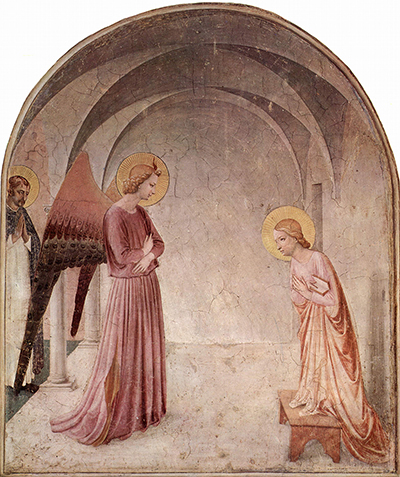
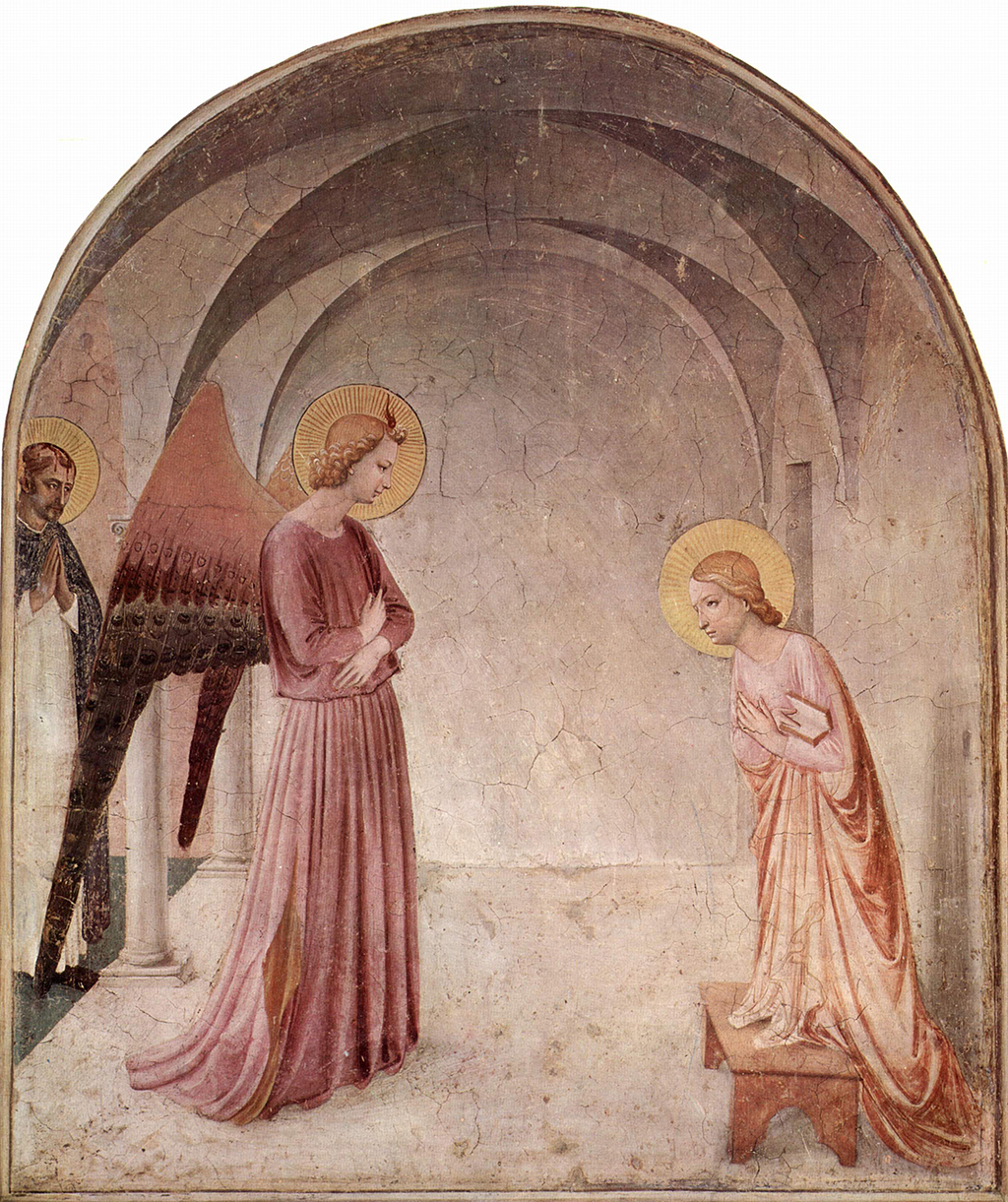
A Dominican friar stands just inside the left edge of Fra Angelico’s Annunciation with Saint Peter Martyr. Gabriel’s wing nearly hides him. He presses his palms together and looks towards Mary, who leans towards Gabriel with a book held to her chest. The fresco still occupies the wall of Cell 3 in the former Dominican convent of San Marco in Florence. Italy’s national catalogue dates it to about 1439–43. The saint’s quiet place at the edge offers a clue to how a friar might have looked at the painting in this small room. [1] [2]
At a Glance
- ArtistFra Angelico (Fra Giovanni da Fiesole). [1]
- DateAbout 1439–43, according to Italy’s national catalogue. [1]
- MediumFresco on plaster. [1]
- LocationCell 3, Museo di San Marco, Florence, Italy. [2]
- SubjectThe Annunciation to Mary, with Saint Peter Martyr as a witness. [1] [2]
Gabriel and Mary beneath the vault
In Luke’s Gospel, the angel Gabriel comes to Mary in Nazareth with news that she will bear a son named Jesus. Mary asks how this can happen. Gabriel tells her that the Holy Spirit will come upon her and that the power of the Most High will overshadow her. She then accepts what he has said. The fresco gives this exchange the scale of an encounter between two people in a small room. Gabriel stands at the left in a deep rose robe. Mary, at the right in paler pink, kneels forward on a low wooden bench, clasping a small book against her chest. [3] [4] [5]
The two figures draw their arms inwards. Gabriel holds one hand high against his chest and lowers the other across his robe. Mary brings one hand across her breast while the other holds the book against her robe. Their gestures rhyme, though their bodies move differently. Gabriel stands almost straight, his head inclined a little. Mary bows her shoulders and extends her neck to look up at him. Atsushi Ito, who compared Mary’s gaze across several Annunciations by Angelico, draws attention to the difference in height between the standing angel and the kneeling Virgin in Cell 3. You can follow that diagonal from Gabriel’s face down to Mary’s, then across the same interval again from one pair of crossed arms to the other. [4] [5]
Above them the vault recedes in broad, alternating bands of light and shade. The arches seem to gather over the narrow space in which the figures meet. Behind Mary, a slim rectangular opening interrupts the right wall. At the other side, a pale column partly screens the saint. Its base and the small strip of green flooring give his feet somewhere to stand, while Gabriel’s long robe spreads onto the pale floor in front. Angelico gives just enough information to orient the viewer. The kneeler, the book and the plain plaster bring Mary’s room close to the world of the friar who would have lived with the fresco. [4] [5]
A witness from the Dominican order
Peter Martyr, also called Peter of Verona, was killed in 1252. His black cloak over a white habit identifies him with the Dominican order, and the thin streaks of blood on his head refer to his murder. Luke’s account describes the meeting between Gabriel and Mary. Angelico’s addition of a much later figure puts a member of the order inside that biblical scene. Peter is close enough to see the exchange, but his position behind the column and wing keeps him at the margin. His upright stance and joined hands give him a distinct role alongside the angel who speaks and the woman who responds. [3] [4] [5] [6]
Michelozzo began rebuilding San Marco in 1437 with Medici backing. Marco Mozzo describes a dormitory arranged to house clerics, novices and lay brothers. The cells of the clerics’ corridor show episodes from the life of Christ, while many cells for novices use variations on Saint Dominic praying before the cross. The rooms served for private prayer as well as lodging. William Hood related the gestures in the cell frescoes to Dominican traditions of bodily prayer. Ito reads Peter’s standing posture and gaze towards Mary as a model for the friar meditating on this particular scene. The position of the saint makes that reading easy to test with your eyes. You first follow his attention to Mary, then hers to Gabriel. [5] [7] [8]
In a convent, a small devotional image could be kept in a cell. Mozzo points out how unusual it was to give the wall itself over to a large sacred scene. In Cell 3, the figures extend from the floor of the painted room to well above its furnishings. The enclosing arch gives the effect of an opening in the wall, but the pigments belong to its plaster surface. Italy’s national catalogue names Angelico as the painter. Mozzo cautions that responsibility for the wider San Marco scheme is harder to reconstruct, given the role of collaborators and the scant documentation for the individual decisions behind it. [1] [4] [7]
The light in the room and the light in the fresco
Begin with the back wall between Gabriel and Mary. It catches a broad area of pale light, and the shading changes where the curved vault meets the wall. Mary’s shadow is appreciably darker against the right side than the faint trace Ito identifies at Gabriel’s feet. There is also a real window to the right of the fresco. Koichi Toyama observed that the painted shadows suggest light coming from the left, the opposite side. Standing in the cell, you can compare the daylight falling across the real wall and the shadows Angelico gave the room he painted on it. Louise Boisclair, writing about her experience of seeing the fresco in place, describes the brightness of the painted white and the daylight from the cell window as contributing to the force of the encounter. [4] [5] [9] [10]
Taro Sugiyama considers that broad white area in relation to the Incarnation, the Christian belief that God took human flesh in Christ. In his reading, the light’s indistinct edges matter. It can seem like ordinary brightness on a wall while also drawing attention to something the figures themselves cannot show. Ito approaches the painting through the shadow instead, linking it to Gabriel’s words about the power of the Most High overshadowing Mary. The two readings start with visible things, the pale expanse and the darker area beside Mary. They ask how an image can suggest the unseen event taking place as the angel speaks. [3] [5] [11]
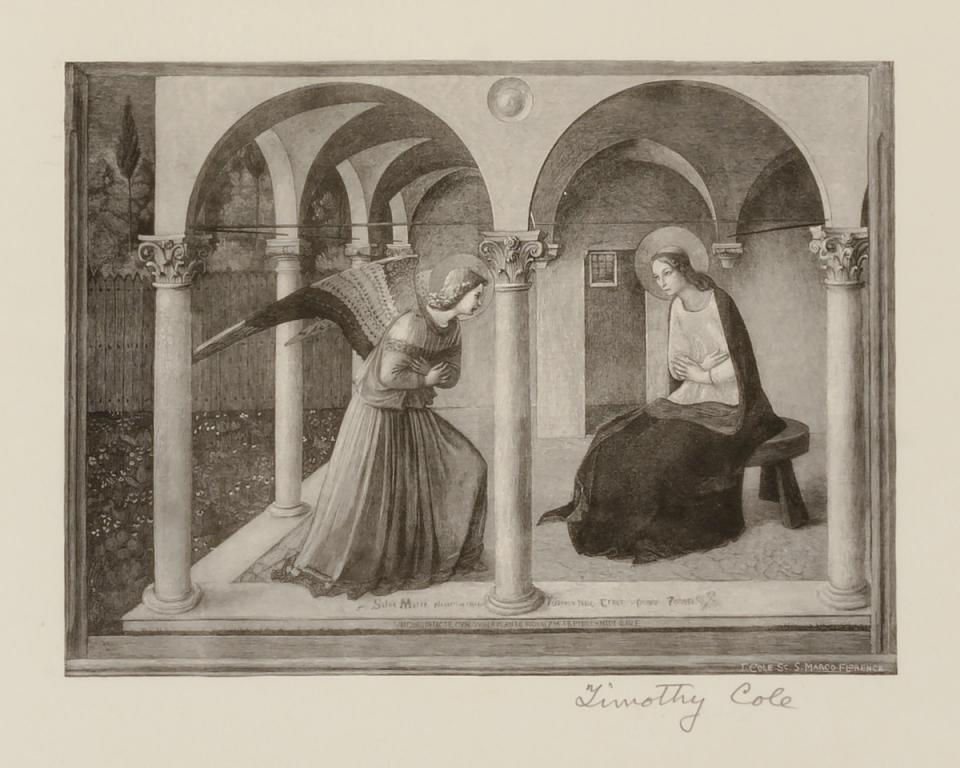
Timothy Cole’s wood engraving after the San Marco corridor Annunciation. Smithsonian American Art Museum 1974.39.24. Smithsonian American Art Museum. Image source. CC0 / Public domain. Proportional web resize.
How Cell 3 differs from Angelico’s other Annunciations
The north-corridor Annunciation is the broad fresco at the top of the stairs at San Marco. There Gabriel bends to greet a seated Mary beneath a colonnade. The fenced garden opens to the left and there is no Dominican witness. A friar could come upon that image while moving through a shared passage. To see the painting with Peter Martyr, he had to enter a particular cell. The change in setting also changes how the scene directs our attention. In the corridor, the eye can follow the arcade out towards the garden. In the cell, Peter’s gaze draws it straight back into the encounter beneath the vault. [4] [5] [7] [12]
The Prado Annunciation is an altarpiece painted on wood for San Domenico in Fiesole. At the left, Adam and Eve are driven out of a densely planted Paradise. At the right, the angel approaches Mary under a painted portico. The pairing invites a worshipper to read the promise of Christ’s birth against the loss of Eden. The Cortona Annunciation also brings the Expulsion into view, and gives Gabriel’s and Mary’s words a visible presence in gold lettering. The scene in Cell 3 leaves the stretch of wall between them clear for the play of light. There is still an exchange to follow, but the lowered head, the lifted eyes and the hands gathered against the chest carry it. [4] [5] [12] [13] [14]
The San Pietro Martire Triptych, also in the Museo di San Marco, brings the Annunciation and Peter Martyr together in a different way. The saint stands beside the enthroned Virgin and Child in the main tier, with scenes of his preaching and death above. Gabriel and Mary appear in separate roundels high in the altarpiece. The triptych gives each subject a place in the frame. In Cell 3, they occupy the same painted room. [4] [7]
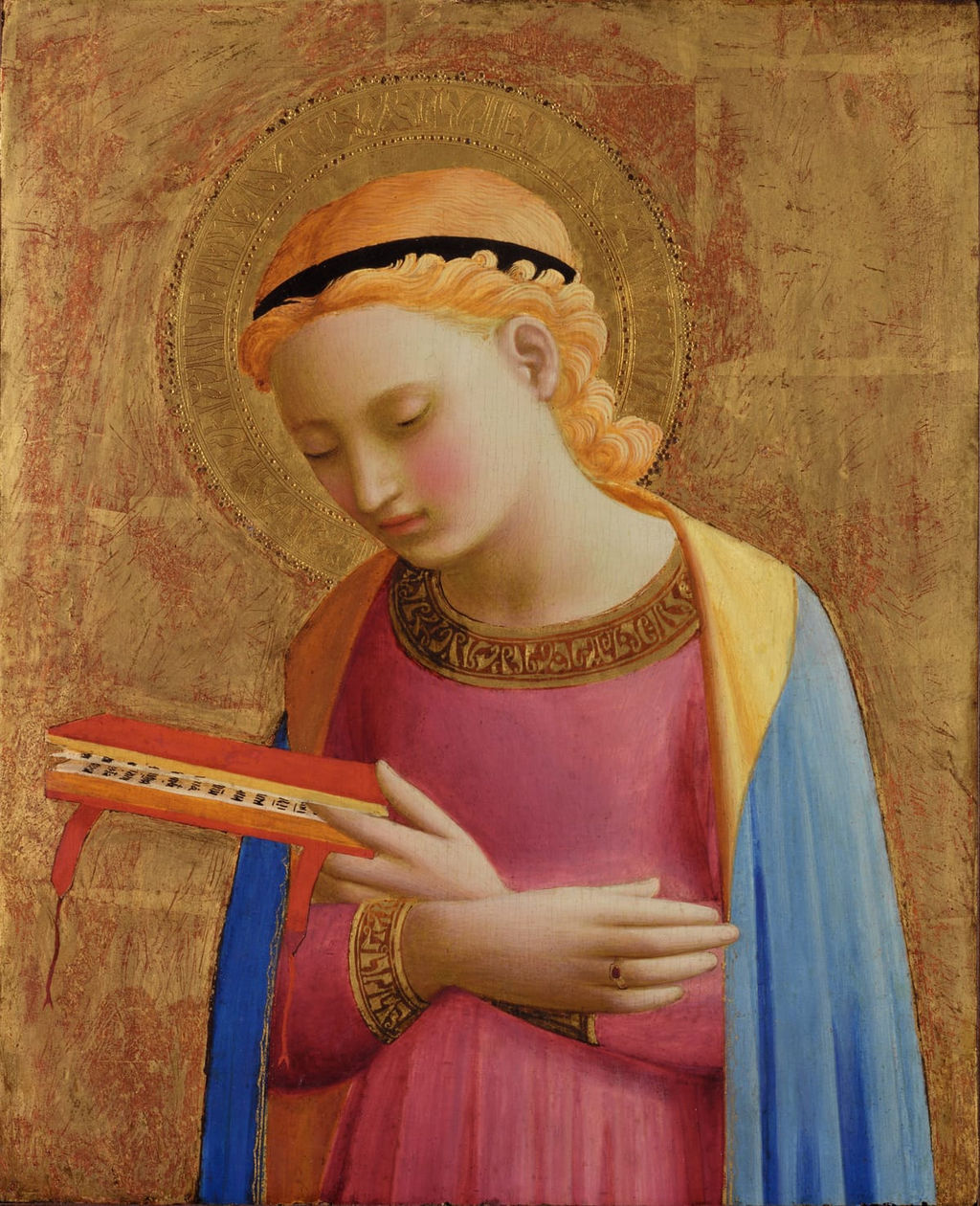
The Detroit Virgin Annunciate, 77.1.2. Her book and hands occupy the space just beneath her lowered head. Image source. Public domain. Proportional web resize.
Further reading
Explore a catalogue or scholarly study related to this article.
Fra Angelico. Painter, Friar, Mystic. Timothy Verdon. Brepols, 2021.
Verdon discusses the San Marco frescoes alongside the devotional traditions behind Angelico’s Annunciations. See the publisher’s description.
Fra Angelico artworks directory
Explore documented works and surviving parts of larger ensembles. Catalogue links identify individual records. Attribution and dating can vary across collections and publications. Search the Federico Zeri Photo Archive by artist.
| Name | Date | Medium and sources |
|---|---|---|
| Adoration of the Magi | About 1440–60, NGA catalogue | Painting Catalogue. |
| Adoration of the Magi (Armadio degli Argenti) | About 1450–53 | Tempera and gold on wood. Catalogue. |
| Agony in the Garden (Armadio degli Argenti) | About 1450–53 | Tempera and gilding on wood Catalogue. |
| Annalena Altarpiece / Pala di Annalena | commonly c. 1435 | Tempera on panel Catalogue. |
| Annunciation (Armadio degli Argenti) | About 1450–53 | Tempera and gilding on wood. Catalogue. |
| Annunciation (Cortona) | generally placed in the 1430s; exact dating remains debated | Tempera on panel Catalogue. |
| Annunciation (Prado) | 1425–26 | Tempera on poplar panel Catalogue. |
| Annunciation (San Marco upper corridor) | commonly c. 1442 | Fresco Catalogue. |
| Annunciation with Saint Peter Martyr | About 1439–43 | Fresco on plaster. Catalogue. |
| Annunciatory Angel | 1450–55, Detroit catalogue | Gold leaf and tempera on wood panel. Catalogue. |
| Armadio degli Argenti (Silver Treasury) | principally c. 1450–52 | Tempera on panel Catalogue. |
| Arrest of Christ (Armadio degli Argenti) | About 1450–53 | Tempera and gilding on wood Catalogue. |
| Ascension (Armadio degli Argenti) | About 1450–53 | Tempera and gilding on wood Catalogue. |
| Baptism of Christ (Armadio, Alesso Baldovinetti) | About 1452–53 | Tempera and gilding on wood Catalogue. |
| Beheading of Saints Cosmas and Damian (San Marco Altarpiece) | About 1438–42 | Painted panel Catalogue. |
| Betrayal of Christ (Armadio degli Argenti) | About 1450–53 | Tempera and gilding on wood Catalogue. |
| Blessed Dominican, Possibly Jordan of Saxony (San Marco Altarpiece) | About 1438–42 | Painted panel Catalogue. |
| Blessed Vincent Ferrer (San Marco Altarpiece) | About 1438–42 | Painted panel Catalogue. |
| Burial of Saints Cosmas and Damian (San Marco Altarpiece) | About 1438–42 | Painted panel Catalogue. |
| Bust of a Cleric and a Group of Figures (recto and verso) | 15th century | Pen and ink on paper Catalogue. |
| Christ among the Doctors (Armadio degli Argenti) | About 1450–53 | Tempera and gilding on wood Catalogue. |
| Christ before Caiaphas (Armadio degli Argenti) | About 1450–53 | Tempera and gilding on wood Catalogue. |
| Christ Glorified in the Court of Heaven | About 1423–24 | Egg tempera on wood, probably poplar, with gold and silver leaf Catalogue. |
| Christ Seated in Judgment | 1447 | Fresco and gilding on plaster. Catalogue. |
| Christ Stripped of His Garments (Armadio degli Argenti) | About 1450–53 | Tempera and gilding on wood Catalogue. |
| Christ Washes the Apostles’ Feet (Armadio degli Argenti) | About 1450–53 | Tempera and gilding on wood Catalogue. |
| Circumcision of Christ (Armadio degli Argenti) | About 1450–53 | Tempera and gilding on wood. Catalogue. |
| Communion of the Apostles (Armadio degli Argenti) | About 1450–53 | Tempera and gilding on wood Catalogue. |
| Coronation of the Virgin (Armadio degli Argenti) | About 1450–53 | Tempera and gilding on wood Catalogue. |
| Coronation of the Virgin (Louvre) | Louvre: second quarter of the fifteenth century, 1425–50; often dated more narrowly c. 1434–35 | Tempera and gold on panel Catalogue. |
| Coronation of the Virgin (Uffizi) | 1431–35 | Tempera on wood, gold ground Catalogue. |
| Cortona Triptych | About 1437 | Tempera and gold on panel. Catalogue. |
| Crucifixion (Armadio degli Argenti) | About 1450–53 | Tempera and gilding on wood Catalogue. |
| Crucifixion and Saints | 1441–42 | Fresco Catalogue. |
| Deposition from the Cross / Santa Trinita Deposition | commissioned 1429–32; completed by Angelico within this period | Tempera on panel Catalogue. |
| Descent into Limbo (Armadio degli Argenti) | About 1450–53 | Tempera and gilding on wood Catalogue. |
| Entombment of Christ (San Marco Altarpiece) | About 1438–42 | Painted panel Catalogue. |
| Entry into Jerusalem (Armadio degli Argenti) | About 1450–53 | Tempera and gilding on wood Catalogue. |
| Expulsion and the Stoning of Saint Stephen | 1448–49, Vatican Museums | Fresco. Catalogue. |
| Fiesole San Domenico Altarpiece | early 1420s; predella about 1423–24 | Tempera on panel Catalogue. |
| Flagellation (Armadio degli Argenti) | About 1450–53 | Tempera and gilding on wood Catalogue. |
| Flight into Egypt | About 1450–53 | Tempera and gilding on wood. Catalogue. |
| Guidalotti Polyptych | c. 1447–49 | Tempera and oil on panel Catalogue. |
| Healing of Palladia and Saint Damian Accepting Her Gift (San Marco Altarpiece) | About 1438–42 | Painted panel Catalogue. |
| Holy Pilgrim, Possibly Saint Roch (San Marco Altarpiece) | About 1438–42 | Painted panel Catalogue. |
| Holy Women at the Tomb (Armadio degli Argenti) | About 1450–53 | Tempera and gilding on wood Catalogue. |
| Judas Receives Payment (Armadio degli Argenti) | About 1450–53 | Tempera and gilding on wood Catalogue. |
| Lamentation over Christ (Armadio degli Argenti) | About 1450–53 | Tempera and gilding on wood Catalogue. |
| Lamentation over the Dead Christ (Croce al Tempio Lamentation) | 1436–41, Zeri catalogue | Tempera and gilding on wood panel. Catalogue. |
| Last Judgement (Armadio degli Argenti) | About 1450–53 | Tempera and gilding on wood Catalogue. |
| Last Judgement (San Marco) | c. 1425–28 | Tempera and gold on panel Catalogue. |
| Last Supper (Armadio degli Argenti) | About 1450–53 | Tempera and gilding on wood Catalogue. |
| Lex Amoris (Armadio degli Argenti) | About 1450–53 | Tempera and gilding on wood Catalogue. |
| Madonna and Child with Saint Dominic and Saint Thomas Aquinas | About 1430, Hermitage catalogue | Detached fresco. Catalogue. |
| Madonna and Child with Saints | About 1411–13 | Tempera on wood panel, with a gold ground. Catalogue. |
| Madonna of Humility | About 1425, Thyssen catalogue | Tempera and gold on wood. Catalogue. |
| Madonna of the Star | 1431–34, Zeri catalogue | Tempera with oil glazes and gold on wood panel, as catalogued by the Gardner for the 2018 exhibition. Catalogue. |
| Marriage at Cana (Armadio, Alesso Baldovinetti) | About 1452–53 | Tempera and gilding on wood Catalogue. |
| Massacre of the Innocents (Armadio degli Argenti) | About 1450–53 | Tempera and gilding on wood Catalogue. |
| Miracle of the Black Leg (San Marco Altarpiece) | About 1438–42 | Painted panel Catalogue. |
| Mocking of Christ (Armadio degli Argenti) | About 1450–53 | Tempera and gilding on wood Catalogue. |
| Mystic Wheel (The Vision of Ezekiel) | About 1450–52 | Tempera and gilding on wood. Catalogue. |
| Nativity (Armadio degli Argenti) | About 1450–53 | Tempera and gilding on wood. Catalogue. |
| Niccoline Chapel frescoes | principally 1448–50 | Fresco Catalogue. |
| Noli me Tangere | broadly within Angelico’s San Marco campaign, late 1430s–1440s | Fresco Catalogue. |
| Ordination of Saint Lawrence | 1448 | Fresco. Catalogue. |
| Pentecost (Armadio degli Argenti) | About 1450–53 | Tempera and gilding on wood Catalogue. |
| Presentation of Christ at the Temple (Armadio degli Argenti) | About 1450–53 | Tempera and gilding on wood. Catalogue. |
| Presentation of Jesus at the Temple | Early 1440s | Fresco on plaster. Catalogue. |
| Raising of Lazarus (Armadio degli Argenti) | About 1450–53 | Tempera and gilding on wood Catalogue. |
| Rescue of Saints Cosmas and Damian and Exorcism of Lysias (San Marco Altarpiece) | About 1438–42 | Painted panel Catalogue. |
| Road to Calvary (Armadio degli Argenti) | About 1450–53 | Tempera and gilding on wood Catalogue. |
| Saint Anthony Abbot (San Marco Altarpiece) | About 1438–42 | Painted panel Catalogue. |
| Saint Bernard of Clairvaux or Saint Benedict (San Marco Altarpiece) | About 1438–42 | Painted panel Catalogue. |
| Saint Damian Receives Money from Palladia | About 1425–49 | Tempera and gilding on wood. Catalogue. |
| Saint Francis and a Bishop Saint, Saint John the Baptist and Saint Dominic | Late 1420s, Getty catalogue | Tempera and gold leaf on panel. Catalogue. |
| Saint James the Greater Freeing the Magician Hermogenes | About 1426–29 | Tempera and gold on panel Catalogue. |
| Saint Jerome (San Marco Altarpiece) | About 1438–42 | Painted panel Catalogue. |
| Saint Lawrence Giving Alms | About 1448 | Wall fresco. Catalogue. |
| Saint Lawrence Receiving the Treasures of the Church from Pope Sixtus II | About 1448–49 | Fresco on plaster. Catalogue. |
| Saint Romuald (San Marco Altarpiece) | About 1438–42 | Painted panel Catalogue. |
| Saint Stephen Addressing the Council | 1448–49, Vatican Museums | Fresco. Catalogue. |
| Saint Stephen Preaching | 1448–49, Vatican Museums | Wall fresco. Catalogue. |
| Saint Thomas Aquinas (San Marco Altarpiece) | About 1438–42 | Painted panel Catalogue. |
| Saints Cosmas and Damian and Their Brothers Survive the Stake | Second quarter of the 15th century | Tempera and gilding on wood. Catalogue. |
| Saints Cosmas and Damian at the Stake (San Marco Altarpiece) | About 1438–42 | Painted panel Catalogue. |
| Saints Cosmas and Damian before Lysias (San Marco Altarpiece) | About 1438–42 | Painted panel Catalogue. |
| Saints Cosmas and Damian Rescued by an Angel | Second quarter of the 15th century | Tempera and gilding on wood. Catalogue. |
| Saints Cosmas and Damian with Their Brothers before Proconsul Lysias | Second quarter of the 15th century | Tempera and gilding on wood. Catalogue. |
| San Marco Altarpiece / Pala di San Marco | 1438–43 | Tempera on panel Catalogue. |
| San Pietro Martire Triptych | About 1422–23, Strozzi exhibition | Tempera and gold on panel. Catalogue. |
| Scenes from the Lives of the Desert Fathers (Thebaid) | About 1420, Uffizi catalogue | Tempera on wood. Catalogue. |
| Sixteen Prophets | 1447 | Fresco and gilding on plaster Catalogue. |
| Stoning and Shooting of the Brothers (San Marco Altarpiece) | About 1438–42 | Painted panel Catalogue. |
| Tabernacle of the Linaioli | 1433–35 | Tempera on panel Catalogue. |
| The Attempted Crucifixion and Stoning of Saints Cosmas and Damian | Second quarter of the 15th century | Tempera and gilding on wood. Catalogue. |
| The Crucifixion | About 1420–23, Met catalogue | Tempera on wood, gold ground. Catalogue. |
| The Death and the Assumption of the Virgin | 1424–34 | Tempera with oil glazes and gold on panel Catalogue. |
| The Dominican Blessed (left end) (Fiesole predella) | About 1423–24 | Egg tempera and gold on wood Catalogue. |
| The Dominican Blessed (right end) (Fiesole predella) | About 1423–24 | Egg tempera and gold on wood Catalogue. |
| The Entombment of Christ | About 1450 | Tempera on poplar panel. Catalogue. |
| The Forerunners of Christ with Saints and Martyrs | About 1423–24 | Egg tempera on wood (probably poplar), with gold and silver leaf. Catalogue. |
| The Funeral of Saint Anthony Abbot | About 1426–30 | Tempera on poplar panel. Catalogue. |
| The Martyrdom of Saints Cosmas and Damian | About 1425–49 | Tempera and gilding on wood. Catalogue. |
| The Mocking of Christ / Christ Mocked | within the San Marco dormitory campaign, broadly late 1430s–1440s | Fresco Catalogue. |
| The Nativity | About 1425, Minneapolis catalogue | Tempera on poplar panel. Catalogue. |
| The Nativity in Cell 5 at San Marco | About 1439–43 | Fresco on plaster. Catalogue. |
| The Penitent Saint Jerome | 1419–20 | Tempera on wood panel Catalogue. |
| The Virgin and Child by Fra Angelico (Fogg Museum) | About 1430, Harvard catalogue | Tempera originally on panel, subsequently transferred to Masonite. Catalogue. |
| The Virgin Mary with the Apostles and Other Saints (Fiesole predella) | About 1423–24 | Egg tempera and gold on wood Catalogue. |
| Transfiguration (Armadio, Alesso Baldovinetti) | About 1452–53 | Tempera and gilding on wood Catalogue. |
| Transfiguration (San Marco Cell 6) | within the San Marco dormitory campaign, broadly late 1430s–1440s | Fresco Catalogue. |
| Virgin Mary Annunciate | 1450–55, Detroit catalogue | Gold leaf and tempera on wood panel. Catalogue. |
| Virgin of the Pomegranate | About 1426 | Tempera on panel with gilding Catalogue. |
Frequently Asked Questions
Discussion
Use these prompts to look again or share an observation.
Reader Insights
Trace the arch and column before looking at Gabriel and Mary. Where has the painter left space between them?
What does Peter Martyr’s position let you notice about the encounter he watches from the margin?
Join the Conversation
Share a detail or question about Annunciation with Saint Peter Martyr.
References
- Catalogo Generale dei Beni Culturali, Annunciazione, San Pietro Martire, national catalogue no. 0900283055 (in Italian). View source.
- Istituto Nazionale di Studi sul Rinascimento, Annunciazione, presente San Pietro martire, photographic archive record (in Italian). View source.
- Gospel of Luke, 1:26–38, New American Bible, Revised Edition. View source.
- Miguel Hermoso Cuesta, photograph of the Cell 3 fresco in situ, 25 July 2015. View source.
- Atsushi Ito, “L’Annunciazione di Fra Angelico nel convento di San Marco a Firenze: Lo sguardo della Vergine Maria e la luce dello Spirito Santo”, Yamano Aesthetic Archives 28–29 (2022), pp. 15–33, especially pp. 18, 24–27 and figs. 6, 33–34 (in Japanese). View source.
- Order of Preachers, Peter of Verona, Priest and Martyr, Dominican saints. View source.
- Marco Mozzo, “The Frescoes in the Convent of San Marco”, in Fondazione Palazzo Strozzi and Museo di San Marco, Fra Angelico (2025), exhibition press kit, PDF pp. 21–22, with “The Dormitory and the Cells”, PDF pp. 18–19, and checklist item 25 on PDF p. 13. View source.
- William Hood, “Saint Dominic’s Manners of Praying: Gestures in Fra Angelico’s Cell Frescoes at S. Marco”, The Art Bulletin 68, no. 2 (1986), pp. 195–206. View source.
- Koichi Toyama, “Note on Fra Angelico’s Rendering of Light and Shadow”, CARLS Series of Advanced Study of Logic and Sensibility 2 (2008), pp. 331–40, especially p. 339 and fig. 11. View source.
- Louise Boisclair, “L’Annonciation de la cellule trois de Fra Angelico: aura et interprétation in situ”, Actes Sémiotiques 114 (2011), especially sections 2 and 3 (in French). View source.
- Taro Sugiyama, “Incarnation and Light in Fra Angelico’s Cell Annunciation at San Marco”, Japanese Society for Aesthetics, 73rd Annual Meeting, report published 2023, pp. 73–82 (in Japanese). View source.
- Museo di San Marco, “Beato Angelico fa TESTO”, 2023, illustrated comparison of the Annunciations at the Prado, Cortona and the north corridor at San Marco (in Italian). View source.
- Museo Nacional del Prado, The Prado Museum Presents the Restored The Annunciation by Fra Angelico, 2019 conservation press release. View source.
- Serena Nocentini, ed., Guida al Museo diocesano di Cortona (2012), entry 13, pp. 50–51 (in Italian). View source.
.jpg)



 Fra Angelico.jpg)


