 by Tom Gurney
Tom Gurney BSc (Hons) is an art history expert with over 20 years experience
Published on June 19, 2020 / Updated on November 29, 2026
Email: tomgurney1@gmail.com / Phone: +44 7429 011000
Introduction
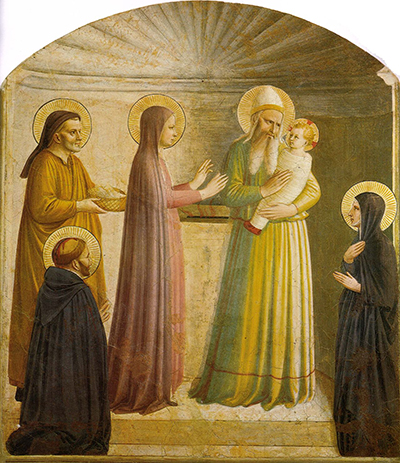
Simeon steadies the swaddled Jesus with one hand and supports him with the other. The child turns his face towards the old man, whose golden halo nearly touches his own. Mary reaches towards them from the other side of the altar, her hands still open now that Simeon is holding the child. The distance between her fingers and his arms is one of the smallest intervals in the fresco, yet almost everything in the picture leads back to it. Fra Angelico painted this encounter for a Dominican friar’s room at San Marco in Florence. It remains on the wall of cell 10. [1] [2] [3]
At a Glance
- ArtistFra Angelico (Fra Giovanni da Fiesole), with some assistance according to Italy’s national catalogue. [1]
- DateEarly 1440s, approximately. [1] [2]
- MediumFresco on plaster. [1]
- Dimensions183 cm high, as recorded in the national catalogue. [1]
- LocationCell 10, Museo di San Marco, Florence, Italy. [1] [2]
Across the altar
The altar stands just behind the exchange, its pale front visible between the robes. A short dark edge marks the top, where small red flames catch the eye below Mary’s hands. Her rose sleeve projects from a long mauve mantle, which falls almost straight to the floor. Simeon’s robe opens out into long folds of green and yellow. The strong downward lines of the two costumes make the subtler diagonals above them stand out, from Mary’s rising forearms to the tilt of the infant in Simeon’s embrace. His arms describe a secure hold. His face inclines towards the child, bringing the meeting into view through a turn of the head as much as through the transfer from one pair of hands to another. [1] [3]
Joseph stands behind Mary with the birds in a woven basket. The basket is almost level with her elbow, close enough to the altar for the eye to connect the offering with the flames, but still held back from the exchange. In Luke’s Gospel, the family travels to Jerusalem to present the firstborn son to God and to make the offering associated with purification under the law of Moses. Luke specifies a pair of turtledoves or two young pigeons, the alternative allowed for a family unable to offer a lamb. The birds are therefore easy to overlook in the fresco and essential to recognising the family’s purpose in the Temple. Joseph’s steady grip on the basket makes a quiet counterpart to Simeon’s hold on Jesus. [1] [3] [4]
In Luke, Simeon has been promised that he will see the Messiah before he dies. He takes the child in his arms and blesses God, speaking of salvation as a light for the nations and glory for Israel. He also tells Mary that her son will meet opposition and that a sword will pierce her own soul. The picture leaves Simeon’s precise words to the viewer’s recollection of Luke. Held together in the story, recognition and forewarning can both inform the way we see Mary’s open hands and Simeon’s concentrated gaze. Luke goes on to describe the prophetess Anna giving thanks and speaking about Jesus to those awaiting Jerusalem’s redemption. Her appearance in the Gospel matters when we turn to the woman on the fresco’s right. [1] [3] [4]
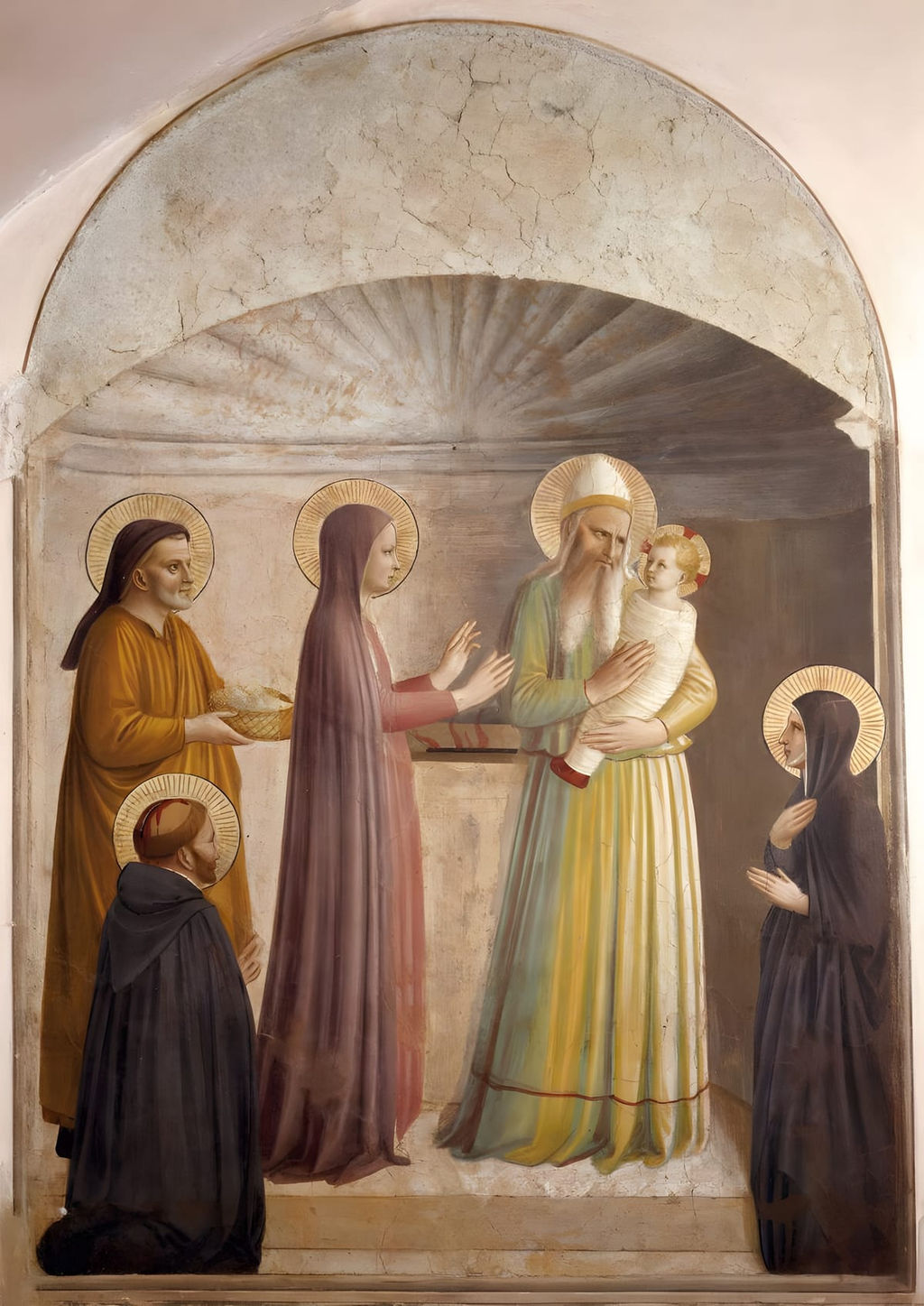
Presentation in the Temple in Cell 10, San Marco. Observe how the witnesses occupy the edges of the arched scene. Image source. Public domain. Proportional web resize.
Peter Martyr and the woman in black
The man low on the left is Saint Peter Martyr, also known as Peter of Verona. Look inside the halo for the red wound across his scalp, a reminder of the attack in which the Dominican friar was killed in 1252. His kneeling figure overlaps Joseph’s long robe, a simple way of putting the saint near the beholder while the biblical figures stand farther into the room. He looks towards the exchange and his dark mantle has a visual counterpart on the other side. The woman there holds one hand to her chest and opens the other towards the group. The two figures are placed at the edges of the action, where they can show a friar how to direct his own attention. [1] [2] [5]
The Italian catalogue proposes that the woman is Blessed Villana de’ Botti, with a question mark. Villana was a fourteenth-century Florentine laywoman associated with the Dominican Order of Penance. She was buried at Florence’s other great Dominican church, Santa Maria Novella, where a new tomb was commissioned from Bernardo Rossellino in 1451. If the figure is Villana, a friar at San Marco could have recognised a comparatively recent figure from his own city alongside a martyr from the early years of his order. Her presence would bring a laywoman into company with the friar even as their gazes converge on the same event. [1] [6] [7]
The identification has a bearing on how closely the fresco follows Luke. As Eliana Corbari notes, the art historian William Hood first took the figure for Villana and later favoured Anna. Corbari suggests that the two readings can overlap. The woman may be Villana shown in a role akin to Anna’s, as one who recognises what is happening. Her habit connects her to the Dominican setting. She opens one hand towards the child, echoing Mary’s outstretched hands beside the altar. [1] [4] [7]
A painted room inside a friar’s cell
The broad curve above Simeon belongs to the Temple as imagined on the wall. Follow the ribs of the shell towards their meeting point and the space opens into a shallow semicircular recess. The horizontal moulding below the shell crosses the painting just above most of the haloes. Near the floor a step runs across the foreground, leaving Peter below the level on which the main figures stand. Shell, ledge and step make it possible to imagine the space continuing beyond the wall where the friar stood. The figures remain close enough for him to make out such small things as the basket and the set of Mary’s fingers. [1] [3]
For a time the shell and recess were hidden under a later coat of red paint. In his account of the restoration carried out by Dino Dini, the art historian Luciano Bellosi recalled their reappearance during the campaign presented to the public in 1983. The shell survived in fragments. The discovery changed the apparent depth of the fresco, revealing a curved space behind the altar. It also helps explain why an older description may emphasise the figures against red while a view of the fresco today shows a strongly articulated architectural background. [3]
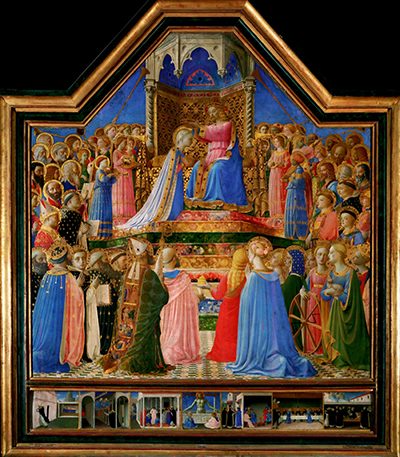
San Marco’s painted rooms date from the rebuilding of the convent under Michelozzo, supported by the Medici. Marco Mozzo places most of the upper-floor frescoes around 1441–43. The national catalogue’s assessment of cell 10 is more specific about authorship than about a single year. It regards this fresco as substantially by Angelico himself, with some contribution from assistants. Neighbouring cell 9 has the Coronation of the Virgin. There the saints are grouped beneath Mary and Christ, and the eye is drawn upwards from their devotion to the crowning. In cell 10 the witnesses look across a shallow floor towards a child held at a person’s height. Both rooms make the example of the figures below important to someone contemplating the scene, a use of gesture that Akari Kitamura connects with the meditative purpose of the dormitory frescoes. [1] [3] [8] [9] [10]
The same encounter on the Armadio degli Argenti
Angelico returned to the Presentation in the Temple on the Armadio degli Argenti, a set of painted panels made around 1450–52 for the cupboard that housed offerings at Florence’s Santissima Annunziata. In the panel, columns separate the central exchange from the figures at the sides. Gerardo de Simone connects the floor pattern and tiers of galleries with Florence’s Baptistery. The episode also has painted bands of text, with Malachi’s prophecy of the Lord coming to his Temple above and words drawn from Luke about the family’s visit below. The inscriptions frame the scene as the fulfilment of a prophecy and give it a place within a sequence of images read together. A friar in cell 10 had this single scene before him on the wall. The step and shell defined its limits, and the people at the edges of the picture invited him to look where they looked. [3] [11] [12]
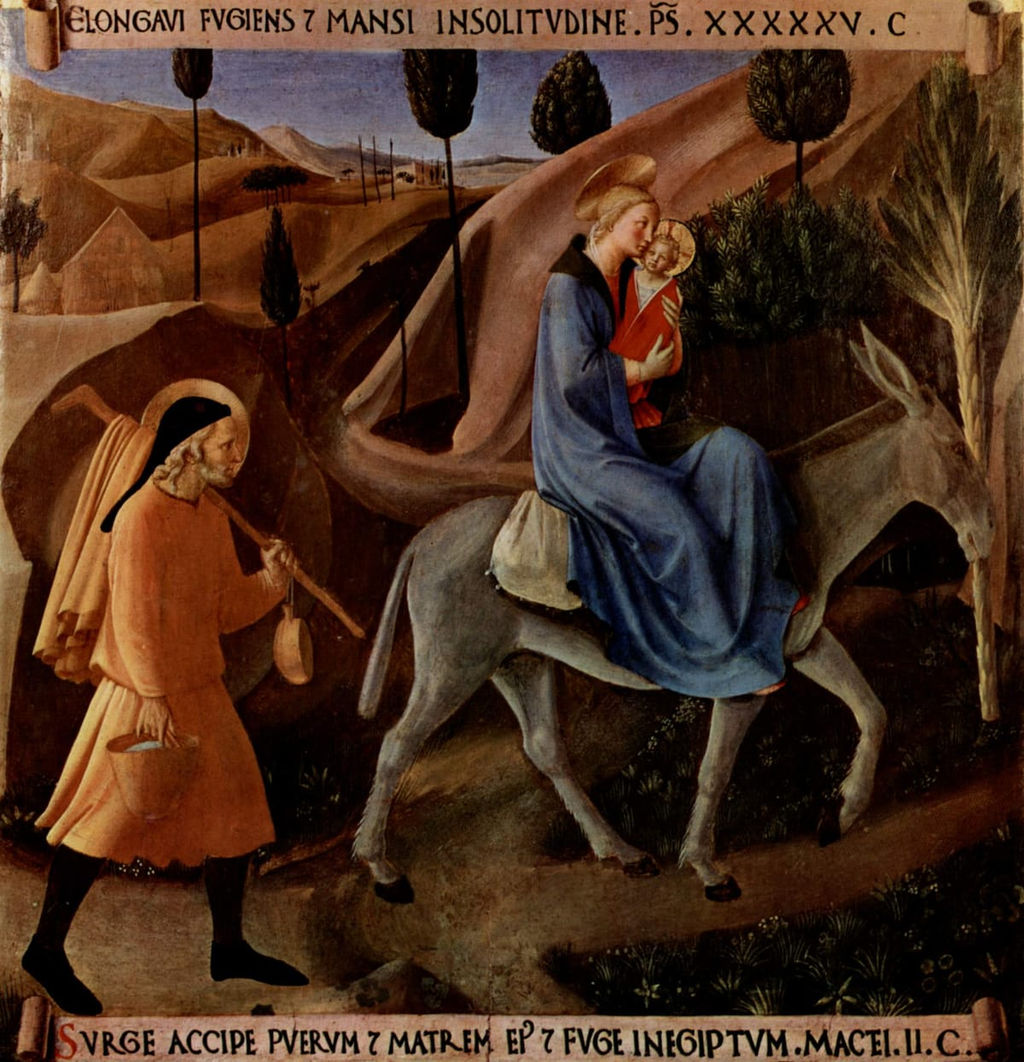
The Flight into Egypt in the Armadio, 0900191187A-7. The inscriptions sit directly above and below the road and its travellers. Image source. Public domain. Proportional web resize.
Fra Angelico artworks directory
Explore documented works and surviving parts of larger ensembles. Catalogue links identify individual records. Attribution and dating can vary across collections and publications. Search the Federico Zeri Photo Archive by artist.
| Name | Date | Medium and sources |
|---|---|---|
| Adoration of the Magi | About 1440–60, NGA catalogue | Painting Catalogue. |
| Adoration of the Magi (Armadio degli Argenti) | About 1450–53 | Tempera and gold on wood. Catalogue. |
| Agony in the Garden (Armadio degli Argenti) | About 1450–53 | Tempera and gilding on wood Catalogue. |
| Annalena Altarpiece / Pala di Annalena | commonly c. 1435 | Tempera on panel Catalogue. |
| Annunciation (Armadio degli Argenti) | About 1450–53 | Tempera and gilding on wood. Catalogue. |
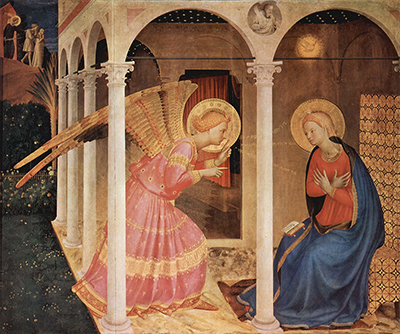
| Annunciation (Cortona) | generally placed in the 1430s; exact dating remains debated | Tempera on panel Catalogue. |
| Annunciation (Prado) | 1425–26 | Tempera on poplar panel Catalogue. |
| Annunciation (San Marco upper corridor) | commonly c. 1442 | Fresco Catalogue. |
| Annunciation with Saint Peter Martyr | About 1439–43 | Fresco on plaster. Catalogue. |
| Annunciatory Angel | 1450–55, Detroit catalogue | Gold leaf and tempera on wood panel. Catalogue. |
| Armadio degli Argenti (Silver Treasury) | principally c. 1450–52 | Tempera on panel Catalogue. |
| Arrest of Christ (Armadio degli Argenti) | About 1450–53 | Tempera and gilding on wood Catalogue. |
| Ascension (Armadio degli Argenti) | About 1450–53 | Tempera and gilding on wood Catalogue. |
| Baptism of Christ (Armadio, Alesso Baldovinetti) | About 1452–53 | Tempera and gilding on wood Catalogue. |
| Beheading of Saints Cosmas and Damian (San Marco Altarpiece) | About 1438–42 | Painted panel Catalogue. |
| Betrayal of Christ (Armadio degli Argenti) | About 1450–53 | Tempera and gilding on wood Catalogue. |
| Blessed Dominican, Possibly Jordan of Saxony (San Marco Altarpiece) | About 1438–42 | Painted panel Catalogue. |
| Blessed Vincent Ferrer (San Marco Altarpiece) | About 1438–42 | Painted panel Catalogue. |
| Burial of Saints Cosmas and Damian (San Marco Altarpiece) | About 1438–42 | Painted panel Catalogue. |
| Bust of a Cleric and a Group of Figures (recto and verso) | 15th century | Pen and ink on paper Catalogue. |
| Christ among the Doctors (Armadio degli Argenti) | About 1450–53 | Tempera and gilding on wood Catalogue. |
| Christ before Caiaphas (Armadio degli Argenti) | About 1450–53 | Tempera and gilding on wood Catalogue. |
| Christ Glorified in the Court of Heaven | About 1423–24 | Egg tempera on wood, probably poplar, with gold and silver leaf Catalogue. |
| Christ Seated in Judgment | 1447 | Fresco and gilding on plaster. Catalogue. |
| Christ Stripped of His Garments (Armadio degli Argenti) | About 1450–53 | Tempera and gilding on wood Catalogue. |
| Christ Washes the Apostles’ Feet (Armadio degli Argenti) | About 1450–53 | Tempera and gilding on wood Catalogue. |
| Circumcision of Christ (Armadio degli Argenti) | About 1450–53 | Tempera and gilding on wood. Catalogue. |
| Communion of the Apostles (Armadio degli Argenti) | About 1450–53 | Tempera and gilding on wood Catalogue. |
| Coronation of the Virgin (Armadio degli Argenti) | About 1450–53 | Tempera and gilding on wood Catalogue. |
| Coronation of the Virgin (Louvre) | Louvre: second quarter of the fifteenth century, 1425–50; often dated more narrowly c. 1434–35 | Tempera and gold on panel Catalogue. |
| Coronation of the Virgin (Uffizi) | 1431–35 | Tempera on wood, gold ground Catalogue. |
| Cortona Triptych | About 1437 | Tempera and gold on panel. Catalogue. |
| Crucifixion (Armadio degli Argenti) | About 1450–53 | Tempera and gilding on wood Catalogue. |
| Crucifixion and Saints | 1441–42 | Fresco Catalogue. |
| Deposition from the Cross / Santa Trinita Deposition | commissioned 1429–32; completed by Angelico within this period | Tempera on panel Catalogue. |
| Descent into Limbo (Armadio degli Argenti) | About 1450–53 | Tempera and gilding on wood Catalogue. |
| Entombment of Christ (San Marco Altarpiece) | About 1438–42 | Painted panel Catalogue. |
| Entry into Jerusalem (Armadio degli Argenti) | About 1450–53 | Tempera and gilding on wood Catalogue. |
| Expulsion and the Stoning of Saint Stephen | 1448–49, Vatican Museums | Fresco. Catalogue. |
| Fiesole San Domenico Altarpiece | early 1420s; predella about 1423–24 | Tempera on panel Catalogue. |
| Flagellation (Armadio degli Argenti) | About 1450–53 | Tempera and gilding on wood Catalogue. |
| Flight into Egypt | About 1450–53 | Tempera and gilding on wood. Catalogue. |
| Guidalotti Polyptych | c. 1447–49 | Tempera and oil on panel Catalogue. |
| Healing of Palladia and Saint Damian Accepting Her Gift (San Marco Altarpiece) | About 1438–42 | Painted panel Catalogue. |
| Holy Pilgrim, Possibly Saint Roch (San Marco Altarpiece) | About 1438–42 | Painted panel Catalogue. |
| Holy Women at the Tomb (Armadio degli Argenti) | About 1450–53 | Tempera and gilding on wood Catalogue. |
| Judas Receives Payment (Armadio degli Argenti) | About 1450–53 | Tempera and gilding on wood Catalogue. |
| Lamentation over Christ (Armadio degli Argenti) | About 1450–53 | Tempera and gilding on wood Catalogue. |
| Lamentation over the Dead Christ (Croce al Tempio Lamentation) | 1436–41, Zeri catalogue | Tempera and gilding on wood panel. Catalogue. |
| Last Judgement (Armadio degli Argenti) | About 1450–53 | Tempera and gilding on wood Catalogue. |
| Last Judgement (San Marco) | c. 1425–28 | Tempera and gold on panel Catalogue. |
| Last Supper (Armadio degli Argenti) | About 1450–53 | Tempera and gilding on wood Catalogue. |
| Lex Amoris (Armadio degli Argenti) | About 1450–53 | Tempera and gilding on wood Catalogue. |
| Madonna and Child with Saint Dominic and Saint Thomas Aquinas | About 1430, Hermitage catalogue | Detached fresco. Catalogue. |
| Madonna and Child with Saints | About 1411–13 | Tempera on wood panel, with a gold ground. Catalogue. |
| Madonna of Humility | About 1425, Thyssen catalogue | Tempera and gold on wood. Catalogue. |
| Madonna of the Star | 1431–34, Zeri catalogue | Tempera with oil glazes and gold on wood panel, as catalogued by the Gardner for the 2018 exhibition. Catalogue. |
| Marriage at Cana (Armadio, Alesso Baldovinetti) | About 1452–53 | Tempera and gilding on wood Catalogue. |
| Massacre of the Innocents (Armadio degli Argenti) | About 1450–53 | Tempera and gilding on wood Catalogue. |
| Miracle of the Black Leg (San Marco Altarpiece) | About 1438–42 | Painted panel Catalogue. |
| Mocking of Christ (Armadio degli Argenti) | About 1450–53 | Tempera and gilding on wood Catalogue. |
| Mystic Wheel (The Vision of Ezekiel) | About 1450–52 | Tempera and gilding on wood. Catalogue. |
| Nativity (Armadio degli Argenti) | About 1450–53 | Tempera and gilding on wood. Catalogue. |
| Niccoline Chapel frescoes | principally 1448–50 | Fresco Catalogue. |
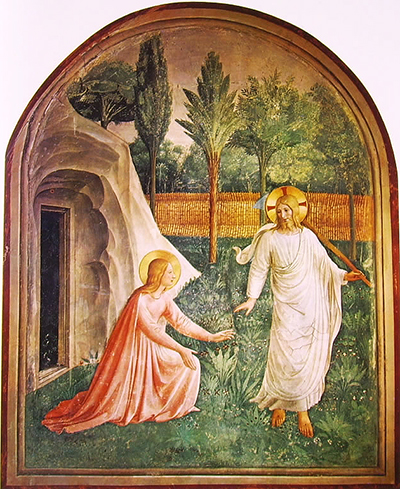
| Noli me Tangere | broadly within Angelico’s San Marco campaign, late 1430s–1440s | Fresco Catalogue. |
| Ordination of Saint Lawrence | 1448 | Fresco. Catalogue. |
| Pentecost (Armadio degli Argenti) | About 1450–53 | Tempera and gilding on wood Catalogue. |
| Presentation of Christ at the Temple (Armadio degli Argenti) | About 1450–53 | Tempera and gilding on wood. Catalogue. |
| Presentation of Jesus at the Temple | Early 1440s | Fresco on plaster. Catalogue. |
| Raising of Lazarus (Armadio degli Argenti) | About 1450–53 | Tempera and gilding on wood Catalogue. |
| Rescue of Saints Cosmas and Damian and Exorcism of Lysias (San Marco Altarpiece) | About 1438–42 | Painted panel Catalogue. |
| Road to Calvary (Armadio degli Argenti) | About 1450–53 | Tempera and gilding on wood Catalogue. |
| Saint Anthony Abbot (San Marco Altarpiece) | About 1438–42 | Painted panel Catalogue. |
| Saint Bernard of Clairvaux or Saint Benedict (San Marco Altarpiece) | About 1438–42 | Painted panel Catalogue. |
| Saint Damian Receives Money from Palladia | About 1425–49 | Tempera and gilding on wood. Catalogue. |
| Saint Francis and a Bishop Saint, Saint John the Baptist and Saint Dominic | Late 1420s, Getty catalogue | Tempera and gold leaf on panel. Catalogue. |
| Saint James the Greater Freeing the Magician Hermogenes | About 1426–29 | Tempera and gold on panel Catalogue. |
| Saint Jerome (San Marco Altarpiece) | About 1438–42 | Painted panel Catalogue. |
| Saint Lawrence Giving Alms | About 1448 | Wall fresco. Catalogue. |
| Saint Lawrence Receiving the Treasures of the Church from Pope Sixtus II | About 1448–49 | Fresco on plaster. Catalogue. |
| Saint Romuald (San Marco Altarpiece) | About 1438–42 | Painted panel Catalogue. |
| Saint Stephen Addressing the Council | 1448–49, Vatican Museums | Fresco. Catalogue. |
| Saint Stephen Preaching | 1448–49, Vatican Museums | Wall fresco. Catalogue. |
| Saint Thomas Aquinas (San Marco Altarpiece) | About 1438–42 | Painted panel Catalogue. |
| Saints Cosmas and Damian and Their Brothers Survive the Stake | Second quarter of the 15th century | Tempera and gilding on wood. Catalogue. |
| Saints Cosmas and Damian at the Stake (San Marco Altarpiece) | About 1438–42 | Painted panel Catalogue. |
| Saints Cosmas and Damian before Lysias (San Marco Altarpiece) | About 1438–42 | Painted panel Catalogue. |
| Saints Cosmas and Damian Rescued by an Angel | Second quarter of the 15th century | Tempera and gilding on wood. Catalogue. |
| Saints Cosmas and Damian with Their Brothers before Proconsul Lysias | Second quarter of the 15th century | Tempera and gilding on wood. Catalogue. |
| San Marco Altarpiece / Pala di San Marco | 1438–43 | Tempera on panel Catalogue. |
| San Pietro Martire Triptych | About 1422–23, Strozzi exhibition | Tempera and gold on panel. Catalogue. |
| Scenes from the Lives of the Desert Fathers (Thebaid) | About 1420, Uffizi catalogue | Tempera on wood. Catalogue. |
| Sixteen Prophets | 1447 | Fresco and gilding on plaster Catalogue. |
| Stoning and Shooting of the Brothers (San Marco Altarpiece) | About 1438–42 | Painted panel Catalogue. |
| Tabernacle of the Linaioli | 1433–35 | Tempera on panel Catalogue. |
| The Attempted Crucifixion and Stoning of Saints Cosmas and Damian | Second quarter of the 15th century | Tempera and gilding on wood. Catalogue. |
| The Crucifixion | About 1420–23, Met catalogue | Tempera on wood, gold ground. Catalogue. |
| The Death and the Assumption of the Virgin | 1424–34 | Tempera with oil glazes and gold on panel Catalogue. |
| The Dominican Blessed (left end) (Fiesole predella) | About 1423–24 | Egg tempera and gold on wood Catalogue. |
| The Dominican Blessed (right end) (Fiesole predella) | About 1423–24 | Egg tempera and gold on wood Catalogue. |
| The Entombment of Christ | About 1450 | Tempera on poplar panel. Catalogue. |
| The Forerunners of Christ with Saints and Martyrs | About 1423–24 | Egg tempera on wood (probably poplar), with gold and silver leaf. Catalogue. |
| The Funeral of Saint Anthony Abbot | About 1426–30 | Tempera on poplar panel. Catalogue. |
| The Martyrdom of Saints Cosmas and Damian | About 1425–49 | Tempera and gilding on wood. Catalogue. |
| The Mocking of Christ / Christ Mocked | within the San Marco dormitory campaign, broadly late 1430s–1440s | Fresco Catalogue. |
| The Nativity | About 1425, Minneapolis catalogue | Tempera on poplar panel. Catalogue. |
| The Nativity in Cell 5 at San Marco | About 1439–43 | Fresco on plaster. Catalogue. |
| The Penitent Saint Jerome | 1419–20 | Tempera on wood panel Catalogue. |
| The Virgin and Child by Fra Angelico (Fogg Museum) | About 1430, Harvard catalogue | Tempera originally on panel, subsequently transferred to Masonite. Catalogue. |
| The Virgin Mary with the Apostles and Other Saints (Fiesole predella) | About 1423–24 | Egg tempera and gold on wood Catalogue. |
| Transfiguration (Armadio, Alesso Baldovinetti) | About 1452–53 | Tempera and gilding on wood Catalogue. |
| Transfiguration (San Marco Cell 6) | within the San Marco dormitory campaign, broadly late 1430s–1440s | Fresco Catalogue. |
| Virgin Mary Annunciate | 1450–55, Detroit catalogue | Gold leaf and tempera on wood panel. Catalogue. |
| Virgin of the Pomegranate | About 1426 | Tempera on panel with gilding Catalogue. |
Frequently Asked Questions
Discussion
Use these prompts to look again or share an observation.
Reader Insights
Where do Simeon’s arms meet the child’s body? Follow the gaze of Mary and the two kneeling witnesses to that point.
Compare the cell fresco with the cabinet scene. What difference do the flanking bays and painted scripture make in the cabinet?
Join the Conversation
Share a detail or question about Presentation of Jesus at the Temple.
References
- Catalogo Generale dei Beni Culturali, Presentazione di Gesù al tempio, San Pietro Martire, Beata Villana (?), 0900290508 (in Italian). View source.
- Istituto Nazionale di Studi sul Rinascimento, Fototeca, Presentazione al Tempio di Gesù, presente San Pietro martire, photograph 1341 (in Italian). View source.
- Museo di San Marco, Luciano Bellosi e il restauro degli affreschi dell’Angelico a San Marco (in Italian, with Bellosi’s 1984 account). View source.
- The New American Bible, Luke 2:22–40 and notes. View source.
- Order of Preachers, Peter of Verona, Priest and Martyr. View source.
- Archivio di Santa Maria Novella, Tomba della beata Villana (in Italian). View source.
- Eliana Corbari, Vernacular Theology: Dominican Sermons and Audience in Late Medieval Italy, University of Bristol, 2008, pp. 208–10. View source.
- Marco Mozzo, The Frescoes in the Convent of San Marco, in the Palazzo Strozzi exhibition materials, 2025. View source.
- Akari Kitamura, Gli affreschi nelle celle del dormitorio del convento di San Marco: devozione e figurazione di Fra Angelico, 1996 (in Japanese, with an Italian abstract). View source.
- Istituto Nazionale di Studi sul Rinascimento, Fototeca, Incoronazione della Vergine e Santi, photograph 6505 (in Italian). View source.
- Museo di San Marco, Beato Angelico “eccellente pittore e miniatore” (in Italian). View source.
- Gerardo de Simone, Un’iconostasi di “figure piccole” del Beato Angelico. L’Armadio degli Argenti per la Santissima Annunziata, fig. 6 and the transcription of the Presentation inscriptions (in Italian). View source.
.jpg)
 Fra Angelico.jpg)